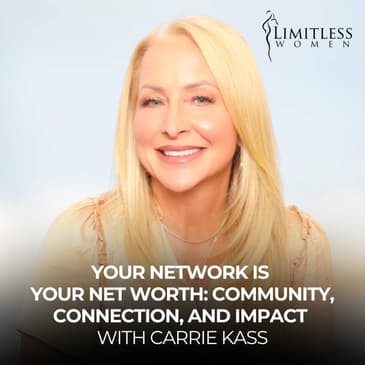
Your next level of success is built through the relationships you’ve already invested in, the courage to be seen, and the boundaries you choose to honor. In this conversation with Carrie Kass, you’re invited into a powerful exploration of community, visibility, and what it truly means to own your voice as a leader. You’ll hear how aligned opportunities emerge organically, how impact-driven business creates deeper fulfillment, and why boundaries are essential for sustainable growth. There’s a grounded reminder that your network, your energy, and your willingness to show up consistently all shape the life and business you’re building.
What You’ll Hear:
- Your relationships are your greatest asset, and the time you invest in people will return to you in ways you can’t predict
- Unexpected transitions can become powerful turning points when you stay open and trust what’s unfolding
- Stepping into visibility and owning your voice is a defining shift in leadership and personal growth
- Saying yes in the right season expands your identity, reveals new opportunities, and clarifies your path
- Building a business around impact creates deeper fulfillment, freedom, and long-term legacy
- Strong boundaries are essential for protecting your energy, making aligned decisions, and sustaining success
Resources:
- Claim Your Friday Gift: Tools to Make Business Easier
- Strategize Your Next Best Step: Schedule a Clarity Conversation with Laura
Featured Guest: Carrie Kass
What happens when you mix 15 years of high-level healthcare operations with a radical belief in human connection? You get today’s guest, Carrie Kass. Carrie is the founder of Impact Flow Advisors and a leading voice on 'Connected Commerce'—the idea that we don't just scale companies, we build resilient communities. From the TEDx stage to her work as a best-selling author, Carrie has dedicated her career to helping leaders move away from the 'lone wolf' mentality and toward radical collaboration. Whether she’s advising C-suite executives or advocating for women in her community and through local organizations, she is on a mission to make business as operationally elite as it is deeply human.
Follow on:
LinkedIn: https://www.linkedin.com/in/carrie-kass-a59114a/
Website: http://carriekass.com/
Meet the Host:
Laura Gisborne, founder of Limitless Women, empowers female entrepreneurs to create businesses that are both profitable and purposeful. With 30+ years of experience, from building multi-million dollar enterprises to guiding small businesses, Laura understands the challenges of scaling beyond solopreneurship. She's a sought-after speaker, business growth strategist, and author of "Stop the Spinning – Move from Surviving to Thriving" and "Limitless Women." Laura's focus is on mindset, authentic leadership, and integrating social impact into business models. The Limitless Women community has raised over $750,000 for charities, reflecting Laura's commitment to "profits with purpose."
Follow Laura
- Website: https://limitlesswomen.com/
- Facebook: https://www.facebook.com/groups/LimitlessWomenGroup/
- Instagram: https://www.instagram.com/limitless.women/
- LinkedIn: https://www.linkedin.com/in/lauragisborne/
***********************************
High Vibe Podcast Network
We are proud to have the Limitless Women Podcast and Laura Gisborne on the High Vibe Podcast Network
Grab your free gift from Laura in our Our High Vibe Gift Vault. Love this show, check out the other shows on the High Vibe Podcast Network. https://highvibepodcastnetwork.com/gifts
Share the Love
✨ If this episode lit something up in you… tag us on Instagram @HighVibeLeaders and let us know your biggest takeaway!
🦋 Don’t forget to rate & review — it helps us reach more conscious rebels like you.
🔊 Listen & Subscribe
🎧 Spotify
Laura, welcome to the Limitless Women podcast. Our mission is to help women business owners like you grow profitable businesses and actualize your opportunities to serve and give to yourself and others. Here's your host, the founder of limitless women. Laura Gisborne
Laura Gisborne:Okay, so today I'm very excited to introduce you to my dear friend Carrie Cass and the thing to know about Carrie is that Carrie has a superpower around building community, around building connection, and somehow she manages to do it all while she looks amazing. So I'm excited for you to meet her, to hear her story, to hear about her work in her philanthropy, and what she's done to create change in effect, not just here locally in Austin, but now through a global scale, through her recent TEDx talk. So thank you for coming today. I'm very excited to have you with us.
Carrie Kass:Thank you. I'm so excited to be here.
Laura Gisborne:Yeah, and tell me a little bit about your just, let's talk about your genetics. Talk that's very exciting. That's this kind of the new iteration that got you out of the world that you thought you were doing with healthcare and physicians and building, you know, a really successful medical practice and in a really innovative way. So when you hear about that whole model that you created and how you built that, because that was really amazing, and at the same time, so you were learning all the lessons, and then this invitation came for you to be on stage.
Carrie Kass:Yes, yes. My background in Austin, specifically is, you know, I was the Director of Operations and Business Development for a large pain and regenerative medicine practice here locally in Austin, I helped start the company back in 2011 and grew it to national recognition up until last year, when they were acquired by private equity. And if you've been through those situations before, you know what can happen. And my role was eliminated, and that was really a catalyst for me to take an inventory of what do I want, what are my goals? Where do I want to be? How do I want to show up in the community? And it happened to be right at that time when the first TEDx in Round Rock was going through their interviews, and I was chosen to do a TEDx talk, and my My topic was called the connected commerce. Why Your network is your net worth? And I was able to tie my personal story in of what had just happened that year to show that your network actually does show up for you. So after people I wasn't very verbal about my departure, but as people in my network started to find out, you know, how word kind of travels, started reaching out to me. And it was crazy to me. Within two weeks, I had probably 2425 letters of recommendation. I had people just reaching out to me, saying, How can I help you? Who can I introduce you to? What do you want to do next? Like, how can I Where can I fit you in? And then I had other practices that I had built relationships with starting to reach out to me, saying, like, Hey, what are you doing? I need help with this. Can you help me with this? Can you do this? I want to introduce you to somebody that I know they might need some help here. And it just kind of started off as this little journey of a couple of contracts that I thought, Oh, hey, I'm just, you know, gonna do these to kind of get by in the interim, get by, yeah, and by September, I had a full schedule of contracts. I had four or five clients at that time, and I said to
Carrie Kass:my husband, I go. I think I just started a consulting business, and that's how it started. I mean, I had no website, no business plan, necessarily. It just very organically happened. And it happened because I had spent so much time building relationships, building community, building that trust factor, showing up for people, and I got back when I needed it. So it was that it's all been a journey in the last year and a half has really been a whirlwind of, right? You're in it now where, yeah,
Laura Gisborne:And, you know, and you're getting ready to have your book published as we're recording this, I mean, so that it's interesting watching you move from behind the scenes, like from behind the camera, to in front of the camera. I mean, that's really the place I remember in my own journey when I moved into this world, right, which we know today is limitless women, and I was being asked to speak and lead, and I was not interested. No, thank you. I'm the person who likes to be in the office and do the numbers and do the systems. You know, I always say Scott's The beauty, and I'm the brains, which is really not super smart, but it's that place of, like, you know, he was front of the house. I was always back at the house, right? So it seemed, you know, just in all the businesses. So it's a shift. It's a shift to come out and be on camera and have your voice out there. And I just, you know, I feel like, what you just. Head around, you know, not really knowing what was going on. So I remember when I moved here in 2022 how you were the first person to raise your hand and come to an event with me, and then really helped me, as I was trying to help the yancies get this E women chapter set up here in Austin. And, you know, I think that's really where our friendship began. And then after my back surgery, when you were launching your own, you know, out there in the world community, and I remember I had just, literally, I was still in my back brace, you know, like coming out, you know, to come and it just, you know, what happens is the showing up. What happens is the giving and the ripple effect of that. And it's almost like, in my experience, like a wave, like you put it out there and it comes back. It doesn't always come back in the way you think it's going to right, like you think you're going to put it out this way, and it comes like, a whole nother way. I feel like that's part of the divine gift, right? I feel like God blesses us in ways that we can't
Laura Gisborne:see. So on that line, did you expect yourself to do a TED Talk? Was that on your radar? Was that something you could see yourself doing? Was a big
Carrie Kass:Not, not at all, you know? I mean, I think historically, I've never been camera shy or afraid of speaking or anything like that. I was just always, and I think I was always putting myself out in the community. I was the voice and the face of a company I was representing, and I had taken part of a multi author book in, gosh, like a little over a year and a half ago, called pieces to purpose, the story of unbreakable women who refused to give up. And it was one of those things I was kind of in this timeframe of life where I was like, just say yes to opportunities. I knew that I was looking for something extra or more, and I didn't know what that was. And so I had this opportunity because I knew Theresa who kind of and Michelle Savage, who were spearheading this book project, and they both asked me individually, like we would love to have you in the book. So I just immediately said yes, not really thinking about what I was getting myself into reading that chapter. I mean, I've always love to write. I never really saw myself as publishing a book or an author, either, and it's funny how that's completely shifted now, but right as I started writing that, it made me dig really deep into some vulnerable places that I haven't visited for a long time. And it was cathartic for me, but it was also scary at the same time, because it was like, Okay, there's, there's not a lot of people in my life that know all of these things, right, some things, and other people knew other things, but there were only a few, like, handful of people that knew everything, yeah. Well, when I hit send on my first draft, I was like, Oh, man. Like, I was like, I'm in it now, so let's just go with it. But you know what? One of it was some beautiful conversations, and my first opportunity to be on a stage, and that was at the unbreakable conference, right, right, yeah, and just sharing my story and through that, ironically, is where Kay first heard me speak. And Kay has her
Carrie Kass:own company called coffee milk media, and she got the rights to TEDx, and so she was the producer of TEDx Round Rock. And so that's how, I don't even know how the dots would have connected otherwise, you know, like Round Rock is, was not my like, backyard necessarily around, yeah, you're not hanging out up there, yeah. And so it just all kind of trickled from there. So it stemmed from one kind of out of my comfort zone, yeses, you know, do something really out of the norm, not in my playbook necessarily. Do something, put something really vulnerable and authentic on paper. And it's funny now, because I look at that chapter and I reread it, and I'm like, Okay, I was being I was being honest at that time, and there's nothing in there that's untrue, but it's also opened these my mind to really dig a little deeper. Yeah, that I'm writing about in this current chapter, I mean, it involves is a little bit of the pieces to purpose, like an evolution of it to current day, and just all the transitions that I've been through and how I found my unacquired voice, you know? And I kind of go through this journey of where my life, my voice was always acquired by a job or by trauma or by being like compliant with what I thought I was supposed to do and who I thought I was supposed to be and how I thought I was supposed to show up in certain places. And through this last year and a half, with all of these things happening, I've found my true voice where I thought I had found it before. Now is like, right? Okay, this is, this is me. Like nobody owns my voice, nobody owns my time, nobody owns my energy anymore. And this is such I feel like I'm in the best place I've ever been, and I'm so happy, and I'm so joyous. Yeah, you know, it's, it's scary, you know, kind of going into the solopreneur world and filing for an S corp. And, you know, because, yeah, we just immersed ourselves and learned a lot in three months. Because my husband also left corporate America at the
Carrie Kass:beginning of 2024 and started his solopreneurship. So we're both just in this together, but it's also brought us closer together. Even though we're doing different things, we're on this path of like, Hey, we're going for it. And we want financial freedom, we want time freedom, we want family freedom,
Laura Gisborne:All the things that we stand for. Yeah, absolutely. And I think, you know, it's interesting about a dozen things, and what you just shared that I want to kind of touch, what bring back to it and awareness. The first is that, you know, when you said, like, the points or the, you know, the dots lining up, I mean, that's really what makes me a believer. Often, when I look back at my life, because I'm turning 60 this year, as we're recording this, and thinking about I could not have connected those dots. You know, there's, there's, for sure, a power greater than I am that was taking care of me when I didn't even know how to take care of myself, right? So there's that the divine blessings, where I think our responsibility or our stewardship is Carrie, that you've done a great job with, is just rising up, right? Just saying, like it was my time to say yes, even if I didn't know what I would say yes to. And then that opens up the doors, right? I mean, we talk about the power of what's going on when you show up in the room, right? There's something. This is our 11th year to do our conference. It's like the people who show up in the room are the people who have a transformed life and business, the people who are sitting on the sidelines, watching, waiting for it to happen. It may be knocking on their door, but they have to meet. You know, you have to rise up to meet it. It's not going to just happen in a vacuum, right? The opportunities may come like they seem like they're out of left field, but I also think, like we talked about a few minutes ago, I think that's that goodwill built up of you serving and giving for so many years. And yeah, I mean, Scott and I are together now, 26 years as we're recording this. And I was married to Peter before this, and Peter and I had several businesses together. So I just would say, like, you know, welcome to the party. So much fun. Yeah, it's so much fun. And it is a little bit of a self induced
Laura Gisborne:insanity, right? The big differentiator is that you don't go to work and then leave it at work like it comes home with you, because you're there, especially if you're especially you're working remote. We're talking about having the home office and what that all feels like, and you have to decide, like, what those healthy boundaries are for you and John. You're going to figure it all out. I mean, you guys are in best time to be but you also get a shared mission with each other, which
Carrie Kass:So true. Yeah. I mean, a lot of our conversations are about like, okay, hey, we have to do this, and we have to remember to do that, and we have to, like, have, you know, our payroll to ourselves, which sounds but you know also we're having, like, strategy conversations. And in while we may be talking work or business, you know, at the dinner table, it's a common bond now, whereas before, like, I was talking about my job and he was talking about his job, and neither one of us really cared about the other one or knew really what was going on. And now we're so immersed and so uplifting of the other what the other one's doing that, you know, when we do have those times together, it's okay to talk about business because it's fun, and it's our future that we're talking about, you're co creating,
Laura Gisborne:Yes, I mean really, and that's, and that's, I would say, one of the secrets to happiness in my relationship. I don't know how it is for other people, but I, you know, I am such a creator, and I move so fast that if I'm not with a partner who actually enjoys that energy, you know, it's like, we're both race horses. And even now, yeah, tired. He's like, yesterday. He's like, I'm going down to the tax office because I'm bored. I'm like, Okay, we'll go to the taxi office. He's like, I just turned 65 I'm pretty sure there's something in that for me. Okay, let me know what happens. But he just, you know, he's not a sitter. I'm not a sitter. It's just not who we are. So, you know,
Carrie Kass:Excited to go to the tax i
Laura Gisborne:He's like, I'm going in after she the dog whatever. I mean, he's just not sitting. So it's interesting, what do you see when you look down the road? And, you know, I have a reason for asking this, because I can feel like you and I, we became instant friends when we met each other. And I'm just curious about what your current vision is when you look down the road for yourself with your business. What do you think is going to happen?
Carrie Kass:I think everything for me is wanting to make an impact. And right now, you know, I have this combination of a consulting business, primarily with kind of in the wellness healthcare industry. I don't like to say healthcare, because I'm working, really in the wellness sector of healthcare, but I don't know if I want, how long I want to do that right, and what I've found in the past couple of years is that I love writing, I love facilitating workshops. I love speaking, you know, I wish I would have discovered that sooner, but again, I think timing is everything, and timing happens when it's supposed to happen, and I would really like to develop that side of. My Business, just so when we do get that financial freedom and that time freedom, I can do that from anywhere, and I can travel these things, and I could travel to make an impact. And you know, we just, we want to be stewards of our money and of our time when it's feasible for sure. So that's our goal. And that's another fun part that we're talking about is like, what, what do we want to do? How do we want to spend our time? You know, obviously, yes, like, selfishly, we want to travel and we want to be able to see things and do things, but in doing that, how are we going to make an impact? Right? And that's big name for both of us. I'm impact flow advisors. John is impact health advisors. So, you know, it's part of our business name, it's just part of our mantra and how we live. Yeah, so I would I see myself consulting for a few years and definitely still helping people. I mean, I like the part I love about this is I get to work with people that I choose to work with, and then I am really passionate about what they're doing or what their mission is. So I don't see me ever fully stepping back from that, but I may not have to necessarily do it full time, but I have a passion for speaking and for being in a room of people and just sharing and any way that I can make an impact, whether
Carrie Kass:I'm on a panel or just being an emcee or just in the room itself, that I just want to show up and have that impact.
Laura Gisborne:You know, we do have such a giver's heart, right? I think that that's one of the pieces that I always loved about you that leads me to what I wanted to ask you next, which is, how did you get into I've heard you tell the story, but I want you to share the story with others, if you don't mind about your work with the American Heart Association, I think it's such a compelling service that you provided for many, many years, and bringing education, bringing awareness, and now it's, you know, I'm seeing even the ripple effect of that work, even though you're off kind of doing other things, you've created a legacy with that work. So tell me a little bit about that story.
Carrie Kass:Yes, thank you. You know, gosh, it was a few years ago, and I had had American Heart Association as kind of the featured nonprofit for an empowerment women's group that I was running. And so from that stemmed a conversation with the person who was running the women of impact campaign with American Heart Association at the time, and she asked me if I would be interested in being nominated, which she was pretty much saying, I'm nominating you, hopefully, women of impact campaign. And at that point, I had no idea what that meant. I didn't know what it was. I was like, Sure, can you tell me a little bit about it? And it's a campaign. It's a national campaign, but run individually in each city that has a local American Heart Association chapter, and it's for women of impact, obviously, who were raising funds just raising awareness about heart disease and women. And I didn't really know about that too much. I knew that I had heart disease in my family, but the timing of it happened to be right, when we had found out that one of my sorority sisters had passed away of a massive coronary event in the middle of the night, and at that point, I think she was 48 or 49 and my age, and it just the way that it rocked our our friendship, you know, our friends and the people that We knew, and just the people in our sorority group, it was sure, it was so impactful and so mind blowing, you know, because Jodi was a picture of health, you know, she she was in great shape. She had a beautiful family. She had three girls in high school, middle school, high school at the time, had been married to her college sweetheart. So, I mean, it was just one of those that you're like, what like, not anything that you would ever expect to happen, especially at that age. And it just started raising conversations, you know. And we started talking like, what can we do? And, you know, I mean, she has her own foundation, but just the opportunity came at that right time where I was
Carrie Kass:like, This is what I'm going to talk about, right I now have something that hit right in my backyard that I can now share. And, I mean, it made me go get a heart scan right away, because I, you know, I'm like, oh, man, maybe we should be looking at this. You don't think you have to really look into it until you're like, you know, older, not necessarily true, because, as I started meeting people and meeting these survivors of heart disease and heart moments in their life, some of the women are in their 30s, right? That are they're experiencing these things, and sure, there's just, you know, nobody's screaming loud enough, and so I just made that my mission during that woman of impact campaign. And then once I came off of my own campaign, I was asked to be the chair of the executive leadership team who kind of oversees and helps nominate people and helps mentor and support all of the. Leaders of impact, teens of impact, and women of impact. So I've seen that for the last year and a half, and I'm going into 2627 I'm bringing on a co chair, because we've really expanded what we're doing. We had, I think, nine or 10 women of impact nominees this year, and we're just hoping to grow that every year. We ended up with eight or nine teens of impact, which is just really, the Austin sector is growing in that, and it's just very hanging to watch, you know, and it's, it's me, to be able to nominate people and just see what they're doing and how other people are passionate in this space. I met so many wonderful women through it, and just heard so many crazy stories, you know? I mean somebody at 30 having a stroke while giving birth. I mean, just imagine that being your life, right? And not all stories are that difficult to hear, or they're not all as big like that, but heart disease is the number one killer of women, and I don't think enough women realize that. And now that I'm kind of getting, you know, taking on clients, I'm working with a longevity company where
Carrie Kass:we're talking about hormone replacement therapy, therapy for women, and how that helps, you know, decrease your risk of heart disease as you're going through perimenopause, and as you're in menopause, so it's all wildly coming together, even in my professional life now
Laura Gisborne:Yeah, there's that divine order, again, very cool. And the kind of the Divine unfolding, and we were talking before about, you know, your business being impact, and that being your desire, and that's really what you know, I feel like you and I share that, and we share a lot of different values in that respect. It's just that, that that's what birthed what has now grown to be the limitless Women movement, right? It was that instead of having one foot in the nonprofit world, of one foot in the private world, I said, Okay, if you're gonna call me to speak, you're gonna call me to get from, you know, behind the desk and in front of the camera, what would be worthy of this message, you know, and pray to be shown. And you probably see my little card back there. It's like, what would what would be worthy to share? And I think it's the whole thing of business as a force for good, being able to use your profits for purpose. I love that you and John both share that. I think that's just another layer of juiciness for the two of you, and this work with American Heart Association is so tied into in so many ways, without even knowing it, all the work you've been doing for, you know, 15 years, or maybe more, around wellness. And, you know, I feel like you're such a beautiful face for your brand, right, for your personal brand, and you're building a business that has its own brand, right? So, so bringing your values into your company's values and integrate that is, is really a great thing. I just see great things happening for you, and I so appreciate you. So appreciate you again. Bringing the awareness to me and to other women of what it is to do, get your heart scan. I just have that don't wait until you think you're ready, and you don't right? You don't want to wait. You don't want to have a wake up call. Correct while awake. What other things do you wish you had known if you were to go back in time, you know, like just for your younger self? And I
Laura Gisborne:the reason I asked this Carrie is that, you know, we are a community that has two lanes now, when we first start with scrolling to live with swimming, we only marketed, we only partnered with women who were over the age of 45 because it was my limiting belief, as the founder of limitless women, that younger women than that were not ready for the conversation of impact, philanthropy, legacy, and maybe back then, when I first started, they worked, right? But the world has changed, and covid changed a lot for a lot of us, and then AI came and changed a lot for a lot of us. So it's fascinating now, how we have these two lanes. And I'm interested you know, hearing you talk about women of impact, teens of impact, because, again, starting younger, right, but as a mature legacy focused woman. Now, in this season of life, you've got to look back to your years as an emerging leader and our world is, how do we use this voice that you have now to get the message out, to make the journey easier for her, right? Like, just do what would you wish you would have known 2030, years ago that you know today?
Unknown:Oh, gosh, probably a lot of things. It's easy to put something out there, but also in being very real with myself and just knowing my own journey. You know, I had a lot of trauma and a lot of just call them bumps in the road in life, and I think all of those piled on top of each other to help shape me to who I am today, and it led me to where I am. And, you know, I had to go through some things and and I think some of the places that I landed, I was a little more comfortable at that point in time, kind of attaching myself to something that was growing and good, and I had a voice. But you. Kind of like being that behind the scenes. But as I started working through all of those things and growing, that shifted, I do feel like the younger generation now is very much more self aware, also engaged, than our generation ever was. I think there's more tools available. You know, it's, don't mean just, like, a self help, talk book or anything like that. They just operate differently. And so I don't know
Laura Gisborne:They've grown up in a different, yeah, they've grown up in an entirely different world, right? I mean, I have to explain to young people that we actually owned businesses before the internet, that we owned businesses before we had cell phones. I mean, like, like, there was a time before cell phones. I'm like, Yeah, we used to actually have a rotary with a core, you know, like, it was attached to a wall. You could even walk around the house. I mean, like, that used to be a telephone, and we were lucky to have that right. Televisions had three channels, so and an antenna on top rabbit ear. So I'm old enough to remember all those things, and I just think about how people often make business and life difficult when they don't realize how much access to resources they actually have.
Unknown:So true. And at the same time too, I feel like how I grew up and in the generation that I grew up in it made me a lot tougher, you know, because you didn't have the easy access to things, you know, like we had to go to a library to research things.
Laura Gisborne:Yes, when I went to law school, like we actually forever. Yeah, for every hour in class, you were expected to work a minimum of two hours studying. And we did, like, you literally, but you had to go find the book and then, like, go to, you know, do the thing. I just had a person who actually asked to rent one of our rentals. It was so interesting because they were, you know, I was laughing, and I'm not trying to be unkind to this person, but they're like, Would you like? They literally rotate, would you like to wash all of your sheets and towels in a detergent that has no scent, because I'm highly sensitive to scent. And I was like, No, I think we're probably not a good match. You know, I happen to be a person who, like, I like the smell of tide, but just to say that, like, if my husband and we're giggling a little bit about this, we wish this person well. And I try to be unkind when I say that, but I think, like, in my generation, I wasn't raised to have that conversation, like there was no that was not the luxury you were having. Like, I don't like the smell of something, you know what? I mean, I don't think that works, but I also think the amount of exposure is a bit of a sensory overload for young people, agreed, right? Agreed they don't. Their nervous system has a hard time regulating often, because there's just so much, so often. So learning those muscles, like, I'm a person who's not on a computer. I'm not on Zoom unless I have something like this going on, you know, people always like, where's the Zoom link? I'm like, book a call. Like, let's have a meeting. I mean, you know, I Yeah, technology is one of those things that's such a great gift. Yes, but we could choose. We can choose, you know, given the, given the paradigm that we get to choose how often we spend our time on it, right?
Unknown:So, right there, yes, even when given the option of an in person versus a Zoom meeting, yeah, I always choose in person. If I can't, you know, I just, I find that more impactful. I feel it's more relational. Not that I mind a Zoom meeting. And obviously, if you're talking to somebody across the city or state or country
Laura Gisborne:Across the world, right, where somebody had a work workout, blessing to be able to do that,
Unknown:Yeah, yeah. So, you know, I think just growing up in our generation, we're more resourceful, you know, because we had to go find things. We had to tap into things. We had to think outside of the box. A to just have fun. As kids, you had to find stuff to do. You know, it wasn't just given to you, and it did make us tougher. You know, I think we just had to learn a lot, a lot. Yeah, it just makes you a little stronger. And I'm not saying that to bash the current generation, because I think there's positives and negatives to any any time and day that you grow up in. I think, yeah, but for me to be able to look back, I don't know, because I, while I had, you know, the bumps in the road, like I said, I don't think I would change it, you know, because it, it, it's why I am who I am at this current day, at this current moment
Laura Gisborne:Which is such a privilege, right? Yeah, you get to have this day. I think again, if you if you get to be around long enough, and you recognize when you lose a loved one, or you lose a friend, or you have a divorce, or you go through some the Wake Up Calls in life, you get to recognize, like, you know, this is the day that I get. I get to have this day, and not everybody gets to have this day. So I'm really glad that you're spending it with me. Yeah, so glad. I think so many good things are coming for you, and so many good things are coming for John's business. And so thank you for making impact part of your model, anything else you want to share. And I think again, just giving you the context of there will be people that. Listening to this from lots of different ages. You know, I think kind of, our youngest person in our community that I'm aware of is around 22 and our most mature person right now is 90, which is really cool. You know, we're all in, you know, in some form or fashion, in between what, as you've gone through this journey and you're in, it sounds almost like you're, you're, you're kind of touching the tip of the iceberg with your own voice in your own message as a leader. And I think you're way farther along than you think you are, but that's just my two cents, you know. And more comes because, again, the more you serve, the more you write. I explained to my son years ago, when I first started doing this, I said it's actually the most selfless work, you know, next to being a momma, this is probably the most selfless work, because it requires you to get out of your fears on behalf of service. Thank you. Thank you for answering the call and anything that you know, that you're aware of that you wish more women knew boundaries.
Carrie Kass:Yeah, good boundaries. I love that. And you know, I'm always the first to admit I was a Yes girl. I you know, I was always the one working late, doing the extra, saying yes, not being really good at delegating either, because it'll kind of all come together. If anyone would like to read this new chapter that's coming out. Yes, all of this makes sense now. I'm like, oh yeah. Like, this is why I was the way I was. And sure, you know, I think it's a learned behavior to be like that, but I've since been coming out of that and realized like you have to have boundaries. You have to have boundaries for yourself. You have to have boundaries in your business. You have to be open and to and I've learned how to be a better leader, right? Like you good leader. You have to be selfless. You have to show up. You have to be willing to delegate and let people do things and take people's ideas. And, you know, I used to think it was kind of like a one woman show, and I was so driven and just so powering through, like everything, like I got to do this, and I have to do this, and this has to be mine, and push, yeah, and I've just that it's my whole mindset is completely shifted, and I feel so more fulfilled and happy, and I still work really hard, and I put a lot of time and effort into the things that I'm doing, but I'm smarter about it. I'm smarter about my time. I protect my space. I protect my energy. It's okay to say no, you know, I mean, I did have a talk at one point. We're talking about the year of Yes, and I did have a time in my life. I was like, I am. I'm going to take this space of a year or two years and say yes to any new opportunity that comes my way. Because I was in exploration mode. Yeah. Doesn't mean that you do that forever. Because what that also did for me is it opened my eyes to things that I should scoot off my plate, or things that I should start saying, Go. So it was very eye opening to go through that and to realize, okay, there's these
Carrie Kass:other things out there that I love doing, that I love being a part of, and I want to say yes to that. So why?
Laura Gisborne:Yeah, you have space for that, right? So it's such a dance, and that's why, kind of, like the first tagline of what's grown into this work. But people were like, how do you do all this stuff? How do you running multiple companies and being a mom, you know? Like, how is this possible? Volunteering? I said, I'm really protective of my time, and I'm just, you know, we have systems for everything, right? Like, really, it's that's systems for how we eat, systems for how we sleep, systems for our relationship. And I was thinking about this morning, and it's just, it's a, it's a full, you know, circle day for me to have this conversation with you, because we sent out this morning for freaking Friday chapter five of my book from stop the spinning, called real connections. And I talked about how I grew up in a family where it was not safe, right? It was a safe and it was the in the message was, the world's a scary place, right? So we really didn't have anybody, we didn't have parties, we didn't have friends over. There was none of that. It was like, everybody's out to get you right? And I think I had to re powder my brain. And so I gave myself an experiment and said, You know, I'm going to just start practicing. And what happened is, I moved to Texas the first time, and complete strangers would try to talk to me, which like, who are you? Why are you talking to me? When Scott and I decided to retire, we just chose Texas. We're like, the Texas are the nicest people in our country. We're so happy here. But, you know, it was just a funny thing, but it was the exercise of re patterning. And I think where I want bring that up is that, if anybody wants to read that chapter, is it Laura free book? You can read that. It went out to our list this morning, but I can say that the part that's interesting is the dance is like, what does it look like, Carrie, to have healthy, strong, good boundaries for yourself around your time and where you choose to say yes
Laura Gisborne:and at the same time. How do you do that and keep an open heart and an open mind? Yes, that's dance, right? So it's almost like you've got like, a push and a pull at the same time, right? So, so what did you find for yourself in that way?
Carrie Kass:You know, funny. It's so funny how these. Conversations are so lining up. I started writing in sub stack in January. Oh, I was really just looking for because I wanted to write, and also I had in mind, like, I want to use that to develop a workshop or develop a workbook or something. And so I called my my sub stack, the impact architect. So that's name architect, yes, and it just coming together. And I developed a small kind of worksheet from the first three months of writing this. And it's really about like giving leaders an opportunity on paper to identify, like, what these what these silos are, what's holding them back? Like, what if you had to take a leave of absence for 14 days or a month? What falls apart first, right? Right? You won't think, I think leaders and founders particularly are so like hamsters on the wheel and just going, going, going and trying, trying to make that, that a they're losing sight of the immediate team or the immediate purpose, and then they're also not being healthy themselves. So I'm kind of interweaving you know how to look out for your team, how to look out for your business as a whole, how to look out for your your energy and your health. And how do you build a long life with longevity and with vibrancy, and also leave a legacy and drop the mic, yeah, boom. So there's that that's it.
Laura Gisborne:All that things, all the things. So I love that you're doing this work, and thank you for sharing your wisdom, and thank you for sharing your time, your most precious resource. And we look forward to reading your next book, and the book after that, and the in the impact architect, I'm glad that we got that excavated out of you, because that's fantastic. We want more people to find you online. You're very easy to find online with your name Carrie Cass and your gorgeous self. You're really good at your personal brand and sharing your message from a place of authenticity and congruency and vulnerability just such a beautiful role model, and I look forward to celebrating more and more success with you, my friend.
Carrie Kass:Same it's always a pleasure hanging out with you, whether it's on Zoom or in person. So this has been whether it's due in person a little more. Yes, please.
Laura Gisborne:Sounds good. All right. Bet you.