
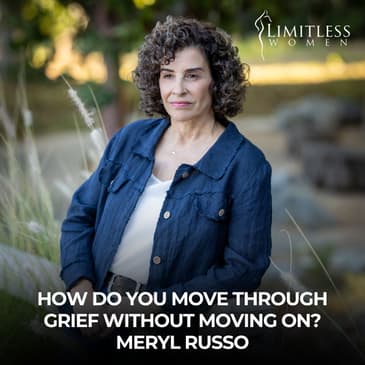
Grief does not ask you to move on, it invites you to find a compassionate way to keep living while honoring what has changed. Laura welcomes grief coach Meryl Russo for a deeply human conversation about loss, emotional expression, and the healing power of being witnessed.
Meryl shares how losing her mother at twenty-six shaped her understanding of grief and ultimately became the runway for her life’s work. Together, she and Laura explore the many forms loss can take, from death and divorce to illness, identity shifts, and unexpected change. They reveal why suppressed emotions continue to surface, how safe community can loosen grief’s grip, and why there is no correct timeline or destination for healing. This conversation reframes asking for help as an act of courage, while reminding women that the first person they approach may not be the person equipped to hold their pain.
Healing is not about erasing what happened or returning to who you were. It is about giving yourself permission to feel, receive support, create a new normal, and live fully in the life that is still here.
What You’ll Hear:
- The subtle difference between moving on from a loss and continuing forward while honoring what mattered.
- Why emotions that remain unspoken often find other ways to express themselves through the body, behavior, or coping patterns.
- How being witnessed by one safe person can soften isolation and create room to breathe again.
- The deeper courage required to keep asking for support when someone is unable to meet you in your grief.
- A compassionate reframing of healing as an ongoing relationship with yourself rather than a destination to reach.
Resources:
- Free Gift From Meryl Russo: Feeling IS Healing: A Downloadable Resource - Access this download for insight into feelings you may be experiencing - http://merylrusso.com/
- Claim Your Friday Gift: Tools to Make Business Easier https://limitlesswomen.com/free-gift-friday/
- Strategize Your Next Best Step: Schedule a Clarity Conversation with Laura http://schedulemycall.today
Featured Guest:
Meryl has spent a lifetime understanding human behavior and driving personal transformation.
She knows firsthand that grief is a deeply personal journey with no "normal" timeline. In a culture that often pressures people to "move on," Meryl offers a compassionate space where grief can be witnessed, emotional and practical tools are shared, and grievers learn they never have to navigate loss alone. She has witnessed profound transformations as people learn to approach their healing with self-compassion, grace, and light.
A former 20-year corporate veteran at the Walt Disney Company, Meryl pivoted to pursue work deeply aligned with her core values of connection, community and service. Currently and for the past 14 years, she leads grief groups at Our House Grief Support Centers in Los Angeles. Additionally, she facilitates groups for Campowerment transformational women’s retreats, and guides clients privately through her coaching practice. She is also the creator of LiveInThePause - a process for accessing authenticity through intentional pausing - and leads WisdomWalks, guided small-group hikes in the San Fernando Valley.
Meryl’s next venture is launching beyourSELFmore - a conversation focused on uncovering life’s true purpose and challenging the myth of imposter syndrome.
Originally and always a New Jersey girl at heart, Meryl lives in Encino, California, with her awesome husband, Michael, and their dog, Coco. She is the proud and grateful mom of three amazing adult sons.
Connect With Meryl Russo
Website: http://merylrusso.com/
Insta: https://www.instagram.com/merylkasherrusso/
Meet the Host:
Laura Gisborne, founder of Limitless Women, empowers female entrepreneurs to create businesses that are both profitable and purposeful. With 30+ years of experience, from building multi-million dollar enterprises to guiding small businesses, Laura understands the challenges of scaling beyond solopreneurship. She's a sought-after speaker, business growth strategist, and author of "Stop the Spinning – Move from Surviving to Thriving" and "Limitless Women." Laura's focus is on mindset, authentic leadership, and integrating social impact into business models. The Limitless Women community has raised over $750,000 for charities, reflecting Laura's commitment to "profits with purpose."
Follow Laura
- Website: https://limitlesswomen.com/
- Facebook: https://www.facebook.com/groups/LimitlessWomenGroup/
- Instagram: https://www.instagram.com/limitless.women/
- LinkedIn: https://www.linkedin.com/in/lauragisborne/
***********************************
High Vibe Podcast Network
We are proud to have the Limitless Women Podcast and Laura Gisborne on the High Vibe Podcast Network
Grab your free gift from Laura in our Our High Vibe Gift Vault. Love this show, check out the other shows on the High Vibe Podcast Network. https://highvibepodcastnetwork.com/gifts
Share the Love
🦋 Don’t forget to rate & review — it helps us reach more conscious rebels like you.
🔊 Listen & Subscribe
🎧 Spotify
Hi everybody! Welcome to another new episode
Lisa Skinner:of the Truth, Lies, and Alzheimer's show. I'm Lisa
Lisa Skinner:Skinner, your host, and I'm feeling really excited today
Lisa Skinner:because I have a very special guest right here with me, and I
Lisa Skinner:can't wait to introduce her to everybody. Her name is Kirsten
Lisa Skinner:Thomas, and she is the co-founder and president of a
Lisa Skinner:company that she created called Kindred Mind. And what she did
Lisa Skinner:is she built from lived experiences, from lived
Lisa Skinner:caregiving experience, an app that is so unique that I
Lisa Skinner:couldn't wait to share it with everybody because I think it's a
Lisa Skinner:really could be a really really helpful tool for some of the
Lisa Skinner:challenges that I know you all live with day in and day out, so
Lisa Skinner:please help me give a very warm welcome to Kirsten. Kirsten,
Lisa Skinner:welcome to the Truth, Lies, and Alzheimer's show. I'm so glad
Lisa Skinner:you're able to join us today.
Kirstin Thomas:Well, thanks so much for inviting me, Lisa. I
Kirstin Thomas:really appreciate
Lisa Skinner:it. You're very welcome. I'm excited to hear
Lisa Skinner:more details about your app called Kindred Mind, let's start
Lisa Skinner:off with what inspired you. What what drove you to even think
Lisa Skinner:about doing something like this? Let alone actually developing it
Lisa Skinner:and putting it out there for people to have a great tool to
Lisa Skinner:work with.
Kirstin Thomas:Yeah, as you said in the in the outset of
Kirstin Thomas:this call, this this was born out of caregiving experience.
Kirstin Thomas:Certainly not from a boardroom, from a strategy meeting. Just a
Kirstin Thomas:little context and background. Rewind the times, so to speak. I
Kirstin Thomas:was raised by my mom, an only mum, single child. Our
Kirstin Thomas:connection was one that is very unique. Some would say
Kirstin Thomas:codependent. There's the enmeshment. I was always kind of
Kirstin Thomas:wired to worry about her, but I would say over the the last
Kirstin Thomas:decade or so, I started noticing things that would cause a little
Kirstin Thomas:bit of red flag, but I would chalk it up often to just aging.
Lisa Skinner:Well, tell us a little bit more about that
Lisa Skinner:because a lot of my audience are always really curious what
Lisa Skinner:people have have actually witnessed that they dismissed
Lisa Skinner:maybe at the time that actually turned out to be something more
Lisa Skinner:serious than just normal aging forgetfulness. So I think they
Lisa Skinner:would love to hear some of the signs that you noticed, but
Lisa Skinner:maybe didn't.
Kirstin Thomas:Yeah, it didn't. It didn't look like the
Kirstin Thomas:universal, typical kind of like forgetfulness that we all know
Kirstin Thomas:of, say Alzheimer's, which is kind of like a catch-all.
Kirstin Thomas:Instead, it showed up with increased fatigue, so much so
Kirstin Thomas:that it didn't match her daily activities. She would sleep a
Kirstin Thomas:lot, so that was one kind of clue. She stopped being able to
Kirstin Thomas:hold on to a story. I'd be halfway through telling her
Kirstin Thomas:something that was, you know, pretty pretty pertinent to my
Kirstin Thomas:well being, but I could tell she sort of lost the thread of it.
Kirstin Thomas:It could be a comprehension or an attention concern. I found
Kirstin Thomas:too she was started substituting words. She would sometimes make
Kirstin Thomas:up words, so that I learned later was paraphasia. It happens
Kirstin Thomas:when the brain can't retrieve the exact word underneath.
Kirstin Thomas:Although the thought is there, the thought is intact, but they
Kirstin Thomas:can't retrieve that word.
Lisa Skinner:And then there's a term. Actually, there's a term
Lisa Skinner:for making up words. It's called confabulation. So it sounds like
Lisa Skinner:she was doing that as well, and that's a very very common thing
Lisa Skinner:that we see with people who actually have one of the brain
Lisa Skinner:diseases, right? Dementia.
Kirstin Thomas:Some other clues, and sadly, I noticed
Kirstin Thomas:socially things started to shift for her. She was ostracized from
Kirstin Thomas:her euchre group because she wasn't following the rules so
Kirstin Thomas:much so anymore. More executive, as I mentioned, more executive
Kirstin Thomas:than memory loss at the beginning. So she knew what she
Kirstin Thomas:wanted to do. For example, you know, set an appointment, or log
Kirstin Thomas:into her Facebook, or collect her voice messages. Even I could
Kirstin Thomas:tell that she couldn't execute point A to point B. So suddenly
Kirstin Thomas:there was no clear path for her. But it wasn't until April 2025
Kirstin Thomas:that her doctors carried out the MoCA test. So that cognitive
Kirstin Thomas:impairment. Detection test, and she scored quite low. That they
Kirstin Thomas:reported her to the Ministry of Transportation, and her her
Kirstin Thomas:license was suspended. And then later in October, she had a
Kirstin Thomas:series of of strokes, ultimately leading to a significant stroke
Kirstin Thomas:that attacked her basal ganglia, which is helps govern voluntary
Kirstin Thomas:movement among other neurological functions, but it
Kirstin Thomas:ended up causing her to be in a wheelchair. So my mom, who once
Kirstin Thomas:drove herself everywhere, who had a social butterfly calendar,
Kirstin Thomas:who went to the gym three times a week, who took care of her
Kirstin Thomas:cat, she would volunteer. She was very active. Was now
Kirstin Thomas:completely dependent in a wheelchair.
Lisa Skinner:Now, how old is she now at this time in 2025?
Kirstin Thomas:She was 81.
Lisa Skinner:And how many years had you been noticing some of
Lisa Skinner:the things you described to us?
Kirstin Thomas:So the rearview mirror is is telling. You know,
Kirstin Thomas:in the moment, as I said, you kind of dismiss it. Maybe it's
Kirstin Thomas:denial. You're excusing it for the natural course of aging, but
Kirstin Thomas:honestly, when I really think back, I would say at least 10
Kirstin Thomas:years.
Lisa Skinner:Interesting. Yeah, and I
Kirstin Thomas:don't think that she addressed it with her
Kirstin Thomas:primary physician at the time because, well, there's a stigma,
Kirstin Thomas:and also she was a very proud, private woman. She was a boss
Kirstin Thomas:lady, hustled, and so this would kind of make her feel less of
Kirstin Thomas:and age out of. So I think that she kept it quiet, even to me.
Kirstin Thomas:She wouldn't admit it. And what? Back to your original question.
Kirstin Thomas:What was it specifically that that kind of was the impetus for
Kirstin Thomas:building the app Kindred Mind? Is that she stopped texting? So
Kirstin Thomas:that was another action or clue, and started calling me more. And
Kirstin Thomas:those calls would come more and more frequently, and the
Kirstin Thomas:questions would be the same over and over again. So we all know
Kirstin Thomas:that one of the symptoms is repetition, but one of the other
Kirstin Thomas:symptoms is this, or what they call reassurance calls due to
Kirstin Thomas:separation anxiety in people living with dementia. So I
Kirstin Thomas:recognize that immediately because I lived this back when I
Kirstin Thomas:was a teenager in high school with my grandmother, her mum's
Kirstin Thomas:mum. So watching the same pattern repeat itself across two
Kirstin Thomas:generations is really what I guess positioned me to problem
Kirstin Thomas:solve that much faster because I didn't want to leave my mum
Kirstin Thomas:hanging the way I felt my grandmother was because we would
Kirstin Thomas:collect voice messages on the answering machine when we'd come
Kirstin Thomas:home from our respective days, and there would be calls from
Kirstin Thomas:morning till night that she would be leaving because there
Kirstin Thomas:were no cell phones back then. This was her only, you know, way
Kirstin Thomas:to reach out to to us to the people that she trusted and felt
Kirstin Thomas:familiar and and comforted by, and I I knew that I couldn't let
Kirstin Thomas:my mom sit in that fear, in that anxiety, and that
Kirstin Thomas:disorientation. I didn't want her to think that I had
Kirstin Thomas:abandoned her. So all that. What
Lisa Skinner:were what were her living arrangements during this
Lisa Skinner:time?
Kirstin Thomas:So prior to the massive stroke, she was living
Kirstin Thomas:independently and doing everything independently. But
Kirstin Thomas:what
Lisa Skinner:about when the these phone calls these so
Kirstin Thomas:so that that actually started leading up to
Kirstin Thomas:her stroke. So I started making more accommodations for her.
Kirstin Thomas:Certainly because of the loss of license, but also I noticed
Kirstin Thomas:there was and at the time I kind of I hate to say this, but I I
Kirstin Thomas:saw it as neediness. But now, in hindsight, I realize it was this
Kirstin Thomas:separation anxiety. She wanted to feel, I guess, she felt
Kirstin Thomas:unstable in her mind and in her spirit, and she was just
Kirstin Thomas:reaching out for the only voice, the only person that she ever
Kirstin Thomas:really had that connection with with which is me as an only
Kirstin Thomas:child,
Lisa Skinner:understandably. Yeah. Okay. So where after she
Lisa Skinner:had the stroke, then did she change the living environment?
Kirstin Thomas:Yes. Well, and because of the wheelchair, her
Kirstin Thomas:and the the need for full full care, you know, from she went
Lisa Skinner:into what assisted living or she's
Kirstin Thomas:not considered a flight risk because she is in a
Kirstin Thomas:wheelchair, so she is able to stay in a traditional retirement
Kirstin Thomas:home that seems to have organically evolved into a space
Kirstin Thomas:that can accommodate high high needs. So, and you're in
Lisa Skinner:Canada, right?
Kirstin Thomas:Yeah, yeah. So
Lisa Skinner:just this was a type of facility that is offered
Lisa Skinner:in your country,
Kirstin Thomas:right? It's not subsidized, but certainly it is.
Kirstin Thomas:I mean, I think that if my mom were considered a flight risk,
Kirstin Thomas:meaning she could wander and and just leave the care. Home
Kirstin Thomas:entirely, then that would be a different conversation. But I'm
Kirstin Thomas:so comfortable where she's at because she still maintains a
Kirstin Thomas:lot of her autonomy as much as she could. And I know one of the
Kirstin Thomas:like ethical principles in dementia care is to preserve and
Kirstin Thomas:maintain the independence as much as safely possible.
Kirstin Thomas:Absolutely, yeah.
Lisa Skinner:So she has a room in this community setting that
Lisa Skinner:offered, you know, dining dining experience. They went to a
Lisa Skinner:dining room, their activities, all those things. But these
Lisa Skinner:calls continued incessantly, right?
Kirstin Thomas:Yes. So it's I. I'm close. I'm about 1520 minute
Kirstin Thomas:drive away, and I do see her almost every day. But it was the
Kirstin Thomas:in between, and she calls, as you know, and it was the in
Kirstin Thomas:between times. So we call that the bridge, the bridge between
Kirstin Thomas:my physical presence and my voice presence. To when I'm when
Kirstin Thomas:I'm not able to get those calls, and it was those calls that I
Kirstin Thomas:missed that weighed most heavily on me. There was, I guess, one
Kirstin Thomas:kind of pivotal moment where I was in my daughter's dance
Kirstin Thomas:recital, and I had to make that choice between watching my
Kirstin Thomas:daughter on stage or picking up the call from my mom, and I had
Kirstin Thomas:to step out of the theater because I, I, I just the guilt
Kirstin Thomas:that ensues if I miss the call weighs heavy. But also, I, I was
Kirstin Thomas:really concerned that maybe this call was something really
Kirstin Thomas:emergent.
Lisa Skinner:Yeah, you just never know. It could be. Yeah,
Lisa Skinner:Kirsten is part of the sandwich generation that we were just
Lisa Skinner:talking about on another episode. So she's dealing with
Lisa Skinner:her aging mom who has been diagnosed with is it
Lisa Skinner:frontotemporal dementia and
Kirstin Thomas:vascular dementia
Lisa Skinner:and vascular dementia. I was going to ask you
Lisa Skinner:if she and
Kirstin Thomas:mixed, yeah,
Lisa Skinner:yeah. So that is called mixed dementia, which is
Lisa Skinner:actually very common. And she also had a daughter, a dependent
Lisa Skinner:daughter, at the same time. So it's a lot of balls for her to
Lisa Skinner:juggle in the air all at once. So she came up with something
Lisa Skinner:really, really clever. So let's pick up where we left off. Go
Lisa Skinner:ahead and continue with your story, Kirsten.
Kirstin Thomas:Thanks, Lisa. I also have two boys. I don't want
Kirstin Thomas:to leave them out of the equation. So three kids and two
Kirstin Thomas:dogs and a business to to build. So it's busy. A lot. It's
Kirstin Thomas:certainly busy, and I did I did feel like that that caregiver
Kirstin Thomas:pull, the caregiver burnout that does ensue. But back to kind of
Kirstin Thomas:describing what Kindred Mind is, knowing that it was kind of the
Kirstin Thomas:impetus was the repetitive reassurance phone calls was the
Kirstin Thomas:the reason for building this or developing this. The product
Kirstin Thomas:itself is an AI voice companion that answers phone calls from
Kirstin Thomas:someone living with dementia using familiar voice technology,
Kirstin Thomas:those are my dogs in the background. I don't know if you
Kirstin Thomas:can hear them. So it's a clone of the the caregiver's voice,
Kirstin Thomas:and in this case, my own. Plus, actually, what we've just built
Kirstin Thomas:in is a proactive check-in call, so we can call or send SMS for
Kirstin Thomas:reminders, which is great, or even a companion, but back to
Kirstin Thomas:the pillars that Kindred Mine is built on. It's built on the
Kirstin Thomas:simulated presence therapies, that being my voice, and the
Kirstin Thomas:validation therapy, and established dementia care
Kirstin Thomas:concepts that favor emotional comfort over little literal
Kirstin Thomas:correction. And I've heard you, Lisa, talking a lot about you
Kirstin Thomas:know confabulation or or compassionate deception, all of
Kirstin Thomas:those things, and it's wildly widely discussed. But we can
Kirstin Thomas:jump into the validation therapy if if you want. It's a great
Kirstin Thomas:discussion to have. Developed by Naomi Fale back in the 60s
Kirstin Thomas:through to the 80s. She worked in a nursing home, and I've done
Kirstin Thomas:a little research, and I found this enlightening. And she
Kirstin Thomas:noticed that the caregivers used to use the like correct them,
Kirstin Thomas:orient them approach. Yeah, the
Lisa Skinner:reality orientation therapy. Yeah, so
Lisa Skinner:like if
Kirstin Thomas:someone, and they always use this example, if
Kirstin Thomas:someone's asking after their spouse who's no longer here.
Kirstin Thomas:Back in the day, they would correct and say, "Oh, he he
Kirstin Thomas:passed away in you know 2019 or what have you. But what she
Kirstin Thomas:found-don't you remember? Yeah, you must have dementia. But she
Kirstin Thomas:found that wasn't helping anyone. It wasn't kind either.
Kirstin Thomas:Even though we were, even though you were giving the facts, it
Kirstin Thomas:wasn't kind, so it wasn't helping. So yeah, people were
Kirstin Thomas:just getting upset. The agitation throughout the care
Kirstin Thomas:community would start spreading like wildfire. It was almost it
Kirstin Thomas:was almost like contagious. So instead, what she thought to do
Kirstin Thomas:was stop trying to fix the facts and start paying attention. The
Kirstin Thomas:feeling underneath them. So, my mom has asked after her mom, and
Kirstin Thomas:so when she's, you know, and my grandmother's been gone like 30
Kirstin Thomas:some odd years, she's. I'm looking at the underlying root
Kirstin Thomas:emotion and not the factual question. Instead, I'm seeing
Kirstin Thomas:her asking like she wants to feel safe. She wants to feel
Kirstin Thomas:cozy. All the things that you feel when you're wanting to be
Kirstin Thomas:with your mom. So I don't correct her. Kindred mind
Kirstin Thomas:doesn't correct her because kindred mind is built on those
Kirstin Thomas:pillars of of validation. So you know, again, to to your point,
Kirstin Thomas:you're not saying you're confused, I just told you this
Kirstin Thomas:five minutes ago, so that's kind of the whole validation example
Kirstin Thomas:in play there. But there's, yeah, there's and there's
Kirstin Thomas:research behind it. You know, studies.
Lisa Skinner:Oh yes, oh yes.
Kirstin Thomas:That validation approaches, like I said, can can
Kirstin Thomas:reduce anxiety and actually even increase communication, like
Kirstin Thomas:positive communication, and that like combats the whole
Kirstin Thomas:loneliness epidemic and all of these things. And certainly,
Kirstin Thomas:too, it has a flip side where it it can it's reported to show
Kirstin Thomas:less caregiver burnout, and caregiver burnout is is not a
Kirstin Thomas:joke.
Lisa Skinner:Oh, it's a real thing. There's no question about
Lisa Skinner:that. Before we run out of time, can you give us maybe a
Lisa Skinner:walkthrough of how exactly this works? Yeah, performs so we have
Lisa Skinner:you know maybe a little bit better understanding of what it
Lisa Skinner:can do to accomplish all these things you just you know hit the
Lisa Skinner:nail on the head about it's all you know just very very true and
Lisa Skinner:very accurate.
Kirstin Thomas:Yeah. Well, thank you. We tried to weave in
Kirstin Thomas:all of the kind of guidelines to dementia friendly conversation.
Kirstin Thomas:and and and lean on because we're in Canada the Alzheimer's
Kirstin Thomas:Society of Canada's guidelines. So all of that is kind of built
Kirstin Thomas:in. the The app itself is on a short leash. It doesn't invent
Kirstin Thomas:things. But how you onboard is that you start with an eight
Kirstin Thomas:minute conversation with a virtual assistant. We call her
Kirstin Thomas:Sarah, and it's just through this two-way conversation, like
Kirstin Thomas:a Q and A. There's no script, and that's enough to build the
Kirstin Thomas:initial voice. So when my mom calls, even with the initial
Kirstin Thomas:voice, it's almost undistinguishable. She hears the
Kirstin Thomas:like nuances, the intonation, some of the words that I might
Kirstin Thomas:say, but during that Q and A, it builds in the background and
Kirstin Thomas:knowledge base, so that when those calls do come in from
Kirstin Thomas:someone living with dementia, the conversation is relevant.
Kirstin Thomas:It's based on real, real life. You know, the rhythms of her
Kirstin Thomas:day, the rhythms of the caregiver's day, the people that
Kirstin Thomas:are important to to both of them, and it is entirely based
Kirstin Thomas:on that whole the whole conversation. So it's not it's
Kirstin Thomas:not recorded. It's it's always two way. And when I was looking
Kirstin Thomas:at I paused there because I wanted to mention and I know
Kirstin Thomas:we're running out of time. I I was looking at the alternatives
Kirstin Thomas:and the alternatives being call blocking, call silencing, you
Kirstin Thomas:know, sending your calls to voicemail. I've heard some
Kirstin Thomas:people remove the lifeline altogether. They remove the
Kirstin Thomas:phone. Some people go so far as medicating the symptoms, which
Kirstin Thomas:is the anxiety underneath those repetitive reassurance calls.
Kirstin Thomas:All of those alternatives didn't sit well with me, so I needed a
Kirstin Thomas:way to answer those calls that I simply couldn't get to in my
Kirstin Thomas:voice, so that that familiar voice and trusted voice is one
Kirstin Thomas:that my mom can sit with. So now she has that, and all of and I
Kirstin Thomas:can update on the fly. So if you know I visit her almost daily.
Kirstin Thomas:If I'm running late, I can update on my mobile app to say
Kirstin Thomas:if she does in the event call while I'm driving, I can say I'm
Kirstin Thomas:running 30 minutes behind schedule. So it'll it's almost
Kirstin Thomas:like my own assistant, but in my voice. One other thing I wanted
Kirstin Thomas:to to say is for those people who may not be comfortable
Kirstin Thomas:having their voice cloned, we do offer a warm assistant voice in
Kirstin Thomas:in female and male, and again all based on that whole set of
Kirstin Thomas:knowledge that you share. And we don't allow for medical records,
Kirstin Thomas:we don't allow for financial information or last names. So
Kirstin Thomas:it's actually very surface level information. Whatever it is, you
Kirstin Thomas:you decide to share with Kindred Mind.
Lisa Skinner:So how has it? I guess your mom was cut for the
Lisa Skinner:app with kind of your beta tester. How so? How has she
Lisa Skinner:responded to using Kindred Mind?
Kirstin Thomas:Yeah, no, that's a great question, and I answer
Kirstin Thomas:it this way. Before Kindred Mind, I was if I missed a call,
Kirstin Thomas:several calls, those calls would come. With more urgency and
Kirstin Thomas:frequency, and by the time I answered the call, she and I say
Kirstin Thomas:this all the time, she literally sounded like she ran a marathon,
Kirstin Thomas:like she was exasperated. And now, when Kindred Mind answers
Kirstin Thomas:those calls, although she forgets because that's part of
Kirstin Thomas:dementia, she'll forget. She just called. She'll call again,
Kirstin Thomas:but they call they come with less frequency, and and the the
Kirstin Thomas:urgency beneath the messaging is a lot is has decreased as well.
Kirstin Thomas:And what's great is I get a summary of all those calls that
Kirstin Thomas:I wasn't able to answer myself. So I know her affect. I know if
Kirstin Thomas:she was you know disoriented or calm or all of those. It's like
Kirstin Thomas:a Cole's notes version of her feeling, the sentiment and the
Kirstin Thomas:messaging. So, if there's any action item, like if she said,
Kirstin Thomas:"I need a new toothbrush, for example, then I I can act on
Kirstin Thomas:that. So you built
Lisa Skinner:in all these metrics into this app. We
Lisa Skinner:absolutely well, yeah, it
Kirstin Thomas:very data driven. And then I I like to
Kirstin Thomas:also say the distress, universal distress keywords are in there,
Kirstin Thomas:so instead of validating someone when they say they've fallen,
Kirstin Thomas:you want to actually break through and let the caregiver
Kirstin Thomas:know in real time. So we've built that in as well. Wow, this
Kirstin Thomas:is just fascinating and brilliant. It's actually
Kirstin Thomas:brilliant. I'm so excited to now. Can can people go onto your
Kirstin Thomas:website and you have like a a demo available for them to
Kirstin Thomas:listen to? Yeah, we have a 14 day free trial, and what that
Kirstin Thomas:allows to do is you can actually go through the onboarding
Kirstin Thomas:process and and get your instant voice clone and done in eight
Kirstin Thomas:minutes, and then you can even test calling that number to see
Kirstin Thomas:how it fields conversation based on the knowledge base and any
Kirstin Thomas:curveballs you may throw at it.
Lisa Skinner:That's amazing. So, what? How do they? How do
Lisa Skinner:they find you? How does yeah?
Kirstin Thomas:Kindred mind care. Kindred mind dot care.
Lisa Skinner:Okay. Well, this is just really. I'm even more
Lisa Skinner:excited than I was before we had our conversation because of all
Lisa Skinner:the things you explained to us that it's capable of doing. I
Lisa Skinner:just see this being a tremendously helpful and
Lisa Skinner:valuable tool because I have seen this behavior from so many
Lisa Skinner:people living with dementia, and yeah, it was just really a
Lisa Skinner:brilliant idea. So I'm glad that you came up with this, and it's
Lisa Skinner:such a a wonderful tool. So thank you again for being here
Lisa Skinner:and for sharing this this exciting information with us.
Lisa Skinner:And I hope a lot of people will look into it because I can see
Lisa Skinner:this really being helpful to family members and caregivers
Lisa Skinner:that do experience these repetitive calls and the
Lisa Skinner:insecurity and and the fear that they often and very commonly
Lisa Skinner:experience living with dementia. This is such a needed needed
Lisa Skinner:resource, so thanks again. Anything else that you'd like to
Lisa Skinner:say before we sign off?
Kirstin Thomas:I don't think so. I think we covered it. I
Kirstin Thomas:think the the you know if you were to distill it down, it it
Kirstin Thomas:works for both the caregiver offering a bit of reprieve in
Kirstin Thomas:their day, but more importantly, and the reason why I built this
Kirstin Thomas:was to make sure that my loved one, the one living with
Kirstin Thomas:dementia, doesn't sit in fear.
Lisa Skinner:That's a good place to leave. So, as far as
Lisa Skinner:how it works on the actual phone, is it just like Seinfeld,
Lisa Skinner:and it's number one on the speed dial? Yeah,
Kirstin Thomas:you can program the special, unique kindred
Kirstin Thomas:number into your phone, and you receive that number once you
Kirstin Thomas:onboard. And then the in this case, my mother has a
Kirstin Thomas:pre-programmed button with my name on it. She presses it, and
Kirstin Thomas:she always gets me, even when I can't answer the phone. She
Kirstin Thomas:still gets me. Yeah.
Lisa Skinner:Okay. All right. Well, we are out of time for
Lisa Skinner:today's episode. This has really been exciting. I just cannot
Lisa Skinner:express how impressed I am with all the information I've learned
Lisa Skinner:about Kindred Mine today. So I hope you know if this applies to
Lisa Skinner:your world, look into it because it might help save your sanity.
Lisa Skinner:All right. Thanks again, Kirsten, for being here, and
Lisa Skinner:good luck with your app.
Kirstin Thomas:Thank you. Thanks so much for having me,
Kirstin Thomas:Lisa. I really appreciate it.
Lisa Skinner:So come back next week. As always, I will have
Lisa Skinner:another new episode prepared for you, and in the. Anytime, have a
Lisa Skinner:great rest of your week. And as I always urge you to do, is to
Lisa Skinner:stay as healthy as you possibly can and happy. And I will see
Lisa Skinner:you all next week. Bye bye for now.