
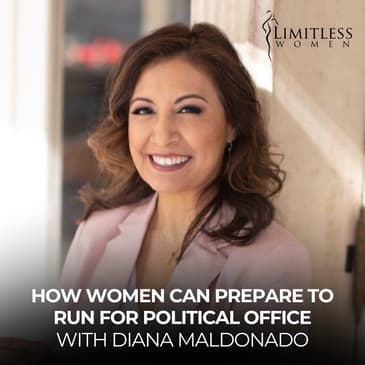
Leadership often begins with a moment of awareness that something in the system is not working. In this conversation, Laura Gisborne speaks with Diana Maldonado about the journey from community advocate to state legislator. Maldonado shares how early experiences with education inequality shaped her commitment to service and how that mission led her into politics.
The discussion also explores the realities of campaign fundraising, the importance of values-driven leadership, and the creation of Candidate School, an initiative designed to prepare women for public office. Through mentorship and practical training, Maldonado aims to help more women confidently step into policymaking and community leadership.
What You’ll Hear:
- How Diana Maldonado’s early experiences with education inequality sparked a lifelong commitment to public service.
- The unexpected journey from community leadership and school board service into running for the Texas legislature.
- Why campaign fundraising can feel unfamiliar to many women and how confidence grows through experience.
- The lessons learned from raising nearly one million dollars during a first major political campaign.
- How the East Williamson County Higher Education Center became a lasting legacy of Maldonado’s legislative work.
- The vision behind Candidate School and its mission to prepare more women for political leadership.
Resources:
- Claim Your Friday Gift: Tools to Make Business Easier
- Strategize Your Next Best Step: Schedule a Clarity Conversation with Laura
Featured Guest: Diana Maldonado
Diana Maldonado, a respected Central Texas political figure, has built a career on achieving the “impossible” while fostering lasting relationships. As a best-selling author, she shares stories from her journey in politics, travel and marathon running through the lens of a Latina.
Diana’s focus is helping women get elected to public office to bring parity, voice and representation to the halls of democracy through the Candidate School. Her meticulously curated daily lessons provide insights into becoming a compelling, influential, and genuine candidate, as she imparts knowledge gained from her own campaign experience. From mastering your candidate identity to managing money, policy and power, these lessons help you navigate your journey to winning office and owning your future with confidence.
As the first Latina elected to represent Williamson County in the House of Representatives, she advocated for education, business, and safe communities. In this role, she authored/co-authored 88 bills and was named “Freshman of the Year” by her colleagues. Through her collaboration with key stakeholders, she secured nearly $16 million for education, $10 million for road expansion, and additional funds for renewable energy initiatives and walking trails in parks. She served as Secretary for the Mexican American Legislative Caucus, Defense & Veterans Affairs, and on the coveted State Affairs committee.
From her six years on the Round Rock ISD Board of Trustees and elected by her peers as president and first Latina to this role, Maldonado oversaw a successful $349 million bond election while improving academic outcomes and goals. Post politics, she worked as a financial advisor at Morgan Stanley where her focus was on women and wealth. Maldonado went on to lead as President & CEO at the Greater Austin Hispanic Chamber of Commerce where she successfully led membership engagement, policy initiatives and revenue diversification efforts. She expanded advocacy in the contributions Latinos make in business and consumer markets as the largest demographic in the United States with a GDP at $3.6 trillion.
Diana is a global marathon runner with races in Tokyo, Berlin, London, Paris and mom of two adult children, Alex and Denise, and spends time with her granddaughter, Camila where she taps into her greatest joy.
Meet the Host:
Laura Gisborne, founder of Limitless Women, empowers female entrepreneurs to create businesses that are both profitable and purposeful. With 30+ years of experience, from building multi-million dollar enterprises to guiding small businesses, Laura understands the challenges of scaling beyond solopreneurship. She's a sought-after speaker, business growth strategist, and author of "Stop the Spinning – Move from Surviving to Thriving" and "Limitless Women." Laura's focus is on mindset, authentic leadership, and integrating social impact into business models. The Limitless Women community has raised over $750,000 for charities, reflecting Laura's commitment to "profits with purpose."
Follow Laura
- Website: https://limitlesswomen.com/
- Facebook: https://www.facebook.com/groups/LimitlessWomenGroup/
- Instagram: https://www.instagram.com/limitless.women/
- LinkedIn: https://www.linkedin.com/in/lauragisborne/
***********************************
High Vibe Podcast Network
We are proud to have the Limitless Women Podcast and Laura Gisborne on the High Vibe Podcast Network
Grab your free gift from Laura in our Our High Vibe Gift Vault. Love this show, check out the other shows on the High Vibe Podcast Network. https://highvibepodcastnetwork.com/gifts
Share the Love
✨ If this episode lit something up in you… tag us on Instagram @HighVibeLeaders and let us know your biggest takeaway!
🦋 Don’t forget to rate & review — it helps us reach more conscious rebels like you.
🔊 Listen & Subscribe
🎧 Spotify
Laura, welcome to The Limitless Women podcast. Our mission is to help women business owners like you grow profitable businesses and actualize your opportunities to serve and give to yourself and others. Here's your host, the founder of limitless women. Laura Gisborne,
Laura Gisborne:Alright, welcome back to the limitless women Podcast. I'm very excited today to share with you a new friend, Diana Maldonado who I met through NABO. That's like a lot of Oz there. Diana Maldonado who I met through NABO. I heard her speak at our local chapter. I was very impressed with her story. I asked if she would come and share a little bit about what she's done and what she's doing, what she's done, and we'll talk a little bit about that today on the show, but also what she's doing with Candidate School, which is an opportunity for women who want to be in service, but maybe need access to the skill sets, the training, the resources, the How to she's got an amazing story of where she's come from and what she's done, and we created a special section at our recent limitless women conference just for her, because she inspired me so much as a woman who's living her legacy, she's legacy in action. She's in a season of giving back, and I'm just so honored to share her with you. Welcome Diana to the limitless women show.
Diana Maldonado:Thank you, Laura. It is a pleasure to be here with you and I admired in the short time that we have met and interacted. You're a very dynamic individual. And it's, it's no cool as it is that we met, and I'm so happy to be here with you.
Laura Gisborne:Yeah, well, we're just getting started, right? May think that's really the part that's kind of cool when there was a, you know, it's something like an event or conference that gives us the opportunity to make the invitation, and then we're here, we'll see where it takes us. So it's very exciting. All right, so I am thrilled to have you talk a little bit about, I mean, again, it's your party, it's your show. I'm going to give you the mic. What is it that had you go into politics? I mean, that's, that's a big leap. And as I was sitting today at the Texas capitol, we went for recognition for novel today, I was sitting there thinking about how many men were in the room, right? And thinking about how unique your experiences as a woman, as a Latina, you know, tell me a little bit about how all this got started for you.
Diana Maldonado:Yes, no, thank you. And it started growing up in a border town in Eagle Pass. I mean, we were born in Lubbock, Texas, up in the panhandle, but through circumstances, you know, with limited work availability, my father moved us all the way down to the border border town to be near his family. But early on, I saw it. Just sensed. It was like intuition, sense the disparities in education. And again, it was my formative years. I mean, like I just knew something was not quite right. So I grew older, I begin volunteering, I begin asking questions. I and I had great teachers that were also mentors and very giving of their time for me to flourish in that part. And so later on, when I left Eagle Pass and into my professional career, that memory or that experience that stayed with me and I wanted to change education. I wanted to be a conduit to change education. So I started volunteering a lot in organizations, being on boards, giving, giving back to them, or finding ways so I could help advance their missions when it came to education and to women's issues. And then I started a career in state government, and that was part of also my leadership development. I mean, I worked for this Texas State Controller's Office, which is the purse strings for the state of Texas.
Laura Gisborne:So there's got to be a big budget, you know, yes, exactly more. Like, how many acres is this building? I mean, like the history of Texas as it could world, right? I mean, if people from Texas are not aware of Texas, you know, it's like its own world over here. So you know about the budget of that? You know that's a big budget to be a part
Diana Maldonado:Right? And at that time, when I was in the ledge, I think we had passed 165 billion. And I think right now, the 88th legislature is passing almost double that. So we are state. We're a big state. I think we're 2.6 trillion in GDP for Texas, so learning early on about budgets and how money moves things and money helps to form policy. Right now, I had the great training ground into leadership development. And that then eventually, you know, catapulted me to run for office, always thinking about how I could be an advocate for education. But it wasn't until I got divorced after a 17 year marriage that that that also propelled me to have, like a clean slate, right? And with what I had as being a single parent, you know, a teen and a preteen, and always knowing that I when I was growing up, my parents, who were very supportive of me being, you know, of service, of supporting other, you know, community engagement. And it finally came together. And then I was asked by Latino Round Rock leaders they had heard about me, and then they asked for my resume. Kind of did a very, kind of, like an informal vetting process how I got into politics when I ran for the Round Rock ISD school board
Laura Gisborne:Beautiful. I think one of the things that's coming to mind, in fact, I know one of the things coming to mind as we're speaking is I know a little bit more ahead of the story that people don't know yet about what it took to run to be a representative, and what that budget was, and it's interesting, as I'm listening to talk about the state budget and what was happening in the comptroller's office. It's so fascinating for me, this whole idea of same game, more zeros, right? And one of the places that I see women, because our work is really around healing the poverty. Consciousness of women visits leaders so they can join us in healing actual poverty, right? And and we always joke that nobody says, Hey, will you help me feel my heal, my poverty consciousness, but it's in there, right? Like and so I am so curious about your courage to go out and say, Okay, I had to raise x amount of dollars before I could run, not necessarily, for the school board, but that next step. Can you talk about those numbers. So I think that's the part that really blew my mind. When I met you, I was like, what you had to raise? How much? What?
Diana Maldonado:A lot of zeros, a lot of zero.
Laura Gisborne:Yeah, tell us about that. I think it's big, but I'm so I'm inspired by that story
Diana Maldonado:Well, and again, you touched on a point there. As women, we're not in a position, or we don't grow up learning about money and being in conversations at the table about money. It's more to the poise, and then men, and then even from a cultural perspective, you know, my from my lens as a Latina, oh my gosh, never even talk about money. Just keep your nose to the grind. Don't make yourself heard and then, but find a way how to do that. And I and I go back to when I was growing up, that one thing that I know now that I was stayed curious, and all I knew Laura is that I didn't want to be the same as everybody. Yeah. But then also took courage and took, you know, I mean, to an extent fear, like, oh my gosh, I'm scared because I don't know this world. I don't know that area, right, but I, but the impetus for me to go in that direction was that I didn't want to stay where I was.
Laura Gisborne:And something was, something was catalyzing you. And I feel that's God's calling in our lives, right? There's that said things start showing up. There's some series, you know, synchronicities that you maybe you know what was happening in Round Rock was like just showing you a little bit of what was possible for yourself. So taking on the journey of what the next invitation was that, how'd you go to being in the legislature? Alleged.
Diana Maldonado:So yeah, so I'll tell the story, which will be coming out in my memoir, book that I'm writing that'll come out later this year, but at that point, I'm the president of the Round Rock School District, and we're at an Education Foundation Gala, and at that point in time, I was with my boyfriend at the time, and the Democratic county party chair was looking for a candidate to run for state rep. And at the same time, we were having a lot of midnight meetings on how to move the budget for public education. We just kept finding wall after wall after wall because the legislature was holding the purse strings to public education, so in that we're there, you know, just kind of thinking, talking about it. But then, you know, my boyfriend and Richard were yapping away, so I'm just kind of like observing, taking a backseat, you know, taking a sip of my glass of wine. Yeah, and he's Richard, keeps going. We need to find somebody who's proven who a name recognition. And my boyfriend, at the time, he was also very involved in community service, that he's pumping up his test, thinking it's going to be him funny, and so they're talking. Working, and I'm just patiently waiting, right? And then finally, Richard looks at me and says, Oh, my God, that's it. The No, the answer has been under my nose all the time. It's you, because you're the one who we need to run. People already know you. You've already made hard decisions. I mean, you don't back down. You you build relationships, you collaborate, and you know, sometimes you have to make the hard decisions, and I have. And so then Richard takes off from the gala. And then my workman looks at me very sternly and says, What are you doing? You know, I said, Well, talk about. He goes, I want to run. You're already, you're already a school board. Now it's my turn to run. And I said, Well, interesting. And I goes, and so, yeah, we got into a little, you know, little heated exchange, but, and then after a
Diana Maldonado:while, I said, You know what? Go ahead and run. He goes, because I'm going to run, and may the best woman win. That was the beginning of the end of our relationship. And yes, so I had to get over the barriers of, you know, the gender, you know, component, because in politics, you do have more, you know, males or men in politics. And looking back, this is one of the reasons that I did candidate school, because I come across so many smart, successful women, whether it's being a leader of a PTA group and or a small business owner, a project manager, all of those skill sets, you're already collaborating, you're building relationships, so many problem, problems, and all of those is what I'm sharing. And this conversation on candidate school that you already have the skill sets. It's about, right, changing that team and going through, you know, you know, your own self assessment, then take that next journey. So definitely, that's one of them. But then when I did run for office, you know, fast forward, the most I had raised Laura was, and I'm doing a stretch, the most I had raised for my two campaigns on the school board was 5000 like, right?
Laura Gisborne:Because it did, the requirement was not so much, right?
Diana Maldonado:Well, yeah, it doesn't take a lot, you know, the voting constituency as well as, yeah, you know, in relation to how important it is, what have you. But, and even as a state rep, you don't have limits in city council, you do. But then I was like, how am I going to raise because at first they told me, well, it normally takes 200 to 250,000 to me that was already an enormous amount. Sure, I've never been around that much money. I mean, at work, yes. But personally I do, and I'm thinking, wow, I think the universe is putting me in a trajectory to be open to that. So as I started doing my dialing for dollars, early on, I stumbled like there was no tomorrow. I jokingly say that people gently gave me money, because it's like they probably felt sorry. I heard me, here's $20 here's $50 and like, I'll take it, yeah, and my confidence started to build from that. And of course, I was surrounded with professionals to help me, because this was a totally brand new journey for me. So as we started to gain momentum, one, we started early. You know, I formed my why? Why I was running started early. Because if you get dollars early in the campaign, then the second half of the campaign, kind of the money starts rolling in. And people will see, the donors and political pundits will see, well, can she raise money? I mean, that's what we're seeing, yeah, yeah. The one main thing that everybody will see, can she raise money? I mean, heaven forbid you're still a first time candidate and raise money, because a lot of time candidates won't be able to raise the money. So we kept going along, and we're like, oh my gosh, you know, I raised 200 and raised 250 and by then Pax and I was traveling statewide. I was even traveling, you know, to DC, because I didn't have the the donor base, uh huh, in the seat that I was running, because we hardly had any, even Democrat Democrats, right, right?
Laura Gisborne:Traditionally, a very Republican state, yes, absolutely, yeah, Republican ideal
Diana Maldonado:In I started. Then it goes up to 350 and I'm like, okay, I'm good, right? It goes no, yeah, keep going. I'm like, Okay. And then we finally reached 500,000 and it goes no, keep going, right? Because we just had momentum. Laura, and to me, it's when you're in alignment, when you're in flow. And I didn't know what was happening. I. But what I was doing is, like, kind of being free about it, like, you know what I'm going to receive it because, because if I would have started thinking, why are they giving me the money? I bet you that money would have gone away.
Laura Gisborne:So it's a lot of it. A lot of it, I think, in your world is very similar to how it is. In our world, we're not raising funds for ourselves. We're in the vehicle of raising funds for others, right to giving access to resources to those who don't have it, right? So the candidacy is such a labor of love, working in service, you know, in the position that you were in the legislature is such a sacrifice. I don't think people have any idea what that is right until they've done something like that themselves, you're really pouring everything there so the money's it's not like you're getting a nice, big fat bank account having no honest big fat yet everything is going through either going through your pain to be in the service to the values, to the mission, the service of humanity. We were talking before we started recording about what I've become very aware of, of when we talk about data and being data inspired, but being pretty driven, right? This whole idea of the service being something on behalf of the people, and that's where, you know, it keeps going. It's kind of cool. It's kind of cool.
Diana Maldonado:Yes, no, you know. And I'll just finish the that fundraising was that after $750,000 which to me, was mind blowing about, campaign team just say, You know what, just go raise all the money you want. I mean, they were even very, you know, surprised that a first time candidate was in flow and alignment and have that momentum. But here's the one thing that I would wake up to, is that I don't know how I'm going to win, but I know I will win. So I had already visualized that you were committed. I was committed to it, but I also was scared because and then in the end, I believe I raised $920,000 which is it equates to a congressional seat. Nice, yeah. And then subsequently, when I ran for reelection, I raised $750,000 and and to lose, because I lost, so there's no guarantee it, yeah, commitment to do the work and to show up, right, right?
Laura Gisborne:So in the time that you were in office, what would you say is, in your recollection now, what was the most impactful work or initiative or bill or something that came through the law that you were part of, that you're still proud of today?
Diana Maldonado:Yes, again, knowing and again that I had an opportunity to to make a promise to that little girl back on the order that said when I grew up, I'm going to help people, you know, get a better education and have a voice in education. So again, I'm a freshman, and during that time, I think there was, like 2426 freshmen, so we had to do a lot of jockeying. And then, in addition to our senior legislators, so when you have 150 members, there's a lot of voices and a lot of jockeying per position. And when I, you know, we would have our weekly meetings with my team and, and we came down to where people here in the district, Hutto, Taylor, Copeland, Thrall, Round Rock, you know, parts of Georgia,
Laura Gisborne:All suburbs of Austin,
Diana Maldonado:Yeah, yeah, so, and, you know, going to Austin, you know, to attend school at Ut or, you know, traveling to San Marcos. I mean, to me, it's like, how can we bring education to the district? Because you have first generation students, you have hard working families that don't have all these extra resources, but the one thing that they do want is to provide an education for their children, yes. So again, being a freshman, not being on the Appropriations Committee, which is the money committee, right? I lobbied the appropriations chair, Chairman kids, and I told I did some storytelling and I and I said, I want you to invite you to the best, you know, dinner with all the best silverware and conversation of people that you're going to get to know. So he was very intrigued, because at the time, legislators were wined and dined, yeah, and so then I took out my little coat card and I said, I am requesting appropriation to build a higher education center in my district. And he laughed because he liked the way I approached him. And in the end, I did. I was able to get almost it was around 16 shy, under 16 million appropriations for them to. Then build a higher education center, which is now in Hutto. It's called the East Williamson County Higher Education Center. And so I drive, you know, on highway 79 and I see this sign, and it just warms my heart.
Laura Gisborne:So great, so, so great. Yeah, there's, there's the when we talked about legacy in action, there's also the lastingness, right? I mean, Scott and I were a part of a group that built the school that our children went to. And this is again, back at our kids are now 28 and 32 as we're recording this so long time ago. But the whole concept of charter schools, the whole concept of individual educational profiles, was very, very unique, and we lived in a small town in Sedona in Arizona, and it does my heart good when I go back through there and see that there's still 160 because there's a waiting list to get in. And every child learns a little differently, right? I mean, if you hide more than one child, you realize that they're like, they don't come out all the same. They come out differently.
Diana Maldonado:There's different learning techniques, and the different regions and geographic also calls for that differently. I think, to me, is like listening to what our students want and need and how they can best attain that education
Laura Gisborne:Well, and then that brings us to school, right? So now you've decided, hey, there's something that needs to be in the marketplace that does not currently exist, which is what I'm going to call Candidate School. So tell me a little bit about what happened there and what you saw. I think I was just was reading this Diana about, like, write the book you want to read. And I think when I when I get interviewed with, like, why do we do what we do with legacy and philanthropy? Why do we do what we do what we do with our education programs in our world? It's this whole idea that, man, I wish I knew. I wish I would have had this right. I wish I would have had a community for mentorship. I wish I would have had and maybe it existed and I didn't know. I mean, I didn't come from a family where we knew about these things, right? So having this access to education, the access for is candidate, school co Ed, men and women can come through, or is it specifically targeted towards women who want to run for office?
Diana Maldonado:It's specifically targeted for women who want to run for office, because the stats still show that, like in our Texas legislatures, we're probably at 33% parity with the representation and at the congressional level, I think it's like 28% and what made me think about that is it was probably in the making, probably maybe five years ago, but in earnest, I didn't really get down to really putting pen to paper maybe two, two and a half years ago. And it's a process. I mean, it's not like I worked on it every day, but it was an evolution of a process. And then when you have a dream, and Laura, you know that? I mean, you're the successful business person and coach, where is when you have that dream and you have that conviction and commitment to help others, then the right people will will appear. And that's what happened, because I knew I couldn't do this alone, and slowly but surely, the right people appeared to where it was a process of creating 20 daily lesson plans for women who want to consider to run for office but don't know where to start. And like I say, it's about, you know, discovering those personal insights and the things that they wish they knew, because I asked those questions of myself, if I were to have done this again, how could I have been more successful in a way that I would have eliminated some of these obstacles that would have made the journey a lot more smoother? Yeah, and in today's time when we do need to have women's voices in policymaking, then it spurred me to create these daily lesson plans. One, it is a holistic approach to the woman as a candidate. What are the things that she needs to consider? And to me, finances is very personal and very moving, because one, it's how we our mindset about money, but then also having that release and that freedom to create, you know, using money as an option to create opportunities for ourselves and that of others, and it's also talks about the support that you're going to
Diana Maldonado:have a lot of times women, we undertake most of the caregiving. And so how do we manage that and not let it be a deterrent for women to take that step? And then it has the different modules on manage. In money, policy and power, and being mindful with your power, because you got elected. People believed in you, people invested in you. So you also have a responsibility and an obligation to represent that
Laura Gisborne:That right, yes, steward of those, of those
Diana Maldonado:Of that of that investment and of that trust?
Laura Gisborne:Yeah, the trust is there, yeah. And we see, we've seen it, you know, the other way we have not doing that. So, you know, it feels like you're very values based in what you're bringing. So bringing the integrity to the office and also bringing the way, you know, we talk often, and we talked a little bit about this while we were at the conference. Women do business differently, and it's not a good thing or a bad thing, but it is a real thing. And so building relationships, building your network, how women network a little differently than men do. And I think it's it's interesting watching the evolution of women finding their voice. You know, a lot of our work is focused on that next generation, and that's what I love about what you're doing here. Deonna, is like this next generation of leaders, giving them access to resources that may not have existed prior to now will make them even better leaders than we could be right like opportunities to make that journey easier so they can be focused on the service and not focused on the minutia of how do I do this?
Diana Maldonado:Exactly, yes, and a lot of I see a lot of women and men who will throw their head in in the ring and not have a well thought out plan right before, or have honed in on their why a little bit tighter? Because when you start sending different messages, and you probably know this, when you start sending different messages, different messages and the voters don't know what you stand for. So you have to have that in advance. You have to have your plan, and you have to have some sort of training or some exposure to fundraising, as if we build them best.
Laura Gisborne:What I always think about, because I've been working in the, I would say the four benefit sector is what we call nonprofit. So working in the for benefit sector equally as long, really, as I have been working outside of McDonald's, right? I mean, like, really, my first job in a law office. I was working as a volunteer for casa. I was court appointed special advocate. I was going to law school at night, working during the day, doing the thing. But I think when we look at the pillars of business, we look at the pillars of what does an organization need to be successful? We call revenue generation in the private sector sales. We call revenue generation in the for benefit sector fundraising. But either way, there's a skill set that has to happen. And without that, then the finance doesn't go and then the team can be supported, and operations, you can't deliver the promise without the funding. So there's that whole idea of, you know, the congruency of that of a thriving organization. And how can your leader, who's being called and feeling like, Hey, maybe I can make a difference with my voice. Maybe I can take the experience I have and bring that wisdom, have the access to the resources, to the structure of support to make that go way faster. Because what we want is that woman to get into wherever she's going to be in office as quickly as possible, as gently as possible, and have her have space for creativity, not caught up in, you know,
Diana Maldonado:Yeah, yeah, because you don't want to be caught up in the weeds. I mean, like your focus needs to be to visualize that win. And how do you visualize that win by learning how to ask for money, learning how to raise the money to fuel the campaign, and then also asking for people to vote for you, and when you do that is because you have a very solid why as to what's going to, you know, attract them to you. But to me, the messaging when I was campaigning I would share a story is like, you know, hey, I know you moved to Round Rock because, you know, you like Safe Communities well as a single mother, so do I, and I'm very interested in making sure that we maintain that safety and that caliber of living. And so how, when you start, and then I said, and the reason I moved here was because I want the good schools for my kids, and they're, yeah, yeah, you're right. So I right there. I touched on three points that would still connect with a voter in one capacity or another. But what I wanted to do is visualize that voter or that future voter, to say your investment in in my campaign and me, I will work hard to make sure that we maintain these issues a priority,
Laura Gisborne:Yeah, well, I think it's so interesting, because when we work in the for benefit sector, what I've personally worked in the for benefit sector for decades now, it's always so exciting around the mission of the bigger why in the private sector, often we get sideways with that, right? It's like. The drive is for dollars, and we lose sight of, why are we doing what we're doing, right? So when we bring you back to the why, and you have that inspiration from your values and for the service again, of others making it about them, it makes it easier to be in the place. And then, of course, there's the integrity of after you've gotten elected. Now, how do you deliver the promise? Right? So if somebody comes into our world, we say, Okay, we've got an education program to help you monetize your business and become profitable. How do we do that? We have to stay in integrity. We have to stay in the partnership. Imagine in your world as well, staying in contact with your constituents, not just for reelection, but knowing, like having your finger on the pulse of what they need and how accessible you are for them to have conversations, and all of those things are that next level of new muscles to build once you actually get elected.
Diana Maldonado:Yes, exactly because, I mean, one session is over, then they're going to grade you and you and it's about, you know, hosting forums in your district, and you want to be able to go on the road show and say, This is what we did in the last 140 days and and then also show a plan by reelecting me. I continue to push these initiatives at the next legislative session, so there's accountability. And again, to me, that's why I did Candidate School, because it is very values driven. It's integrity, it's with ethics in mind. But then also the business side, you got to be tough about this. You know, have to build a tough skin, be knowing, to recognize, you know, the negative talk, and knowing how to pivot and be consistent with your messaging. So there's a lot of moving parts, and that's why, when people, when women, you know, take this course, and it's a self paced course that they're answering all these questions way in advance,
Laura Gisborne:When they come at them, when those questions show up later on the game, yeah,
Diana Maldonado:Yeah, they're not. What's to say that says that they're not building the plane and flying the
Laura Gisborne:Plane as we fly it. Yes. So I think it's an interesting thing too, because you spend time with us in our conference there. If the foundation is not there, if the solid foundation is like building your house on the sand versus building your house on the rocks, if a solid foundation is not there for an organization, whether that is in the for benefit or in the private sector, it's going to be slippery. It's not going to last, right? So you want lasting results for your work? Well, I am just really grateful that we found time to connect today. Thank you for being so generous with your time and speaking to our community in person and coming here on the podcast so we can share what you're up to. I'd like to see more women understand that when they put their stake in the sand, that they really are catalysts for change, and it starts with all of us, often, in a very small way, it's not that you have to go run for president, right? That we're not asking that. We're saying, Where can you be involved at a local level to effect change for yourself, for your family, for your community, and then that ripple effect may take you places like it did Diana, you never know. So you know one thing, you know, I think, if we're alive and breathing, God's not done with us yet. So he'll show us what's what's next in the plan. Anything else you'd like to wrap up, any, any words of wisdom for our audience, some who might be interested in candidacy, some who not, and just may be interested in in learning about you know, you as a leader and what we've been up to.
Diana Maldonado:Yes, no. If they want to learn more about candidate school, they can go to Diana maldonado.com so all the information is there. There's also a guide that you can download complimentary, so you can kind of take a, take a jab at it to see, you know, if they want to go ahead and then take that next step, I'm also available if they want to, you know, reach out personally and do a session with them, a consult with them. But then also love writing because about leadership and, you know, showing that we're normal. We make mistakes. We don't know all the answers. But the thing is also to be vulnerable and be and be in spirit and in alignment with those like minded individuals that can help support you and you to them as well. I mean, I'm a big believer in reciprocity and giving, paying it forward to other people, and being thankful for the people that come into my daily life, off and on. I'm very grateful for the relationships. I'm very grateful for the smiles, but go to Diana maldonado.com and I'm so excited about this opportunity to help other women through Candidate School.
Laura Gisborne:Beautiful Well, thank you again for your time. We so appreciate you being the leader that you are, and for. Sharing your message so more women can get out there and step into their greatest leadership as well.