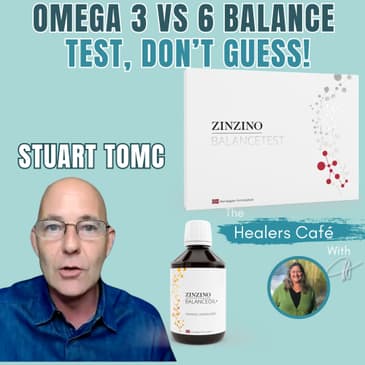
Stuart Tomc, a globally recognized leader in Omega 3 science, discussed his journey in the nutrition industry, emphasizing the shift from guess-based supplementation to test-based precision nutrition. He highlighted the importance of maintaining a balance between Omega 6 and Omega 3, ideally a 1:1 ratio, for optimal health. Tomc introduced Zinzino's Omega 3 blood spot test, which has tested 1.7 million people globally, revealing significant imbalances. He explained Zinzino's Balance Oil, which includes polyphenols for stability and efficacy,
For the transcript and full story go to: https://www.drmanonbolliger.com/stuart-tomc
Highlights from today's episode include:
Stuart says Test, don't guess: Omega‑6:3 balance in red blood cells is the key inflammatory "vital sign" – you can take fish oil and still be completely out of the safe zone.
Stuart explains fish oil ≠ fish: Most refined fish oils are "naked," stripped of protective polyphenols, so they don't behave like real food; Balance Oil restores that missing polyphenol protection.
Manon states health sovereignty: People should be the CEOs of their own health—using at‑home tests to know their status and keeping (or firing) practitioners based on results.
ABOUT STUART TOMC:Stuart Tomc is a globally recognized leader in omega-3 science with 30+ years in the nutrition industry and over $1 billion in supplement sales influenced worldwide.
He has appeared in 6,000+ media interviews and served as Global Educator for Nordic Naturals, training teams at Whole Foods Market, Sprouts Farmers Market, The Vitamin Shoppe, and GNC, as well as independent retailers and healthcare professionals around the world.
Today, Stuart is helping lead the shift from guess-based supplementation to test-based precision nutrition.
Start testing. Stop guessing.
We measure the AA/EPA ratio, Omega-3 Index, Gut Health Index, Vitamin D, and HbA1c — with more AI-driven tests on the way.
Stuart teaches that kitchen table medicine — testing at home with high-quality products delivered to your door — is the future of the supplement industry, and he mentors partners building scalable, subscription-based businesses rooted in real data, real results, and real retention
Core purpose/passion: Moving the dial on public health globally
Website |
ABOUT MANON BOLLIGER, RBHT, FCAH:
As a retired Naturopath 1992-2021, I saw an average of 150 patients per week and have helped people ranging from rural farmers in Nova Scotia to stressed out CEOs in Toronto to tri-athletes here in Vancouver.
My resolve to educate, empower and engage people to take charge of their own health is evident in my best-selling books: 'What Patients Don't Say if Doctors Don't Ask: The Mindful Patient-Doctor Relationship' and 'A Healer in Every Household: Simple Solutions for Stress'. and What if Your Body is Smarter than You Think? I am the Founder & CEO of The Bowen College Inc. which teaches BowenFirst™ Therapy and holds transformational workshops to achieve these goals.
So, when I share with you that LISTENing to Your body is a game changer in the healing process, I am speaking from expertise and direct experience".
Mission: A Healer in Every Household!
For more great information to go to her weekly blog: http://bowencollege.com/blog.
For tips on health & healing go to: https://www.drmanonbolliger.com/tips
Follow: Manon Bolliger website | Linktr.ee | Rumble | Gettr | Facebook | Instagram | YouTube | Twitter | LinkedIn |
Follow: Bowen College Inc. | Facebook | Instagram | LinkedIn | YouTube | Twitter | Rumble | Locals
ABOUT THE HEALERS CAFE:
Manon's show is the #1 show for medical practitioners and holistic healers to have heart to heart conversations about their day to day lives.
Subscribe and review on your favourite platform:
iTunes | Google Play | Spotify | Libsyn | iHeartRadio | Gaana | The Healers Cafe | Radio.com | Medioq | Audacy |
Follow The Healers Café on FB: https://www.facebook.com/thehealerscafe
Remember to subscribe if you like our videos. Click the bell if you want to be one of the first people notified of a new release.
* De-Registered, revoked & retired naturopathic physician after 30 years of practice in healthcare. Now resourceful & resolved to share with you all the tools to take care of your health & vitality!
[00:00:00] Welcome to The Healers Café, the number one show for medical practitioners and holistic healers to have heart-to-heart conversations about their day-to-day lives while sharing their expertise for improving your health and wellness.
[00:00:17] Welcome to The Healers Café and today I have with me Stuart Tomc and he is a globally recognized leader in Omega 3 science with 30 plus years in the nutrition industry and over 1 billion in supplement sales influenced worldwide.
[00:00:39] He has appeared in over 6,000 media interviews and served as global educator for Nordic Naturals, training teams at Whole Foods Market, Sprouts Farmers Market, The Vitamin Shoppe and GNC as well as independent retailers and healthcare professionals around the world.
[00:00:59] Today Stuart is helping lead the shift from guest-based supplementation to test-based precision nutrition. And I think I will leave it at that and just welcome you here and I'm super excited to be to have you present to our audience here and to tell us a little bit more about Zenzino.
[00:01:26] But I think before we start with that, just tell us a little bit about your own journey, your own path and how you connected to this company, because I see you were with Nordic, which a lot of us are familiar with. Well, Manon Bolliger, it's such an honor to be on your show. I'm just so touched. Thank you so much for letting me meet your audience today.
[00:01:52] I have spent my entire life in the dietary supplement industry. I started in 1985 in Chicago in a health food store called Sherwin's Health Food Store. You would have loved it. It was so cool. We had naturopaths working there, doctors like yourself or facilitators and experts in nutrition, and they were very interested in the science. And so I had a very great introduction to the industry. And then do you remember the oil of oregano product from North America?
[00:02:22] Right. Yep. The cure is in the cupboard. Right. I worked alongside Dr. Cass Ingram for 10 years. Wow. And I helped to develop those products. And it was such an honor. What a blessing. He was a great visionary. He wrote like 20 books. He was an osteopath, so he was also still seeing patients. And then I was recruited to be the global educator for Nordic Naturals.
[00:02:47] That was an incredible job. Wow. I mean, with your background, you would have loved it because they sent me to all of the big science conferences. Okay. And I would run the booth. And then during the lectures, I would run in and sit in the back. All right. And then I got to walk up to all of the leading experts in Omega-3 because it's still a small group. Right. And many of them are still alive. The top names.
[00:03:17] William E. Lanz, Ph.D., who is the father of the Omega-6-3 balance. Sir Michael Crawford, who's known as Grandpa DHA. I mean, these men are in their 90s. Susan Carlson. Anyway, the point is I got to meet all of the top experts. And because I was the Nordic Naturals guy, I was a non-threat to them. I was a proxy for their research. Right. So they took me under their wing and we became great friends. Thank you. Still to this day.
[00:03:45] And then after that, I helped to build CV Sciences. If you remember, Plus CBD. That was one of the big publicly traded cannabinoid companies. Oh, okay. Yeah, yeah. I mean, I don't know them. But that was a lot of fun, too. We had the patent for synthetic CBD for smokeless tobacco cessation. Okay. We were a real life science company.
[00:04:08] And then, anyway, and then a couple of years ago, I went back to my first love, which is Omega-3. Right. And so that's what I've done for the last couple of years to try to continue to educate people about test-based nutrition. I found the Omega-3 blood spot test in 2007. So this has been sort of the main quest of my life is to get people tested. Right. Well, I love the fact that there's testing.
[00:04:36] And you're not just guessing, like you said, you know, what your levels are. Because, you know, when I had a practice and I could prescribe, I would prescribe, you know, Nordic sometimes. I tried to get the top of the line and try and do the best amount of research. But, you know, there was no testing. So you don't know if they're having enough. You don't know if you should try a different brand. You don't know anything.
[00:05:05] So when I found out that you could actually test easily and also that the patient or the client themselves could test, that's what got me really excited because, you know, I'm into sovereign health. You know, people take over your own health. Don't trust everybody, but have a team that you trust. And if the team's not working out, fire them, you know, like fire. You know, so I'm a bit ruthless that way.
[00:05:35] So, you know, I know that you can do tests, you know, in some provinces here in Canada. But to have the client pick up the test, check out where they are, you know, I think that's an incredible service. So anyway, enough about this. Oh, no, no. I love hearing it because I'm biased.
[00:05:57] I'm completely invested in this idea of the decentralization and the democratization and the empowerment of testing. Because unless you prick your finger, here's my little lance, and put two drops of blood right on the filter paper, we have no idea if you have the right amount in your tissues. Right. Well, could you speak to why it matters that we should know?
[00:06:27] Like, why does omega-3 matter? I mean, a lot of people do know, but, you know, it's good to have a little bit of a reminder and why you're so passionate about getting this out to millions of people. Well, one of the little lessons that I learned, they call it omega-hand. If you just hold up your left fist and I explain to somebody, imagine this is omega-6. Omega-6 primarily comes from land-based food. It's essential.
[00:06:54] Your body doesn't make it, and it produces the largely pro-inflammatory hormone-like compounds. On the right fist is omega-3. This is also essential. It comes primarily from ocean seed-derived foods. And your body doesn't make it, and it's largely anti-inflammatory. We want these in balance in the tissue, which is the issue, in every cell membrane. So when people say to me, well, what is omega-3?
[00:07:24] Well, it's an essential fatty acid your body doesn't make, and it produces the largely anti-inflammatory hormone-like compounds. Omega-3s also produce things that are called specialized pro-resolution lipid mediators. That's a big mouthful, S-E-M-S, and they're involved in the orchestration of the resolution of inflammation. And what I learned from William E. Land's PhD, my mentor, Fish Omega-3 in Human Health, for those taking notes,
[00:07:52] is that these omega-6 and omega-3, our bodies were designed to have them in balance because they share the same enzymatic pathway. They compete for conversion and placement. So what does this mean to the layperson who's just, you know, plugging in? I know you have a very educated audience. But if you have a balance between omega-6 and omega-3, we have a much healthier inflammatory response.
[00:08:21] Because inflammation happens, it's life. Omega-3s help to suppress inflammation and resolve inflammation. So when people are in balance, one-to-one is ideal, hypothetically. It's still debated. Two-to-one, three-to-one, anything above that, you're missing the boat. And so the entire omega-3 industry, which is based on marketing, and billions of dollars have generated,
[00:08:49] if the patient doesn't test herself, you could be taking fish oil and eating sardines and be completely missing the safe zone. And the human consequence of inflammation that's not regulated is what we see. All our chronic diseases, strokes, heart attacks, you name it.
[00:09:16] I mean, every chronic disease has, well, not every, but almost, has a, you know, an inflammatory component. Right? So I completely agree. And some of my mentors have said to me, the doctor that used to be my boss at Nordic Naturals, I won't mention her name at this moment, but she was super, super, super cool. And she used to say to me, you know, when she saw her patients, she was a naturopath.
[00:09:39] She said, I would say to my patients, do you think that being out of balance is better in your situation? Mm-hmm. Mm-hmm. And just really empower the patients. You know what? I think you're right. I probably would like a better inflammatory or a healthier inflammatory response. So that's what I love about what we're doing now. We don't have to diagnose, treat, cure, mitigate, ameliorate any diseases or disease symptoms.
[00:10:06] We need to show people that if you are in balance and you have the appropriate omega-3 index, it's the most modifiable risk factor for health. Right. Yeah. Very interesting.
[00:10:21] There's a study that I don't know if you could just talk about it that shows how many, I think it's like thousands of people have taken this Zenzino and have had fantastic results in balancing, which, you know, most of our belief system is you put the body in balance and it knows what to do.
[00:10:45] So if you're missing the substrate so that the body can do its work, then you're missing, you can't go into balance. You're just missing too much to be able to do that. Right. Which is what excites me, you know, personally about omega-3 especially. But I like the balance. And what I was also reading is that you keep the polyphenols in.
[00:11:14] Can you maybe speak to that as well? I know I'm asking you two questions. No, no. I'll do that. I'm going to show you the data first. And then we're going to talk about why the cofactors are always important. Okay. Let's do that. They're always important. So let's first show your audience where they can go look at this information themselves. You don't have to register for this website. It's called ZenzinoTest.com. ZenzinoTest.com.
[00:11:43] And this is the global interactive map. Now, this is the reason why I felt so comfortable being part of this company and not just me, the former chief science officer from Nordic Naturals. He's also a partner in Zenzino. Their top medical spokesperson, Dr. Michael Lewis, MD, MPH, MBA. I work very closely with him every single day. My former boss who I had mentioned before, she had been part of Zenzino.
[00:12:13] Five of us from Nordic Naturals. So that should really say something. So first, it's powerful, isn't it? Yeah. We all jump ship. Why? Because we are brand agnostic. I'm going to make this clear. Patients come first. If you ate enough sardines, I walk around with my sardine can. If you ate enough of these and you got the right level in your blood, you don't need any supplements. Yeah. That's what a supplement is. You know what I was hoping?
[00:12:43] I'd be that one. No, me too. And I failed miserably and I ate sardines all the time. We'll get into the co-factor. So let's click Canada right here. So we've tested 11,064 people in Canada. Your average first score is 13.7 to 1.
[00:13:00] That means 13.7 times, let's be more technical, arachidonic acid, which is an obligatory ligand for cox and lox that make these pro-inflammatory hormone-like compounds, thicken your blood, increase sensitivity to pain. Very important when you get cut. EPA makes the anti-inflammatory hormone-like compounds that thin the blood and reduce sensitivity to pain, part of the resolution of inflammation. So look at this.
[00:13:27] 13.7 to 1 down to 3.3 to 1. That's 11,000 people. Wow. That's very persuasive. Now let's look at some other countries. Down here, 22.4 to 1. Wow. Okay. We eat more Pam and Spam and Ding Dongs and Chicken Nuggets and O's and Krispy Kremes than you, and y'all do. And good for you. But then we look at Norway or Sweden. Let's click over here. Norway, we've tested 113,000 people.
[00:13:57] And they go from 10.8 down to 2.7. So if you take some – go ahead, please. Yeah, it's still higher than I would have expected. Yes, everywhere. Yeah. If you look at Japan, and I won't click through all of them, but you can go and look yourself. Like, look at India real quick. 46.3 to 1. Yeah. I can see that. But, yeah, what about Japan? Well, Japan is about the same as Ghana, Africa. Okay. Okay.
[00:14:27] So I'm going to navigate away from this just for a second because it's worth saying. The score in Japan is almost the same as Ghana, Africa. The diet is completely different. They're about 9 to 1. So why? In Japan, they're eating on average 250 pounds of seafood per person per year. And they use a lot of sesame seed oil, which doesn't mean that it's bad. It just has more omega-6. Correct. Yeah. Now, we're looking at linoleate omega-6 in seed oil. We're really talking about arachidonic acid.
[00:14:56] But you see there's a competition. In Ghana, they're almost the same score. I have some partners in Ghana. And they just don't eat junk food. Right. And so it's the silver lining of being poor. It's very beautiful. And so when people look at that map and realize that we've tested 1.7 million people and we found an entire world out of balance. Yeah. That's quite impressive. Yes.
[00:15:26] Then, in summary on this thought, and then we'll talk about why the cofactors are important. Yes. The main reason I was so comfortable with being part of this organization is all of the samples go here. This is called VTAS Analytical Services. This is where the red blood spot testing was born in the Science Center in Oslo, Norway. They work with the Max Planck Institute, Bristol-Myers Squibb, GE Healthcare, and Zenzino as their biggest customer.
[00:15:56] Now, what I loved was you get a little identifier code. It's completely anonymous. They don't get your address or your phone number or anything. And they've taken that data and look at this publication. 590,000 whole blood dry spot samples. This is the largest observational study ever. 590,000 people. And it found a world out of balance.
[00:16:24] Now, we have two other publications going through peer review. When they come out, if you'd be so kind, I'd love to come back. Sure. That'd be great. Show the audience. Because this makes this the biggest public health initiative. And a company that is not a marketing company masking around as a science organization. We're very committed to health. And the people behind the company are some of the greatest minds.
[00:16:53] I will point to the gentleman to the top right, Paul Clayton, Ph.D. He studied at Edinburgh and then worked with Sir Michael Crawford. And if you followed his work ever, he's the greatest living mind in nutrition today, in my opinion. So he's our chief science officer. The man right below him and Angela Rizzo and several others created what's called balance oil and the balance concept. Right.
[00:17:21] And the balance concept was we're not going to guess. We're going to test the patient at baseline. Then we're going to start this next generation oil I'm going to explain based on your body weight. Here's a shot glass. You're bigger, you take more. You're smaller, you take less. And then they said something so simple, so profound. I can't believe we missed it. They said, you can't teach a one day old red blood cell a new trick. It's an old dog and won't learn a new trick.
[00:17:51] You can't affect a 118 day old red blood cell. They live about 120 days. They said you can only impact the new red blood cells that are coming online out of the bone marrow. So you need to take the oil based on your body weight, your bigger, more, smaller, less, for 120 days and then test again.
[00:18:12] And then finally, you have to make sure that your oil is more like oily fish in liquid form, not purified fish oil. Now, this is where I had to eat some humble pie. And I was wrong because I stood on stages all over the world and I said, Nordic Naturals makes the world's safest, most effective omega-3 oils. And I show the levels of oxidation almost non-existent. You remember the sales pitch?
[00:18:42] Oh, yeah. Well, it ends up being naked oil. Denatured. Naked oil. Denatured, right. Allow me to explain. So this is where it all starts. So algae is the source of all EPA and DHA, every single bit. Now, we're not talking about ALA from flax meal or purslane that desaturates and elongates. And there are rate limiting factors there.
[00:19:09] Here, the preformed EPA and DHA all comes from marine microalgae. And around the outside, I'll show you what it looks like, is a polyphenol ring. Technically, it's a fluorotannin with a P. And it protects the omega-3 and it ensures it goes through the trophic levels of the fish. Ultimately, when we eat sardines or fish, the polyphenols are there to help it bioaccumulate.
[00:19:36] When the Inuit were eating seals and whales, they weren't just eating EPA and DHA. They were eating a ton of these polyphenols, which are antioxidants. And allow the Inuit to recycle the small amount of vitamin C they got in the skin of the seals, which is why they didn't have scurvy. So when I unlocked all this, my brain exploded because this is what we do to fish oil. This is an analogy now.
[00:20:06] We take this incredible, perfect food, milk, and then we destroy it. But this is what we do with fish oil. And I don't think people fully appreciate how much processing goes on. Look at the right side of the slide. Heat it up to 250 C under a vacuum. Separate the molecules by weight. We remove the contaminants. That's good.
[00:20:33] And then we remove all of the cofactors in nature. And that's bad. So this is what they look like. If we didn't have that polyphenol ring, the EPA and DHA explode. So what were we doing? We were taking purified fish oil, putting it in a bottle with vitamin E like Edward and rosemary. And the second you ingest it, it's absolutely unstable in the body. It is not the same as eating fish.
[00:21:01] So how do we replace these polyphenols? Well, they got lucky, in my opinion, because there are 8,000 polyphenols. And the ones in olives, pre-harvest baby little olives, are lipophilic and almost identical in structure. And so what they did is genius. During the manufacturing, it's a nitrogen blanket, so there's no oxygen.
[00:21:28] You pump in the triglyceride form fish oil made from anchovies, totally sustainable triglyceride form with the polyphenols. And they wrap around and mimic that delivery system in nature. And when I finally learned that, I shared that with all of my teachers and all of my mentors. And now they're all using the Zenzino products. Right. Well, I mean, it's pretty compelling, right?
[00:21:56] I'm thinking of another example like reverse dosmosis that was such a big thing. But if you don't add the minerals, like it does all kinds of problems afterwards, you know. It's like our cleanup crew. We so need that because we're so toxic from all the policies that are happening, you know. And it's we need to clean up, but we have to replenish. We have to have something whole in the end, you know. Yes.
[00:22:25] No, we need the co-factors. And if I can just one more slide, a couple more papers, if you don't mind. I don't want to know. I get sometimes so excited about this. But then people say to me, OK, great. This sounds really clever. You showed me the map of all of the people that failed the first test and passed the second test. I was one of them. But please, elucidate. Show me a little bit more. So this great paper in molecules, polyphenols and fish oil for improving metabolic health.
[00:22:54] Anyone can get access to this. It's been reported that the combination, like you find in the balance oil, of these nutraceuticals can lead to a threefold increase in glutathione peroxidase activity. As well as a 50 to 200 percent attenuation of common inflammation biomarkers as compared to their individual capacities. Now, that is powerful. But there is more. What about specifically on the stability?
[00:23:20] How much more stable is it not only in the bottle but in the human body? So here this is called the oil stability index. So we compare balance oil on the right to cod liver oil, concentrated omega-3 and krill oil. And you see how much more stable the balance oil is. I encourage anyone to look up hydroxytirosol. I knew nothing, nothing about these molecules. It also crosses the blood-brain barrier. It is a prebiotic.
[00:23:50] And it also eats microcalcifications in your arteries. Very few things do that, maybe natokinase. Which one does? Hydroxytirosol is one of the main polyphenols in the olives. So when you put them together, as you see in this paper, sustainably sourced olive polyphenols and marine and omega-3 marine lipids, a synergy fostering public health.
[00:24:18] Look at the graphic abstract. The fish with the olive. Wow. And look at what it says. Natural polyphenols present in marine oils play an essential role in protecting omega-3 lipids from oxidation and auto-oxidation, ensuring that no pro-inflammatory products are formed after intake, as often happens with refined omega-3 concentrates.
[00:24:46] If you're taking highly purified fish oil, you might be missing the boat. It's not the same as food. What would your life be like if you were pain-free? If you were one of the millions who suffer from chronic pain, the thought of just one day without it may seem impossible. This is often because conventional medicine tends to fall short on the treatment of pain. Opting to prescribe pills or recommend surgery rather than getting to the root cause of the problem.
[00:25:16] But if you are suffering with emotional or physical pain, there is hope. Join the founder and CEO of Bowen College, Manon Bolliger, live online for your body-mind reboot. Learn how to listen to your symptoms and get to the root cause of your pain. Plus, be trained in basic Bowen therapy moves so that you can reboot your body for optimal health. You don't have to live in pain.
[00:25:45] You can heal. Stop the pain pill cycle by visiting www.yourbodymindweaver.com to learn more and to register. And that's why I wasn't delivering. Wow, yeah, that's very eye-opening. I mean, I get it now to another level than when I read it. Thank you so much.
[00:26:15] But it makes, I mean, I'm a real foodie and a food person, you know. So I want everything to go back to food, you know. And I honestly am not a big supplements person. I don't, it's not that I don't believe in them. It's more that I wish we didn't need them. I wish our earth and our land and our soil could provide. And I wish the sun wasn't hiding.
[00:26:42] And, you know, and I wish our clouds were like puffy things like in the past. And I have a lot of wishes. Well, I agree with you completely. I mean, a true supplement should supplement the diet. And if someone ate enough of these sardines. Right. I just always use the sardines because they're easy. Or enough wild-caught salmon. And they tested and they were 2 to 1, 3 to 1, or 1 to 1. You would have the absolute protection that omega-3 is offering. Yeah. Yeah.
[00:27:11] And most people don't eat enough of the fish. And that's why they do need the supplements. Right. And then there's a limit to how much fish without then causing toxicity because of the mercury. Right? Well, it's very highly, it's been highly debated. The selenium that's naturally occurring in the marine food web acts as a natural chelator. So that can help protect you. And also can. Okay. Right. So there are a few other things we would need, right, in a healthy diet.
[00:27:39] Remember, in the marine food web, we're going to have iodine. And there's a huge iodine deficiency. Correct. You're going to need manganese, zinc, copper, and selenium for the antioxidant signaling system in the brain to help protect omega-3. So those are all the things you would get from the marine food web. However, balance oil is a Mediterranean diet in a bottle. Right. Right. Right. Okay. And that is exciting because you could supplement with a little bit of iodine or eat some fish
[00:28:08] and take some of the other micronutrients in your food and really be recreating the Inuit diet in a bottle and the Mediterranean diet in a bottle. And so I think since most people aren't going to eat enough fish, I'm very comfortable saying that this is probably going to be more user-friendly. Right. Yeah. I would imagine. Plus, it can taste like lemon or something rather than fish to those that don't even like fish, you know.
[00:28:37] I had another question that came to me here. Your thoughts on different forms of omega-3. And if you could comment on ethyl, as in ester, ethyl ester, triglyceride, and also isophosphadilcholine bound omega-3s. Okay. Great. Great. So we're going to go back to this. This is such a great question. Thank you so much. Okay. So let's go back to this slide here for a minute.
[00:29:08] So when they want to really concentrate the amount of EPA and DHA, in fish, the average in sardines and anchovies, we call it 18-12, 18 EPA-12 DHA. So there's a little bit more EPA than DHA. Cod liver oil is different because when it's colder, when the water's colder, there's a little bit more DHA.
[00:29:33] So when it's in the natural triglyceride form, it has not been broken apart and then re-esterified. So let's go step by step. When you break it apart to concentrate it, you make something called an ethyl ester. You break the natural glycerin backbone. It's like a letter E. And you attach the omegas to an ethanol. Now, that doesn't exist in nature.
[00:29:59] It melts styrofoam, which doesn't mean it has adverse biological activity. The two FDA-approved drugs, actually the three, the two approved in here and I believe Health Canada and one in Japan are ethyl esters. Because the concentrate pure EPA and pure DHA or pure EPA, it doesn't swim around in nature like that. Now, the layperson often says, well, it's the pharma one. It has to be bad.
[00:30:29] I'm sorry. The WHO has a list of life-saving drugs and they do have a role in medicine and they're now standard of care. So there is Lovaza, which is EPA and DHA to lower triglycerides. And the newer one is called Vasepa, pure EPA, used on top of standard of care, lowers major adverse coronary events by 25%. It was just added to the American Heart Association's list for residual risk.
[00:30:58] So when someone says to me, they're ethyl esters, they don't work, they're not reading. Okay. They're ill-informed. However, a lot of us prefer natural. And so when you use something like balanced oil, we don't break it apart, attach it to an ethanol molecule or re-esterify it like Nordic Naturals does. That's called a re-esterified triglyceride.
[00:31:23] And then there's a debate is if the DHA is in the SN2 position, does it really mimic nature? Then there are all of these new ones. You talked about the new DHA bound, right? They've got to be bound to phospholipids. You see all of this marketing. Well, here's what I love about this test. The first test is it all comes out in the red blood cell. Everything comes out in the red blood cell.
[00:31:51] So everyone's arguing about my mouse trap is better than your mouse trap. This red blood cell test is going to capture. There's the fats we eat, the fats we make from de novo lipogenesis. And then there's the supplements that we're taking. At the end of the day, whether it's an ethyl ester, a triglyceride, a re-esterified triglyceride,
[00:32:14] a phospholipid bound DHA or krill oil, your goal is to get 8% or more of omega-3 in the red blood cell and to get a balance between omega-6 and omega-3 of 3 to 1, 2 to 1 or 1 to 1. That's why the test has the power. I don't like the marketing personally because I feel like they just – you're Canadian. I'm an ad busters follower. I don't know if you ever read ad busters.
[00:32:41] But I just can't stand marketing and advertising. At the end of the day, the tissue is the issue and this captures everything. Yeah, no, I mean I'm also allergic to that, which is – which I find myself in a strange predicament, actually loving a product and believing that it really is what people should be taking and then letting them know about it and then finding –
[00:33:11] well, let me just address the – whatever they call it, the elephant in the room, right? It's this idea that there's a membership, right? So I just want to – and please correct me if I haven't seen it the right way, okay? And so the way I understand it is in order to – well, you can just buy it. You can buy the test separately. You can buy the product separately. You can do anything you want separately. You don't have to be in a membership at all.
[00:33:39] But there's a cost advantage that if you do join a membership, which you are – basically you manage that membership completely on your own. So it's not like you have to do these endless emails, please take me off, please refund me last month, please whatever, all that. You do your own management.
[00:34:03] And the reason it's set up in my understanding is six months is because the first month, the company gives you the test and basically for the same price throws in the product. That way you test yourself. If you happen to be all green and you like what you're doing, then let's say enough sardines and everything's working out.
[00:34:30] You just stop it and that's it. And they actually refund you. If you are another color and you decide, you know what, I'll test this product out, you can continue. And at the five-month mark, Sinzino sends you for free another test. And this way they get a database. Again, it's anonymous, but they can see that their products work.
[00:34:59] You can see that the product works. And then you choose at that point you're all good. Or you choose this product works. I like it. I'm just going to stay on it because it's working for me. And by then, you're past the 120 days. Your body is actually noticeably different. You feel, you know, if you had inflammation, it's less than it was.
[00:35:24] And also like brain fog, like if it does cross the blood-brain barrier, then it would help with cognition and all those things, would it not? You are so spot on. And I want to address this whole thing. I thought I'd be remiss if I didn't quickly show what the results look like as I respond to your comments. Sure. If you just look at how easy this is for the patient to understand.
[00:35:53] Unbalanced. Okay. Look at the omega-3 index. Insufficient. If you are fortunate enough, and I've seen people that scored like this on their first test. Yeah. You're balanced and you have an optimal omega-3 index. The customer gets all of their money back. Yeah. And they get to keep the oil. Now, this is what I find so fascinating.
[00:36:16] There's a doctor in Canada that has over 200 patients that have been taking the test, the before and after test. He's mimicked the results that about 95% of people fail. But the 5% of people that pass, they just decided to stay on the oil anyway because you have to stay in balance. Right. Because of the polyphenols, they report that their guts feel better. Their digestion is better. Their cognition is better. They're just better.
[00:36:46] They're getting improved benefit over time. Now, let's address the elephant in the room. Price is everything. Market efficiency has changed everything. That's why I'm no longer working with a retail brand. Because when you think about being gouged, go to the store shelf. People don't appreciate that $100 product on the shelf is $50 wholesale. The master distributor price is 25% off.
[00:37:14] The broker, she gets 10%. The store owner asks for a free fill. Then there's co-op advertising. What Zenzino figured out, they call it Scandinavian kitchen table medicine. I love it. I love it. I love it. Where you take the test in the privacy of your own home and then the highest quality product is sent to your front door. This is twice as good as Nordic and half the price. You get to manage your entire subscription. I've never seen anything like this.
[00:37:43] Every customer gets their own website. Their own website. They can click on their subscription, add and subtract at any time. You don't need to call anybody or email anybody. Every dollar of shipping gets refunded back to the patient. Right. I heard. After their seventh order, they get 10% on top of the shipping. They can use all of those reward dollars to try other products and they can forward the link to their cloned website. This is so Norwegian.
[00:38:13] This is so cool. They send the link of their cloned website to their friends and then they can earn their products for free. Right. It turns into a little game. So if you really look at market efficiency, I think if you were to ask younger people, they're okay with subscription. Well, it makes sense. You know, I think like I see the sense in that it's who you decide to pay.
[00:38:40] You know, you can do Facebook ads and help Facebook get bigger or you can use other methods as well. Like this. Yes, exactly. Like this is our volunteer army. That's right. This is interesting. We did as much business with Zendino last year as Nordic Naturals did. Now, so they spent millions and millions and millions on branding and advertising. And what did we do? We had a volunteer army where somebody tests and then it turns into a game.
[00:39:10] This is my favorite part. They might not change their diet on the first test, but when they get green on that second test. Then they're sticking with it. Well, the patient compliance and that was the rate limiting factor in your whole life. All my friends are doctors and naturopaths, osteopaths, PhDs and physicians. Isn't it hard to get people to do something? Okay. Mm-hmm. Mm-hmm. It's a good one. Okay. Even if they know they should, they love you. Yeah.
[00:39:39] You know, our time is almost up, but I really do want to... One of the other things I'm excited about the company itself is how innovative it is and how many new tests. Now, I know in Canada we have our own regulations, which maybe we won't shortly. But anyway, the gut tests, like you're doing other things that...
[00:40:03] And again, this goes under my real belief that we need to be in charge of our own health and not to, you know, give it into the hands of experts that are maybe experts, maybe not, maybe paid, maybe this, maybe that. You know, we have to look at all this. But we need to be in charge of it. And so I love that you're having this gut test.
[00:40:28] Can you tell us just a little bit what's coming and what else is available for health sovereignty? Okay. I'll go through this quickly because we've got quite a few slides to show you, but I think it'll be worth it. I'll go through it quick.
[00:40:40] One of the other advantages of getting back into balance is it will shift the metabolism of the amino acid tryptophan from the pro-inflammatory pathway to the indole pathway, which is where your microbes in the gut metabolize the tryptophan. And you can measure it in the blood now for the first time thanks to Zenzino. Now, we built this in-house. We didn't create the omega-3 index. That was born in 2004.
[00:41:10] We bought, Zenzino bought, the balance concept, and we brought it all over the world. This is our Eureka contribution to the world. So no longer a stool sample. If you're measuring lipopolysaccharides or zonulin, you're looking at what's in the stool. There's some information. This is showing the functional output. So for any of your viewers that would like a deeper dive, great article. Cassandra Stern interviews Dr. Maria Torrenson on our team, how we're betting big on blood for gut health.
[00:41:40] And we coined the term the gut health index. You've heard of the omega-3 index. We coined the term the gut health index. You don't need to understand quinolinic acid, the chyurinine pathway, indole-3 propionic acid. Most people won't. What you need to know is you need a high gut index, not a low gut health index. IPA to the right. That's the signal.
[00:42:04] It is a signal that your bacteria, it's a specific bug, chlorostridium sporogenus. And it also goes back up through the blood-brain barrier, and it scavenges free radicals in your brain. It also is a ligand for these targets that help to tighten up these loose junctions. So if you have high levels of IPA in the blood, it's a signal of microbial balance and epithelial resilience. Some have said leaky gut, leaky brain.
[00:42:32] You don't want everything leaking through there with the increased permeability. This is what you want is a high gut health index with a high level of IPA. And so this is the forefront of health sovereignty. If you knew your omega-6-3 balance and your gut health index, you're covering cellular health and gut health. And all the clinicians that are listening too, you can track to see if what your patients are doing is actually working.
[00:43:03] Take the gut health test before, take it after. If you fail, it usually means you need more fermented foods. You need more prebiotic fiber. You have too much stress. You're out of balance, and you're shifting all the tryptophan to the chyuronine pathway. So once you're healthy, you've got good microbiota, a good jungle down there, not too much stress, then you have a higher score. I love what Zenzino is doing to put health, power, and sovereignty back in our hands.
[00:43:33] Okay. Well, I have more questions. We're going to have to do another one. But I think we'll leave it if you're fine with it today like this. I also want to talk about for practitioners, you know, but let's, yeah, because I just see this product as, or the team as wanting to get the word out. They're going to be the biggest preventive health company in the world.
[00:44:00] The biggest preventive health company in the world. This is not about commerce. This is how we're going to change the world. When we come back next time, I worked with the guy that tried to do it at the Pentagon. He couldn't get them to test. We'll talk about that next episode. We tried to do it at Nordic Naturals. This is the volunteer army that we've been looking for our whole lives. Yeah. I'm so honored to get to meet you today. Yeah, well, thank you so much for coming and sharing all this.
[00:44:29] I think it'll be greatly appreciated. Thank you so much. Thank you for joining us at the Healers Cafe. If you haven't already done so, please like, comment, and subscribe with notifications on, as I post a new podcast every Wednesday with tons of useful information and tips for natural healing that you won't want to miss.