
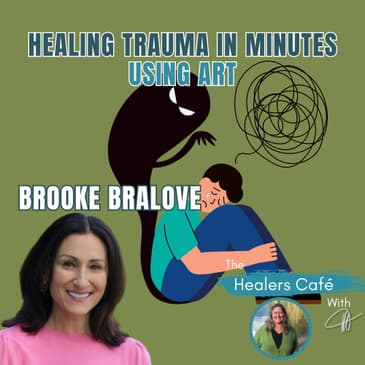
Brooke Bralove, a licensed clinical social worker and AASECT-certified sex therapist, discusses Accelerated Resolution Therapy (ART), a rapid, evidence-based treatment for trauma. ART uses rapid eye movement and voluntary image replacement to reconsolidate distressing memories, often resolving trauma in 1-5 sessions. It can treat PTSD, depression, anxiety, chronic pain, and more. Brooke shares success stories, such as a woman whose toe pain disappeared after processing emotional trauma.
For the transcript and full story go to: https://www.drmanonbolliger.com/brooke-bralove
Highlights from today's episode include:
Brooke explains trauma can often heal in 1–5 ART sessions—even in a single 90‑minute session.
Brook teaches that ART lets you keep the facts but lose the painful images, beliefs, and body sensations.
Manon states the body stores memories in its tissues—and can release them without re‑telling the story.
ABOUT BROOKE BRALOVE:Brooke Bralove, LCSW-C, is a Licensed Clinical Social Worker, psychotherapist, AASECT Certified Sex Therapist, and expert in trauma, sexual health, and emotional healing. With over 20 years in private practice, she helps individuals and couples overcome anxiety, trauma, and relationship challenges so they can feel more connected, confident, and fully themselves.
Brooke integrates neuroscience-based approaches, including Accelerated Resolution Therapy ART, to create rapid and lasting change. She is a sought-after speaker known for her warmth, insight, and ability to translate complex emotional and neurological processes into practical, transformative tools.
Core purpose/passion: Brooke's mission is to help people heal trauma, reclaim their authenticity, and experience more joy, pleasure, and connection in their lives.
Website | Facebook | Instagram | LinkedIn
ABOUT MANON BOLLIGER, RBHT, FCAH:
As a retired Naturopath 1992-2021, I saw an average of 150 patients per week and have helped people ranging from rural farmers in Nova Scotia to stressed out CEOs in Toronto to tri-athletes here in Vancouver.
My resolve to educate, empower and engage people to take charge of their own health is evident in my best-selling books: 'What Patients Don't Say if Doctors Don't Ask: The Mindful Patient-Doctor Relationship' and 'A Healer in Every Household: Simple Solutions for Stress'. and What if Your Body is Smarter than You Think? I am the Founder & CEO of The Bowen College Inc. which teaches BowenFirst™ Therapy and holds transformational workshops to achieve these goals.
So, when I share with you that LISTENing to Your body is a game changer in the healing process, I am speaking from expertise and direct experience".
Mission: A Healer in Every Household!
For more great information to go to her weekly blog: http://bowencollege.com/blog.
For tips on health & healing go to: https://www.drmanonbolliger.com/tips
Follow: Manon Bolliger website | Linktr.ee | Rumble | Gettr | Facebook | Instagram | YouTube | Twitter | LinkedIn |
Follow: Bowen College Inc. | Facebook | Instagram | LinkedIn | YouTube | Twitter | Rumble | Locals
ABOUT THE HEALERS CAFE:
Manon's show is the #1 show for medical practitioners and holistic healers to have heart to heart conversations about their day to day lives.
Subscribe and review on your favourite platform:
iTunes | Google Play | Spotify | Libsyn | iHeartRadio | Gaana | The Healers Cafe | Radio.com | Medioq | Audacy |
Follow The Healers Café on FB: https://www.facebook.com/thehealerscafe
Remember to subscribe if you like our videos. Click the bell if you want to be one of the first people notified of a new release.
* De-Registered, revoked & retired naturopathic physician after 30 years of practice in healthcare. Now resourceful & resolved to share with you all the tools to take care of your health & vitality!
[00:00:00] Welcome to The Healers Café, the number one show for medical practitioners and holistic healers to have heart-to-heart conversations about their day-to-day lives while sharing their expertise for improving your health and wellness. Welcome to The Healers Café and today I have with me Brooke Bralove.
[00:00:26] She is a licensed clinical social worker, a psychotherapist, an AASECT, so ASECT certified sex therapist, an expert in trauma, sexual health and emotional healing.
[00:00:44] With over 20 years in private practice, she helps individuals and couples overcome anxiety, trauma and relationship challenges so they can feel more connected, confident and fully themselves. Brooke integrates neuroscience-based approaches, including accelerated resolution therapy, which is ART, to create rapid and lasting changes.
[00:01:12] She is a sought-after speaker known for her warmth, insight and ability to translate complex emotional and neurological processes into practical transformative tools. So, welcome. Welcome.
[00:01:29] And I actually haven't interviewed anyone who does ART, so I think it's perfect to start with a definition of it that everyone can relate to. Anyway, but welcome, first of all. Thank you so much for having me, Manon, and I'm excited to get into it with you today. Okay, well, so why don't we start with that?
[00:01:56] What is ART exactly and how does it work? How can it help people? You know, and then we'll talk later about, you know, what you've seen and all of that and why you got there. But we'll start with what it is first.
[00:02:10] So, accelerated resolution therapy or ART or ART, I will probably refer to it as ART today, is an evidence-based treatment modality that uses rapid eye movement and voluntary image replacement to change the way the brain stores distressing images, memories,
[00:02:34] and the corresponding negative sensations that show up in the body when you might be triggered. Mm-hmm . And it is revolutionary in that you can heal trauma in only one to five sessions.
[00:02:52] And there are cases specifically with single incident trauma where I have only needed to see someone for one 90-minute session and they are good to go. Mm-hmm . So, the change is rapid and profound and really lasting. And it's the most exciting thing I've ever done in my work.
[00:03:17] Um, I feel very passionate about it, mostly because I literally witness radical transformations in a matter of minutes in my office. Mm-hmm . I can see the change. I can feel the mood shift and how quickly that will happen for someone. And, um, I just love it. I'm really excited about it.
[00:03:42] So, so maybe take us from, you know, most people have heard that the brain doesn't know the difference between, you know, reality, or, or what it imagines or what you imagine for it or whatever, however that works. Um, how, and some of this therapy is based on the play of that. Mm-hmm .
[00:04:07] And then the rapid eye, I'm, I'm going to assume that that is a way to get into the subconscious, right? To be able to rewrite. But tell us like, how does it work? Like how, the simple version. Sure. So, basically, um, let's take an example like, um, someone has been, uh, sexually assaulted in college. Mm-hmm .
[00:04:34] And they are having intrusive memories, thoughts, and specifically, this happens a lot. Let's say the person is an adult, and every time their partner touches them, they wince and tense up and become completely dysregulated. Mm-hmm . So, they're suffering right now based on something that happened before. Correct.
[00:04:58] And so, what we do with the rapid eye movement is we replicate REM sleep. And during REM sleep is when memories are reconsolidated. Mm-hmm . So, I like to think of it like we're taking a process that occurs sort of unconsciously, and we're doing it while, while we're wide awake and alert. Mm-hmm .
[00:05:20] But we're using the rapid eye movement to calm negative sensations that will likely show up in the body when you are processing some sort of scene. In art, we use, uh, the language of cinema. So, we will talk about seeing a scene in your mind. Right. And so, we basically, we have the person see a scene in their mind with no talking.
[00:05:50] ART has almost no talking, so it's not re-traumatizing, which is really wonderful because a lot of trauma therapy is. Yeah. Correct. And we'll have them see that. And while they're doing calming eye movements, and so the negative sensations that show up in the body begin to decrease over the session. Mm-hmm . And then, similar to EMDR, we desensitize them.
[00:06:20] There's a next step around that. And then we ask them to change it any way they want. Mm-hmm . Mm-hmm . And so, for someone, that might be that it never happened. It might be that they never went to the party that night. It might be that they actually fought off their attacker because their need is to feel powerful and strong.
[00:06:46] It's really whatever the brain needs to feel better. And the brain knows how to heal itself. Yep, yep. And so, all we're doing is kind of allowing this window of opportunity to rewrite it. And as you said, the brain does not care if that's real. And in fact, the more fantastical, the better. Mm-hmm .
[00:07:12] So, people bring in superheroes to rewrite their script. Harry Potter shows up a lot. So, you're really talking fantasy, right? And all the brain needs is a really good story. So, it wants to hold on to it. Right. And so, you do have to radically change it. You can't just change it a little bit. Mm-hmm . Or I would say, the brain's kind of lazy. It's like, eh, that's not, I don't really need to change it because it's too similar to the other one.
[00:07:42] Right. And then what happens is, let's say there's, again, a touch, which would be an appropriate touch. What happens is, does the body forget all of the automatic sort of reflexes? It just doesn't go there? That's exactly right. Mm-hmm . So, after ART, when there is a trigger, the person is likely to feel completely neutral. Right.
[00:08:12] And they might be able to know that a week prior, they would have jumped, but they didn't. And that's the real knowing. I mean, I've had people who, you know, come in really just after one or two sessions, and they say, you know, it's all gone. The triggers are all gone. Right. And you're really giving people, you know, a new lease on life because it's disrupting them now. Right.
[00:08:39] And, you know, with ART, it doesn't matter whether the trauma or the incident or what you're processing happened yesterday or 45 years ago. Mm-hmm . It often has, especially if you've retold a trauma that has happened to you, you know, 30 years ago. Mm-hmm . I always say it's like, you know, they are dug in, those images, those neural pathways. Right. And we're basically saying, no, no, look over here.
[00:09:08] Let's work on those new neural pathways. Mm-hmm . And it's really just amazing what the brain can do to heal. Mm-hmm . And so this is done with, so an instance or a memory. Can it be used for pain out of curiosity? Absolutely. I mean, first of all, I do want to just say kind of a general sort of, here are some of the most common ways ART is used.
[00:09:38] It's used for PTSD, trauma, depression, anxiety, insomnia, ADHD, phobias, OCD, chronic pain, chronic illness, migraines, performance anxiety, fear of flying. You name it. It works. Yeah.
[00:10:01] So why I was asking pain specifically is because the other ones I can tell, like once there's a story involved in that or a belief or an opinion or whatever it is, then, you know, it weighs on you whichever way. Right? But, I mean, and pain, certainly there are stories that can be developed about pain.
[00:10:26] So I can see in those cases, but the actual, you know, like let's say post, like neuralgic pain, which is usually triggered by something. Otherwise, it may be silent. So you've got the trigger, but is it, is it the same like pathway to the brain? I mean, that's understood, but I just, I have a hard time fully getting that. Yeah, I understand.
[00:10:54] So it does work exactly the same way. And ART is very procedural. We have a very clear way to do it. And, of course, it involves, you know, bringing in your own flair, but it really does follow very sort of simple steps. And so let's take someone who has, you know, chronic back pain.
[00:11:20] We will do a session simply on what their beliefs are about it, as you said. We could do something around that. It might be the most amazing way that I see chronic pain get worked through is that we bring up the negative sensations while they're sitting there, you know, and they'll say, yeah, you know, my lower back hurts.
[00:11:48] And then we ask the brain to show them the very first time or a much earlier time where they felt those sensations. And what's so beautiful is, again, when you pair it with eye movements, the brain can come up with something often in like 10 seconds. Right. Especially when you don't go thinking about it. And so people will say, you know, oh, my God, I don't know why.
[00:12:15] But, you know, I'm thinking about this time that, you know, my mom yelled at me because I, you know, didn't clear the table correctly. And, you know, it's something that they have zero idea that is connected to their pain. And so then you heal that up. You update the brain to say that's not going on. You have them rewrite that and their back pain will go away. And it literally happens in the session.
[00:12:45] Wow. I'd love to witness that. Yeah. Another good example is the way, you know, let's take that same issue, chronic back pain. Usually they have years and years of going to doctors, not being believed.
[00:13:07] So the medical trauma associated with either chronic illness or chronic pain almost always has to be processed, especially around things like Ehlers-Danlos syndrome or POTS or ME-CFS that, you know. Libromyalgia. Exactly. Where people really, you know, have been made to feel crazy. Yeah. And, again, we have to go through the medical trauma, but we also try to find an earlier time where it started.
[00:13:34] And I would say about eight out of ten times that actually exists. Or we have them process, you know, a very typical day of just living with chronic back pain. So they would just see themselves on a typical day. You know, they wake up and their back is sore and then they have trouble walking. And then, you know, they can't sit for too long at lunch. And, you know, and we just have them see that whole thing because that's their experience.
[00:14:04] And, again, then they change that typical day into clearly a day where they are, you know, moving and grooving and beyond functional. Flying, jumping, running, you know, living their best life. And then we store that in the brain. Okay. And when you store that, is there like, because you have the eye movement, how do you store it?
[00:14:32] How do you get the brain to go, okay, I'm ready now? Like, I know there's methods where, you know, you can go up to a certain emotion and then you can, you know, put it in your finger or your knuckle. I mean, whatever, there's like all kinds of, what is the method here that seems to be anything? You just literally invite the brain to change it. And the brain, again, knows how. There's nothing, there's actually nothing magical. There's no trick there.
[00:15:01] You just leave space for them to come up with it. Now, every once in a while, they'll need to do a couple versions. Sure, sure. Like, they'll do one and they'll be like, eh, that's not so great. And then we know because they're not having positive sensations in their body. Right. But I always say the most amazing moment in an ART session is when someone is imagining, you know, the way they wish something had happened or pain-free living.
[00:15:29] And you all of a sudden see this beautiful smile. And then I always smile because I think to myself, got them. You know, they're in. They're in. And it's really beautiful to watch. And, in fact, I've actually taken pictures of someone when I do it virtually where I'm showing them when they're in a not, you know, when they're in a dysregulated place.
[00:15:57] And then I take a picture of them at the end and I show them. And they are kind of amazed. It's a very serene, you know, look that comes over. What would your life be like if you were pain-free? If you were one of the millions who suffer from chronic pain, the thought of just one day without it may seem impossible. This is often because conventional medicine tends to fall short in the treatment of pain.
[00:16:24] Opting to prescribe pills or recommend surgery rather than getting to the root cause of the problem. But if you are suffering with emotional or physical pain, there is hope. Join the founder and CEO of Bowen College, Manon Bolliger, live online for your Body Mind Reboot. Learn how to listen to your symptoms and get to the root cause of your pain.
[00:16:49] Plus, be trained in basic Bowen therapy moves so that you can reboot your body for optimal health. You don't have to live in pain. You can heal. Stop the pain pill cycle by visiting www.yourbodymindreboot.com to learn more and to register.
[00:17:18] So what got you, well, how did you find out about this or how did you end up adopting this practice? Yeah, so I came by it as a client. I went through a very traumatic breakup in 2017 and I had my regular talk therapy. I doubled up on that. I tried, you know, yoga therapy and all sorts of things and nothing could move this tremendous grief. Nothing.
[00:17:49] And I really was kind of at my wits end. And, you know, one person mentioned this thing. I had never heard of it. And I went and I did two sessions of ART and I felt completely neutral about the breakup. So from, you know, intrusive images, intrusive replaying words and things that he had said to me over and over, they just went to kind of a nothingness, like no attachment.
[00:18:18] So I can tell you, you know, in ART we say keep the knowledge, lose the pain. You, of course, would never want to forget any facts of your life. That's important. But what you don't need are the images, the beliefs about it and the way it gets stuck in your body. You don't need that. That does not serve you anymore. So we're updating the brain to say that's not happening anymore. You're good. Yeah, very interesting.
[00:18:47] Yeah, because do you know a little bit about Bowen therapy? I don't know very much about it. I won't. It's your interview, but I'll just give you this much because a lot of people learn to deal with pain or to help people with pain. And, you know, and there's this sort of physical way of looking at pain. You know, frozen shoulder sciatica, all those kinds of things, low back pain.
[00:19:15] And most people will benefit from it like, you know, 85% plus between three and five visits. And then there's some practitioners. And I train people in this in my school and Bowen College that see it sort of a little bit larger. And they look at it not as 3D pain, but, you know, we've got a 5D universe here.
[00:19:44] And maybe there's more going on and there's trauma and all this stuff. And without, again, without doing any pillow throwing or really reliving, there's none of that. And the body releases memories that I believe it has got caught in its tissues. It's kind of there, right? Anyway, so that's kind of a lot of the audience listening to this.
[00:20:13] That's their background as well, or they've experienced it. And, you know, it's funny because I have come across ART many times. I've never actually experienced it, and I don't have a direct reason. But I'm just curious. There's people who have been listening to my podcast. I've been following my dear partner who's, it's been two years now.
[00:20:41] He's had post-herpetic neuralgia. And it's like in the right ear, around the right ear, shoots down. But he's a very graphic kind of guy. His mind, like, you know, he imagines that he's got, like, all this metal twisting. He's got, like, so much to work with.
[00:21:09] And I'm thinking, you know, it's getting worse, not better. And many, you know, I've tried with him, I mean, for him, many, many therapies. I've had success in my practice with this. We can't touch him. It doesn't work. So is this, and do you have experience with that? Well, I think what I think is so important that you talked about is that, you know,
[00:21:37] he is coming up with imagery and metaphors around it. And in ART, we use metaphors all the time. And so what one of the ways to deal with pain is to put your pain into a picture, into an image. And then you can erase the image or you can find a solution to the problem that the image, you know, represents.
[00:22:05] So sometimes we don't work on just a memory. We change something and we put it into something like, this feels like someone is squashing my ear. Or sometimes people will say it feels like an elephant is on my chest. Right. And then we have them metaphorically solve the problem. So maybe they go and get the circus tamer who says, you know, let's bring the elephant.
[00:22:34] Let's get the elephant off. And usually just by simply them finding the solution to that, their pain can lift. And we cement everything by thinking, having them imagine some time in the future. Right. They might be like maybe the next time he was in a place that was loud, a loud restaurant, you know. And we have them practice that.
[00:23:01] And if negative sensations show up in the body, we process those out and we keep doing it until there are no negative sensations. So then they leave with the belief that they're going to be fine because they saw it in their mind's eye. Right, right. And is it a bit like swapping pictures in the end? I mean, you've got this. Yeah. So you're working through a metaphor to make sense.
[00:23:26] So maybe it's like winding the other way and somebody is pulling out all these electrodes. Yeah. He's not being zapped from wherever. And then it's like having a beautiful day where the wind is blowing and that's the image that kind of replaces. So you can frame that kind of thing, right? Absolutely. And we often work in snapshots as well.
[00:23:54] So we might look for a snapshot that's stuck from a trauma. Right. And you, again, erase it and replace it, just like you said, erase and, you know, replace. And what's amazing is sometimes someone will be working. They'll say, oh, yeah, I have two snapshots, you know, that I have to process. You process out the first one. This happened today. And the person has no idea what the second one was. They cannot think of it.
[00:24:21] I have a client where we've had three ART sessions and every single time she's forgotten what one of her snapshots was when she had had it right there less than two minutes before. Wow. Yeah. Because, again, the brain wants to heal. It's ready. You just got to give it the right circumstances to do what it naturally knows how to do. Yeah.
[00:24:45] And I think, you know, people maybe, this is just a guess, but overqualify the brain, I mean, in the wrong way, in saying that, oh, it's, you know, you can't treat it like it just knows what to do. Like, it's so simple. You know, it's like, oh, it's complicated. There's all these neurotransmitters. And, you know, it's like, no, no, no. You know, like the rest of our body acts normal. You know, you give it to me.
[00:25:15] Why couldn't our brain, right? I mean, you know, so it's very interesting, yeah. So give us maybe, we don't have lots of time, we're quite close to them, but maybe like one or two stories that really just, you know, warmed your heart. Well, there's so many, it's really hard.
[00:25:34] But I think if we're going to try to stay, you know, with the chronic pain or chronic illness, I had a woman come in and she'd had toe pain for just about two years after, you know, she broke her toe, you know, when she was at home one day. And no matter what she did, it wouldn't get better. And I said, well, do you want to try to work on it? And she said, I mean, sure. You know, she had no belief it would work.
[00:26:03] And we had her process the incident that she had just thought was just, you know, whoops, I stubbed my toe and broke it. And it turned out that it was actually during an argument with her husband. And so we needed to process out the emotion, the images around the, you know, little trauma of the argument. Right. Yeah.
[00:26:29] And her toe pain went away 100% in the session and didn't come back. I think that was three years ago. She's having a little foot pain, but still it's the toes, not the problem. And something like that was great. But I've had, you know, what I really love is being able to help people connect to something they thought was unrelated. Yeah, yeah.
[00:26:59] You know, and so look, I mean, spoiler alert, it's often a very early message in a very early, you know, incident. It can often be, though, you know, just sort of complex PTSD where maybe you felt criticized all the time by your, you know, father or mother or whatever, or you were bullied.
[00:27:23] And if you find pain or you find something that's usually bothering the person currently, you just keep asking the brain kind of very open-ended, you know, show me an earlier time where you had those sensations. So you're not asking about a memory. You're asking the body to remember the sensations. And that's the link. And, again, it's profound. Yeah.
[00:27:50] And does that work the same sensations, which I can totally get because that's the somatic imprint, right? But could it be the same emotion? Like, in other words, let's say, circumstantially, okay, the feeling in the moment where this appeared was, like, not being heard. And then you go back and forth. Let's say, yeah.
[00:28:18] So let's say someone is feeling very helpless currently. Something's going on and, you know, they just feel very helpless. Like they, you know, can't help their son who's having trouble in college. Yeah. And they're just really stuck in this feeling of helplessness. They bring up the sensations, you know, tight chest, nauseated stomach, whatever it is. And then, again, you have the brain show you a time where you felt those sensations.
[00:28:48] Yeah. And it usually is around an incident that made them feel helpless. So, yes, it does. Often the feelings are the same. Right. But they just can't connect them when they're just sitting around, you know, talking ad nauseum about them in long-term psychotherapy. No. That I've noticed.
[00:29:09] I mean, when I started bone therapy, like, 35 years ago, I guess a long time ago, that's the people I impacted the most. Because it's like, and many of the therapists were asking me, like, what do you do exactly? Because, like, they're not needing to talk about their stuff anymore. And that's like, well, is that good or is that bad? No, no, it's good because they're fine.
[00:29:38] It's very interesting how it really has evolved, even our way, you know, in psychology to think about all this. It's quite amazing. Oh, yeah. I mean, you know, I did my training, you know, 22, 23 years ago. And I've been a long-term, you know, psychotherapist, psychodynamic psychotherapist. I believe in it 100%, but not for things that are inherently stuck.
[00:30:08] Right. So I believe in the relationship of, you know, a therapist and a client and all of it. I mean, I believe in a lot of it. But what I find is when something, when talk therapy or CBT or, you know, ERP are not touching something, then you don't need to talk about it. You need to get it out of your body and out of your brain and change it. Yeah. Change it so you can live with that. Exactly, yeah.
[00:30:34] And people will not be able to see what happened. They only see the new scene they've created. And you ask them and they'll say, wait, I can't find it. Or, you know, I was working with someone once and, again, it was someone who had been raped. And she was processing. And literally a minute later she goes, I can't see him. He's not even in the room. Where did he go? And I said, your brain just got rid of him. You don't need him there anymore.
[00:31:04] He can't hurt you. And it was amazing. She was just blown away. Yeah. And it's interesting because that's like, that's the reality. You know, right now in the present he is not there. Right. But it's amazing how much one can get attached to the stories. Right. Well, and I really do. I do believe that the body is always trying to protect us.
[00:31:29] And so we do have to do a lot of work around safety, you know, to reassure the body. Thank you so much for warning me all these years to keep me at peace. I'm good now. You can get slower. You know, that's IFS work. Yeah. Yeah. Yeah. It's trying to keep you safe. You can just ask it to just move to the backseat. It can't drive anymore. It's lost that privilege. Yeah. Yeah. Because it doesn't need to. No. Exactly. Okay. Well, anyway, this was great.
[00:31:59] This is very informative and very detailed for, you know, the people that I know are listening to this. So it's been wonderful. So thank you very much. How do people get in touch with you? Yeah, they can find me at brookebolliger.com. And I'm on Instagram and Facebook at Brooke Bray Love Psychotherapy. Thank you for joining us at the Healers Cafe.
[00:32:23] If you haven't already done so, please like, comment and subscribe with notifications on as I post a new podcast every Wednesday with tons of useful information and tips for natural healing that you won't want to miss.