
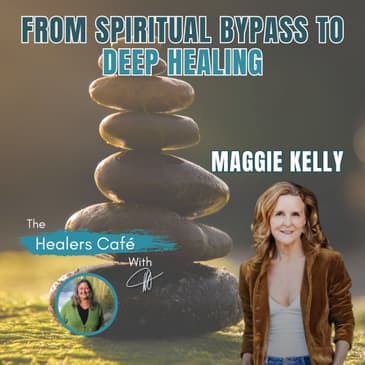
In this episode of The Healers Cafe, Manon speaks with Maggie Kelly, a spiritual counselor and shamanic energy medicine healer, discussing her transformative journey, sparked by her youngest child's cystic fibrosis diagnosis at age 30. Initially coping with stress through drinking, she turned to meditation, which led her to become a Chopra Center meditation teacher and open Satsang House.
For the transcript and full story go to: https://www.drmanonbolliger.com/maggie-kelly
Highlights from today's episode include:
Maggie explains addiction is about pain, not the substance – the real issue isn't alcohol, shopping, or porn, but the unhealed pain underneath.
Maggie speaks about spiritual bypassing – even meditation and spirituality can become another way to avoid feeling and processing trauma.
Manon explains Limited bandwidth & dropping blame – as parents we have only so much capacity; the real growth comes when adult children move from blaming to learning from their experience.
ABOUT MAGGIE KELLY:
We never grow unless or until we are challenged.
Most come to Satsang House in the midst of one of life's challenges or while at a turning point in their lives. Intuitively, I believe they already know they are ready for change or some sort of an upgrade to their current circumstances and life.
I have created Satsang House Meditation and Spiritual Center around my own healing journey. Over the past three decades, I've spent time studying under meditation experts, Eckhart Tolle, Alberto Villoldo and the Inkan Shamans of the Andes. Most recently I've been immersing myself with the work of Dr. Joe Dispenza which has become the perfect compliment to the way I teach and practice meditation as well as to the energy healing side of my work.
I have been extremely blessed to marry my personal experiences into my life's work at Satsang House as a Meditation Teacher, Energy Healer, Spiritual Counselor and Life Coach.
Core purpose/passion: My mission is to help people all over the world cultivate emotional well-being, increase their capacity to love and care for others, and participate in the creation of a more interconnected and compassionate world.
Website | Facebook | Instagram | YouTube |
ABOUT MANON BOLLIGER, RBHT, FCAH:
As a retired Naturopath 1992-2021, I saw an average of 150 patients per week and have helped people ranging from rural farmers in Nova Scotia to stressed out CEOs in Toronto to tri-athletes here in Vancouver.
My resolve to educate, empower and engage people to take charge of their own health is evident in my best-selling books: 'What Patients Don't Say if Doctors Don't Ask: The Mindful Patient-Doctor Relationship' and 'A Healer in Every Household: Simple Solutions for Stress'. and What if Your Body is Smarter than You Think? I am the Founder & CEO of The Bowen College Inc. which teaches BowenFirst™ Therapy and holds transformational workshops to achieve these goals.
So, when I share with you that LISTENing to Your body is a game changer in the healing process, I am speaking from expertise and direct experience".
Mission: A Healer in Every Household!
For more great information to go to her weekly blog: http://bowencollege.com/blog.
For tips on health & healing go to: https://www.drmanonbolliger.com/tips
Follow: Manon Bolliger website | Linktr.ee | Rumble | Gettr | Facebook | Instagram | YouTube | Twitter | LinkedIn |
Follow: Bowen College Inc. | Facebook | Instagram | LinkedIn | YouTube | Twitter | Rumble | Locals
ABOUT THE HEALERS CAFE:
Manon's show is the #1 show for medical practitioners and holistic healers to have heart to heart conversations about their day to day lives.
Subscribe and review on your favourite platform:
iTunes | Google Play | Spotify | Libsyn | iHeartRadio | Gaana | The Healers Cafe | Radio.com | Medioq | Audacy |
Follow The Healers Café on FB: https://www.facebook.com/thehealerscafe
Remember to subscribe if you like our videos. Click the bell if you want to be one of the first people notified of a new release.
* De-Registered, revoked & retired naturopathic physician after 30 years of practice in healthcare. Now resourceful & resolved to share with you all the tools to take care of your health & vitality!
[00:00:00] Welcome to The Healers Café, the number one show for medical practitioners and holistic healers to have heart-to-heart conversations about their day-to-day lives while sharing their expertise for improving your health and wellness. Welcome to The Healers Café.
[00:00:22] Today I have with me Maggie Kelly and she has created Satsang House Meditation and Spiritual Centre around her own healing journey. Over the past three decades she has spent time studying under meditation experts like Eckhart Tolle, Alberto Villoldo and Incan shamans of the Andes.
[00:00:51] And most recently she has been immersing herself with the work of Dr. Jo Dispenza, which has become the perfect complement to the way she teaches and practices meditation, as well as to the energy healing side of her work. So I think I might just cut it right there.
[00:01:14] And, you know, so you're a spiritual counsellor, a shamanic energy medicine healer and a meditation teacher and you run your own centre. So, well, that's what we're going to talk about today. So welcome. Thank you so much. Thank you for having me. Thank you. Thank you.
[00:01:36] So, I guess my first question is, I know it's always step by step, but what led you down this journey? You know, some people they're hit with something that changes them profoundly. Other people it's just like little things that they pick up and they go, huh, and then they're down a path. So what is your path? What was your path?
[00:02:02] Well, I would say, I mean, I've been on the transformational path since I was 30. I'm now 63. But I think the biggest hit was when my youngest child was born chronically ill with cystic fibrosis 24 years ago. And I already had a child who was three years old at the time that my daughter, the second daughter was born.
[00:02:31] And it kind of just threw me off. I didn't fit the pictures I had of my life. Cystic fibrosis, chronic, progressive, life shortening, incurable, mostly lung disease. And in my head and in those days, the average life expectancy was about 27 to 35. It's much higher now and the medications are much better and she's doing very well.
[00:02:59] But in the days that she was born was a thought process of I'm going to watch this child die. Right. And there's only so much I can do. And instead of really rising to that, I decided that I would check out and that I wasn't going to participate. And I did that by starting to drink too much.
[00:03:25] There was a day in there where I just looked at myself and I said, you know what? Not okay. Yes, it doesn't fit the pictures of what you have of your family and what your family is supposed to look like or what you thought it might look like. But this is what it is. Time to take a new picture and pull yourself together and put your ass on the line and get in the game as this parent. Otherwise, you're going to miss what life this child does have.
[00:03:55] And that was when I remembered having read some books written by Deepak Chopra when I was in college. Still had some on the shelves. Grabbed one. Didn't realize he had at the time a center right here, 20 minutes from my house in San Diego. So I put myself in one of his retreats. And these were the days when Deepak wasn't even a name. I mean, I was one of 15 people in the class. Right, right.
[00:04:25] Now it's 500, 1,000 in a room. And he himself taught me how to meditate. And it was meditation that started to really transform my life. So I spent years working through Deepak and doing a lot of his other things and ultimately decided to become a Chopra Center meditation teacher. And then I opened Satsang House the day after I was certified.
[00:04:53] So that's how Satsang House came into being 10 years ago. Mm hmm. Wow. Okay. And so I'm just putting myself in your mindset at the time, which, you know, the checkout, which is not uncommon. Right. It's like if it's overwhelming, you don't you don't know where to start. Checkout is kind of a common response. Right. How long were you in checkout mode?
[00:05:24] Three years. Three years. Three years. Okay. The first year of a child's life. Wow. And then to go into meditation. Because I mean, not much else had changed, except that you realize that you can't go on like this. Right. So how does one meditate through the mindset that you had at the time, the checkout?
[00:05:52] Like how, what was, you know how, well, no, let me not answer my own question. Go ahead. Yeah. Well, I think it was less about meditating through the checkout time and more about bringing my nervous system down and settling my physiology. Right.
[00:06:18] Because in those days I was on the phone with doctors and pharmacies. She had 16 different medications at five different pharmacies and they're all coming at different times and clinic visits every three months. Lung treatments twice a day, every day, 45 minutes each. And that's when she's well. And then I started tube feeding her. So here I am tube feeding her overnight.
[00:06:46] I essentially became a nurse. Yeah. And inside of that, the oldest daughter was sort of put over to the side because obviously you're going to be the one who's sickest. Right. Well, yeah. So I think when I was meditating, I know actually, when I first started meditating and subsequent years after, it was more about restoring my central nervous system
[00:07:16] to a ground state of being that's manageable, where I wasn't hyperventilating through my life, always waiting for the next shoe to drop, constantly anxious and worrying and just spinning, spinning. Yeah. So it was more about that. Yeah. And that's how I say to people that meditation saved my life is because I'm not, you know, that was untenable, an untenable way to live. Right.
[00:07:49] So, I mean, in a sense, I mean, correct me, but when you were drinking, it was a, not the best way, but a way of seemingly to calm down that whole nervous system so you could function. And you were, in a sense, replacing that with something healthy and that would have permanent positive impacts. Yes.
[00:08:15] And, you know, I've done a lot of work with Gabor Mate, who is an expert in trauma healing. Yeah. And his biggest mantra is it's never about the addiction. It's about the pain underneath. Yeah. So, we could be out there addicted to shopping on Amazon or smoking pot or porn or whatever. Anything. Yeah. And it's not about that.
[00:08:42] It's about can you access the pain and actually heal. Right. And honestly, I did not see that until very recently that I actually ended up in a kind of spiritual bypass. Mm.
[00:09:03] So, instead of drinking, I replaced it with meditation and spirituality and then teaching and then creating the center and everything I do. Mm-hmm. And it took me until very recently. I had a big, you know, big thing happen and a really big meltdown.
[00:09:27] And I, you know, the support I had, the trauma therapy I had, was, were the people who introduced the idea of this spiritual bypassing I've been doing all this time. Right. Wow. And so, going back to Gabor, it's never about the addiction, whether it's medication or drinking or whatever. Yeah. Yeah.
[00:09:53] It was about the pain unprocessed and not, certainly not integrated. Right. Yes. Well, it's courageous of you to admit that because, I mean, it's like a life savior and yet it's a big bandage, you know, and it's, you know, spiritual bypass is not that commonly talked about, you know. But it, I mean, I agree completely with Gabor Mate on that point.
[00:10:23] But you also, in your bio, you said, we never grow unless or until we're challenged, you know. And so that's what made me think, hmm, you know this. Right. So, yeah. So the challenge then is, I mean, you were coping and coping way better. But what actually opened everything up where you could feel the pain and heal the pain? Oh, gosh.
[00:10:52] That is what I'm writing my book about. And it's a spiritual memoir and it literally is about the last year of my life. Okay. Having been the most painful, yet the most transformative and the most healing of my life. And where I've been in a relationship with someone for about three years and an avoidant type personality that the closer we got, the more fearful he became.
[00:11:22] And when the relationship shifted into a really beautiful connection, he disappeared. Mm-hmm. Out of thin air. Mm-hmm. No response. No text. No call. No explanation. And what that did was activate every last one of my abandonment wounds. Yep.
[00:11:48] From my childhood that I had never, honestly, I knew I had an inkling, right? Like a little abandonment thing going, you know. But I didn't have this understanding until I was literally taken to my knees from this experience and realized that there was all of this unhealed childhood trauma that needed attention. Yeah.
[00:12:18] And that me, as a healer, as a, you know, spiritual counselor, someone who meditates, someone who works out, someone who does hypnotherapy and acupuncture and all these other modalities, there was nothing I had in my toolbox that was going to help me help myself. Yeah.
[00:12:40] And I finally was literally at my final moments when I reached out and put myself into a trauma treatment center. Wow. Literally saved my life. Literally saved my life. Yeah. And that's, yeah, I mean, when you're seeing somebody else's life as, you know, as is your daily practice, it's a lot easier to see when you're in it. And I know.
[00:13:10] Yeah. It's not you interviewing me, but I know what you mean. So, but it's funny how, yeah, with your, your own child, it's almost there. You had the opportunity that life created for you to go through the abandonment issues. Right. Yeah. There was resistance. Right. Exactly. And even today on the back end of this, I have actually thanked that man. Yeah.
[00:13:40] For imparting me. Yeah. Yeah. Yeah. And letting him know that it was the greatest gift of my life. Yeah. And that there's no words in any language that can convey my gratitude to him. Because he literally saved my life. Mm-hmm. In all different ways. Yeah. Basically, he saved my life, but emotionally. Mm-hmm. Completely. He'll help. I mean, he didn't do it. I did it. Of course. But he was the catalyst, right? Yeah. Yeah.
[00:14:08] And we do need to have a catalyst in our lives. Mm-hmm. Some sort of event that shakes the rug. Mm-hmm. I mean, most people, nobody wants to deal with pain, right? You're about to fall. You put your hands out, right? Nobody wants to fall on their face. Mm-hmm.
[00:14:29] And that's no different than, you know, somebody wanting to, let's just dredge up all this complex childhood trauma and let's just deal with it. No, it's not fun. Mm-hmm. And it's very painful. Mm-hmm. Very difficult. Mm-hmm. Mm-hmm. Mm-hmm. Mm-hmm.
[00:14:56] Where there's tremendous compassion and expertise, right? Mm-hmm. Because looking back, I was, until this point, a wounded healer trying to heal. Right. Right. Right? Mm-hmm. And now, on this side, I am a much more effective and profound healer as a result of what I've just experienced. Yeah.
[00:15:24] So, the healing I have to give is far and away different than anything I've ever done before. Mm-hmm. Because it's not a death that wasn't there. Right. But now you're going to attract the people who are ready for that. Mm-hmm. You know, it's like before you might have attracted people that needed, you know, a simple solution, just a change. Right.
[00:15:49] So, I do think, you know, or at least I've chosen to look at my life as effective all the time just for different people. Right. Yeah. You know, and as I do my own deeper work and releases of that, then I can, yeah, now I feel like I'm really good now and open to the world, you know? Mm-hmm.
[00:16:16] Well, I've looked at, you know, Scott Seng House and 10 years of my business and all that. Mm-hmm. You know, I went from the meditation to then becoming a spiritual counselor. Mm-hmm. Mm-hmm. And then moved into the shamanic medicine, medicine, healing more recently. And I look at that progression and, sure, we can talk about it as spiritual bypassing.
[00:16:45] But on the flip side of that, I am 100% certain that if I had not had that foundation underneath me, I may not be here today. Yeah. Yeah, yeah, exactly. Exactly. I mean, it makes sense. It saved my life. Whether it was a bypass or not to get me there, it doesn't matter. Yeah. No, I think so. I mean, that's the idea of the journey, you know? I think we're given a journey that is for us, you know?
[00:17:14] It's like, and you can't, I mean, you might go faster, but you've got to have something that, in my mind, too, kind of propels you or something that you choose to notice or that you can't help but notice. Like, in your case, like, you know, what can you do without you're absolutely, you know, shocked by it? So you're going to go to the next level, right?
[00:17:40] Well, that's part of why meditation is so profound because literally all we're doing in meditation is training ourselves to notice. Right. We're strengthening our noticing muscles. I'm going to notice when my thoughts want to hijack me and take me off, and I'm going to keep bringing myself back, whether it's through breath or mantra, whatever it is, whatever mentality of meditation you use, doesn't matter. It's all the same thing.
[00:18:08] And it's that training in noticing that is the part where you're, I always tell my students, look, we're in formal meditation practice here. The real meditation is out there. In the world, you're interacting with others.
[00:18:27] That's when you're going to know if your practice is working because that's when you're going to notice how you interact with the grocery store clerk, how you interact with your best friend, how you resolve your differences, whether you even bother to repair. You know, and that's the noticing that matters right now. And that's all the practice in real life. Exactly. Yeah.
[00:18:55] So how has it, I mean, it's very new and all that, but how, or has it changed your relationship to your daughter or anything at this point? And how old is she now? So I have two daughters. I have one that's 28, and the one with cystic fibrosis is 24. Okay. And she and I are extremely close, which makes sense.
[00:19:22] I've been her caregiver, her nurse, all of it, in and out of hospital with her for years. Yeah. The relationship with the older one is actually quite strained because by all intents and purposes, she inherited my own abandonment trauma. Of course. Right? The intergenerational trauma wound is hers now, unfortunately. And for the past two years, she and I have not even spoken. By her choice, it's not mine.
[00:19:52] Yeah. She has no idea the healing I've been through and what I've been through since she has not spoken to me. So she has no idea where I am, and that's okay. Mm-hmm. She'll get there when she gets there, if she gets there. And I need to just let go of that outcome. It's unfortunate, but I completely understand why she would feel abandoned in her own right by me, for sure.
[00:20:22] Because we only have a certain amount of bandwidth. Yes. That doesn't excuse me. Mm-hmm. I am accountable, and I am responsible for not having given her what she needed when she needed it. And I have apologized and tried to make amends for that. What would your life be like if you were pain-free? If you were one of the millions who suffered from chronic pain, the thought of just one day without it may seem impossible.
[00:20:53] This is often because conventional medicine tends to fall short in the treatment of pain. Opting to prescribe pills or recommend surgery rather than getting to the root cause of the problem. But if you are suffering with emotional or physical pain, there is hope. Join the founder and CEO of Bowen College, Manon Bolliger, live online for your Body Mind Reboot.
[00:21:18] Learn how to listen to your symptoms and get to the root cause of your pain. Plus, be trained in basic Bowen therapy moves so that you can reboot your body for optimal health. You don't have to live in pain. You can heal. Stop the pain pill cycle by visiting www.yourbodymindreboot.com to learn more and to register.
[00:21:52] But it does point to, hey, mom is human too. Yeah. Right. But I think it takes time. Like, you know, if I look in my own situation, there's certainly times of abandonment on my part. And I was also dealing, you know, with stage four cancer. That can be a little all-encompassing. You know, so just a tiny bit.
[00:22:22] Anyway, but, you know, it's like things still impact and affect, you know. And you're still the one who did it. You're still responsible for it. You know, and it's only really when they kind of go through really, like, you know, forgiven I have been.
[00:22:44] But to really get that, if they were in the same role, could they have done anything much better or different? Or, you know, and then it's like back to humanity. I mean, there's only so much bandwidth, you know. Like, what else can you do, right? And so it's, I think when we remove that, the blame and all that stuff, when they are no longer victims, which, you know, I think we're there now.
[00:23:14] You know, my youngest is 28. So 27 now, sorry. Eight. Anyway, I can't remember. She just had her birthday and I'm upset. I'm not sure. But, you know, and the others, they're older, right? So it's interesting.
[00:23:32] You know, there's a point in which it's everyone's journey and we choose how much of that journey we're going to fault others for rather than just learn from and go, hmm, yikes. That must have been weird or tough or hard or, you know. Right. And I think, you know, that points to self-compassion.
[00:24:02] Because without self-compassion, it's impossible to have compassion for someone else. Exactly. And very few of us, especially women, give ourselves a break. Yeah. And it's difficult to find compassion for others when we're so busy beating ourselves up. Yeah. Yeah. And that's no example because if they see you beat yourself up, where are they going to learn it from?
[00:24:27] It has to be a full new experience, but it could just come from you, like going, gee, how can you be loving and love yourself? And yet you were such a, you know, abandoner or you were whatever, you know. And it's like, well, because you have to get through to the other side of it, you know. Yeah. And I think that's a really good lesson, you know, when we can be an example as well of what we've learned. For sure.
[00:24:56] Absolutely. Absolutely. And it shows up in a myriad of different ways that you wouldn't expect, you know, just in conversation and passing moments and one simple interaction. I mean, I see the huge change in me since a year ago. Right. Because all the healing that I've done. And it's tough.
[00:25:22] And writing a book about it just, you know, brings it all up again. Whatever still, you know, there's little edges to some of that trauma that's still there. Whatever that is, then it shows up again like, oh, there's still a little bit of charge on that one. I think I need to work a little more here. Right. And I need to not just process but integrate.
[00:25:49] And so there are moments during the writing where I said, I got to put this over here so that I can process and integrate. The process of writing, though, itself has been quite an integration. Oh, yeah. For sure. I mean, it's hard to not turn every stone eventually. Okay. Yeah. You were saying shamanic healing.
[00:26:21] Was it 5DMO? What type of music? I do not do plant medicine ceremony. I do illuminations. I work with the chakra system and do illuminations. Okay. I clear the energy body. I do journeying to the past. I do soul retrievals, extractions of negative energies.
[00:26:51] I do death rites. So, you know, to be able to clear the chakras and send you to the east. And I do cord cuttings. So I do all of the very ancient practices. I'm part of the lineage of Machu Picchu. So the Karam tradition. Okay. I also do fire ceremony.
[00:27:14] So each shaman group, I guess, depending on the region and depending on the lineage, uses a particular element in their healing. So some might use water. Some might use wind. My lineage uses fire. So fire ceremony as rapid transformation, which is one of my favorite things to do.
[00:27:43] In fact, we have a fire ceremony. We always had a full moon. So we have one Saturday. Right. So that's the work that I do is energetic healing. So I'll pretty much start by diagnosing your chakras and going. Interesting. Can you expand a little bit more on that just for people who don't? I haven't, I've never done a ceremony of that type.
[00:28:10] But so what, let's talk about the chakra one and the fire. Okay. What's involved in that. And because you said you, it was, it was that, it was that, those ceremonies, right? That really brought you, sorry, that really brought you to that deeper seeing or understanding of what. Yes.
[00:28:40] I went down. I traveled to Chile. Alberto Villoldo, who you mentioned in the intro, is a Cuban-American shaman. He has brought the Cairo tradition lineage of shamanism to the United States for the most part. He has a retreat center down in Chile where he brings shamans from Machu Picchu to train other people in their practices.
[00:29:09] And these are ancient practices from way back before the conquistadors. Yeah. And just like the, you know, burning the witches in Massachusetts, if at the time of the conquistadors, they arrived on shore and they found shamans, they probably would have killed all the shamans.
[00:29:32] So when the shamans of Machu Picchu knew, well, they weren't of Machu Picchu then, but the Cairo tradition shamans were originally down by the coast. But the conquistadors came and they knew they were in danger. So they ran up into the Andes. And that's how Machu Picchu was built. And the region was built. Okay.
[00:29:55] And that's where all the ancient healing practices placed was in Machu Picchu up in the Andes. And so these shamans that Alberto uses come from Machu Picchu down to his retreat center in Chile to train people like me in those practices. And so I spent a month down there in Chile and we did fire ceremony every day for 30 days.
[00:30:25] And I learned all these ancient practices and the rites and rituals and all kinds of beautiful, beautiful healing practices. And shamanism uses the medicine wheel. And they use the four directions. So you start with the south. Well, in the south direction, the archetype is the serpent. And the reason she is the serpent and the archetype of the south and where you begin is because the serpent sheds her skin.
[00:30:54] So the work of the south is for us to shed all these old stories that no longer serve us. Then we go to the west and the archetype of the west is the jaguar. And the reason it's the jaguar is the jaguar can see six to seven times better than human beings in the dark. The work of the west is the dark work, the shadow. The shadow sides of us hold on to the front.
[00:31:20] And once we've done the work of the serpent and the jaguar, then we moved into the north. And the archetype of the north is the hummingbird. And it is the hummingbird because after we've been slithering on our bellies and then we're stealth in the dark, we're now starting to take flight. We've released some of that past and we're starting to take flight. Well, a hummingbird can fly to Canada and South America on one flight.
[00:31:49] And all they're looking for is the nectar of life. So the work of the north is ancestral. We start to look at our ancestors, our grandparents, all of that. But also, where's the beauty of life? Now that I've gotten rid of some of this past, where's the beauty? And look for the beauty. Then the work of the east is the eagle or the condor.
[00:32:13] And the work of that direction is now that you've done all that other work, you're flying high above the mountaintops like an eagle and you're looking at the world from a macroscopic point of view. Instead of what's in it for me and it's all about me, how can I be of service to the world and why am I even here? That's a very rudimentary way to describe the most of the four directions.
[00:32:45] And so that's a lot of the work that I did for myself. And then I became part of the lineage. And then inside of the lineage, then I call on them to work through me to you. Right, right. So in the chakra system that you asked about, that's primarily an illumination.
[00:33:08] And what that looks like is I will help put you into a trance using pressure points behind your head. And when I know that you're in a sort of trance state, then I know you're a little more suggestible, just like a hypnotherapist would do that too, moving you into a gamma brainwave state. And once I know that, then I have you look around for energy.
[00:33:35] Our energetic body is about six to eight inches off of our physical body. I liken it to like a plate glass window. And any trauma or event that may have happened to you as you were growing up is sort of like a wet mud clod from that window. And it sticks on our energetic body. And if we don't, that trauma or that experience, and if we don't clean the window, so to speak,
[00:34:04] that will move and manifest into our physical body as disease. If it's heart disease or cancer or thyroid issues or bone issues, depending on which chakra is affected. So I diagnose the chakras. And we always work from the bottom up, the first chakra being the base of your spine. We work from the chakra closest to Mother Earth. And then we move up.
[00:34:34] Because the higher up you go, the closer you are to your spiritual zone. The lower three are usually the ones that are tripped up for most of us because they're all about our will, our survival, our primal instincts, our adrenal glands. Each chakra is managed by a particular organ in your body.
[00:35:01] It also has a particular element that is associated with it, like wind, fire, water, air. And each one has an age. So, for instance, the first chakra, anything that may have happened to you between the ages of zero and seven years old, retains its energy in the first chakra.
[00:35:27] Then it's seven to 14, 14 to 21, 21 to 28, 28 to 35, and so on. So we have to keep those bottom three clear so we can get to the heart chakra, which is the fourth chakra, the center of our energetic system.
[00:35:48] If we don't get to the heart chakra, we can never get to our center of creativity, our psychic center, and our spiritual center. So primarily I work with the bottom three because that's just how we are as Americans. And those are usually the ones that are stuck or the pendulum will go backwards or not even move when I'm back.
[00:36:15] So I will open that one, that chakra up. I will illuminate it. You will set an intention for that chakra. I'll close it back up. Move energy down and out through, back to Pachamata, back to Mother Earth. That's an illumination process. Amazing, yeah. That sounds great.
[00:36:39] I mean, you know, what a wonderful thing to have such a variety of insights and tools, you know, to be able to, well, and also for you to actually have grown through it on top of that even more. It's very interesting, yeah. Yeah, sometimes I feel, you know, I have no idea where I got the sense of the shamanic piece.
[00:37:07] I do remember reading a book and hearing about Alberto's center and then looking it up, and then right on the screen it said, when spirit calls, answer. And I was like, oh, my God, I guess I got to go. But that's how it works, right? It is how it works, yeah. I don't know if you noticed lights when we were talking. Okay. That's good. Okay.
[00:37:37] Very interesting. Affirmation. Yeah, affirmation. I mean, you know, it's up to us to see it or not see it, right? That's right. That's right. Anyway, so. Well, and that's it, right? I mean, us are not paying any attention to our intuitive voice. Right. Your intuitive voice is right every single time. I've had my daughter ask me questions.
[00:38:05] She's starting her business, and she asks me questions about the lease and et cetera, and I, instead of answering, just say, what does your gut tell you? Because that's who you should be listening to, not me. Yeah. But it's always right. If you feel like something is off, something's off. Yeah. Right?
[00:38:30] Yeah, that's certainly been one of my biggest, like, not lessons I haven't learned yet. You know, like, that's the truth. It's like, I've come to the distinction between instinct and intuition. I think those are different. Mm-hmm. I know where they're coming from.
[00:38:53] So instinct being much more primordial and, you know, like, fight, flight, knowing, oh, I need to move from this street, or I'm not going to get, I'm going to lock the door before I get out of this garage, or whatever the story might be. That would be an instinct. But an intuition comes differently to me, you know? And it's funny.
[00:39:21] It's like the levels, a lot of the work I did with Gabor Mate actually was on intuition for about 10 years. I kept needing to understand that deeper and deeper. And I would say that at this stage, I'm just beginning again. Like, I felt like I got this. And then it's, nope. We've got to go deeper. So anyway.
[00:39:49] Well, I think it's easy for us to second guess ourselves. Right. We question our own thoughts. Yeah. Oh, yeah. And it's best if we don't. Well, it gets messy, right? Because, or if you use a pendulum or you use something that you imbue with power,
[00:40:15] or that you're where you're coming from isn't exactly as clear as clean can be, because you really want to know the answer if there's attachment. Like, the moment there's anything else, it's not a reading. You know? Right. Right. And you bring up a really good point is the attachment. Right. Because when we have the attachment to the outcome, it's never going to happen. Right. And then you're not reading your intuition.
[00:40:45] Right. Right. I was just having this conversation with someone I was teaching meditation with this morning about, you know, being able to just plant the seed and let go. Yep. Yep. I don't, none of us go out there and plant flowers and go out every day and dig it up and see if it's growing. If the seed is sprouting. Right. And if we do that, we're interfering. Yep.
[00:41:10] We have to be able to just plant the seed and water it as best we can and back off. And trust that the universe has your back. The universe is taking care of all of it. It's the grand orchestrator. Exactly. And gratitude is, you know, it's the only place we can stand on a daily basis with any fundamental stability. Yep.
[00:41:39] It's gratitude for the things we don't have that we think we need or want. It's gratitude for all that we do have. Yep. You know, and even gratitude for the difficult times. Yep. Well, that's, you know, certainly in health, that's learning to be grateful for, you know, this dis-ease. Right. It's quite a step. But Maggie, we are so past our time.
[00:42:08] But I feel like we could easily have a second conversation. Yeah. But yeah, I'll keep it at, you know, a little over half an hour because that's what people are used to. But yeah, thank you so much for sharing. And if you do want to come back again, maybe when you get your book or if you want to talk about the different elements, like we talked a bit about fire, but that would be, you know, that would be...
[00:42:38] Well, I'm happy to come back. It's been a delight. Thank you so much for having me. I appreciate it. All right. Thank you. Thank you for joining us at the The Healers Café. If you haven't already done so, please like, comment, and subscribe with notifications on as I post a new podcast every Wednesday with tons of useful information and tips for natural healing that you won't want to miss.