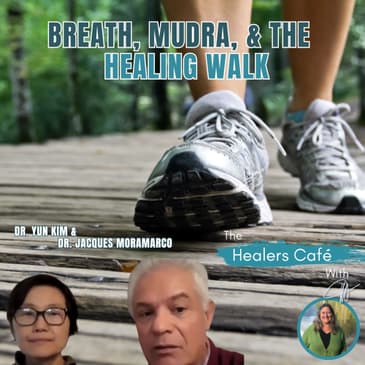
In this episode of The Healers Cafe, Manon speaks with Dr. Yun Kim and Dr. Jacques MoraMarco discussed their new book, "Walking Your Way to Vitality," which integrates walking, breath work, and mindfulness. They emphasized the importance of mindful walking, which involves coordinating steps with dynamic breathing and using a specific mudra to enhance focus. The book includes QR codes and drone footage to demonstrate techniques.
For the transcript and full story go to: https://www.drmanonbolliger.com/drs-kim-moramarco
Highlights from today's episode include:
Dr. Yun Kim explains mindful walking as a way to "check in" to the body—using breath, movement, and mudra to anchor awareness in the present.
Dr. Jacques MoraMarco talks about 5,000–7,000+ steps and about 30 minutes of walking daily can significantly reduce risk of major diseases and improve longevity.
Manon Bolliger states simple rituals (conscious walking, bedtime routines, putting phones away) help the body understand you "mean business" about healing and sleep.
ABOUT DR KIM & DR MORAMARCO
Jacques MoraMarco, a doctor of traditional East Asian medicine, has been a licensed acupuncturist since 1977. A pioneer in the field of Asian medicine, he took the first acupuncture license examination ever administered in the state of California. He apprenticed with See Han Kim, a renowned teacher of traditional Korean medicine, who was trained monastically. He completed his postgraduate work at Ecole Européene d'Acupuncture in Paris. From 1994 to 2004, he studied Sun Tai Chi with Sun Shurong in Beijing, China, and he is a fourth-generation lineage holder of Sun Tai Chi. He is a co-founder of the International Sun Tai Chi Association, along with Thomas Duterme and Eric Lee. Dr. MoraMarco has served as a clinic supervisor at Being Alive, an organization in Los Angeles that provides free wellness services to people living with HIV/AIDS and at the PTSD Clinic at the VA Greater Los Angeles Health System. He is dean emeritus at the former Emperor's College of Traditional East Asian Medicine.
Yun Kim is the founder of Emperor's Wellness, a doctor of traditional East Asian medicine, a fifth-generation lineage holder of Sun Tai Chi, and has practiced mindful meditation for the past twenty years. She has learned from renowned meditation teachers, including Thich Nhat Hanh, Trudy Goodman, and Christiane Wolf. A licensed acupuncturist in the state of California, she completed her doctoral clinical rotation at the PTSD clinic at the VA Greater Los Angeles Health System and maintains an acupuncture practice in Los Angeles. She earned her Doctor of Education at the University of Southern California, Rossier School of Education.
ABOUT MANON BOLLIGER, RBHT, FCAH:
As a retired Naturopath 1992-2021, I saw an average of 150 patients per week and have helped people ranging from rural farmers in Nova Scotia to stressed out CEOs in Toronto to tri-athletes here in Vancouver.
My resolve to educate, empower and engage people to take charge of their own health is evident in my best-selling books: 'What Patients Don't Say if Doctors Don't Ask: The Mindful Patient-Doctor Relationship' and 'A Healer in Every Household: Simple Solutions for Stress'. and What if Your Body is Smarter than You Think? I am the Founder & CEO of The Bowen College Inc. which teaches BowenFirst™ Therapy and holds transformational workshops to achieve these goals.
So, when I share with you that LISTENing to Your body is a game changer in the healing process, I am speaking from expertise and direct experience".
Mission: A Healer in Every Household!
For more great information to go to her weekly blog: http://bowencollege.com/blog.
For tips on health & healing go to: https://www.drmanonbolliger.com/tips
Follow: Manon Bolliger website | Linktr.ee | Rumble | Gettr | Facebook | Instagram | YouTube | Twitter | LinkedIn |
Follow: Bowen College Inc. | Facebook | Instagram | LinkedIn | YouTube | Twitter | Rumble | Locals
ABOUT THE HEALERS CAFE:
Manon's show is the #1 show for medical practitioners and holistic healers to have heart to heart conversations about their day to day lives.
Subscribe and review on your favourite platform:
iTunes | Google Play | Spotify | Libsyn | iHeartRadio | Gaana | The Healers Cafe | Radio.com | Medioq | Audacy |
Follow The Healers Café on FB: https://www.facebook.com/thehealerscafe
Remember to subscribe if you like our videos. Click the bell if you want to be one of the first people notified of a new release.
* De-Registered, revoked & retired naturopathic physician after 30 years of practice in healthcare. Now resourceful & resolved to share with you all the tools to take care of your health & vitality!
[00:00:00] Welcome to The Healers Café, the number one show for medical practitioners and holistic healers to have heart-to-heart conversations about their day-to-day lives while sharing their expertise for improving your health and wellness. So welcome to The Healers Café and today I have with me Dr Yun Kim and Dr Mora Marco.
[00:00:28] And they have, well, they've been doing acupuncture, they've been trained in traditional Eastern Asian medicine and Dr Mora Marco has been an acupuncturist since 1977. He's a pioneer in the field of Asian medicine. He took the first acupuncture license examination ever administered in the state of California.
[00:00:58] That's wonderful. And let's say, I don't want to read too, too much so that both of you can actually introduce a little bit yourselves and what you're doing. But I also want to talk about your new book that just came out in January, Walking Your Way to Vitality. And it's all about integrating walking, breath work and mindfulness in your life.
[00:01:28] Okay, you also do PTSD stuff. Okay, let's, why don't I just start with welcoming you. Let's start with that. Thank you for having us, Dr. Manon. Yeah. And why don't, like most people know, you know, something about acupuncture or Eastern or medicine, but what is it? What is your focus, your passion? How do you work together? Yeah.
[00:01:57] Give us a little bit, whatever you can, what brought you there? All right. Let's have Dr. Yun start. Yes. So we're both acupuncturist doctors of East Asian medicine, and we met at Emperors College, one of the most distinguished acupuncture schools in California called Emperors. And my parents founded the school in 1903 with the mission of training brilliant healers, teachers and leaders in Asian medicine.
[00:02:26] And Dr. Mor Marco, in the early years, taught for several years at Emperors, and he took a long leave, decades, and then came back in 2009 to serve as academic dean. And so we started working together then. He, at that point, he had published a book called The Way of Walking, brilliant book, way ahead of its time. And I kept pestering him.
[00:02:56] You need to reissue this book. This people need this information. It's wonderful. And he kept putting me off. Yeah, I'll get into it. I'll get to it. And then finally, in 2024, that was the time. He said, I'm ready. And will you be my co-author and help me update the book, put in new research, really bring it to the modern era? And that's how the project started. Yeah.
[00:03:22] So, you know, I'm very happy and honored to have worked with this new edition, which is a totally upgraded edition. We went from the ancient tradition, which are included in the backbone of this book, to modern technology. Because in this book, we even have the QR codes in each chapter. Wow. It illustrates under one minute, illustrates the specific styles and walks and disciplines that we teach.
[00:03:48] And also, we even at the end have a QR code with the drone footage. So, you can see exactly as done from above, which is, you know, modern technology. So, we have incorporated some of the ancient tradition with modern technology. So, that's one of the outcomes. Yeah.
[00:04:04] Well, that's so great because, you know, many times there's like mini courses you can take, you know, whether it's Tai Chi and then you have to look at, you know, your little phone or you have to, you know, it's like, it's hard to get the whole thing together. Right. Whereas, if you have a drone actually showing it, you have it in every dimension. Yeah. Well, that's one particular change of direction. Interesting. But yeah.
[00:04:34] But, you know, we have illustration in the book and just the small QR codes are used for, you know, specific to get the real feel of individuals doing it. And we have from younger individuals who are 85 years, 85 years young practitioners who practice Tai Chi for 40 years and she does the mindful walk in it.
[00:04:58] So, we have a wide range of demonstrations that illustrate the variety of people that might be interested. Because at the core of the East Asian medicine, you have disciplines. One of them, of course, we all have heard about acupuncture. We all have heard about herbal medicine. We have heard some of us about the Twina, Amao, Shiatsu, the Bali massage techniques, the medical massage that's done in Asia. And also, one of them being the dietetics.
[00:05:28] And we do include a small chapter in the appendix on dietetics according to some Asian principles. But the movement therapies are really important. And that is one of the things that have been perfected through centuries, if not millennia, because the very first observation from this Chinese physician called Watou, where he observed the movement of specific animals.
[00:05:55] And he observed those qualities within the practice for one's health, well-being and longevity. And we incorporate some of those ideas into the chapters and also part of the Tai Chi motions. They are very complex. So, if people want to do the whole Tai Chi form, the 108 form, it's the traditional form. It's quite complicated. But you can extract some key concepts like very trending Tai Chi walking.
[00:06:22] And in our book, we do have some of those Tai Chi walks that are specific for the animals walking. Animal spirit walking. Yeah. Mm-hmm. Mm-hmm. So, what can you tell us about that? You know, because, like, just so we get more education on walking itself, the incorporation with breath. Like, tell us, like, the importance of that.
[00:06:50] Because, you know, I know, I mean, in our, like, when we teach bow and therapy, we tell people it's very important to have a bit of water, you know, so that you're hydrated. And then go for a conscious walk. But we don't say what that means or what that is, you know. And so, it's very kind of, you know, very at the very beginning of this, you know.
[00:07:16] But the need to integrate information in a walk seems very primal, seems natural, you know. But tell us more, like, obviously here there's an entire tradition of this. So, can you share a little bit the history and then why it's so important? Yes. We'll start with the mindful walking.
[00:07:44] It's one of our chapters where you talk about conscious walking. And I think it's a very similar concept. So, when we are walking, often we are ruminating about the past or thinking about the future. We're rarely in the present moment, actually feeling the sensations and the feelings that we have in our bodies. And so, in that chapter for mindful walking, we invite our readers to check in instead of check out.
[00:08:14] Right. Feet on the ground, feeling the fabric of your clothes, feeling your breath. We have a mudra, a hand gesture that is part of the vitality walk. And so, feeling the mudra, doing the breath work. And so, you know, in all the research that we've read, the key component is the mindfulness, the mindful awareness of the present moment.
[00:08:43] And we can get there by anchoring our mind in the body. So, the breath, the movement, the shifting of the way. And so, that's a kind of training that we can do to be here now. It's a very well-known book by Ram Dass. Be here now. How do we do that? We do that.
[00:09:09] One of the ways in which we can do that is to bring our attention to the body. Right. And how did you start that, the original inspiration? So, about two decades ago, I got very interested in mindful meditation. And I had the great fortune of doing a meditation retreat with the great Vietnamese monk and peace activist, Thich Nhat Hanh, in California at Deer Park Monastery. And his signature teaching was mindful walking.
[00:09:39] And with 200 retreatants in silence, we did mindful walking from the meditation hall up the hill. And I can still picture him. I can still picture his face. He emanated so much peace and serenity. And I was so moved by that experience. And that's when I decided to incorporate this into my life, into my mindfulness practice. Yes. Yes.
[00:10:06] And how long, like, I mean, of course, people can do it all day long, I'm sure. But what is, what do you recommend to people, you know, just to live a healthy life? But how much should they incorporate that into their day or routine? Yeah. You know, I think the goal and objective, of course, is to start with the first step, the first five minutes, possibly.
[00:10:35] To do whatever walk we describe, whatever practice is, do it for five minutes and then build up upon it. But it seems that the magic number is at least you want to do 30 minutes a day. If you can do more, it's better. But at least have that 30 minutes a day. Because also in terms of the steps, there are certain signs behind steps. And the steps between 5,000 and 7,000 is the magic number.
[00:11:02] And unfortunately, here in the West, in Western society, we are walking much less. In some other countries, they walk much more. But again, depending on the city, you know, some cities you walk less, some cities you walk more. But there's a direct correlation with the step, the walking and mortality rate, cancer rate, cardiovascular disease, even things like a dementia. And depression, insomnia, they all are interrelated.
[00:11:29] So, you know, you don't need to achieve the 10,000 steps. That's everybody's, oh, I have to do the 10,000 steps. But that was based on the manco pie, which was a step counter from Japan, a pedometer that worked a little bit like a clock. So everybody was, you know, during the, I think, 1964 Olympic, you have to get this. And that's how the myth came up. But most of the research says, you know, if you achieve that, you know, and then, you know, over, you know, 7,000, 500, 8,000, you're not really gaining that much benefits.
[00:11:58] But what you can do instead of doing the steps is you can start to practice things like the Tai Chi walks to improve and enhance your balance. Because we know that over the age of 65, the rate of falls on seniors increases. And, of course, the severity of the outcome from that within one year, you know, things go pretty much out on that.
[00:12:21] So, you know, the ability to have the fall prevention aspect, which is very, very strong for the practice of the Tai Chi, mainly the catwalk and also what we have in our book, the golden rooster walk. But it's a transitional step in the Tai Chi that makes you really aware how to step slowly with your heel and then roll out of the foot.
[00:12:45] So you get that whole momentum of the conscious movement of the foot, which is really, really important. And also enhances your proper receptors. So those are really important aspects that are part of the Tai Chi practice. And there's over a thousand studies that demonstrate the effects of Tai Chi practice for fall prevention.
[00:13:09] Originally done by Emro University with the backing and the encouragement of Rosalind Carter, which was the wife of Jimmy Carter. And she has had over a 50-year practice, lived to be in the late 90s. Oh, I don't know. Interesting. So what is that? What did you call it? The extra step? Because, I mean, the whole thing increases your proprioception.
[00:13:35] But when you were talking about there's a golden step? Oh, yeah. The golden. No, these are a couple of the exercises in our book we have taken. One is called the catwalk, which is stepping in a very conscious, very slow method that you just consciously step with your heel and roll out. And then the golden rooster is basically stepping and having one leg lifted.
[00:14:01] Very similar to a flamingo stance, which they're testing. Flamingo stance, if you can't stand for 10 seconds, you're in good shape. If you don't stand for 10 seconds, you need to work on that. Or yogic practices, one leg stance. And then in the book we have a more advanced stepping pattern called the bare spirits step. So that's very specific for that Tai Chi chapter. But we even talk about in the beginning part of the book such as retro walking or walking backwards.
[00:14:30] I don't know if you see many people walking backwards around the parks in your area. Not particularly. No, no. I first saw those in China about 30 years ago. There were people walking backwards. And just recently, I noticed in the last six months at a local park in our area, there's an uphill. And I see these people walking up the hill backwards. Of course, it's the concrete. There's no chances of falling off because it's pretty level.
[00:14:57] And I said, what prompted you to do this? Oh, well, my doctor said this is really good for me because it saves on my knee, works on my quads, strengthens up my buttocks muscle, and, of course, works on the proprioceptor. So that backwards walking, we mentioned that in the traditional walk, which is in Chapter 1. But the key thing about that backwards walking, even though most people have not heard of it, it was done in 1915.
[00:15:26] And there was one individual that walked from San Francisco to New York backwards. Oh, my gosh. It was monitored. And it was to be done under one year's time. And at that time, it was $5,000 bet. And he walked in 260 days. So that was quite a feat. And he had a mirror, of course, and he had the monitor. And they wrote him up all the way through the different journals in the different cities. So, you know, there's so many different methods.
[00:15:54] You know, the Japanese walking, which is a dynamic walking, three minutes fast, two minutes slow. So there are different walking in the traditional style. But we went to go into the breath work and the coordination of steps and walking, which include one of the specific walk, which we call it the vitality walk. What would your life be like if you were pain-free?
[00:16:18] If you were one of the millions who suffer from chronic pain, the thought of just one day without it may seem impossible. This is often because conventional medicine tends to fall short in the treatment of pain. Opting to prescribe pills or recommend surgery rather than getting to the root cause of the problem. But if you are suffering with emotional or physical pain, there is hope.
[00:16:43] Join the founder and CEO of Bowen College, Mano Boliger, live online for your Body Mind Reboot. Learn how to listen to your symptoms and get to the root cause of your pain. Plus, be trained in basic Bowen therapy moves so that you can reboot your body for optimal health. You don't have to live in pain. You can heal.
[00:17:08] Stop the pain pill cycle by visiting www.yourbodymindreboot.com to learn more and to register. The key about that walk is coordinating your step with dynamic breathing. And I first saw that in the Himalayan region almost 50 years ago.
[00:17:35] And I noticed the individual in their 50s, 60s, they were walking so fast up the hill. When I was in my early 20s, I said, how is that possible? And they employed this step. It's called dynamic breath with the step. So you count your steps and you do the breath. So the breath is a very dynamic breath. I will just demonstrate. Sure, it would be great. So you breathe into the nose. Two very fast breaths and then you breathe out.
[00:18:05] And then you do two empty steps. So it super oxygenates your body, gives you extra oxygen and you have that power. And that goes back to this whole idea of vitality. Vitality. Say a few things about what is vitality. Well, a little more about actually the breath work. There's more and more research that is showing that certain kinds of breath work, like the inhale and the exhaling, can calm the nervous system.
[00:18:33] A version of this particular kind of breath pattern is being taught at the VA for veterans for PTSD. To calm the nervous system. To bring you to the parasympathetic mode, the rest, digest, relaxation mode. So the walking plus the breath work and the mudra. Okay. There's a mudra involved, which is a spiritual gesture. So very simple. You fold your thumb into the middle of your palm.
[00:19:02] And right here is a very important acupuncture point called the laogang. And then you fold the rest of the fingers. And you're activating the lung channel to help with respiration. It's a very primordial position. And babies often, you see the babies in this position. And so this is part of the vitality walk.
[00:19:27] So when you combine the mudra, the walking, and the breath work, it's incredible. Your mind doesn't wander. Right. You need to have the mind to wander. Right. There's nothing wrong with that. But sometimes it's too much. But is it like, in this case, I mean, you're paying attention to doing this, right? Yeah. You're also breathing. And you're counting your steps. Right.
[00:19:57] You're counting the steps. So your mind is busy. It's just... It's concentrated, though. It's concentrated. Right? Yeah. It's paying attention. Paying attention to the body. Right? Yeah. Very different than when your mind just kind of... Is anywhere. ...pand runs or spirals. Right. Right. So how does the steps align with the breath? So it's very simple.
[00:20:23] At first, it might be a little bit difficult to do, but, you know, you do it for even five or ten minutes and you get the rhythm. So the steps align that you are doing two inhalations on the first two steps. Then you do an exhalation on the third step. Okay. And then you have two steps where you have empty breath, which has also its own health benefits. But the key thing about the mudra, one of the secret methods about this mudra is that
[00:20:50] when you do this, you cannot look at your phone. So you have to point a sign. You can't be on the phone and do this. No. You can't text or answer the phone. No. I mean, so many people, you know, wearing the stuff on the ears and, I mean, it's like accidents waiting to happen, you know? So it's absolutely not paying attention to anything.
[00:21:18] But I don't think they're paying attention to themselves either. You know, they're just out walking, counting steps maybe or getting them counted for you. So, okay. So it's two out breaths. Two in breaths. Oh, in breaths. Okay. While you make a step? One breath per step. One breath per step. Okay.
[00:21:43] So you breathe in, you breathe in, and there are short breaths. Yeah. But dynamic. Very dynamic. Yeah. Fast. Like. Yeah. Yeah. Okay. All through the nose. All the nose. Okay. And then you do one strong exhalation. And through the nose or the mouth? All through the nose. All through the nose. All through the nose. And then you do two more steps empty. So that in Eastern philosophy, you have a yin-yang balance. So there's active and passive.
[00:22:12] So that's the active phase. Then you have a passive phase. And they all complement each other. Okay. So step within, step within, third step out, and then empty, and then empty. Okay. Just like that. And then holding the whole time the mudra points. The mudra. This is the primordial mudra.
[00:22:37] Mudra is a typical word in Sanskrit that means hand gestures. Right. Yeah. You know, we all know about, you know, the ring finger and the thumb for the basic meditative mudra. A prayer hand is a mudra. The adni mudra. So you have so many different positions in Tibetan Buddhism. They have different mudras for different mantras. So, you know, those are all key components that are now being discovered.
[00:23:06] Well, you know, looking at the brain and seeing that in the brain there's the homunculus, the little man, they call it, the projection. You see the thumb is a big, big part of that brain. So even working with the hands and just having this position does power up the system. So it's a bioenergetic functioning. And, you know, going back to even the embryogenesis, the development of the embryo when we talk about
[00:23:32] acupuncture and the outer parts of our skin, they are part of the ectoderm, which is really the nervous system. So it's integrating this primordial system that we have embedded in ourselves into your daily practice. Mm-hmm. Mm-hmm. Mm-hmm. And is this, let's say, like those steps, but done for half an hour, is this what you
[00:23:56] would also use for PTSD to rebalance the autonomic nervous system? Yes, absolutely. You know, and that's the key thing on this breath work. It does work. It does affect certain parasympathetic mechanism. And, of course, you have all the neurotransmitters, all the activation of the serotonin and everything else that goes into the cascade of those neural activators. Mm-hmm.
[00:24:25] And you can take a very short break. I used to do this all the time. We had an outdoor walkway in our office, and I would just go and do it for 10 minutes or walk into the bathroom or walking to the parking lot. Yeah, yeah. It's very invigorating. So it's also called superoxygenation. Right. Yeah. That's one of the methods that we use there, but we have different ones.
[00:24:52] And there's another interesting chapter called immune support or the immunity walk. And that's a very specific walk. It also has the, in Chinese, it also happens to have the two breath and one breath out, which is very interesting from a different part of Asia. You know, this was more or less developed in China by a very famous artist called Guo Lin. And she developed this in the 1960s. She was diagnosed with terminal cancer.
[00:25:19] And at that point, she did this breath work and had some amazing remission. Okay. We need to remission. So now that part of practice, the Guo Lin work, is a cancer support method. And most parts all over China, they have this group of individuals that meet and do this breath practice with their cancer patients. And they're totally integrated into the practice of, you know, traditional Asian medicine with
[00:25:48] Western medicine to integrate those two components. Because it's, the times have changed. It's no longer alternative medicine. It's no longer complementary medicine. It's really becoming integrative medicine. Yeah. Yeah, yeah, yeah. That is the evolution. So, so it would help the body alkalinize. Absolutely. I would imagine to be effective that way.
[00:26:15] And what about people, because many people have sleeping issues. How, is there a time that's the best walk or you just walk when you walk or? You don't want to necessarily do the vitality walk before you go to sleep. Right. So you might want to do maybe the Bagua walk, which is the circle self-reflection walk. And we do have a walk that's called Bagua.
[00:26:42] It's the Bagua style walking. You walk around a circle. And walking a circle, it can take 16 steps to start in a circular pattern. And you go to eight step. Bagua is the trigrams that you might see like on a Korean flag or you might have seen a mirror. Right. Where they have it in different Chinese or herbal stores or other grocery stores.
[00:27:08] They might have a little mirror with this little broken and solid line called the trigrams. And what you do, you walk in this circular pattern. And we know that throughout history, different traditions from different parts of the world, they use the circular pattern walks called circumbulation. And they do it on sacred sites like the Portola in Lhasa in Tibet. And they might even do it around the big mountain, Mount Kalash.
[00:27:34] Or they would do it on the labyrinth. In a lot of places in Europe, they have this labyrinth in old churches where people would do this circular pattern walking. But the circular walk done in this fashion really activates the lymphatic system, especially in the Gua, which is the hip groin area with a lot of lymph nodes. So it's a very particular walk. And the nice thing about it, you can do it indoors in your house, in your living room.
[00:28:01] If it's cold and raining and windy and snowing, or if it's very hot, you can still do it inside. You mentioned sleep issue. That's so prevalent. And this is not in the book, but I recommend to my patient this self-massage, really massaging around the ears. And what you do is you take your middle finger and put it on the tragus of the ear, the index finger behind the ears, and massaging this way, like that up and down, up and down, up and down.
[00:28:31] And you're getting all those wonderful acupuncture points around the ears. And this calms the nervous system. Yeah, so the index finger is on the mastoid here. Right. And the middle finger is on the tragus. Yeah. Up and down. Yeah. I recommend that, and patients love it. You know, it's not just one thing. You know, sleep hygiene. Oh, yeah, there's something. And it's calming the mind. Yeah. And locking your phones in the safe.
[00:29:00] Someone was sharing a hotel room with his cousin, and he was on the phone, so he locked his phone in the safe. Yeah. It was a time change, so I was up in the middle of the night. Oh, right. Put in the safe and locked it, and that was it, you know. Yeah, it's important, too. Yeah, yeah. Put your phones away. Yeah. But I do find that it's helpful sometimes when you give, you know, there's a little routine,
[00:29:28] you know, whether it's closing the blinds, you know, like you say, you know, putting phones away, self-massage, you know what I mean? And these are all, you know, things that tell the body that you're meaning business here. You want sleep, yeah. Yeah, so the circle walk in our book would be one of the walks you might want to do before sleep. Okay. Because it's self-reflection. It's a calming walk. It's a pattern walk. Okay.
[00:29:56] So you have a copy of your book, right, Andy? Do you mind showing everyone? Okay, great. Walking away. Perfect. And is it available on Amazon or your website? Right. For some, at Amazon, at IndieBound for some of the folks who want to patronize independent bookstores, Target, Barnes & Noble. Okay.
[00:30:23] And also it's available in the audio version and Kindle and even like a spiral version so that you can have a workbook too. So in different countries, they have different availabilities. Fair enough, yeah. So depending where you are, certain aspects of it are available. Just maybe some of it is just the audio book and the written book, the paperbacks coming out. So depending on the country.
[00:30:50] Like in Australia, the paperback edition just came out yesterday. Oh, wow. They had the audio books before. Yeah. So our time is up. It's already half an hour. It goes so quickly. But your goal, why don't we speak a little bit about that and then we'll leave it with that. Great. Well, I'll end this session with my favorite quote from the Yellow Emperor's Classics, which is the foundational text for East Asian medicine.
[00:31:19] We quote it in the beginning of our book. It says, superior physicians do not cure diseases. They prevent diseases. So treating a disease after it's risen is like casting weapons when the battle has begun or digging a well when you're thirsty. It's too late. So really want to emphasize the concept of prevention. That's the highest form of medicine.
[00:31:44] And so we want to start these practices when we're relatively young and relatively healthy to prevent what's to come in the future. So it's important to start now and begin where you are. Just start with the mudra, I always say. If you feel like you have physical limits, just start with the mudra. One block around your apartment or your house and you build from there. Yeah.
[00:32:12] And I just want to end with this quote from our chapter five on the animal walks for Tai Chi for balance. It says, what is the aim of Tai Chi Chuan practice? Health and vitality and eternal spring. That was from a great teacher from last century. Oh, great. So health, vitality and eternal spring. Well, thank you very much for sharing this knowledge and practical tips that people can do. Thank you for having us. Thank you. Thank you.
[00:32:42] Thank you for joining us at the Healers Cafe. If you haven't already done so, please like, comment and subscribe with notifications on as I post a new podcast every Wednesday with tons of useful information and tips for natural healing that you won't want to miss.