
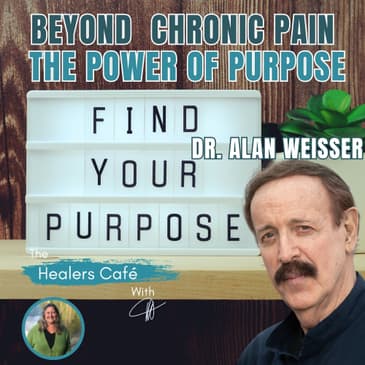
In this episode of The Healers Cafe, Manon speaks with Dr. Alan Weisser, a JD, attorney, clinical psychologist, and program developer, discussed his unique journey integrating legal, psychological, and organizational expertise to address complex mental health conditions and chronic pain.
For the transcript and full story go to: https://www.drmanonbolliger.com/dr-alan-weisser
Highlights from today's episode include:
Existential Immune System & Human Power – We're not designed to be powerless or just suffer; we have an "existential immune system" that's always trying to heal us if we use our thoughts and feelings correctly.
Living in Inspiration – Healing doesn't mean no pain, but having purpose and inspiration (like his patient rediscovering a love of robotics) gives people a real "fighting chance" to live meaningfully despite pain.
The Body Is Built to Heal – The body (and person) is inherently designed to heal; the key is to stop fighting that capacity and instead support it—physically, emotionally, and energetically
ABOUT DR ALAN WEISSER:Dr. Alan Stephen Weisser, JD, PhD, is a psychologist, attorney, and program developer whose career spans more than five decades across law, behavioral health, and system-level clinical leadership. His work reflects a rare integration of legal, psychological, and organizational expertise, with a sustained focus on complex mental health conditions, chronic pain, and the development of effective, patient-centered systems of care.
Dr. Weisser began his professional career in law, practicing as a trial attorney and later in private practice, specializing in real estate, business development and creation, and organizational structuring in the public, private, and not-for-profit sectors. His early legal work included service with the Legal Aid Society in New York, where he handled civil, consumer, and poverty law cases, as well as legal defense for underserved populations. This foundation shaped his lifelong understanding of systemic barriers, advocacy, and the structural dimensions of human suffering.
Transitioning into psychology, Dr. Weisser trained and practiced in some of New York's most demanding clinical environments, including Bellevue Hospital, Maimonides Medical Center, and the Einstein/Bronx Psychiatric Center. There, he developed extensive expertise in psychological assessment, inpatient and outpatient treatment, and psychiatric rehabilitation. He played a key role in the transformation of long-term inpatient psychiatric care into community-oriented rehabilitation systems, designing programs that integrated inpatient, transitional, and outpatient services with a focus on autonomy, functional recovery, and reduced recidivism.
Over the course of the 1990s and early 2000s, Dr. Weisser held multiple senior leadership roles, including Program Director, Clinical Team Leader, and ultimately Clinical Director positions within community mental health systems in Washington State. In these roles, he was responsible for large-scale clinical operations, program development, quality assurance, contract compliance, and supervision of multidisciplinary staff. His work involved the design and implementation of integrated service delivery systems, coordination across agencies and stakeholders, and the advancement of innovative approaches to behavioral health care.
Since 2002, Dr. Weisser has been the Founder and Director of New Options, Inc., in Seattle, Washington, where he provides individual, group, family, and couples therapy, as well as specialized chronic pain evaluations and treatment coordination. His work emphasizes integrating psychological, behavioral, and physical health perspectives, particularly in the treatment of chronic pain and medically complex conditions. He has developed psychoeducational programs, clinical interventions, and training materials designed to empower patients and improve treatment outcomes.
Dr. Weisser is also the author of New Possibilities: Unraveling the Mystery and Mastering Chronic Pain and the developer of the Mastery of Chronic Pain program, a structured, curriculum-based approach to helping individuals regain control over their lives. His work combines clinical rigor with practical application, translating complex psychological and medical concepts into accessible tools for both patients and practitioners.
In addition to his clinical and programmatic work, Dr. Weisser has served as an instructor at the university level, teaching in psychology and public administration. His career reflects a consistent commitment to education, system improvement, and the integration of theory and practice.
Across all phases of his work—from law to psychology to organizational leadership—Dr. Alan Stephen Weisser has focused on one central aim: developing meaningful, effective pathways for individuals and systems to move beyond limitation toward recovery, functionality, and sustained well-being.
Core purpose/passion: My mission in life has been to pursue curiosity, understanding, and deep engagement with what it means to be alive and human. At the center of that journey is a desire to help others.
ABOUT MANON BOLLIGER, RBHT, FCAH:
As a retired Naturopath 1992-2021, I saw an average of 150 patients per week and have helped people ranging from rural farmers in Nova Scotia to stressed out CEOs in Toronto to tri-athletes here in Vancouver.
My resolve to educate, empower and engage people to take charge of their own health is evident in my best-selling books: 'What Patients Don't Say if Doctors Don't Ask: The Mindful Patient-Doctor Relationship' and 'A Healer in Every Household: Simple Solutions for Stress'. and What if Your Body is Smarter than You Think? I am the Founder & CEO of The Bowen College Inc. which teaches BowenFirst™ Therapy and holds transformational workshops to achieve these goals.
So, when I share with you that LISTENing to Your body is a game changer in the healing process, I am speaking from expertise and direct experience".
Mission: A Healer in Every Household!
For more great information to go to her weekly blog: http://bowencollege.com/blog.
For tips on health & healing go to: https://www.drmanonbolliger.com/tips
Follow: Manon Bolliger website | Linktr.ee | Rumble | Gettr | Facebook | Instagram | YouTube | Twitter | LinkedIn |
Follow: Bowen College Inc. | Facebook | Instagram | LinkedIn | YouTube | Twitter | Rumble | Locals
ABOUT THE HEALERS CAFE:
Manon's show is the #1 show for medical practitioners and holistic healers to have heart to heart conversations about their day to day lives.
Subscribe and review on your favourite platform:
iTunes | Google Play | Spotify | Libsyn | iHeartRadio | Gaana | The Healers Cafe | Radio.com | Medioq | Audacy |
Follow The Healers Café on FB: https://www.facebook.com/thehealerscafe
Remember to subscribe if you like our videos. Click the bell if you want to be one of the first people notified of a new release.
* De-Registered, revoked & retired naturopathic physician after 30 years of practice in healthcare. Now resourceful & resolved to share with you all the tools to take care of your health & vitality!
[00:00:00] Welcome to The Healers Café, the number one show for medical practitioners and holistic healers to have heart-to-heart conversations about their day-to-day lives while sharing their expertise for improving your health and wellness. So welcome to The Healers Café. Today I have with me Dr Alan Weisner.
[00:00:27] He is a J.D. Jury Defense? No. Juris Doctor. Juris Doctor, okay. Attorney and Clinical Psychologist. Okay, thank you for that. Juris Doctor, a Ph.D., a psychologist, an attorney, and a program developer whose career spans more than five decades across law, behavioral health, and system-level clinical leadership.
[00:00:56] His work reflects a rare integration of legal, psychological, and organizational expertise with a sustained focus on complex mental health conditions, chronic pain, and the development of effective patient-centered systems of care. Juris Doctor, all right. Juris Doctor, all right. Juris Doctor, I'm not going to go more into your bio.
[00:01:23] Juris Doctor, your bio will be available for everyone to read all the details, but I wanted to get to our discussion a little bit. Juris Doctor, well, first of all, welcome. Juris Doctor, I don't know where you are today. Juris Doctor, you are the best of all. Juris Doctor, what's the best of all ways to know that you are?
[00:01:46] Juris Doctor, your bio-centric mental health is a great resource. so I'm really thrilled to have this opportunity so thank you and as I said thank you as well I'm thinking why don't we start with how you got there basically how did you
[00:02:11] not just leave one thing behind and move on how did you organize your life to decide that all of it was going to stay and you're just going to work bigger how did all that work you might find my answer a little bit different than what you'd expect but I would say it started with comic books okay go ahead growing up I loved science fiction
[00:02:41] I loved fantasy and I was one of those people that read superhero comic books and I go I want to be that not necessarily somebody with powers but a person who could help other people especially people that could not be helped and that was kind of my orientation as a child and I think that sort of set the foundation for what I did and so as you know there's lots of ways you can help people and certainly for me personally I wanted to help people that normally don't get the help
[00:03:11] and I had enough personal experiences with that that also really affirmed that that's what I wanted to do and that's part of how it started my journey which went through being a lawyer and then eventually it's becoming a clinical psychologist and working with the populations I work with so it started with comic books that's my origin story okay and who are the population that you feel are
[00:03:40] yeah that are not being looked after that you're able to help the human race okay but more specifically is there a group I mean that I mean that with all due respect I mean certainly okay don't necessarily need it but I think that especially now too many people do not understand their own power that they don't understand how to deal with a world that has changed so radically in the last 60 or 70 years that they don't understand that
[00:04:09] we don't have to suffer from those changes but right now we are and I through my work and all of it actually it all informs you right in the way you summarize it all the legal skills that I learned and you know this made such a difference when I became a psychologist in a way it's a perfect combination one supported the other I think people in general have always needed to know their own power you understand this in your work
[00:04:38] I kept looking in psychology as you know evolves right there's been many approaches over the years and current psychology is integrating it always based on the model in physics so current model is based on quantum mechanics right and string theory so that's why it's creating mindfulness into therapy now so I was encouraged in my training and I had a lot of really good training supervision to just think beyond what I knew and that has led to the development
[00:05:07] of something that is beyond what I knew but the legal training the background about wanting to help people was reinforced you work with the chronically mentally ill in the state mental hospital which was what I did in my internship and then stayed for 10 years it's a very simple choice you either figure out how you're going to help people whose whole lives are trashed or you just don't do it it's too hard right I wish that every therapist went through that kind of training because I learned a lot of things
[00:05:37] about myself and being there for people but it was really understanding how do you empower people that are psychotic and institutionalized and then beyond that work where I developed a lot of ways to do that beyond what I was taught and I was encouraged to do that then I started working with the chronic pain population almost by accident the reason why I had to stop working with the chronically mentally ill the system was just too broken right okay I knew ways well beyond what was being done you know about institutions
[00:06:06] and how they get in the way yep I get involved with the chronically mentally ill and I go this is very familiar these people aren't psychotic but their whole lives are trash yeah yeah don't get it the problem is we by definition in my opinion you don't make it through a day without suffering injuries it's the nature of being human being alive is dangerous right whether you stub your toe or somebody slights you or something bad really happens it's a natural state of affairs right life comes with side effects and I go
[00:06:35] okay and I've seen the worst of it but then I'm going like okay well isn't there some way to counter that that we designed to suffer which a lot of people believe I go like I don't think so digging into all the models of healing and being trained in a lot of them eventually I find out there's something called the existential immune system that actually is constantly healing as you go through the challenges that you're constantly being healed as you're being injured and if this isn't working
[00:07:05] at an optimal level you've got a shot and I've been through this personally as well as professionally so maybe a bigger answer to the question than what you were asking but that's good no no no that's exactly yeah that's what I'm getting to understand what the scope of it is and how does it make sense and where the limitations are which are clearly there's none there's none you can be chronically mentally ill you can be chronically pain you can have a problem
[00:07:35] with your boss this system started with chronic pain and chronically mentally ill it's a way of dealing with things that it simply understands the nature of your power and how to optimize it the background and legal training my martial arts huge influence on this I don't think of what I do so much as therapy or I think of it as you come to the dojo and you learn how to defend your emotional psychological and existential life okay interesting
[00:08:04] well why don't we or if you're okay with it either take yourself as an example or a client without a name but I'll ask you to speak a little closer to the mic because I'm having some issues how about this is that closer yeah that's better yes sorry about that let me try a quick experiment if I disconnect from my external mic use the computer mic and mic clean it up sure let me try unplugging this and see if it works
[00:08:34] now okay no no can't hear you yeah my technology is not one of my skills yeah don't worry I had my computer not start this morning okay so I'm sorry go back to your question yeah no so why don't we start with turning this into a person whether it's you as an example or anyone that to make the point of
[00:09:04] sort of what is their journey right through your your methodology through your eyes what is that how does it work great question I'll give you a quick rundown on the technology and connect it to an actual situation okay so as far as I can tell all human experience is translated by thoughts and feelings that's kind of where the rubber hits the road we have things happen we experience it through our thinking and feeling right that suggested thought and feeling
[00:09:34] is very important and then the question was if you think of them as systems are they working in the way they were designed for example if you put regular gas in a two million dollar car what's going to happen it may run but not well and eventually it's damaged right so I won't get into this the mechanics of the system but there's a technology for doing this to optimize the thinking process and the feeling process for example if you suppress your emotions you are not
[00:10:03] working with them they're tools all right you engage in judgmental thinking assumptions generalizations rationalizations that is not using thinking in a way that represents the truth the goal in this technology is to bring people into using these systems the way they were designed and optimizing them give you an example I'll tell you there's a lot of ways I could talk about it but I think the number one tool in helping people heal and stay in healing is to live in inspiration
[00:10:34] is to is to what live in inspiration live in inspiration okay you understand that you're obviously a really inspired person case in point I have a patient who suffered some of the worst neck injuries I've ever seen multiple surgeries he's involved in the workers comm system incredibly depressed on the verge of killing himself but kind of has fighting spirit which I understand from the martial arts and I'm trying to help him so he's in a position
[00:11:04] where he's not going to return to the work he did before physically can't do it anymore when I met him he's over he's done he's ready to die his life has no purpose it has no meaning I go okay maybe he had an opportunity to do retraining right you can go back to school get it paid for and I go so let's talk about your life before you took on responsibilities did you want to do what you were doing he says no I said well what was the fantasy what really always
[00:11:34] appealed to you you have no choice you have to change you can get paid for when I tell you that he's one of the worst cases of pain
[00:12:06] I have overcome things in my life personally because I love being alive and I do not like a threat to that and I don't take it lying down and I hit the fan with that one when I was 12 and a half if you may know from my bio 12 and a half I broke in my neck and I was
[00:12:36] I get to choose right and I made a choice so the power in being human has to do with the intention you set and the choices you make and what your purpose is if you know what matters to you that is incredibly motivating and then if you develop that around the different skills and tools to use your system you put those two together inspiration and number two support emotional connectivity
[00:13:05] not being alone in it and then you build the tools around that power and show people you may think you run out of choices you may think that your life is over you're a one trick pony I go there's no such thing how many lives have you lived I've lived I don't know 20 lives already they're all me but they're all different right so I don't know if I'm saying more than you need to hear about but I took on the challenge of my own disability I've taken it with thousands of patients and I go like
[00:13:35] maybe maybe it's not possible to thrive but you could right it's always about possible and there may be things where you go like that's it maybe but I'm not interested in part of what you're saying for you to expand on it when you say or how I'm taking what
[00:14:05] you're saying let's put it this way it's like there has to be a little gap of possibility just that openness that you can then get in like otherwise the person's like no I've done my life I have no purpose so is part of it finding through your questioning you know like with this fellow you mentioned you ask them
[00:14:35] what did they really do what they wanted to do and then boom you've got that window and then it's a question of bringing that out and turning that into something feasible even though he's in chronic pain he can't sit somehow all of that doesn't matter now that he's connected to his goal or it actually goes away like what what's the process that you're seeing doesn't go away if you look at the
[00:15:05] book title it talks about mastering not managing right in the martial arts I'm very skilled does that mean I can never be hurt absolutely not it means I've got a fighting chance a fighting chance yeah and you know this if something really matters to you it's the person who lifts the car up when their child's injured right things people do that are exceptional Stephen Hawking I didn't do what Stephen Hawking did I would love to have met how did you do that right I don't know
[00:15:34] that everybody will find their way we are not designed to be done we're designed to evolve and I say look maybe you can't find your way into something that would balance it's about balance I don't tell people you're not going to care about your pain anymore but that you're going to be cured I do tell people that if you can find enough purpose and meaning and connectivity it might make it worthwhile to stick around and to find a way to
[00:16:04] be in the world part of the problem is you know this people don't get it it's dangerous to be alive people don't clean out they're vulnerable well I never had a choice at 12 and a half like it or not right shock to the system it's an existential crush and I go you get used to the idea that you can but you're designed to find a way through this they don't they don't I just want to give people a fighting chance and suddenly you have no pain
[00:16:34] or you don't have whatever challenges you have but you have more power than you think you do yeah you'd be the nemesis of the MAID system here in Canada I'm sure you've heard of it in Canada the MAID system medically assisted death no if a person wants to do that there's no judgment here no it's not about judgment at all it's the fact that it's the biggest industry we have in Canada Canada and we have
[00:17:04] there's more people killed in that methodology propagated by our government than any other way so it's you know it's it's the hopelessness they bring to people oh you can't pay your rent it's really a problem you know and sorry but you know you do have a way out you can use this I mean I'm mocking it slightly but not much you know and
[00:17:34] so I was going to say that's why you you'd be not very popular in that organization trying to find a little bit of hope for people there may be situations where it's really not worth it sure right but you I both know that that would have to be something so extreme where there's no other logic right that but it's not how it's implemented yeah well if it's been abused that's that's absolutely yeah so look I'm not I'm
[00:18:04] not doing something that's Pollyannish high in the sky I've been at this for a long time and yeah I in the beginning go like really I'm going to do something about this level of suffering and then but I'm not the kind of person to go like there's nothing you can do that's just me right I'm creative I got into doing a lot of program I had a study group you know how every person in the study group has a job
[00:18:34] my job was to come up with an innovative way to do the case what would your life be like if you were pain free if you were one of the millions who suffer from chronic pain the thought of just one day without it may seem impossible this is often because conventional medicine tends to fall short in the treatment of pain opting to prescribe pills or recommend surgery rather than getting to the root cause of the problem but if you are suffering with emotional or physical pain
[00:19:03] there is hope join the founder and CEO of Bowen College Manon Bolliger live online for your body mind reboot learn how to listen to your symptoms and get to the root cause of your pain plus be trained in basic Bowen therapy moves so that you can reboot your body for optimal health you don't have to live in pain you can heal stop the pain pill cycle
[00:19:32] by visiting www.yourbodymindweaver.com to learn more and to register oh yeah let's use insurance law in the criminal case right just I feel very grateful because when I look at any situation you usually find some more effective and efficient ways so I'm just saying and don't get me wrong I don't believe in hope
[00:20:03] right it's magical thinking what I believe is if you know how much power you have as a human and I mean real power maybe you are not designed to be powerless you can never be powerless as a human well what does that mean and how do you connect to that the work you do actually I think is probably based on helping to connect to an aspect of that power and that's used for the healing process I'm just saying find out what you really got going for you yeah
[00:20:33] or you decide that you have no power and that you're done right right I mean yeah I probably go like oh well if I can learn to live with it learn to deal with it and still have a life yeah then if they go like I've lost it all there's no point never getting back okay so how was it for you like as a 12 year old with you know such a serious injury and
[00:21:02] how did you how did you get to the next step like what was the process for you to it nearly destroyed my life yeah I'll tell you why because I just shut down nobody if you talk to me during that whole healing period I mean I was on my back in the bed for a year and a brace not allowed to move had to learn how to walk again even though I wasn't paralyzed but nobody knew
[00:21:32] I'd crack jokes nobody knew I didn't let myself know how I was feeling but here's the interesting part I've got advanced degrees right and picture that I'm flunking out of high school remember this happened way through junior high right and if you asked me at the time why I'm not doing well I would have said I'm not very smart and then I ran into a chemistry teacher in junior year was a young very enthusiastic funny guy
[00:22:01] like to blow things up so I liked him yeah halfway through the quarter he's going you're failing my course why are you failing I go what are you talking about he says you're smart like no I'm not I literally debated with him wow and he said you know what I don't care he made me come after school I got through the course with a C it didn't convince me that I was smart but it made me wonder that maybe if I worked hard enough right there were people along the way and that continued
[00:22:30] I got through high school then I got into college partway there were people that come along and go like you don't really know who you really are but here's the part that is really important I didn't know until 30 years later why I always thought I was stupid in high school I never asked myself why did you think you weren't smart I was busy proving that I was smart most of my life law school that was a test
[00:22:59] graduate school that was a bigger test that was part of law school until 30 years ago 30 years later in a session with a patient I'm reflecting back on that moment and something surfaced that I completely buried it was what I thought when the doctor came in the room and said what he did I thought stupid stupid stupid look what you did to yourself wow
[00:23:29] 30 years later my whole life was plagued by this I'm smart I was able to be accomplished on the surface I looked fine I was not there was nothing about my life that wasn't questioned there was no real confidence behind the bravado right I soldiered my way through it but I kept meeting people who reflected who said you need to know who you really are I can't do this life safely unless we have people to help us whether it was
[00:23:59] in law school or friendships or when I traveled out in the world and ended up living with Bedouin for a while there was people who go like you don't seem to know who you really are I work with people I'm trying to pass that along and go like you may think you know who you are what you are actually you don't so I'm very grateful for that and I also understand why if you don't look at the whole life of a person everything that's been affected nobody was asking me
[00:24:28] and I actually checked in with family after this and I said like how did I seem during that time which I never asked by the way my two brothers had family they go you seem to be fine I think the doctors asked me how I was feeling about what happened to me do you think the doctors even bothered to check up on me to see if maybe I could never happened so this is personal for me yeah no I mean that's
[00:24:59] that's the most critical part of any care right like any connection it's the connection that allows the healing in that sense to take place and it's it's it's so beautiful the way like in your life it's it just it happens along the path and I think that's what it is you know in everybody's life in a sense you know and but to take the moment to notice it is also important right because
[00:25:29] I think sometimes these statements are at least if I reflect in my life I've heard such thing like oh you haven't figured out you know but I really wanted to help people that was the driver so I was doing what I loved but it's the
[00:25:58] it's really the power of understanding the inner power that everyone has like like when I tell my patients your body can heal like it it's made to heal it's almost like we have to appreciate that it can it's built this way let's not fight it you know how can we contribute to this how can we notice it how can we work with it right and I think that's
[00:26:28] and I'm only have it's it goes beyond also the physical it's you know you could call it spiritual that's one way but you know I'm not trying to put any religion in there either I think you can say that it's string theory for the human being because what is the equivalent of string theory for humans
[00:26:58] string theory okay string theory is about everything is made up of energy right right yeah we exactly yeah and what you do and what I do says you are an energetic being yeah exactly through your attention through your choices through your purpose you do that I don't know about you but I believe that humans don't need machines and they don't need doctors but
[00:27:28] we are not raised to understand the power that we have innately to heal and people like yourself come along and go no actually you can't and here's how you do it right like I said humans are wonderful creatures they
[00:28:01] like how you know just because nobody asked you how you were and you didn't think about asking how you were because at that age you didn't have that like you have no context to understand how you could understand right it's like you're just the and there you are you know just you know even physically I
[00:28:31] raised and he goes you know I've never seen this before he said you seem to have experienced a natural fusion which might have been the result of
[00:29:01] they're more likely to heal the placebo effect I mean these are not magic this is people tapping into that power the problem is a lot of educated to not even understand that yeah independent on a system that's more about profit than it is about cure yep and hopefully we're changing that system as we speak and it has probably got a better shot at it compared to what's going on here right
[00:29:31] now I don't know you know like honestly we're so bureaucratically technocratically stuffed up that we don't know who's like there's a lot of soul missing in what's happening here so I'm not so sure about that you know I crave bureaucracy for what's going on here right you see the bureaucracy here yeah
[00:30:01] what's going on in this country right now yeah I know about bureaucracy and the problems with it and by the way just go back to what you started with about being a lawyer right being a lawyer means advocating yes and I think that part of the journey that I went through was having to advocate for other people you can't do that if you're not willing to know you can do that correct it was part of the healing journey for me to actually help other people I started out legal aid society I was working with people that had
[00:30:31] no resources and going up against systems what's going on right now in the world we both know is something that was inevitable human race is due for a reset but the good news is there are people like yourself me other people I know probably you know there may be a soft landing down the road apiece but there was things
[00:31:11] the new deal yeah we did took the smartest minds in the country they came up with a brand new totally innovative program and saved the country right well where's the kitchen cabinet now right so I think that that's why I am not pessimistic about what happens next no I think there's going to be a tremendous amount of pain to go through but I think the human race may be ready to hear a message which is very
[00:31:41] simple you come together and wonderful things happen you pull apart and terrible things happen you get Canada is being confronted now with having to
[00:32:11] change whether it wants to or not absolutely I feel like it's almost you know the new world order protocol you know and like it managed to exist visibly and tangibly here whereas in some countries not that aspects of it haven't but people have you know kind of well or they're more concentrated you know like in Europe or they fought against it or they're
[00:32:41] more separated and therefore more politics comes into play like you know there's all kinds of reasons but I feel like yeah it's inevitable in Canada but it's going to be a shocker this waking you know because I
[00:33:38] I get informed consent, you know, informed consent means informed, you know. So, I mean, I couldn't do this. So the advocacy part, you know, came out loudest actually in the health department. But really it comes back to, wait a minute here, everyone has got to wake up, you know. Individually, everyone's got to not believe that these systems that are supposed to serve us,
[00:34:07] they're not supposed to control us, you know. We're paying for management of sorts, but we're not, like, I think there was a 400% increase in people working for the government during Trudeau's time, you know. And now there's, we're just like, it's those who have a job are on one side and those who are self-employed or losing their jobs are on the other side.
[00:34:36] Like, that's our, it's a fine, you know, fine line. Everything's a little grain of salt because once you make a generalization, there's always untruths. But generally that's kind of where the advocacy is necessary here. But I do think that sometimes you have to show how extreme it could be for people to go, wait a minute here, this is not okay, you know. So I think it's going to be exciting.
[00:35:06] Yeah, well, too many people have been asleep at the wheel, but I think that's the result of too much change too fast. The world has not adjusted to automation, globalism, technology. AI is now jumping into the middle of all of that, which is profound. Yeah. I trust in the human race. I trust in evolution. Yeah. Maybe we survive it, maybe we don't. But I think we could. And I think that there are a lot of people who know that.
[00:35:35] And like I said, I think that people in general, at least in this country, are getting tired of being divided. Yeah. Yeah. I think you're beginning to understand where is that really taking you? This is the Pied Piper, right? It sounds good, but you're going off a cliff. Yeah. Right? Now, it could be wrong, but I've lived through the 60s and 70s. I know a little bit about risking your license. I came really close more than once. Because as you said, you either stand up or you don't.
[00:36:05] Yeah. As much as I'd like to resist doing that, every system I've ever been involved in, which is why I ended up doing what I do now, which is I will now be able to be setting a different tone in all systems. I'm not here to change systems, but I am here to help people who in the moment when they're dealing with a problem, they are empowered to deal with it. Right. More people who realize you've got a responsibility.
[00:36:35] You know that in this country, with a presidential election, less than half the population votes? Yeah. People not understand. And people say, why should I vote? It's only one vote. I get, how did that ever happen? Yeah. Think about that, right? And I think people are going out because what's going to happen, and you and I know this in this next election. People are going to have to really ask themselves how important it is that they have a right to vote. I don't like the fact that there has to be pain before gain, but I'm not sure it could have happened any other way.
[00:37:06] It's not the problem. He's a symptom. Yeah. You know, Canada is its own life. I don't know Canada well enough, although my best friend in life is from Canada. And I traveled with him for a long time. I actually had a bag that had a Canadian flag. I prefer to be Canadian at that point. I spent a lot of time in British Columbia and Vancouver Island.
[00:37:30] Listen, it's changing, but this conversation, people knowing that there's other options, that there's ways through this, that's what people need to know. Yeah, definitely. Well, our time is up, Alan. And anyway, this is sort of the way I see the contribution is putting discussions like this, things that matter really to people who are in health care. And so I'm really thrilled that we were able to, yeah, to have this conversation.
[00:38:00] So thank you so much for taking it. Thank you, too, because we're going to be launching an educational program so you don't just have to see me as a therapist. There'll be a lot of things available that you'll hear more about. And most likely I'll be doing my own podcast. So I want to just extend an invite in advance. Oh, fantastic. I'd love to be part of that. I'll keep you posted, but probably by the end of the summer. Okay. That'll be perfect timing. I really, truly appreciate the conversation.
[00:38:29] Like I said, people need to know there's possibilities. Yes. Yeah. Well, thank you. Thank you for joining us at the The Healers Café. If you haven't already done so, please like, comment and subscribe with notifications on as I post a new podcast every Wednesday with tons of useful information and tips for natural healing that you won't want to miss.