
Being newly single often brings unexpected financial challenges, especially when someone is suddenly responsible for supporting themselves or their children. Whether you're a newly single parent, navigating gray divorce, returning to work after years at home, or simply looking for more flexibility, finding a way to earn income that fits your life can feel overwhelming. But what if there's a career opportunity you haven't considered?
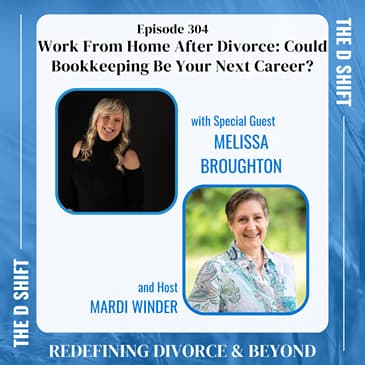
Today, Strategic Divorce Consultant and High-Conflict Divorce Coach Mardi Winder welcomes Melissa Broughton, accountant, entrepreneur, and founder of One Hour Bookkeeping, to explore how bookkeeping can offer opportunities for financial independence and flexible work. Melissa shares how her own experience as a divorced single mother inspired her to build a successful business that allowed her to support her son while being present for the moments that mattered most. She also explains why bookkeeping may be more accessible than people realize, even without an accounting degree or strong math skills.
The conversation explores what bookkeepers actually do, how technology has made remote work more accessible, and why bookkeeping might be worth considering as a second career, part-time income opportunity, or work-from-home business. Melissa also shares her free three-step guide to creating better work-life balance and encourages listeners to think about the possibilities available as they create their next chapter after divorce.
Questions Answered in This Episode
1. Is bookkeeping a good work-from-home career after divorce?
Bookkeeping can offer flexible opportunities for people looking to rebuild their financial independence after divorce. Whether you want a part-time business, additional income, or a full-time career, remote bookkeeping may allow you to work around family responsibilities and personal priorities.
2. Do you need an accounting degree or strong math skills to become a bookkeeper?
Not necessarily. Melissa explains that modern bookkeeping focuses on organizing, categorizing, and tracking financial transactions. With the right training and software, people without formal accounting backgrounds can learn the skills needed to become bookkeepers.
3. What does a bookkeeper actually do?
Bookkeepers help businesses organize their financial information by collecting transactions from bank accounts, credit cards, and other sources and categorizing them within accounting software. This allows business owners to better understand their financial situation and maintain organized records.
4. Could bookkeeping be a good second career for someone going through gray divorce?
Absolutely worth exploring! People returning to the workforce after raising children or leaving a long-term marriage may find bookkeeping appealing because it offers opportunities to develop new skills and potentially work remotely. It can also be an option for retirees or empty-nesters looking for supplemental income.
About the Guest:
Melissa Broughton is an accountant, entrepreneur, author, and nationally recognized bookkeeping educator. As the co-owner of Busy Bee Advisors, she has spent more than 20 years helping small business owners gain financial clarity through proactive bookkeeping, accounting, and tax strategies. Through her education company, 1-Hour Bookkeeper, Melissa has trained thousands of aspiring bookkeepers to launch profitable remote bookkeeping businesses using her proven systems and streamlined processes.
She is the creator of the 1-Hour Bookkeeper Method™, author of multiple bookkeeping books and training programs, and co-host of *The Real Buzz: Taking the Sting Out of Taxes* podcast. Melissa's mission is simple: empower entrepreneurs to build profitable businesses, create financial freedom, and reclaim their time.
For Melissa’s gift: https://gift.1hourbookkeeper.com/thedshift
To connect with Melissa:
Website: 1hourbookkeeper.com
Website: melissabroughton.com
Facebook: https://www.facebook.com/groups/406399388656035
Skool: https://www.skool.com/1-hour-bookkeeper
About the Host
Mardi Winder is a Strategic Divorce Consultant and High-Conflict Divorce Coach who helps high-achieving individuals navigate divorce with clarity, confidence, and control. Drawing on more than 30 years of experience in mediation, divorce coaching and conflict resolution, she supports clients in making smart decisions while reducing emotional and financial fallout, particularly in high-conflict, high-asset and complex divorces. Mardi is the founder of Positive Communication Systems, LLC, and the Strategic Divorce Directory, LLC.
For Mardi’s gift: The Resilience Building Blueprint: A 28-Day Journey To A Stronger You https://www.divorcecoach4women.com/rbb
Connect with Mardi on Social Media:
Facebook - https://www.facebook.com/Divorcecoach4women
LinkedIn: https://www.linkedin.com/in/mardiwinder/
Instagram: https://www.instagram.com/divorcecoach4women/
YouTube: https://www.youtube.com/@divorcecoach4women
Thanks for Listening!
Thanks so much for listening to our podcast! If you enjoyed this episode and think that others could benefit from listening, please share it using the social media buttons on this page.
Do you have feedback or questions about this episode? Leave a comment in the section below!
Subscribe to the Podcast
If you would like to get automatic updates of new podcast episodes, you can subscribe to the podcast on Apple Podcasts. You can also subscribe in your favorite podcast app.
Leave an Apple Podcast Review
Ratings and reviews from our listeners are extremely valuable to us and greatly appreciated. They help our podcast rank higher on Apple Podcasts, which exposes our show to more awesome listeners like you. If you have a minute, please leave an honest review on Apple Podcasts.
[00:00:04] Welcome to the D Shift Podcast, where we provide inspiration, motivation and education to help you transition from the challenges of divorce to discover the freedom and ability to live life on your own terms. Are you ready? Let's get this shift started.
[00:00:22] Hello and welcome to this episode of the D Shift Podcast, where we're going to talk a little bit about divorce, but a lot about a unique opportunity that you may have for creating work post-divorce or even a side hustle if you've got a full-time J-O-B as we like to call them here. So I have the perfect guest to talk about this today. Melissa Broughton is an accountant, entrepreneur, author and nationally recognized bookkeeping educator.
[00:00:52] She is the co-owner of Busy Bee Advisors and she spent more than 20 years helping small business owners get their financial ducks in a row. Through her education company, One Hour Bookkeeping, Melissa trained thousands of aspiring bookkeepers to launch their own businesses and she has all of this wealth of knowledge that I think is fantastic if you're considering this.
[00:01:19] She's also the co-host of The Real Buzz, Taking the Sting Out of Taxes podcast. So Melissa, welcome. Thanks, Mardi Winder. It's really, it's very exciting to be here. I do quite a few podcasts on a weekly and monthly basis, but not all of them hit quite as close to home as this particular topic does. So I'm excited to be here. Well, thank you for being here. And so that's going to lead right perfectly into the next question.
[00:01:47] Why is this, why is what you're doing so important to you now, Melissa? You know, so in relation to your audience and kind of where they're at, I followed probably a similar journey to a lot of your listeners out there. I, you know, I met a guy, I got married at 22, at 23, I had my oldest son.
[00:02:11] And then at, you know, 25, 26, we just realized that we were not, we were not a good match for each other. And we wanted really different things in our lives. And so the, you know, the, the natural solution, and I think back to that, that young woman that I was that long ago and how far I've come. Divorce just really seemed like it was a let's get divorced. It was, it really didn't seem like it was a big deal.
[00:02:40] And neither of us really fought for the marriage. And so we went through the process. And I will tell you, it was brutal. It was brutal. It was devastating. It left me feeling empty and confused and wondering about my worth and so many other questions.
[00:03:00] But I still had this three-year-old at the time that was dependent on me to, you know, earn an income, earn a living, keep a roof over our head. And, you know, the, the house that my ex-husband then at, at the time, and I were always kind of struggling to make ends meet. Now, all of that responsibility fell on my shoulders and still wanting to be there and be present for my kiddo.
[00:03:29] And what happened for me was this realization that dropping him off at daycare didn't work for me. It really, you know, it really didn't. And so I looked at things from a place of that was my, that was my non-negotiable. I didn't want to drop him off at daycare every day. It felt like it ripped my heart out of my body. And so what could I do?
[00:03:54] And I, you know, honestly, I was willing to do, to do anything, kind of the stuff that we were talking about. Now, you know, I had a background in accounting. I had worked. At the time, I was a controller for hair school. And, you know, that sounds really funny, but I had a good job. I had a good job where I was making good money.
[00:04:16] And I was, even with all of the craziness of what was going on in my personal life, I was able to, you know, hold it together, I would say, at work. But I actually, it was interesting because really the breaking point for me was when I got offered a promotion.
[00:04:36] And the number, the dollar signs, right, for that promotion really made sense of like, okay, I could make life work for my son and I at this, with this salary coming in. But what I knew, because I wasn't naive, was that as I moved up the corporate ladder, that there would be more demands on my time. And so that meant I was going against what was the most important thing to me and what had to be the most important thing to me.
[00:05:03] I mean, our kids deserve to be the most important thing to us. Right. And I, you know, I will not say that I just left without a question or without a thought.
[00:05:19] It probably took me about six months to really figure out kind of how I would approach it and started reaching out, started figuring out what type of clients I would, you know, I would want to work for. And took me about six months and I launched and I did something that was very scary, but I had the support of my parents.
[00:05:41] And I walked away for the first time from corporate America and started what I would say was the prequel to the firm I own now, which is Busy Bee Advisors. Yeah.
[00:05:56] And so, first of all, thank you for sharing your story, because I'm sure there are 80% of the people listening that, because not everybody has kids, but 80% of the people listening are going to resonate with that whole wanting to spend more time with your child. And the people that maybe don't have kids that are listening are going, yeah, I'd like to be able to walk away from my corporate job and do some things as well. So, I really appreciate you sharing that.
[00:06:24] Now, I do want to ask you this interesting question, because when I'm guessing when you were doing this, it wasn't like today where everything's done online and everybody's just used to doing online Zoom calls. With every professional in your life, including your doctor and everybody else. Right, right.
[00:06:44] And I'm guessing when you started, this was really, did you do it online or was it more of an in-person, like localized bookkeeping service? So, we didn't really get the benefit of being able to do everything online until COVID hit, which was so many years after I started.
[00:07:07] I started what I did in my system and I kind of laughed about it, but again, I started with what was most important to me. And that was being there for my son and moved kind of backwards from there on how it would work. No, most of my clients, most of my clients had no clue how to use Zoom, probably had never even heard of Zoom, but they knew what FedEx was.
[00:07:29] And they also knew, and it was part of the reason why they wanted an outside bookkeeper, that they didn't have the space in their offices for a bookkeeper to come in and work in their space. Right. And so, I, you know, I kind of, my mom is probably one of the most brilliant people I know. And her and I, I presented her with the problem and I gave her what I now as a mom realize is like the greatest gift. I said, fix this for me.
[00:07:58] And she was, she, yeah, I think her brain probably went on overdrive. But what I did was I set up a FedEx account and all of my clients would have my FedEx number. I gave them instructions on, have a box that you dedicate or an inbox, you know, not like a cardboard box, but an inbox that you dedicate to all of your bookkeeping items or all of your financial items or heck, all of the items that you just don't know what to do with.
[00:08:24] And once a week, here's the FedEx number, you drop them and you FedEx them to me. And so, what would happen was that I would have, you know, client packages that would regularly come on different days of the week. And the client knew that Wednesday was their day to FedEx things out. So, I would get those by Monday the following week. I would do the work. If there were original documents, I would send them back. But that was really how in the early phases we handled remote bookkeeping.
[00:08:54] Right. And, you know, and a lot of times it was also time sensitive, which we have the luxury now with QuickBooks Online. But it was time sensitive because we were working in QuickBooks Desktop, which meant client had to do a backup, send us the backup. We then had this very specific or I then had this very specific time slot where I was doing the client's book work.
[00:09:18] But usually what happened was that it would be after my kiddo was in bed or after time that he, you know, needed me, so to speak. And so, the after hours work schedule that I had kind of worked out perfectly. We would, you know, I would do the updates, whatever needed to be done and send the backup back to the client and then drop their stuff back in, you know, good old FedEx was my best friend in the world at the time.
[00:09:44] Right. And now, like you say, I mean, I know my accountant and I don't I don't have a bookkeeper, but I do have an accountant. And I know, like, even I just do everything online. And then I just he just gets a password. He goes into the account. He does all my taxes from that.
[00:10:01] And I love your story, though, how creative you got so that not only were you able to continue to earn an income that you needed to support yourself and your child, but also that you could be mom when you needed to be mom and then also be Melissa, the bookkeeper to be the professional. I think that's I think women are so innovative how they come. Women are amazing. Women are absolutely amazing.
[00:10:27] You know, and I come from, I'll say, two generations of single moms. My my grandmother was the was the original single mom. I mean, she raised four kids in the 60s and the 70s with a husband. And my grandfather was a great guy. He was incredibly charming, but he was not what you would call dependable. And he would just leave for weeks at a time. And so she worked. She didn't have a driver's license.
[00:10:54] She worked at a hospital as a radiologist. I always search for that word, you know, and walked to work and did bookkeeping on the side at her kitchen table on the weekends. And so I can't really take credit for being super creative on this because there were a lot of things that I took from watching what she did. My mom was the bookkeeper and ran the finance department for a bank for her whole career.
[00:11:23] So I watched and I watched what these amazing, strong women in my life had done. And I just kind of built on it and saw the potential and was really, you know, was really blown away. I mean, I know the amount of money that I was looking to bring in to support my son and I. And I knocked that out of like out of the park, out of the water, whatever the phrase is, within three months of starting. Wow.
[00:11:51] Really, it just it was mind blowing to me, the demand that was out there for, you know, for bookkeepers. And that was the demand now is more than it was then. So so that was that was how I started.
[00:12:10] But what as we grew, what happened was that I started to think about, you know, OK, do I really want this to be where I'm working more hours, even though it's for myself, where I'm working more hours than I was when I had that job? And that didn't quite make sense. So then I started thinking about, OK, I'm going to need to hire. And, you know, let me tell you, my first place to go to was was a mom. Give me a mom. Give me a mom any day.
[00:12:38] I don't care if she's got you know, I had one woman that worked for me. She was a stay at home mom. She homeschooled her. Wait, listen for this. Eight children. Like I stopped at two. She homeschooled her eight children. And, you know, her husband worked in construction. She was one of my she became one of my first students and he was gone a lot. And she needed something that brought in some income for the family.
[00:13:04] I mean, I remember the first time I talked to her and her saying if I could bring in one hundred dollars a month, it would be it would change our situation. Right. And so we we kind of built a process around her being able to she was she was my hybrid, I would say, of working remotely. And then what I realized was that there was so much other talent that I could find for those. You know, just because you have a baby doesn't mean you lose your brain. Right. Right.
[00:13:33] And there are a lot of stay at home moms and stay at home dads that are out there that are looking for part time jobs. And it just became it was I kind of felt like I was cheating because you had these people with these. I mean, I've had I've had women who have had double masters that I mean, their education level is far greater than mine that have worked for me as a bookkeeper because it helped them in some, you know, some aspect of their life. Right. Right.
[00:14:02] And so so internally, what happened, because everybody has a different definition of what bookkeeping means internally, I started internally within our own company. I started to develop a training program so that I could make sure that anybody I brought on, whether she was the stay at home mom who her only experience with bookkeeping was balancing the check, the family checkbook, or maybe she had a degree in finance or something like that.
[00:14:30] But that I could have everybody that started out kind of at the same the same place. Right. The same because bookkeeping is different than, you know, accounting as related to taxes. And it's certainly different than if you, you know, went to school and got your degree in accounting or got your degree in finance. I mean, there were some pieces that you touched on, but I needed everybody to be at the same place when they started. And so there was an internal training program that we developed.
[00:14:58] And then, you know, I'll let you ask your next question. But that's that's really what led to the one hour bookkeeper. Yeah. So that's what I wanted to talk to you about, because here's here's what I hear women say a lot, particularly the women that I'm working with who may, you know, the kids may be adult kids that are out of the home already. They're going through what we now call the gray divorce phase of life. But they're very talented there.
[00:15:27] A lot of them, like you say, have university or college degrees that they actually haven't used perhaps for two or three decades because they've been home with kids, you know, based on how older kids and how far they are spaced out. But I hear so many women say this. I'm not good at math. This is what I hear all the time. Oh, I'm not good at money. I'm not good with this. I'm not good with that.
[00:15:48] So let's talk a little bit about what those myths are and and how like bookkeeping, how does bookkeeping actually work and how like not the not the logistics of how people get clients, but like what does it look like to be a bookkeeper? Because like you say, I know a little bit about this because I have my niece is actually a bookkeeper.
[00:16:13] So but go ahead and tell us about this, Melissa, if you don't mind the whole math myth and then the like what what what does a bookkeeper actually do? So what's what's interesting, lots of pieces to that question for me to go with. So I'll start with this. What's interesting about going through the process of a divorce or a separation? We'll just say that because there are some, you know, I'm from the Midwest originally and you call it the great divorce after kids have moved out.
[00:16:41] We call it the Florida divorce because that's where, you know, one spouse, they would never get divorced. I grew up in a very Catholic community in Chicago. Nope. They nobody got divorced, but the husband or the wife would just move to Florida. Right. And, you know, for all intents and purposes, you're divorced. You may not be as far as the courts see it, but you're no longer a part of your family unit as you once were.
[00:17:06] So whether it's a divorce or a separation, you as, you know, a woman or a man, you all of a sudden have found yourself thrown into the deep end of the pool. And there's a whole lot of stuff that maybe you were no longer, you know, you never thought you would have to get comfortable doing that you're doing and that you're figuring out. So there is a little bit of it where you're primed when you're in that phase of getting comfortable, getting uncomfortable.
[00:17:34] Um, and yeah, I too hear a lot of people that say I'm not good at math and, you know, I, ironically, I'll be the first one to raise my hand and say, I'm not necessarily good at math either. And here's the good news. We have calculators. We've had calculators for a long time.
[00:17:52] You know, I, my first job, excuse me, my first job when I graduated was working for a company that did everything ledger style and those, those businesses just don't exist anymore. So the good news is that there's calculators and there's very systematic approaches.
[00:18:14] If you can follow a very simple recipe, you can absolutely learn how to become a bookkeeper. Right. Right. And I, and I think now, even with, with the software systems, like so much of the stuff, like you don't, you know, you just, you, you really plug data into specific places. It's the, it's your, your light is knowing where those places are and what the categories are. Right. Correct. Sorry. And I'm going to move on you.
[00:18:44] So I don't keep coughing because allergies in Sacramento right now are awful. Okay. But it really is. Our job as bookkeepers, you know, a lot of people will ask like, what does bookkeeping mean? And I've, I've had other bookkeepers that I've talked to and either other, even, even CPAs, you know, the highest level, sorry, the highest level of education in our industry.
[00:19:09] They, they don't necessarily know how to articulate what it means as far as bookkeeping. So really what you're doing as a bookkeeper is you're, you're approaching your client from a place of, they have all of these different financial buckets, right? So they have a credit card bucket. They have a checking account bucket. They may have a cash bucket where they're spending money for their business. And you're taking everything from those buckets and you're compiling it into one central area, which would be your accounting software.
[00:19:39] And then you're adding labels. So you're assigning categories to the different transactions that happen. And once you realize it's just really as simple as that, I had a mom that thought, you know, I was talking to her and she was cleaning up a ball pit that her kids had been playing with.
[00:19:59] And she's sorting, she's sorting the different colored balls because I guess her daughter only liked to have specific colored balls in her ball pit, which we understand kids like that. And I said, it's exactly like what you're doing with the sorting. You're just sorting things.
[00:20:16] And when you realize it's just as simple as that, and you kind of understand the high level overview of what you're trying to accomplish as a bookkeeper, I think it makes it, I think it makes it simpler and not feel as overwhelming as it could feel. Yeah. Yeah. Thanks for, thanks for sharing that, Melissa. Melissa. Now, you do have a gift for everybody.
[00:20:39] And I want to make sure, and I know these interviews go so quickly, but I really love that you shared all this information. And you have kindly provided a gift for everybody. Can you just give like a one sentence description of what that is? And I'll make sure all of the information is in the show notes. So don't, you don't have to worry about giving out the website or anything. So the giveaway, the gift is it's a three-step guide to achieving work-life balance.
[00:21:07] And it really takes the readers down the path of what are you looking for? What does that balance look like to you? Because it's very different for all of us, right? What may be balanced to you is very different than what it may be to me. And it introduces bookkeeping very gently as a potential solution. And it's really, it's really out there for somebody who, well, geez, who's looking for a little bit of balance.
[00:21:36] Because when you're going through a shakeup like a divorce, balance feels so far in the distance. So it gives some very helpful tips on achieving balance. It also goes into being gentle with yourself and allowing yourself some grace. I mean, you're going through something that you've never gone through before. And you do have to give yourself some grace and some forgiveness and some gentleness. So it just walks you through the path.
[00:22:06] And it presents, you know, bookkeeping as a potential solution and a potential answer. Yeah. Well, I normally ask people at this point in time kind of for their takeaway. But I think you summed it up beautifully with that whole idea of giving yourself grace and taking a look at what the possibilities are out there. But I'm going to leave it up to you. Do you have anything else you want to add?
[00:22:28] I, you know, if you have questions, if there's a spark in you and you're listening to this and you're just wanting something different or you're wanting to live a life of intention, I think it's worth it for you to, you know, check it out and to investigate it. Our team is more than happy to talk and answer your questions. And, you know, I'll just leave it at that. Yeah. And it's worthwhile. You know, if you're thinking, I just want to work an hour a day or I want to work eight hours a day.
[00:22:58] This offers that flexibility. And I'm guessing as long as you have a laptop and access to the Internet, you could probably work from anywhere you wanted to. So if you want to travel, if you want to spend your time going coast to coast, visiting the grandkids, you know, you've got all those options. So, yeah, absolutely. I mean, I have, you know, I have younger moms that that I've have gone through my training programs.
[00:23:22] I also have women and men and I don't want to exclude the guys out there, but I have women and men that are at that. They're at the phase where they've retired from a career and that retirement money that they thought was for sure going to be able to cover them. It's you know, it's making things a little bit tighter than what they thought. I have one young lady who her husband is a long haul trucker. Their kids are grown. Her husband's a long haul trucker.
[00:23:51] And so she has a laptop and she gets to be on the road with him and has, you know, a dozen bookkeeping clients that she works with around the country. So really, it's the laptop and an Internet connection. It's that what do they call it? A working nomad life. You could do whatever you want. Top lifestyle. Yep. So, Melissa, one last question. If people want to find out more about what you do, they want to reach out to you or your team. Where do they go to get that information?
[00:24:20] Super simple. Visit our website, onehourbookkeeper.com. Perfect. I will make sure all of that is in the show notes. Melissa, thanks for this. And I really think that, you know, this idea of bookkeeping is something that could be a great fit for people going through divorce, people of any age, or if you have kids or don't have kids or want to travel or don't want to travel. It sounds like a really great option. So, thanks for being here and sharing all this. Oh, thanks for having me.
[00:24:48] And thank you, everyone, for listening in to this episode of The D Shift. And please reach out to Melissa and her team if this is something that you're interested in at all. Thanks for listening and supporting The D-Shift Podcast. If you would like to attend live trainings by our amazing guests and have a chance to ask questions and get answers from our experts, join The D-Shift Crew.
[00:25:11] For more details and to sign up, head on over to www.divorcecoachforwomen and click on the podcast page.