
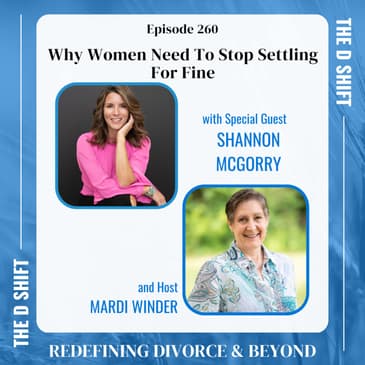
Divorce is not the only experience that can completely reshape a woman’s identity. Career shifts, children leaving home, relocation, loss, and major life changes can all create moments where women stop and ask themselves a difficult question: Who am I now?
In this episode of The D Shift, Mardi Winder sits down with Shannon McGorry for a thoughtful conversation about transformation, self-discovery, and what it means to intentionally create a life that reflects who you are in this current chapter.
Through her experience navigating divorce while raising two young daughters, Shannon shares how many women unintentionally lose touch with themselves by constantly adapting to the needs and expectations of others. She discusses how easy it becomes to define identity through roles such as wife, mother, caregiver, or professional, while never truly exploring what matters most to her personally.
The conversation explores why so many women settle for being “fine” even when they know something beneath the surface feels misaligned. Shannon explains how identifying personal values lays the foundation for making better decisions, creating healthier habits, and building a more intentional life.
Shannon breaks down her Activate Your Female Genius framework, which helps women reconnect with their identity, strengthen self-leadership, and uncover the unique strengths and gifts that often get buried during difficult life transitions. Rather than approaching change as something to fear, Shannon encourages women to see these moments as opportunities to redefine themselves with greater clarity and purpose.
Shannon shares how:
• Many women unconsciously shape-shift into roles and expectations that no longer align with who they are
• “Fine” can become a way of settling instead of honestly addressing what feels off
• Personal values can change throughout different stages of life and deserve regular reflection
• Living out of alignment with core values often creates stress, resentment, and emotional exhaustion
• Self-awareness and intentional habits help women create a stronger sense of direction after divorce or transition
About the Guest:
Shannon McGorry is the creator of Activate Your Female Genius®, a transformative framework that blends clarity-building, habit transformation, and actionable strategy to help women stop settling for “fine” and instead create an updated strategy for their current chapter of life.
A PCC-level coach accredited by the ICF, Shannon is the founder and chief strategist of Love, Strength, and Grace, a women’s empowerment coaching firm offering 1:1 coaching, keynote speaking, and professional development workshops. Shannon also co-founded Your Strategy Reset™; a brand of in-person, customized, boutique women's leadership experiences. She combines professional expertise with lived experience to empower women as they navigate meaningful change with an updated strategy.
For Shannon’s gift: https://www.lovestrengthandgrace.com/events
To connect with Shannon:
Website: www.lovestrengthandgrace.com
Website: www.yourstrategyreset.com
Instagram:lovestrengthandgrace
LinkedIn: Your Strategy Reset | LinkedIn
About the Host
Mardi Winder is a Strategic Divorce Consultant and High-Conflict Divorce Coach who helps high-achieving individuals navigate divorce with clarity, confidence, and control. Drawing on more than 30 years of experience in mediation, divorce coaching and conflict resolution, she supports clients in making smart decisions while reducing emotional and financial fallout, particularly in high-conflict, high-asset and complex divorces. Mardi is the founder of Positive Communication Systems, LLC, and the Strategic Divorce Directory, LLC.
For Mardi’s gift: The Resilience Building Blueprint: A 28-Day Journey To A Stronger You https://www.divorcecoach4women.com/rbb
Connect with Mardi on Social Media:
Facebook - https://www.facebook.com/Divorcecoach4women
LinkedIn: https://www.linkedin.com/in/mardiwinderadams/
Instagram: https://www.instagram.com/divorcecoach4women/
YouTube: https://www.youtube.com/@divorcecoach4women
Thanks for Listening!
Thanks so much for listening to our podcast! If you enjoyed this episode and think that others could benefit from listening, please share it using the social media buttons on this page.
Do you have feedback or questions about this episode? Leave a comment in the section below!
Subscribe to the Podcast
If you would like to get automatic updates of new podcast episodes, you can subscribe to the podcast on Apple Podcasts. You can also subscribe in your favorite podcast app.
Leave an Apple Podcast Review
Ratings and reviews from our listeners are extremely valuable to us and greatly appreciated. They help our podcast rank higher on Apple Podcasts, which exposes our show to more awesome listeners like you. If you have a minute, please leave an honest review on Apple Podcasts.
[00:00:06] Welcome to the The D Shift, where we provide inspiration, motivation, and education to help you transition from the challenges of divorce to discover the freedom and ability to live life on your own terms. Are you ready? Let's get this shift started. Hello and welcome to this episode of the D Shift Podcast.
[00:00:28] And today we're going to talk all about transformation, rediscovery, and really stepping into ourselves as women after going through big life transitions. We're not necessarily just going to be talking about divorce because there's all kinds of transitions that can impact us. And I have an expert to talk to us about this. Shannon McGorry is just a phenomenal woman. I've met her several times. She's been on our summits. If you've been to any of the D Shift summits, you've heard her speaking.
[00:00:58] She's been on the YouTube channel. We've done a few things together. We're in a couple of groups. And she just really has a unique way of looking at this. So Shannon is the creator of Activate Your Female Genius, a transformative framework that help blend clarity, habit, and actionable strategy to help you stop settling for fine and instead create an updated strategy for your current chapter in life.
[00:01:26] So just to let you know, Shannon is a PCC level coach accredited by the ICF. She's founder and chief strategist of Love, Strength, and Grace, a women's empowerment coaching firm. She's also a keynote speaker, does workshops, and she does some really cool boutique style in-person women's retreat and leadership experiences. So Shannon, welcome. Thank you, Mardi.
[00:01:55] I always enjoy speaking with you and very much appreciate the opportunity to have a conversation today. Well, you know, and it's – thank you for that. And I think it's always amazing how – I find that I tend to have the fortunate experience of being in a lot of professional groups with people who are very committed to helping others. And I think that makes a big difference. You know, your energies just kind of match and mesh or whatever.
[00:02:22] It takes one to know one, I think it's the saying, you know. Yeah, it kind of makes a natural thing. So without getting too far into the content yet, Shannon, tell us a little bit about yourself and why you moved into this area of women's empowerment. Sure. So I navigated my own divorce when my girls were four and five. We lived in Tampa, Florida at the time. And I did have the incredible good fortune of working with an amazing therapist.
[00:02:50] And I thought I wanted to then become a therapist to help other women not be defined by that moment of divorce. And at the same time, the girls that I moved from Florida to the Philadelphia region, I was studying at one in the morning in a full-time weekend accelerated master's program. They had never seen snow before. They're adjusting to life that, you know, was completely turned on its ear. And I had to take a pause and realize, like, this is not what I'm meant to be doing at this moment.
[00:03:18] My girls need me to help them acclimate to this new chapter of life. And in doing so, I also turned my eye to coaching and became certified as a professional coach and really settled into this niche of helping women facing this question of, like, what now and what next? Because when I went through my own divorce, I was determined not to be defined by it. Yes, it was devastating. Yes, it was hard.
[00:03:44] Yes, there were a lot of emotions to deal with as well as practical tasks to navigate through. However, I did not want to become resentful, bitter, defined by that. And so I saw this opportunity to help other women who maybe felt the same way. And that's really what my business was founded on. It's called Love, Strength, and Grace. And then I also developed a framework that I used as I was navigating through.
[00:04:09] Because one of the most important things I realized about myself, and I find time and time again with women who are very purpose-driven and faced with divorce, or maybe, like you said, another life-changing chapter. Maybe their children are leaving the nest. Maybe they're changing careers. Maybe they're moving geographically.
[00:04:27] Maybe they're changing things.
[00:04:57] Because I loved them. Or because I thought that's what you did when you compromised. Or because it didn't really matter to me if we had pizza or sushi. But when I was faced with that moment of divorce, I was quickly welcomed to the school of, you've got to figure this out. And by this, I mean myself. I had to figure out who I was and what I really valued in life in order to build a life that I was loving day after day after day. Yeah.
[00:05:23] And so this is something that I think that it's an unexpected element of divorce that really throws people. Yeah. And I don't care whether you go through an amicable divorce where, you know, generally you agree on 95% of the stuff and the other parts you're able to come to some kind of a compromise.
[00:05:46] Or whether you go through a really high conflict divorce where you are, you know, fighting for just your very survival, the needs that you have. And there's going to be this time afterwards. I call it the post-divorce void where it's just like, okay, like it's like you're in a vacuum. Who am I? What am I doing? What is my purpose?
[00:06:08] And I think it gets more significant if you do not have children that you're caring for, whether you didn't have kids in the relationship or whether they're out of the house and on their own. And you're just there with yourself. And all of a sudden it's like, holy shit, what do I do now? Like what's going on? How do I fill my time? I've had women in their 70s who have gone through divorce who have been married for perhaps five decades.
[00:06:36] And they're like, I came home and I honestly didn't know what to cook for dinner. I knew what my kids would have liked, what my spouse would have liked. I knew what we had for dinner on Tuesday at the house. It's Tuesday at my house and I don't have a clue what I should eat. And I don't know what I even want to eat. And that's really true. Yeah. Yes. 100,000%. It is a theme I see time and time again.
[00:07:01] And you can't really, you know, as a divorce coach or strategic divorce consultant, now I tell people this is going to happen. So let's start planning for this in your divorce. And, you know, I get a lot of pushback on that. I get, no, no, no. I just want to get through this divorce and then I'll worry about it. And it's like, by the time you get to that point, then it becomes really worrisome for you because it's like, yeah, what's going on?
[00:07:27] I had my therapist say to me when I was going through mine, just be careful of how you show up through the divorce process because it may inadvertently become who you are. And I find that to be true because the habits that we employ and take on, some of them stick. And we just want to make sure and check ourselves. Like, of course, yes, I went through my stage where I was like Hallmark movies and take out food on the couch. Those were my weekends if my girls weren't with me.
[00:07:54] But I remember her cautioning me and saying, like, just be aware of the habits you're taking on. And is that who you want to become and how you want to be living going forward? So I love that you're prompting women to address that before it becomes kind of that, oh, no moment. Right, right. Now, one of the things that you talk about is why, as women, we should stop settling for that word fine.
[00:08:20] And I don't know if you know Lori Sates, but every time I hear somebody use the word fine, I think she has a podcast called Fine is a Four Letter Word. And that's kind of her focus is on how we need to stop doing that. But I'd love to hear your take on that. Yeah, I think it is fine is equivalent to settling in my book. It means things are OK, but they could be better. I think it's an automatic response that we're conditioned to, you know, answering with that question.
[00:08:50] How are you or how are things? It's fine. I'm fine. Everything's fine. And it started with my girlfriends and I because like, well, that's the red flag. If one of us says fine, we know, OK, stop the conversation. We're focusing on her because that's the red flag that something is actually not in alignment. And when I do workshops or deliveries and I have a setting with a lot of women, I tend to ask them the question, why do you why do you think we do this?
[00:09:15] And it's really interesting, the feedback that I get, which is things like, well, when people ask, how are you? They don't really they're not really wanting to know the full story or I'm scared to admit that everything isn't cool because it's supposed to look or be a certain way. Like that perfectionism that we're chasing or people are expecting things to be a certain way.
[00:09:37] But when we get really honest with ourselves, can we give ourselves permission to not settle to say, yeah, maybe it's not terrible, but it could be a little bit better. And what's the something I could do just to shift it one degree in that direction? We don't have to be scared of this vast mass overhaul in life, but maybe there's something we could shift a little bit that would improve things out of that fine space. Yes. And it's so true, I think.
[00:10:03] And the other one I hear now, this may be more of a generational thing, but you just didn't talk to people about problems that you're having that are either, you know, personal or inside the relationship. Again, even, you know, I remember not so much my generation, because in my generation, you kind of told your best friend everything or your group of close friends. But I know my mom, for instance, didn't even tell people her health issues for years.
[00:10:33] I mean, she had terminal cancer. She didn't want anybody to know. And I mean, there's various reasons why people may do that. But she really just believed that wasn't appropriate to talk to other people about those personal issues. And I think that's changing a little bit. Yes. And I think it's so healthy that it is. Yeah. Sorry, I didn't mean to cut you off, but I think it's a healthy thing.
[00:10:54] And I think it's also healthy for us as women supporting women to ask the question if somebody and not obviously not if you're, you know, in a public setting or if it's not not a cool time to do it. But you can always circle back and say, you know, we had that conversation on Tuesday, even if you just give him a call or send him a text or something. Hey, you know, you said things were fine. Do you want to talk some more about this? Let's you know, we can go grab a coffee or whatever.
[00:11:21] Because I think if we if women felt more supported, they would be more comfortable in sharing that kind of information. I agree with you. And when we do give ourselves permission to be a little bit vulnerable, when it feels appropriate and right, like you said, I think it's so surprising that other women are feeling the same way.
[00:11:42] And that shared sense of, oh, my gosh, I feel really seen or I feel understood or I'm not alone can be so powerful in and of itself. Right. Right. And, you know, it's funny. I'm sure you've heard this term divorce contagion that, you know, people don't like to talk about divorce or other people don't like to hear about it because sometimes it shines a light on potential challenges in their relationship.
[00:12:12] And maybe if there was more of a dialogue with us as a community of women where we could say, yeah, I'm having some problems. Maybe we could get some support from women who said, yes, I've had that experience as well. And here's some things we worked on, you know, just again, not to tell anybody what to do, but just to say, yeah, there's ways to work out of this situation. Or it may be time to pull the plug on it, one or the other. Just getting some right back.
[00:12:41] Yeah. Yeah. Yeah. I read a statistic the other day that said 70 percent of Americans feel like they don't have someone who will truly listen. And that was staggering to me. But I see that to be true. And I think that's a lot of reason why people come to coaching is not because something's drastically wrong, but because there's an opportunity to have a space that's consistent for you to be able to voice some of your thoughts,
[00:13:04] to express some of your feelings and to get clarity on what's going on versus having it just constantly going off in your own head, like a snooze alarm. And I think the other nice thing is it's judgment free, at least at least with good coaches. It's judgment free. There's no advice crammed down your throat or there's nothing that you're told what to do. It's let's explore the options. And then what do you think is a good option for you? You know, and it may take a few sessions to work through everything.
[00:13:34] But yeah, very different experience. Now, one of the things you talk about, Shannon, is upgrading your strategy. What does that mean? And what does that maybe look like in practical terms? Sure. So the foundation of that is identifying and being aware of what your values are and when I ask my clients, what do you value? I call it the mic drop question because I'm usually faced with deer in headlights, silence.
[00:14:04] And it's because we're not used to being asked that, right? We're being used to being asked, like, do you have children? Where do you work? Where do you live? Those types of questions. So when you ask someone, what do you value? I find that women are caught off guard. And secondly, they're not quite sure how to answer it because they might not know. Right. And then as we start to unpack it and they feel permission to explore what it is that they value, meaning what lights them up? What gets them out of bed in the morning?
[00:14:33] What could they not do without in life? And it could be the simple things from, like, their favorite cup of coffee to something like financial stability. And there's, again, no judgment, no right or wrong. I've had some clients give me two values and that's full stop. And I've had another that we worked through a list of 47 before we whittled it down to, like, four or six core values. But I like to bring that to women to create that awareness first and foremost, because
[00:14:59] then we can build habits and actions and decisions around those things that we value. Yeah. So that's number one. Two is that's not to discount the responsibilities that we have in our life, right? Because the values are usually the things that are fun and light us up. And the responsibilities are sometimes like inviting the elephant into the room, like, we drag the mood down. But when we can marry a responsibility with a value, that also shifts things a little bit.
[00:15:25] It may not change our decision, but it may make it easier in how we show up for that responsibility when it's tied to a value. And all of this to say, it's important that that's kind of where we, the framework or the strategy for life comes in. It's really what you value and how you're going to show up, what you're going to say yes to, what you're going to say no to and why. And I think it's important to reevaluate that, Marty, ongoing because life changes. Yes.
[00:15:52] A lot of us are inherited or inherit our values from our parents, right? Like I certainly did. One of my values of faith came from my parents and I'm forever grateful for it. One of my other values in college was, you know, going out on a Thursday night with my girlfriends and my pleather pants. That's not a value I have right now as a 47 year old mom of two. And so our values change. And if we don't keep up with that strategy, that awareness of our values for this chapter
[00:16:21] in life, that's where I believe we are inadvertently welcoming and stress and tension and resentment because we're doing something from this. I should place or I, I always have. So I, it must be what I do. It's not necessarily true. Life changes. And as women that are purpose driven and we're taking on more in life and things are shifting, we still got the same set of shoulders.
[00:16:49] We've still got the same brain and the heart. And are we meant to carry all of this? Can we sideline something first a little bit of time while we're doing this other thing over here? And then pick it back up. Maybe, maybe not. But taking the time to address your values and to set a strategy, I think is one of the most empowering, impactful things I see time and time again for women. I couldn't agree more.
[00:17:16] And the thing that I want to highlight that you mentioned is that your values can change over life. You know, again, what you valued in your 20s is probably not the same thing you value in your 60s. I mean, some things may be like honesty and integrity, hard work. But you know, your hard work at 20 is different than your hard work at 60. Hopefully. Hopefully. A hundred percent. Yeah.
[00:17:42] And so it's okay to let go of some of those things and shift them around. Maybe something was your priority and now it's maybe number 11 or 12 on the list. Yeah. I think that is so important. And the other thing I just want to stress, Shannon, is that if you're not acting in integrity with an alignment with your values, then you feel off. Yeah.
[00:18:05] And this is where I see a lot of women in divorce get kind of messed up or get added stress on them because they have a value of honesty, transparency, and even loyalty to their partner. That's a value for them. Now they're going through a divorce. So they feel like somehow they're becoming disloyal. They're going through a divorce and maybe they're being told, don't discuss this with your partner or don't share this information with your partner from their attorney, which
[00:18:33] is not to say there's anything wrong with that. That's a strategy. You don't want to tell the other side your whole legal strategy. So there's all these things that you're being asked to do that may feel out of alignment with your values. So you may have to just look at that and go, okay, this is I'm doing this and not telling information is not that I'm not being transparent. It's that I'm being strategic. And so my value now has to be self, maybe self-preservation and strategy.
[00:19:01] So yeah, I really like that idea. Yeah. And you might be being transparent with yourself. Yeah. For now, you know, there may be this reorientation of where you can exercise that certain value in a different way or with a different person or in a different area. But that habit probably has been very strong, especially for people that have been married a long time and have some of those values at play like loyalty and such that you described. Right.
[00:19:28] So I do want to make sure that we have a little bit of time to talk about the framework that you use to activate your female genius. Can you talk to us a little bit? Because I love the idea of a framework, because this is something I think that a lot of women, when they go into coaching or a lot of human beings going into coaching go, well, I don't want to just sit around like navel gazing. And that's really not what that's not what effective coaching is at all.
[00:19:55] Let's talk about your framework and how that helps people move through this situation. Yeah, sure. I kind of liken it to before COVID, none of us really knew what it was like to have our groceries delivered. Well, I certainly didn't. Right. So we couldn't really explain that value until we experienced it. And I think sometimes coaching is like that as well. It can be a little bit nebulous or a little misunderstood. And so thanks for calling light to that, that it is, there can be strategy and intended outcomes with it. And it is a very purposeful time. It's not just
[00:20:25] like, well, let me pull out of thin air what's come up for me today. And we'll just sit and chat about that for an hour. Yeah. Now I use a framework. It comes in three parts. It's based on defining who you are, your self leadership, and then what I'd like to call your signature self. And within each of those bubbles or components, there are three as well. So within the who you are component, we're going to talk about your values. We're going to talk about your identity, we're going to talk about your roles,
[00:20:51] because those are all kind of interlinked, you know, interlinked and intertwined. But we want to make sure you're leading with the values that are important to you in this chapter. Not that you're not defined by a role. I was just facilitating a group this past Monday, and I asked the women to introduce themselves, but I led. And I said, I'm Shannon. I love the beach. I love laughter,
[00:21:16] love wearing the color pink. I'm a Swifty diehard. I'm a yogi. I'm a girl mom of two. And I love empowering women through their chapter of what's next. And you could see people sit back in their chair. And the woman who was going to go first said, I need a minute, because I was going to introduce myself based on my title at work, right? And based on what I do for a living. And that's
[00:21:43] not wrong. Because if that's what you value, and that's what you're leading with full on permission to do so. But she was at first caught off guard, because you could see that wasn't what she wanted to lead with, but she had been conditioned to do so. So the who you are and getting really solid in anchoring into those values is step number one. The next piece of self leadership comes in our
[00:22:07] outlets, our habits, our time, our energy, how are we leading ourself? How are we showing up? How are we being in the world? And then the third pillar of signature self is really the fun part. That's where we're, how are you? How are you doing life? What is your essence? What gifts do you have? What skills? What talents? What makes you you externalize to the outside world? So one of my
[00:22:32] clients is like, yeah, it's my red hair. Like that is my, you know, that is my signature sauce. We got to know that. And we got to know what our kryptonite is to what catches me up every time. Is it my imposter syndrome where I'm sitting at a table wondering what other people are thinking of me. And so when we move through these nine elements, I find that there are aha moments for most women where they're like, never thought about that before. Or I haven't thought about that in a really long time.
[00:23:02] Or there's like strategic practical steps that they shift where it's like, ah, I didn't realize I was using so much time and energy thinking about my ex when I could have been planning my vacation or cooking this amazing meal. And so there's these small, but end up being large shifts in a very practical, emotional sense of self and how we're crafting our day to day in our life. And that's really
[00:23:31] the activate your female genius method, because I believe all of us have this purpose and passion and knowing inside of ourselves. But I think the noise of the world and specifically the chaos of divorce crowd that out. Oh, definitely. And I was getting, I was getting really excited when you were going through all those things, because I was thinking that, you know, if you really had all of those three, three big
[00:23:57] pillars, and then the three components within or four components within, I mean, you would really know exactly who you were. I mean, if you went through that, that framework, you would have a clear picture of who you were. It's funny, you mentioned that about introductions. I was at a workshop, this is probably 20 years ago. And that's what they did to us. And it was not a women's empowerment
[00:24:22] workshop at all. It was a, I don't know, some kind of, kind of like a personal growth thing, but I can't even remember what it was. But I remember that exercise, they had us introduce ourselves. Of course, none, none of us knew anybody, it was like at a conference, and we couldn't introduce by our relationship title, our business title, or we couldn't talk about any degrees or certifications or licenses we had. You have never seen a bunch of adults wandering around going,
[00:24:51] Hi, my name is, and, um, um, um, you know, because, you know, we typically, when you talk to people, they're going to say, Oh, especially if you work with women, they're going to say, Oh, I'm a mom. I'm a wife. Yep. My, you know, and I live, you know, we live, uh, or maybe, maybe I went to school, or I'm a member of the PTA, or it's the roles, and it's the titles. That's what we talk about.
[00:25:16] Yeah, absolutely. That's really interesting. You mentioned that. Now, you have something that is absolutely phenomenal, um, that you are going to talk, or I'm going to ask you to talk about, and that is your gift. And it is a, um, a journal activity with a video. Can you tell us a little bit about that? Sure. I think, um, one of the most valuable things I did during my divorce,
[00:25:43] and if continued to do it through chapters where I feel you talked about misalignment, or I feel like that just something is off, right? I go to my journal and I hated it at first, Marty hated it. Like my, when my therapist prescribed that to me, I was like, you've got to be kidding me. I don't want to live through these moments to begin with. Now you want me to write about them and God forbid, potentially read them about them later on. Like you are crazy.
[00:26:05] But what I found was it gave me a space to emote, to let things out and then gain clarity. Cause I'm like, Oh, there, that's why I'm angry. Or that's why I feel kind of lost right now. Or yeah, that made me so happy. And I didn't even, you know, give it enough credence at the time. So, but I think journaling can be a little bit intimidating because people don't know where to start. I have clients
[00:26:33] say that to me often. Like, and so I'll send journal prompts to them based on our session. Like, Hey, maybe this week just reflect on this one question. And so I put that together in a free format and I also tied a video to it so that I'm giving them prompts, talking a little bit about why we're going to explore that. Then they can pause the video, go work through the journal prompt, come back to the video and do more or come back to it the next day. And I find it's a good match
[00:27:02] because it does provide some personal context and hopefully a little fun. Cause I'm not a very dry, serious person as you can tell. But then the journal prompts are there for them too. So I do find that it's a nice mix together. Great. Yeah. Thank you for that very generous gift. And I'm, I'm with you. Journaling is not my thing. I'll go through times where I'll journal and I get really good about it. And then one day I just wake up and go, don't want to do this today. So you know what? I don't, and maybe I don't do it for a couple of months and then
[00:27:31] something will pop back up again. So appreciate that. Shannon, of all this stuff that you have shared and you have been most generous in sharing your insight and wisdom here, what do you think is the most important takeaway you'd like people to remember from this discussion? Hmm. I think it would be to give yourself permission to get curious about what your values
[00:27:56] are right now in this chapter of life. Sideline everything else, who you think you should be, what your goals are, what you inherited, what matters to you right now and give yourself the space and curiosity just to wonder about that for the next couple of days as you're driving, as you're doing your day-to-day thing, as you're taking a walk or working out or processing something at work. What is it that's valuable to you? Great. And, and I'm going to second that and then,
[00:28:25] and then take action on it. Once you know what it is, do something that one small step to get you heading that direction. Shannon, last question. If people want to find out more about what you do, or maybe reach out to work with you, what is the best way to do that? Yeah. The best way to do that is through my website, which is lovestrengthandgrace.com. And then, or they can just email me directly at Shannon at lovestrengthandgrace.com. And you spell
[00:28:50] everything out. A-N-D, no ampersand sign, anything like that. Jamie Lima at lovestrengthandgrace.com or my website. Thank you. I'll make sure that's all in the show notes as well as the link for your gift, most generous gift. Thank you, Shannon. Thanks so much for being here today. I really enjoyed this conversation. Same, Marty. It's always a pleasure. Thanks for the great work that you do. Well, thank you for your work. And thank you everybody for listening in to this episode of
[00:29:16] The D-Shift. And don't forget to tune in to the next one. Thanks for listening and supporting The D-Shift Podcast. If you would like to attend live trainings by our amazing guests and have a chance to ask questions and get answers from our experts, join The D-Shift Crew. For more details and to sign up, head on over to www.divorcecoachforwomen and click on the podcast page.