
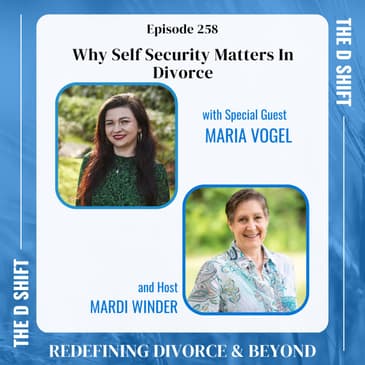
What if the key to healthier relationships is not changing the other person, but learning how to feel secure within yourself?
In this episode of The D Shift, Mardi Winder sits down with Maria Vogel, Licensed Marriage and Family Therapist, to explore attachment styles, emotional safety, and the role self-security plays in both relationships and divorce.
Maria shares how her work evolved from supporting children and families to helping adults heal unhealthy relational patterns. Drawing from both her professional expertise and her own experience as a child of divorce, Maria explains how attachment styles shape the way people seek emotional safety in relationships.
Mardi and Maria unpack the anxious and avoidant dynamics that often appear in struggling marriages and why so many couples unintentionally trigger each other’s deepest insecurities. The conversation explores the emotional toll of resentment, the challenges of deciding whether to stay or leave, and how self-regulation and boundaries can dramatically change the way people navigate conflict.
Maria introduces the concept of “self security,” which focuses on building self-trust, emotional regulation, and healthy boundaries rather than depending on another person for emotional stability. The discussion also examines why staying together for the children can sometimes create more harm than healing and how divorce can become an opportunity for growth and healthier patterns moving forward.
The episode highlights how:
• Attachment styles are often strategies people develop to create emotional safety
• Many struggling relationships involve anxious and avoidant dynamics that reinforce conflict
• Resentment grows when issues remain unresolved for too long
• Couples often wait far too long before seeking therapy or support
• Self security comes from emotional regulation and healthy boundaries
• Staying together for the children can sometimes create unhealthy emotional environments
• Divorce is not failure and can become an opportunity for healing and growth
• Building a healthier relationship with yourself changes every other relationship in your life
About the Guest:
Maria Vogel is a Licensed Marriage and Family Therapist specializing in couples and individuals who want to heal relational patterns. Through her group practice, Bhumi Therapy Center, Maria teaches clients how to build more intentional lives using mindfulness-based therapy techniques.
For Maria’s book, “Finally Secure”: https://a.co/d/0cIQzfW1
To connect with Maria:
Website: www.bhumitherapycenter.com
IG: @mariavtherapy
About the Host
Mardi Winder is a Strategic Divorce Consultant and High-Conflict Divorce Coach who helps high-achieving individuals navigate divorce with clarity, confidence, and control. Drawing on more than 30 years of experience in mediation, divorce coaching and conflict resolution, she supports clients in making smart decisions while reducing emotional and financial fallout, particularly in high-conflict, high-asset and complex divorces. Mardi is the founder of Positive Communication Systems, LLC, and the Strategic Divorce Directory, LLC.
For Mardi’s gift: The Resilience Building Blueprint: A 28-Day Journey To A Stronger You https://www.divorcecoach4women.com/rbb
Connect with Mardi on Social Media:
Facebook - https://www.facebook.com/Divorcecoach4women
LinkedIn: https://www.linkedin.com/in/mardiwinderadams/
Instagram: https://www.instagram.com/divorcecoach4women/
YouTube: https://www.youtube.com/@divorcecoach4women
Thanks for Listening!
Thanks so much for listening to our podcast! If you enjoyed this episode and think that others could benefit from listening, please share it using the social media buttons on this page.
Do you have feedback or questions about this episode? Leave a comment in the section below!
Subscribe to the Podcast
If you would like to get automatic updates of new podcast episodes, you can subscribe to the podcast on Apple Podcasts. You can also subscribe in your favorite podcast app.
Leave an Apple Podcast Review
Ratings and reviews from our listeners are extremely valuable to us and greatly appreciated. They help our podcast rank higher on Apple Podcasts, which exposes our show to more awesome listeners like you. If you have a minute, please leave an honest review on Apple Podcasts.
[00:00:04] Welcome to the D Shift Podcast, where we provide inspiration, motivation, and education to help you transition from the challenges of divorce to discover the freedom and ability to live life on your own terms. Are you ready? Let's get this shift started.
[00:00:21] Hello and welcome to this episode of the D Shift Podcast. And today I am really, really happy to have Jamie Lima on. And Maria is a licensed marriage and family therapist. She specializes in helping couples and singles to heal unhealthy relational patterns.
[00:00:43] In her group practice, Boomi Therapy Center, she teaches clients to build intentional lives using mindfulness-based therapy techniques. And I just love this whole concept. And we're going to talk all about how this plays into divorce. So Maria, first of all, welcome. Thank you. So glad to be here.
[00:01:05] Well, and I'm glad to have you. It's always so wonderful to have therapists and really anybody who works on, I'm going to say, the emotional and mental health side of divorce, because that's something that quite often people kind of get blindsided with how much divorce can unearth some really maybe unhealthy patterns you've been living with and also just shake your whole world.
[00:01:31] Yeah, absolutely. I think divorce is a huge transformation. Just like sometimes marriage can be a huge transformation or becoming a parent can become a huge transformation. Divorce can also be part of that too. Absolutely. So Maria, before we go any further, tell us a little bit about how you got into this area and why this is the focus in your practice.
[00:01:54] Yeah. So I've been a therapist for 10 years. I actually started with my focus being on children. I worked in school systems. I worked with foster youth. But at a certain point, I realized that in working with children, especially younger children, you're often working with the parents and really helping the parents heal their dynamic, heal their attachment so that they can have healthy attachment with their children.
[00:02:18] And so at a certain point, I decided I need to switch my focus to working with couples. Also, I was a child of divorce. So I know how divorce can impact children if there are children in your marriage and how much being self-secure in yourself, like having secure attachment with yourself, having a healthy attachment with yourself helps you be the best parent you can be.
[00:02:43] And so that is why that became the focus of my practice is really helping people develop self-security, healthy relational patterns with their partners, with their children. Even if you are separating from your partner, you can actually still have a healthy dynamic with and co-parent dynamic with your partner or your ex-partner.
[00:03:04] Yes. And that's one of the big things I think people have to, a lot of people, even though they have kids, somehow think that divorce is going to be this, okay, we're not, we're not, we're not doing anything together anymore. Well, it's not, that's not true. If you have kids or even if you have pets, sometimes you're going to be in that co-parenting relationship.
[00:03:25] And so why not use this as a time to reset, get rid of all those old beliefs and weird stuff that was hanging over and start like, okay, this is how we want this to look moving forward. There's nothing that says you can't do that. Yeah, absolutely. And that's where the divorce can actually be like leaving a relationship can be the first step towards healing your attachment wounds. Yes. Yeah. And that's security.
[00:03:55] And I just want to throw this in here. We're not talking about cases where there is any kind of abuse or there is, you know, maybe addiction problems with one or both partners. We're talking with people, we're talking now about people that are generally healthy and capable of, of engaging in meaningful interactions with each other. So we're not talking about the high conflict necessarily individual.
[00:04:22] So it just, I just always like to throw that out there because sometimes it's impossible. You can want the, you can have the best intentions to have a great relationship, but if your partner doesn't care, you're banging your head against a wall on that one. Of course. I think that's a, that's a very good point to bring up. And also sometimes too, I think actually stepping out of, especially if we're talking about addiction, codependence, right?
[00:04:46] Stepping out of that codependent role and the enabling role that sometimes comes with being very anxiously attached in a relationship with active addiction, stepping out of that role and saying enough, right? And really having that boundary for yourself and modeling that for children, if you have them, is that again, that first step towards building that self-security. And what the other person does with their addiction is their business, right? You can't control it.
[00:05:13] And sometimes they are able to take responsibility for themselves and sometimes they're not, but the point is you're doing it for you. Right. Yes. So you've mentioned attachment styles a couple of times and we have had people come on before and talk about attachment styles, but more from the dating relationship perspective. So I know that you work with people who are in trying to decide if they should go through a divorce or, or actually going through a divorce.
[00:05:40] What, how do attachment styles play into those situations? Yeah, great question. Um, so I like to describe attachment as the way we learned to create safety for ourselves in relationship. I find it's less shaming. Sometimes I feel like all this language around anxious avoidant attachment can be very shaming. But if we think of it as this is how I learned to feel safe. And some of us learn to feel safe by reaching out, asking for help, asking for reassurance.
[00:06:09] Some of us learn to create safety actually by fighting, because if we're fighting, we're at least we're in connection, right? It might not be healthy connection, but we're talking if we're fighting. Right. Some of us learn to create safety by creating space, right? By distracting ourselves, by dismissing, avoiding conflict. Both of these are just strategies for feeling internally safe. And we tend to find somebody who has our opposite strategy. And then we drag each other nuts. Right.
[00:06:38] And I like to say, and that's marriage. But that is a lot of marriage, right? That's about 95% of marriages have this anxious avoidant kind of attachment. At least the ones that come to therapy, right? Right. That's the dynamic that they're in is this anxious avoidant negative cycle. And so that's sort of how I like to frame attachment is both of you are trying to find safety. You have opposite strategies that trigger the other person. So we have to learn how to do it a little bit differently.
[00:07:09] But, yeah, making this decision of when is the time to leave? I get that question all the time. Right. When is the time to leave? That's a tough question. It's very case by case dependent. It's not there's not one nice, clean answer. Obviously, you know, that disclaimer around abuse, like if you are being physically harmed, if you feel unsafe in any way, that is a time to seek help to leave. Right.
[00:07:36] But what if it's just high conflict, emotional conflict? Right. That's tougher. That's more of a gray area. I think it's not romantic, but I like to think of it as we all have things we can and can't tolerate. Right. Right. If you cannot tolerate the level of conflict, you have a few choices. Right. You can work on your part, which is the only part you have control over. Right. Your own self-regulation, how you respond and react to the other person.
[00:08:06] Right. Your part in the negative cycle that's happening between the two of you. And in doing that and being our best self, in taking that responsibility and showing up differently, sometimes that sort of sets the stage for change to happen. Like the other side has more room to respond differently if they're capable and willing. Right. Right. Sometimes not, though. Right. Sometimes they're not capable or willing. Right. You know, that does happen. Right.
[00:08:34] So changing your part, giving it time, waiting and seeing with patience and curiosity. Can they? Sometimes, you know, it means it does mean taking that step back. Right. Being like, you know what? Actually, this is intolerable. Right. This level of avoidance, dismissal, whatever it is, conflict is actually intolerable to me. And I have to choose myself. Right. And try to choose that self-security.
[00:09:04] And if you have children, model that for the children. Yeah. And I think it's, you know, I've had a couple of people come on and talk about this. Dr. Pamela Pine came on and talked about, you know, the real challenges of this whole notion of I'll stay in a bad relationship for the kids. And there's lots of research now that says that that is the exact opposite of what really happens.
[00:09:28] That getting out of those hostile environments, like even mental energy, you know, whether you're on the woo side or not, it doesn't matter. If you walk into a room and people are like glaring at each other, as strangers, we can pick up that there's a problem in the relationship. Can you imagine living in that all the time? Like some kids are exposed to.
[00:09:51] Of course, getting out of that is going to have a better long-term impact on the kids' mental health than staying in those really hostile emotional situations. Yeah, absolutely. Sometimes people do say, oh, I stay for the kids, right? Or I feel trapped because we have kids. And that, I mean, it's tricky. You know, I won't deny how complicated that makes the situation.
[00:10:16] And also, yes, staying for the kids usually accidentally puts also some burden and responsibility on the children. Right. Right. Like, especially if that message gets portrayed consciously or unconsciously, right, later down the road. And it's not going to, staying for the kids is not going to heal the marriage, right? It's not going to heal the unhealthy dynamic. Right. So, Maria, let me ask you this question.
[00:10:46] And this may be a little bit unfair to ask you. So, you don't have to answer it if you don't want to. I'm going to say that up front. Okay. A lot of times what I see, because I only work with people, well, I shouldn't say that. 90% of the people that I work with already know they want to go through the divorce. They may have not left. They may have not done anything about it, but they know they want to. When is it too late to come to therapy?
[00:11:13] Or is there, or is that, I mean, I know every relationship is different, but I hear so many people that say, you know, we took six months and did therapy. And we were further behind after we got out of therapy than we were, when we went in, because we had unearthed a whole bunch of stuff that we didn't even realize we had problems with. Well, no, that's a great, that's a great question. Actually, you know, there's research on this, right?
[00:11:39] Like from the Gottman Institute, which is where I got my couples therapy training, that I think it's like the average couple waits five to six years to go to therapy. And they've already been having issues for that long. Right. And yeah, that's, it's too late. I shouldn't say too late as in like, it's, you're destined, you're doomed. Right. But I would say people are sometimes afraid to go to therapy because they're afraid, oh, if we need therapy, it's really the beginning of the end. Right. Right.
[00:12:06] Or if we need therapy, if we admit we need therapy, there's a real problem here. Actually, go sooner. Therapy is like your best chance for healing this dynamic before the resentment has built up to the point of no return. Because that does happen for sure. Right. Couples wait too long. The dynamic is so entrenched. This negative cycle is so entrenched. Both people are hurting. There's usually resentment on both sides.
[00:12:32] And, you know, I like to say resentment is the one feeling that lasts forever. All feelings fade. But resentment is the gift that keeps on giving. And so if you have that much resentment, it can be really, really hard to get through it. It's almost like a debt, you know, that has compounding interest. Yeah. Yeah. It was completely overwhelmed by that compounding interest. And it's really hard to pay off.
[00:12:57] And I think that's right because, you know, if you resent somebody, it just kind of festers. And then every time they do something that triggers you, it just like blows up again. Oh, yeah. I completely understand when you're saying it's the one feeling that doesn't fade. I think it just, yeah, keeps compounding. Yeah, right. And then we've got that, what's it, what is it, confirmational bias where even if they try to do something, we're going to perceive it through that lens of resentment. Absolutely.
[00:13:26] It creates this negative perspective, right? That's one of the biggest things I see with a lot of couples who are stuck in that resentment and negative cycle and contemplating divorce. Is they often have a very negative perspective on the other person and their intentions. Right. Sometimes that negative perspective, you know, it has some accuracy to it, you know, and it's based on past experiences. Sometimes it's not accurate. It's based on interpretation, right?
[00:13:53] Because we usually filter our experiences through our own lens. Right. And the impact something has had on us and other people tend to filter it through their intentions, right? So it's like, well, I had good intentions, but the impact was this, right? And so we're filtering it through the impact. They're filtering it through their intentions and then you can't agree, right? And that's where those safety tasks come in to try to make themselves feel safe.
[00:14:20] I know this wasn't something we had, you know, originally said we were going to ask. And I tend to do this. I go off on little tangents when I do these. If there has been infidelity, so somebody has had an affair, whether it's a one night stand or whether it's a long term affair. To me, I always said in my relationships, that would be the deal breaker right there. And I never, to my knowledge, that wasn't a factor in either one of the relationships.
[00:14:49] It's my first marriage or my second one. But like, can people, I mean, I have friends that have forgiven a partner who has had an affair. Is that, is that even possible? I mean, I'm just asking this from, from a curiosity perspective for myself. I mean, I think anything is possible, right? So sure, it's possible. I think, again, it's very context dependent, right? Or are we talking a one time thing?
[00:15:16] Or are we talking, you know, chronic infidelity, right? But I have those different situations. But yeah, I mean, I actually, most couples that have an affair attempt to stay together afterwards. Attempt to repair and do stay together, actually. Like the vast majority tend to stay together. But it's a lot of work. It's hard work. And I imagine there's a real trust issue that has to be overcome in those situations. Oh, yeah. Yeah. And the relationship is different afterwards, right?
[00:15:45] You have to, it changes. It's like a new relationship. And you have to rebuild that trust. And a lot of things, a lot of things have to be rebuilt. And understanding how the circumstances happened that the affair was able to happen as well, right? It's a little more complicated than just one person made a decision. That's not to blame the victim of the affair. But still, it's like, it's understanding the dynamic, right? The deeper dynamic at play. Yeah.
[00:16:12] You know, so this is the way it was explained to me by a very good friend of mine. She said, because she went back and stayed with her husband after he had multiple affairs. But what she, which I never got, like, honestly, that was just beyond my ability to, maybe I'm just not that open or that forgiving or whatever. But what she told me is she saw that that was not the cause of the problem in their relationship, but a symptom. Right.
[00:16:42] And so that was her perspective. And I can understand it from that perspective. I could not personally do it, but I appreciated what that she was able to. And they did. They had a, they're still together today. So obviously something's working. I mean. Right. Well, that's the thing, right? That's the question. What's tolerable or intolerable to you, right? It's okay for you. You have a boundary around that would be intolerable to me. I could tolerate. I would not be able to come back from that. I think that's good to know about yourself, right? People are allowed to have different boundaries. Yes.
[00:17:12] Yeah, that's right. Everybody's unique and there's no right or wrong. I mean, lots of couples have open relationships where there are rules around having relationships with people outside of the marriage or, excuse me, bringing people into the relationship. But without getting off on that rabbit hole, you also talk about building self-security. Can you talk about what self-security is and how that plays into maybe going through the divorce process?
[00:17:42] Yeah, absolutely. Absolutely. I do go over some of this in my book, actually, and finally secure where when we're talking, especially about anxious attachment, which for people who don't know, it is majority women who have anxious attachment. Although, of course, there are exceptions, right? Like, you know, it's not a monolith. People are not a monolith. But when we're talking about anxious attachment, there is a real other focus, as in I will feel
[00:18:09] better when the other person does what I need them to do, right? When they hear me, when they listen, when they start being reliable, when they take out the trash, right? Whatever it is, whatever the issue is, right? It could be, it's fill in the blank, right? I'll feel better when you fill in the blank, right? And actually, the problem is having that other focus makes us very insecure because we are not in control of other people's behaviors. We are not in control of their reactions or their responses. We are only in control of ours.
[00:18:39] And so building self-security is about building self-trust, which I really think is about two things, two fundamental foundational skills. Self-regulation, like can I handle a hard moment without exploding, falling apart, shutting down, right? Can I handle it and express myself with clarity and maturity and without fawning or people-pleasing or, yeah, without getting really, really angry and upset?
[00:19:06] So the self-regulation and then also the boundaries, right? Can I hold my own boundaries? Do I know what they are? Do I know what I need? And can I assert myself skillfully, right? And those skills together build this self-security of I can handle it. Whatever's happening, I can handle it. And it actually becomes so much easier to, one, be in a relationship or leave a relationship if you need to. It becomes much clearer.
[00:19:34] I need to leave this relationship because oftentimes when we're struggling with that self-security, with that anxious attachment, we waffle. Should I leave? Should I stay? Right? Is this too much? Am I ruining something good? You know, like that questioning. Oh, it's torture. It's so torturous for people. It's an awful place to be emotionally and mentally, to be questioning your relationship back and forth, back and forth, right? Yeah. Yeah.
[00:20:03] It's an awful seesaw that you want to get off of. And so having the self-security, right? Building those skills really for you. Like, don't even do it for the other person. Do it for you so you can feel better. And then C, right? It's possible that in building that self-security, you can handle and communicate in a new way that allows for something new in the relationship. It's also possible that it will become very clear to you, like crystal clear. Well, okay, I've done everything that I can do.
[00:20:33] It's still not working for me. My needs aren't being met. This is a boundary for me. Right. Right. And this sounds so uplifting and reassuring that whatever those attachment things you got going, you don't have to stay there. You can adjust and you can move and you can shift and you can... I love that term self-security. I've never heard that before. And I really...
[00:21:00] That makes sense to me that you're just really secure in who you are and the decisions you make and you're not dependent on somebody external to you to provide that for you. Yeah, absolutely. I think that's a big one, right? Like, if we spend our whole lives having that other focus, looking at what others are doing and how that makes us feel. I mean, of course, we're impacted by other people's behavior, you know? Sure. But still, right?
[00:21:30] Like being able to look inside and be like, well, how do I feel about that? And what can I give to myself? And where can I hold boundaries around my own needs? Right. You know, really makes sense. And it makes sense to me when you said that mostly women fall into that category. Because, you know, when we're thinking of that people-pleasing, that... Desire to be everything to everybody. That's almost what...
[00:21:59] We've talked about this many times on the podcast. This is... You know, society kind of expects that. That's what we're supposed to do is... We're supposed to be the glue that holds everything. We're supposed to put kids and a spouse and everything first. And it's so backwards to where we really need to be. Absolutely. Definitely. Yeah. A lot of women find themselves in that anxious position, right?
[00:22:24] And I always try to tell people, don't bend yourself into a pretzel to make something work, right? Don't do it for anybody. Don't do it for your spouse. Don't do it for your boss. Don't do it for your friends. Don't do it for your parents. Be your own shape. Hold your shape. I love that. Be your own shape. And Maria, you mentioned... You just briefly mentioned... And I'd like to spend just a little bit of time here on it because we're almost out of time, but tell us a little bit about your book. Yeah. So my book is called Finally Secure.
[00:22:54] It's about building that self-security in three different parts of relationships. So the dating kind of phase and the maintaining of relationships, and then also the leaving, right? So it has all three components because all three are important, right? Like actually, it's very important to know how to date. It's very important to know how to maintain relationships. And it's equally important to know how to assess when you should leave. Yes. And that leaving is not failure, right?
[00:23:22] People sometimes see leaving a marriage or a relationship as failure, and it's not. Actually, sometimes the leaving is that first step towards that self-security that you deserve to have. Yes. Yes. And I'm going to make sure the link to access that book is in the show notes. So if you're thinking, oh, what did she say? What's the name? Don't worry. It's all going to be in the show notes. So now, Maria, of all the things you've talked about, because you've shared a lot here today, and I really do appreciate that.
[00:23:51] What do you think is kind of the takeaway or the big idea you want people to recall? Yeah, probably that no matter where you're at in your relationship journey, if you're questioning your relationship, if you're deciding to leave and start over, that really, it all starts with you, right? That self-security, that inner work of the secure, healthy attachment that you can build with yourself, right? That actually you have to build with yourself first.
[00:24:20] Sounds great. Now, Maria, if people want to find out more about what you do or want to reach out and find out how to work with you, what's the best way to get in touch? So you can check out my website, which is boometherapycenter.com, or you can find me on Instagram. My handle is Maria V Therapy. Wonderful. And again, I will make sure all of that is in the show notes. Maria, thank you so much for being here today and sharing your expertise and I think giving
[00:24:49] us some really good insights into a whole bunch of things, attachment disorder or attachment styles. Should we stay or should we go? Really helpful information to think about. So thanks, Maria. Appreciate you. Yeah. Thanks so much for having me. And thank you everybody for listening in to this episode. And don't forget to tune in to the next one. Thanks for listening and supporting the D-Shift podcast.
[00:25:16] If you would like to attend live trainings by our amazing guests and have a chance to ask questions and get answers from our experts, join the D-Shift crew. For more details and to sign up, head on over to www.divorcecoachforwomen and click on the podcast page.