
Divorce and heartbreak often leave people asking one difficult question: what now? While many rush toward the next relationship hoping to escape loneliness or pain, others begin realizing that healing, self-awareness, and personal growth may be the most important work they can do before starting over again.
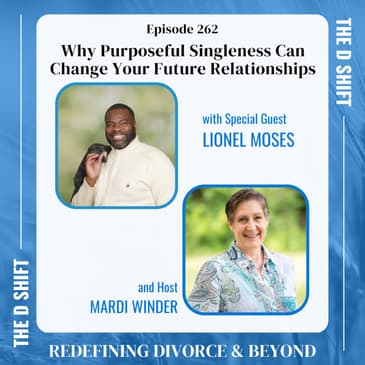
In this episode of The D Shift, Mardi Winder speaks with Lionel Moses about relationships, identity, emotional healing, and the concept of “purposeful singleness.”
After experiencing two divorces himself, Lionel shares how he stopped viewing divorce as failure and instead began using those experiences as opportunities for deeper self-reflection and growth. Rather than focusing only on relationship theory or surface-level advice, the conversation explores the practical realities of learning who you are outside of a relationship and why so many people unknowingly repeat unhealthy patterns when they avoid doing that work.
Together, they discuss the difference between simply being single and intentionally using singleness as a season for healing, growth, and honest self-assessment. Lionel explains how many people spend years studying their partners while never truly learning themselves, which often leads to people pleasing, emotional exhaustion, and relationships built around performance rather than authenticity.
Mardi and Lionel share how:
• Purposeful singleness creates space for healing, reflection, and self-discovery after divorce
• Many people enter relationships knowing their partner better than they know themselves
• Healing after divorce requires honesty, intentionality, and emotional self-awareness
• Relationship patterns often repeat when people avoid processing pain from previous relationships
• Gender expectations and societal roles still impact modern relationships in significant ways
About the Guest:
Lionel Moses stands out because he combines his real-world experience with a passion for teaching the 'heart of rediscovery.' He offers pragmatic, relationship-focused strategies and levity techniques to boost morale and self-identity, drawing from his personal 'aha moment' about the power of connection.
For Lionel’s gift: https://www.themarriageseed.com/ Discount Code: DSHIFT15
To connect with Lionel:
Website: https://www.lionelmoses.com/
Website: https://www.themarriageseed.com/
Facebook: https://www.facebook.com/profile.php?id=100068053150680
About the Host
Mardi Winder is a Strategic Divorce Consultant and High-Conflict Divorce Coach who helps high-achieving individuals navigate divorce with clarity, confidence, and control. Drawing on more than 30 years of experience in mediation, divorce coaching and conflict resolution, she supports clients in making smart decisions while reducing emotional and financial fallout, particularly in high-conflict, high-asset and complex divorces. Mardi is the founder of Positive Communication Systems, LLC, and the Strategic Divorce Directory, LLC.
For Mardi’s gift: The Resilience Building Blueprint: A 28-Day Journey To A Stronger You https://www.divorcecoach4women.com/rbb
Connect with Mardi on Social Media:
Facebook - https://www.facebook.com/Divorcecoach4women
LinkedIn: https://www.linkedin.com/in/mardiwinderadams/
Instagram: https://www.instagram.com/divorcecoach4women/
YouTube: https://www.youtube.com/@divorcecoach4women
Thanks for Listening!
Thanks so much for listening to our podcast! If you enjoyed this episode and think that others could benefit from listening, please share it using the social media buttons on this page.
Do you have feedback or questions about this episode? Leave a comment in the section below!
Subscribe to the Podcast
If you would like to get automatic updates of new podcast episodes, you can subscribe to the podcast on Apple Podcasts. You can also subscribe in your favorite podcast app.
Leave an Apple Podcast Review
Ratings and reviews from our listeners are extremely valuable to us and greatly appreciated. They help our podcast rank higher on Apple Podcasts, which exposes our show to more awesome listeners like you. If you have a minute, please leave an honest review on Apple Podcasts.
[00:00:04] Welcome to the The D Shift Podcast, where we provide inspiration, motivation, and education to help you transition from the challenges of divorce to discover the freedom and ability to live life on your own terms. Are you ready? Let's get this shift started.
[00:00:22] Hello, and today on The D Shift Podcast, we are going to be talking all about relationships. And we've all been in relationships, whether they're family, whether they're personal relationships with intimate partners, whether they're relationships at work. Relationships surround us all over the place.
[00:00:40] So today I have an expert on to talk to us about this, and I'm welcoming Lionel Moses. He is a relationship coach, and he really combines his real-world experience with a passion for teaching the heart of rediscovering yourself. And I just love that. I think that that is such an important step.
[00:01:02] And Lionel offers a pragmatic, relationship-focused, strategies-based program that helps boost morale, self-identity, and helps people really come out the other side of this feeling stronger and more independent and better suited to getting into their next great relationship. So, Lionel, welcome. Morning. I'm glad to be here.
[00:01:27] Well, and I'm so glad to have you. I love speaking with relationship experts. I tend to work with my clients at the kind of the heat of the divorce, and we're not really talking about relationships. As a matter of fact, I'm saying don't get into a relationship right now. So how did you come to this point where this is where you support people?
[00:01:47] Actually, the way I came to this place is I was married twice and divorced twice. And I realized that being divorced isn't the end of the world. So what I decided to do is just take my life experiences and use it for what it is, which is a tool to help me learn more about myself and learn more about the world that I live in.
[00:02:14] And in doing so, I met so many people that had the same types of struggles, but no one is speaking candidly or openly about it. Most people are sugarcoating stuff or they're giving them theory. In life, you need more than theory. You need practice. You do. And practical experience. Yeah. Yeah.
[00:02:33] Yeah, I can't agree with you more. And I think that, you know, a lot of times people hear like the theory or the, you know, the real pat kind of answers, you know, the sort of this, all the stuff that the coaches that all people say, whether you're a coach or a therapist or whatever, there's those kind of platitudes that people get, like time will heal all, you know, and things like that. Yeah, but how?
[00:02:59] Yeah, yeah, exactly. Exactly. So how do you, how do clients typically find you? Like, how do you, how do you get people at this point where they're saying, I need to do something about my relationship skills? Honestly, most of the clients that I get at this point are through social media. People will see a post or something and they'll comment. And most of the time when people comment on my post, I respond. Yeah.
[00:03:25] Yeah. So I have someone that responds for me, but I, I respond to them because, you know, and I've asked, as a matter of fact, Mardi, just the other day, I had someone respond to a post that I put up and they said, you know, therapy and coaching doesn't work.
[00:03:41] And I told them, you know, something simple. Every coach is not for everyone. And every therapist is not for everyone. You know, we're, especially when you're talking about relationships, you know, you're having a problem with your relationship because someone that you thought fit doesn't. Right. Or you thought you fit with someone and they don't. So it's, it's not necessarily the coach or the therapist is bad. They're just not for you.
[00:04:04] Right. And, you know, and I love that because I agree with you so much. I mean, I get clients that come to me and, you know, when they say, well, why should I work with you? I say, well, this is who I am. And if I don't work for you, if it doesn't feel right, there's like 2 million other divorce coaches, knock yourself out. You know, I mean, you're right. Not everybody is for everybody. The interesting thing I find quite often when I hear people say coaching and therapy doesn't work.
[00:04:34] I hear in my head, I've, I've tried it. I didn't put in much effort and I got nothing out of it. And therefore I don't think it works. Mardi, you nailed it. They don't want to, they don't want to put in the effort. In other words, most times that I hear people talk about coaching, same as you. The coach is not that the coaching and the therapy didn't work. You didn't work. Yeah. Yeah. And that's one thing, you know, I think that's, and coaching and therapy.
[00:05:02] I know we're on the same path on this one, are very different things. One is back faced and more diagnostic and the other one is forward facing and more change directed. And I think the thing that we have to remember is that it can only go as far as you want to take it. And if you're stuck, if you're working with a coach or therapist and you're not getting the progress you need, you probably need to change professionals.
[00:05:30] Yeah. Yeah. Well, I, I'm, I'm a firm believer. And again, I'm biased because I'm a coach and not a therapist that you can progress a lot more with the coach than you can with the therapist. A therapist frees you and make you available to be present for a coach. Yes. Yes. And I, I also see, and this is not what we were going to talk about at all, but we're going down this path.
[00:05:54] Anyhow, we'll come back to relationships now, but I do really believe that, um, like, especially with my clients, a lot of my clients are dealing with getting out of toxic relationships. So they're dealing with a lot of, um, abuse on different levels and getting out of their relationship. I find quite often pairing therapy and coaching, as long as the therapist and the coach are both aware of what's going on, can be extremely helpful because they compliment each other in many ways.
[00:06:21] Like you said, the therapist can free you up to be able to take on some of the tasks and the forward progress that you're going to see with, with the coach. So it can work very nicely hand in hand as well. Agreed. So let's get back to the relationship stuff, because this is really where, where you are the expert on the spot here today.
[00:06:42] So let's talk about this whole idea of how relationships maybe evolve that whole idea of before and after marriage. You're, I don't think you're the same person. I was divorced once and my second husband passed away. So I've gone through both of those situations and I know I'm not the same person in either one of those life transitions, um, as when I went in. So can you talk a little bit about that whole before and after marriage and relationship issue?
[00:07:11] Yeah, I, I, for me personally, uh, the before and after what I see with me and many of the people that I work with is that when you walk into, and it goes back to what I said, something I said earlier. When you go into a relationship, you're going in based on a theory. You did your data. You got, you gather your data through dating. You assess the person and where you want to be. But it's not until you, you come together into a relationship that you actually see if that plan will work.
[00:07:42] And it's, you can go through all the marriage counseling you want until you have to put to practice all the principles and work it through life. And the curve balls of life constantly throw at you. Things are going to be completely different. So going into my relationships, I had a plan always now, you know, I I'm in a phase of singleness, which is after the relationship. I, I learned myself. Yeah.
[00:08:10] And once, once I learned myself, a lot of the things that I thought would be good for me in a relationship, I learned is not right. Because, you know, my, my, my, my dream package is not, you know, was best for me always. Right. Yeah. And I, and I think that's the thing.
[00:08:31] And if we don't spend that time doing that, I call it self-reflection, but what introspection, whatever people want to call it, we're just going to repeat the same pattern. Like what scares me the most is when people get just kind of hop from relationship to relationship. I mean, and this is not, this is not a personal judgment thing. People can do whatever they want. There's no morality associated with this for my or values or anything like that.
[00:08:56] But if you're in a difficult relationship and you're already looking for your next partner while you're still trying to get out of this difficult relationship, there's no space to breathe or to learn or to grow. And it just seems like you just keep repeating the pattern over and over. Sure. Absolutely. You said breathe, learn and grow. But there's one other thing I want to add to that. And that's heal. Good one. Yeah. Yeah.
[00:09:24] Because every time, I mean, every, every time I've been in a relationship, there was some damage. There's something in me that changed and damage is not necessarily negative, you know, because our brain works, you know, by, you know, breaking and tearing. And so do muscles breaking and tearing and rebuilding. But you have to heal what was wrong and learn to honestly assess the role that you played in it.
[00:09:52] And when you're in pain and you're hurting and you're mad with your partner, you're not going to be able to do that properly and honestly. And what happens is, is you jump into a relationship too soon as you're speaking of, you're going to bring all that with you. And you really don't need to bring anything from the past relationships into your new one. It's not going to be healthy. Yeah. I've heard so many dating coaches say that's a big red flag.
[00:10:21] If when you're on your first couple of dates, your, your conversation, either you keep talking about your ex or they keep talking about their ex. That's a pretty good sign. You're neither one of you or you're not ready to progress into a new relationship. I leave that baggage behind. Yeah. Absolutely. And how do you do that work?
[00:10:40] Like, I know it's easy for people to say, oh, you know, I, I started doing yoga and I listened to Mel Robbins and I did, you know, whatever it may be that they've done or Tony Robbins for that matter. And so now I feel I'm ready, but it's more, it's more intentional than just listening to some podcasts. Although podcasts are great.
[00:11:33] You have to, you, you have to honestly learn to feel intentionally feel yourself. You have to ask questions of yourself. Okay. Mel Robbins said this, but does this apply to me? Mel Robbins is fabulous. Like I love her. Let's go on the record. Say I, she's fabulous. She is. But you, you, you, you, you, does this work for me? Right. Does this, does this work for me?
[00:11:57] And, and take an honest assessment just because it worked for a mentor or a model of yours doesn't mean it's going to work for you. So you have to learn your own voice. Right. Because you will speak to yourself. Your body will speak to you. Your mind will speak to you. Your gut will speak to you, but you have to intentionally listen to yourself. Now we have our ears. So we used to listen to other people, but most people that I work with, one of the biggest problems is they don't really know themselves. Yes. Yeah. Yeah.
[00:12:27] Don't make the investment into learning. Yeah. You know, it's so funny when you say that about, well, not funny, but interesting that this, because I have, I work with mostly women. I do work with some men as well, but, you know, just typically tends to be more women.
[00:12:42] And I can't tell you how many people have said to me within our first couple of meetings that they said, you know, the day that I pulled up outside the church to get married, there was a voice inside my head saying, don't do this. And, you know, it's like, but everybody's there. The wedding's been paid for. I'm at, you know, and they, it happens. Right.
[00:13:07] And I'm surprised how many people say, looking back, my stomach was telling me, my head was telling me, my heart was telling me, but I did it anyhow. I, I, I know from personal experience that those things happen because I've heard the saying before. Hindsight is 20, 20. When I sit back and look, you know, a lot of times because I didn't know myself, I would think I'm just, I'm just nervous. Yeah.
[00:13:35] But when you have sign after sign after sign, you know, sometimes, you know, okay, let's just stop. Put a pause on it. If it's, if it's meant to be in marriage, it's supposed to be a lifelong commitment. If it's meant to be, we can, we can push it back a day or two. Right. Right. And it should not affect. And, and if that changes, you know, the fact that we get married, then there, there you have it. You have your answer. Right. Your gut was right. Right.
[00:14:04] Because if you can't postpone two days because I'm nervous, that lets me know a little bit how you feel, how you care about me. Right. Yes. Yeah. That's, that's a really good point too. And you started to touch on this and I'd like to go a little bit deeper into this because it's interesting. Um, I have had a lot of women come on and talk about the concept of self-love and being intuitive and listening to themselves.
[00:14:28] I would love to have a man explain this from, from perhaps a slightly different perspective. Maybe it's going to be very similar. I don't know. I'm really curious. I believe it'd be really similar personally. Uh, the only difference would be the, the activities and the way we, we outlet. So for me, listen to myself and, you know, being intentional about everything. I, I've, the first thing I had to do, Marty was learn to laugh at myself.
[00:14:58] And that's because I'm, I'm, I'm generalizing, but as a man, my ego is very delicate and it was, it's hard to admit when I'm wrong sometimes. Mm-hmm. So I, I had to learn to just realize that I'm a human being, you know, regardless of my gender and I am not going to get everything right.
[00:15:24] And when I changed that vantage point, I began to laugh at everything and, you know, became a whole lot more open. And, and I feel, I actually feel liberated and free because I, I, I, I get to see myself for who I am. Right. One of the issues that I had in my prior relationships and stuff I write about in the book is I was a people pleaser. I listened, I, I studied my wives. I studied.
[00:15:54] So I knew what they wanted. I knew what they needed, but guess who I didn't know? Yeah. I didn't know lie now. So, you know, after the post-divorce, I was, I was forced to sit with me. I was forced to hear me. And, you know, I began to, to learn so much about me. I didn't know how much I loved art. I didn't know how much I love music.
[00:16:20] Where it, whereas, because for me in my life, I was typically focused on being a major provider, making sure my family have what they need. And not necessarily caring for me other than going to the gym. So now I've learned how to cook. You know, I learned what I like, what, what, what things taste like. So it's a beautiful experience to honestly just, just, just learn myself and enjoy, you know, I'll say my singleness. Right. Right.
[00:16:50] Do you think, and I know this is just us speculating, we're not trained in therapy or assessments or anything like that. Do you think that some of that is a societal thing that, you know, as a man, you're just supposed to do, do, do and be the provider and all that. And, and I hear that from the women's perspective, a lot of times that they feel that they shouldn't necessarily be really assertive in the relationship. They, you know, if the man wants to deal with the finances, that's okay. He can do that.
[00:17:18] That, you know, do you think it's still very stereotypical or do you think that's changing? Oh my gosh. I, I believe it's changing, but I don't believe it's changing fast enough. I agree with you. Yeah. It's not changing fast enough. Yeah. I, I, I wrote about that in my book, the marriage scene is like, you know, and I, I, I use humor for everything because I love life. Life is funny and a gift. So it's meant to be a joy.
[00:17:48] So I put in there, you know, if, if I'm good with numbers and my wife isn't, I should handle the books. I should say, I'm going to say should, because should is not in our vocabulary. That's another thing I say. Should should not be in your vocabulary because should creates expectations, but it will be, it will be a good idea for me to handle the books.
[00:18:10] But if my wife can't boil eggs without burning them and I'm a chef, it just makes sense. So these gender roles, they need to, they need to go away. Yes. You know, especially with the way the world is today. Hey, whoever's the major breadwinner. I mean, we, you have to get behind them and push. Yeah. Whether it's a male or female. And a lot of guys have problems with that. Yeah.
[00:18:40] Because, because of their ego. And not only do a lot of guys have problems with that. I've known women to turn down promotions because they think it would break up their relationship because they don't think they would have the support. But when you talk to them separately, oh, they're both on the same page. Right. That, okay, I will support you, but you have to know. Yeah. So communication is everything. But these gender roles, they need to go. Yeah, they do. And you know what? It's funny you said that.
[00:19:08] I just read an article that one of the, one of the highest risks for women in it working in corporate, wherever, corporate America, Canada, UK, wherever it may be, is when they get promoted above like an entry level management position.
[00:19:25] That that, like anything when women get promoted into like the C-suite or anything into upper management, if that then places them in a corporate structure higher than that of their spouse or boosts up their income where they're making significantly more than their spouse, that's a big trigger for a divorce. And that just always amazed me that that would still be happening in this day and age. But it really, I think it really is important. I'm glad you said that, Lionel. I really am.
[00:19:55] And I'm totally in agreement with you. I think this whole gender role thing, I think it's, if you're good at the books and I'm good at cooking, let's help each other out. You come cook in the kitchen with me, I'll sit around the kitchen table and learn how to do the money as well. Yeah. That's true. That's true. It's a relationship. Exactly. Yeah. Yeah. So let's talk a little bit about the idea of purposeful singleness. You mentioned this earlier and we talked a little bit about this before we got on the recording.
[00:20:24] So what is this experience for you? And why do you see that this is something that is worth a consideration? Not for everybody. I get that. Some people don't like the idea. But what is it to you? What's the definition? And how do you see that this fits into the whole idea of having a better relationship? Well, purposeful singleness actually is one of the chapters in my book that gets the most comments. I get more feedback from that than anything else.
[00:20:52] And, you know, actually the reason why I wrote it, Marty, was because, like I said, I was married twice and I'm single again. And I feel something, as you said before, I didn't rush back into another relationship, but I wasn't ready.
[00:21:08] So what purposeful singleness is, is learning who I am, what I love and what I like and building bridges based on where I was, where I felt, and just honestly assessing who I am and where I want to go. It allows me to be the authentic me that, you know, I was created to be.
[00:21:32] You know, the earth needs, the earth needs line out, not a guy that's walking around, breathing air and space because he's focused on pleasing someone else. And, you know, it all goes back to, you know, although we're talking about relationships, we're talking about the hierarchy in a family and the cause for divorce. The woman rises higher than the man. A lot of that is caused because of, you know, insecurities. Right.
[00:22:01] And during my singleness time, I'm looking at them and I'm addressing them. I'm asking myself honestly how I feel about it. And that's the key is you have to be honest with yourself because if you're not honest with yourself, you're not going to be honest with anyone or anything else in life. Right. Oh, that's such a great thing.
[00:22:22] And I also think when you know who you are, what your values are, what you stand for, you can find a partner then that's a complement to that rather than somebody who you're just physically attracted to. And then maybe you get into the relationship and the values are completely different. And, you know, the expectations are really different. And that, again, I think that's common.
[00:22:45] Quite often we think with the physical attraction part of the relationship less than the whole, I'm going to be with this person for 40, 50, 60 years. What are we going to talk with 20 years from now? You know, these are questions we have to ask. And when we know ourselves, we're better at it. I think it's much more important to ask yourself the honest questions at first because I was laughing while you were talking because you said, yes, we're going to be in a relationship with this person 30, 40, 50 years.
[00:23:15] They're not going to look the same. Exactly. Yeah. So if you're looking at the superficial, that's not going to last, you know. And so then what do you have? That's what happened with my first marriage. Yeah. I married my high school sweetheart and we were kids. Once we started having a family and started seeing life differently and have to make adult decisions, well, we realized we didn't think alike. Right. And we weren't grounded the same way.
[00:23:45] So now in my season of purposeful singleness, I'm learning me. I'm learning how to partner with friends. You know, not necessarily a partner for a marital relationship or anything like that or romantic relationship. But my friends, you know, coworkers, all aspects of life, all relationships tell you a little bit about yourself. Yeah.
[00:24:07] And, you know, I used each one of them for the same purposes to build me up, to be the authentic me in the best possible version of myself that I can be. Yeah. Yeah. I love this. Now, Lionel, you have kindly offered a gift for the listeners. You have your book is called The Marriage Seed and you have offered people a discount if they want to buy your book. So the code is going to be in the show notes.
[00:24:35] So I highly recommend I'm going to go get a copy of Lionel's book and read through it. It sounds fascinating just from listening to this. I definitely want to read it. So if you if you want that, grab the code that's in the in the show notes. And Lionel, before you go, I want to ask you of all the things we've talked about. I know we've gone down a couple of rabbit trails here today. What what do you think is the most important message that you want people to remember from today's conversation?
[00:25:02] I want everyone to remember that there's life after divorce. You know, relearn yourself, love yourself and keep on moving. What a positive way to end this. Lionel, last question. If people want to reach out, find out more about you or even work with you, what's the best way to do that? The best way to reach me is on my website is lionelmoses.com. All my socials are attached to that. Great. That makes it easy.
[00:25:31] And definitely grab a copy of the book if you're interested in this. Especially I'm going to read that chapter on purposeful singleness. I love that. I love that title. I love that word. I may have to I may have to steal that from you. Please do feel free to use it. It's just a great thing to use. Lionel, thank you so much for being here and sharing all your wisdom and information and having like a really upbeat conversation on something that can be really difficult for people. So thanks for doing that today. My pleasure, Mardi Winder.
[00:25:58] And thank you, everyone, for listening to this episode of The D-Shift. And don't forget to tune in to the next one. Thanks for listening and supporting The D-Shift Podcast. If you would like to attend live trainings by our amazing guests and have a chance to ask questions and get answers from our experts, join The D-Shift Crew. For more details and to sign up, head on over to www.divorcecoachforwomen and click on the podcast page.