
Most relationships do not end because two people suddenly stop loving each other. More often, relationships slowly become disconnected through repeated misunderstandings, emotional triggers, unresolved resentment, and communication patterns that quietly erode trust over time.
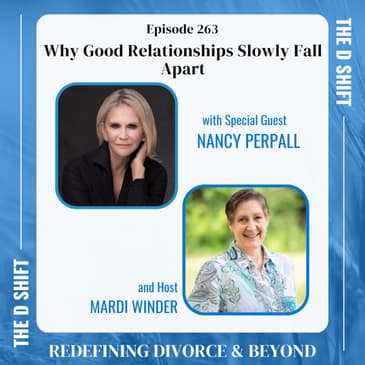
In this episode of The D Shift, Mardi Winder welcomes back Nancy Perpall to discuss her new book, The Malnourished Marriage, and the powerful food metaphor she uses to explain what relationships truly need to survive and thrive.
After more than three decades as a divorce attorney, Nancy shares why she shifted her focus from helping people end marriages to helping couples better understand how relationships break down in the first place. Drawing from both science and real-world experience, she explains how the early dopamine-driven stage of relationships often blinds people to issues that later become major points of conflict once everyday life takes over.
The conversation explores the emotional “nutrients” that relationships require, including communication, trust, compromise, intimacy, laughter, and emotional safety. Nancy explains why communication functions like water in a relationship and how words can either flow or crash depending on how people approach difficult conversations.
Together, they also unpack the role childhood core wounds play in adult relationships and why people often unknowingly trigger each other’s deepest insecurities during moments of stress or conflict. Rather than viewing compromise as weakness, Nancy reframes it as compassion and understanding for another person’s perspective.
Nancy highlights how:
• Early relationship chemistry often masks incompatibilities and unresolved issues
• Communication can either create connection or intensify emotional damage, depending on how words are used
• Childhood core wounds frequently influence adult relationship dynamics and conflict patterns
• Compromise is not weakness but compassion for another person’s perspective
• Laughter, playfulness, and emotional intimacy are essential parts of long-term relationship health
About the Guest:
Nancy Perpall began her professional career as a critical care nurse. Dedicated to instituting better patient outcomes she contributed to a textbook, Advanced Concepts In Clinical Nursing (J.B. Lippincott). However, to get the rural hospital she was working at to accept those protocols she was told that since she was not a doctor, who were the only ones who could change protocols, she should go to law school since "people listen to lawyers". As a nurse-attorney, Nancy has appeared on radio shows, podcasts, and TV and has published extensively.
To connect with Nancy:
Website: https://nancyperpall.com
LinkedIn: https://www.linkedin.com/in/nancyperpall/
About the Host
Mardi Winder is a Strategic Divorce Consultant and High-Conflict Divorce Coach who helps high-achieving individuals navigate divorce with clarity, confidence, and control. Drawing on more than 30 years of experience in mediation, divorce coaching and conflict resolution, she supports clients in making smart decisions while reducing emotional and financial fallout, particularly in high-conflict, high-asset and complex divorces. Mardi is the founder of Positive Communication Systems, LLC, and the Strategic Divorce Directory, LLC.
For Mardi’s gift: The Resilience Building Blueprint: A 28-Day Journey To A Stronger You https://www.divorcecoach4women.com/rbb
Connect with Mardi on Social Media:
Facebook - https://www.facebook.com/Divorcecoach4women
LinkedIn: https://www.linkedin.com/in/mardiwinderadams/
Instagram: https://www.instagram.com/divorcecoach4women/
YouTube: https://www.youtube.com/@divorcecoach4women
Thanks for Listening!
Thanks so much for listening to our podcast! If you enjoyed this episode and think that others could benefit from listening, please share it using the social media buttons on this page.
Do you have feedback or questions about this episode? Leave a comment in the section below!
Subscribe to the Podcast
If you would like to get automatic updates of new podcast episodes, you can subscribe to the podcast on Apple Podcasts. You can also subscribe in your favorite podcast app.
Leave an Apple Podcast Review
Ratings and reviews from our listeners are extremely valuable to us and greatly appreciated. They help our podcast rank higher on Apple Podcasts, which exposes our show to more awesome listeners like you. If you have a minute, please leave an honest review on Apple Podcasts.
[00:00:04] Welcome to the D Shift Podcast, where we provide inspiration, motivation, and education to help you transition from the challenges of divorce to discover the freedom and ability to live life on your own terms. Are you ready? Let's get this shift started.
[00:00:23] Hello, and welcome back to this episode of the D Shift Podcast. And I am so happy to be welcoming back an amazing guest who was on the, gosh, one of the early people I interviewed. I think it's been a couple of years. I want to introduce you to Nancy Purpal. Nancy began, and she's got a really interesting backstory, so I want her to share a little bit of it, but I want to just give you a teaser.
[00:00:47] She actually started out as a critical care nurse, helped write a textbook about advanced concepts in critical nursing, had all this amazing experience, and tried to implement some stuff in the hospital she was working in, and they said, nope, you can't do that. You're not an attorney. So Nancy, being the determined woman she is, just went out and became an attorney. I think that's fantastic. So Nancy, welcome.
[00:01:15] Oh, thank you so much. Oh, thank you so much. And actually, you netted it out very, very, very well. I compliment you. Well, I just, I mean, I think that's such a fantastic, that's such a fantastic story. But you didn't just stop with becoming an attorney. Now you are a two-time published author, probably much more than that, if we're counting your professional writings you did as an attorney and as a nurse.
[00:01:42] But you come up with a brand new book called The Malnourished Marriage. And this is really what we're going to focus in on today, is how people can feed their relationship so that it doesn't end up malnourished. So Nancy, maybe fill in any of the backstory you think or kind of where you're at now and why this is your area of focus.
[00:02:06] Well, I spent over 34 years as a divorce attorney. And I want to spend the time I have left on this earth, instead of taking apart marriages, trying to keep them together. Because really, I've seen so many marriages go through divorce when really they could have been saved. Right.
[00:02:28] In my book, what I do is I use a food metaphor to describe what the body needs to be healthy. And I compare everything the body needs to be healthy to what a relationship needs to be healthy and thrive.
[00:02:42] And as we know, the older you get, the better you are at understanding metaphors and making complex thought process, distill them down so that you can understand them and contemplate them and adopt them. And that's why I use the food metaphor.
[00:03:03] Yeah. And I think, you know, so this is really timely because I think not only are people maybe evaluating whether their current relationship is a keeper or if it's one that has had its season and needs to, you know, needs to dissolve so that people can move forward.
[00:03:24] But then there's also this whole thing of, you know, you're just going to repeat whatever the challenges were of your first relationship. So let's start kind of at square one or at the appetizer if we're going to go to the food. Oh, I love that. Yeah, I love that. Okay. Let's start with the appetizer.
[00:03:46] So let's talk about this whole thing. And I hear almost every client I work with tells me, we started out, we had such a great relationship and then the fighting started. And I'm not talking domestic violence. I'm talking about verbal disagreements, constant conflict, nothing that rose to the level necessarily of abuse at that early stage.
[00:04:12] But why do couples get into that place? There are several reasons. And you're right on target with your analysis. When you first meet someone and then you're interested in the dopamine in your system starts cascading into your brain. And as we know, dopamine lights up the same area of the brain as cocaine.
[00:04:36] And so you have this high. And all of the imperfections that are really there in the person that you're attracted to. They're there, but you don't see them. Because your vision is crowded using another metaphor. Your vision is crowded with this dopamine haze that's there in your brain. Right.
[00:04:59] And that only has a shell life of, say, 12 to 24 months. And then suddenly what you thought was attractive becomes repulsive. Yeah. And basically, biologically, having been a nurse, I can tell you that, you know, this is all this is backed up by all the science. When you start when that dopamine is released and it's gone, you really do start to see the flaws that were always there. Yeah.
[00:05:27] But you look at them through a different lens. Right. It's really interesting. I was talking to a therapist. I had a therapist on the show that was that had kind of touched on this, although not not from the same kind of focus that you are working on it. But she said, basically, if we didn't have that dopamine reaction, none of us would get married ever and nobody would ever reproduce because we would all find each other.
[00:05:51] I 100% agree. But what my book is about is how to keep the dopamine, you know, flowing. Right. And, you know, if I can explain very quickly, I compare communication to water and water is absolutely necessary for the human body to survive. Communication is absolutely vital for a relationship to survive.
[00:06:19] And in my book, I describe how you can use that in your relationship. I give tips and strategies. I'd like for your podcast listeners to remember one thing, if you don't remember anything else about this podcast, and that is water can crash or it can flow. Words can crash or they can flow.
[00:06:42] If you go into a conversation, discussion with the person that you're involved with, whether it be a spouse, a partner, or even a colleague, and you say to yourself, you have a mindset that I don't want my words to crash. Guess what happens? They don't. Yeah.
[00:07:02] Because you're able to mentally prime yourself and change that neural network where human beings are not good listeners. We just aren't. You know, we're waiting for that last sentence to be or consonant to be said so that we can give our position. Right. And the older we get, the harder it is to listen and to realize that really what ruins most relationship are words. Yeah.
[00:07:31] Yes. And the words are as a result of a disagreement or misunderstanding. I didn't mean it that way. Well, you said it. You know, once you say something in an intimate relationship, whether you're married or you're not, you can't take those words back. They've been said. And the amygdala will hang on to that to the day you die. Yeah. Yeah.
[00:07:54] And one other thing about human biology, and again, this is all borne out by the research in my book. It took me three years to research this. When we are in a conversation with, we are hardwired not to remember what we said. We only remember what the other person said. Yeah. So our memory is very defective. And that's one of the other problems.
[00:08:24] We don't, if we don't really sit back and listen in a relationship, and we're just wanting our words to crash deliberately, what's going to happen? The relationship is going to splinter. Right. But communication, the body cannot live more than three days without water. A relationship can go on for 50 years without the people really, really communicating. Right. But are they thriving? Are they happy? Right.
[00:08:53] And that's the issue. And that's why the divorce rate has skyrocketed among older adults. Sure. You know, older, years and years ago, in the 50s and 60s, you didn't get divorced when you were 50 or 60. Right. You know, it was death to us part. Right. But today, it's very different. And communication is the absolute key. Yes. I love that. I absolutely love that.
[00:09:23] And I couldn't agree with you more. And I think I just want to interject that two people can be talking and there's absolutely no communication going on. There's two different things. 100%. 100%. So if you're not really listening to what the other person says, you're just wasting your time. Yeah. The second nutrient, I call them emotional nutrients I talk about, is sex. And I compare that to protein.
[00:09:52] Protein is the building block of the body. And sex is the building block of the relationship. And what I stress in my book is that sex is not just intercourse. It's outer course. It's touching and stroking and cuddling and holding hands and looking at somebody intimately. Right. And that really needs to be done almost every day. You don't have to have intercourse every day.
[00:10:20] The statistics are that usually people have something once a week. But you really need outer course every day. Yeah. The next one that I compare to is carbohydrate to laughter and play. The body, the brain needs carbohydrate to function. That's why if you're really low on your carbohydrate, you get like a brain fog. Right. During World War II, if you've ever seen any of the old movies with the soldiers giving kids the Hershey bars,
[00:10:48] they gave Hershey bars to soldiers to eat before a battle so that they would be sharp because they needed the carbohydrate to go to the brain. So laughter and play is what gives the relationship energy. And you have to have laughter and play in a relationship. Don't you agree, Marty? Oh, absolutely. And this just, you know, this just makes sense.
[00:11:12] And sometimes the best things are things we already kind of know, but we're not able to implement. And that's where I think your book is going to take this. Well, I know we're supposed to be, you know, but really bring it down to something really practical and really clear to understand. Well, I think if people really look at their relationship and taking care of it as they do their body, then I think it will connect. And that's my hope.
[00:11:42] Yeah. The next nutrient that I discuss is I compare healthy fats to compromise. Compromise is not a bad word. A lot of researchers say, well, you shouldn't compromise. In my book, I explain compromise is compassion for the point of view of the other person. That's what compromise is. It's having some compassion for what the person that you're involved in, whether it's an intimate relationship or not.
[00:12:11] What is their point of view and where are they coming from? And if I could just explain one other thing that I explain in the book is we all come out of childhood with some core wounds, whether we've been made fun of, whether we've been poor, whether we've been the wrong color, the wrong culture, the wrong religion. All of us come out with what's called core wounds. They don't go away.
[00:12:39] We, we, we, we, we, the core wounds are triggered as adults in relationships, whether it be work or family or, excuse me, or social media. Core wounds are what causes people not to compromise. Right. And that's, that's what we, you have to understand what the person is coming from and what is their trigger. Right.
[00:13:05] You know, if, you know, I've been married a couple of times myself and I know that sometimes, and before I did all this research, I didn't understand a lot of why my relationship with my first husband didn't work out. Now it's crystal clear to me. Crystal. Yeah. Just to provoke him once in a while, I would deliberately trigger what I knew was a core wound. I know that's, but that, this is not, but I'm telling you, that's human nature.
[00:13:35] We all do it. Everybody, I tell you, everybody who's been in a relationship knows exactly how to push the other person's buttons. And in, even in the healthiest of relationships, when you are upset, we all know that saying hurt people, hurt people. And so if you're feeling attacked and you're feeling like you have to defend yourself, your natural response is going to be to push that button, hit that core wound.
[00:14:03] And again, in a healthy relationship, everybody feels remorseful. People apologize and they learn from that. In an unhealthy relationship, everybody just keeps hitting that button until somebody finally says, that's it, I'm out. Bless you. Very well said. Hurt people, hurt people. Yeah. And that's exactly what happens. And we have to be honest with ourselves about what is our core wound.
[00:14:29] I mean, you know, I'm the middle of seven kids. And so I didn't get as much attention as I think I should have. Right. Right. So, you know, I have, you know, that has always been an issue for me. I have to understand that, you know, we all come out of our childhood with some feelings of neglect or resentment or something. I mean, we all do.
[00:14:58] But anyway, my last nutrient, which is very important and no relationship can survive without it, is trust. And I compare trust to a multivitamin. A multivitamin fills the gap when the body is deficient in some other vitamin. Trust is the multivitamin when you're in conflict with your spouse. Trust.
[00:15:23] You said something very, very on target that we all deliberately or inadvertently push buttons. I call them triggers with the person that we're involved in. And you said, and then you get remorse and you try to make it up. Why do you try to make it up? Because you trust that person really. It is, this is the person I really want to continue my life with. Right. Right.
[00:15:53] That's trust. Nobody can really feel it or define it except the people in the relationship. That's trust. It's the same thing with an, you know, a girl best friend. You trust that person. You trust that the confidence you say to them and how you feel is not going to be ridiculed or made fun of or disclosed unless you tell them that they can. That is trust. Yeah.
[00:16:23] And so you need trust to fill the gap when you have those arguments and you will have arguments in the relationship. Yeah. And I always say. Oh, sorry, Nancy. I cut you off there. Go ahead. But no, anybody who says they haven't had an argument with their husband or their intimate partner is lying. They're lying or they're in an abusive relationship and they just don't realize that they're not able, they're not safe enough to express that.
[00:16:50] So I, because I, I am, um, I'm kind of fascinated by conflict. I've got to tell you, it's something that's always kind of fascinated me. One of the reasons I got into being a mediator, like way back in the nineties. But one of the things that I, I think is that conflict is important and it can be a very positive thing because if you don't have conflict, everything stays status quo. Nothing ever changes.
[00:17:16] It takes somebody kind of rocking the boat and saying, we could do this better, or we need to do this differently, whatever it is. And if a couple is able to incorporate healthy dialogue to share those differences of opinions, and maybe there's going to be a little anger and a little bit of, you know, um, like you sleep on the couch tonight. Cause I'm tired of listening to you kind of behavior.
[00:17:43] But, but, but healthy couples are able to then go away and contemplate. And like you say, compromise and say, okay, I see what, I see what you're saying about this. Can you see what I'm saying about this? How can we meet somewhere in the middle and make this work? But unhealthy couples aren't, don't seem to have that ability. It's like, I take my toys and I storm off to my room and that's it. And I'm not, you know, like little two-year-old kids playing with their toys and getting mad
[00:18:13] at their brothers and sisters. And that's the core wound that has never healed. Right. That's the core wound that's never healed. You're absolutely on, you know, your experience, you know, shows, I mean, it took me three years to research what you said in about five minutes. Well, I'm just summarizing stuff. But Nancy. Well, but I mean, you, you anecdotally, what you have described is supported by all the research is, is really my point. Right.
[00:18:41] And, you know, there are many, many foundations and national studies done on relationships. Right. And I want to get one question in here because believe it or not, we are almost out of time. I can't believe how fast these conversations go. This has been fun. But it is, it's always so nice to speak with you. But I want to ask you because you have a really unique question that you, that you post for me.
[00:19:07] And it is, is a communication problem in a relationship? Is it a lack of will or a lack of skill or some combination? I'd love to hear your thoughts on that. My thought is that it's a lack of skill. And my thought on that is, if you think about your communication as you think about water, and you don't want your words to crash, that's the skill.
[00:19:33] So if you, if you can't think about this in your head as almost a picture of your words crashing, is that what you really want? If they crash against the wall, what's going to happen? Nothing. Right. So I think it is an absolute lack of skill. And what I'm, my hope is that when people read the book, and they can use some of the
[00:19:59] strategies I suggest, they can have in their mind, the forethought, or mindset, if you wish, that I don't want my words to crash. If you get to the point where you feel as if they're going to crash, and you want them to crash, as you said a little earlier, because we're all human, then you say, look, I have to take a step backward. I don't want, I have to take a time out. I think I need to really think about this. I want to appreciate your position.
[00:20:29] I want to have compassion for what you're saying, but I need some time to think about it. Yeah. That's the skill. So it's not really will. I don't think people who are married or in an intimate relationship really wanted to break up. Right. I think they wanted to work. Right. But you have to work at the relationship. And you have to look at the relationship as a separate entity, which I also explain in the book. Right.
[00:20:55] A relationship is not just your needs or the other person's needs. It's what the relationship needs to survive and thrive and be healthy. And I'm guessing too, one of the things that you mentioned there is that it would be really helpful if you're going to use that kind of language and say, I need to step back or I'm starting to feel like I'm not able to listen to you. And I really, this is important for me.
[00:21:22] It would be really helpful for both people to have that language and to have read that book. But I'm guessing even if just one person reads the book, it's going to be better. And you actually have a course that goes along with the book. Is that right, Nancy? Yes, I do. I do. And it's in my website, nancyperpaul.com. And that's P-E-R-P-A-L-L. And as you said, it's in your show notes. So thank you. Yeah. So can people take the course together or do they take it separately?
[00:21:52] Sure. If they want. But, you know, again, the research bears out that if one person in a relationship changes their mindset about the relationship, the relationship changes. Right. Right. Yeah. And I just want to. I would hope that both people, you know, I was interviewed with someone on a radio show. They're in Los Angeles. And they said, well, what if, you know, somebody thinks this is funny? I said, there's nothing funny about a divorce. Right. Yeah.
[00:22:22] You know, and it was a man and a man. I think men would think of this metaphor as stupid or silly. Sure. But if they really understood what I'm trying to say and trying to prevent is really the key. I'm trying to prevent people from getting divorced and from relationships breaking up. Right. Because changing partners is not going to be the solution, as you said earlier. That's not the solution.
[00:22:51] We now call it sequential divorces. Right. Yes. Yeah. Yeah. And we want to, and I just want to highlight too, that when Nancy and I are talking today, we are talking about two healthy adults who are interested in maintaining the relationship. If one person is already out the door in a new relationship, doesn't have, and that's what I'm not, I wanted to talk about that trust.
[00:23:21] And we are so close to the end, but I want to, I want to get, just sneak this in there. If, if one of those people is not taking the multivitamin of trust and they're betraying you through affairs or financial, fraudulent financial activity or all kinds of whatever, gambling, alcoholism, drug addiction, and they're making no effort to correct it. Then there's a limited amount of, I'm just going to say it.
[00:23:50] I couldn't, I couldn't keep going for forever trying to support somebody who was doing that kind of stuff. But that's not the majority of divorces. The majority of divorces occur because of exactly what Nancy's highlighted, that there's an erosion of the communication, which leads to lack of intimacy, which leads to conflict, which leads to somebody filing a divorce. Absolutely. That's in a nutshell. I mean, that's what happens. Yeah. Time. I mean, I've handled thousands of divorces.
[00:24:21] And I can tell you that many of them were unnecessary. If they would take a step back, listen to each other, learn how, learn the skill of communication. Right. It's not, they have the will, they want to communicate, but they don't have the skill. Yeah. And these are the five things that I saw over the course of over 30 years that happened in almost every relationship.
[00:24:47] Breakdown and communication, which you just said, leads to lack of sex, leads to lack of compromise, leads to lack of trust, and certainly leads to lack of laughter and play. Sure. Yes. I mean, this is what laughter and play are so important in a relationship. It's that secret language between couples that is born out of laughter and play. Yeah. Yeah. Yeah.
[00:25:16] And I always, I always love it when you see people that have been together for a while, they just have to say a word or a glance or, you know, somebody says something and they, they look at each other and burst out laughing because they have that mutual history and those, that, that sense of wellbeing between them that just comes out. So Dancy, you have shared so much information. I'm going to put you on the spot though. What is the one takeaway you'd like people to kind of keep on the top of their head when
[00:25:46] they get off this, get off, take their earbuds out and go on about their busy days? Do not have your words crash. Have them flow. When you're in a communication conversation discussion with someone, anyone, you're going to learn more about them and you're going to get more satisfaction. If you make sure your words are not crashing. Make them flow. And if you go in there with that mindset, I'm telling you it works. Yeah.
[00:26:15] Yeah, absolutely. Absolutely. When you're a mediator, what do you think? Oh, I. You deal with people who hate each other every day. Yeah. Yeah. And in my divorce coaching, that's one of the things I talk to my people about. If you go into your next conversation and think it's going to blow up, I guarantee you it's going to blow up. Exactly. Yeah. Exactly. Yeah. Nancy, tell us one more time how to get a hold of you, how to find out more about your book and your course. It's all on my website.
[00:26:45] Excuse me. Nancy Perpall.com. And I really thank you so much for having me on today. I just enjoy. I just love talking to you. Well, thank you so much. And Nancy, we'll have you back again, of course. And I just want to mention, too, Nancy has another book. Let's just scoot in a 30 second thing about your earlier book. It's a different book. My earlier book was a novel. It's called Around Which All Things Bend, Which Is Love.
[00:27:15] And it's also how far are you willing to bend to get it and how far are you willing to bend to keep it? And that's what this novel is about. I did a lot of research for that book as well. Well, most of the advice is in terms of dialogue and through the characters. And someone who read that book said, you really need to do a nonfiction book and just lay out things.
[00:27:43] That was really, I was laying out what you needed in a relationship in a different way in that book. Right. Thank you. Oh, sorry. No, no. But thank you so much for mentioning that. I appreciate it. And that's also available on your website. So all of the information will be in the show notes, but you can go to Nancy's website and grab it. Nancy, thank you so much. As always, absolute pleasure to have you here. And thank you so much for sharing all your expertise and wisdom on this. My pleasure. Thanks for having me.
[00:28:10] And thank you everyone for listening to this episode of The D-Shift. And don't forget to tune in for the next one. Thanks for listening and supporting The D-Shift Podcast. If you would like to attend live trainings by our amazing guests and have a chance to ask questions and get answers from our experts, join the D-Shift crew. For more details and to sign up, head on over to www.divorcecoachforwomen and click on the podcast page.