
Divorce does not happen in isolation. You may be dealing with the end of your marriage while still running a business, leading a team, raising children, managing a household, and showing up in situations where people expect you to function just as you always have.
But what happens when you simply don't feel like yourself anymore?
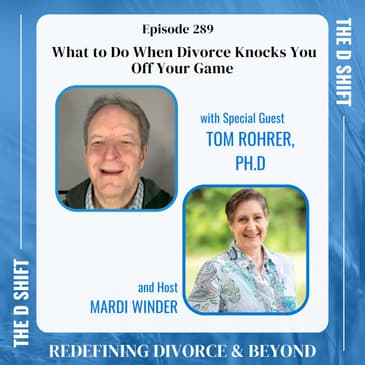
Today, Strategic Divorce Consultant Mardi Winder talks with mental performance specialist and psychotherapist Tom Rohrer, PhD, about the connection between emotional experiences and our ability to perform in everyday life.
Tom shares how unresolved emotional issues can affect confidence and performance, why taking responsibility is different from taking all the blame, and how realistically examining your role in a relationship can help interrupt unhealthy patterns. He also introduces brainspotting, a therapeutic approach he uses in his work, and discusses the connection between emotional processing, the brain, and the body.
Questions We Explore
Q: Why can divorce affect your ability to perform in other areas of life?
A: Significant emotional stress does not disappear simply because you walk into the office, attend an event, or need to take care of your family. Tom explains how unresolved emotional experiences can be triggered in situations that require us to perform and function at our usual level.
Q: How do you stop blaming yourself for everything that went wrong in the marriage?
A: Tom discusses “disputation,” a positive psychology approach that involves examining what actually happened, identifying your realistic share of responsibility, and separating that from the tendency to personalize everything that went wrong.
Q: Can changing your own behavior interrupt an unhealthy relationship pattern?
A: Sometimes. When one person stops covering, placating, making excuses, or participating in an established dynamic, the pattern itself may begin to change.
Q: What is brainspotting?
A: Tom describes brainspotting as a therapeutic approach that uses a person’s visual field along with awareness of physical sensations as part of processing emotional experiences. He discusses how it developed from EMDR and how he incorporates it into his work.
Q: What if you don't feel confident or capable after divorce?
A: Rather than accepting that this is simply who you are now, Tom encourages looking at what may be underneath that loss of confidence and addressing the emotional experiences that may be affecting how you show up today.
About the Guest:
Tom Rohrer, PhD, is a mental performance specialist and psychotherapist who assists public performers, mainly athletes to: resolve emotional issues that are causing performance problems, integrate mental resource states like confidence, courage, or optimism, and expand their ability to perform in the flow state (zone). He also helps his clients with addiction issues by neutralizing triggers, boosting motivation and commitment. He works individually and offers webinars.
To connect with Tom:
Website: https://tomrohrer.com/
About the Host
Mardi Winder is a Strategic Divorce Consultant and High-Conflict Divorce Coach who helps high-achieving individuals navigate divorce with clarity, confidence, and control. Drawing on more than 30 years of experience in mediation, divorce coaching and conflict resolution, she supports clients in making smart decisions while reducing emotional and financial fallout, particularly in high-conflict, high-asset and complex divorces. Mardi is the founder of Positive Communication Systems, LLC, and the Strategic Divorce Directory, LLC.
For Mardi’s gift: The Resilience Building Blueprint: A 28-Day Journey To A Stronger You https://www.divorcecoach4women.com/rbb
Connect with Mardi on Social Media:
Facebook - https://www.facebook.com/Divorcecoach4women
LinkedIn: https://www.linkedin.com/in/mardiwinder/
Instagram: https://www.instagram.com/divorcecoach4women/
YouTube: https://www.youtube.com/@divorcecoach4women
Thanks for Listening!
Thanks so much for listening to our podcast! If you enjoyed this episode and think that others could benefit from listening, please share it using the social media buttons on this page.
Do you have feedback or questions about this episode? Leave a comment in the section below!
Subscribe to the Podcast
If you would like to get automatic updates of new podcast episodes, you can subscribe to the podcast on Apple Podcasts. You can also subscribe in your favorite podcast app.
Leave an Apple Podcast Review
Ratings and reviews from our listeners are extremely valuable to us and greatly appreciated. They help our podcast rank higher on Apple Podcasts, which exposes our show to more awesome listeners like you. If you have a minute, please leave an honest review on Apple Podcasts.
[00:00:04] Welcome to the The D Shift Podcast, where we provide inspiration, motivation, and education to help you transition from the challenges of divorce to discover the freedom and ability to live life on your own terms. Hello and welcome to the D Shift Podcast. Are you ready? And today we are going to talk about the importance of being at your best whenever you are doing anything.
[00:00:26] And so I have an expert in this area who is going to share with us a lot of information about how to get yourself into that peak performance state. So Tom Rohr, PhD, is a mental performance specialist and psychotherapist. He has done a lot of things in his background. Now he does a lot of work with athletes to resolve emotional issues that are causing performance problems.
[00:00:51] And he also helps to integrate mental resource stakes like confidence, courage, or optimism. And that's certainly something that any of us can use when we're going through difficult periods in life. And divorce certainly falls into those. So Tom, I am so happy to have you on here sharing your expertise. Thank you, Mardi. Thank you for having me. Well, and I so appreciate this because I like to have people from a whole bunch of different areas.
[00:01:19] Like not just, you know, your traditional people who you associate with divorce. And this whole idea of performance is really important because a lot of my clients are going through divorce, but they're also business leaders. They're C-suite professionals. They're entrepreneurs. They're busy people running households, doing everything. We got to be on top of our game. Yeah.
[00:01:44] Well, and it wouldn't be one of the toughest parts of life is going through divorce and going to one's class reunion or going to a family get together. And one of the first times after the divorce has started. And maybe they know, maybe they don't. But probably the best way to approach that is to perform well. Yeah. Oh, I couldn't agree with you more. Yeah. Yeah. So, Tom.
[00:02:10] We've all witnessed or self-experienced being in public, struggling with performing, and we fall below our expectations. And, you know, why does that happen? Often happens because of some unresolved emotional, mental, emotional issue. Well, if somebody's going through divorce, it's kind of obvious that that's a big one.
[00:02:34] But it also may be triggering something deeper, more in our unconscious, in our more mammalian or reptilian brain. Yes. Which is adding to that and making it more difficult.
[00:02:46] And one of the things that's the most common with people are, whether it's an athlete who has what's referred to as the yips or slumps and such, or an average everyday person who's just trying to live their life and do better and handle all the things that life, the opportunities that life hands us. It's the ability to go into the public and perform. And it isn't easy.
[00:03:14] And when there are people that have unresolved issues, this can be much more difficult. Because commonly they're triggered. Whether it's something, you know, in terms of divorce, you're going to a class union and, you know, you can lie and say, well, you know, my husband got called out of town. Or my wife, it's like, you know, and people go, oh, okay. And maybe that's fine. And that circumstance is, it might be the best strategy. But we have to be able to go there and act like we aren't at least massively depressed.
[00:03:44] Yes. If not, we're fairly happy. And some of that's reframing, right? We're happy that a person who didn't want to be with us or is a total mismatch, we now don't have to struggle with it anymore. That can be a pretty big reframe, but it can certainly be effective. Yeah. Yeah. And Tom, can you just, because I love the audience to be able to kind of understand where the guests are coming from.
[00:04:11] Can you just tell us a little bit briefly about how you got to this area of focus? Because you're right. We're all performing all the time, whether we're an athlete or whether we're running a business or whether we're running a family. Yeah. Well, it started with me when I was an athlete and a basketball player in high school. And I started double dribbling, which today we call the yips.
[00:04:41] And I couldn't understand why. And it literally has been the last decade. I've been able to figure out it was because of a major family trauma that that got wired into my brain and attached. And so I spent years, you know, having that affect me. And who knows what, why things happen exactly. But I got married young and divorced almost immediately thereafter.
[00:05:08] And so I've been through two divorces and know that quite well personally, the pain going through that. Fortunately, I'm in a third marriage, which is, let's just say, much better than most. All relationships have their issues. I've gotten more comfortable with living in the messiness is about the best word for it.
[00:05:37] Equality relationship, marriage, friendship even can be pretty messy. It's really good. The better it is, the messier it is usually. Yeah. You get really blessed with everything exactly the way you do. So I have that personal experience. And so I both got into psychology because of that, but also then later into sports performance and performance work because of my own.
[00:06:05] I think it was fairly unconscious, but I wanted to figure out, you know, we often go to the fields that are much more motivated by our personality or style or unconscious desires than we want to believe it is. And I was figure out what the hell happened. Yeah. I don't know what the heck happened. You're good. But, you know, what you just said there, I think is worth kind of pausing about a little bit.
[00:06:31] That a lot of people, even though they did everything they could to fix the relationship, to make it work, to try to compromise and even create a different person to try to match up to what their partner wanted. When that relationship falls apart, a lot of times one person like just feels like it was all their fault.
[00:06:58] And I'm going to say, I think a lot of times it's women because women in society are supposed to keep the family together. They're supposed to keep everybody happy. And I'm sure a lot of men or most men feel the same. But why do you think we place, how can we get over that sense of failure? Is that really what you focus on now? If I was working with a person with that issue, absolutely.
[00:07:23] You say that a big part of the reason is women are more connected emotionally. Sure. And so we feel things more than men do. Men tend to be more devastated by divorces than women are. The research is that because men don't tend to have many men they have an emotional connection to, they tend to be, they're more lost because of the divorce. So when I first heard that, I thought that's kind of interesting.
[00:07:53] It makes sense. Yeah, I think that keeping things in balance, you hear a lot about balance. Balance is very difficult to do in most things in life. But keeping that realistic balance is a process that I learned when I studied positive psychology, and it's called disputation. And it's basically disputing. It's like, first of all, you go, did this happen?
[00:08:22] What did happen? How much of it was my doing? What percentage is it? And am I owning that? And then what can I do about it? Yeah. The other piece that I may have missed. But basically that's this. Looking at it, and women especially, but all people will sometimes go into, oh my God, I just ruined this. It was all my fault. It's like, look at it realistically.
[00:08:51] There's going to be, it's possible that something could be a 90-10, even 99-10 possibly. But we all are going to have some level of, right? And if we tend to personalize, then we go, oh my God. And we think we did cause much more than we actually did. Right. In a relationship, it's both people's fault to some degree. Right. And I mean that to some degree.
[00:09:18] It could be just one person didn't respond, right? You see that in addiction. You know, the classic male alcoholic and goes on and gets drunk and the wife blames herself, hides the bottles, et cetera, et cetera. Well, don't hide the bottles. It's amazing what happens when the one person, the husband or wife, just stops being the co. Yeah.
[00:09:45] And just stops and says, I remember one case where the woman just, the husband comes in at 2.30 and next morning she gets up and he's vomited all the floor and the bathroom. She just uses the other bathroom, goes to work. He wakes up, next time she gets home, everything's cleaned up and he got to work somehow. She didn't call the boss and say, oh, Charlie's not feeling well. Right.
[00:10:11] Amazing how fast that changed when one person starts playing the game or says something realistic or just doesn't keep covering, right? Right. Whatever the particular pattern is. And I think that's a really good, I think that's, yeah, that's a really good point is that a lot of times everybody takes all the responsibility for whatever the disaster was. And I'm using disaster, you know, it could be a big disaster.
[00:10:41] It could be a small disaster or the argument or the conflict. You know, one person will say, well, if I had just not reacted or if I had done something different, and the reality is you can't control how another person reacts. And that's where unhealthy relationships get started, I think, is because somebody reacts badly and instead of calling them out or leaving that time, the other person gives them the benefit
[00:11:08] of the doubt, you know, over empathizes with the situation, it makes an excuse. And then that creates a pattern within that relationship. Yeah, absolutely. I think in hindsight, I think with my second wife, I think that's one of the things I did is I, I soothed things over. I, I placated her. And after a while, I, I finally started guessing that what she, I was trying to be kind and considerate, she saw as weakness.
[00:11:38] Right. And eventually it's like, she just tried to keep, at that point, run over me at that point and said, enough. Yeah. I'm going to do this anymore. This isn't right. So, yeah. And, and, but to beat ourselves up for being too kind, right? Yeah. It's like, yes, you will make mistakes. That's pretty much, and that's pretty much a guarantee of life. Right? The question is, are you going to look at it realistically?
[00:12:07] Are you going to pay attention? And then are you going to take, make changes so that if it's divorced, the next relationship, if it's not divorcing, then you can hopefully, you know, find some way to reconnect and mesh things together. Right. But both people have to be willing to do that. Right. I'm very canning. Too lopsided. Yeah. Oh, yes. I so agree with you.
[00:12:32] Tom, let's say somebody is listening and they're saying, okay, I recognize I'm out of this marriage. And I recognize I don't feel, I don't feel myself anymore. I don't have confidence. I don't feel like I have the capacity to do things like I used to do. What, what are kind of, what do you, what do you work with them to do? Or how do you, how do you work your magic? I know you've probably got a lot of modalities and things you work with.
[00:13:01] I have, I think I've trained in just about everything over the years. The one that I like the best is, is a tool. Well, there's two actually. And all the standard cognitive behavioral stuff, it's good stuff. But there's one called brain spotting and it's called polyvagal theory. And brain spotting is about where you look and your visual feel determines or at least influences how you feel and how you deal with things.
[00:13:31] And this is, I suspect your listening audience has noticed in themselves or somebody and they're in a monologue and they're staring someplace. Right. And that is the basic structure of how brain spotting works. It's sorry about that. You know, I had that on. I don't know how to turn it off. It's an old phone.
[00:14:02] It's okay. I should have moved it myself. That's okay. It happens. It happens that, you know what? I have dogs and they'll bark in the background and I couldn't hear it anyhow. So don't worry about it. Okay. Great. Okay. So, so with brain spotting, that, that basic idea. And so it literally is, brain spotting is more complex than that. The basic, what's called self-spotting can be used that effectively.
[00:14:30] And that is, either you, either you create this or you notice that you're thinking about your ex and you're staring someplace. Just keep doing that. Just keep talking or thinking or talking and noticing and hold that gaze in that spot, wherever that spot is. And just sit there and do that and keep doing it. And if you do it for, who knows, but a reasonable amount of time, probably, let's say, 20 minutes
[00:14:57] to an hour, couple of hours, maybe in different time periods. It will help. Your brain and body will literally help you resolve it. Is that, is that related to like EMDR in some way? Yes. But brain spotting came out of EMDR about 22 years ago. The guy named David Grant was actually working with an ice skater using EMDR. And he would, unlike the way it gets taught, I used it for a couple of decades.
[00:15:26] He was very, very slow. And he got to dead center level. And he heard a voice say, just hold your finger there. He actually just used his finger. And so he did. And this young woman who had gotten to the point after almost a year of being able to do triple toe loops, but not triple loops, just went into unconscious mannerisms, which makes you know that the person's processing something. So she was swallowing and blinking.
[00:15:57] And a few minutes later, she calmed down and they stopped and they had to end. She calls him three days later and says, I can do triple loops over again and not fall at all. And he kind of went, gee, what did I discover here? That's brain spotting. Okay. Yeah. And so it's similar, but it's not, it's not the... Zippy, zippy thing. Yeah. And I don't know if it could, because EMDR is effective. It is. Yeah. It is.
[00:16:26] But it's like David's words for it. He said, it's like having this powerful, effective tool you know works, but you don't know exactly how to use it. And that's really good. With the brain spotting, once you find that spot, and it usually is not difficult to find, you got it. It's like you're locked in. The second part of that is noticing where you have the strongest body sensations and just noticing that. Holding the eye gaze, notice the... And that's typically upper body, typically upper chest.
[00:16:56] So no matter what the thing is, whether it's a negative thing that can be evolved towards neutral, or whether it's a mentally emotional resource state, typically, but a positive, which you can integrate more, that's really helpful. Yeah. Yeah. Yeah. Yes. It can take...
[00:17:20] This is unusual, but I had a guy who had been seeing, and he literally integrated, neutralized a 10 of 10, intense PTSD, simple, single episode in one session. Wow. Wow. And there was a woman who literally... She started off working with her mother, and she literally had me take...
[00:17:48] He's a pointer, typically, for life. So he kept saying, move it over here, move it over here, move it over here. She said, I just neutralized six different situations with my mother. Yeah. Again, that's really unusual. It's unusual. But it's amazing how the body, the brain can sync like that and deal with that trauma. Yeah. But it's not unusual to do significant issues in a session two, three. It's not at all.
[00:18:16] Again, it goes back to how open and ready is the person. That's true of all therapies, all change. When a person is hanging on to it and doesn't want to let go and identifies with it, etc., etc., it's going to be very difficult, maybe impossible, until the person is ready to let go of that. Right. To allow it to be let go. And that, my point of view, that doesn't matter if you're working truly psychologically
[00:18:44] or physiologically or spiritually. Yeah. You know? Yeah. Go together. Yeah. That's fantastic because I think that there is, I'm not a therapist, but I do, and I do find that therapy is CBT or brief solution focus, whatever process you use can be really effective, but it can also keep people trapped in just telling that same story over and over.
[00:19:15] And that's what I see with a lot of my clients who have been in marriage therapy, marriage and family therapy prior to going through the divorce. I deal mostly with high conflict situations. So there's one very toxic person, sometimes two very toxic people. But it is like there is, it's just an endless loop of telling, like telling yourself this, that story. And it just becomes more and more ingrained rather than actually creating any way to get out of the story.
[00:19:44] Absolutely. And one of the ways of bringing in tools like EMDR and brain spotting and other physiological kinds of things, it tends to move things. Right. In ways that just, because that's all up in the upper cortex, right? All the issues tend to be stored in our midbrain or reptilian brain. Right. And if they don't necessarily connect. Yeah. You're not going to get the results. There's another thing I just wrote real quick.
[00:20:12] And it's using symbolism. And one of the ones I like a lot is with couples is white flag. Right. You can literally make a white flag and write the word down, whatever. And you have a, it comes in a fair fight training mostly. And that is, if you make an agreement, then somebody says, whatever, white flag. You just both, you make an agreement. You stop, you don't say anything more, one version.
[00:20:40] And you turn around and walk away for X amount of time. And then you come back, having thought about what your part in that was and say, identify what that was. I think that, but the part I'm bringing in is the idea that you have something that somebody says can be referred to as symbolic communication. Yeah. Great idea. Tom, we could probably talk for forever, but we are out of time. I can't believe this. This is really interesting. And I love this new idea of brain spotting.
[00:21:09] I'm definitely going to take some more, do some reading up on that because I think that's a phenomenal resource. If people who are listening want to find out more about what you do or get in touch with you to work with you, what's the best way to do that? Well, my website is just my name, TomRor.com. And spell R-O-H-R-E-R.com. And that's probably the easiest at this point. I could give a phone number, but. Sounds great. I will make sure that gets in the show notes.
[00:21:39] So it's really easy to find. They can just click on it and go right there. Tom, thank you so much for sharing all your expertise and wisdom on this. Something I've never heard about. So, hey, it was a real learning experience for me as well. And thank you, everybody. Thank you, everyone, for listening in to this episode of The D Shift. And don't forget to tune in to the next one. Thanks for listening and supporting The D-Shift Podcast.
[00:22:07] If you would like to attend live trainings by our amazing guests and have a chance to ask questions and get answers from our experts, join The D-Shift Crew. For more details and to sign up, head on over to www.divorcecoachforwomen and click on the podcast page.