
What if divorce did not have to destroy everything in its path?
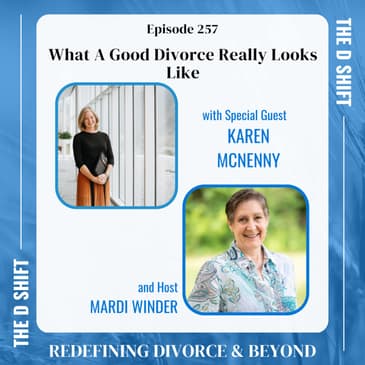
In this episode of The D Shift, Mardi Winder sits down with Karen McNenny to explore a very different perspective. One that challenges the traditional adversarial model and instead focuses on creating a thoughtful, intentional path forward, especially when children are involved.
Karen shares her personal divorce journey and how it led her to build what she now calls the Good Divorce movement. Rather than focusing on conflict, she helps families navigate separation in a way that prioritizes long-term relationships, especially the co-parenting dynamic.
Together, Mardi and Karen unpack what a “good divorce” actually means and why it is far more common than people realize, even if those stories are rarely shared. They discuss the limitations of the traditional legal system, the importance of early decisions, and how starting with communication and parenting plans can significantly change the outcome.
This episode also challenges common assumptions, including the belief that staying together for the children is always the better choice, or that waiting until they are older will make divorce easier. Instead, the focus shifts to what children actually need, which is stability, honesty, and parents who can function in a healthy way, whether together or apart.
Karen also shares insights from her new book, which is designed not just for those going through divorce, but for anyone connected to it. Her work emphasizes that divorce is not the end of a relationship, but a restructuring of it, and one that can be handled with intention rather than defaulting to conflict.
This is a conversation about possibility, responsibility, and redefining what divorce can look like when people choose a different approach.
The episode explores why:
• Most divorces are not high conflict, but those stories are rarely shared
• Divorce does not end a relationship; it restructures it
• Starting with communication and parenting plans creates better long-term outcomes
• The traditional legal system is built for conflict, not cooperation
• Staying together for the children can sometimes cause more harm than good
• Children need stability and honesty more than they need parents in the same home
• A good divorce is not about perfection, it is about intention and design
• Early decisions in the process often determine how the divorce will end
About the Guest:
Renowned for blending warmth, clarity, and practical strategy, Karen helps navigate change with intention. As a sought-after speaker, trusted advisor, and TEDx presenter, she draws on over two decades of leadership coaching and consulting across nonprofit, corporate, and public sectors. Karen is also the founder of the Good Divorce show and Good Divorce Academy, and author of The Good Divorce. Her lived experience—navigating her own divorce while raising children across two homes from kindergarten through college—proves families can restructure without rupturing, making her guidance profoundly relatable and effective.
To connect with Karen:
Website: thegooddivorcecoach.com
Instagram: https://www.instagram.com/gooddivorcecoach/
Facebook: https://www.facebook.com/gooddivorcecoach
LinkedIn: https://www.linkedin.com/in/gooddivorcecoach
TikTok: https://www.tiktok.com/@gooddivorcecoach
YouTube: @gooddivorcecoach
About the Host
Mardi Winder is a Strategic Divorce Consultant and High-Conflict Divorce Coach who helps high-achieving individuals navigate divorce with clarity, confidence, and control. Drawing on more than 30 years of experience in mediation, divorce coaching and conflict resolution, she supports clients in making smart decisions while reducing emotional and financial fallout, particularly in high-conflict, high-asset and complex divorces. Mardi is the founder of Positive Communication Systems, LLC, and the Strategic Divorce Directory, LLC.
For Mardi’s gift: The Resilience Building Blueprint: A 28-Day Journey To A Stronger You https://www.divorcecoach4women.com/rbb
Connect with Mardi on Social Media:
Facebook - https://www.facebook.com/Divorcecoach4women
LinkedIn: https://www.linkedin.com/in/mardiwinderadams/
Instagram: https://www.instagram.com/divorcecoach4women/
YouTube: https://www.youtube.com/@divorcecoach4women
Thanks for Listening!
Thanks so much for listening to our podcast! If you enjoyed this episode and think that others could benefit from listening, please share it using the social media buttons on this page.
Do you have feedback or questions about this episode? Leave a comment in the section below!
Subscribe to the Podcast
If you would like to get automatic updates of new podcast episodes, you can subscribe to the podcast on Apple Podcasts. You can also subscribe in your favorite podcast app.
Leave an Apple Podcast Review
Ratings and reviews from our listeners are extremely valuable to us and greatly appreciated. They help our podcast rank higher on Apple Podcasts, which exposes our show to more awesome listeners like you. If you have a minute, please leave an honest review on Apple Podcasts.
[00:00:04] Welcome to The D Shift Podcast, where we provide inspiration, motivation, and education to help you transition from the challenges of divorce to discover the freedom and ability to live life on your own terms. Are you ready? Let's get this shift started.
[00:00:21] Hello, and welcome to this episode of The D Shift Podcast. And I have a returning guest, just an amazing person who I've had on the show before, Karen McNanny. And she has a brand new thing that we're going to talk about. But more importantly, we're going to talk all about the idea of what is a good divorce. And those of you who have been following along know that I typically work with the high conflict end of divorce.
[00:00:48] And Karen works with people who are more concerned about getting through the divorce without burning everything to the ground and where both people are committed to the well-being of their children during the divorce. And so I want to introduce you to Karen if you haven't met her before. Jamie Lima is the founder of The Good Divorce Academy and The Good Divorce Show.
[00:01:11] She is also the author of The Good Divorce, which is a brand new book that is going to be launching. It's in pre-sale mode now, but it's going to be launching. And we're really excited to be able to highlight that. She's a speaker, a trusted advisor, and a TEDx presenter, as well as being an amazing coach to support people through a good divorce. So, Karen, welcome. Welcome.
[00:01:36] It's so great to be here with you, Mardi. And thank you for sharing the platform and the microphone and hello to your listeners who all of us are navigating a place that we never thought we would be in, a story we didn't want to write for ourselves. Yes, it's a friend of mine said this and the Widowers Club is something you never wanted to sign up for and don't want to be a member of, but you're stuck here anyhow. So, yeah, absolutely so true.
[00:02:04] So, Karen, in case people didn't hear our first episode, tell us a little bit about you, how you got here and why this is your focus. Lovely to go back in time a bit because it's been 15 years since my own divorce, so it's not so painful. And I want to remind people that time is a healing elixir and we're kind of in charge of the gas pedal and the brake. And some days as I look back, I'm like, I wish I would have pushed down on that gas pedal a little faster. We would have gotten to the good stuff sooner.
[00:02:35] Our children were five and seven when we went through getting unmarried, right? And we were looking for an alternative. We did not need to call attorneys. We weren't high conflict. We right away knew that our children would live across two homes equally, that we would share all of the expense of raising them together equally, and that we wanted to be able to sit side by side at every important event and celebrate the journey of our children. They are now 20 and 21.
[00:03:03] So we went from kindergarten to college as a two-home family living six blocks apart with the elementary school between us. And obviously, at the time of my divorce, I didn't even know divorce coaching existed. And it was only just starting. But I was passionate about trying to find an alternative. And we poked around in the dark and found our way. But during the pandemic, I shifted.
[00:03:32] I had been a business consultant, and I still do some of that formal work of project management and leadership development, really human behavior and relationship at work. Well, it's the same thing at home, all those challenging dynamics of people. And a lot of that work was quiet during the pandemic.
[00:03:49] And I stumbled into divorce coaching and brought all of my consulting skills into that and built out over the last five years the Good Divorce Movement, which is what I like to think of it, that we are doing more than just getting people divorced, Marty. We're really trying to help show people how to be divorced on the other side. Yes, I love that.
[00:04:11] And so I want to put this in context, because I think we hear all of the celebrity divorce fiascos and shenanigans and PR stunts and whatever they are. And then we also hear typically about all the really high-conflict divorces in our own communities, because quite often these are played out in public. There's not a lot. The high-conflict person is more than happy to air the dirty laundry and share everything. But that is not the majority of divorces.
[00:04:41] I don't know the exact number, but I know that only about 10% to 15% of divorces ever hit litigation. So I would assume that that means about 85%, maybe 90% of divorces are at some level amicable enough to resolve through mediation or collaborative law processes. And so that's really the vast majority of divorces.
[00:05:05] You just don't hear very many people say, me and my ex-spouse are still great friends. We work together. We raised our kids. Sometimes I have people who tell me, I do vacations with my child's father or mother. We go, we get different hotel rooms, but we're there together with our kids. We do birthdays. We do Christmases. Our new partners are involved.
[00:05:34] We all are one big happy family. And that's such a positive experience. Be rare. Often we hear that story and we're like, oh, wow, that's amazing. I'm like, that should be the norm. And I was approached to start a podcast four years ago about leadership and my background in workplace development. And I told the producer, I said, wow, I'm into this new thing.
[00:06:03] I'd really rather do a podcast about divorce. And I said, really? And I said, yeah. And I want to call it the good divorce. And I want to have people on the show who've had a good divorce, whether they come on as a couple or one member of that spouse relationship. Sometimes it's adult children of divorce who are thanking their parents for not screwing them up. Because you're right. We don't usually hear the stories and the models of what it can sound like.
[00:06:32] So through storytelling in my podcast, we just kicked off our fourth season of the Good Divorce Show. So there's experts like Mardi on there. But 50% of the guests are folks just like you and me who are trying to find our way and to hear what it sounds like. And even those journeys that don't litigate and escalate to that level of high conflict,
[00:06:58] I still think that early intervention and prevention is kind of the secret sauce to good divorce. How we begin is how we end. And I don't think the beginning is call an attorney and start talking about finances. Right. I think the beginning is a communication plan that obviously everyone's, how do we tell our kids?
[00:07:19] But it's also how you tell your circle of support, the circle of support of the children, how you kind of, as you're pulling apart the marital relationship, you're redefining your codependent or your, might be codependent, your co-parent relationship. You know, I always say your marriage is ending, not your relationship. Right. Right. That's getting renovated.
[00:07:42] And all of these early stepping stones, even couples that might still be living in the same house when they make the decision, which is not uncommon. And we have to wait for a house to sell or for the money to sort out. So I try to help my clients work on a residential schedule. So we're not on top of each other in the kitchen. And are we now living in separate bedrooms? And then maybe there's nesting.
[00:08:06] Like there's this progressive entry into the legal piece, which is really just this little sliver of your whole journey. And I'm a big believer in family before finances. I like clients to write their parenting plan before they start talking about all the money or at least going into negotiation so that the kids are never put on the table as a negotiating factor. I love that.
[00:08:33] And I, I have a, you know, I'm a mediator as well. And so I have a slight parting of the way with a lot of the more traditional attorney mediators. So I'm just going to call them that there's, there's nothing wrong with it. It's just quite often in the mediator circle, it's designated you're an attorney mediator or a non-attorney mediator.
[00:08:55] So an attorney mediator is somebody that typically has a family law practice or, or has been in the past a family lawyer or maybe a judge or somebody like that. So what I find they want to do is they want to deal with the nuts and bolts first, because their mentality is that if you get the nuts and bolts done, you take the emotion out of the thing. And the emotion is really around for most parents, if children are involved, the highest level of emotion is typically around kids and then money.
[00:09:22] So I love the idea of let's work together collaboratively, because once we know who's got the kids and who's doing what, and really what a lot of things parents don't even think about are all the things that they're going to have to pay for as parents. You know, if you're divorcing when your kids are five or seven, you're probably not thinking about who's going to pay for college, who's going to pay for car insurance, who's going to think about this, who's going to think about that.
[00:09:47] If you, if you get that agreed upon, then people look at that and go, well, the finances need to match up with. With our parenting plan. Yeah. And our values as parents. Yeah. And, you know, one of the first conversations I have with clients, and I think you and I might be rare, Marty, when we're really working with the parents together. So often, the first thing we do is divide them and turn them to enemies and we start to weaponize divorce.
[00:10:17] It's not a weapon. Right. Needs to stop being treated as a weapon by the family law profession. It's a tool of transformation with the intent of taking something that's not working very well and help it to be more functional. We're already in a dysfunctional marriage. Why do we want to spend 30, 50, $60,000 and pour out our soul only to end up with a worse divorce than what our bad marriage was? Yes. It just makes no sense.
[00:10:45] And when you can get those parents, not even on the same side of the table, I really like to think of it as round table relationships. But you and your kids, you are all at the same family table. And you and I know this approach isn't for everyone because sometimes there's domestic violence and addiction and infidelity of all sorts, whether that's intimacy or financial.
[00:11:10] There are those situations where we really need to think about tight legal boundaries and protections. Right. But again, I think that's not the norm. Right. There's a lot of normal neurotics like myself and my first husband who just need to get unmarried so that we can have a better environment to raise our children. It should still be, you know, starting with that question. How are they doing?
[00:11:40] How are those kids doing? And when we start from that place, parents, it's the one thing the two of you care more about than anything else in the world. That co-parent is the only other person who's going to love those kids like you do. Right. That's the bonding of your DNA. So let's give them a better launch pad. Yes. And this is so I think this is something that. You're right. The the family court system.
[00:12:09] I'm just going to say this. Let's upset some people, Marty. We're here to disrupt. It is it is set up adversarial. You know, the attorney represents party A. Attorney represents party B. The attorneys are are tasked. That is their job to get the very best settlement possible, even if it means messing over the other side. I'm just going to say it right. It's a win, lose binary.
[00:12:37] They're doing what they're trained to do in a system that is constructed for conflict, not cooperation. Right. And it works very well in criminal court. It works pretty well in other civil court matters. But divorce, unless you are going to walk away and never see the other person again, is not as you mentioned already, Karen. It is not the end of the relationship.
[00:13:02] It's a it's a reset and a re evaluation of the relationship because you're always going to be connected through your children. If kids are involved or if pets are involved or if you have a family business together. I've seen cases where people are divorcing but want to keep working together in the family business. You have to get you've got to get over the emotional stuff and move forward and have a different way of looking at this.
[00:13:30] So really, the family court system, it does a disservice. I really believe that. I agree. And within my book, there's an entire chapter challenging kind of the Kool-Aid that we've been drinking for decades, as well as other areas where there's divorce penalties. We make it hard for families to hold on to their family or their family home when we have to totally refinance rather than an assumption of loan.
[00:13:57] We don't support divorcing folks at work through the Family Medical Leave Act. It's not covered. And we know it's high stress, high crisis. So I again, I'm so grateful to share in a conversation such as you. I'm starting to refer to us all as the great disruptors of divorce. And we are here to disrupt and to give you, the listener, permission to know you can design your divorce and design your family.
[00:14:25] It is not divorce by default. Right. And if your first call is to an attorney, they're going to do, God love them, exactly what they're trained to do in a system that is not built for the forever journey of a family. Right. A lot of damage can be done. And I do want to carve out the collaborative law movement is making a big shift here. So the collaborative law movement, and we've had several attorneys come on and talk about that.
[00:14:53] Manisha Patel just recently came on and talked about it in North Carolina. But it's really the goal is having this whole roundtable conversation where you both have your own attorneys, but the attorneys are committed to working together. There's no lawsuits being filed. There's not a whole bunch of motions. Nothing's going on in the background. It's just. You signed an agreement. Yeah. We will not go to court. You have professionals. And I love the distinction.
[00:15:20] Collaborative law isn't even necessarily that you and your spouse are required to collaborate. You might be mad as hell with them. Right. The attorneys are committing to collaborate and keep you in the conversation to get a great outcome. And collaborative law is still one of those best kept secrets. Right. People don't know. But almost every state and in your area has a collaborative law team.
[00:15:43] And if people need a little more support than a coach or a mediator, fabulous people like Marty and I, then collaborative law is a wonderful way. And that doesn't mean that we can't support you in, again, that runway. Because even collaborative law is going to start at the point of discovery, process, finances, separating the stuff. Right.
[00:16:08] And not necessarily the tools of restructuring the family, the logistics of two homes, that communication plan. There's just so much more to the journey. And I think if we could get a little further upstream, we wouldn't lose people in the rapids downstream. Right. And, you know, we were talking about this before we got on the air, but most of my clients, because I do, again, work on the high conflict side. And I want to stress this.
[00:16:38] If you are in a relationship with a high conflict person, I'm not saying this is your responsibility and there's anything you can do to make them be more rational, reasonable and collaborative. You have no control over them. I get that. But when both people want to work together, even if there is a lot of anger, we can help people as coaches. We can help people deal with that anger. We can help people work through it, process it, move forward.
[00:17:07] And it all starts by creating, I believe, creating a vision of what do you want your relationship with your kids to look like in the future? What is the role you want your, the other parent to play in that and get a clear picture of this? And then once you can both agree on that vision, that anger is going to, it kind of just seems to just naturally fade away. Doesn't mean everything's going to be sunshine and roses and you're going to have disagreements.
[00:17:36] But if you start from we're in a fight, you got a bigger problem. Yes. Yes. And of course, there's so much grief that comes with divorce that, you know, emotions are high. And I don't, I wouldn't even suggest that the goal is to be friends. Right. But the goal is to be friendly. Right. As you would anyone else on the street, on the playground that you run into. And how we begin is often how we end.
[00:18:06] So those beginning stages. And I would even go further to say that some of us do not begin soon enough. If you cannot bear to be in a conversation with a person you had a love story with, that you married, that you brought children into this world together, and you cannot stand the presence of them, cannot have a civil conversation. Honey, you stayed too long. Yeah. Yep. Just probably stayed too long.
[00:18:35] And we don't give a lot of social permission to exit our marriages that are just like not really functioning well. And we sort of know what, we know the trajectory it's going. We wait until that sucker is on fire. And some of us start to build those fires. Right. And know our truth long before we speak it.
[00:19:02] And I always say, if you see the off ramp, usually we drive by it many, many times. Right. Someone in that relationship, sometimes both. Until there's an affair. Until there's misconduct of some other kind. And even just the subtle ones. Like, I hate how you load the dishwasher. And all you're going to see are the negative qualities of your spouse until you're so angry and irritated with each other. Right.
[00:19:28] Whereas if we gave a little more permission and we knew that there was an option that wasn't going to destroy our family, we might have an elegant exit. Yes. Down that off ramp. That brings me up to this point. And I would love to get your take on this. I hear so many people say, well, it's not that bad. There's no abuse. You know, we tolerate each other. We have some good moments still.
[00:19:56] And I don't want to get a divorce until the kids are off on their own. Talk about what your thoughts are on that. But, well, again, I think if we had more social support and understanding and less shame and isolation, people would exit sooner. I think there is a myth that if we wait till the kids graduate, then we don't have to deal with the co-parenting and it'll be better for the kids.
[00:20:25] But what I've seen, and I'm guessing you've seen this as well, Marty, that there's a cliff. And I want you just to imagine your child goes off to college. You start the divorce proceedings. Maybe you sell the family home. Parents move into new places. Child comes home for Christmas break. Where's my stuff? Where do I go? Your family has actually no practice of what it is to be a two-home family.
[00:20:51] Your child doesn't know how to navigate this new relationship of their parents because they've never lived it. But you still have a forever relationship. And what happens is that those kids feel very disoriented, especially that young adult 18 to 25. They need a solid ground, which doesn't mean they need one house. They need to know where their support is. They need to know how their family works because they're boomerang kids. They're going out. They're coming back. They're getting their own car.
[00:21:20] Can you still pay my insurance? I don't have the job. I lost the job. I don't have health insurance. We've all been there. So the myth that our kids are going to graduate and then we don't really have to deal with each other is a complete myth. Yeah. And furthermore, it's possible that that child has spent five, ten years living in either a high-conflict house because you chose not to divorce. And we know that is more damaging to a child's psyche than divorce.
[00:21:50] And I always say divorce isn't what screws kids up. Right. It's adults behaving badly, married, unmarried. That's what screws kids up. So keeping them in an environment of a marriage that is eroding and can be either high-conflict or you become roommates. Right. And it is a loveless marriage. And you move into, well, I think sometimes separate bedrooms can save a lot of marriages, but you're not seeing affection. You're not seeing connection.
[00:22:19] And I grew up in a house like that. And I had hoped my parents would get divorced. And it moved between conflict and passive. Right. But what I mostly saw was the absence of love. Right. And that carried over into my adult relationships because my parents did not model a healthy marriage. Right. So you've got to also think about what am I modeling for my children as I stay?
[00:22:49] Because the shadow, the long echo of divorce will live on through your children. Yeah. And thank you. That is such a wonderful way of saying that. Because you're right. Just because they're adults, just because they're out, well, technically adults, legally adults, doesn't mean that they still don't feel that whole foundational shift. Because they're like, what the hell? I went off to college. Now my mom and dad are divorcing.
[00:23:17] How much of my life has been this facade that they have put up? And I'm going to throw this in. I know we're almost out of time and I almost hate to do this because I think this could be a whole nother conversation we need to have.
[00:23:30] But this whole idea of the Facebook perfect family, when this kind of stuff is going on in the background and how that distorts a child's ability to, a child of any age's ability to understand and really relate to relationships. Like, I think they get this idea that relationships look one way. You have to present this really perfect image.
[00:23:57] And that's one of the signs of a lot of my high conflict people is that they've been coerced into creating those false images. But sometimes people just do it because, hey, you know, we don't want our church community or we don't want our neighborhood or we don't want our friends and family to know that we don't talk to each other. We both come home from work. We go our separate ways. She watches TV downstairs. He watches TV in the bedroom. And that's, you know, they don't even eat together. They cook in the same room and take their meals and go elsewhere.
[00:24:26] And that's a sad thing for kids to grow up in. I think the external and internal, when they don't match up, it can cause a lot of discord and confusion for kiddos. And you're right. The whole social media is another follow-up that I certainly can't conquer. But I think we should all embrace the truth that when we are sharing publicly, of course, we want to share the happy moments. Sure.
[00:24:55] And the vacation and the running along the beach and us all snuggled in a pile like a bunch of puppies on the couch. That is what we're going to share. And just know that that is the public-facing story. Right. And there's always a deeper truth. And none of us can understand kind of the private, precious place that a marriage lives. Right. It's complicated for all of us. And there's not one reason why marriages end.
[00:25:23] It is a complex tapestry. And you pull on one string, it tugs on all the others. And sometimes you get the one and that's all apples. Yes. Karen, we're almost out of time, but I do want you to talk a little bit about your book. Tell us about your book. And because it's in the pre-launch stage, right? Yes. Which actually is really important in the world of publishing. You know, the middle of May, the book will go live.
[00:25:49] If you go to my website, karenmcninney.com or just thegooddivorcecoach or gooddivorce.com, you're going to find me. And there's a page there that talks a little bit about the book, has an interview that I did about the content of the book. And you're also going to find the links to Amazon and BAM and Bookshop if you want to support your local book dealer. So it's really easy if you go to my website to learn more about the book. There's a few little snippets from the book.
[00:26:19] And you can order directly right now. And those pre-order cells, again, you know this as well as I'm already, we're not getting rich off books. That's not what books do. Books, for me in particular, this book is a catalyst for family-centered divorce reform. And it's not just for people in the journey of divorce. I really say it's for anyone who is divorce adjacent, which is pretty much all of us.
[00:26:45] If you are the grandparents, read this book so you can better understand your child's journey and what your grandkids need. If you're a professional in the industry, please read it. If you're divorce curious, have you and your spouse read it. Because again, divorce sits on the shelf as a threat in every marriage. And how dare you say the D word? Right. Exactly.
[00:27:09] If we could look at it more as we should be educated and know so that it doesn't sit with this energetic distraction to the marriage. And that if we do, just like on an airplane, if there's going to be turbulence and if you're going to go down, we want you to know what to do. We don't want this plane to crash. But that flight attendant is going to tell us how. So the book is one, it's kind of a trifecta. It's one part memoir.
[00:27:37] It is the journey of me and our two kids. I cannot tell the story of my children or my first husband. But I really dig into my decision making and the early grief and new partners being introduced. All of that component that weaves throughout the book. And then there's the nonfiction part. It's the divorce consultant giving you scripts and dues and what to think about.
[00:28:04] And then the third piece is this call to action to really reveal what the divorce industrial complex has become and how you as an individual, as a parent can design your divorce differently. And it would mean so much to the movement to hop on and order a book as soon as you hear these words. And you might be buying it for a friend.
[00:28:31] Yeah, I'm definitely going to be getting a copy and it will go on my list of referrals for my clients to take a look at. So, Karen, thank you so much for sharing this. Before we get off the call, though, give us again your website so if people want to look for you. And also, just to let everybody know, this is all going to be in the show notes. So if you're driving or walking or whatever, don't worry. Just go home and look on your device and you will find that information. If you start Googling The Good Divorce Coach, you'll find me.
[00:29:00] You'll find the podcast, the book, The Good Divorce Academy, my online community where you can learn and get a lot of tools long before you call that attorney. Wonderful. Karen, thank you so much for coming on and sharing this. And congratulations on the book, The Good Divorce. I'm really looking forward to getting my copy and reading through it. My pleasure. And thank you, everybody, for listening to this episode of the The D Shift Podcast.
[00:29:26] You know, if you've got any comments or questions or anything, reach out to me and I can always put you in contact with Karen. Take care and don't forget to listen to the next episode. Thanks for listening and supporting the D-Shift Podcast. If you would like to attend live trainings by our amazing guests and have a chance to ask questions and get answers from our experts, join the D-Shift crew. For more details and to sign up, head on over to www.divorcecoachforwomen
[00:29:56] and click on the podcast page.