
A life transition like divorce can also be a time to make other changes and shifts. Whether you're considering a career change, launching a business, or turning a lifelong passion into an income stream, today's technology offers opportunities that simply didn't exist a few years ago.
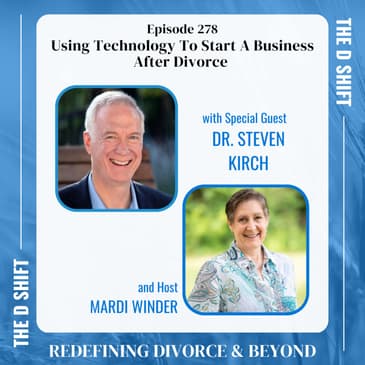
In this episode of The D Shift, Mardi Winder sits down with business strategist Dr. Steven Kirch to explore how artificial intelligence can become a valuable thinking partner for anyone rebuilding their professional life after divorce. Rather than replacing human creativity, AI can help organize ideas, explore possibilities, challenge assumptions, and support better decision making.
Together they discuss practical ways AI can help evaluate business ideas, create business plans, brainstorm marketing strategies, identify blind spots, and even prepare for conversations with potential investors. They also explain why AI should always be viewed as a tool to support your thinking rather than replace your judgment, and why reviewing and verifying information remains essential.
Whether you're dreaming about a side business, returning to the workforce, or exploring an entirely new direction after divorce, this conversation will give you practical ideas for using AI to support your next chapter.
In this episode you'll learn:
• How AI can become a brainstorming and strategic thinking partner.
• Ways to explore new business ideas before investing significant time or money.
• How AI can help organize business plans and identify potential gaps.
• Why asking better questions produces better AI responses.
• What AI hallucinations are and why you should always verify important information.
• Privacy considerations when using AI for business planning.
Artificial intelligence is changing how entrepreneurs work, but success still depends on thoughtful planning, critical thinking, and informed decision making.
About the Guest:
Dr. Steven Kirch's path to Profit Minds began with a Ph.D. in Physics from the University of Illinois Urbana-Champaign, followed by more than 25 years in high tech, first at IBM, where he pioneered Focused Ion Beam techniques for failure analysis, before moving to Intel. His roles at Intel were many and varied, among them, running an analytical lab, serving as Chief of Staff to the VP managing Intel's most productive factory, and leading a 40-person international team. And along the way, he became a co-inventor on 10 U.S. patents across 5 technical fields, most of them earned as a manager contributing outside his own domain of expertise. After Intel, he founded Business Culture Advantage and then Profit Minds in 2020, where he has now served 50+ clients ranging from solopreneurs to mid-market firms.
Now partnering with his daughter, Suzy, at Profit Minds, they have shifted the focus to help businesses transform through the power of AI. Steve's mission is to take what he learned inside two of the most demanding companies on earth and put it to work for the leaders and teams of small and mid-sized businesses.
For Steve’s gift: https://aiisnothard.com/
To connect:
Website: https://profitminds.net/
LinkedIn: https://www.linkedin.com/in/stevekirch/
About the Host
Mardi Winder is a Strategic Divorce Consultant and High-Conflict Divorce Coach who helps high-achieving individuals navigate divorce with clarity, confidence, and control. Drawing on more than 30 years of experience in mediation, divorce coaching and conflict resolution, she supports clients in making smart decisions while reducing emotional and financial fallout, particularly in high-conflict, high-asset and complex divorces. Mardi is the founder of Positive Communication Systems, LLC, and the Strategic Divorce Directory, LLC.
For Mardi’s gift: The Resilience Building Blueprint: A 28-Day Journey To A Stronger You https://www.divorcecoach4women.com/rbb
Connect with Mardi on Social Media:
Facebook - https://www.facebook.com/Divorcecoach4women
LinkedIn: https://www.linkedin.com/in/mardiwinderadams/
Instagram: https://www.instagram.com/divorcecoach4women/
YouTube: https://www.youtube.com/@divorcecoach4women
Thanks for Listening!
Thanks so much for listening to our podcast! If you enjoyed this episode and think that others could benefit from listening, please share it using the social media buttons on this page.
Do you have feedback or questions about this episode? Leave a comment in the section below!
Subscribe to the Podcast
If you would like to get automatic updates of new podcast episodes, you can subscribe to the podcast on Apple Podcasts. You can also subscribe in your favorite podcast app.
Leave an Apple Podcast Review
Ratings and reviews from our listeners are extremely valuable to us and greatly appreciated. They help our podcast rank higher on Apple Podcasts, which exposes our show to more awesome listeners like you. If you have a minute, please leave an honest review on Apple Podcasts.
[00:00:04] Welcome to the D Shift Podcast, where we provide inspiration, motivation, and education to help you transition from the challenges of divorce to discover the freedom and ability to live life on your own terms. Are you ready? Let's get this shift started. Hello and welcome to this episode of the D Shift Podcast.
[00:00:25] And we are going off script today because we are going to talk about something that is not directly related to the nuts and bolts of maybe going through a divorce, but it is something that a lot of my clients are doing now, which is moving, using the divorce as a way to restart their life or perhaps get into business for themselves when they have spent the last 20 years or 30 years or 40 years supporting a family and perhaps supporting their spouse in their business.
[00:00:55] So I have an expert today, Dr. Stephen Kirsch. He has over 25 years of high-tech leadership, and he helps small and medium-sized businesses scale faster using artificial intelligence. And that's a big topic today. It's a controversial topic lately, but probably only in the United States, but there you go.
[00:01:18] And, you know, the thing is, is if you're not using AI today, you're doing a whole lot of work and you're going to be losing ground compared to what your competitors are doing. So should I call you Dr. Stephen or how would you like to be addressed? Just call me Steve. I love that. Thank you, Steve. All right. So, Steve, tell us a little bit about your background and how you got into this really fascinating area of business development.
[00:01:45] Yeah. So I have a PhD in physics, and I spent 30 years working in high-tech. A couple of companies you've probably heard of. I worked at IBM for a while and then at Intel. And while I was at Intel, I got the opportunity to learn how to use and teach the seven habits of highly effective people. Yes. Yeah. Dr. Covey's seminal work from a long time ago.
[00:02:15] Yes. Way back when. So I'm a certified facilitator. I've been a certified facilitator for 30 years. And what I discovered was that I really loved teaching people how to be more effective. And, you know, fast forward now 30 years. I left Intel almost 10 years ago and started my coaching consulting practice. And focused on the productivity space.
[00:02:47] And over the years, I've added new tools for profit growth, for scaling of businesses. And then a couple of years ago, of course, as the AI sort of burst onto the scene, I got the opportunity to learn for myself how to use it in my own business and realized what a powerful thing it could be for the small business. Right. Who often can't afford to hire the number of people that they need to hire.
[00:03:17] And, you know, the things that we do with AI, really, truly transformational. Right. And there's speculation that we will have the first single person unicorn. A business that's worth a billion dollars that's run by one person as a single employee. Because of the ability of AI to do this. So it's perfect for somebody who wants to start out. There are so many things you can do.
[00:03:48] One of the things that is interesting to me is that almost everybody focuses on how to use AI to do things faster. And yes, there's a whole category of things. You know, emails and content and all of this sort of stuff. But there's a category of things that AI can help you do better. If you use it as a thinking partner. Yes. Let me give you an example.
[00:04:17] Right. You're trying to solve a problem, a business problem. I want to come up with a business plan. For example, new business. You know, what are the different aspects of that business that I need to think about? Right. And you can have the AI act as your CFO, as your chief marketing officer, as your chief sales officer, as your... You can have it act in a lot of different ways.
[00:04:44] And you can interact with it and ask questions. Say, here's my business plan. What's good about it? What's bad about it? What should we do differently? Have it poke holes in what you're trying to develop. I love that. I got... So, I was at a thing, a thing, a conference, like a mastermind. That's the word I'm looking for. And they gave us this chat GPT thing because...
[00:05:12] Well, I'm specifically talking ChatGPT, but I think any AI would work. Once it gets to know you, it gives you what it knows you want to hear. Like, if you do something, it'll go, oh, this is a magnificent letter. Or it's just... But then you can actually tell your GPT or whatever, your AI, to say, I want you to be brutally honest with me and speak as if you're a critic of my business. What do you think of this?
[00:05:39] And it really does give you that, I mean, brutally honest feedback that you may not even want to see, but it's so effective as that thinking partner. That's right. You can use it as a brainstorming partner. I never ask a generative AI tool, and you're right, you can talk about chat GPT or Gemini or Claw or, you know, perplexity.
[00:06:06] I never ask it for the answer. Okay. I'm always asking it for give me three options or five options or suggest five world-class experts that could help me solve this problem. Oh, what a great question. Right? And what would they recommend and why? Yeah.
[00:06:31] And then once you say, well, you know, I like this aspect of this person and this aspect of this person. I really don't like this one. Can you give me a different one? Right? You can do all of that sort of stuff. Or you can say, can we combine these three? Right. Into a plan. And I'm thinking for people that are thinking of starting a business, this would be a dynamic,
[00:06:55] just a powerful way to put their, you know, put their idea out and get some feedback on, is it viable? Has it already been done a million times? What's the competition look like? Oh, absolutely. Before you invest any money or time in it that you've lost. That's a really great idea. One of the things, here's a pro tip.
[00:07:22] Turn on the voice mode on your interface to your AI and tell it, don't do anything until I tell you to go. And just record all your thoughts around this. And then after you've spoken for whatever length of time, two, three, five minutes, you can say, okay, now summarize what I've told you.
[00:07:51] So you can collect a whole bunch of thoughts, random thoughts. They don't have to be in paragraph form because if you were trying to type this all out, it would take you a long time and you'd go back and you'd re-edit it and you'd, you know, we do all of those kinds of things. So just put it in voice mode and talk to it, but you need to tell it, don't do anything until I tell you to go because otherwise every time you pause, it'll start doing stuff. Right. Right.
[00:08:22] Oh, this is fantastic. You know, I had never thought about all of this stuff. This is fantastic, Steve. Thank you. Yeah. So, so one of the other things is, you know, putting together a strategic plan, a three-year, a five-year plan, looking at, at profit margins. You know, how can I, how can I improve profit margins?
[00:08:49] All of those kinds of things, you know, again, acting like a CFO. Right. You can also, of course, use it to figure out what's the first hire I should make. Yeah. How can I leverage and, and, and get, you know, you want a cultural fit more than a knowledge fit. Yeah. The knowledge is sort of important, but it's not as crucial as the cultural fit.
[00:09:19] Right. And you can use the AI to teach that person maybe some of the things that they may not know yet. Right. Right. Yeah. So there's a whole bunch of ways that with a startup business, again, figuring out what to do.
[00:09:38] Um, in fact, we have a great prompt, uh, that we use for people who are looking for work that, um, it's, you know, it goes through, you know, all of the things that you've ever done. Your hobbies, you know, what, what are you good at? What do you, you know, and, and sort of suggests different directions. You can do the same kind of thing with, um, what kind of business should I start? Right. Yeah. What are the hobbies that I have?
[00:10:07] What are the things I love to do? What are the things I don't like to do? What kind of work environment do I want to have? There's a whole bunch of things like that, that you can, that you can just anything that you can think of that you could ask to have it put in. And then you can ask it, say, what context have I left out? That's what I was going to say. It can pick up what you haven't put in too. That's right. You can ask it to say, okay, before you answer this question, what should I make my business?
[00:10:37] What other context would you like to have? Right. Right. Yeah. It's, it's really like having, it's amazing. It's like having your own team right there. The key is, I think is what scares most people is not knowing, like they put some like garbage in, garbage out. We used to say, you know, so you ask it a lame question with no specifics and you get back some generalized answer or maybe something that's not true.
[00:11:06] And let's talk, if you don't mind, let's talk a little bit about that whole, the false information that we sometimes get back. We call it hallucinations. Okay. Okay. Yeah. That was the word I was trying to think of it. Yeah. Yeah. Yeah. I don't know if people understand how it comes about, but AI is a prediction engine. Generative AI generates one word at a time.
[00:11:35] And it's, it does so based on the context, all of the things that are a part of this conversation and anything that it knows about you or your account or whatever. Right. Um, but it predicts the next most likely word one at a time. It doesn't really understand anything. Okay.
[00:11:57] The problem is that in order to make, make it so that the AI didn't sound robotic, they put in a little bit of probability variation, statistical variation in what word is next. And so it's just like the old party game.
[00:12:21] I don't know if you've, it's been probably been a while since you played it, but you go around the room and everybody, you're creating a story and everybody gives them the next word. Right. Yes. There's always one clown. It's usually me, but, or somebody in my family who would just, you know, when everything was going in this direction would say, okay, we're going to go in a different direction. Right. Right. And then of course the story has to pick up with that word. Right.
[00:12:50] Generative AI hallucinations are the same thing. Okay. What happens is the word is slightly off and then the next word is slightly off and then the next word is slightly off and pretty soon you've made a left turn. Right. Yeah. And, and that's how hallucinations happen. And so one of the things that's really crucial when you're using AI is that you don't check your brain at the door. Yeah. You must.
[00:13:18] So we talk about this, a thinking partner, but you also have to treat it like a very patient, tireless intern. Okay. Right. Right. You would never take the output of an intern and give it to a client. Right. Without looking at it first. Right. Or to a family member or to your boss. Right.
[00:13:46] You always read it first. Right. So you've got to make sure you do that. Yeah. Yeah. And I think, you know, it's funny because I'm sure you heard of all those cases where that, you know, people filed to the Supreme Court with some brief. It was full of all kinds of just weirdness. You know, and unfortunately in my, in my field, I have seen people do their divorce settlements using AI. Sure.
[00:14:14] And it can give you a good basic structure, but it doesn't understand the intricacies of your relationship and your kids. The nuance. Yeah. And so, you know, it, it, it would have these crazy, crazy co-parenting schedules. Well, but AI said this was a good one. Well, yeah, but that's not a good one for your children. Yeah.
[00:14:36] So, but, but I love this idea of doing all this research without having to, you know, actually go out and say, and here's another one that I've heard people do is if they're thinking of opening, let's say they want to open a coffee shop or a cafe in their neighborhood. You can go into chat GPT, give your exact core or whatever AI system and say, these are my, these are my coordinates. How many coffee shops are in a five mile radius of where I am?
[00:15:04] And we'll immediately give you a list of them and their addresses. And it's phenomenal for that kind of thing. But you could also ask it for what are the characteristics of each of those coffee shops and what would be a unique aspect that we could make in a new coffee shop that might be attractive to a certain kind of clientele or somebody that's underserved or right. Right.
[00:15:34] What would be unique enough to stand out in the marketplace? So you can do, you know, even if there's, even if it's crowded. Yeah. There's a lot of people buying coffee. Yes. And if you have a unique product, that's how Starbucks started. Right. Right. Because it was not about the coffee. It was about the place. Yes. It was the vibe. Yeah. Exactly. Yeah. Yeah.
[00:16:01] So, so, you know, just as that example. Right. But, but then the other question, of course, is what are the competitive pressures like? You know, what am I going to be able to sell a cup of coffee for that? Right. Right. And, and how much is it going to cost me and all of that kind of stuff. Right. Yeah. And that's that business analysis part that it can do for you. And this is what I think is fascinating because if you're going through a divorce, you may not,
[00:16:29] or if you're recently divorced, you may not be, you may not have enough money to do this, but you can still play around. And if you think you've got a great idea, then you can go to other people and get investors and you can actually have something to give them and say, look at this report. Here's a business plan. This is my business proposal. This is what I'm thinking. And if they come back and they put some comments in, you just go back to chat GPT and you just get them to, you know, you can incorporate those.
[00:16:57] But actually before you go to the investors, you ask the AI to critique your pitch. Yeah. That would be a great one. Actually, like an angel funder and critique the pitch. What am I missing? Yeah. Yeah. Right. It's amazing. It is absolutely amazing to think about this because it's free.
[00:17:25] You can sit at your computer and just play around with it. And if you don't like what it gives you, you don't have to use it. It's just, it's just information, right? Let me, let me insert just a word of caution around it's free. Okay. Because if you're using the free version and you can use the free version of all of these, it's like loading your business plan on the internet.
[00:17:54] Okay. So you really, I really would emphasize to people who are serious about starting a business that you at least invest the 20 bucks a month or 30 bucks a month to get a paid plan and make sure you go in and turn off the training. Yes. Because it will use your conversations to train the model. And if it comes up with a business plan, that business plan is essentially shared with the universe. Right. Right.
[00:18:23] So probably don't want to do it for free. Okay. That's a good point. I've had, I've always had the paid one because somebody told me about that way, way, like three years ago. And so I just figured 20 bucks a month, I can afford it. And I turned off that. You got to turn off the training. No sharing. Yeah. It's not going to, it's not going to train anything. And it's really cool because you can even go in and ask it and say, hey, are you sharing this information with anybody? And it'll say, well, yes, because you have to go turn this off.
[00:18:53] And because I had done something accidentally. But yeah, it's very, it's fun. And again, for somebody who's starting out that doesn't have maybe a background in business or even has a background in business, but doesn't want to invest in a big analytical thing and hiring somebody to do this market research and everything for you. It's a good starting point to get this going. Yeah. We refer to it as AI insourcing as opposed to outsourcing.
[00:19:22] You know, you go to a consultant and you pay them to do the work, right? You can insource it with AI. You can do it yourself. You can do it. You can have one of your employees do it if you have a small business, right? It's one of the things that, you know, and the great part of that is that you don't have to teach the consultant. You don't have to spend the time teaching the consulting firm about your business. Right. Yeah. Yeah. And so it happens faster. And you can get world-class experts.
[00:19:51] You can ask it for, you know, give me three world-class experts that could help me solve this particular part of the problem. Right. Right. Yeah. And, you know, so the sky really is the limit with this. It's, it's, I always think of it when I went to school, we didn't even have computers. We're just going to school. And we had to go to the library and we had those, you know, those long file drawers that you, yes, I probably have one of those.
[00:20:17] But, you know, and maybe if you were lucky, there was an updated Encyclopedia Britannica set on the shelf, but everything was print books. And it took so long to even write a report because you'd have, you know, now between, you know, Googling things and look at, listen to experts on YouTube and doing this. Because the world is really at our fingertips.
[00:20:40] And when you're starting over or where you recreate or you wanting to create a new life, you got a wealth of information at your fingertips if you just play around with it and experiment. But thank you for that tip about going with the paid version. I think that's a really smart idea. Yeah. Yeah. So it's, it is important. Yeah. And Steve, we are at the end of our time here today. I absolutely cannot believe how fast these things go. Is there any parting words or information you want to share with the listeners?
[00:21:09] Well, sure. I actually have a free gift that I would love to offer for, and this is applicable more than just for business owners. This is a thing that my daughter and I developed together. It's a custom GPT or prompt that help you solve a problem. What are you working on? And it will, if you've got a problem, it will ask for context.
[00:21:39] Then it will suggest approaches based on world-class experts and then help you put together a plan to implement. And the plan can be as simple as a checklist or as elaborate as a, you know, three or six month implementation process. Wow. And, and it's at AIisnothard.com. Oh, I love that. And I will make sure that gets in the show notes. Thank you so much.
[00:22:10] This has been a really, it's been a fun conversation, but really interesting. And again, there's a lot of opportunities here. All we have to do is take advantage of them. So Steve, thank you so much for this. It, it, like I say, it's really, um, you've given me a lot of things to think about, uh, and, you know, and to share with, share with others who may be thinking about starting a business. Even if it's just a side hustle in your garage, you can get some information out of this. Thank you so much, Steve.
[00:22:37] And thank you everybody for listening to this episode of the D-Shift podcast. Thank you, Mardi. Thanks for listening and supporting the D-Shift podcast. If you would like to attend live trainings by our amazing guests and have a chance to ask questions and get answers from our experts, join the D Shift crew. For more details and to sign up, head on over to www.divorcecoachforwomen and click on the podcast page.