
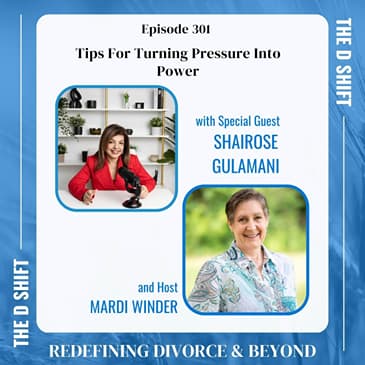
Pressure is part of life, and during major transitions like divorce, it can feel relentless. But what if the goal isn't to eliminate pressure, but to change how you respond to it?
Strategic Divorce Consultant Mardi Winder talks with Leadership Coach, Resilience Strategist, and International Speaker Shairose Gulamani about turning pressure into a source of strength. They explore why constantly pushing harder isn't sustainable, how pausing can lead to better decisions, and why resilience is built through learning to trust yourself during difficult moments.
Shairose also shares why calm can be a powerful advantage, the importance of support and community, and how focusing on the next best step can make even an overwhelming situation feel more manageable.
Q: Can we eliminate pressure from our lives?
A: Probably not, and that shouldn't necessarily be the goal. Pressure is inevitable. What matters is developing the ability to recognize it, regulate yourself, and choose how you respond.
Q: What can I do when a situation feels overwhelming?
A: Pause and focus on the next best step rather than trying to solve the entire problem at once. Breaking challenges into smaller pieces can reduce the sense of overwhelm.
Q: Why is calm so important when we're under pressure?
A: Calm allows us to move from reacting to responding. When we give ourselves time to regulate and think, we're more likely to make decisions that serve us and the people around us.
Q: How do we build resilience?
A: Resilience develops through experience. Each time we move through a difficult situation, we have an opportunity to build greater self-trust and recognize our capacity to handle future challenges.
Q: Do we need to handle difficult situations on our own?
A: No. Support and community are important parts of resilience. Asking for help doesn't diminish our strength or capability, especially during high-pressure periods of life.
About the Guest:
Shairose Gulamani is an award-winning executive coach , international speaker, and resilience strategist who helps high-performing leaders transform pressure into power. Drawing on decades of experience building businesses, leading teams, and developing people, she equips executives and entrepreneurs with practical tools to increase clarity, expand capacity, and sustain peak performance without burnout.
Her work addresses one of today’s greatest leadership challenges: navigating relentless pressure while maintaining impact, resilience, and connection. Through coaching, speaking, and transformative programs, Shairose helps leaders unlock their next level of influence, effectiveness, and fulfillment. Her mission is simple: to help people lead with greater purpose, perform with greater confidence, and create meaningful success that lasts.
To connect with Shairose:
Website: www.pressurepoint.coach
LinkedIn: linkedin.com/in/shairosegulamani
Instagram: instagram.com/calmisthenewflex
About the Host
Mardi Winder is a Strategic Divorce Consultant and High-Conflict Divorce Coach who helps high-achieving individuals navigate divorce with clarity, confidence, and control. Drawing on more than 30 years of experience in mediation, divorce coaching and conflict resolution, she supports clients in making smart decisions while reducing emotional and financial fallout, particularly in high-conflict, high-asset and complex divorces. Mardi is the founder of Positive Communication Systems, LLC, and the Strategic Divorce Directory, LLC.
For Mardi’s gift: The Resilience Building Blueprint: A 28-Day Journey To A Stronger You https://www.divorcecoach4women.com/rbb
Connect with Mardi on Social Media:
Facebook - https://www.facebook.com/Divorcecoach4women
LinkedIn: https://www.linkedin.com/in/mardiwinder/
Instagram: https://www.instagram.com/divorcecoach4women/
YouTube: https://www.youtube.com/@divorcecoach4women
Thanks for Listening!
Thanks so much for listening to our podcast! If you enjoyed this episode and think that others could benefit from listening, please share it using the social media buttons on this page.
Do you have feedback or questions about this episode? Leave a comment in the section below!
Subscribe to the Podcast
If you would like to get automatic updates of new podcast episodes, you can subscribe to the podcast on Apple Podcasts. You can also subscribe in your favorite podcast app.
Leave an Apple Podcast Review
Ratings and reviews from our listeners are extremely valuable to us and greatly appreciated. They help our podcast rank higher on Apple Podcasts, which exposes our show to more awesome listeners like you. If you have a minute, please leave an honest review on Apple Podcasts.
[00:00:04] Welcome to the D Shift Podcast, where we provide inspiration, motivation, and education to help you transition from the challenges of divorce to discover the freedom and ability to live life on your own terms. Are you ready? Let's get this shift started. Hello and welcome to the D Shift Podcast.
[00:00:26] And today we're going to talk all about how to utilize pressure that happens in life and create something powerful out of it. And I have a guest today who I absolutely, I just love her to death. She's a fantastic person. She is, she's like an award-winning coach. She's a speaker. She's a strategist. She works and helps people with resilience.
[00:00:53] But her focus is really on turning, transforming pressure into power. And I want to introduce you to Shai Rose Goulamani. And she, like I said, she's just an absolute gift to anybody who gets to work with her as a coach. So Shai Rose, welcome. Oh, Mardi, thank you so much for those kind words. You were awesome yourself. And I'm so happy to be here. Thank you for having me. Well, and what I really, well, and you're very welcome.
[00:01:22] I'm honored to have you on the podcast. And I think one of the things that you really bring to our conversation is that this idea of leaders, leaders are doing things that make them really effective leaders. And those things can transform or transfer into everyday life as well. They're not just for people sitting like in the C-suite of some big, huge company.
[00:01:48] And you have international experience working around the globe, literally around the globe with various organizations in different countries. And you have a really clear insight into how to use leadership strategies that are super effective in all areas of your life. So let's talk a little bit about you for a minute, Shai Rose. Tell the audience, because I know a little bit about you.
[00:02:18] We've done a YouTube together. We've done a few things. Tell everybody who's listening a little bit about yourself so they have a better understanding of where you're coming from. Sure. Thanks, Mardi. My name is Shai Rose Goulamani, and I'm a leadership coach and a resilient strategist, also an international speaker.
[00:02:38] And I help leaders discover that pressure does not need to break them, that it can reveal their leadership skills. It's an opportunity for them to find that inner capacity that all of us have. We all have it. We just need to become aware of when pressure hits us and then decide what we're going to do with it. How are we going to respond to that?
[00:03:05] And that key of how we choose to respond is the work that I do to allow them to find that mind shift so that pressure starts working for them instead of against them. So I work with high performers. I work with executives. I work with anybody who has pressure. As you said, pressure is not something just that leaders get or CEOs get. In fact, we are the CEOs of our own lives.
[00:03:34] And so we all have it. And so that's the work I do. And you know what I find, what I really find refreshing about your approach is it's not, you know, there's some magic technique or tool that you can use that will just eliminate pressure out of your life. And I think that's so unrealistic when people say, well, you know, if they're going to say through divorce, if I just get through the divorce, everything's going to be better.
[00:04:02] Well, it's, you know, it's going to probably be a little bit better, but it's your pressure is not all going to go away. There's lots of things you have to do now. In addition to dealing with all the leftover stuff from the divorce, you've also got a whole new life to get started on. So there's going to be pressure no matter where you are in life and no matter what you do in life. Absolutely.
[00:04:25] You know, as I always say to my clients and in talks that I've given, the pressure is inevitable, but suffering is not, right? Pressure is part of leadership. Pressure is part of life. And with it comes the responsibility, the growth, the visibility and making decisions that not only impact us, but they impact people around us, right? Our loved ones, our colleagues, our families, our friends.
[00:04:53] We cannot be in pressure and think it's just in isolation because it's not, right? Nor can we eliminate pressure and nor should we try because it is inevitable. And the question isn't whether we will experience pressure because we will. The question is, how do we choose to respond to it?
[00:05:17] And I think that is where a lot of leaders that I have worked with and what I have found is that they mistake pushing harder for leading better. But that's not it. Just because you stay in constant state of activation or constant stress, that they believe that success requires that relentless effort. But I'm here to tell you it doesn't, right?
[00:05:44] That over time, if you keep staying in that relentless effort and then that constant state of pressure, it's going to be unsustainable. And your leadership performance is going to suffer. Your health is going to suffer. Your relationships are going to suffer because pressure is going to leak into all those parts of your life. And that's not what we want. The leaders who thrive are not the ones with the least pressure.
[00:06:10] They're just the ones who have developed the inner capacity to navigate that pressure so that they can think clearly under stress. They can recover more quickly. They can make those decisions that are going to move them forward and the ones that they're leading. Yeah. And so I love this message. And I tell my clients that that whole idea of you can be a victim in your life or you can be a leader in your life.
[00:06:39] And it's entirely your choice. And whatever you choose is what you're going to be. And I have seen people who have gone through horrific experiences, you know, men and women who have literally gone through things that, you know, we're not even aware. I got a fly buzzing around here. Sorry. We're not even aware of the challenges that they've had in life. And when you see them, you don't even, I mean, there's no hint of, oh, poor me.
[00:07:09] Or why is this being done to me? Or why is everything always going wrong in my life? They kind of look for the lessons that they were supposed to learn out of that. And then they move forward. What are your thoughts on that whole idea of, and I love that suffering is optional. Why do we, and I've done it before in the past. I'm guilty of it too, where I've sat there and gone, oh, poor me. Why is this happening to me? Why does everybody else get this? And I'm stuck with this. We all do it.
[00:07:38] Why are some people able to just naturally navigate that better than others? Yeah. And you're so right. We all do it. And it's okay. That's not a sign of failure. That's not saying that you have shortcomings. Those are all human qualities, right? When we find ourselves with a struggle that feels really heavy or really overwhelming, it's natural for us to say, oh my gosh, why is this happening to me? What have I done? Or why am I deserving this?
[00:08:08] Or however we want to look at it. But, you know, pressure can become one of our greatest teachers. When we learn to work with it rather than have it work for us than against us, pressure shifts from something we simply endure into something that strengthens our judgment, right? Our inner capacity, our way of thinking.
[00:08:33] And it also helps us see growth or get growth in parts that we never knew that we were capable of. A lot of time pressure tests us and we learn that we are bigger than what is presented to us. We are more than what pressure is giving us. And that lesson is really empowering because we find our inner strength and our inner capacity
[00:09:00] to grow as a leader, as a human, as a parent, as whatever life throws at us. It allows us to be on the other side of it because we believe we have self-trust. We know this is going to be okay and that we're going to be able to get through this.
[00:09:22] It's that trust, I think, that we form over a multitude of experiences that we experience in our life. Multitude of challenges. That resilience that is built and repeated over and over again. We find that when the next time a pressure test comes, we look at it differently. We respond to it differently, right? We don't say this is doom, right? Or gloom.
[00:09:51] We look at it as, okay, here's another challenge. Right. I'm up for it. I don't know why this is happening, but I know I'm going to make it through. And just taking that in small steps, I think, makes a huge difference. Just one thing I'd like to add, and I see this a lot, and that is when a pressure test comes, initially it's overwhelming. Initially, it's overwhelming.
[00:10:17] But when we stop and we pause and we take a breath and we just regulate ourselves and settle ourselves, then we find that we don't have to think about the whole thing. Right. We just need to think about what's the next best step. And when we think of it in those small increments, that pressure loses its power. Right. Yes. Good reminder. Excellent reminder. I really appreciate that.
[00:10:46] And I also appreciate what you said about looking back, because we have all overcome big things in our life. My big things are different than your big things are different than somebody who's listening big things. It doesn't matter what everybody else has gone through. It's what you have gone through. And I think sometimes if we can just, particularly as women, I think sometimes we don't give ourselves enough credit for what we've already done. It's like, oh yeah, that happened, but that was 10 years ago or something.
[00:11:16] But it's an experience and it's a learning opportunity. And you've grown and you've got stronger and more resilient since then. And we just don't give ourselves enough credit for how we've handled these things in the past. Right. We don't recognize and value the capacity that we built. Right. For decades, success was determined by productivity. Right.
[00:11:43] How much you did, what the output was, and how fast you did it almost. Right. Today's leadership landscape is quite different. It's the real competitive advantage is not how quickly you can respond or how much longer you can work or how quickly you push through. It's more how calm are you, right? Like my Instagram is calm as the new flex.
[00:12:12] And that was by design. I wanted people to understand that calm is a new strength and it's a competitive advantage in this new leadership landscape. That when we build our inner capacity and we realize that we can ground ourselves and not lose ourselves to stress or to overwhelm or to pressure. That's when we find our superpower. Right.
[00:12:38] That's when pressure does transform into something more of a resource of strength. And so that capacity is the ability to lead well when demands are high. But it's only available if, like you said, through life experiences, we have practiced this.
[00:12:59] We have seen when we react, sometimes we say things or make decisions that don't serve us. But when we pause and we reflect and we take the time to decide what is the state I'm in and how am I going to choose the next best step.
[00:13:22] And when we're really intentional and thoughtful in that regard, then the choices we make and the decisions we use and the decisions we make are far better. And they serve us and the people around us because calm is contagious. Yeah, I love that.
[00:13:42] And do you find that people, thanks to this handy dandy little device, that people now feel compelled to give immediate answer? You know, especially, I think especially in our personal lives. Like if somebody texts us, we just, we expect they're going to respond like immediately. And we expect we have to respond immediately.
[00:14:06] And I think, you know, when you're looking at the big picture, whether it's personally or professionally, taking a moment and letting that grounding and calmness get ourselves so we can actually think through the responses rather than the reactions. It's a win-win for everybody. But there's this belief that we have to be instant with our answers now. Like everything has to be instantaneous. Do you find that?
[00:14:37] Oh, yes. We're supposed to be on all the time. We're not allowed to be off. You know, like literally and figuratively, right? We're not allowed to be off. And that's just not sustainable. That is not how we were created. We were not meant to always be on. We need to allow ourselves the time to rest and recover and recalibrate in moments where life is demanding.
[00:15:04] In fact, that is when we most need it. But it's funny because when those moments come, that is when we become reactive, irritable. We take the least time for ourselves. And we just, you know, we just think that this is a breaking point and we have to make the decision and we just have to respond. And that's just not true. True. There's no one holding a gun to your head when you're in a pressure test. Yeah.
[00:15:33] Only yourself, right? There's only yourself that's making this nervous system think that they're in utmost state of threat. But it doesn't need to be that way, right? And I think one of the ways, even though technology has made us so that the world has become smaller for us and that we have, we are so much more interconnected in ways that we never imagined.
[00:16:02] And it's still when leaders, what I find with leaders today is that they still feel isolated. The higher they rise, the less they feel connected. And the reason is that they feel like they have to handle the responsibility and carry the weight all by themselves. And that's just not true.
[00:16:29] Leadership needs community. It needs people that can support you, that you can lean on, that you can ask questions to, that you can share your vulnerabilities, your deepest fears, and know that it's going to be safe, that you're going to be heard, right? And you're going to be seen. But a lot of leaders don't know how to practice it.
[00:16:54] And I think the fear is that if they state it out loud of something that they're thinking, that somehow it weakens their authority. And it doesn't, right? It doesn't. Because even, I'm sure, your clients, Marty, right, that are going through a divorce, there must be times when they feel so alone. Yeah. Yeah. Right. And really, that strength and that resilience is not built in isolation.
[00:17:24] It is built with the companionship of others, with the community around us, right? We are not, we as humans are not meant to be alone. We are meant to be in community. We need that social interaction. We need to feel safe with others.
[00:17:43] And so I think that if we practiced that more of that and had our mind shift, know that when times get hard, it's okay to ask for support. Yeah. And so I've got a couple of things that came to mind when you were talking. I think this always on communication also becomes incredibly transactional rather than relationship building.
[00:18:08] So if you think of a time when you're under pressure, and I used to, so I'm going to get off track a little bit. But if you think about times when you're under pressure, typically it's a transaction, whether it's a, you know, yes, my kid can go to a sleepover or yes, buy that, you know, let's put in that million dollar bid on that, whatever. It's, it's, it's business and personal could still be very, very transactional, especially when you're going through a divorce. There's a lot of transactional communication that you do.
[00:18:37] As a matter of fact, that may be the only communication you have with your soon to be ex-partner. Um, and the second thing that, that really came to mind when you were talking is I used to be an executive and leadership coach and I worked with several, several, um, clients in, you know, fortune 500 companies. And one of the things I found with them is. The reason that they found coaching so beneficial is exactly what you said.
[00:19:02] It was somebody that was there to listen to them, not judge them, not tell them what to do to help them organize and clarify their thinking and to help them really have the time to reflect on what's going well. What do I want to change? How do I want to work on it?
[00:19:21] And almost everyone that I spoke to, the underlying fear was, I don't want my counterpart or my team or my, whoever I'm reporting to, to know that I don't have all the answers and I'm not really sure what the hell I'm doing right now. Like that was the big concern. Right. Right.
[00:19:40] And that's so true for us as just as human beings on planet earth, whether we're running a fortune 500 company or whether we're, um, you know, dealing with somebody at the bank that we don't get along with when we're trying to do transactions. It's so much the same thing. Absolutely. It's that fear we have of judgment, right? Of what, what are others going to think of us?
[00:20:05] So what is my team going to think if they think I'm, I honestly don't know what to do next. Right. And, and, and, you know, I had a, I had an experience with that in my own business, um, years ago when I was doing, um, leading a cafe and, um, our, our crepe master did not show up and, and we didn't know what to do. And the staff's all looking at me and I had basically two choices.
[00:20:32] And one was tell them that there were no crepes for that day or keep the continuity going and serve our customers to what, for what they were going to come in. So I ended up making crepes that day for the first time in my life. But it, but what, what, and the only reason I came to that decision is because I actually had to ground myself. I was also looping the decision in my mind saying, oh my God, what do I do now? What do I do now? What do I do now?
[00:20:59] And I knew that I was in a state of pressure. I recognized it. I was aware of it. And I knew that I had to now stay, you know, ground myself and decide. And I, and the decision I made is that I was going to be the calmest person in that cafe, no matter what happened next. And once I did that, my mind shift just switched, you know, and it, and empowered me to say, okay, put on that apron, get behind the grill and, um, and, and make, make crepes.
[00:21:28] And it, and it turned out and it worked out really well. But we find ourselves in those kinds of situations, small, big, medium, whatever, all the time. And I think where some of this lessons that I know the clients that I have worked with, how they have developed is they have learned to trust themselves.
[00:21:50] They have learned that their inner capacity, that inner voice that guides them when they really do reflect and ground themselves is powerful. Right. And that they have the answers and it doesn't need to be the perfect answer and it doesn't need to be the best answer. It's just the next step they can take to, and then the next one, and then the next one. But that's how resilience is built, right?
[00:22:18] That's how resilience takes pressure and lets it transform it into power. Yeah. It's only in those small increments. So I think that if we all just had a little more self-compassion for ourselves, some self-care, some self-trust for ourselves, and knew that the pressure that we feel is inevitable and it's natural.
[00:22:43] A lot of people think that they feel pressure because they have done something wrong, that they are not the leaders that they were meant to be. And that how come they see all other leaders, you know, managing so smoothly and so without any kind of bumps in the road. It's just not the case. Right.
[00:23:03] And so once we start trusting that this is not something that we have done to ourselves, it's something that we're finding ourselves in and that we have a choice on how we respond. And I think leaders sometimes forget when they are under pressure that they have a choice. When our nervous system believes it's an ultimate threat, we feel we have no choices and that reactions are the only way to lead. But it isn't. Right.
[00:23:32] And I think that's a really beautiful way to kind of summarize what we've talked about so far. And these conversations go by so fast. I cannot believe how quickly they go. So before I don't I don't want to miss saying this. You have kindly offered a gift for everybody that's listening. Can you tell us a little bit about your gift, Shai Rose Goulamani? Because it is such a valuable tool. Yeah.
[00:23:55] So on my website, www.pressurepoint.coach, and if you do slash assessment, there is an opportunity for anyone who is feeling pressure in their lives in whatever capacity, whether they are CEOs or executives leading teams or they're solo entrepreneurs or just high performers and they're feeling pressure.
[00:24:21] There is a pressure test that they can take that kind of identifies some of the areas where pressure may be costing your leadership and where what you might want to become aware of so that you are more cognizant of the areas in which you need to pay a little more attention to so that that pressure starts working for you instead of against you. Wonderful. And I'll make sure the link for that is in the show notes.
[00:24:48] I'm also going to put a link to the YouTube video that Shiroz and I did because it's got some different information. And if you're interested in finding out a little bit more, that's a simple quick and quick and simple way to do that. Now, before you get before we let you go, I've got a couple more more things to ask you. The first one is what's the one thing that you would like to leave in everybody's mind as they go on about their busy day?
[00:25:14] I think it's what I started with. That pressure is inevitable, but suffering is not. Suffering is optional. And once we decide that we can deal with the pressure and that we have the capacity to regulate ourselves, to let pressure reveal the leaders we are, then pressure is not something that we fear anymore.
[00:25:43] And once we understand that, our nervous system, every single time that we come across a challenge, doesn't go automatically into threat mode. It says, oh, here's another thing that we need to get through. And it allows us to regulate ourselves a lot quicker and recover through that overwhelm so that we can go on and become the great leaders that we're meant to be. Love that message.
[00:26:12] Shai Rose, if people want to find out more, I know you've given us your website, but I'd like you to do it again. If people want to find out more about what you do or maybe reach out and work with you, what's the best way to do that? Yeah, I think the best way would be just to go to my website at www.pressurepoint.coach. Or you're always welcome to connect with me on LinkedIn. I love people who interact there. And I do reply to every single comment and message that's there. Wonderful.
[00:26:41] And LinkedIn is actually a great platform. I quite enjoy it. But there's lots of other good platforms out there, too. I just happen to really enjoy LinkedIn. So, Shai Rose, thank you so much for being here today. And I always love talking to you because somehow I just feel calmer. Even just having this conversation, I feel calm. It's less pressure, more resilient, ready to take on the day. Shai Rose, thank you so much for being here. You are so welcome. Thank you, Marty. And I apologize for that phone. Oh, don't worry about it.
[00:27:11] Usually my dogs are barking in the background, so don't worry about it. And thank you, everyone, for listening in to this episode of The D Shift. And don't forget to tune in to the next one. Thanks for listening and supporting The D-Shift Podcast. If you would like to attend live trainings by our amazing guests and have a chance to ask questions and get answers from our experts, join The D-Shift Crew. For more details and to sign up, head on over to www.divorcecoachforwomen
[00:27:40] and click on the podcast page.