
The divorce process ends the marriage, but when you have children together, it does not end your relationship with your former spouse. Instead, you are faced with the challenge of creating an entirely different relationship as co-parents.
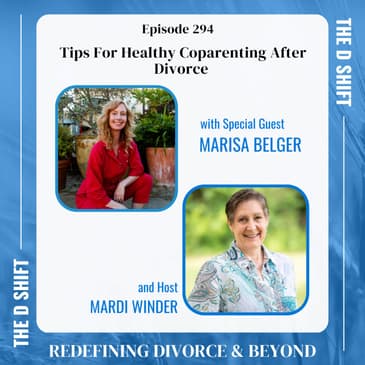
In this episode, Strategic Divorce Consultant Mardi Winder talks with Certified Professional Coach Marisa Belger about what it takes to build a healthy co-parenting relationship after divorce. Marisa brings both professional and personal experience to the conversation, having created a successful co-parenting dynamic involving her children, their fathers, and new partners.
Mardi and Marisa discuss why trust is such an important part of co-parenting and why that trust has to be built slowly over time. They explore the importance of communication, flexibility, and giving the other parent some grace when things do not go exactly according to plan. They also talk about recognizing that someone who may not have been the right spouse for you can still be a loving, capable parent to your children.
The conversation also looks at the personal growth that can come from divorce and co-parenting. Learning to separate your own hurt, expectations, and emotions from what is actually happening with your children can be difficult, but it can also help you become more intentional about how you respond and the kind of relationship you want to create moving forward.
Questions we cover:
Can you start preparing for co-parenting before the divorce is final?
Yes. Conversations about expectations, communication, boundaries, and what matters most to each parent can begin early and help establish the foundation for the new parenting relationship.
Does successful co-parenting mean agreeing on everything?
No. Each parent may have a different parenting style. The goal is not to control how the other parent does everything, but to recognize what truly matters and distinguish those issues from differences that may simply require flexibility.
Why is trust so important after divorce?
Co-parenting requires both parents to rely on one another in an entirely new way. That kind of trust does not automatically carry over from the marriage and often has to be rebuilt gradually.
How do you keep old marital conflict from taking over the co-parenting relationship?
It requires recognizing that the marriage and the parenting partnership are two different relationships. Old roles, resentments, and patterns may need to be intentionally dismantled so something new can take their place.
What can children learn from watching their parents navigate divorce?
Children can see that difficult emotions and major life transitions can be handled without pretending everything is fine or allowing those emotions to overwhelm the family. Parents have an opportunity to model resilience, emotional awareness, and the ability to move through difficult change.
About the Guest:
Marisa Belger is a certified professional coach who supports mothers through divorce and co-parenting. She believes divorce with kids isn't a failure or a detour from your growth. It's the most rigorous personal development curriculum a modern woman can be handed, custom-designed for exactly who she needs to become. Marisa helps high-achieving mothers stop trying to put the old pieces back together and instead get built by the experience, drawing on somatic work, nervous-system science, and contemplative traditions.
She coaches women at every stage, from contemplating separation to years deep into a dynamic that isn't working. She also co-parents teenagers across a blended family of six, and knows this terrain from the inside. She is co-author of the bestselling The First Forty Days, with 18+ years writing about women's wellness. You can learn more about Marisa at marisabelger.com. Marisa offers customized 1:1 coaching packages, workshops, and retreats.
For Marisa’s gift: https://www.marisabelger.com/stop-the-spin
To connect with Marisa:
Linkedin: linkedin.com/in/marisabelger/
Website: marisabelger.com
IG: @marisabelger
About the Host
Mardi Winder is a Strategic Divorce Consultant and High-Conflict Divorce Coach who helps high-achieving individuals navigate divorce with clarity, confidence, and control. Drawing on more than 30 years of experience in mediation, divorce coaching and conflict resolution, she supports clients in making smart decisions while reducing emotional and financial fallout, particularly in high-conflict, high-asset and complex divorces. Mardi is the founder of Positive Communication Systems, LLC, and the Strategic Divorce Directory, LLC.
For Mardi’s gift: The Resilience Building Blueprint: A 28-Day Journey To A Stronger You https://www.divorcecoach4women.com/rbb
Connect with Mardi on Social Media:
Facebook - https://www.facebook.com/Divorcecoach4women
LinkedIn: https://www.linkedin.com/in/mardiwinder/
Instagram: https://www.instagram.com/divorcecoach4women/
YouTube: https://www.youtube.com/@divorcecoach4women
Thanks for Listening!
Thanks so much for listening to our podcast! If you enjoyed this episode and think that others could benefit from listening, please share it using the social media buttons on this page.
Do you have feedback or questions about this episode? Leave a comment in the section below!
Subscribe to the Podcast
If you would like to get automatic updates of new podcast episodes, you can subscribe to the podcast on Apple Podcasts. You can also subscribe in your favorite podcast app.
Leave an Apple Podcast Review
Ratings and reviews from our listeners are extremely valuable to us and greatly appreciated. They help our podcast rank higher on Apple Podcasts, which exposes our show to more awesome listeners like you. If you have a minute, please leave an honest review on Apple Podcasts.
[00:00:04] Welcome to the The D Shift, where we provide inspiration, motivation, and education to help you transition from the challenges of divorce to discover the freedom and ability to live life on your own terms. Are you ready? Let's get this shift started. Hello and welcome to the D Shift Podcast.
[00:00:26] And today we are going to talk all about one of the most important things you're going to do post-divorce, and that is how do you co-parent well? I have an expert on today with me, Marissa Belger. She is a certified professional coach, and she works exclusively supporting mothers through divorce and co-parenting.
[00:00:48] And she believes divorce with kids is not a failure or a detour from your growth, but it is a personal development opportunity and curriculum that can really be helpful for women to help them evolve post-divorce to become the person they are destined to become. So Marissa is also an author and a frequent contributor to publications on women's wellness issues.
[00:01:13] She also has a book out that I want to make sure that we have a chance to talk about because I always like supporting authors on this. So Marissa, welcome. Thank you so much for having me. I'm so excited to be here. Well, I am so excited to have you. As we were chatting a little bit before we started recording, I think that the idea of co-parenting is so essential.
[00:01:38] And some mindset shifts that you can do while you're going through the divorce can really help you set up a positive co-parenting relationship on the other side, if that is possible, given the dynamics of your marriage and divorce and what life is going to look like afterwards. Before we get into all that good stuff, though, tell us a little bit about yourself, Marissa, and why this is now your area of focus. Yes. Well, thank you so much for asking.
[00:02:08] So I became a coach after a career as a reporter, journalist. I was a nonfiction book author and all the work I was doing unexpectedly ended up being for women and for mothers, really supporting women and mothers through different transitions in their lives, including motherhood and postpartum challenges, things like that. And I started to just pay attention like we do, kind of getting into my own midlife.
[00:02:37] Like what's next next in my in what I want to give back to the world. And I realized that I really wanted to start working directly with the women that I had been writing for all these years. And so I realized that I could support them in a coaching capacity. And then right on top of that, very quickly, I saw that my special sauce or my my area of expertise, my 10,000 hours comes from as born from my own experience in a very complex co-parenting dynamic.
[00:03:06] So I am raising my two children with two different fathers and we are all raising our kids with our respective partners in a in a peaceful and harmonious co-parenting dynamic that, in honesty, was hard earned. So the wisdom from that is what creates the foundation of my coaching practice.
[00:03:29] Yes. And congratulations and celebrating you and the kids fathers and new partners and everybody for being able to work collaboratively to do that. Because I tell my clients, if you thought the marriage was hard, wait till you get to the co-parenting part, because there's a whole different dynamic that can come in there. Right. Absolutely. Absolutely. That's a very wise observation. Yes.
[00:03:53] Well, and there are so just to clarify there, because I know we've talked about this on the podcast and not everybody listens to every podcast. I got that. We are talking about co-parenting today. So not parallel parenting where the parents kind of have an agreement and they they run kind of on separate tracks of a railway, but they never actually connect or communicate other than through very strict set up plans and methods.
[00:04:20] Co-parenting is really where everybody is actively involved in the child's lives or the children's lives. And there's a lot of communication. There's a lot of collaboration. And I'm guessing there's a lot of flexibility and patience and really pre-planning what's going to happen for your kids. So tell us a little bit about this.
[00:04:41] Yes, you have you have hit all of it and the most complex Google calendar situation I think you've ever seen, balancing all the different needs of the children and the respective micro families that are inside the greater ecosystem of our co-parenting unit. So, yeah, so we we have been raising our kids actively together, which means exactly what you're what you're sharing here.
[00:05:09] We are all equally involved, especially the core parents. So myself and the two biological fathers, we are actively involved in the raising of our kids, which means everything from legal, logistical, circumstantial, emotional, academic, all of the aspects of raising a child. We are we are actively parenting together. And then the step parents have a very prominent and thoughtful role as well.
[00:05:38] That's different. Yeah. Yeah. And I think that this is a really important distinction. And I encourage the people I work with to start out with that, that the biological parents stay. Kind of the captains of the ship and the the new partners are sort of the first mates in the deckhands and everybody else until until that that relationship is built with the kids in that new person,
[00:06:06] but also with the other parent and that person, because there's I'm guessing there's a lot of trust that has to be built up before you can have a healthy dynamic in this. Yes. I'm so happy that you brought up the word trust because trust and I always throw up a little capital T trust with a capital T big, robust trust.
[00:06:28] The kind of trust that has to be earned and that takes time is a fundamental element of of everything that's going on in this co-parenting dynamic. First, actually with the biological parents. So trust had to be. And you had mentioned something like this, right? Like co-parenting. You thought the divorce was hard or the end of the marriage was hard. Co-parenting with somebody that you have decided you actually can't be in a romantic life partnership under the same roof.
[00:06:56] Now you have to figure out how to raise your child with that person. It's an entirely new situation with a whole new set of structures and a new paradigm and trust is woven through all of it. And then when you bring in additional adults into the system, so in this case, step parents, they, too, have to be part of that slow, slow burn of trust being built.
[00:07:20] Right. Yeah. And I think it's really important for the kids, too, because it you know, it's hard for kids sometimes, depending on their age, when you go when the marriage ends and now you're entering the co-parenting phase of life. It's hard for kids to just accept a new adult as another person in their biological parents life. Sometimes there's jealousy. Sometimes there's anger. Even sometimes there's a little bit of fear about that new person and what they're going to do and everything.
[00:07:50] Let's step back a little bit from even that. And let's talk about when you're going through the divorce. Let's say you're in the in the stage where you're talking about it. You haven't necessarily got all the legal stuff in place or anything, but you're you're talking about it as parents and how you want your relationship and your and the other parents relationship with the kids to be.
[00:08:12] How do you start those conversations and what do you find works particularly well in in setting it up so that there is this sense of, OK, we're going to trust each other moving forward? Yes. So very, very important. And you're speaking specifically about bringing in the additional step parent. When you're I'm even thinking of before that, Marissa, like let's say when you're just going when you're just talking about the divorce between each other.
[00:08:40] Nobody's moved on yet. We're still you know, you're still kind of in that. Should we divorce? Should we not divorce? And then, OK, we've made the decision. This is what we want to do. How do we start as as as people now in that divorce phase? How do we start thinking about our kids and what that co-parenting relationship needs to look like?
[00:08:59] Yes. So I love that question. And you had already started to answer it by saying that it seems as if a dynamic that the one that I'm in and that maybe other people would be into requires an incredible amount of communication. So we're going to we'll start there by saying that there's an expression. I'm not sure what expert or wise one said it, but something like the conversation is the relationship.
[00:09:24] So understanding that there is going to be an incredible amount of courageous, open hearted, risk taking conversations. And the risk is being brave enough to to state and express how you really feel.
[00:09:39] So if how you really feel is that you're uncomfortable with a new person coming into your child's life before and you get to decide what feels right to you before meeting them or before a certain amount of time. And we know that that dating new people often can be part of someone's custody, a divorce couple's custody plan. Often it's written out sort of the rules and regulations around that.
[00:10:07] So so being able to communicate that clearly and then and then checking in along the way. Is this working? Does this feel OK? It doesn't feel OK. Let me tell you why. Yeah. And I think the other one that's nice is if people can enter into those agreements and have those conversations, whether they do it between themselves or whether they go to a mediator or whether they go through an attorney, go through the mediator if you can.
[00:10:33] It's a lot cheaper. But I think it's important to to not then kind of be laying in wait for the other person to do one thing wrong and then jumping on them. Like I see so many people. But our co-parenting plan says this. And if it's just one of those minor little things, I think you have to let it slide. But then come back and have that conversation about, hey, when this happened, this is what I experienced.
[00:11:03] Yes. Yes. One hundred percent. So what you're touching on here from from where I sit and what I experienced with my clients and in my own life is is offering that kind of generosity. And in that generosity really is a recognition of the other of the other's humanity. It might sound so simple and basic.
[00:11:23] And to be able to build something that feels supportive, that that that's based on trust, it's important to be able to recognize your co-parents humanity. And part of humanity is being imperfect. Right. Yeah. And being able to recognize, OK, when is that just an imperfection that I can let slide? Or did it touch upon a non-negotiable in me, something that just doesn't feel OK and being able to bring that to the table?
[00:11:52] So in your when you're working with your clients, how do you advise them or do you advise them about anything about that kind of language in a co-parenting plan? Or is that is that something that you work with your clients on so that they're comfortable with what that might look like? Yes, one hundred percent. So I work with my clients to define the work I do with clients.
[00:12:15] I really say I'm I'm working with her to help her connect to what's most true for her, because it's hard to it's actually impossible to ask for something in a co-parenting dynamic or in a legal document if you don't even know what that is. And so often, right, coming out of the spin of chaos and pain of the end of a marriage that's not working, you really can lose yourself.
[00:12:40] So it's really a process in our work of like, wait a minute. Wait, here I am. Oh, this is what actually matters to me. So this is what this is what I need to feel secure as a parent, to feel secure as a human being in this dynamic. And now I'm able to express it because I understand what it is. Right. Yes. And I think that's so important. Yeah. So important.
[00:13:02] And I think the other thing that I would kind of tag along with you on that one is that if the other parent has always been an active participant in the child's life, has always been a healthy, loving, kind parent that has put their child, if not first, definitely at the very top of their mind when they're doing things, expect that to continue. They're not going to suddenly start doing weird stuff just because they're or you hope they don't.
[00:13:33] And you can obviously be be aware of that. But I think we have to give people the grace that they're going to continue to be the great parent, even if maybe they weren't the great spouse for us. They can still be the great parent if that's been their history with the child or the children. Yes. And exactly. And so it's so funny you say grace because the word grace was just coming into my mind so much. And then you said it. And that's part of this.
[00:14:00] This I'm using the word generosity. And I really think I really believe and stand by that in a healthy and active co-parenting dynamic, there is a lot of generosity. And part of that generosity is being able to take yourself sometimes, if not entirely out of the equation, to just tip back a little bit to allow your child to become centered. Right. And in centering your kiddo, you'll be able to see, oh, yes, exactly.
[00:14:28] This this other parent really has been there and really is there, might not be there in the way that I would be there. It's a different flavor and a different style. And can I stretch to make room for them to parent the way they're a parent, for them to love the way they love? Right. Yes. Yes. And I know one of the things that you talk about, and I'm really excited to talk about this a little bit,
[00:14:54] is the whole idea of using your divorce as a personal development curriculum. I know we've touched a little bit on this, I think, but can you just expand upon that? Because I, I too believe this is an opportunity for self-reflection and growth and kind of redesigning how you want the next half of your, the next part of your life to, to look. So take it away, Marissa. Yes, I love it. I get so excited to speak about this concept.
[00:15:24] And what, what you, the last question you're asking really is, is can you, you know, are, can you find it within yourself to see the goodness basically to see the good intention in your other parent? So that type of inner exploration and sort of inner discovery, do I have what it takes to put my child first? Can I pull back a little bit with my ego? I call that, that's an advanced curriculum.
[00:15:51] I joke around my clients. I'm like, you are in a PhD level course of inner exploration and discovery and of personal responsibility, being able to discern, okay, what's my, what's my hurt? What's my wounding? What are my feelings? And what is actually about how we're parenting this child? That discernment is not, it's not for the faint of heart and it takes practice.
[00:16:21] It takes cultivation, just like going to the gym, strengthening muscles. These are inner muscles of, of a psychological and emotional knowing. Yeah. Yeah. And I think the opportunity, instead of seeing this as it's a failure, there's something wrong with me, I'm not good enough. Like women still get a lot of that message from, um, the culture, from depending on where you are, sometimes from your religion, sometimes from
[00:16:48] your family, sometimes from your, um, you know, your cultural background. Women can bear a lot of you fail to keep the family together. There's something wrong with you. Um, and I think men get it too. I'm speaking as a woman. So that's, that's where I'm, that's where I'm coming from. But that can be incredibly hard when you're going through this huge life transition, you are going to be, um, having to navigate this co-parenting role. And you're still carrying a lot of that stuff, that baggage,
[00:17:16] that emotional baggage forward. So, so much so. And it's, it's shocking to me sometimes how in 2026, right, all across the country, big cities, small cities, women are still feeling, and I know it because I felt it, the psychological, I mean, excuse me, the societal judgment that can come down because you're choosing a path that still isn't the norm. And even if you have people that
[00:17:43] are on your side, that are on your team, there are still those, they could be your parents, right? Even your friends, colleagues, teachers at your kid's school, parents at your kid's school that give you that little sense of, you're doing something that maybe isn't the best. Right. So, you know what it takes? I, and this is what it comes down to too. It takes courage. It takes courage and, and strength to stand by what's true for you. And what's true for you here
[00:18:11] is that that marriage was not working. Right. Right. And you are not the best person you could be inside of that marriage. Yeah. It's, it's bold. Yeah. And it's also, you know, the, yeah, I'm a bit of a science geeky person. The research is really clear that kids living in that, in a household where there is that emotional distancing, where there is that maybe passive aggressive
[00:18:37] behavior between parents, there, there is a long-term psychological issue that those children have a higher risk of facing because of that dynamic in the family. Whereas, you know, and I forget who said this one, and I love this quote, it's better for kids to live in two households with sunshine than one household of darkness. And I just, that vision to me just sums up the whole, the whole thing. And what you're talking about is your kids are living in multiple households of sunshine. And that just
[00:19:05] sounds fantastic. Hmm. Yeah. Thank you. I love that. I love that idea of the two houses. Um, uh, I will say before the sunshine though, in the new house, it may be cloudy as you, as you adjust. And that cloudiness is also an opportunity to invite your children into your experience in a way that's developmentally appropriate. Basically you get a chance to model for your kids. You know what?
[00:19:34] This does hurt and it, and it is hard and I'm going to be okay. And we're going to be okay. I'm going to feel these feelings and some of them are sad and we're going to be okay. To me, that is a radical opportunity to teach kids how to work with big emotions. Yeah. And how to go through transition successfully, because let's face it, things are going to happen in our lives. We're going to have
[00:19:59] losses of loved ones. We're going to have all kinds of things happen. And if kids have a parent, can see parents go through these things and handle it well and respect their emotions, not stuff them down, pretend they're not happening, not overwhelm the kids with them either. But I think that's such a healthy thing. And Marissa, I think this is the perfect time to talk about this. You have a gift for the audience. Can you tell us a little bit about your gift? Because I think this ties in perfectly.
[00:20:26] Oh, yes. So I've created basically a little guide called Stop the Spin with the understanding that so much of that heat and that overwhelm that can arise in the complexity and challenge of co-parenting, if we don't give ourselves space and don't practice strengthening the tools to work with those big feelings, we may react instead of respond. I'm sure we've all heard that, right? We react
[00:20:55] rather than respond. We may say something we regret. We may damage a delicate, it's almost like the co-parenting relationship is a little sprout that's growing in a new garden and it can be damaged. It could be stepped on or it can be given water and sunlight. So if we take time to learn how to work with big emotions, we'll be given, we give ourselves more capacity to show up in hard situations. And
[00:21:23] there will be hard situations in co-parenting. So that's what the guide is basically about, a step-by-step process in working with that overwhelm that can arise. Great gift. Thank you so much. That's really generous. And it's, I love these practical tips and techniques and tools that people can get and keep them. I mean, it's, you get to keep it and now you get to use it and you can probably teach your kids how to use it and deal with all of this kind of stuff when things are coming up. So Marissa, we could probably talk for the rest of the day,
[00:21:52] I have a feeling, but we're just about out of time. What is the one big takeaway or the golden nugget of wisdom you want to leave with, with anybody who might be listening to this podcast? Yes. Well, there's so many nuggets and the number one, that's the number one sort of teaching that I really offer my clients that was again, born from my own life is that a peaceful, harmonious
[00:22:21] co-parenting dynamic is something that takes time. And it also requires the dismantling of the old paradigms of the relationship, which means that all that toxicity from the end of the marriage and all of those roles that you were playing really need to, I'm, I try not to use the metaphor, like burn down to the ground, but they do really need to be dismantled before something new can be
[00:22:45] built upon it. Because the co-parenting dynamic that you're creating is truly a new shape of family. And it needs to start from a foundation that's fresh and that's new. That, that is a really, I love metaphors because for me, I'm a visual, I guess I'm more of a visual person. But to me, that just makes a lot of sense that you, you can't carry all the crap from your relationship into a co-parenting relationship and expect it to flourish. You've got to start
[00:23:15] clean slate as much as humanly possible. Now, last question, Marissa, where can people find out more about what you do or reach out if they want to work with you? Yes. Well, thank you so much. The best way is on my website, which is just my name. So it's Marissa, M-A-R-I-S-A-B-E-L-G-E-R. So marissabelger.com. You can find out lots about my work. There's links to
[00:23:42] connect. I'm always happy to have a conversation with anybody who's interested in learning more about this work. Thank you. And we, I forgot to ask you this. So I want to get this in. You wrote a book that I think is a fascinating, a fascinating book. Can you just tell us the title and a little bit about the book? I know it's, it's a little off the divorce topic, but I think it's a really cool idea. So tell us a little about that. Are you speaking about the first 40 days? Yes. Okay. Yes. Oh,
[00:24:08] thank you for asking. Yes. And this, that's a great example of where I, the work I've done before coaching, which does, does influence my coaching. So it's called the first 40 days, The Essential Art of Nourishing the New Mother. And I am a co-author on it with two other women and mothers. And it actually has become like a bestseller in its category. I say that humbly
[00:24:28] with joy that we were part of the first conversation in the U S that was offering targeted care to the new mother after the birth of her baby. So until then it'd really been, okay, you have a baby. Now it's all about the baby. Is the baby sleeping? Is the baby eating? And there was no attention turned towards the unbelievable grand identity shift that she had just gone through and the psychological
[00:24:55] and physiological changes, the gateway that she had just walked through going from not being a mother to being a mother or becoming a mother again. So that book is all about holding her very strategically and thoughtfully in that transitional period. And, and a lot of people, you know, if you've got young kids, you, you have friends who are having babies or expecting. And so I just thought this would be a
[00:25:19] fantastic gift or just like, like a little baby shower gift, even to give, uh, to the mom in addition to whatever you're giving for the baby as well. So yeah, it's just fantastic. Thank you so much. It is a great, it's a great shower gift. I will say because it's actually for the mother. Yes. Yeah. Yeah. Marissa, thank you so much for being here and for sharing all your wisdom. I've lots of practical information about how to successfully co-parent. Thank you so much,
[00:25:47] Mardi. It's been great. Thank you everybody for listening into this episode of the D-Shift and don't forget to tune in to the next one. Thanks for listening and supporting the D-Shift podcast. If you would like to attend live trainings by our amazing guests and have a chance to ask questions and get answers from our experts, join the D-Shift crew. For more details and to sign up, head on over to www.divorcecoachforwomen and click on the podcast page.