
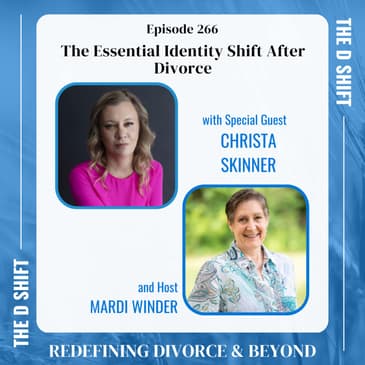
Divorce is often viewed as an ending, but what if it could become a life-changing, very positive beginning?
Today on The D Shift, Mardi Winder sits down with divorce coach Christa Skinner to discuss how divorce can become a powerful catalyst for personal growth, self-discovery, and transformation. Sharing her own experience of navigating an unexpected divorce after more than three decades together, Christa talks about how she turned one of life's most difficult transitions into an opportunity to create a more authentic and fulfilling life.
Together, Mardi and Christa explore the emotional challenges many women face during divorce, including the loss of identity, family expectations, self-trust, and the fear of starting over. They also discuss the critical role divorce coaching can play in helping individuals make informed decisions, avoid costly mistakes, and move forward with greater confidence and clarity.
Whether you are contemplating divorce, currently navigating the process, or rebuilding your life afterward, this conversation offers hope, encouragement, and practical insight into creating a meaningful next chapter.
In this episode we discuss:
• What makes divorce coaching different from traditional life coaching
• Why many women struggle with identity loss during and after divorce
• The impact of family expectations, judgment, and societal pressures
• How to rebuild self-trust after a relationship ends
• Why healing and self-discovery are essential parts of the divorce journey
• How to move from surviving to thriving after divorce
About the Guest:
Christa Skinner is a certified health, life, and Canadian-trained breakup and divorce coach who guides women through midlife identity shifts and life transitions with clarity, confidence, and grounded strength. After meeting her former husband at twelve, marrying young, and raising three daughters, Christa faced an unexpected divorce following 22 years of marriage — an experience that left her depleted but ultimately became the catalyst for profound reinvention.
Determined to provide the support she once searched for, she trained through the Health Coach Institute and under Sara Davison, the world’s leading divorce coach. She is a member of the International Divorce Coach Centre of Excellence (IDCCOE) and continues to deepen her expertise in high-conflict dynamics and collaborative resolution. A co-author of the bestselling book Emotional Alchemy and featured in national media, Christa’s forthcoming Fall 2026 book positions midlife not as breakdown, but as re-anchoring, power, and intentional becoming.
To connect with Christa:
Website: https://www.christaskinnercoaching.com/
Instagram:https://www.instagram.com/christaskinnerbecoming?igsh=c2FjY3Y0b3JoaWV4&utm_source=qr
LinkedIn: http://linkedin.com/in/christa-s-b323b03a5
About the Host
Mardi Winder is a Strategic Divorce Consultant and High-Conflict Divorce Coach who helps high-achieving individuals navigate divorce with clarity, confidence, and control. Drawing on more than 30 years of experience in mediation, divorce coaching and conflict resolution, she supports clients in making smart decisions while reducing emotional and financial fallout, particularly in high-conflict, high-asset and complex divorces. Mardi is the founder of Positive Communication Systems, LLC, and the Strategic Divorce Directory, LLC.
For Mardi’s gift: The Resilience Building Blueprint: A 28-Day Journey To A Stronger You https://www.divorcecoach4women.com/rbb
Connect with Mardi on Social Media:
Facebook - https://www.facebook.com/Divorcecoach4women
LinkedIn: https://www.linkedin.com/in/mardiwinderadams/
Instagram: https://www.instagram.com/divorcecoach4women/
YouTube: https://www.youtube.com/@divorcecoach4women
Thanks for Listening!
Thanks so much for listening to our podcast! If you enjoyed this episode and think that others could benefit from listening, please share it using the social media buttons on this page.
Do you have feedback or questions about this episode? Leave a comment in the section below!
Subscribe to the Podcast
If you would like to get automatic updates of new podcast episodes, you can subscribe to the podcast on Apple Podcasts. You can also subscribe in your favorite podcast app.
Leave an Apple Podcast Review
Ratings and reviews from our listeners are extremely valuable to us and greatly appreciated. They help our podcast rank higher on Apple Podcasts, which exposes our show to more awesome listeners like you. If you have a minute, please leave an honest review on Apple Podcasts.
[00:00:04] Welcome to The D Shift Podcast, where we provide inspiration, motivation, and education to help you transition from the challenges of divorce to discover the freedom and ability to live life on your own terms. Are you ready? Let's get this shift started. Hello and welcome to this episode of The D Shift Podcast.
[00:00:26] And today we are going to talk all about getting through divorce, changing, maybe using divorce as a real springboard to be able to change your presence, your perspective, your identity, and how to do that really strategically. So I am, we were just chatting before we got on the recording here.
[00:00:48] Krista and I, believe it or not, my guest, actually grew up in the same moderate-sized city in Alberta. And it was such a fluke. We just got introduced to each other a few months ago and found out that we had grown up all our lives not too far apart from each other. So it's funny how it's a small world. But I want to introduce you to Krista Skinner. She is a certified health, life, and Canadian-trained breakup and divorce coach.
[00:01:17] She's a member of the International Divorce Center of Excellence, co-author of the best-selling book, Emotional Alchemy. And she has a new book coming out, Fall of 2026, that we definitely need to chat a little bit about, Krista, and find out what that's going to be. So, Krista, welcome. Thank you. I'm very happy to be here today. Well, I'm really excited to speak to you because you and I do similar things in the world of divorce coaching,
[00:01:45] but we have a different approach to doing this. And this is why I think having different divorce coaches on is really helpful, just like there's different kinds of attorneys and different kinds of financial planners. Everybody's not the right fit for everybody. So I think sharing different perspectives and different methodologies of working people through this really challenging part of life is so helpful. So, Krista, how did you get into this area of becoming a divorce coach? Well, I never thought I would get into this area.
[00:02:15] I had a career previously when my children were young in the health care industry. So this was a bit of a shift for me. But I found myself midlife staring down at a divorce myself. I had been married for a very long time, deep into 20 years. We had been together for about 36 years and it came unexpected. And so in my own road to recovery, I just found there wasn't a lot of support out there for me. So I ended up joining an online group.
[00:02:43] It was a three-month divorce intensive recovery program. It was daily work. It was almost a complete purge, complete transformation. And I loved every part of it. And then that led me to Sarah Davison divorce coaching out of England. So I took her program, met a lot of great people, was mentored by Sarah, and then started into the field of coaching and just sort of organically went from there. So it just kind of happened.
[00:03:10] And, you know, I've got to say, probably 80% of all divorce professionals I interview say, especially coaches, say, I became the professional I wish I'd had in my divorce and there really wasn't anybody, you know, around that did this kind of thing. And divorce coaching is relatively new. So, you know, mid-2010 kind of is when things really got going, at least where people talked a lot about divorce coaching.
[00:03:39] So it hasn't been around all that long as a distinct part of your professional team. No, it really hasn't. And for myself, I don't really know if I knew much about it. Of course, I had worked with life coaches before and knew that aspect, but I just didn't really know it was something that was an option and really available to me. And the support system is so crucial when you are divorcing. And unfortunately, my divorce took quite a few years and it was ever evolving.
[00:04:06] And I think I saturated that support group that I have around me at the time, understandably. So I just really needed that professional reach. And I was able to gain that. And I just really want to be that for other people. It's really nice to separate yourself from that support system and use a professional. Well, and I think one of the things that professionals offer that a support group doesn't
[00:04:30] is hopefully the professional you're working with has a level of training and expertise in this to not just help you deal with the day-to-day stuff, but to give you like the big picture, what you can expect, some of the things to watch out for, some of the common, I'm going to say pitfalls that people fall into either during the divorce or post-divorce, because there's a lot of mistakes you can make
[00:04:56] that are going to end up costing you time, emotional energy, and even money if you have to keep going back to court for modifications and things like that. So, and that's stressful, you know? It really is. And that's exactly, absolutely what it is. We look at the divorce from a completely different lens than what the people around you are seeing or you yourself are seeing. And so we can fully see it, have the tools to help you get through something, get through stuck,
[00:05:22] maybe be a little bit more into the healing stages a little bit quicker, I guess you could say, or move through them a little bit more efficiently. And we remove the emotion too. I can definitely have empathy for my clients and compassion for what they're going to, recognize that, talk to them. But at the end of the day, my goal is to move them in a safe and comfortable way into the next phase so that they're not living just overall in a miserable state, which is what it can be for a long time for some people.
[00:05:52] Yes. And again, divorce coaching is different than life coaching because I see a lot of life coaches that says, oh yes, I'll help people going through divorce. But they're more working on the traditional coaching model where people in divorce quite often need a little more education, a little bit more guidance, a little bit more emphasis on the strategic part of this process.
[00:06:18] Because it is an important transition in life because if you make mistakes in your divorce, it can cost you hundreds of thousands of dollars, even into your retirement years, how you can access those retirement funds. How were they set out? Does it make sense to keep the house even if you can afford to keep it? Do you really want to have it?
[00:06:44] There's all these decisions that it's hard to pull the emotions away from them if you're not working with somebody that has that skill set to be able to do that with you. Yeah, that's so accurate. It's exactly like that, especially when it comes to things like your child plan on what your child support is going to look like, what your children's needs are going to be, the time spent between parents, saving of the family home. Who should be in that home? Should you really actually stay there? Are you wanting to keep it in motion?
[00:07:14] It's thinking long term and women get exhausted, understandably, and sometimes just want to throw in the towel and just be like, I'm done. I'm not going to do this part anymore and then regret that down the road. But just looking at it from that lens of breaking down each step and making sure that they're protecting themselves long term while protecting their emotions now. And so it's very complicated. And I did take my life and health coaching as well. And it's really nice because you can cross reference there.
[00:07:41] A lot of the health side of things that women are faced with during divorce as well and not taking care of themselves or proper nutrition or things like that. But you're absolutely right. Divorce coaching is unique in its own with what it totally encompasses. Right. And so we can talk, you know, I've had a lot of guests come on and talk about how do you strategically plan for the whole divorce? And that's kind of my thing is helping my clients do that.
[00:08:08] But one of the things that you really help, especially the women. Now, do you only work with women, Krista? Or do you work with men as well? They only work with women. OK, so I used to only work with women. And then in the last few years, I found there's been quite a few men calling and saying, hey, will you work with men or will you work with me as a man going through divorce? Because there just really aren't a lot of divorce coaches that focus on men. And I almost feel like saying this, if you're a man and listening, I'm not talking to you.
[00:08:37] Men are just not as coachable in this area. I find they're more competitive. And but that's really stereotypical. So, yes, absolutely. There are men that are now seeing the value of this and working through it. But I went off tangent or I went on a tangent there. What what you offer is really a unique perspective on seeing divorce as what you call an identity threshold. Can you talk a little bit about that?
[00:09:04] And and what do you do in that in your coaching role to help people through that aspect of the process? Well, I really like to work with women and get them from the part that is the hardest challenge for them to the other side. And the other side is where I feel like we have to focus and put our attention towards, because that's that's where we start feeling better. And that's where we start finding ourselves again. And I love that phase. For me, that felt like the biggest opening probably in my entire adult life because I
[00:09:33] was stuck for so many years. I used to sort of refer to it as during the divorce phase, there was many days where I was drowning in the middle of the lake. And then some days I'm treading water. And once I can get my clients from the drowning phase into treading water, we're having a good day when we're treading water. But when I can get them floating in the middle of the sun, peaceful, happy is when I feel like I've done what I'm here to do. And so I love that identity shift, bringing them into the person that they can be now and
[00:10:02] moving them forward, finding the clarity, finding the purpose again, finding what they value and just moving into the positive side. I really want to look at it from a positive lens and not a negative lens. There's such a negative stigmatism around divorce, being divorced, divorced women. There's like societal influences on that. Women get judged. And I want to take the negative aspect and turn it into, hey, what can this now be for you in your life from a positive lens?
[00:10:32] Yeah, and that is so true. And I think as women, if you go to a networking event or you meet a new woman in your business or even in your community or at an event or at a get together, what's the first thing they say? Oh, I'm a wife. I'm a mother. And then that becomes the identity.
[00:10:54] And if you've kind of grown up either maybe in a cultural or a religious or a family expectation that you would be married and you would stay married and that's the trajectory of your life, this can be a huge shift and not in a good way if you're not thinking about that whole, what's the possibilities out here now? Yes, for sure.
[00:11:24] The family of origin makes it really hard for some women to divorce at that judgment. It's definitely a huge chapter of feeling like you're letting people down, not just your children, which we hate to do, but the people around us, parents, friends. And so it leads into just such a massive dynamic of the secondary losses that they're feeling, the judgment that they're feeling. And there are unfortunately women that get stuck in that and have a hard time moving forward.
[00:11:50] I've had a client who has been like quite stuck for a long time and that's where different things like alcohol come into play, potentially just negative side effects of living in that state, constant state of depression or being able to not move forward. And so my goal is just, I'm going to move you forward and we're going to get out of this together and we're going to work through this to get you to the other side and deal with those judgments or deal with that family of origin stuff that you have that's back there and just realize that,
[00:12:20] you know, it's okay to make the right choices for you and move forward. Possibly something's been dealt to you that you didn't want in the first place, but we'll get you to the other side. Right. And I think, you know, that's something that I don't think we give enough consideration to when we talk to people and we say, you know, do you have a support network? Most people are going to say, yes, my family supports me. But if your family doesn't agree with the whole concept of divorce, they may support you as a human being.
[00:12:47] But if you know there's that undercurrent of we don't think what you're doing is very good or is right, or even worse, we don't think you tried hard enough to keep this relationship together, or you should have done more. That's the other side of that coin, right? That can be like, who do you go to? Because if everybody has already judged you, it can be a very lonely point in life going through divorce. Absolutely.
[00:13:13] And some of your family themselves may be in unhappy relationships or relationships that they feel stuck in or don't feel like they can leave. So then there might be greater judgment because they're seeing it from their lens, which is, you know, we're not going to leave. We're staying. We're stuck. You should be stuck too. And some people see too. And there's jealousy, there's fear, there's shame, there's all kinds of emotions. And so I always look at it as I want in my very first meeting with clients, I want them to establish who their support system is.
[00:13:43] But that maybe there might be a friend for certain things or might be a family member for certain things. But it really is really important to look at who can help me the best. And quite often, it is a divorce coach. Yes. And quite often, you know, friends and family members, they're too emotionally attached. Even if they're really good support people, they're too emotionally attached to you. They're not able to be objective. I recently spoke to a client who was getting a lot of support from her father.
[00:14:12] And her father had some expertise in the divorce area. And the advice he was giving her, though, I don't think would be advice he would ever have given one of his clients going through divorce. Because it was so like, it was just so off base. And I started thinking, I guess as a father, you know, he was trying to encourage her. But what he was doing was just creating more conflict between them and making it way more
[00:14:41] adversarial than it had to be. And I had to kind of tell her, you might want to just tell dad to just, you know, what would it feel like to have dad back off a little? How might that help you? What might be the benefits of that? So, you know, she worked around some boundaries on setting up with dad about how much advice he was going to be giving her about this. Well, those things get tricky, right? And a family can be grieving as well. They're all the person that was a part of their family and not sure how to establish that
[00:15:10] relationship or they might have to immediately cut off that relationship. And that's hard for people too. You might be a very beloved family member. So their advice is also coming from emotion on their part, which complicates things even further. It absolutely does. Let's talk about the idea of, especially if you've been through a divorce where things blindsided you or the opposite side, because the vast majority of divorces, over 70% are
[00:15:40] filed by women. So, you know, the mistake is always that, well, you know, men just get tired of the woman and they file a divorce and they go on to a new partner. My experience, and I may be stepping across a line here, but my experience is that men will stay in relationships way past the expiry date as long because it's comfortable. It's security.
[00:16:05] And they might be stepping out on the relationship and having an affair with somebody else, but they still have a sense of connection to their legally married spouse. And so a lot of times with women, when these kinds of situations come up, they start to lose their sense of self-trust. And there's a fear that my life is going to become very unstable when I go from being a married person to being a single person.
[00:16:33] How do you approach that with your clients? And what's some kind of insight you have on those concerns? Well, I have a lot of clients that come to me before they've actually left or filed for divorce. They're just in the stages of, I think I want this. And they need on the clarity to make the decision or not. So they've had one foot out the door for quite a long time. And so I think it's just a buildup for them to get them to that point. And then they make the decision whether or not they're ready to leave.
[00:17:03] But I think men are just willing to just accept it, like you said, and live through it. But it is funny because the men are the ones that seem to move on the fastest after. But the women take more often. And I see they're really taking the time to work through it and to heal and to recover from it. Maybe a lot of it is because they lost so much of their self-identity during it. But no, they really just need the clarity at that time because I think they know well
[00:17:31] before the time that it's time for them to move on. And they need to know that it's OK for them to do that. Yeah, I was going to say, so I tend to, that's one of my intake questions I ask my clients is, how long have you been contemplating divorce? And it's interesting. I think the last time I ran it, there were several hundred surveys that I kind of, you know, threw up there and had Google sorted all out for Google Docs, sort out all the answers.
[00:17:56] And one of the things that I found was that my clients tend to be 16 months or more that they have seriously considered the divorce, the idea of divorce. They have, you know, most of them reported trying to have multiple conversations with their partner. Some of them talked about trying to get their partner into, you know, therapy, marriage and family therapy. And it's interesting because when I used to do mediations, that used to be a question that would come up quite often in my pre-mediation screening.
[00:18:24] And almost inevitably, the women said, we have talked for at least a year and I have shared what I need them to do and how we need to start, you know, making more time for each other. And almost inevitably, the men said, I never heard anything about this. The first thing I knew there was a problem was when I got served with divorce papers. And I'm thinking like, how can that possibly be? But, you know, I guess it's that whole, what is it? Men are from Mars and women are from Venus.
[00:18:53] There really is that difference in how they're perceiving things. There's just a bit of a disconnect there. And I mean, we hear it all the time about women's intuition. And I think their intuition is that there's something here. Can I fix it? Can I not? How do I maneuver through this? And sometimes it is with divorce and sometimes they can get their partner to wake up and work on the stuff for sure. But a lot of my clients have come when they're, they've been through the therapy. They've put in the work, gone and done it all.
[00:19:22] And there still is no outcome that is going to work for them. But I, I, at the same time, I think that there's a pressure on women nowadays to just fully recognize, like, am I living my best self? We have a different societal expectations on us to, to not just be the mothers and taking care of the home and go out and work. But are we truly happy on the inside? And women want to be happy. And I'm not saying that men don't, but I'm saying it looks different for both.
[00:19:49] And I think women's fulfillment levels are changing and they want to get their fulfillment, maybe potentially outside of the confines of an unhappy marriage. Yeah. And, you know, I think it's, it's kind of unrealistic in many ways to expect people who maybe get into a serious relationship in their twenties or even in their thirties or, or even longer
[00:20:12] and are going to be together for 10, 15, 20, 30, 40 years that nothing ever changes for the both of them. Their goals stay exactly the same. What, what I find Krista is interesting is I find that kind of 40, 40 year mark is kind of a big adjustment where if let's say, um, mom has stayed at home to raise the kids. Now the kids are getting older. They're, they're off to maybe high school or even college.
[00:20:41] And dad maybe has been out in the workplace. And now he's planning on retiring in the next 10 years. And, and mom is saying, I'm finally free from dealing with the kids. Not that kids are a burden, but you know what I mean? I don't have that requirement now I want to step up and I want to do what I always wanted to do, whether it's go back to school, start your own business, you know, get some training, enter into the workplace. So it's like at that point, things start to split.
[00:21:11] And if the couple can't bring it back together and those future goals, then they just keep getting farther and farther apart. Yeah. And we start realizing there is an end date to our time here. And are we really doing what we want to be doing in that time? And does it really look the way that we imagined or want it to look? I, I knew at 16 years old that I was going to marry my ex-husband and that was, came from family of origin. It came from expectations that other people I felt had on me, but also on expectations I had on myself.
[00:21:41] It came from the potential of first love, trauma bond, all of the above. But I didn't even give myself the time to discover who he truly was. But not only that, I didn't take the time to discover who he was. He didn't even know who he was. Sure. I didn't know who I was. So I got to midlife with a marriage that fell apart and had to figure out who I was. And turns out, I really liked me. I like this phase of my life. I like where I'm at. I'm content.
[00:22:11] I was happy in my marriage for a long time. I was happy with young children. I was happy with the life that we had created, but there's just a different level of contentment and happiness now that I'm not sure if I really ever felt. And it's because I'm responsible. I'm creating my life. Every single day I wake up and I get to make a decision of what my life is going to look like today. Sure, obligations and things keep you in check at times, but I get to be true to who I am, but I also got to find out who I am.
[00:22:40] And I think that's what I'm really passionate about when I am working with a client is I can see them kind of coming out of their shell a little bit. And I think that women are powerful. I think that women are amazing. And I think being able to discover that yourself, if maybe you have been clouded in marriage for a while is important because I don't have any clients I think that ever wanted to get divorced. I don't think anybody signs up for it. It does feel like a failure, but being able to make the most out of it, sure, can bring
[00:23:08] you out the other side and feel a heck of a lot better than staying in that marriage if you're not happy. Absolutely. Absolutely. Now, Krista, we alluded to a couple of books. So I know that we want to make sure we get those in and time is almost up here. Things go so quickly. You have a gift for everybody. And I think that that will kind of fit in with talking about your first book. So can you tell us a little bit about that, please? So the first book was I was co-author of a book called Emotional Alchemy, and it is a collection
[00:23:37] of stories from divorce coaches who share their story as to why they're in the position that they're in in their life right now and how they help people and their own story a bit about their own divorce. Actually, there's a couple that haven't been divorced, but why they work with people who are divorced. It's a great book. And it is coming out in a digital download. It's number one bestselling book on Amazon. So it will be a digital download here shortly in the next two weeks. So that will be available to anybody who wants to email me. I'll make sure they get a copy of it.
[00:24:06] And I think it's fantastic. And then I have my own book that will be coming out hopefully this fall. And I think being a co-author just made me realize I want to take this project on myself. And it does not go through divorce so much. It's a little bit more midlife and more on the side of becoming your own person later in life and recognizing that and a little bit about those family of origins that we talked about and some lineage and how that shapes who we are midlife. Oh, fantastic.
[00:24:33] Well, I can't wait to get a copy of both books. So I'm definitely going to be hopping on Amazon and checking this out. And thank you for that generous gift to all the listeners. So if you are listening and you're thinking, oh my gosh, I want to get a copy of that digital book, Emotional Alchemy, just go down the show notes and you're going to see to reach Krista for her gift. There'll be an email in there. Just send her an email and she will make sure that you get a copy of the book digitally
[00:25:03] Thank you so much for that. Krista, of all the things you've shared and you have really, I think you have such a calling for this. Like you can tell. I mean, this really lights you up when you're talking about this. What do you think is the one thing, one takeaway you want anybody listening today to have? I think what I want people to realize is that divorce is an incredibly profound ending, completely life changing.
[00:25:31] But just know that it can also be a profound beginning. And that beginning is what we have control over. And it's what we can build ourselves from. And it's okay to start fresh and build yourself because you never know what and who you're going to be. And it might be pretty great. Yes. Oh, what a great way to wrap this up. Final question, Krista. What's the best way for people if they're listening and they go, wow, I want to find out more about what Krista does or I want to work with you. What's the best way to get hold of you?
[00:26:00] That would probably be through my website, which is KristaSkinnerCoaching.com. And then they can also reach me through my email anytime, which is also KristaSkinnerCoaching.ca. Wonderful. And Krista, thank you so much for being here. I love talking to divorce coaches, especially people like yourself who are really passionate about helping people. So Krista, thank you for what you do. And thank you for being here today. Thank you, Marty. It's been great. Yes, as always.
[00:26:29] And thank you everyone for listening in to this episode of The D-Shift. And don't forget to tune in to the next one. Thanks for listening and supporting The D-Shift Podcast. If you would like to attend live trainings by our amazing guests and have a chance to ask questions and get answers from our experts, join the D-Shift crew. For more details and to sign up, head on over to www.divorcecoachforwomen and click on the podcast page.