
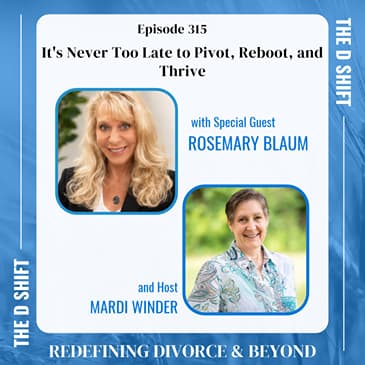
What happens when the life you've built no longer feels like the life you want to live? Whether you're navigating divorce, changing careers, or simply recognizing that something needs to change, starting over can feel overwhelming.
Mardi Winder welcomes Rosemary Blaum to explore her Pivot, Reboot, and Thrive framework and how small, intentional changes can help people move beyond fear, self-doubt, and the expectations of others.
Rosemary shares her experiences of leaving a marriage, changing career directions, and returning to school at 59. Together, they discuss why meaningful change doesn't have to happen all at once, how negative self-talk and other people's opinions can keep us stuck, and why letting go of outdated beliefs and expectations is essential to moving forward.
The conversation also explores how to recognize when it's time for a new direction, why accepting where you are today matters more than dwelling on past decisions, and how to begin building a life that reflects who you are now rather than who you used to be.
Questions and Answers From the Conversation
Why is it so difficult to make major life changes?
Rosemary explains that fear, uncertainty, and self-doubt can make change feel overwhelming. When people can't see a clear path forward, they may remain in situations that no longer make them happy simply because those situations are familiar.
How can small steps help people move forward after divorce or another major transition?
Rosemary encourages making manageable changes rather than trying to transform everything at once. She shares how changing one small daily habit helped her overcome a frustrating pattern and explains why small successes can build confidence to tackle bigger challenges.
What does it mean to pivot in life?
Pivoting means recognizing that something needs to change and making an intentional adjustment in direction. Rosemary shares how the end of her marriage and career led her to pursue new education and professional opportunities, demonstrating that major changes are possible at any age.
How can you deal with people who criticize your decisions or discourage you from making changes?
Rosemary shares her mother's advice about letting negative comments roll off your back. Rather than allowing other people's opinions to determine your choices, she encourages acknowledging their perspective without feeling obligated to follow their advice.
How can you stop regretting past decisions?
Mardi and Rosemary discuss the importance of recognizing that decisions were made with the information and understanding available at the time. Rather than repeatedly criticizing yourself for what you didn't know, focus on what you've learned and how you can use that knowledge moving forward.
What does it mean to thrive after a major life transition?
According to Rosemary, thriving begins with accepting where you are today and recognizing that each day offers a fresh start. It means taking responsibility for your direction, identifying what matters to you now, and creating a life that reflects your own priorities and values.
About the Guest:
Rosemary “Rose” Blaum guides women who are ready to step into their next chapter. Drawing on her education and experience in leadership, change management, and brain and mental health, she brings blind spots into focus.
Through her Pivot • Reboot • Thrive framework, she combines success principles with transformational strategies to guide leaders to tap into their internal GPS and recalibrate their mindset or path so they can align with who they are with self-confidence and vitality!
For Rose’s gift: https://rosemaryblaum.com/#section-ZJAdQF1SSO
To connect with Rose:
Web: https://rosemaryblaum.com/
Email: rose@rosemaryblaum.com
About the Host
Mardi Winder is a Strategic Divorce Consultant and High-Conflict Divorce Coach who helps high-achieving individuals navigate divorce with clarity, confidence, and control. Drawing on more than 30 years of experience in mediation, divorce coaching and conflict resolution, she supports clients in making smart decisions while reducing emotional and financial fallout, particularly in high-conflict, high-asset and complex divorces. Mardi is the founder of Positive Communication Systems, LLC, and the Strategic Divorce Directory, LLC.
For Mardi’s gift: The Resilience Building Blueprint: A 28-Day Journey To A Stronger You https://www.divorcecoach4women.com/rbb
Connect with Mardi on Social Media:
Facebook - https://www.facebook.com/Divorcecoach4women
LinkedIn: https://www.linkedin.com/in/mardiwinder/
Instagram: https://www.instagram.com/divorcecoach4women/
YouTube: https://www.youtube.com/@divorcecoach4women
Thanks for Listening!
Thanks so much for listening to our podcast! If you enjoyed this episode and think that others could benefit from listening, please share it using the social media buttons on this page.
Do you have feedback or questions about this episode? Leave a comment in the section below!
Subscribe to the Podcast
If you would like to get automatic updates of new podcast episodes, you can subscribe to the podcast on Apple Podcasts. You can also subscribe in your favorite podcast app.
Leave an Apple Podcast Review
Ratings and reviews from our listeners are extremely valuable to us and greatly appreciated. They help our podcast rank higher on Apple Podcasts, which exposes our show to more awesome listeners like you. If you have a minute, please leave an honest review on Apple Podcasts.
[00:00:04] Welcome to the D Shift Podcast, where we provide inspiration, motivation, and education to help you transition from the challenges of divorce to discover the freedom and ability to live life on your own terms. Are you ready? Let's get this shift started.
[00:00:24] Hello, and welcome to this episode of the D Shift Podcast. And today, I am really, really happy to be able to introduce you to my next guest. Rosemary Blom guides women who are ready to step into their next chapter. Drawing on her education and experience in leadership, change management in brain and mental health, she brings Blind Spots into focus.
[00:00:50] And she has a really cool program. It's her Pivot, Reboot, and Thrive framework. And we're going to talk all about that and how it can be so effective in helping you make big or small life transitions. So, Rose, welcome. Thank you, Mardi. It's great to be here. Well, and it's wonderful to have you.
[00:01:12] And just full disclosure, Rose and I met on the Influencers Cruise, where we got to travel around and go to a conference at the same time. And Rose was an amazing award winner for this phenomenal group of impact awards that we have that was so phenomenal to be.
[00:01:41] The gala was on the cruise for that, too. So, Rose, tell us a little bit about yourself and why is this your area of focus and passion? Why is pivoting and rebooting my life? Because if I don't pivot and I don't reboot and we don't do that, what happens? We get stuck. We stay in the mucky muck in life. Nobody wants to be there.
[00:02:07] I did live many years stuck in that with shoulda, woulda, coulda. Hmm, why is my life like this? Why isn't my life like that? Until I looked at the common denominator, Marty, and guess what? It was me.
[00:02:25] Then I realized that if I am really going to make some traction and get a better just groove on life and be able to step into who I am and who I really want to be, then I can't look in the rearview mirror anymore. I can't live there because, you know, like our car, if we drove by the rearview mirror, we would have a lot of accidents.
[00:02:55] And that's what I was doing. Well, that's true. And, you know, that old saying, and I keep, for some reason I've used this several times this week, that old saying, no matter where you go, there you are. And if you don't make those changes, you know, this is why we find ourselves getting into these patterns in life. And we're like, why is this always happening to me? Yeah. Because maybe we have to do some work. There's a lesson we need to learn or there's a change we need to make. But change is really hard for most people. Wouldn't you agree?
[00:03:27] Oh, it's sometimes debilitating. You know, we can't move because we don't see where we're like the horse with the blinders. We don't see that it's the fear, the doubts, the uncertainties. Gee, I haven't done this before. Can I really do this? Right. And can I really make it on my own?
[00:03:51] Like when I stepped away from my marriage, I didn't think I could do that on my own. I was just feeling that this is all there is. This is where my lot is in life. And then I realized that I was surviving and not thriving. So then when we make changes, wow, little bitty steps. And guess what?
[00:04:21] It's not the big steps. I have a disease of chronic learning. So I'm a chronic learner. And I'll admit it. And so I go for different certifications that help me in life and help me work with clients and individuals to help their life become better.
[00:04:45] And recently I was, I'm getting a degree in human flourishing and a master's in that. And one of the things that they have discovered through scientific research is when we make baby steps towards something, it just takes five minutes for the neurotransmitters to reset and re-groove a new path.
[00:05:13] But when we say, oh, I have all this thing. I have to clean my entire house. There's people coming. We, or I just have to re get out of here. And, and I don't know, I'm just going to move and that will make it better. Those don't work because our brain doesn't accept it. You heard that. Yeah, you know that too, because you're very well-versed in this area.
[00:05:40] And so I realized, oh, that's really cool. So I started to implement. No, we get stuck in things like, okay, one of my little baby steps, I must confess is when I get the mail, for some reason, I take it to the kitchen counter. And before I know it, the kitchen counter is full of mail. I know.
[00:06:04] So I thought, okay, I'm going to make a little baby step because when he gets big and someone like me that has a, you know, attention deficit or something, I think, oh, it's overwhelming. I, you know, I'll just move the stack over there. And so I've just, those baby steps of going through it. I started to sit on the, on the outside porch and I opened the mail before I come in the house.
[00:06:32] And that has been something that works for me. Right. So if we find, you know, it's not a cookie cutter, you know, right? Change. Yeah. What works for you does not going to work for me. Yeah. And that's, you know, that's, that's that whole premise of that book, Atomic Habits, which is an old book, but it's still completely relevant, right? Just do something 1% different every day. 1% is not very much, you know?
[00:07:00] And, and it's amazing how quickly once you do that, you feel more motivated. Like I can do, I can do bigger things and I can do bigger things. Right now, this is, this is so relevant right now. I have a cast on my right arm from my shoulder to the end of my, well, it's not a cast, it's a splint. And I've had to learn to do everything with my left hand. I could not, the first day I was trying to eat soup and I couldn't really figure out how to do that.
[00:07:29] You know, it's been a week I've had it on now. I had soup last night. No problem. That's how fast it takes to create those new neural pathways, right? And it's little things, not big, huge things. I love that message, Rose. That's important. It is important because we get, we feel like it's not moving fast enough. Right. And that's what brings me to thinking about pivot.
[00:07:55] And what, what I had to do in my life was totally make a shift. And, um, in basketball, you can't just grab the ball and run. You might make some good headway, but you're going to have a foul and you're going to be kicked out or said no. Yeah. So what we do is we pivot just a little degree sometime. And sometime it could be like, oh, so overwhelming.
[00:08:25] When I knew that I needed to make a change in my life, everything was happening at one time. You know, Murphy's law kicked in. Right. The marriage was way done before I emotionally accepted it to be. And the job, the, my career was at the end.
[00:08:53] Also at the same time before I was ready to say, this is not making me feel good. Right. And, um, so what I did was I had to think, what can I do differently? So just a little shift for me, it was retraining in an area that was brand new and making a transition is sometimes pretty scary.
[00:09:19] I went back to school and got my master's at 59 with this in organizational leadership for management and brain, uh, health research. And my background was construction interior design. Right. So people were thinking I had lost my mind. Well, don't you, don't you.
[00:09:49] So first of all, congratulations. I think that's really exciting. Um, and second of all, don't you find that sometimes we have a, as women, we feel a really strong pull to do make a big change. Like, okay, we're changing our, our, our, our relational status. We're moving out of a relationship that's no longer serving us or no longer healthy for us to be in. And at the same time, well, if we're changing that, why not? Why not make big changes? Like why not change?
[00:10:17] And then you get everybody who, who's in the back corner, just nattering away. Oh, you shouldn't do that. I'm so glad you said that because, or people say, well, you know, you're, you're old enough. Why don't you just retire? Like you should be planning for retirement. I get that all the time. Oh, I do too. I'm like, I'm never going to retire. I love what I do. Yeah. Yeah. So how does your framework address maybe those negative people in your life? Like what, what are your suggestions?
[00:10:47] If, if people are getting that constant chatter, especially women who are, you know, like us of a certain age, how do you get rid of, or how do you, how do you deal with those kinds of people in your life? Well, first of all, one of the things that's a great question is I, I just thought of Marty, something my mom always said, and she always said, somebody said something and I didn't like it.
[00:11:13] And I went, Oh, that person said this about me and this about me. My mom would say water off the duck's back, honey, water off the duck's back. Yeah. Yeah. Yeah. And I didn't get it when I was a teenager, but I get it now. And when we allow that to, to permeate and to get into, uh, changing who we are, then we,
[00:11:40] we start living small and we're not stepping into who we are. And sometimes it's just a matter of saying, thank you for your opinion. I'll think about that or I'll consider it. Thank you for your advice and don't consider it. Yeah. Yeah. Immediately put it in the trash bin. And, and, you know, don't shoot on yourself either because I did that for so many years.
[00:12:10] I should have done this. I should have done that. Or, Oh, I screwed up on that because all of those keep those lines, those negative, those channels, those dibbits, those pits in our brain and keep us from moving into the life that we really want. Right. Right. And so just the worst thing that we can do is be our own worst enemy. Yeah.
[00:12:38] And just love yourself for, okay. You know, maybe I didn't make the right choices before, but I have, this is my due day. Right. And I can move on. Yeah. Yes. Yeah. So I was going to say, so this is getting to the reboot part. And I always, you know, in, in NLP and I, I'm a big, I'm a big NLP fan. I've been trained in it. I'm a, I'm a master coach in NLP.
[00:13:05] But one of the things that I think is so important is that we do, you know, one of the presuppositions of NLP is people do the best with the information they have at the time that they have, that they have to make a choice. Now that's why hindsight's 2020, because you've got a lot smarter since you made that decision to where you are now. And you look back and said, I should have done that. But at the time you had to make that decision, you didn't have all this extra information. We need to stop.
[00:13:33] We need to stop beating ourselves up for not knowing stuff. Like, you know, the person you married when you're 20 and then you lived with them for 20 years, you learned their real character. Right. But you didn't know that when you were first in the relationship. So people, women need to stop. Women and men need to stop doing that. So let's get to the reboot part. Tell me about what you've made the pivot now. What's the reboot all about?
[00:14:02] Well, if we, we can pivot, but we have to have a plan, a strategy, and we may not know what that is. So just listen to your gut, listen to your intuition. When we're born, we're born with 500 million neurons in our gut. They're there for a reason. They're there to signal us, to tell us, huh? Perhaps I might want to learn this. Okay.
[00:14:32] Well, I don't know anything about it. Your brain will kick in and try to protect you, your mind and say, that's not your background. Or why do you think you could do that? So just ignore it. Say, okay, I know you're there. And just try something new. It may work. And it may just lead you to a different path altogether. Right. And that's cool, too. Yeah. You know?
[00:14:57] Just because I thought that I wanted to go into organizational leadership to be a teacher. Then I realized that what I really want is to help people from interior design. I'm working on the outside in, making their life, their environment better.
[00:15:19] But I love working from the inside out on helping people rewire their brain, their conscious thinking, their beliefs and attitudes of who they are. And, you know, you are divinely made. You're one of a kind. And you've got something to offer. And step into that. And just other people that may not say, hey, you can't do that.
[00:15:46] Just say, okay, you might want to have the attitude. Watch me. Yeah. Yes. Yes. Well, and Mel Robbins just came out with that book, Let Them. No, let them. You know? And I think that's so, like, let them believe whatever they want. Don't argue with them. Just do your thing. And the proof is going to be in the pudding, right?
[00:16:06] Because when people see you succeed, you're going to figure out who in your life is really there to support you and who are the haters that are going to, you know, call you down and say, oh, you know, you're too old or you need to retire or you should have stayed married or, you know, you're not good with money. You're not going to be able to manage things. That's their issues, not yours. But it's hard to do that reboot step. Oh, it is.
[00:16:36] And what happens is it's like you're in quicksand or mucky muck. That middle ground is really, really uncomfortable because I didn't know what I wanted to do. When I rebooted, it was, well, I don't even know how many times I've rebooted at least 10. And, you know, it's not one time we go through change so much. Just today, I might need to reboot.
[00:17:04] Because it's just little things that we think, are we, are the things that I am doing today having value to where I want my life to go? And if your answers come back, not really, then what can we eliminate or subtract from where we need to get to where we want to go? Right.
[00:17:34] And that's really important. Yeah. And that letting go of all the stuff, all the roles, the responsibilities, the beliefs, the things that society or your mom or whoever taught you that are no longer relevant. It's like a computer. I love the idea of a reboot because you get all these old programs and fragments and weird things on your computer.
[00:18:00] It stops running, but you reboot it, clear the system, and it's like you've got a brand new desktop or laptop all over again, right? And we can do the same for ourselves. I love this idea. And, you know, you made me think about something. We just said it's kind of uncomfortable. I am one of these. I'm not really great tech savvy. I didn't grow up with computers or cell phones for that matter.
[00:18:29] But so sometimes when I'll be typing and I lose something or the screen goes black, I start to panic. And I think that's what happens sometimes. If we react and then we're off course, we're all thrown off, right? So responding, say, okay, all right, I can do this. I will figure this out or go get some help. Someone else.
[00:18:57] So if you can't do it a lot, we're not made to do this world by ourselves. And that's what's so great about this program that you have, this podcast and all the wonderful things that you're doing with people. It's just plug in, you guys. Listen, send people to programs like this. When you have a day that you feel like I just can't take it anymore. I don't know what to do. Go to we have the Internet.
[00:19:27] You have no excuse anymore. Right. It's at your fingertip and research. Find what podcast can I relate to or webinar or person or program. Yeah. And that's really, really find your find a new tribe. Yeah. I love that. That's so important.
[00:19:50] Now, we're almost out of time here, Rose, but I want to make sure we get in the last part of your pivot, reboot. And then the last one is thrive, right? So what does thrive look like? Thriving starts by accepting exactly where you are and saying, okay, this is my new beginning. This is my new start. Every day when I wake up, I think today is a new beginning.
[00:20:20] Even if I'm delayed on something or I didn't finish something before, I think, no, today is a fresh start. Today is a fresh start. So then when you re-channel, we've talked a lot about the neuropathways and the programs in our brain.
[00:20:36] When we re-channel those, then we can step into a life that we really want and set a new course, set a new direction, reset, find your compass, find your true north. There's a book on that, too, I believe. And just, you know what? Grab the pen. Rewrite your story. This is your life.
[00:21:05] No one else is going to rewrite your story. Take responsibility. We all need to. This is your life. No one else got us there. And you have the opportunity to get a new key and start the new path in life. Yeah. Oh, I love that. And, you know, I could leave you with this. You cannot pivot looking backward. We can't.
[00:21:33] We've stuck to stay in the past or you have no idea what my life has been like. No. Okay, I don't. But you don't know what others are either. So we just take where we are and we move on. And you will find one day, you're going to mark my word, that you will start thriving. You're going to wake up and start feeling better about yourself. Yes. Yes. And that's such a positive message and a positive way to end this.
[00:22:00] But I do want to ask you because you have kindly offered a couple of gifts for people listening in today that are going to help them get started with the pivot, reboot and thrive framework and process. So now to get to Rose's gifts, I'm going to put her email in the show notes and you just email her and say, send me the gifts and she will email you back with this. So tell us a little bit about them, Rose. Okay, great.
[00:22:30] The first one is a pivot, reboot and thrive self-assessment. How do you know if you're ready to pivot? What if I'm not? Oh, am I really ready? And what to do to get ready? And the other one is an inner clarity tool. Really think about what do I need to get clear on in my life? If I don't know what to do? Find a coach. I coach.
[00:23:00] Marty coaches. I have workshops for wonderful people that are ready to make a transition in life. And I would love to connect with you. And the great thing about emailing Rose is you'll get on her email list. And then if she does have upcoming events, you just get, you know, you just get the odd email saying, hey, I'm hosting this event. And if it fits for your time and schedule, you can hop in.
[00:23:26] And I always tell people the more resources you can have, the better off you're going to be. You may not use them today, but you may find that all of a sudden one, you know, you can't get to sleep one night and you're thinking, I really need to make a change. Ha, I have that. I have that information from Rose. I'm going to go spend a little bit of time working on that. And having those resources is really beneficial. Now, Rose, do you- Adding tools to your toolbox. Exactly. Exactly.
[00:23:55] Do you have a website or a way that if people do want to find out more about you, what would be the best way to go about doing that? Yes. And we can put that in the show notes. It's also, it's rosemaryblom.com. And my email is rose at rosemaryblom.com. Fantastic. And we'll put that in. Fantastic. Is there any, any last words of wisdom you want to leave us with today, Rose?
[00:24:23] There's a little plaque in my office and it says, follow your heart. And I would suggest, listen, listen to your heart, listen to your soul, listen to your inner guidance, your inner wisdom, and you will make the right decisions. Your life will pivot and you will- Thank you so much. That is fantastic.
[00:24:51] And Rose, thank you so much for sharing your expertise and wisdom. It's always such, so fun to talk to you. I so appreciate that. And I want to thank everybody for listening in to this episode of The D-Shift. And don't forget to tune in to the next one. Thanks for listening and supporting The D-Shift Podcast. If you would like to attend live trainings by our amazing guests and have a chance to ask questions and get answers from our experts, join The D-Shift Crew.
[00:25:18] For more details and to sign up, head on over to www.divorcecoach4women.com and click on the podcast page. Thank you.