
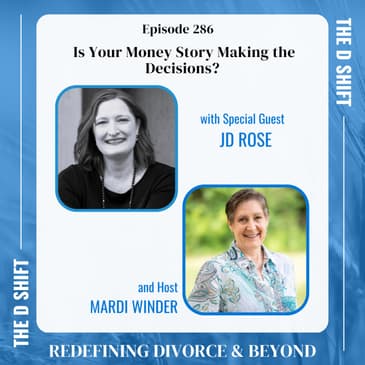
Money decisions are rarely just about the numbers. The beliefs we absorb from our families, culture, and past experiences can quietly influence how we spend, save, invest, and even how comfortable we feel having money.
In this episode of The D Shift: Redefining Divorce and Beyond, Strategic Divorce Consultant Mardi Winder talks with financial wellbeing coach JD Rose, creator of the Whole Money Method, about the connection between money, identity, emotions, and the body.
JD explains why financial security does not automatically eliminate feelings of scarcity, how long-held beliefs about money can continue influencing us well into adulthood, and why changing our relationship with money requires more than simply thinking differently.
For anyone facing major financial decisions during or after divorce, this conversation offers a different way to consider what may be influencing those choices beneath the surface.
Questions We Explore
Q: Why can someone have plenty of money and still feel financially insecure?
A: Because feelings of financial safety can be connected to identity, cultural conditioning, family messages, and deeply held beliefs about scarcity, not simply the amount of money in the bank.
Q: How do childhood experiences influence our financial decisions as adults?
A: Messages about saving, spending, debt, success, and what we “should” or “should not” do with money can become part of an internal operating system that continues influencing our choices years later.
Q: How can you begin identifying a money story that may no longer serve you?
A: JD suggests slowing down and getting curious about the story behind a reaction or behavior, then questioning whether that belief is actually true or simply something you have learned to accept as true.
Q: Why isn’t changing your money mindset just about changing your thoughts?
A: Money can create very real emotional and physical responses. JD explains why recognizing feelings such as shame, guilt, fear, or even tension in the body can be an important part of changing your relationship with money.
Q: What is one idea JD wants listeners to remember?
A: “Wealth begins in your body. It doesn’t begin in your bank account.”
About the Guest:
JD Rose is a Financial Well-Being Coach and creator of The Whole Money Method, a whole-person approach to personal finance grounded in practical strategy, emotional clarity, and energy alignment. Drawing on 25 years spanning therapeutic bodywork, health & business coaching, and financial well-being, she works with soulful, sensitive women who feel capable in most areas of life yet secretly struggle with anxiety and shame around money. Through a process that's as much about healing as it is about strategy, her clients build financial confidence and self-trust in the near term, and genuine peace with money in the long term.
To connect with JD:
Instagram: @the.resourced.woman
LinkedIn: www.linkedin.com/in/jd-rose/
Website: www.theresourcedwoman.com
About the Host
Mardi Winder is a Strategic Divorce Consultant and High-Conflict Divorce Coach who helps high-achieving individuals navigate divorce with clarity, confidence, and control. Drawing on more than 30 years of experience in mediation, divorce coaching and conflict resolution, she supports clients in making smart decisions while reducing emotional and financial fallout, particularly in high-conflict, high-asset and complex divorces. Mardi is the founder of Positive Communication Systems, LLC, and the Strategic Divorce Directory, LLC.
For Mardi’s gift: The Resilience Building Blueprint: A 28-Day Journey To A Stronger You https://www.divorcecoach4women.com/rbb
Connect with Mardi on Social Media:
Facebook - https://www.facebook.com/Divorcecoach4women
LinkedIn: https://www.linkedin.com/in/mardiwinder/
Instagram: https://www.instagram.com/divorcecoach4women/
YouTube: https://www.youtube.com/@divorcecoach4women
Thanks for Listening!
Thanks so much for listening to our podcast! If you enjoyed this episode and think that others could benefit from listening, please share it using the social media buttons on this page.
Do you have feedback or questions about this episode? Leave a comment in the section below!
Subscribe to the Podcast
If you would like to get automatic updates of new podcast episodes, you can subscribe to the podcast on Apple Podcasts. You can also subscribe in your favorite podcast app.
Leave an Apple Podcast Review
Ratings and reviews from our listeners are extremely valuable to us and greatly appreciated. They help our podcast rank higher on Apple Podcasts, which exposes our show to more awesome listeners like you. If you have a minute, please leave an honest review on Apple Podcasts.
[00:00:04] Welcome to the D Shift Podcast, where we provide inspiration, motivation and education to help you transition from the challenges of divorce to discover the freedom and ability to live life on your own terms. Are you ready? Let's get this shift started.
[00:00:22] Hello and welcome to this episode of the D Shift Podcast. And we are going to talk all about money, mindset and cultural conditioning and how we think about money, which I think is a big thing for most women and a lot of men who maybe don't want to admit that it's a thing for them. So I do hold that thought in my head quite often.
[00:00:44] My guest today is J.D. Rose. She is a financial well-being coach and creator of The Whole Money Method, which is a whole person approach to finances grounded in practical strategy, emotional clarity and energy alignment.
[00:01:01] And I'm really excited to talk about this because the whole idea of money and mindset and what that represents to you energetically is really important when you're making big financial decisions. So J.D., welcome. Thank you so much. I'm so happy to be here with you, Mardi. Well, I'm happy you're here talking about this because money is always one of those conversations that I find people have two responses.
[00:01:28] They're either like write in to listen or they're like, heck no, this is not for me. Money is icky. It's evil. I don't want to talk about it. So this whole mindset piece is a big thing, I think. So J.D., before we get into all the good information we're going to share, you're going to share with us what kind of got you here and why is this your area of focus now? Thank you for asking that question to set us up because it's been a really circuitous route to get here.
[00:01:55] It was not a direct line at all. And I've basically been in the wellness industry for the past 20, 25 years. Don't get me on specific numbers there. But I started out in body work. I was a professional massage therapist for many years and I loved helping people get calm and relaxed in their body and come home to themselves physically in that way. I expanded my practice to include health coaching.
[00:02:23] I got my health coaching certification back in 2008. And that led me into this whole expanded experience in that realm, helping people build their businesses who were new health coaches, learning advanced coaching techniques. And the money piece of building your business and launching a new endeavor like that is huge. And I spent about eight years working with primarily women, but some men building their businesses.
[00:02:53] And it just kept coming up again and again and again. And then when I went through my own divorce experience, if you will, I met with a new financial planner. And in that interaction, everything changed for me and all the pieces came together. And I realized, oh, my gosh, this entire conflagration of skill sets with mindset and body and spirit. It's all it's all together. Mind, body, spirit, money.
[00:03:20] That's the way in for, I think, everybody, really. Yeah. And this is where I find so fascinating. I work with all types of clients. I have worked with clients who, you know, $100 million matrimonial estate that they're splitting up. I've worked with clients who are very high profile people. And I've worked with people who are living literally paycheck to paycheck.
[00:03:49] And it doesn't seem to matter. Sometimes, like, you just assume. When I work with my first really rich client, I thought, oh, like, money's going to be no object. There's the finances. It was like, no matter what the settlement was, and it was in the millions of dollars. The matrimonial support was in the millions of dollars. And it was still like there was this white knuckle, I'm not going to have enough money.
[00:04:12] And I'm thinking, oh, my gosh, most of my clients, if they had a tenth of that, they would be, like, throwing it on the bed and rolling around in it. That's what I would be doing. So why does this money thinking distort so much for people? Well, so here's the thing. What we're taught, I think, in our overculture, that if we just have more money, if we just get better at saving and investing and planning, then we're going to be fine. We're going to be safe. We're going to have what we need.
[00:04:42] But, you know, money issues aren't about the money itself. Our financial reality really comes down to our identity, who we believe we are in relation to money, in relation to the world around us, what we believe we're deserving of or not deserving of. And this is all, it has nothing that we created ourselves. These are layers and layers of cultural stories that have come from our families of origin, our ancestral lineage.
[00:05:10] It comes from, obviously, the overculture with all the messaging we get through media and social media. And we're trained, right? We're trained to look through a lens. I call it the cultural spell of scarcity. We're trained to look at what's not there, right? What we need more of that we can't get. And there's all this messaging around struggle and difficulty. And it's really hard to swim upstream against that kind of messaging and programming. Yeah.
[00:05:36] And where did, like, I know, so I grew up, my parents were not wealthy. My mom was very sick most of my life. And my dad was a police officer and then a farmer for a long time. And so, you know, we didn't have, we had enough. We lived very comfortably. We never went, like, without meals or anything like that. I don't want to make it sound like that. But my dad really believed that you didn't buy on credit and you saved and you scrimped. And, like, if they wanted to buy a car, they walked in and paid cash for that vehicle.
[00:06:06] Like, that was the way that my family operated. And I still, like, I still feel that sometimes if I put something on a credit card that's not, like, that's a frivolous expense or a luxury expense. In other words, not something I absolutely need. I still hear that little voice in my head going, ooh, this is so bad. Even though I know I've got money in the bank to pay it off. Like, it's weird. It's weird that I experienced that. Or is that perfectly normal?
[00:06:36] It's not weird at all. Everybody has that voice. And that voice isn't them. And that's a lot of the work that I do with clients is helping them understand what is that voice? What exactly is it saying? Because a lot of times this is very unconscious. Like, it's kind of buzzing in the background all the time. But we're not really consciously aware of it most of the time when we're making decisions.
[00:06:56] But our, you know, our, all of our decisions, 90% of our financial decisions are driven by our emotional experience around money. So, if you believe that, oh, it's not okay to spend on luxuries or like the judgment around the word frivolous even, right? And you acknowledged it. We have ideas about what's okay and what's not okay.
[00:07:19] And it doesn't matter how much, you know, we've moved, you know, how many years have changed in between, you know, growing up and moving away from the family. We still have all the messaging ingrained in us. Our sense of identity just in general is built in by the time we're a very young child, usually by the age of seven. Like, everything's kind of in place. And we don't think about it. We go through life just kind of operating on that built-in operating system.
[00:07:45] And it's only when we get older and we start noticing that there are patterns coming up that we realize, oh, there's an opportunity here to interrupt this pattern and upgrade that operating system. Right. And some of those patterns are, I think they're healthy and helpful. Like, we were, you know, my dad was big on you need to be saving for retirement. Like, even as I can remember when I was a kid, like, helping out and working on the neighbor's place and stuff and getting paid, it was always like we could keep a tent.
[00:08:15] This was, I don't know where he made these numbers up. We could keep a tent. We could buy something with a tent. And we had to put the rest of the 80% had to go into a savings account. And in those days, savings accounts actually paid something. Nowadays, you know, you might as well just put it under your mattress as well as put it in a savings account. Well, there are some savings accounts that do pay a little bit more than your average, but you're absolutely right. It's very different. Right.
[00:08:39] And so, with sometimes getting out of that, just do things the way that you've always done them and looking at things like indexed markets and things like that, where there's a little bit of risk, but it's not like, you know, you're just throwing your money in the wind and hoping you get big returns. There's some protection. So, breaking these patterns is really critical, I think, for making good money choices. I would absolutely agree.
[00:09:07] And it's the biggest hurdle that we have to jump over, right? Because even when we're in that place where we have awareness and we're ready to move forward, we're not really sure, like, what's our first step in moving forward? What is the thing that we need to change and bucking the system, like going against people that we love or a community that, you know, kind of built these things into us? There's a sense of needing to be belonging.
[00:09:33] We don't want to lose the people that we love because we start changing ourselves and making new decisions. And so, that is what happens in our subconscious, but it's like constantly trying to pull us back and protect us and make sure that we don't get, you know, we don't become pariahs in the tribe, as it were. Yeah, I've told this story before on one of the podcasts, but I have a client who went through a divorce, used her money to start her own business. She's doing incredibly well.
[00:10:01] I'm so, you know, I'm so proud of what she's accomplished in just a few years. And she bought herself this beautiful diamond ring as a celebration. And she won't wear it when she knows any of her family is going to be present. Like, she just doesn't even, it doesn't go on her hand. Because again, she's worried what they're going to say about her. She, and she plays like her business isn't really doing all that good at home. So, she's living this double life, like where she lives.
[00:10:29] Everybody knows her kind of as this community leader and very successful businesswoman. At home, she's still kind of the struggling divorcee that's trying to get her feet back under her. And I'm like, doesn't that make you crazy trying to live those two lives? And she goes, yes, it does. I hardly ever go home anymore because I don't feel I'm being authentic there. Yeah, it's not unusual at all. I hear that sort of thing all the time. I'm sure you hear that all the time in your work.
[00:10:55] And the deepest desire I think we all have as human beings is to just live authentically as ourselves and to be accepted for who we are. Right. And so, really coming home to ourselves and being willing to do the brave thing and be that person, it takes a lot of courage. But it's certainly not impossible.
[00:11:17] And when we come back to our true selves and we don't have our eyes on other people's paper, we're not trying to manage other people's opinions and experiences because, let's face it, at the end of the day, we don't have that kind of power. We have no control over what other people think or experience. All we have is our control over our own experience. When we're willing to really root into that and just show up as our full selves, that's when our experience of everything, not just money, but everything in our life changes, right?
[00:11:45] Because money is just a mirror for all of the other relationships that we have in our life, really. Right, right. So, let's say you recognize, let's say somebody's sitting here listening and going, yeah, I do that. I play small or I feel uncomfortable with making purchases even though I know I've got, I budgeted it. It's an intentional purchase. It's not a purchase. It's not like just an impulse buy.
[00:12:12] What's maybe one way that they can start shifting that pattern? So, I think one of the most important things that we can do just in the very beginning is to bring curiosity to what's actually happening, right? To be curious enough to slow down and look at that behavior and then ask ourselves, what's the story that's propelling that behavior, right? Like, what am I telling myself? What am I believing is going to be true?
[00:12:40] That's steering my behavior here. And then really starting to take a critical eye to whether or not that story is true. It can feel really true for a lot of folks initially, but then when we start to really look at it and start to just like ask more questions, we realize that the story we've been telling ourselves just falls apart. It's a lie, right? It's one of many possible stories that are available.
[00:13:06] But we've just been filtering for evidence of the thing that we already believe, which is that it's not okay necessarily to have the luxuries and wear the diamond ring or it's, you know, whatever, fill in the blank of whatever your belief is, right? So we're really just starting to get curious and look for what are these other possibilities out here? If this isn't necessarily 100% true, what else might be true here? And then that kind of frees us up to kind of explore a little bit more.
[00:13:31] And I think that's really important is it's hard sometimes to do this work on your own, though, because we're so in our own stories that it takes somebody like yourself asking the right questions to get our minds to actually open up to the fact that, yeah, this is a self-constructed story. And my cognitive bias just keeps reinforcing whatever I believe to be true about money. Yeah, that's so true.
[00:14:00] I am a firm believer in getting support and finding somebody that you can unpack this sort of thing with. I mean, if coaches have coaches, I've had my own mentor that I've been working with over the years around the stories that are blind spots for me. We're constantly changing and evolving and growing. And very often we circle back around to something as the new version of ourselves to really start peeling away the layers of the onion even more. Right.
[00:14:26] And I was talking, I was on like a webinar and it was, I can't even remember whose webinar it was. So I'd just be making up a name if I said one. So I'm not going to say one. I was on this webinar and it was all, it was kind of along this idea of the money stories that we tell ourselves.
[00:14:42] And it was really interesting because the presenter said, how many of you think like the billionaires are greedy and, you know, not helpful to society kind of thing. And virtually everybody's hand in the room went up to some degree. Some people were really high. Some people were kind of like this.
[00:15:04] But then the speaker said, if you dislike that whole class, millionaires and billionaires, then you're never going to get there because you're automatically going to sabotage yourself because you don't want to put yourself in that. Because you don't want to be the villain. Yeah. So many people are afraid of, oh, no, if I have more money, if I have more success, then I'm going to be a villain. But the truth is money doesn't turn you into something that's terrible. It's just an amplifier for what's already there. Right.
[00:15:33] So if you're a generous person, if you're a kind person, whatever your natural attributes are, the money is just a vehicle for expressing more of that. Right. Like the more money you have as a generous person, the more money you can give away, the more you can be a philanthropist in your life. Right. The more impact you can have on other people in their lives. Yeah. And that's what that is the big it was like a light bulb went off in my head because not like I didn't I don't think all rich people are evil.
[00:16:01] But I was brought up that, you know, well, rich people have their own set of rules and we're poor people. Not and we weren't. But, you know, that was just kind of there was that distinction. You're either rich or you're poor. And it's so funny because exactly what you just said, when when people are able to grasp that money is only a tool and you decide how you want to use it. It's like it opens up that energetically.
[00:16:26] It opens up that sense of abundance that, you know, if I've got ten dollars in the bank and I want to give away five, that's that's OK. I can do that. But and if I've got a million in the bank and I want to give away half a million, that's OK, too. So it's kind of cool to make that shift. It is.
[00:16:46] It's one of my favorite parts, actually, of working with clients is to see what happens for them when things do shift, when something clicks in for them, when the story changes, when the window that they're looking through gets wider. It's really gratifying to see that. The thing that I want to avoid.
[00:17:06] Given the impression of with listeners, though, I just want to make sure that when we're talking about money stories, there's a tendency, I think, a lot in the coaching world to focus on mindset as a mental practice. And what's really happening at the level of the story is the emotions that are attached to it. And it's the emotional experience. That's the really important piece that we're looking to shift. Right. We're trying to create that sense of safety in the body to be with money.
[00:17:34] We're trying to create that experience of calm and expansiveness and openness. And so it's not just happening at the story level. It's really that full physical, visceral experiences. So many women, for example, don't like the word budget because everything in their body tightens up. Right. Right. We just kind of have this clenching experience.
[00:17:55] And so it's helpful just to kind of notice what's happening in your body when you hear a specific word that you respond to or you're having a conversation and you're having some sort of response. Not just looking at the story, but physically what's happening for you and getting curious about that as well. I think that is something really I think we can do this all if, you know, when you go to the mailbox because we do still get a lot of stuff by mail.
[00:18:21] And if you hold that letter and you think it's like from the IRS or something, it automatically you just get that. Like you feel it in your body. Or if you if you know you've got a big credit card debt or, you know, you've got you know, you can feel that. And it's a physical experience. Yeah. Yeah. And then how does the emotional how does the emotional part tie in? So.
[00:18:47] From an emotional perspective, so many of us are carrying lots of shame and lots of guilt around our decisions past, present, perhaps around money. We have ideas about our value in the world as people and how that's tied to productivity and whatnot.
[00:19:06] So really, the emotional component is all about unraveling these ideas of net worth and the entanglement that they have with self-worth and coming back to a place where we can start expanding our capacity for our own trust and self-compassion. When we can start bringing that in, that helps shift our emotional experience. That's like step three of my system is bringing in that restoration.
[00:19:36] And that's when everything starts to change, because when we can look through a lens of compassion for ourselves and understand that past versions of us, no matter what decisions they were making around money, were doing the best they could with the best intentions at the time. Then we get to release the heaviness of that burden and then focus on what we do want to be creating. Yeah. Oh, that is such a positive message.
[00:19:59] JD, if you were to give everybody kind of like one big takeaway, you want everybody to remember when they go on about their busy day after our conversation, what do you want that to be? Oh, my gosh. What do I want that to be? I think I would want that to be that wealth begins in your body. It doesn't begin in your bank account. Right. We just did all everything that we experience in the external really starts from the inside experience first.
[00:20:29] That is such a good message. And I'm also thinking that this whole idea of the body and the emotion and the mindset and everything around money. You really do. I'm going to say this. I know I'm not trying to put words in JD's mouth here, but I think she would agree with me.
[00:20:49] This is something that if this is a thing that you're running up against, if this is an obstacle in your making financial decisions and moving forward with your finances, and especially after divorce, you've got a whole lot of decisions about money and money stuff that you're going to have to deal with after the divorce happens or during the divorce.
[00:21:08] This would be a really good time to start working with somebody who can help you unpack all that stuff and really have clarity so that you can make the most effective decisions. Because I'm guessing you don't tell anybody what to do with their money. I don't. I walk them through some practical system setup that's designed to be flexible and supportive for them. And I have my own perspective on how best to approach it. But money is really personal.
[00:21:38] And I'm not here to tell anybody what they should do with their money. I'm here just to act as a support for helping you understand who you are with money and how you want to be in the future with money. And that is the perfect segue into my last question for you today, JD. If people want to work with you or find out more about what you do, what's the best way to do that? There's a bunch of ways to do that. I'm online and easy to find. You can find me at my website, which is theresourcedwoman.com. My handle is TheResourcedWoman on Instagram.
[00:22:08] And my link, if you click my link there, there's all kinds of ways you can connect with me. Freebies and giveaways there. I'm also on LinkedIn. If you're on LinkedIn, I'm easy to find. J.D. Rose, Financial Wellbeing Coach for Sensitive Souls. Pop right up. I will make sure that is easy. Yes, I will make sure that that is all in the chat. And one of the things, if you're listening and you're not doing this, all of the guests, well, not all. I'm going to say 90% of the guests that are on the podcast are on LinkedIn at least.
[00:22:37] That tends to be where a lot of professionals are. You can get a free LinkedIn account. You can get on that. You can follow all of the professionals, including JD, and get access to all the posts and the little tidbits and nuggets that they give out. Find out where they're speaking, what they're doing. It's a great way to stay connected with divorce professionals. So I would encourage you to do that. JD, thank you so much for being here today and for sharing this really unique perspective,
[00:23:07] interesting and unique perspective on the whole idea of how we tell ourselves stories about money and what it does to us. I really appreciated this. Thank you, Marty. It was a pleasure being in conversation with you. And thank you, everyone, for listening in to this episode of The D Shift. And don't forget to tune in to the next one. Thanks for listening and supporting The D-Shift Podcast.
[00:23:30] If you would like to attend live trainings by our amazing guests and have a chance to ask questions and get answers from our experts, join the D-Shift crew. For more details and to sign up, head on over to www.divorcecoachforwomen and click on the podcast page.