
Major life transitions like divorce can change almost every aspect of your financial life. If you were not the person who primarily handled investments or long-term financial decisions during your marriage, suddenly being responsible for those choices can feel overwhelming. Even if you were involved in the finances, making decisions on your own after divorce can be very different.
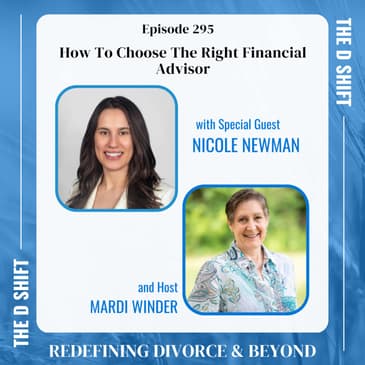
Strategic Divorce Consultant Mardi Winder talks with Nicole Newman, MBA, CPA, and Investment Advisor at Stone Creek Advisors, about building financial confidence and finding the right professional to help you make informed decisions after divorce.
Nicole explains why financial confidence is not simply something you either have or you don’t. For many women, there are historical and generational reasons why they may not have been encouraged to take an active role in investing and financial decision-making. Divorce can suddenly change that, creating both a challenge and an opportunity to become more engaged in your own financial future.
Mardi and Nicole also get very practical about choosing an Investment Advisor. They discuss what it means to work with a fiduciary, why you should interview several professionals before making a decision, what questions to ask about fees and how your money is held, and some of the red flags that should make you stop and ask more questions.
Most importantly, becoming financially independent does not mean you need to become a financial expert or make every decision by yourself. It means understanding your options, asking questions, building a trusted professional team, and remaining an active participant in the decisions that affect your future.
Questions we explore:
Why can financial decisions feel so overwhelming after divorce?
If someone else handled much of the financial decision-making during the marriage, divorce may be the first time you are solely responsible for those choices. Even people who understand budgeting and everyday finances may feel less confident when it comes to investing and long-term financial planning.
What should you look for when choosing a financial professional?
Nicole recommends interviewing several professionals rather than automatically choosing the first person you meet. Ask whether they are a fiduciary, how they are compensated, what fees you will pay, where your assets will be held, and how they will involve you in the decision-making process.
What are some red flags when interviewing an Investment Advisor?
Vague answers about fees, compensation, or where your money will be held deserve closer attention. Another significant warning sign is anyone promising a specific investment return. A reputable professional should be willing to clearly explain how they work and answer your questions.
Do you need significant wealth before talking to an Investment Advisor?
Not necessarily. Some advisors have minimum investment requirements and others do not. The important thing is finding someone who will give you appropriate advice based on your actual financial situation rather than simply trying to sell you a product or service.
What does financial independence really mean after divorce?
Financial independence does not mean doing everything alone. It means developing the confidence to ask questions, understand your choices, work collaboratively with qualified professionals, and take ownership of the decisions affecting your financial future.
About the Guest:
Nicole Newman, MBA, CEPA, is an Investment Advisor at StoneCreek Advisors, where she works with individuals and families navigating some of life’s most significant transitions—from divorce and loss to business succession. With a background in corporate strategy and mergers & acquisitions, Nicole brings a strategic, big-picture perspective to complex financial decisions.
She is particularly passionate about helping women move from financial uncertainty to becoming confident stewards of their money and future. Nicole is known for building clear frameworks that simplify complex financial decisions, helping clients feel informed, empowered, and in control during pivotal moments of change.
For Nicole’s gift: https://bookings.cloud.microsoft/bookwithme/user/a46463ea2af748168a1632fbec4345e2%40stonecreek-advisors.com/meetingtype/g1QcOc2BDU-PeXQ28CtY0A2?anonymous&ismsaljsauthenabled=true
To connect with Nicole:
LinkedIn: https://www.linkedin.com/in/nicoledupranewman/
Website: https://www.stonecreek-advisors.com/
About the Host
Mardi Winder is a Strategic Divorce Consultant and High-Conflict Divorce Coach who helps high-achieving individuals navigate divorce with clarity, confidence, and control. Drawing on more than 30 years of experience in mediation, divorce coaching and conflict resolution, she supports clients in making smart decisions while reducing emotional and financial fallout, particularly in high-conflict, high-asset and complex divorces. Mardi is the founder of Positive Communication Systems, LLC, and the Strategic Divorce Directory, LLC.
For Mardi’s gift: The Resilience Building Blueprint: A 28-Day Journey To A Stronger You https://www.divorcecoach4women.com/rbb
Connect with Mardi on Social Media:
Facebook - https://www.facebook.com/Divorcecoach4women
LinkedIn: https://www.linkedin.com/in/mardiwinder/
Instagram: https://www.instagram.com/divorcecoach4women/
YouTube: https://www.youtube.com/@divorcecoach4women
Thanks for Listening!
Thanks so much for listening to our podcast! If you enjoyed this episode and think that others could benefit from listening, please share it using the social media buttons on this page.
Do you have feedback or questions about this episode? Leave a comment in the section below!
Subscribe to the Podcast
If you would like to get automatic updates of new podcast episodes, you can subscribe to the podcast on Apple Podcasts. You can also subscribe in your favorite podcast app.
Leave an Apple Podcast Review
Ratings and reviews from our listeners are extremely valuable to us and greatly appreciated. They help our podcast rank higher on Apple Podcasts, which exposes our show to more awesome listeners like you. If you have a minute, please leave an honest review on Apple Podcasts.
[00:00:04] Welcome to The D Shift Podcast, where we provide inspiration, motivation, and education to help you transition from the challenges of divorce to discover the freedom and ability to live life on your own terms. Are you ready? Let's get this shift started. Hello, and welcome back to The D Shift Podcast. I'm your host, Mardi Winder. I'm a strategic divorce consultant and high-conflict divorce coach.
[00:00:32] And today we are going to talk about something that I think needs to be talked about more, and that is if you go through a divorce or a life transition of any kind, and all of a sudden you find yourself responsible for the financial decisions, and maybe that hasn't been your wheelhouse in the past.
[00:00:51] That can be really overwhelming. I know it has been for me in the past, and when you don't feel like you're confident, you often are paralyzed and don't make decisions, or you just jump in and make a decision and it may not be the best one for your financial future. So today I have an amazing guest on to talk all about this, Nicole Newman. She has her MBA, she is a CPA, and she is an investment advisor at Stone Creek Advisors.
[00:01:21] And Nicole's superpower is that she can take really complex financial situations and break them down into a big-picture perspective for both individuals and families so they can understand what are their options moving forward and what's in their best interest. And that's what we need is we need more people advising us, not telling us what to do. So, Nicole, welcome.
[00:01:49] Thank you so much, Mardi. First of all, I really appreciate you having me on, and I'm excited to talk with you today. Well, I'm excited to talk to you. We had a little conversation a little bit ago, and I just think, again, I think what you do is so important. So before we jump into kind of the whole meat and potatoes of what we're going to talk about today, tell us a little bit about yourself, Nicole, and why is this area of expertise kind of your focus area?
[00:02:19] Sure. So in brief, my background spans management consulting, corporate strategy, mergers and acquisitions, and private equity. And it was kind of a dry topic and got a little bit transactional in a way. And I started to realize through my work that in having conversations with people going through major transitions in life, whether it was selling a business or what have you,
[00:02:45] people just needed more guidance and were fundamentally just unprepared for major life transitions. And there was a lack of coordination happening with advisors, whether it was your CPA, your attorney, your financial advisor. Everyone wasn't coming together to provide the best advice to help their clients because no one really owned the process.
[00:03:07] So I made a major transition into becoming an investment advisor to help clients find an advisor who can own that process and guide them through these major transitions, whether it's divorce or what have you.
[00:03:22] Yeah. And Nicole, before we go any further, can you just like, is there a specific, like, I know I've heard people talk about being an investment advisor or being an investment professional or being an investment manager. Like what, what specifically is an investment advisor? Oh, that's, I love this question because a financial advisor is going to be your broader term.
[00:03:51] There's a bunch of different categories or, or titles that fall under that. You can have a financial planner. You can have myself, which is an investment advisor. What, what kind of earns you that title is by taking the series 65. So it's a very technical thing that were governed by the SEC and certain government regulations. You also have your broker dealers, which take a different series and are governed by another governing body by the government.
[00:04:17] So it just depends on what tests you've essentially taken and whether or not you're considered a fiduciary and investment advisors are in fact fiduciaries. Okay. Now, before we go any further, just because I know I've gone over this in detail on a couple of other podcasts, but everybody hasn't listened to every podcast. What is a fiduciary?
[00:04:37] Sure. So we are legally obligated to act in our client's best interests and put their best interest above our own at all times, no matter what. So this is what I always tell people that fiduciary is a really important one because that means the professional cannot recommend or only offer a product that they are making some kind of a commission or some kind of fees,
[00:05:05] or there's something they're kind of like they have to put your best interests first before their own possible financial gains or whatever may be going on. Right. Exactly. And you actually touched on something, a fee only fiduciary is the next level up.
[00:05:25] So not selling a commission based product is another layer to that type of, I guess, trust and transparency and lack of conflict of interest in that case. Right. So there are certain broker dealers might have a commission based product or insurance agents might have a commission based products where simply an investment advisor. It's unlikely that they do unless they also have another layer of service that they're providing on the side.
[00:05:52] And I think this is honestly, this is really important. And for people that are concerned, because we've all heard stories about people who have, you know, talked to a financial person, whether they're actually licensed or regulated or have any kind of training. There is a big difference. So this is a big question to ask, because we've all heard stories about people that have invested and got messed over.
[00:06:19] That's the polite way to say it and lost their investment because, you know, they're there. The person that was talking to them was only selling the product that they were making the most commission off of or whatever. So I really appreciate you taking the time to do this, Nicole. So I know one of the things that we wanted to talk about today was how come or why women in particular are quite often a bit overwhelmed and not all women. And some men may be.
[00:06:49] I know that some men are because I've talked to men going through divorce who are like, wow, you know, we've always made joint financial decisions or she's always made the decisions. And that's great. But when you have to start making your own financial decisions, let's talk about in particular women. Why is this sometimes an overwhelming sort of aspect of divorce or widowhood or, you know, big life trans transitions?
[00:07:16] Yeah, so I truly believe that it's easy to assume that financial confidence is simply a personal trait. However, if we look at history, that kind of tells a different story, especially as it relates to women in history. It wasn't until 1974, the Equal Credit Opportunity Act was put into place. And before that act, women could legally be denied credit simply because they were women.
[00:07:43] So you couldn't get lending without a husband or a brother or a son's signature on that loan or that credit card. And then it wasn't until 1988 that women, the Women's Business Ownership Act came out. So before this law, many women still face barriers to obtaining business loans and they were required to have a male co-sign for them.
[00:08:07] So historically, we've been essentially told that we're not capable or really, we're not capable of managing capital. And therefore, why should we feel confident? And this is only going back 1988. I was two years old. Like we're in the generation. I am the generation that this happened. It's very current. So, you know, I think back to when we were children, there was like, take your daughter to school.
[00:08:36] And now it's take or excuse me, take your daughter to work day. And now it's take your child to work day. But as a child going through that and being taken out of school at eight years old, much, many of us were not going to our mother's business where she was able to obtain that business loan to get that business off the ground on her own.
[00:08:58] So there's a lot of retraining that is required as a society to remember that we are worthy as women and we are capable of making exceptional financial decisions. Yeah. And, you know, Nicole, I want to say, first of all, I'm a lot older than you, but I was 10 in 1974. And I don't know how old I was in 1988, but I know I was going out and having a lot of fun in 1988. 1988.
[00:09:25] So I know I was probably, yeah, I'm not doing the math in my head right now. But you're right. Even though we were talking, we said historically, this is not historically. This is within our, both of our lifetimes. And look how young you are. And so the thing that, the other thing that I was going to say is a lot of women that I see that are divorcing in their, in their fifties and sixties, because I'm, I work a lot with people in that kind of gray divorce area.
[00:09:52] And even women in their forties, depending on how traditional your upbringing was in your family, you may have grown up in your family where, you know, maybe your mom and dad sat at the kitchen table and balanced the checking account. But typically, typically dad or your father was the financial person in the family. Not because there was any kind of financial abuse. I'm not suggesting that, but just because traditionally men took care of the money.
[00:10:22] Because, again, in the, you know, in the forties, fifties and sixties, there were still a lot of women that weren't working or maybe just had like a little part-time job or something like that. There wasn't, there wasn't that history of women being the bread earners and the decision makers and families. Yeah, exactly. And we do still see that today. Sometimes that's a conscious choice for women to decide that they want to take that seat in the relationship. Sometimes it's not.
[00:10:48] But, you know, in this role, I have seen cases of financial abuse, both with men and women. It does happen on both sides of the coin. It's not just women being financially abused, but oftentimes it is. And in divorce, it can actually, there might be a scenario where there was no financial abuse in the relationship. But then suddenly it kicks in and money starts to disappear while you're going through the process. And I can say I've seen that many times, unfortunately.
[00:11:15] But yeah, my goal is to help women realize that there is something to be said for stepping into your power by saying, I'm going to be an active participant in the family household finances. And when you're going through a divorce, you really don't have a choice. Unfortunately, you're thrown into it and it can feel so overwhelming and intimidating, especially if you weren't a part of those conversations in the beginning of the situation.
[00:11:44] But this is an opportunity to step into your power when you have to face this type of adversity. And I have seen women come out on the other side just so empowered, starting their own businesses from nothing after a divorce when all the money disappeared and they don't get access to it. It can be a moment of like rebirth for some people. Yeah.
[00:12:08] And that's what we want to focus on is, and that's why I love the idea of working with an investment advisor. And I think there is a, and again, I'm being very stereotypical here, so I'm not saying everyone. But there is sort of a trust factor. I know for myself, because finances are not my strong suit.
[00:12:33] And when I go and when I'm looking for a professional, I tend to look first at women. Just because I feel more comfortable, I don't feel, and it's not like the men are doing anything. This is totally a me thing. But I think a lot of women feel more comfortable working with a woman, you know, an attorney, a financial advisor, a tax accountant, a doctor, whatever it may be. Sometimes there's just a level of comfort in working with another woman.
[00:13:02] That doesn't mean to say all, you know, I'm not endorsing anybody by their gender or knocking anybody out by their gender. But there is that sense of, you know, kind of like, she's got my back. Yeah, well, I think it could come back to that history again, where we're really all pioneering this together.
[00:13:21] We had these other women who fought before us to get our fight for our rights and our right to manage and maintain capital and get loans on our own and credit. But now we're figuring out together, what does that look like? So I don't think it's all that surprising to lean on another female attorney or a female CPA, because quite frankly, we're all navigating it at the same time generationally. Yeah.
[00:13:49] So, Nicole, let's look at this from a, okay, you've gone, you've kind of gone through the divorce. You've got this, now you've got this money, whether you get a lump sum, whether you're getting, you know, spousal maintenance, or whether you are maybe not, maybe you just divided what you got. And now you, you know, you have to navigate this on your own. You're going to be your sole income earner. Maybe you're not getting anything from the other party and that's okay too.
[00:14:14] But how, what's the first step that you would, that you would sort of suggest for a woman who's maybe has, you know, basic budgeting down, but is now wondering, well, what do I do? Because we all know sticking stuff in a savings account is probably the least effective way to go these days. Yeah. Yeah.
[00:14:39] So I would say there's a statistic out there where roughly 70% of women will change their financial advisor during a divorce. Cause you probably, if you have one during your marriage, you're probably not interested in sticking around. Right. So finding someone new is, can be a daunting thing. So that would be my first advice is starting, starting to interview other advisors and interview as many as you can.
[00:15:04] Like maybe five, go to different places, go to the larger wire houses and feel like, what does that feel like to work with the bigger, larger banks and wire houses that we all know? Try and find a smaller registered investment advisor in your community. Figure out what that feels like. And then also if you do, if you are looking for someone, this is an interesting tie back to the whole looking for a fiduciary.
[00:15:31] There is a government and the SEC has a website, advisorinfo.sec.gov, where you can look for fiduciaries and you might be able to find a name of a woman that you're interested in looking for. And you'll be able to see the disclaimers, how much experience they have instead of just going through like a Google search. But yes, interviewing a new advisor would be step one and getting the comfort of who's the right fit for you.
[00:16:02] Who do you feel like you can trust? Who's going to advise, especially instead of just don't think that you're just handing over money and saying, that's it. I'm going to take a passive role in this. They should be able to explain everything and everything that they're doing and every recommendation so that you have ownership over what's happening. And this is just simply a collaboration. Oh, I think that is great.
[00:16:25] And is there one question that perhaps is critical to make sure that you ask each one of your potential professionals you might be looking at working with? Is there kind of one question you're thinking, eh, that's one you definitely need to make sure you ask? Well, you already hit this down the head with the first one. Are you a fiduciary? That's number one, which you can always like, again, cross check on that SEC website.
[00:16:54] The other one would be, who do you custody with? Because the custodian is really where the money ends up sitting. Instead of it, you don't want the money to go to the advisor per se. That's how you end up in the, want to avoid a Ponzi scheme, right? But if you, if you put the money into a custodian account, then the advisor is simply managing the money, but doesn't truly have access to it. So you don't have to worry about it spontaneously disappearing.
[00:17:21] So those are the two largest ones, I'd say. And then outside of that, what are your fees? How do you get paid? Just to ensure that they are fee only. And that's how you can figure out that there's no commission based products also being sold. Right, right. And is there, so let's ask the flip side of that coin then.
[00:17:43] Is there a specific red flag that you should be alerted to anything that you should, if you hear this, you need to really just kind of stop and think about whether you want to go forward with the person. I know that's putting you on the spot. It's like asking you to, asking you to share the dirty little secret in the industry. And that's not what I'm trying to get you to do. But just so that, because, you know, it's great to know what to listen for.
[00:18:11] But then what's one thing if you hear this, you need to definitely look further. I would say any vague answers. Everyone should be able to answer these questions concisely and with confidence. They should have an exact fee and it should be incredibly transparent. Okay. You want to ask if there's any hidden fees and they should be able to tell you exactly what those are. If they don't know what those are, then, you know, who knows what you're going to be paying in fees.
[00:18:40] And additionally, with the custodians, what options do you have available? It should be someone who's highly reputable and you've heard of. If you haven't heard of who that custodian's name is, they're probably not someone you want to be working with. Okay. So thank you for that. And what about a woman who's saying, well, I don't really have that much money. Like I only have, you know, maybe a couple thousand dollars to play around with. Or maybe it's even only a few hundred a month.
[00:19:10] What advice would you give them? So there are, when you're interviewing these financial advisors, sometimes there are minimums that are required to start working with them. Ask if they have minimums so that that's one thing you can overcome right away. There are many advisors out there that do not have minimums. But on top of that, this is part of like the caution.
[00:19:32] If there's not a considerable amount to invest, then you want to make sure that they're not hung up on what that number is and that they still have your best interest at mind. Or so there's two ways to look at this. You shouldn't be dismissed because you don't have an unbelievable amount of wealth. And you also don't want to be taken advantage of where they say, oh, don't worry about it. Well, we're happy to take that just because they get to make money off of you. Sometimes the best advice is to say, you know what? This is what I would do.
[00:20:01] I would put it in a bank account until it gets to a certain amount. And let's continue the conversation until you reach a certain goal and we can continue to work together from there. Okay. And I'm guessing that's where if you interview this, because I think you and I have the same approach to getting professionals on your team. But that's why if you interview three to five people, you're going to see there will be generally consistent information that you get. And then you'll get one or two outliers.
[00:20:30] And the outliers to me to be aware of are the people that promise you like, oh, we can triple your investment in three years and things like that. I actually have had clients who have said, oh, I worked with this. I talked to this guy and he said or this gal and she said. And then I'm like, okay, but what did everybody else say? Well, everybody else said, you know, maybe seven to 10 percent annual growth and interest.
[00:20:59] And this guy, this gal said, wow, we can probably do like 33 percent. And I'm like, really? How are they going to do that? And so I think that's where those outliers you have to really look at. And you don't know who the outliers are unless you interview enough people to get that kind of that base level information. Yes. And for what it's worth, a fiduciary is not allowed to promise returns. It's against the law.
[00:21:25] So if you do hear a promise and a return run, that's one of the red flags for sure. And it didn't occur to me because we're not allowed to say that. But what we are allowed to provide is what historical returns have looked like given someone's situation. So it's an estimate based on history, but never a promise or commitment to a return because that's not possible. That's another good point. Thank you, Nicole. That's helpful, too, because it's not possible to promise a return.
[00:21:55] You know, it's like send this money to this Nigerian prince and you will get it. Yeah. Well, right. I promise they don't have a custodian. That's for sure. That's one of the custodial issues. Right. So, Nicole, yeah. Yeah. Yeah.
[00:22:13] And this is, I think, where the hesitancy for a lot of people comes in because, you know, we hear of these horror stories of, you know, like Bernie Madoff and Enron. And, you know, there's like, you know, all of the big, the whole debacle that happened whenever, when a whole bunch of the big financial names kind of came, got rocked a few years ago. And so people hear about this.
[00:22:41] And if you haven't had experience in investing, those stories stick in your head. But those are really the extreme examples. And if you vet your professional and if you take your time, because you can leave your money in the bank account, it's still earning some interest. And even if it takes you a couple of months to decide who you want to work with, that's, it sounds to me like that's the best option. That's what you're recommending. Absolutely. I would encourage anyone to take their time. Don't take like too much time.
[00:23:11] You don't want to delay and procrastinate. But don't rush the decision. And if anyone ever, an advisor ever says that there's a fee for getting out, they, you know, they shouldn't be charging a fee. You're entitled to fire your advisor and transition to another one at any time. So keep that in mind as well. So you're not held to sticking with someone. Not that it's a pain to do the paperwork for the client. So I would advise that someone takes their time interviewing.
[00:23:40] But you're not stuck. You can leave whenever you feel like you need to leave. Yeah. And hopefully, like you say, if you do a good job of vetting the process and really considering your options. Because you don't want to, it's like in anything in life. You don't want to jump from professional to professional to professional. Because then you don't have any consistent strategy. And you're constantly, you know, kind of chasing that. To me, you're chasing something that might not be a reality. And I think that's one issue.
[00:24:09] Now, Nicole, we are almost out of time. And I know these conversations go so fast. But I think what you've talked about is really important. And we haven't had kind of this in-depth look at this whole idea of getting into the financial side. How to choose somebody. You have offered, kindly offered a gift for everybody. Can you just let us know a little bit about that, please? Sure. So it's a direct link to my calendar for about a 30-minute conversation.
[00:24:36] Just to have a chat, answer any questions that you might have. Happy to do a portfolio analysis as well. And just guide in any way, shape, or form. I do have a complete list of questions that I do often encourage people to ask when interviewing an advisor. And would be more than happy to share that. And answer them myself as well. Because I'm a great trial run to interview someone as well. So I'm always happy to be a resource.
[00:25:06] And you may find out that Nicole is the perfect person to work with. Oh, I did have one question to ask you. Can a, like an investment advisor such as yourself, are you, do you have to be licensed in each state? Or can you work with people across the United States? Or how does that work? So it depends on what we call AUM or assets under management and the size. So in my particular case, being SEC certified, I can work with anyone across the United States.
[00:25:35] And including some individuals with American assets that live international, depending on where they live. It's dependent. Some investment advisors are only state registered if they're on the smaller side. Okay, perfect. So last question. No, second last question.
[00:25:55] What piece of advice would you give somebody who is through the divorce and has an amount of money that they're looking at effectively using? Is there, and maybe it's something we've already said that you just kind of want to reiterate. That's fine as well. But what's that golden nugget you want to leave everybody with?
[00:26:17] I would say that I would reiterate that financial independence isn't about doing everything alone. Being independent doesn't mean that you do everything by yourself. It's about building a team and a relationship instead of dependent, instead of just dependence on these people. So, you know, have the confidence to ask the questions and make informed choices and do that with an advisor that you trust.
[00:26:46] And give yourself grace because you're going to make mistakes. Thank you. Thank you. And that's the nice thing that, you know, they're not really mistakes. They're learning opportunities, right? That's what I try to get people to think about. Nicole, one last question, though. If people want to reach out, find out more about you. I know I'm going to have your calendar link in the show notes, the direct link to that.
[00:27:10] But what's the website or what's the best way for people to reach you if they want to follow you on social or find out more about what you do? So our website is stonecreek-advisors.com. I write quite a bit. So there's a few blog posts in there that are worthwhile to read. And then the other best way would be likely through LinkedIn or outside of my Calendly link. It's going to be through LinkedIn. And my LinkedIn name is Nicole Newman.
[00:27:40] Wonderful. Yeah, the tag is Nicole Dupre Newman, but my name is Nicole Newman. All right. I will make sure that that gets in the show notes as well. Nicole, thank you so much for being on it. I mean, I've learned a lot. This has been really, really helpful. I think this has been a great kind of overview of how to get in connection with a financial and investment advisor and to consider how to hire that professional. So thanks so much for doing this today.
[00:28:11] Thank you, Marty. I appreciate it. And thank you everyone for listening in to this episode of The D-Shift. And don't forget to tune in to the next one. Thanks for listening and supporting The D-Shift Podcast. If you would like to attend live trainings by our amazing guests and have a chance to ask questions and get answers from our experts, join The D-Shift Crew.
[00:28:33] For more details and to sign up, head on over to www.divorcecoachforwomen and click on the podcast page.