
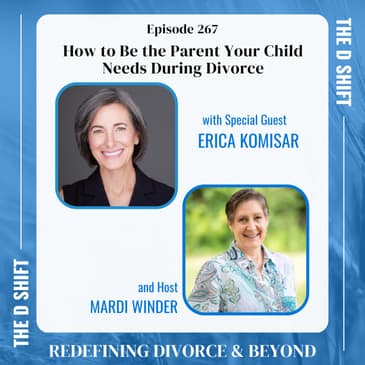
In this episode of The D Shift, Mardi Winder welcomes parenting expert, psychoanalyst, and author Erica Komisar to discuss how parents can minimize the emotional toll of divorce on their children. Drawing on more than three decades of clinical experience, Erica shares practical guidance for helping children feel secure, supported, and protected during one of the most significant transitions a family can face.
Together, Mardi and Erica explore the importance of emotional regulation, healthy co-parenting, grief, attachment, and why children should never become the messengers or emotional support system for their parents. They also discuss common mistakes parents make during divorce, how to navigate high-conflict situations, and why putting children's needs ahead of fairness can lead to better long-term outcomes.
Whether you are considering divorce, currently navigating it, or working to build a healthy co-parenting relationship, this conversation offers valuable insight into protecting your children while supporting your own healing.
Our talk focuses on:
• Why divorce is traumatic for children and how parents can reduce the impact
• The importance of emotional regulation during the divorce process
• How unresolved grief and anger can affect parenting decisions
• Why children should never be caught in the middle of parental conflict
• The dangers of oversharing adult problems with children
• How to support your child's grief without burdening them with your own
• Why consistency and stability matter during family transitions
• The challenges of high-conflict co-parenting situations
• What parents should consider before introducing a new romantic partner
• The realities of blended families and step-sibling relationships
• Why divorce should focus on children's needs rather than fairness between parents
About the Guest:
Erica Komisar, LCSW, is a clinical social worker, psychoanalyst, and parenting expert with over 30 years of experience in private practice. She is the author of Being There and Chicken Little: The Sky Isn’t Falling, and her third book on healthy divorce and parenting will be released in 2025.
Erica is a regular contributor to The Wall Street Journal, The Institute for Family Studies, and The Dispatch, and has appeared on CBS, Fox News, and The Diary of a CEO podcast. She is the founder of Attachment Circles, serves on the advisory board of ARC (Alliance for Responsible Citizenship), and has spoken at the United Nations on child development and emotional health. She lives in New York City with her husband and three young adult children.
To connect with Erica:
Website: ericakomisar.com
About the Host
Mardi Winder is a Strategic Divorce Consultant and High-Conflict Divorce Coach who helps high-achieving individuals navigate divorce with clarity, confidence, and control. Drawing on more than 30 years of experience in mediation, divorce coaching and conflict resolution, she supports clients in making smart decisions while reducing emotional and financial fallout, particularly in high-conflict, high-asset and complex divorces. Mardi is the founder of Positive Communication Systems, LLC, and the Strategic Divorce Directory, LLC.
For Mardi’s gift: The Resilience Building Blueprint: A 28-Day Journey To A Stronger You https://www.divorcecoach4women.com/rbb
Connect with Mardi on Social Media:
Facebook - https://www.facebook.com/Divorcecoach4women
LinkedIn: https://www.linkedin.com/in/mardiwinderadams/
Instagram: https://www.instagram.com/divorcecoach4women/
YouTube: https://www.youtube.com/@divorcecoach4women
Thanks for Listening!
Thanks so much for listening to our podcast! If you enjoyed this episode and think that others could benefit from listening, please share it using the social media buttons on this page.
Do you have feedback or questions about this episode? Leave a comment in the section below!
Subscribe to the Podcast
If you would like to get automatic updates of new podcast episodes, you can subscribe to the podcast on Apple Podcasts. You can also subscribe in your favorite podcast app.
Leave an Apple Podcast Review
Ratings and reviews from our listeners are extremely valuable to us and greatly appreciated. They help our podcast rank higher on Apple Podcasts, which exposes our show to more awesome listeners like you. If you have a minute, please leave an honest review on Apple Podcasts.
[00:00:05] Welcome to the D Shift Podcast, where we provide inspiration, motivation, and education to help you transition from the challenges of divorce to discover the freedom and ability to live life on your own terms. Are you ready? Let's get this shift started.
[00:00:23] Hello and welcome to this episode of the D Shift Podcast. And as always, we are going to be talking about things divorce, but in particular, we're going to be talking about children and divorce and parenting through divorce, which are big issues for most people.
[00:00:41] My guest today is Erica Komisar. She is a licensed clinical social worker, a psychoanalyst, and a parenting expert with over 30 years of experience in private practice. She's an author, a media contributor, and founder of Attachment Circles.
[00:01:01] And Erica has spoken at the United Nations on child development and mental health, as well as speaking to multiple news shows and different organizations and groups. So, Erica, thank you so much for being here today. Thank you for having me.
[00:01:19] Well, and I always welcome people coming on the show with expertise and guidance on helping children get through divorce, because I think I always say there's only two things in divorce that people disagree with, and that is the raising of the children and the money. And typically, raising of the kids is the big one or the kids' health and well-being during the divorce. So, Erica, how did you get into this area of work?
[00:01:45] Well, I'm a therapist, and I work in very high-conflict divorce cases. And so, over the many years that I've been in practice, I've been in practice for about 36 years in New York, I've seen really the effects, the negative effects that divorces can have on children,
[00:02:09] particularly if parents are consumed by their own pain to the extent that their pain and their anger towards one another, to the extent that the children get lost in the fray. And so, this book was really my effort to prevent some of the difficulties and the challenges that children will have because of the divorce process.
[00:02:33] I mean, you're not going to eliminate all of the challenges that divorce poses for children. It's still going to be, you know, divorce is traumatic, no matter how you cut it, but you can reduce a lot of the effect on children by divorcing in a healthier way. In fact, the original title of the book was A Child Healthy Divorce, and that's actually still the title in Europe for the book. Penguin has a different title in Europe.
[00:03:02] And so, here it's called The Parent's Guide to Divorce. But essentially, it's how to divorce and do the least harm to your children. Yeah, and I think that is so important. And I, too, tend to work mostly with high-conflict situations. And here's what I hear my clients say all the time, and justifiably so. So, I'm doing everything I'm supposed to be, but the toxic person on the other side has actually ramped up.
[00:03:30] And it, if anything, escalated their campaign of manipulation, gaslighting, scapegoating, golden child, you name it. They're doing all the things. And that's where I find so many of my people get so frustrated because they know they can't control the other person, but they also see the damage that's being done. And they feel like the courts aren't really doing anything.
[00:03:57] And I know that I'm sure that you hear the same thing with your clients. So, let's set aside that particular dynamic for right now because that could be a whole, like, month-long podcast just to deal with that. Let's talk about two adults that are going through divorce that, like you say, are really consumed by their own pain and grief.
[00:04:20] What are some basics that you would say that they need to look at to not only protect themselves, but also, and more importantly, to protect their kids through this process? Well, I mean, I do think that the courts are sort of overwhelmed and insensitive often and immune to the nuance of the pain that divorces cause children.
[00:04:46] So, if you're starving your child, if you're beating your child, if you're sexually abusing, if there's extreme neglect, then the court will recognize it. But if it's more nuanced emotional neglect or more nuanced emotional abuse, it's not really recognized. And I tell parents that when they're going to divorce, if they have any options at all,
[00:05:12] there are certain windows that you want to be careful to avoid if you can, you know, meaning if you've partnered with someone and you've had children, unless there's extreme abuse, there are certain windows where it may pay to stay together for a little longer if you can. One of those windows is zero to three. I don't recommend that people separate or break up or divorce if they have children from zero to three, unless the situations are very extreme.
[00:05:40] And I don't think people really realize when they divorce that they're going to lose their, I mean, I know it sounds like such a common sense thing that they're going to lose their children half of the time based on what the courts do today. But when you have such a young child who is, you know, going through attachment security and needs their primary attachment object and, you know, whichever parents, usually the mother, but it can be the father. Then, you know, going through a divorce during that period.
[00:06:08] There's some other sensitive periods as well that I don't recommend. And, you know, that the middle school years, I say, be careful if you can avoid those years of divorcing when your children are going through probably the worst time of their life might be a good time to avoid it. And then also try to avoid it when they are going away to college because, you know, these are things that you'd say, well, don't they make common sense? But I think people don't.
[00:06:36] So the concept that when a child is going to college, they need to feel attached to something that's secure. Right. So, yeah. So I think that the courts don't recognize the pain that is caused to children through this divorce process. But I think in the end, you can't change another person. You know, as you said a moment ago, sometimes you're working with a case where one parent is very reasonable and the other parent is not reasonable.
[00:07:04] And the court isn't going to recognize the subtlety of the unreasonable nature of the other parent. And so all you can do is control yourself, which is hard enough. I mean, you know, in our country right now, we know what it's like to sit down at a dinner table with people we don't agree with and not lose it. You know, it's very hard. So now imagine when you have a child at stake, how you can lose it very easily when you're in conflict.
[00:07:32] And I think working on yourself, working on your emotional regulation, working on creating a structure and a value system that you believe is good for your child and sticking to it, even if the other parent is trying to push you off of your path, you know, kind of stick to what is you believe is right for your child.
[00:07:57] And work with your child around understanding that they have two different parents who have two different set of rules in two different homes. And it's not always going to be aligned. But then when they come home to you, these are the rules and this is the way you do it. And although your partner, ex-partner may do it differently. So be your best self rather than always trying to change the other person when it's not possible, you know.
[00:08:24] Right. And that's with the exception of really abusive situations that are recognized by the court. And in that case, I say, you know, don't hesitate if you are concerned about serious abuse or neglect. Don't hesitate to go back to court. I know it's expensive. I know it's hard. But in those cases, you should not yield in any way. But in more subtle situations, yeah. I mean, I would say that parents need to work on their own pain.
[00:08:53] They need to work on their own emotional regulation. And they need to be their best selves for their children, even though their partner may have mental illness or a personality disorder or may not abide by the same rules. Yeah. And thank you for saying that. And I think, you know, one thing that I think that we can all agree on is that if the parents can at least agree to do no harm to the children, that is really the first big step.
[00:09:22] And I think that that even starts with how do you approach your partner about the fact that you're going through a divorce or you want a divorce or you want to end the relationship. And I think it's never too early to start talking about this is going to be tough for our kids. What can we do as parents to make this as easy for the children as possible? And I think so many people get caught up in their own issues during the divorce and they think, oh, well, the kids will be OK.
[00:09:51] And that's that's really bad. Yeah. And the truth is that, you know, this whole idea of an amicable divorce. I mean, in my very long career, I've seen only a handful of what we would define as truly amicable divorces. They're very unusual because in the end there's loss involved. Whether you initiated the loss or the other partner initiated the loss, there's loss.
[00:10:18] And so in the end, it does matter because if the other person had an affair or initiated the loss, you're going to feel rejected. You're going to feel abandoned. And these are very painful feelings, you know, to be loved and then left. But in reality, your children need you to be your most secure self. And so you need support. That's the first thing.
[00:10:41] You need to find yourself a really good therapist or someone you can bring that pain to and can be a container for that pain. So you don't leak onto your children because some of the most common things are that parents will, you know, leak. They they will overshare their pain with their children. They will share their anger towards their partner with their children. They'll bad mouth the other their partner.
[00:11:09] You know, and to remember that your children didn't ask to be born and they certainly didn't ask to be thrown into the middle of a high conflict divorce. And so protecting them at all costs in whatever way you can protect them. I mean, again, you can't control everything. There's two people in the equation, but protecting them at least on your side from your from your emotional challenges.
[00:11:37] I think that's the point of the book. It would be wonderful if two parents could read this book together and do it together and and go through the process. And that's what I recommend that, you know, you as early on in the process as possible, you read my book together and you talk about these things and you talk about how you want to go through this to protect your child. The reality is it isn't often that way. It's one person reading the book and the other saying, you know, I don't need to read the book or I'm not going to read the book.
[00:12:07] And so being being your best self and doing what's best for your child, even though your partner may not be their best self. Right. And that's I think that's the really positive message is that one parent doing the right thing is going to be way better for kids than two parents doing the wrong thing. That's right. So if your child comes back and says, well, mommy, you know, said you're a, you know, a bum and you don't pay child support.
[00:12:34] And, you know, and this is, again, leaking, you know, to say to your child, look, this is between daddy and I. And, you know, you know, it's OK to love your daddy and daddy. Daddy and I have to work this out. And you should not be in the middle of this. And and I'll talk to daddy. And, you know, don't worry about it. It's it's sort of getting your child out from being monkey in the middle. Right.
[00:12:58] You know, not having them deliver messages, not retaliating when your spouse is talking badly about you and telling your child things. And, you know, sort of being the grown up, you would hope that you have two grown ups because remember, your child is a child. Even if they're an adolescent, there's still a child. We say childhood goes on till 25 to 27, depending on whether it's a boy or a girl.
[00:13:23] So, you know, you're dealing with a child and that means that you have to be the adult. And you would hope that there's two adults in the room, but often there's only one adult. Right. And, you know, so one of the things that I think is actually a good initiative put in by the court system and it's it's not as adhered to, you know, COVID kind of shifted everybody's everybody's efforts to do a lot of this stuff.
[00:13:52] But in many states, there is the mandatory four hour co-parenting training that at least like I used to teach it here in Texas. And it was pretty it was pretty brutal. It was like, if you do this, this is what's going to happen to your children. And very upfront, we talked about different ages and stages, what to expect from your kids.
[00:14:15] And then we really focused on how parents needed to be emotionally regulated around their kids and how they could support each other. And one of the things we talked about a lot in that program was being flexible. You know, yes, your temporary parenting plan or your permanent one may say, you know, pick up at six o'clock, drop off at 9 a.m.
[00:14:38] Don't, you know, don't be so rigid that you can't exchange weekends and you can't accommodate for special events and other things. And as your kids get older, they don't want to spend weekends with either one of their parents, let alone go back and forth between homes.
[00:14:54] So even what can start out as a relatively good scenario when the kids are young, parents have to stay flexible perhaps for 10 or 15 or more years if they're in these long-term co-parenting plans. How do you see that being effectively done? Does time heal all wounds when it comes to, you know, this grief and loss and anger that goes along with divorce and parenting?
[00:15:24] Well, as you know, the grief process, the mourning process can be a very long process. And you go through different stages. Think of Kubler-Ross. And one of those stages is anger. Another is sadness. One's disbelief, you know. But you get to acceptance. And it can take years for, particularly if you were presented with a divorce and didn't want that divorce, didn't want to separate from your children half the time.
[00:15:52] You know, it can take many years to accept that this is something very real, that it's something that you have to realistically negotiate with another person. And so, and you, you know, unfortunately, you can't rush mourning. It's why I do say both parents and children would benefit from being in some kind of therapeutic process as they're going through it because it gives you a safe place to bring your feelings.
[00:16:17] And in many cases, you don't want to share those feelings with your relatives or your friends or you feel you've overburdened them. And you definitely don't want to share them with your children. So, so, so, yeah. So it's, it's, it's a very difficult and long process, the grieving process. And everybody goes through it in their own individual time. You know, you can't really rush it.
[00:16:42] And so hopefully, you know, the book isn't saying, you know, get over yourself and you have to get over everything. It's saying you need to have a place to go to grieve. Maybe many places to go to grieve. Maybe religion and faith is another place to grieve, but you just can't grieve with your child. You can, you can help your child to grieve, which is very important.
[00:17:06] So being there, listening, reflecting their feelings, understanding their, their sadness, their anger, not rushing them through or dismissing their feelings, not diminishing or demeaning their, the process they're going through, but recognizing it. But that's helping them to grieve. And that's quite different than, different than the grieving process yourself as a parent, which you also have to go through. You just, you can't do it with your child. Yeah. Yeah.
[00:17:36] So that's the difference, right? So when you're in the adult position, you're, you're not, you're creating places, compartments where you can bring those feelings. So you don't shed and leak onto your children. I really like that term leak, leak. That to me just resonates because it's like an oil spill. It just covers everything. Yeah. Yeah. I really like that. Now, here's, here's a question that I always get asked.
[00:18:04] And I am of the opinion that the longer you can stay out of your next relationship, if you have been through particularly a high conflict divorce, the better off you're going to be. And your kids are going to be because it gives everybody time to adjust and to settle into a new normal. And then slowly look at possibly integrating a new, a new partner. If it's a serious relationship.
[00:18:32] What, what are your thoughts on that? Like as a therapist, what, what advice, and I know everybody's different, but what advice would you say about this whole idea of a new partner, a new significant partner in your life? Well, so remember that your children have experienced probably one of the greatest losses that they will experience in their life, right? They, it's, it's tantamount to death.
[00:18:59] It's not the death of a parent, but it's the death of a marriage and it's the death of a nuclear family. So it's like a death. And so you just want to be sensitive that you don't, you know, that your children don't have to experience too many major losses of relationships.
[00:19:18] Or that the person that you're introducing them to is someone who you can see in the future in your life, someone you don't have to be married to them to introduce them to your children, but that you're very serious about committing to them. And they're very serious, you know, about committing to you.
[00:19:35] I mean, in the end, you can't really make a decision when you're choosing a partner and a blended family until you actually see the person you're dating with your children, because that's a very big piece of it, right? You're not just re-partnering or remarrying. You are actually choosing not just a romantic partner for yourself, but someone who's going to be good to your children and kind and generous and loving to your children and isn't going to resent them.
[00:20:04] And so, you know, you're not going to know for sure until you actually do introduce them. But you want to make sure that you've done all the litmus tests before to make sure that they are someone you could see yourself pairing with for a very long time before you introduce the risk to your children of having to lose. You know, it's very common, you know, as people are grieving, they meet someone else and they say, oh, I love this person.
[00:20:29] And they rush the process and then they introduce them to their partner and then they end up children get attached to that new partner and then they end up losing that partner because then the parent is right. No, they're not the right person for me. So, yeah, it's a balance. I mean, as I said, you can't really know if the person is going to be right for you until you see them with your children.
[00:20:52] At the same time, you want to be sure that you have kind of crossed all your T's and dotted your I's that this is someone you could see yourself being with very long term before you introduce your children to the risk of losing another person. Right. And then and we're almost out of time when I know we can't even get into this this area. But then there's the whole idea if they have kids now, how is that going to work for your children?
[00:21:15] Because I know sometimes the parents have the best of intention and but the the new step siblings are not on board with each other being in each other's lives. So it's a very complicated dynamic this moving forward. Yeah, yeah, it is. Blended families are very complicated, a little bit, usually a little bit more like oil and water than making a smoothie.
[00:21:42] And so, yeah, so so what I would say is just treated sensitively and don't expect your children to be joyful about your new partner. Don't expect anything. Don't expect that they should love their new siblings and treat them, you know, have few expectations of your children and just allow them to go through whatever process they need to. You know, they might be angry, they might be sad, they might not want to talk to the new partner.
[00:22:11] And that's got to be OK. And if the new partner can't bear that, then that's a litmus test of whether that person is right, because even if they were your even if they were the biological parent of that child, as you say, adolescence in particular is a time when children will ignore their parents and not want to talk to them and be angry at them and be rebellious.
[00:22:31] And so, you know, you want to make sure that your partner is up for and you're up for for them, too, with their children, that you're both up for the challenges not only of raising children together, but of raising each other's children together. Yes. Yes. Thank you. Thank you for sharing that. Erica, you have shared a ton of information and I think we could probably talk for several hours. I think we could.
[00:22:55] Because I think if there's anything that if there's anything that unites most parents is the desire to not harm their children through the process. I believe in every parent's heart, it's there. Sometimes it doesn't come to the surface and it's not demonstrated, but I think it's still initially it's it's there for for people unless they have like we talked about the personality disorders or some other reason why they're just not able to participate as a parent.
[00:23:25] Out of everything that you have shared, Erica, what do you think is the takeaway you want to leave people with today? Well, it's actually something that we didn't get to talk about yet, but I'm going to tell people because I think it might be one of the most important points of the book, which is that divorces aren't fair. It's not about fairness for you as the grownups in the room. It's about doing what's right for your children. So what may be right for your children may not be even Steven.
[00:23:52] It may not be an exactly 50 50 percent of time, you know, depending on what your children are going through, what developmental stage they're at. It's not fair. And so take the word fair out of it and think about what's good for your child at that stage, knowing that in the end, children will love the parents who put the children first as opposed to put themselves first. That is a wonderful point.
[00:24:21] Thank you so much for making that. Erica, if people want to find out more about what you do or want to reach out to work with you, what is the best way to do that? They can go to www.comisar.com and you can see, you can schedule an appointment with me. You can see, you can order my books. You can, there are links to Amazon and all kinds of sites. And then you can see all the articles I've written and different books that I've written. And so that's sort of the hub.
[00:24:49] And then I'm on, you know, Twitter and Instagram too, and they can follow me. And then Attachment Circles is a wonderful organization, which is about promoting attachment security and parenting. Wonderful. I will make sure all of that information gets in the show notes. Erica, thank you so much for being on here and sharing your expertise, your experience in helping parents. I mean, it just shines through in everything you do. So thank you so much. Thank you. Thank you for having me.
[00:25:17] And thank you everyone for listening to this episode of the D-Shift. And don't forget to tune in again to the next one. Thanks for listening and supporting the D-Shift podcast. If you would like to attend live trainings by our amazing guests and have a chance to ask questions and get answers from our experts, join the D-Shift crew. For more details and to sign up, head on over to www.divorcecoachforwomen and click on the podcast page.