
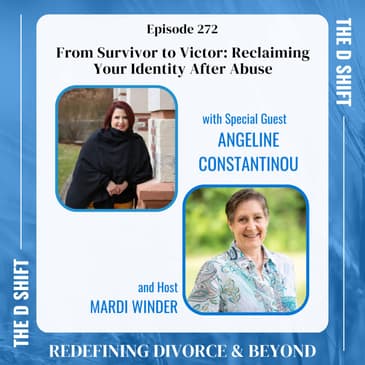
Leaving an abusive relationship is rarely as simple as walking away. Fear, shame, financial concerns, family expectations, and emotional manipulation often make the decision incredibly difficult. In this episode of The D Shift, Mardi Winder is joined by women's empowerment coach and podcast host Angeline Constantinou to discuss the realities of domestic abuse, emotional healing, and rebuilding life after trauma.
Angeline shares how she survived years of abuse, found the courage to leave, and ultimately transformed her pain into a mission to help other women reclaim their confidence and identity. Together, Mardi and Angeline explore the many forms abuse can take, including emotional, financial, psychological, and coercive control, while emphasizing that every person's journey is unique.
The conversation also highlights practical steps that can support healing, including developing a safety plan, seeking trusted support, challenging limiting beliefs, practicing self-care, and recognizing that recovery is a process rather than a single decision. They discuss why leaving an abusive relationship is often the most dangerous time, why financial abuse is so common, and why survivors should avoid sharing details publicly while legal proceedings are still underway.
Whether you are personally facing an abusive relationship, supporting someone who is, or simply want to better understand the challenges survivors experience, this episode offers encouragement, practical insights, and hope that life after abuse is possible.
Mardi and Angeline highlight:
• Understanding the many forms of abuse beyond physical violence
• The emotional impact of shame, guilt, and manipulation
• Financial abuse and unexpected financial challenges after divorce
• The importance of creating a safety and exit plan
• Rebuilding confidence and identity after trauma
• Why sharing your story can become part of the healing process
• Finding support through trusted professionals and community resources
About the Guest:
Angeline Constantinou knows the pain of feeling trapped and unheard. After breaking free from an abusive relationship, she made it her mission to help other women do the same. As a Women’s Empowerment Partner and founder of Let’s Break the Silence, she created a space for survivors to heal, rebuild confidence, and reclaim their future. She’s not just a coach or a speaker; she’s been there. And now, she’s here to remind women that they are stronger than their past, worthy of joy, and capable of creating a future on their own terms.
To connect:
Website: https://letsbreakthesilence.com/
Facebook: https://www.facebook.com/angeline.constantinou/
IG: https://www.instagram.com/angeline_constantinou/
About the Host
Mardi Winder is a Strategic Divorce Consultant and High-Conflict Divorce Coach who helps high-achieving individuals navigate divorce with clarity, confidence, and control. Drawing on more than 30 years of experience in mediation, divorce coaching and conflict resolution, she supports clients in making smart decisions while reducing emotional and financial fallout, particularly in high-conflict, high-asset and complex divorces. Mardi is the founder of Positive Communication Systems, LLC, and the Strategic Divorce Directory, LLC.
For Mardi’s gift: The Resilience Building Blueprint: A 28-Day Journey To A Stronger You https://www.divorcecoach4women.com/rbb
Connect with Mardi on Social Media:
Facebook - https://www.facebook.com/Divorcecoach4women
LinkedIn: https://www.linkedin.com/in/mardiwinderadams/
Instagram: https://www.instagram.com/divorcecoach4women/
YouTube: https://www.youtube.com/@divorcecoach4women
Thanks for Listening!
Thanks so much for listening to our podcast! If you enjoyed this episode and think that others could benefit from listening, please share it using the social media buttons on this page.
Do you have feedback or questions about this episode? Leave a comment in the section below!
Subscribe to the Podcast
If you would like to get automatic updates of new podcast episodes, you can subscribe to the podcast on Apple Podcasts. You can also subscribe in your favorite podcast app.
Leave an Apple Podcast Review
Ratings and reviews from our listeners are extremely valuable to us and greatly appreciated. They help our podcast rank higher on Apple Podcasts, which exposes our show to more awesome listeners like you. If you have a minute, please leave an honest review on Apple Podcasts.
[00:00:04] Welcome to The D Shift Podcast, where we provide inspiration, motivation, and education to help you transition from the challenges of divorce to discover the freedom and ability to live life on your own terms. Are you ready? Let's get this shift started.
[00:00:21] Hello and welcome to this episode of The D Shift Podcast. Today we are going to talk about a serious topic, but also a topic that can be an incredible springboard and an incredible area of personal growth and development for people going through divorce and particularly women.
[00:00:41] So I want to introduce my guest, Angeline Constantinou. She has an amazing backstory, so I don't want to give you much of her backstory because it's so inspirational. But she did get out of a very abusive relationship and has created this mission and passion to help other women do the same.
[00:01:03] She is a women's empowerment partner and founder of Let's Break the Silence, where she has created a unique space to help survivors rebuild themselves, get comfortable with who they are, and really be able to look forward to a positive future. So, Angeline, I am so glad to have you on the podcast. I was recently interviewed on Angeline's podcast. We're going to talk about that in a little bit.
[00:01:29] So thank you for being here because I so appreciate the message and your mission. Thank you so much, Marty, and thank you so much for having me on your show. And it was a pleasure to have you on my podcast show as well. And we'll talk about that later too.
[00:01:44] Yeah, and I think this whole, you know, it's sad to say this, but it seems like it's been maybe the last, I'm going to say five or six years, that there's really been a lot more open dialogue and discussion about the hidden parts of abuse and the long-term impact on survivors of abuse.
[00:02:11] And I think this whole, you know, and I think this whole, that there's really been a lot of people that you had to say, but it's really been a lot of people that you have. And I think this whole, you know, that you have a lot of people that you have to say, but you also have an amazing backstory, Angeline. So can you talk to us a little bit about how you got here and why this is your particular area of focus? Yes. And thank you again for having me on your show. So let me share a little backstory. So once upon a time, I used to be, I used to be married to whom I thought was going to be the love of my life.
[00:02:39] And, um, he worked in New York city, direct mail advertising. And, um, he invited me to work with him. And this was back in 1987. And then we officially tied the dot in 1988. So anyways, it's 25 years old and, um, it just seemed to be the norm then.
[00:03:02] And, um, and he did not reveal who he truly was until later. So meanwhile, I, um, generated six figure income in, in the business. We were married. We had a house in the Hudson Valley of New York state and also a place in New York city, but something happened. So, um, so.
[00:03:32] Gradually he had taken off the mask and he started, he started to display like narcissistic behavior, beating gaslighting manipulation. Um, there was love bombing in the beginning and I was, you know, like the love bombing. I didn't even know what it was. I was like, Oh wow. You must be really, really be in love with me. But that was not the case.
[00:03:57] And there was physical violence to the point where I was in the hospital all night on Ivy because I broke my nose. Um, my nose was broken resulting from him throwing me against the wall, falling backwards in the house. And, um, I was bleeding. I had black and blue all over my face and it was really bad. And I was crying and, um, he took me to the hospital, which is not unusual in these types
[00:04:25] of situations to, to cover it up. Um, so anyway, so fast forward then in 2008, the stock market crashed. And we lost over $150,000 in savings in the stock market. So different stocks and he, and then I found out later that, and you know, that's when
[00:04:50] I started to go work out and work in corporate America to make a name for myself because I felt that I had lost my identity. So people will ask, why didn't you leave earlier? Um, with, with, um, women who are in these situations, it's not that easy to just pack up and leave. Um, because like I was brought up in a Greek strict family and we were conditioned, like
[00:05:19] I said, to believe that you marry for better, for worse, for richer or poorer, who cares if he hits you, blah, blah, blah. And that's it. But that was not me. So I finally stood up for myself. And for the last three years before I've actually the last two years before I filed for divorce, I worked on myself. And I got to meet other people. I got, I started to get involved in the online space and it changed my life.
[00:05:47] So I got myself into a room with other, with other women, men, coaches, mentors. And, um, so it ignited a fire in me and I just said, I am going, so I made a plan. Right. So before you leave, always make a plan. And, um, so that's what I did. I had some, um, savings put aside, thank goodness, which, you know, I had to dig and do all that.
[00:06:17] So, so I had some savings put aside. I had about three months of savings. The divorce took about a year, but you know, people welcomed me into their homes. I was basically living like a gypsy for one year because they do they, and I asked for help. So one of the things is don't be afraid to ask for help. If you need help in these situations, don't be afraid, even if you have to send out an SOS. Right.
[00:06:44] And there's so many resources that are available to survivors, to victors of domestic violence, the national domestic violence hotline. So there's many, many resources that actually was not available when I went through it. So I did research. I went to the public library. I did some research and I gotten to, you know, involved in the online space.
[00:07:10] Like I said, with the health and wellness company that at that time, at that time changed my life. And then fast forward to now, the last five years have been challenging, meaning for, especially for women, because as they're, because COVID happened. Right. So that means that people were stuck in the house. So then I had a vision before COVID to start my podcast and community.
[00:07:39] Let's break the silence with Angeline to empower survivors. And I was recently in Tampa a week and a half ago for, because I'm also a co-author.
[00:08:02] I am a published author of this book series called Breaking the Silence Voices of Survivors. And so there, I am one of 20 authors. I wrote my chapter. I shared my story and my story is having an impact already. Right. Right. Yeah. So, yeah.
[00:08:23] So it's, it's been really life-changing for me to be able to give that space for women to amplify their voices. Cause there's a lot of trauma out there. There's a lot of women who I know are suffering, but they don't need to suffer anymore. They don't need to be in that place. You can, you can come out of that on the other side and reclaim your identity.
[00:08:52] Because one of the things that I talk about in my podcasts and coaching programs is being able to reclaim your identity and your confidence. Yes. And that requires letting go. I call it the baggage, letting go of the baggage and your belief systems. Yeah. That have been imposed on you. So, and I think that this is, so the reason I really thank you for sharing that. Sure.
[00:09:21] And the reason I think that is so important is because a lot of times people have this image of who, and this is going to be very stereotypical, but I worked as a domestic violence client advocate for six years. And one of the things that I would hear all the time was women would come in feeling absolutely guilty. Didn't want their families to know what was going on.
[00:09:45] Didn't want their friends and certainly didn't want people at their place of employment knowing what was going on. Because, you know, there, like you said, a lot of times there is this sense of guilt. And a lot of times the abuser, whether it's actual physical violence, which is horrible, but we also know of all the other kinds, you know, coercive control and narcissistic abuse and financial abuse and emotional abuse.
[00:10:12] And we know about the long-term traumatic impacts of these. And let's face it, a lot of times, unfortunately, our friends and sometimes even our family members try to warn us about the danger, the dangerous person we were entering into a relationship with. And so, you know, if people have to, in order to support victims, or I'm going to use the word victim here, I don't particularly like it. I love the word survivor or victor instead.
[00:10:42] But when you're trying to get out, you truly are a victim of the other person because this is when we know statistically, this is when they become the most aggressive and the most dangerous. And even when, perhaps when there hasn't been physical violence in the past, this is where physical violence, like when the partner actually gets strong enough and builds up that courage to leave, now all of a sudden the abuser has no control anymore.
[00:11:11] And it quite often sends them to a much elevated level of aggression. Oh, a lot, a lot. Because they're losing control. Right. They're losing control. And they don't like to lose control. Right. They want to control that person no matter what. You know, because unfortunately there was manipulation. He manipulated our finances.
[00:11:36] He wrote out balance transfer checks against our mutual funds, resulting in losing over $50,000. So I found myself in the hole because they were joint accounts. Right. So, and I was able to pay it off. Well, congratulations for that. And unfortunately, there's a lot of women out there that aren't in that situation.
[00:11:57] And I'm hearing more and more about like really weird tax stuff that has been going on for the last, you know, sometimes decades where, especially if there's a, especially if it's a cell phone business where business funds have been siphoned off so they don't ever show up on the balance sheets. And now all of a sudden going through the divorce. Well, guess what?
[00:12:20] Some of this, somebody else now is looking at these financial records and all of a sudden all these issues are coming to the surface. Well, you know, there's likely going to be some kind of action taken if there's actual fraud being perpetuated. I mean, attorneys can't turn a blind eye to the fact that fraud is going on. So they have, so a lot of times this stuff comes to the surface. And here's what bothers me the most, Angeline.
[00:12:47] When the IRS gets that information and comes after people for back taxes, they come after everybody. They do. Anybody that has money. So it doesn't matter whether your divorce decree says you're not responsible for taxes. The IRS supersedes anything that's on your divorce decree. That's my understanding. That's true. We're both not attorneys. Yeah, we both need to. I had to pay. You ready for this? Last year, it was an old debt.
[00:13:15] Going back, it was going back to 2008, 2009. So this was a little bit of a scary moment for me, but I worked through it. So I received a notice from the bank that they froze, my account was frozen. So I investigated and it was an old debt that he was not responsible for paying. Right. Yeah. I wasn't even aware of it. Right.
[00:13:42] So I called the company and we worked out a settlement. I said, look, this happened during my divorce. I had no idea this happened. It was $10,000. Yeah. Yeah. $10,000. Yeah. And I was like, can we just do a payment plan or something? So they said, no, you have to pay the whole thing. So we're selling for $8,000. I said, okay. Right. Pay it off and that's it. So. And sometimes that's, you know, and this is the stuff that out of the blue can come up.
[00:14:13] And it's unfortunate. I think in some areas, things are getting a little better. Yeah. Where the part, in some states and in some jurisdictions, I know that the person can be mandated to assume all of those debts. Um, and then that, and, and even in the United States here, the, the opportunity may exist if you meet the criteria to file for what they call innocent spouse. Innocent spouse. Right. For those years.
[00:14:42] And again, if you're concerned about this, um, you know, cause we know financial abuse goes along with almost every kind of abuse. It's, it's kind of involved in a lot of these cases. Talk to your attorney or your legal professional or call the IRS and find out, would you qualify for innocent spouse and see if you get it. Yeah. So had I known that I would have done that because it was an old debt. It was an old debt going back.
[00:15:08] And I know, I know there's very specific criteria and I don't know enough about it other than I know it exists out there. Um, so let's talk a little bit about, about flipping the corner. Now, let's say, how do, how do you see, or how do women make this shift from the victim to the victor in their life? If they're coming out of these abusive situations? Okay. So the first thing is self-awareness and to surrender.
[00:15:38] So I drew a line in the sand. I surrendered and I called myself out and I said, this is it. I am no longer a victim of my circumstances. I'm no longer a victim of domestic violence. And so, um, I took ownership. That's what I did.
[00:16:03] So once you take ownership, that's a release in itself because you're releasing the old, the limiting beliefs. So it requires a lot of, so I sought mentorship to help me remove old beliefs, just shatter the beliefs. Systems. That's the first thing. Shatter those beliefs that were instilled on you because the abuser will tell you that you're no good. You're not good enough.
[00:16:32] You're not going to make it in life. Right. And I was told that and I proved him wrong. So it's mentorship. It's being able to identify those hidden blocks because they're, because you're not conscious of it at first. Right. So I did mirror work. I did the inner work. I do sound healing meditations.
[00:16:57] And that helps because the sound and the light goes into your nervous system. So nervous system regulation. Right. So I do all that and I teach all that now. Yeah. Then we start with journaling, journaling, keeping a gratitude journal and start with writing at least three things that you're grateful for today. Always wake up.
[00:17:24] You know, like for me, it's waking up and taking my first breath. Right. And being in that state of gratitude. So, and being in the present moment and not worrying about what's going to happen three months from now and not focusing on the past. So we, so in essence, what you have to do is you have to unlearn everything that you did learn in marriage.
[00:17:49] And, um, so I help women with that and I take them through that journey and I help them remove the limiting beliefs. So they can step into their true identity and reclaim their power. Because once you do that, you've already reclaimed your power. You're halfway there already. Yeah. Oh, I love that. That's so powerful. Yeah, it is.
[00:18:17] You reclaim your power and now you've taken a stand. Now you're ready to move forward and live this new life that you were destined to live. And thank goodness. It's brought me to, um, with let's break the silence. I'm seven years into the podcast with 193 episodes. And I'll be recording two more episodes. That'll be 195.
[00:18:43] And the podcast in the women's empowerment category in the top 100, it's ranked 54th. I don't know where it is now, but this was three weeks ago when I was looking up the stats. So over 5,000 downloads. One of the episodes that I did reached 3 million viewers. Wow. And then I shared my story online in March of 2018. It spiraled to 7 million views because someone was impacted. So your story.
[00:19:14] So it's a combination of rewriting your story and I'm, well, and sharing it to the public. Right. Like just go public and share it. Like some people would be like, what? I'm like, yeah, go public and share it. Right. And don't be afraid of what other people think. Right. And release, you know, like I was done with people pleasing because, you know, like you talked about some family members, you know, they're, they're going to judge, they're going to judge you.
[00:19:39] Um, and they may think it's from a place of love, but it's not, it's not from a place of love. So be your own person, be authentic, be real, share your story. Your story will have an impact on so many people's lives. It even just one or two people. Right. Like I remember this, she was a lady from the UK and she shared it in every single Facebook group.
[00:20:05] Like I was like, and then people kept commenting, commenting and commenting. Like I didn't post anything else for two days. I said, I'm just going to let this real go and everything. So, um, and this is from holding my phone in my one bedroom apartment. Yes, it was shaking because I was the biggest trigger of going to Facebook live, but I took ownership of my mentor said, you got to go Facebook live and share your story. And that's what I did.
[00:20:31] And there's many ways to share your story because I can hear some people saying, well, first of all, I'm going to say this. Don't share your story in the middle of a divorce because. No, no, I didn't do that. No. Yeah. This needs to be after. And just because I were right. And at the beginning. It was seven years later. So it's okay though. That's okay. Yeah. After, after things have calmed down and after you're, after you have healed, because you don't want to keep repeating a story if you're right. Right.
[00:20:59] You know, if you're dealing, but I love the idea of sharing your story. I think that is incredibly powerful. And if you don't want to do it in a public way, if you're thinking like, I, well, I don't want to do a Facebook live or I don't, you can even, um, you know, you can share it with people in your neighborhood. I did that in the beginning and I wrote a blog. I wrote a personal blog. Right. Right. So I was blogging. See, that's part of it. Writing. Yeah. So I didn't go live at first. And actually, I'm glad you brought that point out.
[00:21:28] Do not go live during your divorce. Do not say anything. Right. Don't tell people what your plans are. Work behind the scenes. Yeah. So like I shared only with close friends and family members where I was going, what I was doing. Right. And, you know, and that, and be private. Yeah. Because he will find out. Eventually they'll find out.
[00:21:53] And I was going to say, so, you know, most, most areas will have, um, some kind of a community resource, some kind of outlet. If you're in a rural area, like I am, you might not be in your community. It might be in the next community or the next county over, or the next area over. If you're in a big center, you typically have more services. Um, some church groups, uh, will provide, um, uh, you know, support. They have meetings. That's what I do.
[00:22:19] Um, you can, most, most, uh, domestic violence shelters have some kind of group activity that you can participate in. And if you're in the recovery phase in the victor mode, I'm going to call it recovery and healing and rebuilding. Sometimes going back and sharing with women that are very early in the journey of getting away from the abuser. Um, you know, you don't need to know the answers, but for those women, just seeing that somebody
[00:22:47] got out and now is, is moving forward in life is, can be really inspirational and supportive. Oh, absolutely. Absolutely. When they see that, it inspires them. Yeah. And they know that they can move forward now because I, I, if I could do it, anyone else could do it. Yeah. And this is, this is a very, um, you know, this is a very sensitive topic for a lot of people. There's a lot of, um, depending on your culture and your religious beliefs and everything,
[00:23:17] like you talked about, you know, the idea of, well, once you got married, you're supposed to stay married and you're just supposed to make the best of a bad situation. Um, so yes, I mean, and that, that's unfortunate, an unfortunate reality. So don't try to convince people of why, like, I think that's a waste of your energy and your, your, you know, your mental and physical energy to try to convince people that are going to be against what you do, that you were doing the right thing.
[00:23:44] Just know in your heart, you know, that you did the right thing and you got out to save yourself. Yeah. Sure. Yeah. I saved myself. Yeah. No one is coming to save you. Yeah. No one's coming to save you. I was able to get out and I was able to move. So that's another thing. Like he didn't know until the tail end of the divorce that I was moving. And when I moved, I had a witness there. Right.
[00:24:12] And, you know, I brought very little furniture, but I had boxes of clothes and everything. And I know, you know, and he was there, but the fact that I had a witness helped. Right. So, and after that, there was no contact. Yeah. After. Yeah. After I moved. So that was another, cause you know, we didn't have children. Right. So that was one thing off my back. And I know that there are some women out there who do have children and some have been very good at co-parenting. Right.
[00:24:42] Yeah. Sometimes it works. Not always. Not every, right. Sometimes it works. And so, um, I'm just going to throw this in there. One of the, two of the biggest reasons that, that women stay in those relationships are children and pets. That's right. Yeah. I know. Yeah. Oh yeah. They'll fight over pets. Yeah. Yeah. Or they're, you know, the abuser will threaten to kill or harm the pet or give it away or just horrific things.
[00:25:08] Again, again, because they're, it's a master manipulation game they're playing. So, and you, you've just shared a wealth of information and, and I, I, it's, it's a sad thing that we're still talking about this in 2026. I know women are still going through this every single day. The, but it's also wonderful to know that there are resources and services and support
[00:25:34] once they decide that, okay, I don't, I don't want to be here and there's no shame if it takes a while to get to that point. Um, so, but when you do make the decision, there are resources out there to support you. So, Angelina, of all the things we've talked about, um, what do you think is the most important thing you want people to remember as they go on about their busy day? Okay. So, what I would say is never lose hope.
[00:26:04] Hope may not be a strategy, but to get through the day, believe in yourself, have faith in yourself, have faith in the process and learn to love yourself. Because when you love yourself, eventually you'll be able to love on others, but work on yourself, give yourself grace, give yourself that self-care because that's so important,
[00:26:30] especially after, after being out of domestic violence and trauma and narcissistic abuse, take care of you first. Yeah. And that's what I did. I got involved in dancing. I got involved with yoga. I would go to a yoga studio and just take yourself out. Take yourself out. Yeah. Do something nice for yourself. What a great way to wrap this up. Now, if people want to find out more about you and get access to the podcast so that they
[00:26:59] can listen in, what's the best, what's the best way to do that? Okay. All right. Perfect. So people can go to my website, which is letsbreakthesilence.com. There you will find my podcast. Let's Break the Silence with Angeline. You will find my speaking. You will find my coaching programs. Plus you will find all my social media platforms.
[00:27:23] So I'm on YouTube, Instagram, Facebook, and LinkedIn, and also on TikTok. So I'll make sure that you have all the links in the show notes and my podcast. I have two podcasts. So Let's Break the Silence with Angeline, which is my signature podcast. You can find that.
[00:27:46] Like and subscribe on Spotify, Apple, iHeartRadio, and all the Amazon music and all the live streaming platforms you listen to. And her unapologetic voice where Marty shared. We had an amazing conversation last week. It's real and raw talk, real and raw talk for women.
[00:28:08] So you can also find that on Spotify, Apple, iHeartRadio, Amazon music, and all the live streaming platforms that you listen to. Plus on my YouTube. So my YouTube is Let's Break the Silence with Angeline and her unapologetic voice. When you, so when you type it in the search bar, it'll come up, but yes. And they're also on my website. So going to the website is probably the most direct and I'll make sure all that information
[00:28:37] is in the show notes. So Angeline, thank you so much for being, uh, being on the podcast today. I really enjoyed this conversation and again, really hopeful message for people that might be facing really difficult situations. Yes, definitely. Especially in the times that we would live in today. Yes, absolutely. So have a beautiful day, everyone. Thank you, Angeline. And thank you everybody for listening to this episode of the D-Shift podcast. And don't forget to tune in to the next one.
[00:29:06] Thanks for listening and supporting the D-Shift podcast. If you would like to attend live trainings by our amazing guests and have a chance to ask questions and get answers from our experts, join the D-Shift crew. For more details and to sign up, head on over to www.divorcecoachforwomen and click on the podcast page.