For generations, women were taught a fairly predictable story about creating a family: find the right person, get married, and then have children. But what happens when life does not follow that sequence?
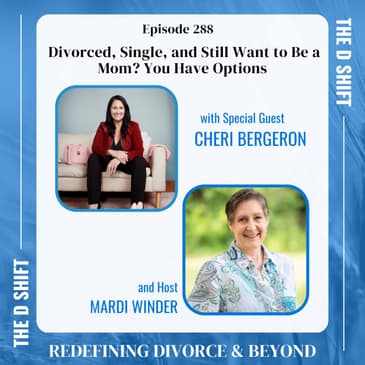
In this episode, Strategic Divorce Consultant Mardi Winder talks with bestselling author, speaker, life coach, and nonprofit founder Cheri Bergeron about motherhood, divorce, fertility, and creating a family on your own terms.
Cheri shares her personal journey from believing she needed marriage to “earn the right to motherhood” to becoming a single mother by choice. She talks openly about fertility treatment, donor conception, becoming a mother in her 40s, and grieving the traditional family story she once expected while discovering that a different path could still create the family she deeply wanted.
This is a hopeful conversation about self-trust, understanding your options, and recognizing that the end of a marriage does not necessarily mean the end of your dream of motherhood.
Questions We Explore
Q: What if you are divorced and still want children?
A: Divorce does not necessarily close the door on motherhood. Cheri discusses several paths that may be available and why learning about your options can help you make choices that reflect what you truly want.
Q: Why is understanding fertility earlier in life so important?
A: Cheri explains that many women learn about reproductive timelines much later than they wish they had. Understanding fertility and available options earlier can provide more opportunity to think intentionally about future family planning.
Q: Can you become a mother later in life?
A: Cheri shares her own experience with fertility treatment and donor eggs, including having children in her 40s. Individual circumstances vary, making personalized medical guidance an important part of exploring fertility options.
Q: How do single mothers by choice talk with their children about their origins?
A: Cheri believes openness, honesty, and age-appropriate conversations can help children understand their individual family story while building trust between parent and child.
Q: What if the family you create looks nothing like the one you originally imagined?
A: Cheri encourages women to allow themselves to grieve the traditional story they expected while remaining open to another possibility: different does not have to mean less meaningful.
About the Guest:
Cheri Bergeron is a former tech executive turned bestselling author, speaker, life coach, and nonprofit founder. After a 10-year struggle with divorce and infertility involving IVF, donor conception, genetic defects and child loss, she gave birth to her children in her mid 40s. Driven by these experiences, Cheri wrote the #1 Amazon bestseller Mission: Motherhood and started Cheri's Choice to help women navigate non-traditional paths to motherhood on their own terms—with clarity, confidence, and choice.
To connect with Cheri:
Website: https://www.cheribergeron.com/
Facebook: https://www.facebook.com/missionmotherhood
LinkedIn: https://www.linkedin.com/in/cheribergeron/
About the Host
Mardi Winder is a Strategic Divorce Consultant and High-Conflict Divorce Coach who helps high-achieving individuals navigate divorce with clarity, confidence, and control. Drawing on more than 30 years of experience in mediation, divorce coaching and conflict resolution, she supports clients in making smart decisions while reducing emotional and financial fallout, particularly in high-conflict, high-asset and complex divorces. Mardi is the founder of Positive Communication Systems, LLC, and the Strategic Divorce Directory, LLC.
For Mardi’s gift: The Resilience Building Blueprint: A 28-Day Journey To A Stronger You https://www.divorcecoach4women.com/rbb
Connect with Mardi on Social Media:
Facebook - https://www.facebook.com/Divorcecoach4women
LinkedIn: https://www.linkedin.com/in/mardiwinder/
Instagram: https://www.instagram.com/divorcecoach4women/
YouTube: https://www.youtube.com/@divorcecoach4women
Thanks for Listening!
Thanks so much for listening to our podcast! If you enjoyed this episode and think that others could benefit from listening, please share it using the social media buttons on this page.
Do you have feedback or questions about this episode? Leave a comment in the section below!
Subscribe to the Podcast
If you would like to get automatic updates of new podcast episodes, you can subscribe to the podcast on Apple Podcasts. You can also subscribe in your favorite podcast app.
Leave an Apple Podcast Review
Ratings and reviews from our listeners are extremely valuable to us and greatly appreciated. They help our podcast rank higher on Apple Podcasts, which exposes our show to more awesome listeners like you. If you have a minute, please leave an honest review on Apple Podcasts.
[00:00:04] Welcome to The D Shift Podcast, where we provide inspiration, motivation, and education to help you transition from the challenges of divorce to discover the freedom and ability to live life on your own terms. Are you ready? Let's get this shift started.
[00:00:21] Hello, and welcome to this episode of The D Shift Podcast. And today we're going to talk about a topic that is not talked about enough. And that is about the whole idea of divorce, motherhood, and creating a family and how we can, as women, we have a lot more options than we used to have. And it doesn't necessarily depend on having a partner or being married as to how we want to have our family.
[00:00:48] So I have an amazing guest. Cherie Bergeron is a former tech executive turned bestselling author, speaker, life coach, and nonprofit founder. And I am going to, I'm going to mention Cherie's book is Mission Motherhood. And I think that that, oh, it's back there. Yay!
[00:01:10] It's funny. I just love that mission motherhood. And it's mission semicolon motherhood or colon motherhood. And I think that, you know, this whole idea of women being able to navigate perhaps paths that weren't open to us to be able to go ahead and have families. So Cherie, welcome. Thank you so much, Mardi. I appreciate it.
[00:01:32] And I gave a very short bio about all the amazing stuff that's with you. But tell us, how did you get into this space? Because this is, you know, this is a long way from being a tech executive. It is. And it was not the path that I planned at all. I will tell you that when I was, you know, coming out of college, I had the momentum of feminism behind me.
[00:01:56] And I was pursuing my career with, you know, vigor. And I enjoyed all the financial independence and self-determination and adventure. And, you know, the higher I climbed in my career, somewhat, I didn't like the view always in terms of what the behaviors were and things like that. And in my 30s, I started, I didn't really grow up knowing for sure that I wanted children, but I grew up in a traditional family.
[00:02:26] And I thought, well, one day I'll meet the right person and then I'll just magically get pregnant. And my life just didn't evolve that way. I really struggled as a successful career woman to find the person I wanted to have a family with. And, you know, when I was in my 30s, my biological clock just really started ringing in my ears, I think, as it does for a lot of women. And a friend said to me, well, if you're going to do this thing, you better get on it.
[00:02:53] And so I chose a man who, in the book I call Prince Convenient, not exactly Prince Charming, someone who looked good on paper. And I felt that I needed to be married to earn the right to motherhood. And so I kind of force fit that fairy tale that I had been holding. And for me, that was not a very good choice because we were fundamentally misaligned.
[00:03:19] And I spent eight years trying to make that incompatibility work. And it never worked. And so ultimately, when I was in my early 40s, I ended up choosing to become a single mother on my own. And I had my children at 44 and two weeks from my 47th birthday.
[00:03:43] But it really was those attitudes that I had about marriage and family and how they had to be linked that sort of kept me stuck for a lot of years. So you and I really hear what you're saying. I have worked with so many clients who have told me, I went in my wedding dress, in the limo, to the church or wherever they were getting married. And I sat in that car and thought, nope, this is not the right thing to do.
[00:04:12] What am I doing? I don't really love this person, but he's not that bad of a guy. And everybody's already here. So what the heck? I might as well just go through with it. And literally, you know, did this. Now, you did something, though, that I think takes a lot of courage. You went through your divorce and then you decided to have, and then you proceeded to create a family, which is amazing.
[00:04:39] How did you come to that decision or what, where did you get that courage from? Because a lot of women I'm thinking are going to go, well, I could never do that on my own. And that's the belief. I think that's the fear. I'll tell you that I didn't start the journey off on my own.
[00:04:59] I started the IVF process with my then husband, even though we were struggling with compatibility. And ultimately, it's such a long story, probably more than what we have. But he, we had some loss along the way that really started to erode what little foundation we had. And at one point, I wanted to continue and he didn't.
[00:05:29] And he said, well, if we're not together, I don't want to have anything to do with any children. And that I said, okay, this is, we've crossed over into an area that I just cannot deal with anymore. That's, that was really the impetus for me to become a mother on my own. And I remember saying to him, I said, I'm going to become a mother with you or without you. Right.
[00:05:57] And that's probably not the best recipe for a great marriage, but that's where I was. And so we separated before I knew that I was pregnant with my, I had a daughter and a son who, unfortunately, my son passed at 19 days. I'm sorry.
[00:06:45] I was willing to go through the other unknowns. And I think one of the things that we have to do as women, if we find ourselves in a position of being divorced without the children that we want or with an incomplete family, there's some self-trust there for one, but also some grief. We have to go through the grief that we're not ending up with the traditional fairy tale that we've been taught to want.
[00:07:09] But I think as we process that, we can say, you know what, it might not be traditional, but it will still be beautiful because it's coming from love and something that I want to give to another human being and give to the world. And so I'm so glad I pushed through those reservations or those concerns because I can't imagine not having my son that I had using an anonymous sperm donor.
[00:07:36] I'm so, I'm so grateful that he's in my life. Yeah. Yeah. Yeah. And I mean, your love and your passion comes shining through. And so I think that's probably the biggest statement on that one. So, and this may be a personal question. Sure, if you don't want to answer this, don't.
[00:07:54] But did you get any, or do you feel, not you specifically, but do you feel that women who are maybe say over 35 or even over 40, does it, is there even pushback from the professional like IVF community about whether or not that should be something you do? Or did you find people were, the professionals that you went to were pretty open and said, yes, we'd be happy to help you.
[00:08:23] Well, when I went to the fertility doctor's office, I was 40. And so what the clinics are going to tell you is that biology isn't all that forgiving. And I think, you know, the thing is, we get sex education as young people in high school, middle school, but no one teaches us about reproductive timelines.
[00:08:44] And so that's a big part of the mission that I have through Cherie's Choice is to help educate younger women in their 20s and 30s about what these, you know, biological realities are and how we can proactively plan if we want to have children a bit later. So what the clinics will tell you is, you know, our egg quality diminishes and our ovarian reserve diminishes.
[00:09:09] And the later we go and sitting there at 40, my options to have a healthy pregnancy on my own were very slim. And as a educated, independent woman, I thought, how did I miss this? How did I not get this memo about these realities? And in some ways, I think I was dealing with cultural messages without a lot of real information. And in some ways, I don't think I wanted to know I was afraid to know.
[00:09:37] And so I chose to use an egg donor. And what I learned was that if you use the eggs of a younger woman, in my case, say a 27 year old, that even in my 40s, my odds of having a healthy pregnancy and birth were about the same as hers. And that was a huge revelation to me.
[00:09:56] Of course, I had to be willing to forego my genetics being used, but to have the odds be a lot higher to have a healthy baby and be able to experience the joys of carrying and pregnancy and delivery and all of those things from the beginning. That felt like a gift. And so, you know, I think not enough people know there's embryo donation, there's egg donation.
[00:10:23] There are these options available even for an older woman. I had a very healthy pregnancy almost at 47. You don't. And the reason I asked that, and I realize that's a personal question, so thank you for answering it. No, there's no. I spill all the tea in my book, honestly. I spill it all. Yeah, because I do know.
[00:10:47] So I've known other people that have gone through the IVF process, and I have actually a client whose daughter is doing it right now. And she is a single woman in her late 20s, and she doesn't ever want to marry. That's just not. I need her number. I love her already. I don't know her. I love her. Yeah, and she's just very strong. She wants to be on her own.
[00:11:10] And she had some difficulty when she went to different clinics because they just told her, well, you know, it's too expensive. It's too costly. It's too difficult for you to try to do this on your own, and you need a partner. And she eventually went to somebody who was more than happy to provide her with the service.
[00:11:30] And at the same time, the first two or three clinics she went to, they were like, no, we would prefer that you have a partner, that it's going to be a, this is what they told her, a stable household. And I'm putting that in air quotes, a stable household. Thinking, yeah, like every two-parent household is a stable household. Right. Yeah, I mean, one only needs to look at the divorce rate and other things.
[00:11:55] But what you're bringing up, Marty, is so critical because we think we've come such a long way in society and with feminism. But these beliefs that, and many of them are not very helpful, are woven into the fabric of our society and into even our medical communities. And this is why we as women have to be really well educated. And we need to be strong in what our idea of happiness is and what our priorities are.
[00:12:23] And I would love to connect with her. I applaud her even in her late 20s for knowing and being so clear about what she wanted. Because what I learned is that choosing the wrong man and then ultimately our daughter has really suffered from some of those aspects of divorce. And I think that if a woman has the power to say, I'm going to have a child on my own and perhaps spare a bad decision of divorce,
[00:12:52] then that can really make a positive impact on the lives of your future children. I mean, you know, obviously, if you're in a bad marriage, don't stay in it. You know, if you really feel that for yourself, you know, you need to be free of that. Your children will likely be healthier as a result of not seeing that dynamic. That was a real driving force for me. I didn't want that.
[00:13:17] But wow, I applaud her insight into herself that she, you know, knew that her path was going to be different. So I celebrate that. But I think it really is interesting that the doctors were sort of putting their own personal values on her journey. And I'm glad she found somebody else. And this is way off topic. And this may, again, you don't have to answer any questions.
[00:13:46] Do you think maybe the same gender relationships have helped promote the different paths to fertility, you know, with LGBTQ plus couples now being able to conceive or have, you know, surrogates? And there's so many different options now. Do you think in some way that that has freed up a little bit of the options that women or people in alternative relationships
[00:14:16] or whatever it may be are able to at least explore these options a little more openly than maybe it's been in the past? Or I don't know. I mean, I think that those groups are one very important set of hopeful parents that often need to use fertility treatment. So I think that's good.
[00:14:40] But I will tell you, it hasn't been all that long that society felt that a same sex couple was an inferior model as well. And there are still many people who believe that, right? Well, the same is true of single mothers by choice. People in our society can think that that is an inferior model. But I will tell you, I've seen a lot of research that suggests that single mothers by choice have very healthy, well-adjusted children
[00:15:06] who don't feel like they have been dealt a bad set of cards or sort of disadvantaged in any way. They have incredible loving connections with their parents. Sometimes it's been simpler than a traditional family, especially some that may have had some problematic things. I think it's all to, this is a personal journey of discovery for someone who wants to be a parent. And who are we to judge them?
[00:15:36] You know, I think everyone has the right as, you know, especially in our country to life, liberty, and the pursuit of happiness. And why we seek as a culture to judge that, I think is a real misstep and kind of overstepping what we should be doing as a society. So again, I applaud the same-sex couples that take, you know, that take those steps and want to build a family together.
[00:16:02] And I also applaud that woman who was young but still said, well, marriage isn't for me, but parenthood absolutely is. Yeah, and I love that term you used, hopeful families. I love that. Or hopeful parents. I think that's fantastic. Now, one thing, so I am adopted. My sister was adopted. We grew up knowing we were adopted. My mom had cancer, had a hysterectomy way, way back in like 1963.
[00:16:30] So it was, you know, it was a relatively new process and there wasn't much. Like, you know, there was adoption. That was really the only, or fostering kids. So they chose to adopt. And I grew up knowing from like Jump Street that I was adopted. Those were not my biological parents. And it was very natural and very normal. And I still love them, mom and dad. I called them mom and dad all my life. Never had any urge to look for my biological parents at all.
[00:16:59] How do parents who are single moms, how do they approach that with their children who are, like you said, maybe not genetically related to them, but we're carried, we're birthed, we're loved like crazy. Do most single moms then offer that level of transparency? Or is that really an individual decision?
[00:17:23] You know, for one, I love that your parents were so open with you because I think at that time, the majority of adoptions were very closed and very secretive. And I think what they found with research over time was that that was not very helpful to the children who may or may not want to seek more information about their identity. And that really is up to the child.
[00:17:47] But I think it's the parent needs to be a supportive participant in whatever that journey is that their child chooses. And so I think the same is true in a single parent situation or in a donor situation, where if you're open and transparent and honest and loving in those conversations, it's never, there's never a stigma to it.
[00:18:13] You know, my conversations with my children have always been that I wanted you so much that I sought help from a doctor that allowed me to do that. And then over time, share those pieces of information with them openly. And so what I've heard from so many single mothers by choice is that, or even the adult children of those single mothers by choice, is that someone might try to make an insult. Oh, you don't have a dad or something like that.
[00:18:42] And for those who had this open, transparent understanding of their origin story, it didn't, it didn't, it didn't injure them. Just like with you, like if some said, oh, you're adopted. Yeah, yes, I am. And you know what? I have a loving family. And I'm special because they chose me and these kinds of things. And so the same is true of children of SMCs that I think they feel incredibly lucky to have the parent that they have. And it's their normal.
[00:19:12] Right. And so, you know, I think it's really the openness and the transparency that builds the trust with your parent, between parent and child. So, and I think that's so true. I had a very good friend who I went to school with and we didn't know until in, she was about 25 and she had a health issue. And anyhow, there was a need for medical information from the parents.
[00:19:38] And at that point in time, everybody kind of in the family started backpedaling about this whole, who is mom and dad and the family. And it turns out she was adopted, but she had grown up all her life thinking those were her biological parents. And it really hit her hard. She was dealing with this serious health condition. Then she found out this thing about her parents. And even though they were loving and everybody rallied around her, it was a real shock for her.
[00:20:05] And it took her a long time to kind of come back into the family because of that. She just felt so betrayed by everybody. You're right. That's exactly a matter of trust. And then there's this idea of what was real. I was somehow living some kind of lie. And I think it's, that is where like secrets imply that there's some shame, that there needs
[00:20:30] to, you know, there needs to be, there's a reason why the truth can't be told openly and honestly. And I think that is the by-product that you want to avoid by being open and transparent about it. And I think something else, and we're almost out of time here, but I think something else is having advocates like yourself be able to talk about this and share, you know, the,
[00:20:57] because the stereotypical single mom, you know, kind of living out of her car, not able to care for her kids. This is not what's happening in the vast majority of situations where a child, obviously your kids have to be very planned if you're going to go through this procedure. So it's not like a, you know, an impulse on New Year's Eve where all of a sudden somebody's pregnant. This is a very planned out path.
[00:21:23] And a lot of, a lot, I'm sure a lot of consideration and effort went into choosing everything at every step along the way for these planned pregnancies that you went through. Well, you're right. As a single mother by choice, I think we give a lot more thought and planning into all the various aspects of it than sometimes a married couple might because it was just sort of the natural thing to do.
[00:21:46] But what I really want to say to the women who may find themselves divorced and they haven't fulfilled fully their dreams of motherhood, this isn't, this doesn't have to be the end. It truly doesn't have to be the end. And I think if you feel that it's your calling, a big part of your purpose to be a mother, I just want to encourage you and I want to support you in any way that I can. And just know that there, there are possibilities for you.
[00:22:15] You do have options and I want to see you have the family that you want. That is the perfect way to wrap up this episode. Cherie, I have one last question though. If people, if somebody's listening and they're thinking, I want to find out more, I want to connect, what is the best way for people to reach out to you? They can go to Cherie's Choice and connect with me there. Also, I'm on Instagram, TikTok, LinkedIn, just look for either Cherie's Choice or Cherie Bergeron.
[00:22:43] And I am going to get all of that information and it will be in the show notes so that it's even easier for you to find. You can just look down below and you will find everything. Cherie, thank you so much for being here and sharing your expertise and experience. And I think you have just given such a hopeful, a hopeful message to this. So thank you so much. Thank you. I appreciate it, Marty. And thank you everyone for listening into this podcast.
[00:23:07] I hope this has inspired you and maybe it doesn't apply to you, but maybe you know a woman in your circle that is, that has expressed these kinds of issues, concerns, wishes, desires. Share this podcast with her so that she can get in touch with Cherie as well. Thank you so much for listening and don't forget to tune in to the next episode. Thanks for listening and supporting the D Shift Podcast.
[00:23:30] If you would like to attend live trainings by our amazing guests and have a chance to ask questions and get answers from our experts, join the D Shift crew. For more details and to sign up, head on over to www.divorcecoachforwomen and click on the podcast page.