
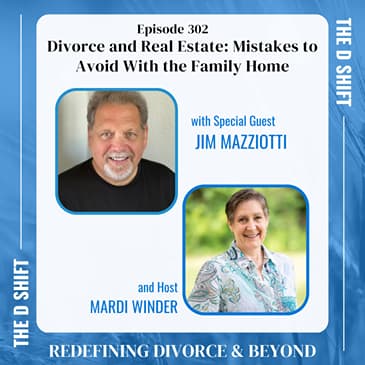
Deciding what to do with the family home during divorce can be one of the most emotional and financially significant decisions you make. For many people, particularly those navigating gray divorce after decades of marriage, the family home represents much more than a financial asset. It holds memories, provides a sense of stability, and may represent a significant portion of the couple's shared wealth. Understanding your options before making decisions can help you avoid unnecessary financial and emotional complications.
In this episode of The D Shift: Redefining Divorce and Beyond, Strategic Divorce Consultant Mardi Winder welcomes experienced real estate professional Jim Mazziotti to discuss the challenges of managing real estate during and after divorce. Drawing on more than 30 years of real estate experience, Jim explains why selling or keeping a home during divorce requires a different approach from a traditional real estate transaction.
Together, they explore the importance of understanding home equity, mortgage obligations, property ownership, and the financial realities of maintaining a home independently. They also discuss common mistakes, including making decisions too quickly, choosing a real estate agent without divorce-specific experience, and assuming that keeping the family home is always the best option. Jim shares why having the right professional team and reliable information can make a significant difference in protecting your financial future.
Questions Answered in This Episode
1. What should you do first when deciding what happens to the family home during divorce?
Before making decisions, obtain a current market evaluation of the property and review your mortgage information, including the outstanding balance, interest rate, and whose names appear on the loan and title. Understanding how much equity exists and what financial obligations remain provides a starting point for evaluating your options. Jim also emphasizes the importance of getting professional guidance before making major decisions about moving out or selling.
2. What are some common real estate mistakes people make during divorce?
One of the biggest mistakes is reacting emotionally instead of gathering information and developing a plan. Moving out of the family home without legal advice, failing to understand the property's value, or assuming a particular outcome is guaranteed can create unnecessary complications. Jim encourages people to slow down, ask questions, and build a team of professionals who understand the unique financial and legal considerations involved in divorce.
3. How do you know if you can afford to keep your home after divorce?
Keeping the family home involves more than determining its current market value or negotiating who receives it in the settlement. You also need to establish whether you can qualify for a mortgage independently, particularly if you have been out of the workforce or have relied on your spouse's income. Working with a divorce lending professional can help you understand financing requirements and whether keeping the home is a realistic long-term option.
4. What happens when divorcing spouses disagree about selling the family home?
Disagreements over the listing price, selection of a real estate agent, or timing of the sale can quickly become additional sources of conflict. Jim explains why objective market evaluations, accurate local property information, and an experienced real estate professional are important in these situations. He also discusses the challenges that arise when one spouse believes the agent is favoring the other and why trust and transparency are essential.
5. Why is it important to choose a real estate professional experienced in divorce?
Selling a home during divorce often involves additional legal, financial, and emotional considerations that are not part of a typical real estate transaction. Jim recommends looking beyond an agent's years of experience or number of sales and asking about their specific experience with divorce-related transactions. Professionals who understand the importance of neutrality, communication, and collaboration with attorneys, financial specialists, and divorce consultants can help clients make better-informed decisions while minimizing unnecessary conflict.
About the Guest:
With 34 years in real estate spanning Iowa, Oregon, and now the Dallas–Fort Worth Metroplex, Jim Mazziotti brings rare depth to every transaction. A former franchise broker/owner, Principal Managing Broker, published author, and certified Coach, Trainer, and Speaker with the John Maxwell Team, he holds designations including SFR, SRES, and MRP. He is the founder of the Senior To Seniors podcast and serves clients at EXIT Realty Elite in Grapevine, Texas. He has spent more than 20 years coaching agents and speaking nationally on real estate strategy, mostly to real estate agents and brokers. Married 46 years to Leann, father of three, and grandfather to two — Jim understands that behind every real estate decision is a real human story. Today he's here to help you navigate yours and to provide you with information that will directly benefit you.
For Jim’s gift: https://www.jimmazziotti.com/
To connect with Jim:
Website: JimMazziotti.com
LinkedIn: linkedin.com/in/jimmazziotti
Senior To Seniors Podcast: https://podcasts.apple.com/us/podcast/senior- to-seniors/id1774531212
About the Host
Mardi Winder is a Strategic Divorce Consultant and High-Conflict Divorce Coach who helps high-achieving individuals navigate divorce with clarity, confidence, and control. Drawing on more than 30 years of experience in mediation, divorce coaching and conflict resolution, she supports clients in making smart decisions while reducing emotional and financial fallout, particularly in high-conflict, high-asset and complex divorces. Mardi is the founder of Positive Communication Systems, LLC, and the Strategic Divorce Directory, LLC.
For Mardi’s gift: The Resilience Building Blueprint: A 28-Day Journey To A Stronger You https://www.divorcecoach4women.com/rbb
Connect with Mardi on Social Media:
Facebook - https://www.facebook.com/Divorcecoach4women
LinkedIn: https://www.linkedin.com/in/mardiwinder/
Instagram: https://www.instagram.com/divorcecoach4women/
YouTube: https://www.youtube.com/@divorcecoach4women
Thanks for Listening!
Thanks so much for listening to our podcast! If you enjoyed this episode and think that others could benefit from listening, please share it using the social media buttons on this page.
Do you have feedback or questions about this episode? Leave a comment in the section below!
Subscribe to the Podcast
If you would like to get automatic updates of new podcast episodes, you can subscribe to the podcast on Apple Podcasts. You can also subscribe in your favorite podcast app.
Leave an Apple Podcast Review
Ratings and reviews from our listeners are extremely valuable to us and greatly appreciated. They help our podcast rank higher on Apple Podcasts, which exposes our show to more awesome listeners like you. If you have a minute, please leave an honest review on Apple Podcasts.
[00:00:04] Welcome to The D Shift, where we provide inspiration, motivation and education to help you transition from the challenges of divorce to discover the freedom and ability to live life on your own terms. Are you ready? Let's get this shift started.
[00:00:22] Hello and welcome to The D Shift today. And if you're looking for information about what to do with the house, going through a divorce and post-divorce, I have a real expert on the show with me today. Jim Mazziotti is a seasoned realtor serving the Dallas-Fort Worth area, but he's also worked in many other states. He actually works with the team. He has a very different approach. It's not just a transactional sell your house.
[00:00:49] Jim and his team will help you with the logistics, the decision making, the actual home sale, the disentangling of the relationship and all of the stuff. And I think the really phenomenal thing is supporting you with the emotional issues that we've talked about many times are focused around that idea of the family home. And so Jim is a podcaster. He has his own podcast called Seniors to Seniors.
[00:01:15] He also has he's an author. He's a coach. He trains. He just does kind of all the things. So, Jim, welcome. Hey, thank you so much for the invitation. I appreciate being here. Well, I love having people that are experts. And I have to say, I'm really excited because Jim is in Texas, as I mentioned, in the Dallas-Fort Worth area.
[00:01:36] And so Texas is one of those unique states because it is a it is a community property 50-50 state, which has a little bit of a different play sometimes on assets in the relationship. So before we dive into all of that, Jim, tell us a little bit about your story and why you now focus on a much more comprehensive support service for people that are looking at selling during or after a divorce.
[00:02:05] Yeah, I think, you know, I think I've adapted to what has been needed. You know, I try to approach real estate, which is a very transactional business and try to make make it more transformational and especially in the divorce part of it, because it's transformational when you go through a divorce. Right. And and so I think the ingredients of both are really, really important.
[00:02:31] I came from I'm actually 72. I started real estate in 1992 in Iowa, small town, Iowa. And, you know, when I started in real estate at that time, there were no such thing as credentialed real estate agents in divorce. There was nothing available. So you just kind of learned by doing it.
[00:02:58] I've really had three different parts of my life. I spent my first 10 years of real estate in Iowa, small town, Iowa. I spent the next 20 years in Oregon and in Oregon, I worked in resort properties, which is interesting dealing with divorces as well.
[00:03:20] And then I also opened my own brokerage where I had 30 agents that worked with and for me. So worked primarily as a coach and a trainer and discovered I learned much more from agents than I really knew, because the agents were the ones that went out, got the specialty credentials that they needed for real estate, whatever it might have been.
[00:03:46] And so I spent the next 20 years in Oregon. Actually, probably the best part of my life and the most enjoyable part of my life. About five years ago, came to Texas because my wife told me I had to. We have kids. Our three children moved here because jobs were here when they weren't available in Oregon.
[00:04:07] Property was affordable here and it wasn't where we were in the central Oregon, which is very resorty and upscale. And they got jobs and we had a baby. We had a grandchild. So once a grandchild was born, my wife told me that we're going to Texas. And if you'd like to go with me, you're welcome. You know, that was kind of a crazy approach.
[00:04:33] And when I let one of my agents know the very next day that my wife gave me that ultimatum, so to speak, I sold the real estate office to that person, which is usually a very difficult deal. Selling real estate offices is not easy. And so that's kind of my story.
[00:04:53] I've had a 34 year run in real estate and I transitioned from being, you know, the first 10 years, kind of a general real estate agent, learning everything that I needed to learn. The next 20, really running a brokerage training and coaching people. And for these last five, I've morphed into specializing in dealing with seniors. That is kind of my thing because I am one.
[00:05:21] And, you know, I found that seniors probably need, it's a different kind of help, Marty, than other people. It's completely different. Even in the divorce area, you know, where seniors 65 and over, about 15% of all seniors go through divorce that are 65 and over. If you're 50 and over, I think it's like one third. It's, you know, it's more.
[00:05:50] But the climb for seniors has happened in the last few years where we're seeing more seniors looking at the option of divorce. And you probably know this. You're the expert in this area for sure, Marty. But you probably know that when I started in 1992, women didn't have the same financial capability that they have today. It's a much different world. Right.
[00:06:17] And, you know, in 1992, when I dealt with clients, women going through divorce, it was like, I don't know what I'm going to do. I don't have choices. And it's far different now where women are obviously 50% of the workforce. They are able to support themselves in many cases. And so it's a whole different area.
[00:06:44] And so dealing with seniors is kind of what I have morphed into. And I love it. I love working with seniors because they need help. Yeah. And what I found in real estate, there's about 1% of all agents that really know what divorce is all about, how to deal with divorce. Right.
[00:07:04] The problem, Marty, with real estate agents that I think everyone should be aware of is most real estate agents, this is a generality, but most agents are doing everything. They're looking to close a transaction. It can come from a buyer, a seller. It can be in North Dallas, South Dallas. It can be in Texarkana. A lot of agents will do whatever they need to do to make a living.
[00:07:34] So there isn't as much of a specialization in real estate. So that is what's really important for people to know. If you are in a position that you need someone that has expertise in real estate, be very careful in choosing the real estate agent you work with. Right.
[00:07:58] My approach has been to assemble experts around me. I don't know everything. But the people that I work with do know the things that I don't. Right.
[00:08:16] So you need, I believe, you need to look for a real estate agent that is willing and capable of relying on a team if they don't have the expertise. And again, 1% do. Right. So it's, right. And so I've put together a team with people like you. On my personal real estate team, I have an agent who is a certified divorce real estate expert.
[00:08:45] And so when I work with someone, obviously, I'm not going to play the role. I'm not going to fake it till I make it. Right. You know, and a lot of people will do that. So for, I rely on her to help me with it. And of course, I have finance, a financial expert. I have attorneys. I have people around me that I can go to.
[00:09:12] And I'm willing to admit that I don't know everything. But I'm willing to reach out. Well, and I think that's so important. And so there are, you know, there are a few designations that people should be looking for. And I think that this is where what you don't know can really hurt you if you are the person going through the divorce.
[00:09:35] Because, you know, you just assume if you hire a realtor or a real estate agent that these people have some level of training. And they're all going to say this. Nothing against them. They're all going to say, yes, I've handled a lot of home sales and divorce. And they probably have. But did they do the best for the clients? Who knows, right? Yeah, you are totally spot on. And so that's why, you know, you need to be so careful.
[00:10:03] And you need to do a background check. One thing that's always bothered me in this business is relying on the number of years that a person has been licensed. And the number of transactions they've done to grade them on are they the right agent. Now, you know, my team and I owning my brokerage, we've done over 2,000 transactions in the 34 years.
[00:10:32] But I don't know that I'm any brighter than anybody else that's done 20. I've been in the business 34 years. But I know there's a lot of people that have designations that I don't have that know more than I do. So, Marty, it's so important.
[00:10:49] Find somebody who is willing to slow down, to listen, especially listen, and to educate and to help you get through the divorce that you're going through. Yeah, and I think this is a good – thank you for saying that. And I think this is a good time, Jim, to kind of jump into this. Let's talk about what are some of the common mistakes that you see people make. And most of the people listening to the podcast are going to be women.
[00:11:19] And, you know, they tend to be across all ages. But the majority of my clients are going through what they call the gray divorce, which you're right, is the largest demographic, the only divorce demographic that's actually increasing in the rate of divorces in that group. Yeah. So, let's talk about some of the common mistakes that you think that people should be aware of so they don't accidentally, you know, step into those pitfalls.
[00:11:46] Well, I think the biggest mistake is to be reactive. And, of course, anybody going through – I haven't gone through a divorce, but I certainly understand it working with people and even family situations. I think it's to get informed and not be totally reactive to the whole situation. You know, again, slow down and listen. I always talk about, you know, for me, I'm a man of faith.
[00:12:16] And I believe that it's important to look in, look out, and to look up. And I think that advice works for all people if you just do that. I'd say there are five things I would recommend for anybody, especially a woman who's going through a divorce.
[00:12:36] First of all, if there's property that's owned, husband and wife, common property in Texas, we know that it's community property here, that you get a market evaluation immediately. That is – that's one of the first things to do. Get a market evaluation so you know what you're talking about. You know, you want to pull a mortgage statement. You want to know the payoff amount.
[00:13:04] You want to know what the interest rate is on the loan, the mortgage that you have. And you want to know whose name the mortgage is in, right? And a lot of times people don't know. They buy a house. Things are thrown together quickly. Paperwork is flying all over the place. And they're not even sure how they took title, what name is on the loan, and so forth.
[00:13:31] And you want to find out how much equity there is. So those are the – that's number one thing to do. The second thing I would recommend is check both names on a title, okay? Check to make sure sometimes people don't realize. I think one of the important things – I think you'd probably agree with this – is if you're a woman, do not move out of the house hastily. Do not just leave the house.
[00:14:00] Now, there are situations where it might not be right. It might be dangerous. Yeah, yeah. But don't move out without legal advice, okay? I think that's hugely important because occupancy – occupancy during divorce can have huge implications. When you go down the line, when you look at your rights and an eventual settlement.
[00:14:28] And I would say next is to assemble your team early. You know, get the market evaluation. Know your equity payoff amount. Don't leave the home hastily. And look for a team. I would say, although there are different people might say different things, a realtor might be the first person you talk to.
[00:14:55] But it should not – absolutely should not be the person that you hang your hat on for everything. So I think you need a team. You need a certified divorce specialist. You need somebody, Marty, like you. You know, you are the person that has gone through this. You've mediated. You have vast experience. And you know the ropes. You know the ups and downs. You know far more than I do.
[00:15:22] So, you know, if I have somebody and there are questions, guess who I'm calling? I'm calling you because you are going to help guide them. And you would say the same things, I'm guessing. Yes, absolutely. You need an attorney. But an attorney may not be the first person you call. Right. You know, but you need an attorney. You absolutely need a financial expert. You absolutely need that expert because you're going to – this is not just a one and done deal.
[00:15:52] Right. You need somebody that can help you plan for your future. And, you know, so there are certified divorce financial analysts. There are people – what I tell everyone, and this isn't a plug of any kind, but I can find people all over the United States just like I do referrals for real estate.
[00:16:17] If somebody's moving to Massachusetts and they need a referral and they need to know an agent, I do the same thing when somebody comes to me and says, you know, we're going through a divorce. And they're calling me from Iowa. We're going through a divorce. What I will do is very carefully and methodically look at agents that have background and expertise in the area. And here's the key. I interview them. I actually interview them and I say, I have a client in Texas moving to Iowa.
[00:16:47] They're going through – or that lives in – whatever. There's a divorce involved. Tell me about your team. Tell me about your expertise because it's more than one person. It's many people. So I think those are the first things to look at. Have a four- or five-point plan to move into this. I think that's hugely important. And I think that – and you're so right. That's exactly the same way when I'm making a referral. It's either somebody I personally know or somebody I've reached out and talked to before I even mentioned the name to my client.
[00:17:16] But the other thing that I think that – the one thing I would like to add, and I completely agree with everything you said, Jim, is I think the other thing is, particularly for women, if you have taken time off from the workplace to raise kids, you're not going to – those don't get credited to you for things like Social Security and all that kind of stuff.
[00:17:38] So I think for women in particular, talking to a lending professional and making sure they can even qualify for the mortgage. Because a lot of women just assume they can assume the mortgage. You typically can't. So you've got to qualify on your own. And if you don't have any income, you can't count alimony until you've collected it for six months. And a lot of times, even then, it's got to continue, I think, for at least three to five years or something.
[00:18:07] There's a timeline in there. And again, this isn't my area of expertise. So I refer out to a certified divorce lending professional and say, hey, can you run the numbers and see if he or she will even qualify? Because there's no point in spending all this time if you don't qualify for the mortgage. You might as well leverage that ability to say to your partner, hey, I would – you know, I know you really want the house. You don't have to say I won't qualify. You can leverage it. Yeah.
[00:18:36] And you don't want people to find out that they can't have a house that they've looked at and want. I've made that mistake, you know, and I learned from it. Where I showed property to a person, they said, oh, we love it. Oh, I love it. I've got to have it. And I failed to do what I needed to do with a mortgage professional, with a financial expert that told them that, yeah, you do qualify for a loan.
[00:19:05] I actually had a woman in an office. I took her into the bank and wanted to make sure that the offer that we had made, that she could get financing. I assumed – I was early in my career. This is 1994. I assumed she could. And as I sat outside the room where she was meeting with a lender, I could – it was a windowed room and I could see her. And then I saw her, you know, break down in tears.
[00:19:32] And when she came out, she said, this is all your fault. You showed me a house that I can't have. We even wrote an offer on a house that I can't have. Why did you do that to me? And I learned from that. And that situation can happen. So you need to reach out to experts, a team of experts. Yeah. Jim, so this is a question that I hear quite often.
[00:20:02] And I don't want to put you on the spot. So if this isn't your – you know, what you handle with your clients, just say, ah, we'll pass on that question. I'm good with that. Let's say the couple has agreed. Nobody wants to retain the family home. Everybody wants to move somewhere different. Or maybe they want to – maybe one wants to go where the grandkids are. And one wants to go to, you know, an adult community or whatever may be going on.
[00:20:28] And what happens when the couple agrees to sell the house as part of the divorce settlement, but they can't agree on what the asking price would be or they can't agree on a realtor? I mean, I've had people say, well, we both had realtors for the sale. And I'm thinking, oh, my gosh, I can't believe what a nightmare that would probably be for the professionals involved and for the people. So what typically happens in situations like that?
[00:20:57] You know, so many times I actually am contacted by an attorney that is asking for my help to provide the couple, the divorcing couple in this situation with a market analysis. And so what's key, I think, for the person going through a divorce is finding somebody that they know has experience in the divorce field but in pricing property.
[00:21:26] And price can be and has been in my career. It's been a bump in the road, you know. And I especially in small town Iowa, I dealt with couples and they knew both of them knew me, you know, that was difficult. But I had one situation where the husband and wife knew me. We knew each other really well. But it turned out that the husband didn't trust me.
[00:21:57] And so he wanted a different real estate agent. I walked away from that. I said, you know, if we can't work together, I understand. I don't want to create more problems. But it can be difficult. I think when I'm working with a couple on pricing of a home, I have to provide them with the information that is backed up, dependable, and that is accurate.
[00:22:22] And I think I do that really well because I've done it for so long. But not all realtors are built the same, right? And there are some who will go to Zillow or go to Trulia or Realtor.com or some of the easy tools to come up with an evaluation. So make sure you get somebody that's dependable.
[00:22:50] A lot of times testimonials can help. Okay? So the couple asking for testimonials from other couples that have gone through divorce or other couples that have sold, I think can help. And really, it's really a safeguard. But it can be very difficult, Marty. There's no question about it.
[00:23:11] I really try to shy away from a lot of transactions for a divorcing couple where I'm representing both of them. Although it's messy, it can be difficult. I need trust. I need to. And I don't want one or the other to feel that I am favoring the other. Right? It's just, it's difficult.
[00:23:35] But I think you have to look with somebody with experience and professionalism and make sure that they know what the heck they're doing. And, you know, here's another thing, Marty. Another thing to be careful of. For instance, in the Dallas Metroplex, 8 million people, right? And there's agents that might come in this area that I focus on. Okay? I have a geographical area. I work. And I know it.
[00:24:02] I know it really well because I've been doing it. But there are agents, they're real estate agents and they're licensed, but they don't work this area. So be very careful that they understand the area, they know the area, and they have expertise. Yeah. And, Jim, I think this is a perfect time, if you don't mind. I know you've got a gift for everybody who's listening who may be interested. Can you just tell us a little bit about that home clarity call that you're offering? Yeah. Thank you for that.
[00:24:31] What I'm offering everybody that's listening is a 20-minute consultation. Now, I don't claim that we'll get through everything in a 20-minute consultation. But what I'm hoping is I can guide you. I can be your guide for your next steps. You know, we talked a little bit about, you know, the steps today, the first steps.
[00:24:56] But I can also help them with my team explaining to them who they need to connect with. I usually will suggest that they do, you know, their own due diligence for attorneys, for CPAs, for whomever. But my job is to provide them with the very best people I know in the business. So the consultation is a 20-minute consultation.
[00:25:22] Regardless of where you live in the United States, I'm able to help you with that consultation. And it's likely if you live outside of my area, I'm not going to be the realtor that you'll work with. But what I have done for the last 20 years being part of a franchise company called Exit, I know 400 agents around the country. I've talked to them. I've met them. I've partied with them.
[00:25:51] We've done business together, right? And so I believe I can find and interview the right people. And so with this consultation, I'll just give you some ideas that I have and see if they're helpful to you. And people can reach me by going to jimmazziati.com backslash appointment. Okay? And I'll make sure all of that's in the show notes. Yeah, of course.
[00:26:18] My website's jimmazziati, two Zs, two Ts, jimmazziati.com. And I'll get them there. I'll help them. And that is such – thank you for that. That's very generous of you. Jim, before we let you go, what do you think is kind of one big takeaway that you'd like people to have to remember from this conversation? Yeah, I think, you know, I have dealt with working with divorced people.
[00:26:44] And I call it the three Cs when I work with them. I want total clarity for – so I work with clarity. I want to know about credit, the next C. And the next one is control. I know that decisions are made on information.
[00:27:06] And so providing the right information, not through fear or urgency, but through thinking things through. So clarity, credit, and control. Know that you have control of the situation if you put the right team together. A perfectly terrible situation, you have to find the best direction for you. Right?
[00:27:36] Wonderful. I think that's a really good reminder for everybody. If it's real estate or whatever, that kind of applies right across the board. Jim, one last time, what's your website? And again, I'll make sure it's in the show notes. But just in case people want to listen to you, tell it one more time. Yeah, my website is jimmazziotti.com. My last name's spelled M-A-Z-Z-I-O-T-T-I. I'm just a little bit Italian. jimmazziotti.com.
[00:28:06] And you'll find my site. And then you'll find on there the way that you can connect. And I'd love to talk to you. Again, I don't claim to be the expert of all things. But I know the people who can help you, I believe. Wonderful. And I just have to say this. For the Canadians and Europeans listening, that is M-A-Z-Z-I-O-T-T-I. I did not know that. My mother is Canadian or she's passed away. But she was from VAMP.
[00:28:34] That's where she grew up. Oh, okay. So I'm red deer just down the road is where I spent most of my life. So there you go. Well, Marty, we might be related and we don't even know it. Who knows? Who knows? Jim, thank you so much for your time and for sharing your expertise. And it's just been phenomenal speaking with you. So thank you. Same here. I loved it. Thank you, Marty. And thank you, everyone, for listening in. If you've got any questions about real estate or what to do now,
[00:29:04] if you've got a home to deal with or investment property or a cabin or whatever you might have, give Jim a call and take him up on his offer. Thank you, Marty. Thank you all for listening in to this episode. And don't forget to tune in to the next episode of The D Shift. Thank you. Thanks for listening and supporting The D-Shift Podcast. If you would like to attend live trainings by our amazing guests and have a chance to ask questions and get answers from our experts,
[00:29:33] join The D Shift Crew. For more details and to sign up, head on over to www.divorcecoachforwomen and click on the podcast page.