
What if the next step in your healing isn't finding the perfect answer, but simply changing your environment?
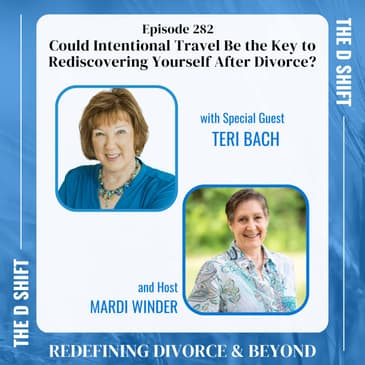
In this episode, Mardi Winder welcomes intentional travel coach and former psychotherapist Teri Bach for a fascinating conversation about how travel can become a powerful tool for healing, growth, and self-discovery after divorce and other major life transitions. Rather than encouraging women to simply "get away," Teri explains how intentional travel helps create the mental and emotional space needed to reconnect with yourself, process grief, and build confidence for the future.
Drawing from her own experiences as both a longtime caregiver and someone who found herself asking, "Who am I now?" after a significant loss, Teri shares how a single trip to Italy transformed her outlook and inspired an entirely new career helping women over 50 reclaim their sense of purpose.
Together, Mardi and Teri discuss why so many women struggle after losing an important life role, whether through divorce, caregiving, or becoming an empty nester. They explore the importance of grieving before rushing into the next chapter, why simply changing locations doesn't automatically change your mindset, and how thoughtful preparation can turn even a short getaway into a life-changing experience.
Whether your dream is traveling across Europe or simply spending a quiet weekend in the next town over, this conversation offers a refreshing perspective on how stepping outside your daily routine can help you step into the next version of yourself.
In this episode, you'll discover:
• Why losing a life role often feels more unsettling than expected.
• The difference between a vacation and intentional travel.
• How grief and healing influence your readiness for new experiences.
• Why travel doesn't have to be expensive or international to be transformational.
• Practical ways to rebuild confidence and create a meaningful next chapter after divorce or loss.
About the Guest:
Teri Bach is a Travel Coach, former psychotherapist with 28 years of experience, and speaker who helps women over 50 rediscover themselves after major life transitions. After experiencing profound personal losses and the end of her role as a caregiver, Teri found herself asking the same questions many women do: Who am I now? What comes next? A life-changing trip to Italy became the turning point that helped her reconnect with herself and see new possibilities for her future. Today, she specializes in intentional travel—using new environments and experiences as a powerful way to help women move from feeling lost and disconnected to gaining clarity, confidence, and a renewed sense of purpose.
For Teri’s gift: https://untappedpotentialcoaching.com/quiz-stuck-spinning-or-ready-for-more/
To connect:
Website: www.UntappedPotentialCoaching.com
Facebook: https://www.facebook.com/teri.bach.79
LinkedIn: https://www.linkedin.com/in/teribach
About the Host
Mardi Winder is a Strategic Divorce Consultant and High-Conflict Divorce Coach who helps high-achieving individuals navigate divorce with clarity, confidence, and control. Drawing on more than 30 years of experience in mediation, divorce coaching and conflict resolution, she supports clients in making smart decisions while reducing emotional and financial fallout, particularly in high-conflict, high-asset and complex divorces. Mardi is the founder of Positive Communication Systems, LLC, and the Strategic Divorce Directory, LLC.
For Mardi’s gift: The Resilience Building Blueprint: A 28-Day Journey To A Stronger You https://www.divorcecoach4women.com/rbb
Connect with Mardi on Social Media:
Facebook - https://www.facebook.com/Divorcecoach4women
LinkedIn: https://www.linkedin.com/in/mardiwinder/
Instagram: https://www.instagram.com/divorcecoach4women/
YouTube: https://www.youtube.com/@divorcecoach4women
Thanks for Listening!
Thanks so much for listening to our podcast! If you enjoyed this episode and think that others could benefit from listening, please share it using the social media buttons on this page.
Do you have feedback or questions about this episode? Leave a comment in the section below!
Subscribe to the Podcast
If you would like to get automatic updates of new podcast episodes, you can subscribe to the podcast on Apple Podcasts. You can also subscribe in your favorite podcast app.
Leave an Apple Podcast Review
Ratings and reviews from our listeners are extremely valuable to us and greatly appreciated. They help our podcast rank higher on Apple Podcasts, which exposes our show to more awesome listeners like you. If you have a minute, please leave an honest review on Apple Podcasts.
[00:00:04] Welcome to the D Shift Podcast, where we provide inspiration, motivation, and education to help you transition from the challenges of divorce to discover the freedom and ability to live life on your own terms. Are you ready? Let's get this shift started.
[00:00:22] Hello, and welcome to another episode of the D Shift Podcast. And sometimes you just have to get out of your comfort zone and do something a little bit different to help yourself get started, get moving forward. If you're feeling like, ah, I'm kind of in a rut here, or I need some change in my life. So I have an amazing guest on the show today, Terry Bach. Terry is a travel coach. She's a former
[00:00:52] psychotherapist with over 28 years of experience. And she's recently made this shift, and I'm so excited to learn more about this. But she really wants to help women over 50 who want to rediscover themselves after some kind of major loss or life transition. She specializes in intentional travel, and Terry's going to tell us what that is all about, and how to use new environments and experiences to really gain clarity, confidence, and a sense
[00:01:21] of purpose after you've gone through one of these big life events. So Terry, welcome. Thank you. Thank you, Mardi. Well, and it's so nice to have you because I am a traveler. I have loved traveling all my life. And I have almost exclusively traveled on my own. Even when I was married, it never seemed like it was, you know, that there was an opportunity to do much more than, I mean, camping trips and stuff. Yes. But I mean, like real travel.
[00:01:51] So this is something that it can also be really uncomfortable for women to do on their own. And I love that you're helping out with this. But before we get into all the good stuff, tell us a little bit about why did you move from psychotherapy to being a travel coach? And what kind of got you into this new area of life for yourself? Yeah, so I loved being a therapist.
[00:02:16] I was a therapist. But I don't know how things are in the world. I didn't love the business of therapy, and especially in California, where there is very rigid rules. And the thing, the major thing that made me change into coaching, so I did money coaching in between what I'm doing now and psychotherapy, was I wanted to spend more time with my mom.
[00:02:42] And she was living in Fargo, North Dakota. And so I had purchased a home in Minnesota at the lake, so I could go back there in the summers and spend time with her and take care of her. Well, I ended up moving back there. And you can't, in psychotherapy, you have to, like, get licensed and go through all of the hoops again when you move to a different state. And I just didn't want to go through all that.
[00:03:09] And so I thought, and so I needed to do coaching that, you know, kind of did a deep dive with people. And so I did the money coaching for a while, I ended up taking care of my mom.
[00:03:24] I had moved to Minnesota full time by then. And after she died, I was lost. I had been her caregiver for a few years by that time. And I didn't know who I was. And I had been independent. I had been married years before, but had been divorced for like 30 years. So I was used to being independent, you know, traveling, doing all of that stuff on my own.
[00:03:52] And yet, and yet, after my mom died in my role as caregiver ended, I felt completely lost, really unsettled. And, and I kept asking myself, who am I now, you know, and what do I want for the rest of my life? Because I had been so focused on my mom during those years that I was just put on the back burner.
[00:04:21] And, and, and so now it's like, I don't know how to focus on myself. I mean, I was really thrown, you know, even though she was 98 years old, so I knew it was going to happen at some point. And so an opportunity came up for me. And I hadn't traveled in years, because I had been taking care of my mom and other things.
[00:04:45] An opportunity came up for me to go to Rome, Italy with other entrepreneurs. And I hesitated, I can't believe now that I hesitated, but I didn't know anybody going on the trip, even the people putting it on, I didn't know. And I didn't have a current passport. And it was coming up real soon. And I thought, you know what, this is the change I need in my life.
[00:05:11] And so I said yes, and got my passport and time, went to Rome, Italy for a month, we stayed in apartments, we had work co working spaces, and we had meetings, and we had a lot of free time. And that trip was life changing for me, because I came back feeling the confidence I used to feel.
[00:05:41] I just rediscovered myself, I found this courageous self again. And you know, all the things that I felt like I had lost came back to me. And I had a clarity about my life and about my business and about everything. And so this opportunity came up, I believe in jumping in on opportunities.
[00:06:05] This opportunity recently came up like a year ago or so, and to be a travel coach. And I thought, I know how much travel has changed my life. And I really want to help other women who are older, like I am, have the same kind of change in their lives that I did. That's how I got into it.
[00:06:29] Yeah, and I love these stories when people tell them, because I think it's like, we can all see ourselves in what you know, what you what you talked about. I was, I was my husband's caregiver for eight years before he passed away, my second husband. And, you know, I mean, there's, there's all of these things that there's all of these commonalities that we have.
[00:06:51] Right. And at the same time, I think for a lot of women who have been a caregiver been in relationships kind of had this limited ability to, you know, to get out and to do things, it can be really overwhelming to think of, you know, to think of leaving your house that can even be stressful.
[00:07:16] You know, it was funny for me, after taking care of my husband for so many years, leaving the house and not having to think of do I have a respite caregiver in here? You know, how long am I going to be gone for? Do they have do they know where I'm going to be if they have to get hold of me? Like, I was so programmed into that, that the first, you know, the first couple of weeks, I'd be like, I can just go to the grocery store whenever I want. Yeah, it was very exciting to go to the grocery store.
[00:07:46] Well, preening and sharing at the same time, yes. Yeah. And, and so let's talk a little bit about why is that? Why does that happen to us? And I think you have an amazing expertise on this because of your background in psychotherapy. But why do we get so afraid to take these steps outside our comfort zone? And why does it seem to get more pronounced as we get older?
[00:08:15] Good questions. I think that there are. I think what I talk about most is losing that role in life, you know, because as you were talking about, you get so focused on that other person. And I too, kind of put myself on the back burner for those years. And, and so it's new. And, and I know your, your focus is more on divorce.
[00:08:42] And that's certainly a major life transition as well. And so I think when women are coming out of this divorce or being a caregiver or being an empty nester, whatever that life transition is, it, that change of role, I think is huge. And I don't think we give it enough credit.
[00:09:05] Yeah. Because I think when, you know, our, our roles in life are really, they become part of our life so much. It's like becomes our structure and it becomes our, our identity.
[00:09:24] Entity and, you know, it's kind of what we talk about when we're, when we're communicating with people and all of that. And so when that role goes away, it's unsettling. Yeah. I use the word unsettling a lot because I think it is unsettling. It's, and, and sometimes it's kind of a surprise. It's like, you know, like in my situation, I was kind of surprised. I felt that way after my mom died.
[00:09:52] And I think when you're going through a divorce too, even if, especially maybe if you were the one who wanted the divorce, you're kind of surprised that it feels so unsettling when, when you're single now. And especially if you, I was going to say, especially if you don't have children, but I think even if you do have children still at home, when you're going through the divorce, it's still such a change in role.
[00:10:22] And so I think that there's a grieving that has to go on. Right. And I think in our society in particular, we don't do a very good job of grieving. You know, we do a little bit better if somebody died, you know, then we expect somebody to go through a grieving process. But when you're losing a role in life, you're, that's a loss.
[00:10:52] Right. That's a loss that I think has to be addressed first before you can move on. And so, you know, I think what happens is we, we feel this pressure to hurry up and move on before we're ready to move on. And so I think part of what you were talking about is we're not ready to go outside yet. We're not ready to face people.
[00:11:15] And I know my situation's a little different when I got a divorce because my daughter also died during like two months within that period of time. So I lost two roles all at the same time. I remember going to get groceries and I'd hear some mother yelling at her child and I'd leave my cart full of groceries there and I'd walk out. Yeah. You know, or things like that.
[00:11:45] I just, I think when you go through a loss and, you know, it varies for different people, but I think there's, it's hard to find normal again. Yeah. Yeah. I think that, that whole idea of normal. And, you know, one of the things I talk to my clients about is you create your own normal. So stop thinking about that normal that existed back then, but that's done. That's already, that's already not normal anymore.
[00:12:13] So, so I think that that is really important. And I want to, I like this idea and you use the term intentional travel. Can you talk a little bit more about that? Yeah. Because I have always been a traveler. We were talking before the, you know, before my first, my first big travel trip was I was 17 and our, our high school did a trip to Scotland. I was in Canada at the time.
[00:12:43] And one of our teachers was from Scotland. And so he, he agreed to be the chaperone and two other parents came with, and we went to Scotland for the Easter break. And it was phenomenal. And that kind of put the bug in, in my, in me about, about travel, but not everybody is comfortable.
[00:13:01] Not everybody's done travel or it's not something particularly, you know, it's funny in the United States, people don't travel the way they do say in Europe and other countries where they go to different countries all the time. Whereas the States, you know, tend to stay in the States. And I think different pieces, like I grew up in the Midwest, upper Midwest, hardly anybody at that time was traveling. Right.
[00:13:25] And, and yet when I moved to California and that's where I did, you know, out there for 28 years, everybody traveled and almost everybody I met had gone to Europe. I hadn't been to Europe yet when I moved out there. And so I think it really depends and, and travel's not for everyone.
[00:13:45] And I want to, I want to say this upfront before I forget, when I talk about travel and I tell my story about Italy, a lot of people assume, I mean, that you have to go to Asia or Europe or somewhere far away to find yourself or to rediscover yourself or to get benefit out of intentional travel. You don't. You merely want to get out of your house. You want to get out of your, for a period of time.
[00:14:13] And there's no magic about how long that is. Just get out of your house, go to the town next door, get an Airbnb or hotel and just get out of your environment for a short period of time even will give you a lot of benefit. Yeah. And thank you for saying that because I think you're right. You know, if you want to, like, for instance, I have this incredible longing to go see like the, the amazing parks in Utah.
[00:14:41] I just want to see them. There's just something I know I want to do. And so that could be an intentional travel. So yeah. So talk about this idea of intentional travel, Terry. Okay. And I used to call myself a travel coach and everybody thought I was a travel agent. And so I tried to be a little more descriptive. Some, I could call it transformational travel as well. Basically. So think about your last vacation for the audience.
[00:15:10] You know, if you're like a lot of people, when we go on vacation, we try to see all the sights and, you know, people have said, oh, you're going here. You have to see this and you have to see this and you have to see this. And so when you come home, you're exhausted. And I've heard many people say, oh, my gosh, I need a vacation from my vacation. Right. Right. Work piled up and stuff while you were gone.
[00:15:38] So intentional travel is more like slow travel. And I call it intentional travel because when I'm working with somebody. We get them to a place where they're a little bit more in a neutral place. So we make I make sure she's done some grief work or send her to a therapist if it's, you know, a big, a big need. And then we work on beliefs.
[00:16:05] I use tapping or emotional freedom techniques. So I can quickly help somebody bring down their anxiety or bring down their fears or change a belief that they might have. Like a lot of women say, oh, it's too late for me. I'm too old. Or, you know, what are people going to say? Or, you know, whatever those beliefs are, we can shift that.
[00:16:34] And then we start planning a trip that's going to give the woman, the client who, you know, what she what kind of change she wants to make. Like, so we want to look at what are some of the things you maybe have wished you were like, I wish I were more outgoing. I wish I could get out of my comfort zone more.
[00:16:59] I'd like to build my life into something a little bigger than it's been the last 20 years or 30 years or whatever. Or, you know, I want to get more comfortable talking to strangers or, you know, whatever that is. And then look at what do you have you ever dreamed about what you want wanted your life to look like? Because most of us have a dream that's been shoved down for a very long time.
[00:17:28] I just a few years ago rediscovered that I had talked about writing in Italy, writing in Europe. In high school. I had completely forgotten about it. But it's something that started coming up for me without realizing it. It's been living in me all those decades. So we want to kind of rediscover that. And then we plan a trip with some activities and a place.
[00:17:56] So if you're grieving, you're not going to go to New York City or someplace loud and chaotic. You know, we want to pick a place and maybe you already have a place in mind. And we plan some activities for you to do while you're on this trip that are going to give you the kind of transformation that you're looking for. So that's for me, I do a lot of journaling. Now, I hardly ever journal when I'm at home. I know it's something that I like.
[00:18:25] I love to write. And yet I don't do it. Right. And yet I journal almost every day when I'm traveling. Yeah. So I love this whole idea. I think this is phenomenal. And I really appreciate how you you're not a travel agent. So I think that's really important.
[00:18:43] And you're not you're not going to be, you know, just firing everybody off to the Caribbean or maybe it's really customized to what the client wants to experience. And the last. Oh, can I tell you? Yeah. Then is I call it the integration piece. So and by the way, I'm available during the trip for support if needed.
[00:19:10] And I was telling you, I want to be building up a mastermind, a group of women, a community of women for support so that everybody's available for support when each one is on a on a on their trip. Not everybody's going to be traveling at the same time.
[00:19:27] And then the last piece, the integration piece is really about integrating all this transformation that you've learned about yourself, about your life, what changes you want to make, because you're coming back into an environment that hasn't changed. It's still the same as when you left it, but you have changed.
[00:19:48] And so we want to bring all of that into your current environment to see what needs to change now here in your current environment, because if you don't change that, you're going to all these beautiful changes you've made on your trip. You're going to try to fit them into your current environment. And we don't want that. We don't want that.
[00:20:11] We want the current environment to accommodate who you have become now. Yeah, yeah. And like I said, I just think that's such an incredible experience because I do like a holistic approach to this, because I have heard, you know, a lot of women will, it was funny, I just did a cruise. It was like a conference on a cruise thing.
[00:20:39] And one of the, I was talking to a lady that was there and she had just gone through a divorce. She was in her 70s. She'd just gone through a divorce and she decided to go on this cruise by herself. And she wasn't prepared and she didn't want to talk to people. And she was like sitting there and she goes, well, everybody's here with their partner. And I'm like, well, you're on a cruise. Like, what were you thinking was going to be on here?
[00:21:05] And, you know, she noticed that I was with another group and it was almost all women. So she came over and she talked to us because she thought we were a group of single women. And she, you know, and so it was kind of interesting because she was saying she actually felt more lonely on the cruise than she did at home. And so, you know, you know, we, everybody kind of said, hey, well, we're going on this excursion, come with us. And she was like, no, no, no, I just want to stay on the ship.
[00:21:35] And so it was like, you know, okay, that's, that's your choice. But she was obviously not prepared mentally. Right, right. And she just assumed that a change of venue would cure all the ills. And that really wasn't. So I'm like, yeah. But you're bringing yourself with you. Right. So, yeah, you do.
[00:21:54] I mean, I would have maybe had her look for a cruise where, because there are cruises that accommodate more single people too, or at least have a single component to it, a solo traveler. So, yeah, there are a lot of, a lot of work that she might have done that would have made the trip so much more fun.
[00:22:15] And I can, I can just imagine, like, you know, if you're, if you're a beach person, maybe going to the Outer Banks or something and renting an Airbnb or, or, or, you know, staying in a hotel if it's a shorter trip. And then just, just spending days, you know, walking on the beach and looking at the shells and going to see the wild horses. Like, that would be so amazing to do as a solo person.
[00:22:41] And you wouldn't feel awkward because that's going to be what a lot of people there are doing as well. So, yeah. Yeah. And eventually you can get to the place where she was, where you go on a cruise. And it doesn't matter if you're the only solo person. Right, right. You know, but she wasn't there yet. Well, and I think it's got, and I know we're almost out of time, but I think it's got a little bit to do with personalities. You know, I, I will talk to everybody. I will make friends in the grocery store. It's just what I do. That's not everybody.
[00:23:11] And that's okay. And so if you're one of those people that is maybe a little, a little less, I don't want to say outgoing, because that's not correct, but a little, a little less interested in, in talking to strangers. Sure. Then, you know, maybe creating a vacation where you have more space so you're not around a lot of people would actually be more appropriate. So, Terry, this is absolutely fantastic.
[00:23:40] Now, you have a gift for everybody. Can you tell us a little bit about that? It's a quiz. I love taking quizzes. So, it's called Stuck, Spinning, and Ready for More. And so it really helps you decide kind of where you are. Are you feeling, are you stuck? And then the results that you get back will kind of give you some idea of where to go from there, depending on how you, you know, what comes up for you during that.
[00:24:10] And then at the end of the quiz, there's a chance for you to reach out to me if you want to and set up a complimentary clarity session. I call it Reclaim Your Spark Clarity Session, where we can talk about what came up for you in the quiz. And, you know, maybe I can get you started on what's next for you or, you know, what to look at next. Great. And I will make sure that's in the show notes.
[00:24:37] Now, before we let you get off the call here, what do you think is the biggest takeaway you'd like everybody to remember? The biggest takeaway I have for this time, especially after 50, and I mean, there's nothing magical about the number 50, but I think is that when we go through these major life transitions, it isn't the ending. It's not the end of our lives. It's really an invitation for more.
[00:25:06] Because now we don't have a lot of the responsibilities we used to have. We have, it's just, it's like now we can do whatever we want. You just have to figure out what that is. But it's a joyous time, not the end. Yeah. Fantastic. Terry, if people want to find out more about what you do or talk to you about your intentional travel coaching services, what's the best way to do that?
[00:25:35] The quiz is a really good place to start. And then they'll be on my mailing list. And so they start, or my email list. So they start hearing more and more about intentional travel and going through a life transition. They can also reach out to me at Terry. It's a little more complicated. Terry, T-E-R-I, at untappedpotentialcoaching.com. Great. And I will make sure that is in the show notes as well.
[00:26:04] Terry, thanks so much for sharing this. And you've got me all thinking, where would I like to go next now? Now I've got the travel bug again. Thank you so much for this conversation. I'm leaving next month for six months. So I'm going to be traveling and working and traveling. Well, that's the way to go nowadays. We can do it all from our laptop, right? Exactly. It works out very well. Terry, thanks so much for sharing your wisdom and expertise today. Thank you, Marty, for having me on.
[00:26:34] And thank you, everybody, for listening to this episode of The D Shift. And don't forget to tune in to the next one. Thanks for listening and supporting The D-Shift Podcast. If you would like to attend live trainings by our amazing guests and have a chance to ask questions and get answers from our experts, join The D-Shift Crew. For more details and to sign up, head on over to www.divorcecoachforwomen and click on the podcast page.