
After decades of marriage, hearing that your spouse no longer wants to be married can shake far more than the relationship itself. It can affect your confidence, your sense of identity, and the future you thought you were building together.
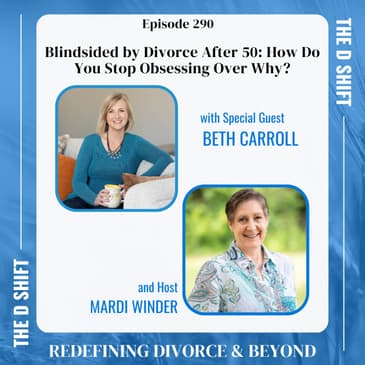
Strategic Divorce Consultant Mardi Winder talks with Divorce Coach Beth Carroll, who works specifically with women over 50 who have been blindsided by divorce.
Drawing from her own experience after a 25-year marriage, Beth talks openly about the constant replay of what happened, waking up thinking about it, questioning what was wrong with her, and wondering whether she had wasted the best years of her life. She shares how she eventually began moving beyond those questions and now helps other women do the same.
Mardi and Beth also discuss identity after a long marriage, the difference between helpful support and remaining stuck in the same story, and why emotional overwhelm during divorce can influence important decisions about your future.
Questions We Explore
Q: Why can being blindsided by divorce feel so destabilizing?
A: When your marriage, family, work, future plans, and identity have been intertwined for decades, the unexpected end of the relationship can leave you questioning not only what happened, but who you are without it.
Q: How do you stop constantly thinking about your ex and what went wrong?
A: Beth describes moving beyond simply retelling the story and exploring the beliefs and emotional patterns that kept her focused on the relationship. For her, reaching a place of neutrality rather than love, anger, or regret became an important sign that she was moving forward.
Q: Can divorce support groups sometimes keep you stuck?
A: Support and connection can be incredibly valuable, but Beth and Mardi discuss how groups that continually reinforce the pain without helping members move forward can sometimes become an echo chamber. Beth believes support works best when there is also an intentional path toward healing and growth.
Q: Why might being the “good person” hurt you during divorce?
A: Beth sees women who are so concerned about appearing reasonable or proving that they were not responsible for the divorce that they may avoid getting appropriate professional support or advocating for their own interests.
Q: Are the best years of your life behind you after divorce later in life?
A: Absolutely not. Beth's message is that the end of a decades-long marriage does not define the rest of your life. There can still be tremendous opportunity to discover what you want and create a future that belongs to you.
About the Guest:
Beth Carroll helps women 50+ who were blindsided by divorce stop obsessing over him, release the belief that they weren’t enough, and reclaim their confidence, calm, and sense of self. Using Rapid Reprogramming and somatic processing, Beth teaches why his leaving can feel like proof of your worth, and how to rewire that belief at the root so you can finally move forward.
For Beth’s gift:
The Blindside Distinction Guide: https://app.bethcarrollcoaching.com/theblindsideddistinction-840544
To connect with Beth:
Website: https://bethcarrollcoaching.com/
Instagram: https://www.instagram.com/bethcarrollcoaching/
Facebook: https://www.facebook.com/profile.php?id=61550705971239
About the Host
Mardi Winder is a Strategic Divorce Consultant and High-Conflict Divorce Coach who helps high-achieving individuals navigate divorce with clarity, confidence, and control. Drawing on more than 30 years of experience in mediation, divorce coaching and conflict resolution, she supports clients in making smart decisions while reducing emotional and financial fallout, particularly in high-conflict, high-asset and complex divorces. Mardi is the founder of Positive Communication Systems, LLC, and the Strategic Divorce Directory, LLC.
For Mardi’s gift: The Resilience Building Blueprint: A 28-Day Journey To A Stronger You https://www.divorcecoach4women.com/rbb
Connect with Mardi on Social Media:
Facebook - https://www.facebook.com/Divorcecoach4women
LinkedIn: https://www.linkedin.com/in/mardiwinder/
Instagram: https://www.instagram.com/divorcecoach4women/
YouTube: https://www.youtube.com/@divorcecoach4women
Thanks for Listening!
Thanks so much for listening to our podcast! If you enjoyed this episode and think that others could benefit from listening, please share it using the social media buttons on this page.
Do you have feedback or questions about this episode? Leave a comment in the section below!
Subscribe to the Podcast
If you would like to get automatic updates of new podcast episodes, you can subscribe to the podcast on Apple Podcasts. You can also subscribe in your favorite podcast app.
Leave an Apple Podcast Review
Ratings and reviews from our listeners are extremely valuable to us and greatly appreciated. They help our podcast rank higher on Apple Podcasts, which exposes our show to more awesome listeners like you. If you have a minute, please leave an honest review on Apple Podcasts.
[00:00:04] Welcome to the D Shift Podcast, where we provide inspiration, motivation and education to help you transition from the challenges of divorce to discover the freedom and ability to live life on your own terms. Are you ready? Let's get this shift started. Hello and welcome to this episode of the D Shift Podcast and I am so happy to have another divorce coach on the show today.
[00:00:30] Beth Carroll, she focuses specifically with women who are 50 years and older who were blindsided by divorce and to help stop obsessing over the relationship, release all those negative beliefs about what caused the problem in the relationship and why the divorce happened and why he left and really reclaim their confidence, calm and sense of self.
[00:00:53] And I know Beth has several, several very specific processes that she uses to help people do this and I want her to share all about this. But I, I think this is so important because people can be blindsided by divorce and it can really literally pull the rug right out from underneath you. So, Beth, welcome. Thank you so much for having me, Mardi. I'm happy to be here and happy to meet you.
[00:01:17] Well, and I'm so happy to have you on here because I don't think there's enough that we can say about what divorce can do on the other side. I have so many people that say, if I can just get through the divorce, everything will be fine. I'm like, no, that's not typically going to be the case, especially if you, if you wish the relationship has been going on. If, if it was just all of a sudden out of the blue, these things happen.
[00:01:44] So before we get into all that, Beth, tell us a little bit about what brought you here. Cause I'm sure like me, you didn't grow up thinking I would really like to be a divorce coach. No, no, I did not. Excuse me. So I got into this because it happened to me and my husband, we'd been together for 30 years, married 25. The oldest was in college. The youngest was getting ready for college. And I'm sorry. Go ahead. Excuse me.
[00:02:13] I know that always happens to me too. Don't worry. And we were, you know, headed towards empty nest and really working on our what's next. And it was really a very exciting time to sort of think about reconnecting as a couple and all of that. And that's where I was. And that's not where he was. And he basically said to me one day, I don't want to be married anymore. And I was shocked. I was beyond shocked. And my dad had just died. And there was right afterwards, we went into COVID. So there was so much happening.
[00:02:44] And it just set me back like nothing had ever set me back. And I was a very confident, secure person. And him doing this took me down to what's wrong with me. There's something terrible with me. I spent a lot of time trying to figure out how I could fix this. I was non-functional for quite a while. I watched a lot of Great British Bake Off because there's no conflict in that show. And I could not believe how much it set me back.
[00:03:14] So as I tried all different things and I finally found a methodology that really worked, and then I added somatic work to that, I realized that I really, really wanted to do this. I wanted to share it and put something together for this specific demographic of women who are dealing with something that wasn't their choice. But here they are. Right. Right. And, you know, like I said at the very beginning, divorce can come at you in many different ways.
[00:03:42] And even women, like we know in the United States and Canada, 70% of divorces are followed by women. We know that. I mean, statistically. And yet I still hear from so many women who say, literally, I didn't have a clue there was anything wrong with the relationship. It tends to be when the kids have left the home.
[00:04:06] Quite often it seems like whichever one is going to initiate the divorce kind of hangs on until that happens. And then it's like, well, this won't bother the kids anymore because they've left the home. And it won't bother my spouse because I don't really care. Like, that's really what comes when it comes out. Like, I just don't care. And in that whole idea of this, what do I do now? I don't think I don't think we could ever prepare ourselves for that. No. And there's so much of a who am I now?
[00:04:36] You know, there's your whole life has been built around this other person, this family. My husband and I worked together. I worked in his family business. So all this identity was tied up with being married and what came with that. And when he decided to leave, I lost my job. My kids were growing up. My dad, my mom died a few months later. Like, there was just all of this identity crisis. And for the first time in my life, I just froze.
[00:05:03] You know, and they don't, you don't really think about it because you have such an identity when you're in this marriage and raising this family and doing this work. Right. Right. Right. And when you work with clients now, do you find that their story, I mean, maybe the details aren't in there and all of the loss that you went through, which I'm very sorry for. But do you find that there's a common thread through the stories of the clients that you tend to work with? Oh, 100%. And most of us just had no idea.
[00:05:32] And some people's marriages maybe were a little shakier than others. But at the end of the day, they thought they were in a committed relationship. They didn't realize that there was any chance that they were going to lose it. And they certainly didn't realize there was any chance that they were going to lose it with like, I'm out of here kind of thing. Right. So that's something everybody has in common is just that absolute shock of you started the day, you know, in a 20 or 30 or 40 year marriage. And at the end of the day, that's gone. Yes. Yeah. Yeah.
[00:06:01] So talk to us a little bit because you went through a lot of exploration as to what actually worked to help you release some of that, that those obstacles or that, that mental fog that was going on. How did you deal with all of that? And what, what are the tools and techniques you use with your clients now? The thing that I couldn't believe was happening the most to me is constantly thinking about
[00:06:30] it, waking up in the middle of the night, thinking about it all day, talking to everybody about it, almost ad nauseum, you know, people were getting tired of me because to a lot of people, when you go through this, it's just a divorce, you know, everybody gets divorced kind of deal with it. Yeah. So I went to therapy. I listened to all kinds of podcasts, meditations. I went to the gym. I walked, I joined a support group.
[00:06:56] And when I was in that support group, it's when I really realized I loved the support group, but we were almost keeping each other stuck because we were all in that same place and we all had the same complaints and issues. And I mean, there's still some of my closest friends today, so I don't want to knock it, but I needed to do something else so that I could bring my healing into that room. And I started to explore. I'm like, okay, nothing's working. There's got to be something else.
[00:07:23] And I started to explore a subconscious work and somatic work. And I found a subconscious reprogramming program. And I learned about how to find beliefs and release them and change the pathways and change the way I was thinking about it. And as I started doing that work, I realized that I was starting to function again. I was starting to feel okay. I wasn't thinking about him anymore. My friends were coming back. I wasn't talking about him anymore.
[00:07:51] I was starting to be able to look at the future and what that meant. And so that's when I really realized as I was working through this, that this is what I wanted to do. And I wanted to offer it to my support group of women at the same time. And I wanted to add in different pieces and really build something that you could count on that would get you to the other side of this really feeling okay. And I like to say that he becomes someone you used to know. You know, it doesn't erase the memories.
[00:08:19] And there was a lot of good and all of that. But, you know, it's he doesn't matter anymore. Yeah. And I always think that that's kind of the key point is when you can think back on the relationship and be neutral in your response. Yes. Like you don't desire or you're not angry with. You're just neutral. It happened. There was some, like you say, there was some good times. And we can remember those now. And they don't trigger anything for us.
[00:08:46] I think that's a really good sign that healing has happened. And it's, you're done. You're ready to move on. Yeah. Yeah. So I think that's the biggest question I get when I start working or I meet with, you know, prospective clients is will I be indifferent? When will I be indifferent? Because they're just so exhausted. And the other thing I hear, though, a lot is I wasted my whole life. I gave the best years of my life to him. And I'd like to get you to a place where you realize that's not true.
[00:09:13] Like there's a lot of good that came from that and a lot of life experience that you've learned. And that's your foundation now. So you don't spend time worried thinking about that and regretting things. You're ready to look forward. And we still have a lot of living to do. I was going to say, you know, I think that's that's that cultural thing that women of a certain age. And I've used this a couple of times. You just go sit on the porch, knit Afghans and talk to their cats like that is not what we want to do.
[00:09:42] And well, maybe you do. And if you do, that's great. That's fantastic. Do it. Enjoy. Enjoy. Not everybody wants to travel. Not everybody, you know, wants to take a painting class. Do what makes you happy. But you don't have to. The best years of your life are not over unless you want them to be. And then that's exactly what you're going to get. Right. Right. And the empowerment of it's your choice now is really important. So you can choose if you want to sit on the rocker and crochet.
[00:10:11] You can choose if you want to travel the world or go back to college or start a new career. I have a client that became a Zumba instructor. She just is having an absolute ball. Yeah. And she'd never been to the gym before. So there's so much. There's just so much possibility. And it's really important to be able to get to that. And I really believe that's possible for everybody. Yeah. And that is such a powerful message. And I want to just circle back to something you said.
[00:10:40] Therapy can be extremely effective. And support groups can be extremely effective as well. They've got to be designed to move you forward. You know, therapy can be a whole lot of navel gazing for years and years without a whole lot that gets accomplished. Nothing against therapists. There's great therapists. There's bad therapists. There's good coaches. There's bad coaches. The one challenge I always see with my clients in support groups is exactly what you said.
[00:11:08] Nobody wants to look like they're healing when everybody else is still in pain. And so it's like nobody wants to move out of that or say, whoa, I'm having a fantastic day. I'm just feeling so because everybody else and we were empathetic. These are people we come to care about very much. And sometimes support groups outlive their usefulness for people because that echo chamber of
[00:11:38] this is my sad story keeps going and going in those groups sometimes. Yeah, and I think if it's not designed around a program. So I love the groups that I work with because that is your support group and we're healing together. And then we can share those bad days, but we can also share those good days. Yeah, I think I think that's the important part. And I didn't get in a group that was, you know, we were in similar situations. So we spent a lot of time going, yeah, I get it. And oh, gosh, you know, that's the worst. And he's the worst.
[00:12:07] And which is great. But yeah, it has its place. So what is the first step that you would recommend if somebody has just had this experience? Like when should they start working with you during the divorce process? Are you mostly post-divorce support or do you do you work with people at all times during the divorce? Or where's kind of your ideal sweet spot to start working with clients? I usually say four months to four years plus. Yes.
[00:12:37] Right. That shock that happens at the beginning leaves you. I mean, you're not ready to look at what you believe or how it affected you or you're just trying to figure out like how the bills are going to be paid or what. Like there's just so much in those first four months. So I do have women reach out to me right when it happens. And I usually kind of just stay in touch with them until they feel a little bit more stable about their situation.
[00:13:03] And then when you're feeling a little bit more, you're maybe not even accepting it, but you're just a little bit more stable about what the day to day looks like and you're ready to sort of let go. That's when I work. That's when I usually start my program. If I meet with you before then, I'm just kind of your support person to check in with. I don't start any kind of a program or anything like that until you're really ready for it. Yeah.
[00:13:31] And what might be the signs if somebody, if a woman is listening and going, wow, I'd really like to learn more or I'd like to work with Beth. What are the signs that they could recognize within themselves that would say this is a good time to start this process? For me, the number one is I don't want to feel like this anymore. I'm tired of constantly thinking about it. I'm tired of only talking about it.
[00:13:57] Some women start becoming estranged from their children who want to keep a relationship with their father. But you think, well, how can they have a relationship with him after what he did to me and our family? So there's anger around there. You know, when you're getting to the point where you're really starting to be stuck. I think that's your sign of and you're ready to be done with it. And do you find that because the divorce process, so I mostly work with clients from like contemplating
[00:14:27] divorce up to actually going through, you know, all of the stuff you have to do and then, you know, preparing for mediation if that's going to happen or preparing for litigation. And with all of that that's going on, I'm thinking that a lot of clarity would really help around those decisions as well because they're very emotionally driven decisions.
[00:14:52] And I'm sure you have worked with a lot of clients who have made really bad decisions because they have been totally propelled by emotion rather than actually thinking what their best interest was. And that's really, that's really important. I do a lot of that, especially when because of what happened, because of the way we're left, a lot of times my clients want to seem like the good person. Like I'm going to let him have what he wants or I'm going to go to mediation because that's what he wants.
[00:15:20] And I won't get my own attorney because I don't want to seem like the bad guy. I don't want to give him reason to say, well, that's why I left her. She's awful. Look at what she's putting me through. So we end up self-sabotaging and we don't stand up for what, what we need, you know, what we deserve and what we're entitled to. And a lot of my clients have gotten stuck in the, and that's a lot of times when they do come to me is all of a sudden they're in this mediation situation that's not going their way.
[00:15:49] And they really need to secure their own representation and to get them to the point where they recognize that that's what they deserve. They deserve somebody that's going to be in their corner and is going to understand their needs and fight for them. And then they can cut the contact because your attorney is going to handle it. Right. So it really helps to get to a point where you can stand up for yourself and I can help get them there. Yeah. Yeah. That, that is so important.
[00:16:17] Beth, you have shared a ton of information and I so appreciate this because really this is something we don't talk enough about. We don't, you know, we don't talk about the emotional impact of divorce and how that, that impacts. And there's a lot of neuroscience about why this, you know, we know we're being flooded with cortisol. We know that shuts down our executive thinking process. We all go into our fight, flight, freeze reaction, whatever you've normally done. And a lot of people it's freeze.
[00:16:46] So they become really paralyzed during the whole divorce process. And like you say, it's just like, let me sign whatever, let's just get this done. And once you sign on the dotted line, I'm sorry, there's no do over unless there was some kind of fraud or squirreling away of assets or something. But other than that, if you signed on that dotted line, it's, it's a done deal. And so I so appreciate what you're able to do to help clients move forward like that.
[00:17:15] How long do you typically work for clients, Beth? Um, about four months, give or take. I mean, some people extend it. It's also depends on when I met them. If they've been divorced four years, um, a lot of times there's just some sticky stuff that we need to get through and, and four months is, you know, fine. And then we just stay in touch after that. If I meet you earlier in the process, we might work longer. Everybody's different.
[00:17:41] You know, everybody's different about what they're able to find and acknowledge and rewire. And if they're open to the somatic work and everybody's different. And my commitment really is to stay with someone until they're on the other side of this feeling good. Okay, great. And do you whatever it takes? Yeah. Well, that's kind of me too. Like I have, I usually work with clients for three or six months, but I have lots of clients who re up like that maybe do the six month and then do the three.
[00:18:09] Um, do you work with clients online or is it in person or is it a combination or how do you do that? I have an in-person group here in Tucson, but, um, that's more of a support group, but I do all basically all online and I work in different countries. I have clients in Canada and the UK. So I, I do everything really now I do everything online. Yeah. It's, it's, that's one of the good things about, um, about being online for the whole
[00:18:37] COVID experience was people got really comfortable, you know, before, before, and I know it's a little bit off track, but before COVID people wanted to meet in person. I mean, I, I had lots of executive and, um, divorce coaches that I was driving all across Texas to, to be able to see. And now it's like, well, we'll just hop on a zoom call. And it's much less costly for me, for them, for everybody. It's, it's a great way to do this.
[00:19:03] So Beth, thank you so much for sharing all this information. If you had one big, if you had one takeaway that you would like everybody to remember or women listening in to remember from this conversation, what would it be? When your husband walks like this after decades of marriage, this does not define you. It is not a verdict or a life sentence. It is something that you need to work through.
[00:19:29] You will learn so much about yourself and there's still a lot of life left and it can be fantastic. What a positive way to wrap this up. I so appreciate this. And Beth, thank you for coming on and talking about the services you provide for women going through divorce. If they do want to reach out and find out more about you or consult with you or work with you, what's the best way to do that? My website is bethcarolcoaching.com. And I'm also on Instagram, bethcarolcoaching. Great.
[00:19:59] And those are easy to, easy to find. And I will make sure that information is in the show notes so that if you're driving or walking or running errands or washing the dishes, I listen to podcasts when I'm washing the dishes because I'm old fashioned. I wash my dishes by hand. So I never have a pen to write anything down, but it's all in the show notes. You can pick it up anytime you want. And Beth, again, thank you so much for sharing your expertise. Thanks, Marty. Thanks for having me.
[00:20:27] And thank you everybody for listening to this episode of The D-Shift. And don't forget to tune in to the next one. Thanks for listening and supporting The D-Shift Podcast. If you would like to attend live trainings by our amazing guests and have a chance to ask questions and get answers from our experts, join The D-Shift Crew. For more details and to sign up, head on over to www.divorcecoachforwomen and click on the podcast page.