
One of the greatest challenges after divorce is communication, especially when co-parenting with a high-conflict ex. Every text message, email, or notification can trigger anxiety, frustration, and emotional exhaustion.
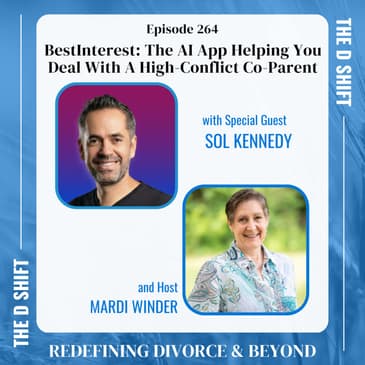
In this episode of The D Shift, Mardi Winder welcomes Sol Kennedy, founder of BestInterest, an innovative AI-powered co-parenting app designed to reduce conflict and help parents focus on what matters most: their children.
After experiencing his own difficult divorce, Sol set out to create a tool that shields parents from toxic communication while preserving the information they actually need to effectively co-parent. The result is a unique platform that is changing the way divorced parents communicate.
If you struggle with difficult co-parenting conversations, emotional triggers, or constant conflict, this episode offers practical insights and a glimpse into how technology may help reduce stress during one of life's most challenging transitions.
Sol shares:
• Why communication becomes so difficult after divorce
• The emotional toll of high-conflict co-parenting
• How toxic messages impact mental health and decision making
• The story behind the creation of the BestInterest app
• How AI can help filter conflict and reduce emotional triggers
• Protecting your peace while still effectively co-parenting
• Why self-love and healing remain essential after divorce
About the Guest:
Sol Kennedy is a former Google product manager, a devoted dad, and the founder of BestInterest—the AI co-parenting app endorsed by Dr. Ramani. After navigating his own high-conflict divorce, Sol built the tool he wished he’d had: an app that acts as an emotional shield, filtering out toxic messages and leaving only what matters: the kids. WIRED calls BestInterest "life saving" for coparents experiencing conflict. Through his app and his podcast, Coparenting Beyond Conflict, Sol helps parents set boundaries, reduce daily anxiety, and build a future where they can proudly sit at their child's graduation without a lifetime of resentment.
For Sol’s gift: Use when purchasing BestInterest on any app platform: DSHIFT10 - $10 off BestInterest for Coparents
To connect with Sol:
Website: https://bestinterest.app
Instagram: https://www.instagram.com/bestinterest.app/
LinkedIn: https://www.linkedin.com/company/bestinterestapp/
About the Host
Mardi Winder is a Strategic Divorce Consultant and High-Conflict Divorce Coach who helps high-achieving individuals navigate divorce with clarity, confidence, and control. Drawing on more than 30 years of experience in mediation, divorce coaching and conflict resolution, she supports clients in making smart decisions while reducing emotional and financial fallout, particularly in high-conflict, high-asset and complex divorces. Mardi is the founder of Positive Communication Systems, LLC, and the Strategic Divorce Directory, LLC.
For Mardi’s gift: The Resilience Building Blueprint: A 28-Day Journey To A Stronger You https://www.divorcecoach4women.com/rbb
Connect with Mardi on Social Media:
Facebook - https://www.facebook.com/Divorcecoach4women
LinkedIn: https://www.linkedin.com/in/mardiwinderadams/
Instagram: https://www.instagram.com/divorcecoach4women/
YouTube: https://www.youtube.com/@divorcecoach4women
Thanks for Listening!
Thanks so much for listening to our podcast! If you enjoyed this episode and think that others could benefit from listening, please share it using the social media buttons on this page.
Do you have feedback or questions about this episode? Leave a comment in the section below!
Subscribe to the Podcast
If you would like to get automatic updates of new podcast episodes, you can subscribe to the podcast on Apple Podcasts. You can also subscribe in your favorite podcast app.
Leave an Apple Podcast Review
Ratings and reviews from our listeners are extremely valuable to us and greatly appreciated. They help our podcast rank higher on Apple Podcasts, which exposes our show to more awesome listeners like you. If you have a minute, please leave an honest review on Apple Podcasts.
[00:00:04] Welcome to the D Shift Podcast, where we provide inspiration, motivation and education to help you transition from the challenges of divorce to discover the freedom and ability to live life on your own terms. Are you ready? Let's get this shift started.
[00:00:23] Hello and welcome to the D Shift Podcast. And today I have got a guest on today that is really going to help us with something that is a problem in every high conflict divorce where there's children involved. And that is how are you able to have some kind of meaningful conversation with the other parent without subjecting yourself to all of their garbage. I'm going to say that politely today, all their garbage.
[00:00:51] So I am really honored to have somebody on who has really actually done something about this and created a very effective product that's going to be able to help you to navigate these difficult waters. So I want to introduce you to Saul Kennedy. He is a former Google product manager and he is a father and he went through a difficult divorce. I'm going to let you talk all about that Saul. But he actually invented an app that's called a
[00:01:21] called Best Interest. And it is an AI co-parenting app that is actually endorsed by Dr. Romani. And those who have listened, we've talked about Dr. Romani on several of these podcasts and I've encouraged people to follow her as well. So the app actually acts as an emotional shield and filters out the toxic messaging so that all you are left with is the information that you need to be a great parent for your kids and to co-parent whatever style that happens.
[00:01:51] So what's the best to look like? So what's the best to look like? So what's the best to look like? So what's the best to look like? So I'll actually also has his own podcast, Co-Parenting Beyond Conflict. So Saul, welcome. Thank you, Marty. It's a pleasure to be with you today.
[00:02:04] And it's a pleasure to have you. I'm always so amazed when people are able to just get an idea and run with it and create something that really offers a benefit to a huge sector of the population going through divorce. So how did you get, tell us your backstory, Saul.
[00:02:23] Well, I certainly didn't just wave a magic wand and have it come into reality. I think that a lot of us who find themselves serving this population of people that have gone through divorce, we went through it ourselves. And that's the case for me. I'll take you back to a moment six years ago. I was in the midst of my own divorce and I was lying in bed going to sleep. And, you know, as you're going through divorce, sleep is really important.
[00:02:48] And I got this ding on my phone and it wasn't, you know, the typical text message ding. It was a notification noise from our family wizard. And so I knew it was a message from my ex. And in that moment, I felt my heart racing. I felt sweat across my brow. And more importantly, I knew that I wasn't going to be able to sleep that night until I had checked that message and probably spent the next hour or two figuring out how to respond.
[00:03:14] And in that moment, I realized this is not a way to rebuild a life. And it really felt more like a jail cell. And so that was the inspiration. But the problem for me continued until I started playing around with AI with my kids.
[00:03:34] And we were, I was using it to create bedtime stories for them back when ChatGPT was really early. And it was really fun. It was a fun way to engage with them and have them be creative and try out this new tool. And that night I thought, well, gosh, AI seems to really understand language. I wonder if I could have it understand what I'm going through a little bit.
[00:03:53] And so I uploaded some of our co-parenting communication and I was floored by how I felt seen. I felt understood. I felt like I left the conversation with some good ideas about how I might respond and proceed. And I thought, OK, well, this is something that I'd really like to help. I would love to help people that have gone through divorce to get through it in a good way. And that is the spark that created the best interest app for co-parents.
[00:04:21] Yeah, and that's fantastic. And so many of the co-parenting programs and full disclosure, I taught the co-parenting program for divorce through a company here in Texas. I was one of their trainers. So that's that four hour court ordered mandated course. I don't know where you are if it's mandated, but it is in Texas. And, you know, they have similar ones all over the United States, Canada. Many countries have these.
[00:04:45] And then I was a co-parenting coordinator for a few years. And, you know, I kept running into the same problem. If you've got a high conflict person and a I'm going to say a more reasonable person on the other side, all you can do really is work with the more reasonable person because the high conflict person is not going to change.
[00:05:09] That's just that ship has sailed. And so it felt like the burden was always on one person to make all the adjustments to, you know, reduce the conflict. And that just added to the resentment. So I love the idea of this app where. Well, let me let me stop talking and let you tell us about the app, because I read I read a whole bunch of stuff about it. And I'm really excited about what it offers. So you tell us about it, Saul.
[00:05:36] Well, you know, I think you come into this conversation having experienced our family wizard. I'm sure many of your listeners either have had a court ordered or are contemplating it. And I think it's a good comparison. So our family wizard started about 30 years ago and with a really smart concept, which is if we record all the conversations and allow our parents to bring in the documentation to court, then the court can do something about it versus arguing who said what. Right.
[00:06:05] And that's a really good solution. And yet I also experienced that it didn't do anything to reduce the conflict in my situation. And so I thought when I was creating best interest, I would like us to play a more active role in reducing the conflict between two co-parents. So our headlining feature, one that no other app offers co-parents, is that we will shield the communication coming from your co-parent,
[00:06:33] no matter what they're saying to you and how they're saying it. Usually there is, at least in some of their communication, there are nuggets of important bits that you need to know to be a good co-parent, to do the business of co-parenting. We leave those in and everything else gets stripped out. So Marty, if you and I were co-parenting and maybe I'm feeling super spicy today and I'm going to bring up the past, I'm going to say, Marty, because you're always late, I demand that you pick them up at 3 a.m. today.
[00:07:04] Well, gosh, you're going to get set up, get defensive. I'm never late. What are you talking about? And then you're having to manage all of that emotion. Well, with best interest, we're going to filter everything except for so I would like you to pick them up or pick them up at 3 p.m. And so then you know what you need to do the right thing. And then you can just respond simply okay without having to do all that extra emotional processing.
[00:07:28] And what's unique about this is that it saves you from that moment of anxiety of, gosh, I don't know what I'm going to get from my co-parent, but all the original messages are still there for you. So you can then later, if you want to, view the original message. Maybe you've dropped off the kids and so you have a moment of peace. Or maybe you're with your therapist and you can talk through the emotional triggers.
[00:07:53] You open up that original message and you can read it and do the processing, right? But it doesn't tie you into the other person's moods and their own time scale. It allows you to really take control of the communication. Right. And I love that. I love that. To me, that's priceless for people that are having to deal with this. Yeah. And to add to that too. So we also, everyone is capable of responding in a triggered way or getting to our old patterns.
[00:08:23] Right. And so we're going to review every message that you send and we're going to give you feedback. If your communication style is likely to create some type of resentment in the other party, then we're going to help coach you into a better way of reducing that conflict before it starts. And again, this is an active process of reducing conflict so that it doesn't boil over and then spill into the court system, which the courts don't even want.
[00:08:52] Right. Right. And so I'm going to tell you the devil's advocate thing that I hear every now and then is, well, if you're using AI or any tool, not your tool, but any tool to do this, and I've heard people lambaste any of these apps about this, is that you're not really teaching anybody how to effectively reduce communication. You're just using a filter system. And yes, and celebrate that.
[00:09:20] Because again, you're not going, the person that's causing the issue, the high conflict person is not going to listen to the app. They're not going to change because they already think they're doing everything right. They already think the other person is 100% wrong. And that's, that's the problem with the relationship. So if anybody's thinking that thought, I want to, I want to crush that one right now. You did my work for me, Marty. Oh, darn it. Well, you know, here's the thing. I have grown so much through divorce.
[00:09:50] And I think that that in and of itself is a huge mindset shift that we can make is that, wow, we can learn so much about how to communicate with challenging people in this forced relationship. So no bypass here, right? AI, best interest is never going to write your messages for you. It's going to coach you into better ways of writing, but you can always say, no, I want to send a nasty message because I'm feeling that way today. That's okay. You can send it, right?
[00:10:18] It's giving you the power and control. It's not taking it away. And then in addition, it's, you're never, while you can view the message as it comes in, you're being, it's preventing you from being in the firing. What's the word I'm thinking of? You're no longer. Exactly. You're no longer in the line of fire from your co-parent, which allows you to take a breath. And I think that that's the best place for us to heal
[00:10:48] because I know for myself when I was constantly getting barraged by triggering things, I wasn't healing. I was just miserable. And this best interest will allow us to slow things down, take a breath, and then actually do the process that it takes to heal and become a better communicator. Yeah, I agree with you on all of those points. Now, what about the reality that some parents may face where,
[00:11:15] let's say you want to use it, but I'm saying, nope, I'm not using an app. I don't want to do it. Because I hear that quite a bit too, where, again, the one parent that does want to use this as an introspective learning experience and get better is all gung-ho to do these things and the other person is dragging their feet. So how does that work? So common, right? That we're in a situation where, for whatever reason,
[00:11:42] the other party doesn't want to have anything to do with reducing the conflict. That's really frustrating. Best interest, we, from the very beginning, came out with this feature that's very unique in our space, which is that you don't need to get your ex to use the app in order to install the shield on your communication. So what we do is you sign up for the app, you're given a new phone number, and you can give that number to your ex. They don't know you're using an app.
[00:12:10] They don't know you're benefiting in any way. They just see it as a normal SMS number. And when you respond, it goes through that number. When they respond, it goes through the app. And that's how it goes. And so you benefit from all the AI features without needing to get them to agree to anything or have to go to court to get a court order. You can just experience peace today. Okay. So let me ask you one question about that because I can already hear a couple of my clients
[00:12:39] asking me this question in the background. Is that if you do it solo, can you take that information into court? Yes. Okay. Yes. In fact, that is a benefit, right? So if you're using it solo and maybe today you're bringing in printouts of text messages, there's a real authenticity problem with that. And so with best interest, those messages are going to flow through the app
[00:13:08] and you'll be able to print out a verified court report that has a QR code and the data about the message, which is much more provable in court. And you wouldn't have had that otherwise. Thank you for saying that. Now, and that works for text messages. If you can't, and I just want to throw this in here, and I'm not practicing law, I'm not giving legal advice, neither is Saul. Check it out with your own attorney in your own jurisdiction. What you can't do is take in,
[00:13:37] like you can't record people who are actually talking to you if it's a dual consent area. So, but text messages, you're typing them, you know that they're going somewhere. So there is no... Yeah, totally. This is not, right. This doesn't fall under wiretapping because it's not a voice communication. If it was a voice communication, then you definitely would need to inform for most states. Right. Yes, absolutely. Now, let's talk a little bit, if you don't mind,
[00:14:05] about what are the, what do you see is the big benefit? Other than you've talked about, you know, smoothing the communication down. There's a couple of other features that I think that your app has that's really unique and nice to have. Let's talk about some of those benefits for people as well. Yeah. So we talked about solo mode. We talked about the tone guardian, which is the message review on the outside. We also have,
[00:14:34] I'd mentioned court reports, but our co-parenting app is unique in that we're the only one that I'm aware of that has an advanced verification system. So when a judge receives the communication, a printout, they can actually scan and verify that the document that they're reviewing is it matches with the data in the database. So that way they know it hasn't been altered, which really nips those,
[00:15:03] I didn't actually say that in the butt. Right. And so let's see, there's also calendaring. I mean, basically we operate in the same way that a lot of co-parenting apps and that we're helping you organize your life. You can put in your expenses, you can exchange those with your co-parent. We have a to-do list, so you can share a to-do list and tick off those agenda items for your kids. We have calendaring, so you can put in, you know,
[00:15:31] Johnny's soccer in the calendar and you can both collaborate on that. And these are all features that, depending on your level of collaboration, can be really helpful to keep the communication structured and that reduces the potential for conflict. Right. And do you have some kind of a feature that like helps people? Because a lot of people that are in these high-conflict divorces really have trouble setting boundaries
[00:15:59] because their boundaries have been trampled for so many years that's just so hard to actually establish them. How can the app maybe support that boundary setting exercise? I love that you put it that way. I'm a huge fan of boundaries. I've gone through my own personal journey that started with, I remember being in my therapist's office and I was talking about some sort of interaction I'd had, I think with my mom, and she said, you know,
[00:16:28] you can set a boundary about that. And I'm like, what do you mean a boundary? What is that? And then, you know, two years later, I'm able to maybe start setting kind of boundaries, right? It's a long journey. And so in creating the Best Interest app, we're really, we're not therapy, but because of my own experience going through therapy, we're very therapeutically minded. We support the therapeutic process.
[00:16:56] And that includes helping you have personal agency around how you want to be talked to and also how often you want to be talked to. So if you're with a, if you have a co-parent that is a frequent communicator and you're getting 20 messages a day, you're not going to be able to get on with your life in that scenario, right? And you can't necessarily just tell them, hey, could you just keep it to one a day, right? That's very difficult.
[00:17:26] Well, in this situation with Best Interest, because we're reviewing every message and we understand the nuance and the, what they're actually talking about, it allows you to set a boundary. Like I only want to hear from them once a day. And if your co-parent, it's safe because if your co-parent messages you about something last minute, like Johnny forgot his homework, can you bring it to school? Right? You'll want to know that immediately. We'll bubble that up. Or gosh, Johnny's in the hospital.
[00:17:56] I need you right now. We'll bubble that up. Everything else that can wait and we're going to help. We're going to queue it up. And so when you're ready to receive it, then you can view it all at once. Oh, great. So you get like kind of a summary of all the text messages they sent all day. And they don't know that this is happening, right? They don't know. They think that they have you on a hook and they don't. Okay. Wonderful. And what's some of the feedback? Because I'm sure you hear a lot of this
[00:18:24] from people who have used this app. And if I can already hear people on here going, oh my gosh, I wish I had this right now. What do people say to you after they've used it for a while? Well, a very common thing that I get, I kid you not. And if you told me six years ago that I would be running a co-parenting app that was receiving this type of feedback, I would have not believed you. But I frequently get a email from a parent
[00:18:54] who says that it's changed their life. And for me, having gone through that and been at the deepest, darkest lows going through difficult co-parenting and then getting that type of feedback about a solution that I helped to bring into the world is just like, oh, so healing. It's really wonderful. And just because it's top of mind, I was putting together our newsletter this morning and sometimes I throw out some stats about how many messages
[00:19:23] that we're filtering. And I like to think of it as a community, right? We're all in this together. We're all kind of in the same sort of situation with different people. And so I like to see it as that we're working on this together. And we've processed since inception, we have filtered out 36,000 harmful messages, like the kind of messages that would have ruined someone's day. We filtered those out. So that those parents were able to be present with their kids in that moment.
[00:19:54] And that's just really, I'm so glad to be part of this. Yeah. Yeah. And I agree with you. And thank you for creating this. I think it's phenomenal. What about, no, it is designed, I understand, for people that are co-parenting with a high conflict person. But I'm guessing that even, you know, even if you've had a rough divorce where things got pretty heated and the relationship isn't in a good place now,
[00:20:22] you could still use this. And then as things cool off and without the added conflict of bad text messages back and forth, you know, you might use it for a year or maybe a couple years and then you may find that you've learned the skills that both of you need to have to better manage your anger and move forward and you could stop using it, right? It can be a learning tool in that way for anybody dealing with it. Absolutely. Yeah. Yeah. I like to think that
[00:20:52] that is part of our role is that because we are actively reducing the conflict, we're helping change the trajectory of this relationship dynamic from going off the rails. And most people, you get the few odd exceptions, but most people in the very beginning when they're navigating the court system, when they're moving to new homes, their lives are literally falling apart in some ways. You're in conflict. You're navigating a lot.
[00:21:21] And so even getting in best interest early in that process can help change the trajectory of that relationship and create better outcomes. And I do believe over time, I would love to hear from co-parents that used it for a year, used it for two years and then are like, you know what? Things are going well now. We're on a better track. We don't need to subscribe anymore. It's great. Yay, I won. Yeah, yeah, yeah. Yeah, and now I know, again,
[00:21:50] I'm playing devil's advocate here. I just know people are sitting there going, well, this is going to be like a million dollars. There's no way I can afford something like this. This is a super reasonable app. Like it is crazy reasonable. I don't know if you're comfortable. I don't want to put you on the spot with this. But this is like less than a dinner out for the whole year. You know, but like co-parents, we are challenged financially. You know, we had to go through a divorce
[00:22:19] where sometimes we're currently or had just paid a huge lawyer bill. We're just, we're counting every penny and that totally makes sense. And, you know, again, when I started this, I wanted this to be accessible and reasonable to everyone. So that's really the reason for our pricing, not because we're providing less value. In fact, I think we're doing a lot more work for our users than a lot of the other co-parenting apps. But anyway, yeah, $15 a month gets you the AI, all the shielding, all the features that we talked about.
[00:22:49] And you can get a discount for here. Yeah, yeah. Sorry, I didn't mean to step all over you. But one of the nice things I was going to say is you can pay month by month. Other apps, a lot of other apps require you pay for a year lump sum and you are month by month. And I think that's a really nice gift. Of course, if you want to pay by the whole year, you can do that. But you can also just go month to month as well. Well, and I think that it also is just, it's a mindset shift here that we have
[00:23:18] is that I don't want to trap any parent into using this app. If they come to a place where they don't need it anymore, then I celebrate that. And in addition, if you're in a situation where maybe your conflict kind of goes up and down, like a lot of us do in a high conflict, like, gosh, everything seems to be fine. Maybe I don't need the app. Well, you can actually customize, downgrade the subscription when you don't need it and then upgrade it again.
[00:23:47] But you can keep using the app for communication for free. So there's always that option as you can just fall back on the free version if you just need basic communication. Yeah, wonderful. And like I say, it's so refreshing because I think there's so much emphasis in, and yes, co-parenting coordination or facilitation or whatever it's called in your area is important. And there's all these different classes and trainings and they work very, very well when everybody wants to participate. But the beauty of this app
[00:24:16] is only one person has to use it and you can still get all the benefit and avoid all that toxic language and nastiness that you don't have to listen to unless you want to listen to it and then you can review it. So, Saul, and I stepped on you when you were saying this, but you are offering a really generous gift for the listeners. Do you want to just tell them a little bit about that? Yes, sure. So through this podcast, we have a promo code
[00:24:45] where you can get two months free if you subscribe to a year, which equates to about 20% off. And so the promo code, I think we went with, what was it? The D shift, actually just D shift and that will get you in. Okay. And I'm going to make sure that that gets in the show notes so you can see that. Saul, you have shared just a wonderful resource. Like I really, a fantastic resource for people here. Of all the things
[00:25:14] that you've talked about, what do you think is the one golden nugget of wisdom you want to leave people with today? Well, you know, I know we talked a lot about the app and I know a lot of your listeners might already be using another app or they're not able or willing to go in that direction at this point. And I just have to say, like for me, going through the process of divorce
[00:25:39] and relearning how to love myself again has been a really important process. And I think we get our heads crammed with all this advice about how we can communicate better and how we can set boundaries. And I found that honestly, it's focusing on loving yourself more will result in all of those things. Because when you love yourself, you can't not set good boundaries. You can't not.
[00:26:09] And there are many ways up that mountain, but I love to just remind people that that's where it's at. Go inward and learn how to love yourself even deeper. Oh, wow. Thank you for that. That's a really nice uplifting message to end up the podcast. So Saul, thank you so much for being here. If people do want to find out more about Best Interest or about you and your amazing development, what's the best way to do that? Well, you can search for Best Interest. We're on the Android store
[00:26:36] or the iOS app store. And you can also just go to bestinterest.app. Wonderful. And I'm going to send, I make sure all that information is in the show notes. And I'm going to recommend if you're going through divorce, good, bad, or the otherwise, just take a look at the app and see the features that it offers because it really is unique, I think, in the co-parenting app space. So Saul, thank you so much for being here today. Thank you, Marty. And thank you everyone for listening in to this episode of The D-Shift. And don't forget to tune in
[00:27:06] to the next one. Thanks for listening and supporting The D-Shift Podcast. If you would like to attend live trainings by our amazing guests and have a chance to ask questions and get answers from our experts, join The D-Shift Crew. For more details and to sign up, head on over to www.divorcecoachforwomen and click on the podcast page.