
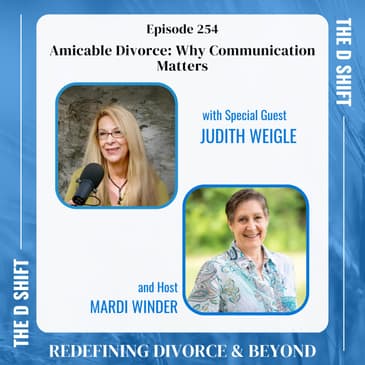
In this episode of The D Shift, Mardi Winder speaks with mediator, speaker, and host of the Amicable Divorce Expert podcast, Judith Weigle, about what it really takes to navigate an amicable divorce and why communication and timing play a critical role in the process.
Judith shares her journey into mediation and offers a grounded perspective on what “amicable” truly means. Rather than agreeing on everything, an amicable divorce is about the ability to have productive conversations, even in the midst of emotional stress and uncertainty.
Mardi and Judith explore how communication breakdown is often at the core of relationship challenges and how those same patterns can show up in mediation. With the right guidance and support, however, couples can learn to communicate more effectively, leading to better outcomes during divorce and beyond.
This episode highlights:
• What an amicable divorce really means
• Why communication is the foundation of successful mediation
• How timing impacts the divorce process from start to finish
• Common challenges people face when navigating divorce discussions
• How professionals can support better outcomes without increasing conflict
The conversation also highlights the importance of allowing both parties the time they need to process the emotional aspects of divorce before moving too quickly into legal decisions. Judith explains how rushing the process can create resistance, while thoughtful pacing can lead to more balanced and sustainable agreements.
About the Guest:
JUDITH M. WEIGLE, Mediator, Podcast Host, Professional Speaker Her company, Divorce Resource, Inc., provides both mediation and filing services in family law. Judith is one of those rare individuals who can make you laugh while you’re going through a painful experience. Her ability to see through the complexities of emotion in order to help people think through and reach a negotiated settlement is unparalleled in the field of divorce mediation.
Her TEDx talk "Secrets to an Amicable Divorce" displays these traits. Host of THE Amicable Divorce Expert podcast Judith promotes amicable divorces. Weigle is also author of the Internet sensation My Office Is a 3-Ring Circus! Must I Take Orders From Clowns, a business development book. Judith’s Philosophy: Be Honest and Authentic, Speak from the Heart, and Take Responsibility for Your Actions
Judith’s gift: A free one-hour communication coaching, www.DivorceResourceInc.com
To connect with Judith:
LinkedIn:https://www.linkedin.com/in/judith-weigle-divorce-expert/
Facebook: https://www.facebook.com/JudithMWeigle/
Instagram: @theamicabledivorceexpert
YouTube: https://www.youtube.com/watch?v=78KSKbCP5D4 Secrets to an Amicable Divorce TEDx talk
THE Amicable Divorce Expert podcast www.TheAmicableDivorceExpert.com
About the Host
Mardi Winder is a Strategic Divorce Consultant and High-Conflict Divorce Coach who helps high-achieving individuals navigate divorce with clarity, confidence, and control. Drawing on more than 30 years of experience in mediation, divorce coaching and conflict resolution, she supports clients in making smart decisions while reducing emotional and financial fallout, particularly in high-conflict, high-asset and complex divorces. Mardi is the founder of Positive Communication Systems, LLC, and the Strategic Divorce Directory, LLC.
For Mardi’s gift: The Resilience Building Blueprint: A 28-Day Journey To A Stronger You https://www.divorcecoach4women.com/rbb
Connect with Mardi on Social Media:
Facebook - https://www.facebook.com/Divorcecoach4women
LinkedIn: https://www.linkedin.com/in/mardiwinderadams/
Instagram: https://www.instagram.com/divorcecoach4women/
YouTube: https://www.youtube.com/@divorcecoach4women
Thanks for Listening!
Thanks so much for listening to our podcast! If you enjoyed this episode and think that others could benefit from listening, please share it using the social media buttons on this page.
Do you have feedback or questions about this episode? Leave a comment in the section below!
Subscribe to the Podcast
If you would like to get automatic updates of new podcast episodes, you can subscribe to the podcast on Apple Podcasts. You can also subscribe in your favorite podcast app.
Leave an Apple Podcast Review
Ratings and reviews from our listeners are extremely valuable to us and greatly appreciated. They help our podcast rank higher on Apple Podcasts, which exposes our show to more awesome listeners like you. If you have a minute, please leave an honest review on Apple Podcasts.
[00:00:04] Welcome to the The D Shift, where we provide inspiration, motivation and education to help you transition from the challenges of divorce to discover the freedom and ability to live life on your own terms. Are you ready? Let's get this shift started.
[00:00:22] Hello, and welcome to this episode of the The D Shift. And today I have a guest and we have a lot in common. It's interesting. We met through a mutual friend introduced us and we just we've chatted a couple times and we spent a few hours, I think, chatting back and forth. So I want to introduce you to Judith Weigel. She is the host of the Amicable Divorce Expert Podcast. She is an accomplished and experienced.
[00:00:51] Mediator. And she is also a professional speaker who has an amazing TEDx talk out that you definitely need to listen to. She is the owner of Divorce Resource Incorporated and provides mediation and filing services in family law in California. So Judith, welcome. Thank you, Mardi. That was the best introduction. It was concise. You pronounced all the words correctly.
[00:01:18] Well, yeah, sometimes I mess those up. Oh, there you go. So Judith, before we get into all the great stuff that we want to talk about, tell us a little bit about yourself and why this is your area of focus and passion. You know, life just has a way, Marty, of pushing you in directions you never could foresee. My entire background prior to family law was in entertainment. So I toured the country with the Clyde Beattie Cole Brothers Circus.
[00:01:48] As a marketing director. And then eventually as the dancing bear when I married the band leader. That was the thinnest I've ever been in my adult life because it's a lot of work, dancing in a bear costume. But then other than that, just toured the country with other different entertainment ventures.
[00:02:06] When I got into family law, it was a little bit of a process. Three female attorneys approached me back in the late 2008, 2009 and just said, you have a great personality for mediation. You should consider it.
[00:02:23] I had no idea what it was. I did not consider it. But the third person in a nail salon in Los Angeles, the former owner of my company, Divorce Resource Incorporated, said, you have a great personality for mediation. You should consider it. And I said, OK, I'm supposed to consider it. This is the third time.
[00:02:43] And I did. I loved it. It's a wonderful experience to be able to work with people who need help communicating, who need help navigating a very emotional time in their lives. And boy, do they love you if you can help them. So I enjoy this tremendously.
[00:03:06] And I think the heart of every mediator is that helping and help, you know, there to support people, not in obviously mediators never or they shouldn't absolutely never tell parties what to do, but to give them the opportunity to consider options, to think about what's best for them and their kids, and then to make decisions that are really personalized.
[00:03:32] That that is you're right. It's a gift. And when it works well and when both people are willing to participate and do some things, it is such a positive experience for most people. It really is. And they know it when it's happening. They really do get it. It is one of the hardest jobs I've ever had, Marty. I can do sales. I can travel. I can speak. That's pretty easy.
[00:03:57] But to be able to be neutral, to be able to sit with people who are in pain generally and having a very difficult time talking to one another. I mean, my gosh, you're in an emotional crisis and you're trying to make decisions about money and kids. Right. I couldn't think of anything harder than that.
[00:04:16] So to be able to get inside of these two strangers and be able to move them forward in a discussion that they've never really had the way they're going to have it in a mediation, it not only helps them be creative, and I don't mind brainstorming. I will not tell anybody how to make a decision like you, not our jobs. But I can brainstorm.
[00:04:44] I mean, we have clients that we can say, you know what? I had a similar case like this. This is what they chose. Do you think any part of this may work for you? Right. Absolutely. Just helping them like that. It's so fulfilling at the end of that. It is. Yes. Yeah.
[00:05:04] And I know today we were going to focus on this whole idea of amicable divorces and how we can create this scenario if you're going through a divorce. Because let's face it, you don't hear about the amicable divorces and there are tons of them. Almost 85, what is it, between 85 and 90 percent of divorces settle out of court. So that means only 10 percent, 15 to 10 percent actually get to litigation.
[00:05:33] And typically there's only a couple of reasons for that. Somebody is not a rational person or a high conflict divorce or a high conflict personality. Or there are very complex issues that neither party can agree upon because of their complexity. And when that happens, it's at what we call impasse in mediation or no agreement. And then you go in front of a judge and you have somebody make that decision for you.
[00:06:01] But outside of those, the vast majority of divorces are are settled in mediation in a nice, comfortable office. You know, and sometimes it doesn't take very long to do this. So, Judith, how do you see these amicable, amicable divorces getting started? And how do you see people being able to navigate this without becoming mortal enemies through the divorce process?
[00:06:30] Well, first of all, let me define the word amicable the way I define it. Amicable doesn't mean you agree on everything. Amicable to me means you can at least have a conversation. That's all it takes. You can at least have a conversation. Now you involve the professionals to help you understand what this process is about, what the goal is, the steps in getting to the goal.
[00:06:53] And then I like to talk about how important communication is, because that is the centerpiece of every relationship, isn't it? The way we communicate with each other. And then understanding that if you are married to a high conflict person, nobody asked to be born that way. Now, you don't have to stay married to them, but you don't have to make them a villain. You don't have to make them a bad guy.
[00:07:21] Yes, they've done some things that really hurt you. It's leading to the end of the marriage. But we have to understand people are born with aspects to their personality that are their journey. And you have to then work around them. Or this is where you have to involve professionals. You just can't always do it on your own. Because if you could, you'd be at the kitchen table. Right. Making the settlement.
[00:07:49] So just understand it's not horrible to involve professionals. You know, a lot of times people want to avoid two different types of people in their lives when they're getting divorced. Lawyers, wrong. You need to learn the law. Sit with a lawyer for an hour. Learn the law. Then you can come to people like us, mediators or, you know, people who file. Don't try and do that yourself. Chat GPT.
[00:08:16] Can I just make this announcement on your show? Yes, it's been made many times. Oh, my God. Chat GPT does not know the law. The chat GPT will steer you in the wrong direction every single time. Do you know how many divorces I have inherited after they couldn't take it anymore? And I said, how did you fill these forms out? I know they're not intuitive, but we have some defects we have to refile. Well, chat GPT. Right.
[00:08:47] Yes. It's the big issue that we're running into. This is a personal experience going through divorce, and you need people in your lives to help you, to calm you down, to make you know, to let you know that there is an end in sight. It will come. It's one day at a time. And just take a breath. Yeah. Yeah.
[00:09:12] And that, so we talked a little bit about communication, and I think, or you did, and I think one of the important things is that typically when there is a breakdown of a relationship, communication was at the heart of that breakdown at some level. And then now you're in a mediation room, and you're going to communicate using those same skills that got you to this point in your relationship.
[00:09:38] So I think this is where the whole idea of listening and being able to take on some new communication skills through the mediation process can really set you up, not only for getting a good settlement there, but then also if you have kids, whether they're adult kids or young kids, it's going to set you up to have better communication with your
[00:10:04] ex, and that hopefully will lead to reduction or complete elimination of conflict post-divorce. What do you think about that, Judith? I think it's excellent. So at the beginning of my mediations, I like to say to people, communication is at the heart of this. Well, Judy, what is mediation? Maybe it starts before then. Well, what is mediation?
[00:10:29] Mediation is a conversation and a negotiation to get to settlement terms. Okay, but we don't know how to do that. We don't communicate very well. That's okay. I'm your guide. And so I ask people's permission, do you mind if I rephrase things along the way if they're phrased in such a way that your spouse is going to put a wall up?
[00:10:57] Because the whole point of this is you want the other person to listen, to process, and to be able to meet you where you're at in this negotiation. And people need skills. They just need communication skills. And even on a good day, if they communicate fairly well in whatever job they have, that goes out the window when it's your divorce and you're in a mediation room.
[00:11:24] You just need guidance in how to rephrase things. One of the things that comes up that I become very uncomfortable with, to be honest with you, and therefore I think the other person does, California is a no-fault divorce state. We don't have to talk about why we're getting divorced, but it is the backdrop to the negotiation. It sits on their shoulders in that room.
[00:11:51] And sometimes they just burst out with, if you hadn't done X, Y, Z, we wouldn't be here. And that's a tough spot for everybody to be in. At that point, if I see the communication is really fragile, I'll just say, can I just speak to one of you alone individually? And it just puts that whole thing to rest. And then I can do one-on-one communication skills with them when we come back to the room.
[00:12:20] And sometimes, so I so agree with you, and I so appreciate that perspective. Sometimes that blurred out, though, offers the opportunity for the person who did something wrong, whether it's had an affair, blew through the money, lied on their taxes, I don't know, committed a criminal act. I've had people who blurted out that they couldn't take it anymore because their spouse had committed
[00:12:48] some illegal act, had gone to jail or been sued or whatever and kind of tore the family apart that way. If the person who bears that responsibility is able to say, you know, you're right, and I wish there's something I could do, I could go back and do it over, but I can't. And I acknowledge how much this has hurt you and the kids or how this has contributed to this
[00:13:18] where we're at right now. Sometimes that's maybe the only time that that person really feels that sense of, I need to make amends or I need to apologize. And the power of a sincere apology at a negotiation is, I don't think you could say enough about it because sometimes everything just, okay, thank you for saying that. Now, how can we work together to move forward? Yeah.
[00:13:46] Marty, I wish that would happen in every mediation. It has happened. It has happened, but it doesn't always happen. So when it does happen, I'm like, oh my God, this is great. It's like I'm witnessing a miracle. And I really appreciate being there, watching these two people transform a little bit. So I think that's an honored position to be in, but not always.
[00:14:10] And it embarrasses the person, even though they do know what they did. Here's Judy, the stranger, Marty, the stranger in that room. And it just depends on how they handle us. So I watch.
[00:14:32] I just watch to see what the reaction's like, to see what maybe I should do to help smooth out that burst of emotion. But then at the same time, it helps me as a mediator to actually know where the hurt is. Right. Then I can understand what the ask is. Right. Right. And Judith, I think we've been kind of sneaking up on this from our own different ways here.
[00:15:00] But one of the things that you talk about is how timing is so critical throughout this. And a couple of things that we've alluded to are that sense of timing, both on the parties to the mediation, as well as the mediators aspect. But tell us a little bit about this idea of timing being everything. Timing starts at the very beginning of, I think we need to transition out of this relationship.
[00:15:28] So one person will typically think about it first. Both people may know generally that the relationship isn't working. But one person will have more concrete ideas about moving out of the relationship. They process that for a while. They're sure about it. And then they say, can we have a talk? So they have the talk. And then they just want to file. Well, no, no, no. Timing is everything.
[00:15:57] The other person needs time to process what you just said. And maybe not even try and change your mind as much as, okay, this is a life change. Let me look at myself differently. What are the plans I have to make? I mean, there's a lot that goes on. Kids, no kids. Does everybody work? Does somebody have to find a job? There's so much that goes into that.
[00:16:26] So the timing starts with the person who initiates the conversation needs to let the other person have some time to work through that emotion and say, okay, I'm ready to file. Yes. Now, the person who brought it up can go ahead and look for legal advice, but don't push that person. Okay, now the other person's ready to roll. You engage in the legal divorce. So you're going through the emotional divorce first. Right.
[00:16:54] And now you're ready to engage in the legal divorce. Time to file. Okay, we file. We serve. Maybe your response is filed against the petition. That's great. It's all part of the process. Next step are the disclosure forms. Well, that in and of itself will cause people to stop. Okay, we filed the petition. We filed the response. Can I just touch my breath? Right. So again, you just have to be sensitive. Well, I don't know why they can't move forward.
[00:17:24] They know we're going to get divorced. It's emotional. And emotions have a different sense of logic. So you just have to let it play out. Because if you force that person, who knows how it's going to affect the settlement. Well, and so thank you. Because a lot of people don't realize that once you file, you start a clock. And that clock, depending on your jurisdiction, might be 30 days, 45 days. You know, it just depends.
[00:17:52] And in some areas, because I know there's a fair number of listeners here up in Canada, you know, you may have had to have been separated for a year before you can file. Down here, you can walk into the courthouse the next day and file. It doesn't matter. There's no such thing as in a lot of states. There's no recognition of a legal separation, as there are in many other countries. So you really have to understand. And I so appreciate what Judith is saying about give the other person time to catch up.
[00:18:22] Because that the big one I see, Judith, is when people start getting those financial requirements to fill in. This is not a one page document. This is going to take you hours to fill these out. You're going to have to go back. You have to create a budget for yourself. And you can't just ballpark it. You've got to have real numbers, you know. Because if you ballpark it and you estimate your budget real low, that's what they're running off of.
[00:18:50] You don't, it doesn't, it doesn't serve you to guesstimate. You really need to take the time and research these numbers. And that, I think, is where I see a lot of people, they can be pretty amicable right up to that, right up to those numbers. Once you get into the financial stuff, people become very defensive about it, how they spend, what they've spent, where the money has gone. Very proprietary, territorial. Yeah. Well, I put, this is my 401k.
[00:19:19] Well, in the community property state, it's both of your 401ks. But I don't want to divide it. Okay. So that's one thing to support what you just said. In terms of timing and money, maybe one person has to start a career or boost their income. And if you allow that person to try and put better financing together for themselves in terms of their work, the settlement will be better.
[00:19:49] They'll be less dependent on you. Right. Yes. If you're, you know, I'm talking about if the other person is the revenue generator. And so there's just so many moving parts. In California, where it's a minimum of six months plus a day before the court will allow you to be divorced if all of your paperwork is in, the court is generous in time. So here's about time what I tell people. Listen, stop the bleeding.
[00:20:16] If they want to know when should we start, I would say, well, if this is kind of debt heavy, stop the bleeding, file, name a date of separation. Now you're stopping the responsibility to pay the other person's debts. So there's that. And then I can show them where they can play with time. So to your point, the financial disclosure forms, and there's two of them. One is about income and budget.
[00:20:46] The other is about assets and debts. The court allows you more than the suggested 60 days to complete that. So what happens in some divorces is, no, we just want to do it now. We just want to get through this. And they can. Okay, great. So I'll work with them quickly. But in so many other cases, people don't like paperwork. And that's the only paperwork people have to do on their own because they're the only ones
[00:21:15] who know what they have. Right. So I'm generous with time. I don't push people to work beyond their capacity. But what can happen is one person may take more than 60 days. There's a lot to get together. They're working. They're traveling. But the other person's not even starting. Yes. So how do you balance that? Well, timing is everything. So I just say, well, how much time can you afford to the one who's ready to move forward?
[00:21:46] I get that. So I said, well, let's just have a little talk with your spouse. Have it be understanding. And just offer a timeframe in which they can work more than we have with the court appointed. And then I'll follow up. Don't you follow up. Let me follow up. Right. And it's easier if I follow up. I'm not the one that they're engaged in an emotional relationship with. And I'm the professional. Right.
[00:22:15] So I have found that if I'm the one that says, listen, I'm not pushing you, but I do want to help you. How can I help you organize? Right. Yes. Yes. Yeah. And quite often that's what I find is people are just overwhelmed. You know, there's like you say, they're working. Maybe they're having to relocate. Maybe they're moving out of the house. Or if you're staying in the house now, all of a sudden, all the tasks that the other person used to do, maintenance, yard work, whatever it may be.
[00:22:44] Now, all of a sudden you're responsible for that. There's a whole lot of things shifting right at this time. And for a lot of people, that one extra little, it's like the straw that breaks the camel's back, that page. Even if there aren't a lot of debts or there aren't a lot of assets, that requirement to fill that in just becomes the point where they go, nope, this is too much. I'm not going there. And that gentle approach of saying, how can I help?
[00:23:14] What do you need some support with? And let's look at a range where you can get this in instead of it has to be in on this date by this time. I think that is so phenomenal. Well, Marty, truer words were never spoken, what you just said. Maybe somebody has very few credit cards, so not a lot of debt, very few assets. That doesn't really even matter.
[00:23:38] The fact that this is a task that has to be done that they don't normally deal with is all. I mean, that's it. Because what I will do in my first meetings when I file is I'll go through the disclosure forms and I'll give them guidance on how to do it. And I'll do very short versions if I can. And then a month or two will go by. They'll forget about it, even though it's written down. We've taken notes.
[00:24:05] And it's just the emotion of dealing with it that makes it a mountain to climb instead of let's do one step a day. I've even said, well, each form is four pages long. Let's do one page a week. Right. Even. Right. You know, just to minimize. Bite-sized pieces. Yes.
[00:24:29] Judith, we could probably, I know you and I could talk for hours on this because this is both something that's near and dear to our hearts. But we do, we are running out of time, believe it or not. So I do want you, so you have most generously offered a gift to the listeners. So I'd like you to tell us a little bit about that gift because it's really a phenomenal opportunity. It's my most favorite gift ever. It's communication training. I want to train you how to communicate in conflict through the divorce.
[00:24:57] I want to train you how to communicate in a mediation. And it's the words we choose and the tone of voice we use that is everything in communication. And yes, I love doing it. And please take me up on my offer, on my gift. Yes. So Judith has offered a one-hour communication coaching session with her. And you can access that through her website.
[00:25:25] So Judith, let me ask you, of all the things that we've talked about, what do you think is the takeaway that you want people to keep in their mind when they go on about their busy days? Life is a journey. The only way I can make sense of life and not feel like a victim is everything that comes to us is for a reason.
[00:25:53] If we can look at the divorce as something necessary from which to grow, that all of a sudden makes us look at divorce in an entirely different way. It's okay to be divorced. Nobody did anything wrong or bad. It is a learning experience. And it's one of many. So that's my big takeaway is life is a journey. Divorce is here to help us.
[00:26:22] Funny enough to say that, but we will learn and grow from it. Absolutely. Everything is a learning experience if you choose to make it so. That's absolutely true. Yeah. Judith, if people are listening and they're thinking, oh, wow, I really want to know more about what you do or they want to reach out and work with you, what's the best way to do that? Just go to my website. It has my email and my phone number and it's DivorceResourceInc.com.
[00:26:50] The name of the company, DivorceResourceInc.com. And I will be thank you for having me. Oh, well, thank you. And I'm going to have all that information in the show notes as well as some social media platforms that Judith is on that if you want to follow her, reach out and get her little nuggets of wisdom as she drips them across the social media platforms. You're more than welcome to do that. And Judith, as always, thank you so much for being here. I so enjoy talking with you.
[00:27:18] Such a balanced approach to mediation. It's really wonderful to hear. Well, I'm honored to be your guest because I've listened to your interviews and they are phenomenal. I have learned from them. So thank you for having me as a guest. Well, thank you. And thank you, everyone, for listening in to this episode of the D-Shift Podcast. And don't forget to tune in to the next one. Thanks for listening and supporting the D-Shift Podcast.
[00:27:44] If you would like to attend live trainings by our amazing guests and have a chance to ask questions and get answers from our experts, join the D-Shift crew. For more details and to sign up, head on over to www.divorcecoachforwomen and click on the podcast page.