
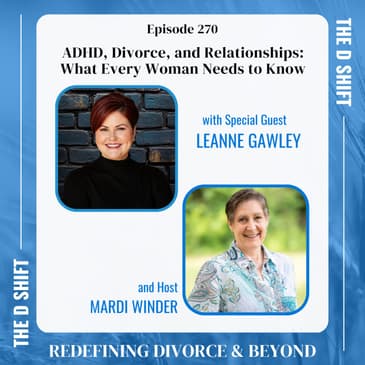
What happens when ADHD, relationships, and divorce collide?
In this episode of The D Shift, Strategic Divorce Consultant and High-Conflict Divorce Coach Mardi Winder sits down with ADHD coach and executive leadership expert Leanne Gawley to discuss how neurodivergence, particularly ADHD, can affect relationships, communication, organization, and the divorce process. Leanne shares her personal journey of being diagnosed later in life after her son was identified as having ADHD, and how that discovery transformed both her understanding of herself and the work she does today.
They explore why ADHD often presents differently in women than in men, why so many women go undiagnosed for years, and how common challenges such as overwhelm, time blindness, anxiety, emotional sensitivity, and organization can become even more pronounced during periods of major life transition.
Leanne offers practical strategies for managing the demands of divorce, including gathering documentation, working effectively with attorneys and professionals, breaking overwhelming tasks into manageable steps, and creating systems that work with your brain rather than against it.
This conversation is valuable whether you have been diagnosed with ADHD, suspect you may be neurodivergent, or simply find yourself struggling with overwhelm during difficult life transitions. Most importantly, Leanne reminds us that we are not alone, and that understanding how our brains work can be one of the most powerful tools for moving forward with greater confidence and self-compassion.
Mardi and Leanne explore:
• Why ADHD often looks different in women than in men
• The connection between ADHD, anxiety, and overwhelm
• How neurodivergence can impact relationships and communication
• Strategies for managing time blindness and procrastination
• How to work more effectively with attorneys and divorce professionals
• The importance of self-compassion during major life transitions
• Why community and support matter when navigating divorce and ADHD
About the Guest:
Leanne Gawley is the founder of The ADHD Advantage with Leanne Gawley, a Calgary-based coaching practice serving women in leadership and neurodivergent professionals and families. A former C-Suite finance executive and late-diagnosed woman with ADHD, Leanne knows firsthand how an ADHD brain can quietly complicate the things that look simple on paper: staying on top of deadlines, keeping files organized, and communicating clearly when emotions are running high. She brings her lived experience alongside her CPA, MBA, and ICF ACC credentials to help clients build systems that actually work for their brains, not against them.
Leanne is also a Canadian Certified Inclusion Professional with deep roots in neurodiversity advocacy and workplace inclusion. She coaches virtually worldwide and is currently writing her first book, Brilliant and Wired Differently: The ADHD Advantage.
For Leanne’s gift: https://adhd.leannegawley.ca/
To connect:
website: www.leannegawley.ca
Linkedin: www.linkedin.com/in/lgawley/
Instagram: @leanne.gawley
About the Host
Mardi Winder is a Strategic Divorce Consultant and High-Conflict Divorce Coach who helps high-achieving individuals navigate divorce with clarity, confidence, and control. Drawing on more than 30 years of experience in mediation, divorce coaching, and conflict resolution, she supports clients in making smart decisions while reducing emotional and financial fallout, particularly in high-conflict, high-asset, and complex divorces. Mardi is the founder of Positive Communication Systems, LLC, and the Strategic Divorce Directory, LLC.
For Mardi’s gift: The Resilience Building Blueprint: A 28-Day Journey To A Stronger You https://www.divorcecoach4women.com/rbb
Connect with Mardi on Social Media:
Facebook - https://www.facebook.com/Divorcecoach4women
LinkedIn: https://www.linkedin.com/in/mardiwinderadams/
Instagram: https://www.instagram.com/divorcecoach4women/
YouTube: https://www.youtube.com/@divorcecoach4women
Thanks for Listening!
Thanks so much for listening to our podcast! If you enjoyed this episode and think that others could benefit from listening, please share it using the social media buttons on this page.
Do you have feedback or questions about this episode? Leave a comment in the section below!
Subscribe to the Podcast
If you would like to get automatic updates of new podcast episodes, you can subscribe to the podcast on Apple Podcasts. You can also subscribe in your favorite podcast app.
Leave an Apple Podcast Review
Ratings and reviews from our listeners are extremely valuable to us and greatly appreciated. They help our podcast rank higher on Apple Podcasts, which exposes our show to more awesome listeners like you. If you have a minute, please leave an honest review on Apple Podcasts.
[00:00:04] Welcome to The D Shift Podcast, where we provide inspiration, motivation, and education to help you transition from the challenges of divorce to discover the freedom and ability to live life on your own terms. Are you ready? Let's get this shift started.
[00:00:21] Hello and welcome to this episode of The D Shift Podcast. And I am thrilled to have somebody come on today to talk about something that I think is so important, and that is how does neurodivergent issues such as ADHD impact the challenges of going through divorce, getting into a new relationship, staying in a current relationship? These are all very real considerations.
[00:00:49] And I have a wonderful guest who happens to live just down the road from where I grew up most of my life, so it's kind of cool. Leanne Gowley, she is founder of the ADHD Advantage with Leanne Gowley, a Calgary-based professional services and coaching practice helping women in leadership roles and those with neurodivergent issues and their families.
[00:01:15] And I think Leanne Gowley, she is a Calgary-based professional. And I think Leanne's background is very unique. She's got experience as a C-suite executive, and she has also worked in many different roles and also found out, I'm going to say later in life, that she had ADHD.
[00:01:32] And she has learned some really amazing techniques and skills and ways of reframing this and using that diagnosis to really excel at what she does. So, Leanne, welcome. Thank you so much, Marty. You're so sweet. That was the best intro ever. Well, thank you. Well, and just full disclosure, I didn't know Leanne, and we happened to be on the Voices of Women Summit, and I was interviewing her.
[00:01:58] And we found out literally we had lived 100 miles away from each other most of our life, and we meet on a virtual summit with a couple of hundred women speaking. So it was really interesting. Yeah. Leanne, I gave a very brief bit of your background. Introduce yourself to the audience and let them know how you came into this very specific way of helping other women.
[00:02:23] Yeah. So once again, thank you so much for having me. I'm so excited. Our interview was amazing, and I'm thrilled to be back chatting with you again. It was so much fun. So for me, yeah, you're absolutely right. I was late diagnosed with ADHD, and I honestly had no idea. No idea I had ADHD.
[00:02:43] I knew that I was different. I knew that my brain worked differently than other people. I knew there were some struggles that I had that weren't struggles, you know, with other people who were C-suite leaders as well. And, you know, it really, it comes down to, like, my son. He was five, and he was struggling with reading at school and struggling with kind of, like, you know, sitting down, paying attention, all that kind of stuff. And the teacher just kept on saying to me, like, he can't read, he can't read. And I was like, okay, well, like, let me take him and get him assessed.
[00:03:11] Because, you know, when I put blocks in front of him, he can pick out words, no problem. He can make words with blocks. But when you want him to read in a book, it's totally different, and it just doesn't kind of click. And I was like, you know, I'm just interested. Maybe he learns differently. Maybe there's something else we need to know. Like, what's going on with my kiddo so I can help the teacher? And the psychologist, after meeting with him for a number of hours over a couple of weeks, said to me, you know, he's got ADHD. And I was like, I felt like somebody had, like, hit my heart really, really hard.
[00:03:41] Because I was like, you know, I had Ray when I was 35. And so there's, you know, the rumors about, you know, like, things that can happen in pregnancy when you have kids when you're older and all that kind of stuff. And I was really shocked because it wasn't in my family. We didn't know it was in my husband's family. I certainly didn't know I had it at the time. And then the psychologist said to me, you know, after speaking with you and doing interviews and stuff with you, it might be good for you and your husband to think about getting assessed as well because it can run in families. And I was like, oh, that's really interesting. Doesn't really resonate with me. You know, I did fine in school.
[00:04:10] Like, you know, I'm fine. I've got, like, things that will help me get through. And she was like, you know, it's totally different in men than it is in women. And I was like, oh, isn't that interesting? And then as I dove into it more, I was like, all of these things line up for me in, you know, more ways than I can count. Like, maybe I really should get assessed and just kind of see what's going on. And I did. I went to go get assessed. They came back and said, yeah, you've got ADHD.
[00:04:35] When I talked to my husband, he also, like, he was like, oh, yeah, I hit all those things as well from, you know, from the time I was a kid. He grew up outside of Canada. And so he didn't have kind of the reference points for what ADHD was. And so then I decided I was going to do this really deep learning to be able to help my kiddo and, you know, have him, like, have the teachers understand what he was going through, have folks around him support him, and just be able to talk about it in a way that was, like, really helpful for him and have the right language and all that kind of stuff.
[00:05:02] So as I was doing that, I was already an executive coach. And then I thought, well, the best thing I can do is, like, go get ADHD coaching certified. And so I did that and I learned a ton. And then all my clients slowly went from, like, you know, executives, which are amazing, but then it turned into executives who are neurodivergent. And what that's meant for me is that, you know, I've realized there's a whole community out there that really needs support and really needs help and needs people who get it. And so, you know, thank goodness. It's so much fun. I absolutely adore my clients. They're all amazing.
[00:05:32] And I learned from them just as much as they learned from me. So that's kind of how I came to be where I am. Yeah. And, you know, that's at the heart. And I say this, I feel like a broken record. I say this almost every podcast.
[00:05:44] But a lot of the coaches that I meet that are really good at what they do have lived experience, either through a divorce, you know, working with a child or a family member who has some kind of medical or neurodivergent issue or actually has experienced a diagnosis themselves. Because it's very different.
[00:06:09] It's very different to have the theoretical knowledge and not have the practical knowledge of the struggles that ADHD can cause if you're fighting your own brain and trying to do things the way that everybody else does things, I guess. Exactly. Exactly. Yeah, for sure.
[00:06:55] So that's a lot of people going through divorce that people with ADHD may experience, specifically women. And because I've got my own ideas of working with clients, and I'd like us to kind of compare where we see these things happening. Sure. I think there's a lot of different ways where ADHD can impact divorce both before, you know, you get to the point of deciding you're going to have a divorce or you're going to go through a divorce, but also through the divorce process itself. Right.
[00:07:23] So, you know, and the one thing I'll say about testing is it's not imperative for you to be tested. If you know your brain, you know your body best, you know, if a diagnosis is going to mean something for you, if it doesn't add anything, and that's totally fine. These tips hopefully will help anybody going through divorce because whatever is good for neurodivergent folks and people who think differently and are different works for other people as well. Like ramps for wheelchairs also work for moms with strollers. Like there's things that will help everybody.
[00:07:51] So hopefully even non-neurodivergent folks out there will also be able to resonate with some of this stuff. So from, like if I back up a little bit, and from a relationship perspective, ADHD can be really, really hard, especially if it's a neurodivergent person with a non-neurodivergent person and if or you don't know that you're diagnosed. And so it can be things like what I see with my clients is typically like they're super good at home and work is falling apart or they're super good at work and home is just like we can't get it together. And there's nothing wrong with that.
[00:08:20] It's a little bit of spoon theory where like you wake up and you've got 100 spoons. And for somebody with ADHD, it might take you 20 spoons to get out of the house and get ready and go. You've got 80 spoons left for the day. For a neurotypical person, that might take five spoons because it's routine. I do this thing every day and away we go. And so you're landing at the office or wherever your workplace is with 80 spoons left and everybody else is landing there with like 95. So you're already starting off the day a little bit of a different and spoons is like dopamine. So as your spoons kind of go down for different things, there are other things that are going to lift it up.
[00:08:48] So things like the tasks you really enjoy doing that you can like dive right into that will increase your dopamine and make things go really well for you. So when it comes to divorce or relationships even, some of that, you know, falling apart at work or falling apart at home or both or none. Sometimes it doesn't happen in that way. It can be really hard for our partners to understand exactly what's going through our head. Like, how did you forget that? Why is the fridge left open? This cupboard is always open. Like, what is going on here? And you walk around the kitchen. All of a sudden you realize I went in to make a coffee.
[00:09:18] So here's the cream for my coffee. There's the coffee cup. But I didn't make the coffee. And the other person is going like, seriously, put this stuff away. And it's those little things that can start to like, you know, on top of all the other big things that we deal with in relationships, right? It's these little things that can start to wear. And then also for us as ADHD folks being reminded, yes, you forgot your mug out. You forgot the coffee. Like, all these things you're like, yep, failed again, failed again, failed again. So some of it is how we talk to ourselves and what we give ourselves leeway for, right? What's really important? Is it important that I left my mug out? Not really.
[00:09:47] But having that conversation with your partner can help them understand. Showing videos of what it's like for an ADHD brain to go in and process getting a snack from the kitchen. There's one I absolutely love. That's amazing because it really opens up the other person's eyes, especially if they don't have the experience of having dealt with or have neurodivergence themselves. And then when it comes to divorce, I mean, there is a whole other world that needs to be organized and efficient and accessible.
[00:10:17] And there are so many things you need, the bank statements, the property information, the bills, the child care, all the things. And so from a, you know, that can be overwhelming in and of itself. And for me, when my body hits overwhelm, it's like I'm ready for sleeping. And it could be 10 o'clock in the morning and I could have had the best sleep of my life. If I'm overwhelmed, my body goes, nope, time to nap. And I just like, I honestly, like, I cannot, can't keep my eyes open because that's how my body deals with it. Everybody's different. Some folks, they go for a run.
[00:10:46] Other folks, they know that they need craft time or whatever it is. But my body goes into like complete shutdown. And so for me, I lean into that nap a little bit and then I go, okay, I'm going to give myself 20 minutes to lay down. I'm going to figure out, like, I'm going to go through the overwhelm and I'm going to take just one thing that I need to do today. One thing that I'm not going to be super overwhelmed about, I'm going to give myself 10 minutes to do that task. And if I take the 10 minutes and I hit stride and I can actually, you know, I feel like I could keep going after 10 minutes, that's okay. And if I can only go 10 minutes, guess what?
[00:11:16] I did one thing that day. I started that task and that's huge. And especially when things get super, super tough. The other thing I would say is like, if that even feels difficult, write a list of all the things you need to do. So this is, I got out of bed. I had a shower. I did my hair. I did my makeup. If you do makeup or not, whatever. But all the little things that you do in your routine, start that checkbox because that starts the dopamine going, yeah, I did that. I did that. I did that. And then you can get into that task a lot easier than if you were to like, just go, okay, here's like the 10 things I need to do. I haven't done anything yet today.
[00:11:46] Yes, you have. You got out of bed. Maybe you got your kids to school. Maybe you went to work. Maybe whatever. But you've at least accomplished five things. There's nobody that wakes up and gets out of bed and doesn't accomplish five things in that first 10 minutes of what they do. Yeah. So that's a way to kind of trick your brain into getting into some of that stuff. Yeah. And I think maybe it might even be helpful if somebody's listening to this and they're going, yeah, I do that all the time. I walk into a room. And, you know, I know what I'm going to do. I get in there. I see something else I have to do.
[00:12:16] I start doing that. And then I see something else I have to do. And I start doing that. And then I'm standing in the middle of the room with 15 things halfway done. And I don't even remember what I went in the room to do. Exactly. And I'm getting older. So sometimes I wonder if that's true. And there's a whole menopause thing that happens as well, right? Yeah. Perimenopause, like all of that stuff. Yeah. Maybe it might be helpful. I was just thinking of this. Could you just kind of, because you said earlier that women experience ADHD different than men. Yeah.
[00:12:44] So could you maybe just give us sort of the Reader's Digest version of what? And, of course, we're not diagnosing or providing any kind of medical or mental health information. This is strictly for educational purposes. Yeah. Can you just kind of tell us a little bit about, if you're not diagnosed, but you've always had that attention, hyper attention or hypo attention kind of thing going on. Can you explain what that might look like for a woman? Yeah.
[00:13:10] So the first thing I'll do is I'll go to like the theoretical definition, not theory, but what we normally see in boys. And then I'll talk about what we normally see in girls. So in boys, typically what we see is the combination of hyperactivity. And what that means is like they're the ones who can't sit still in a classroom, can't like like to roll around, like to do things upside down, all that kind of stuff. Motion is their way of processing things.
[00:13:35] And it's not you can have the absolute sweetest kid who doesn't mean that they're disturbing the class and it doesn't mean that they're, you know, causing trouble. It means that they just need more motion and their motion. My son processes things by walking around the house. 100%. If I'm quizzing him on something, we do it out loud and he walks around the house while he's doing it because that's what his body needs. In women, it's completely the opposite, even though we could have the same cross pattern of ADHD. We could be still hyperactive. But what that means is for most women is we're hyperactive in our brains.
[00:14:04] And so we are doing the what if spiral all the time. OK, so I'm going to go out and I'm going to pick up groceries. OK, oh, right. I forgot I need this. I forgot I need that. I forgot I need this. I forgot I need that. So now I'm going to do 15 errands in my one errand and I'm not going to be gone for the 40 minutes that I thought I was going to be gone from. I'm actually going to be gone for most of the afternoon because it's timely. I forgot whatever it is, but it's all in our heads. And that also can be a huge comorbidity. What we've noticed is that there's there's tons of studies on this women who struggle with anxiety.
[00:14:33] There is a comorbidity with ADHD. So it doesn't necessarily mean 100% correlation, but it means that women with anxiety can be predisposed to have ADHD. And so there is a correlation there. It's not one to one for me. I have both. And the anxiety is exacerbated by my ADHD because I start getting anxious about something. And then the ADHD takes over and goes, OK, now I'm going to plan out like all these things, you know, and part of that's the anxiety. And part of it is the hyper focus for ADHD. So it's really like it's very internal. It's very in our bodies.
[00:15:01] And that's why so many women for so long have been missed when I was a kid. So I'm like, I guess, late 40s now. Thanks, birthday. So late 40s, I'm 47. And, you know, when I was a kid, ADHD was like girls didn't have ADHD. It was just the boys. And the girls are missed because they're, you know, they're looking out the window. They're daydreaming a little bit. They are making business plans. Their minds are doing whatever they're doing. But it's not as external as it is with boys. So that's the difference. And that's why so many women are missed.
[00:15:27] So that's what I would, you know, kind of brief your listeners with in terms of ADHD. There's a lot more that goes along with it, but that's probably the biggest one. Yeah. And I was thinking just generally, because honestly, a lot of the more I do reading about this, the more I think, you know, there's times in my life where I think I would have probably and again, there's no blood test. There's no it's it's a you know, the diagnosis is based on a series of patterns and behaviors that have, you know, occurred over a set period of time.
[00:15:59] I'm very what I have is that and I've never been diagnosed. And I don't think I'm certainly high on the ADHD. If anything, it's like way down on this kind of on the spectrum of it. But I am very tangential. Like my thinking, I don't think like going in a linear thing. And so I get really bored with people who are going point to point to point to point. I'm like, I want to see the big picture and then I want to make my own connections and
[00:16:25] I want to get to my own space sometimes ahead of where the other person is. And then I get bored listening. So, Leanne, what would that look like for a woman walking in to talk to an attorney? Yeah. So attorneys are super methodical. They're going to go from, you know, point A to point C in that very methodical order. And it can be really tough for women who are making all the connections for anybody, really, who's making all the connections and needs that big picture.
[00:16:52] And so in a lawyer, the first thing I would love to say is just that it is so important to have a lawyer who understands neurodivergence so that they understand. And you can even say to them, like, this is the way that I work the best. I need like the big picture. And then we can kind of like dive in to different things. Like you can you don't have to disclose that you have ADHD. Maybe, you know, maybe you don't. It doesn't matter. But you can say this is the way that I work best. And you're the client. So you can ask for that.
[00:17:21] And they need to help you understand what you're what you're going to be dealing with, because it's most important that you know what you're getting yourself into and that you have a chance to get all of your information out there in a way that you feel like you've been heard and you've been understood and all they have everything that they need to go forward. Yeah. And that's really important. And I think the other thing is sometimes attorneys are not going to have any of that kind of background, but they may be the greatest person to represent you.
[00:17:49] And that's where somebody like a divorce coach or a person that like Leanne that specializes in helping people with ADHD can really be beneficial because we can take the information from the attorney that you provide us. And then we can like I with my clients quite often set out a strategy of how are we going to complete this documentation? Because one of the things with divorce is it's not an unlimited time experience.
[00:18:18] Like quite often, if there's emotion, you have 30 days to respond or you're going to have 60 days to get the information in. If not, you are looking at being, you know, in in potentially in violation of those court orders. And you really don't want to be doing that in your divorce. It ends up adding to the cost. It gets the conflict going and causes a whole bunch of stress. So that's that's the one I see.
[00:18:42] And a lot of times with the numbers, I know that a lot of people are with with nor divergence issues are very good with numbers, not always good at the rote, you know, gathering information and laying it out in a method that work. That's the way that the court wants it laid out. And that's the problem, because, you know, quite often what the court is asking you to do or your attorney is asking you to do is not the way that you would prefer to organize
[00:19:12] and structure this information. Would you say that's accurate? Totally. I mean, we all work in different ways. Everybody's mind is different. And so that's why what I would suggest for your clients is, you know, have a cloud storage folder that has this password protected. Only you can access it. And as you come across stuff in your house, you just scan it into that folder. You take a picture, you put the picture in that folder and that will really minimize all of the things you're hunting for once that timeline starts, because time blindness
[00:19:40] is quite frankly, the other thing that is going to really impede some of this stuff. So with the trick that I've done with with my own thing, like I am great when I'm close to a deadline. You tell me I've got 30 days to file something great. I'll talk to you on day 28 or 29 because it's not an emergency until it's an emergency, right? It's either now or not now. And so now is like day 28. Great. I've got two days. I need to get this done. So that helps minimize what you're going to cram into those two days as you've got a file folder and maybe you've got something that's called like pick five general topics.
[00:20:10] You need something on your property. You need something on your financials. You need something on your life insurance. You know, maybe there's a couple of other things, whether it's kids or pets or, you know, house matrimonial stuff, whatever, business, whatever. You've got your five folders or however many you need and you just drop stuff in there as you come across it. Just drop things and you can organize it later. But you have the starting point for that building block that your lawyer is going to need. Have it on the cloud because then you can access it on your phone. You can access it on a computer. You can access it on a tablet wherever you are. And that way it's not like I need to be at home to do this work. You can be anywhere and do that work.
[00:20:40] And it just helps. You know, it's one picture. It's this or it's that. Yeah. And I really want to stress something else Leanne said. It's got to be password protected. And if it's on the cloud and it's a shared connection with your spouse, get a separate one and don't let them know that it's up there because you don't want, you know, you're not doing anything untowards or unethical or illegal by gathering this information. But you also don't want to do all their work for them either.
[00:21:09] So, you know, make sure that you are keeping it completely separate from any account that they may have. I do. And these, you know, it's always amazing to me how fast these conversations can go. And Leanne, I think we could talk for hours on this. I think so too. Why do you think, like, I think we talked a little bit about this, but why do you think women going through divorce who are diagnosed or undiagnosed with ADHD or another neurodivergent
[00:21:38] condition may be more vulnerable than some other groups of women going through the divorce? I think we are ADHD, folks with ADHD, men and women are really big feelers. And we tend to, especially as women, we tend to internalize a lot of the things going on. So it must be my fault. I must have done something where people pleasing and ADHD go almost hand in hand.
[00:22:04] And so what you need to realize is that it takes two to tango. It is not your fault alone. If you have decided to get a divorce, think about what it's going to be like on the other side of that. When you're done all this messiness, when you're done with all the things that you have to deal with right now, right now is that really super messy middle and it hurts. It's painful. It is like all of your energy to try to stay positive for the people around you. Maybe it's your kids, maybe it's work, maybe it's whatever.
[00:22:32] There are reasons why you're going to try to kind of like mask some of that. And that's exhausting. It's absolutely exhausting, especially when you're masking ADHD or some another type of neurodivergence on top of that. But know that it's not your fault. It's not your fault. It is especially when we like all of us are super big feelers. Our kids are big feelers. Anybody around us like tends to attract like. So there are probably some ADHD folks in your circle and they are also big feelers. And so being able to just step back and realize like this is happening for a reason.
[00:23:02] And on the other side of this messy middle, this hurtful, messy middle, I'm going to feel and focus on what that feeling is for you. What's that one thing you're going to do to celebrate when everything is done and you've got some peace in your life? And that's, you know, aside from, you know, feeling disorganized, which isn't necessarily the case. It's just that your files are organized differently than somewhere else. Right. So don't beat yourself up about that. It is the way you are and it's the way your brain needs it. So move past that. Don't blame yourself.
[00:23:32] Continue to look at like what's going to happen on the other side of this. And this is why that's important. What a great, what a great message. Now you actually very kindly have provided a gift for people listening into the podcast and that is the ADHD money clarity. Can you tell us a little bit about that? Yeah, I'd love to. So this is a toolkit that I put together for some of my clients who are struggling with bills, making sure they're getting paid. They are, you know, everything is kind of a little bit of everywhere.
[00:24:01] And this really just walks you through like kind of where you are right now, what your goals are and then what's like one thing you can do and one like one more thing you can do. And you kind of like put a checklist together of the things you need to work on, whether that's like could be for tax purposes. This is amazing for taxes. It could be for like getting a loan together for a house. It could be for divorce. It could be for a number of different things. And it just kind of walks you through a process of like getting organized on a piece of paper and then just doing it focuses on doing like the one thing for 10 minutes. What's one thing I could do just for 10 minutes? If you hit stride, you keep going.
[00:24:31] If you don't hit stride, pick it up again tomorrow. You still did 10 minutes of one thing. So it helps you kind of it's on paper organization. You can use it as a PDF as well if you don't want to be on paper because that tends to get shuffled into some of the other piles as well. But yeah, but it's really just meant to like kind of help you with some checkbox exercises that can help you get organized and then really create your own plan for organization for whatever that's for. I love that. And I think, you know, even if you're not dealing with ADHD, if you're just dealing with
[00:25:01] overwhelming anxiety, this is a great tool. I had to look at it myself. And I just think there's so many ways that anybody can incorporate this into any aspect of their life. So thank you. Thank you so much. That's very generous. Now, Leanne, I got two more things to ask you. And this next one is going to really put you on the spot. Are you ready? I love it. Go for it. What do you think out of all the things that you've shared? And I know there's a lot more that we could talk about here.
[00:25:30] So this is just kind of the tip of the iceberg. But what do you think is the message you want to leave for women who are diagnosed or undiagnosed with ADHD who are going through divorce? You're not alone. You're absolutely not alone. You're not alone in your neurodivergence. You're not alone in getting a divorce. You're not alone with anything that's going on in your life. So find those circles and those communities that can help you feel like you're understood and like you have people in your corner.
[00:25:56] Because feeling alone through all of this, especially when you add in neurodivergence to the picture, is such a lonely game. And it's so heartbreaking and can feel like you're the only one fighting this battle. And that is absolutely not the case. Great message. And that, you know, it is so positive because you're right. Having a community who understands you and supports you can make all the difference when you're going through these tougher things in life, for sure. Now, Leanne, if somebody is listening in and goes,
[00:26:23] oh my gosh, I have to work with that woman or I have to find out more about what she does, what's the best way to do that? So you can reach out to me by email at hello at leannegawley.ca. That's L-E-A-N-N-E-G-A-W-L-E-Y.ca. Or you can Google me. I've got a website and that gives you some information on how to reach out to me, how to book a consultation call. All that kind of stuff is all online as well. Fantastic. And I will make sure that is all in the show notes so it's easy to find. And Leanne, thank you so much.
[00:26:53] I'm so glad that we were both on Voices of Women and somehow we got connected on that. We had the chance to interview. And now I've had you on the podcast. Yay! I love it. Wonderful. So thanks so much, Leanne. I really appreciate you. Anytime, Marty. Thank you so much for having me. And thank you, everyone, for listening to this episode of The D-Shift. And if you are dealing with any kind of these issues, please reach out to Leanne because she is the person that's going to be able to help. So take care. Enjoy the rest of your day.
[00:27:22] And don't forget to tune in to the next episode of The D-Shift. Thanks for listening and supporting The D-Shift Podcast. If you would like to attend live trainings by our amazing guests and have a chance to ask questions and get answers from our experts, join The D-Shift Crew. For more details and to sign up, head on over to www.divorcecoachforwomen and click on the podcast page.