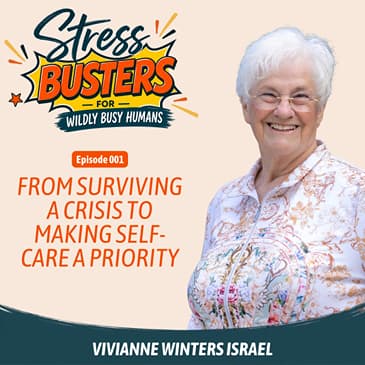
How can you make time for self-care when you’re already overwhelmed by work, family, and everyone else’s needs? Vivianne Winters Israel, a registered nurse, mom, author, and cancer thriver, knows that struggle firsthand. Braden Ricketts, co-founder of AmplifYou, joins her to uncover the experiences behind her passion for helping wildly busy humans release stress and reclaim joy. From a life-altering back injury to a frightening cancer diagnosis, Vivianne shares the difference she noticed when facing a crisis with a self-care practice already in place.
With warmth and energy, Vivianne offers a fresh perspective on caring for yourself without adding another burden to your day. She shares why her return to nursing sparked a search for shorter, practical tools and invites you to find an approach that fits your time, energy, and physical needs. If taking care of yourself keeps slipping to the bottom of your list, this conversation is an encouraging place to begin. True self-care is not selfish. It helps you show up for yourself and the people you love.
The Stress-Busting Good Stuff:
- A frightening diagnosis reveals an unexpected difference in how Vivianne responds to a life crisis.
- Returning to the nursing career she loves sparks a search for self-care that fits a demanding life.
- A closer look at “me time” opens a conversation about what it means to truly care for yourself.
- Finding a place to begin starts with considering your own time, energy, and physical needs.
- Vivianne shares a surprising observation about time after establishing a regular self-care practice.
Get your copy of The Wildly Busy Humans Self-Care Shortlist - A self-care advocate's 20+ year curated list of powerful self-care methods at https://wildlybusyhumans.com/shortlist
About the Host:
After nearly 50 years as a critical care R.N. and first responder — and her own battle with breast cancer — Vivianne Winters Israel knows crisis from every angle. Now she teaches wildly busy caregivers, parents, and teachers a neuroscience-backed, two-minute stress-release practice that fits into any schedule, no matter how chaotic. She's also the award-winning author of Tender Moments: Diary of a First-time Mother, winner of the Author of Impact Award, and currently writing the Abby Hart children's novel series, helping young readers navigate today's social and emotional challenges. Her podcast, Stress Busters for Wildly Busy Humans,— proof that real relief doesn't require an hour to spare.
Connect with Vivianne:
Website: https://wildlybusyhumans.com
Facebook: https://www.facebook.com/groups/wildlybusyhumans
YouTube: https://www.youtube.com/@WildlyBusyHumans
Thanks for listening!
Thanks so much for listening to our podcast! If you enjoyed this episode and think that others could benefit from listening, please share it using the social media buttons on this page.
Do you have some feedback or questions about this episode? Leave a comment in the section below!
Subscribe to the podcast
If you would like to get automatic updates of new podcast episodes, you can follow the podcast on Apple Podcasts or your favorite podcast app.
Leave us an Apple Podcasts review
Ratings and reviews from our listeners are extremely valuable to us and greatly appreciated. They help our podcast rank higher on Apple Podcasts, which exposes our show to more awesome listeners like you. If you are enjoying the show, please leave us a review on Apple Podcasts.
Welcome back to Stress Busters for Wildly Busy Humans. If you're ready to release your stress and reclaim your joy in life, you're in the right place. I'm your host, Vivianne Winters Israel. Let's get to
Vivianne:Braden Ricketts (AmplifYou): it. Vivian, welcome! I'm so glad to do this with you. Thank you. We're talking stress busters for wildly busy humans.
Vivianne:Yes.
Vivianne:Braden Ricketts (AmplifYou): First of all, I'd love to know a little bit more about you.
Vivianne:Okay.
Vivianne:Braden Ricketts (AmplifYou): Tell us who you are, and then what is the source of your passion for self care?
Vivianne:I'm Vivianne Winters, Israel. I'm a mom, cancer thriver, and worked as a registered nurse for nearly 50 years. Author and entrepreneur. The source of why I care so much about self care came about just after I received a metastatic breast cancer diagnosis very unceremoniously. I was work. I got a call. Someone from the doctor's office said, "Your biopsy shows you have metastatic breast cancer. You need to make an appointment with the doctor. I didn't even quite believe what came from jealously. What is this real? Does anybody say this with zero preamble? And so I was flashing back
Vivianne:and forth in my head: Is this real? How am I going to tell my daughter about this? How? What if I? How does somebody do this? And I was scared. I was truly scared, but it wasn't the same kind of paralyzing fear that I'd had 11 years earlier when I had a life-altering back injury, and because this was a life-threatening, potentially life-threatening diagnosis at the time, I didn't understand why that was, and it was a while before I did understand why that was, and I found out. I don't remember exactly how long it was, but I tried to figure out what was different. I didn't know what in me
Vivianne:or about me was different than when I had reacted so terrified and actually handled badly the back injury several years before. So I tried to think what this was, and the only thing I could think of was an audio proprietary audio technology that I had started using about eight months before that nasty phone call. So I started looking into that. It was the audio technology was called Flosync, and I had been studying it, using it for improved memory recall and better mental focus, and as I started looking deeper into it, it also calms the area of your mind responsible for stress,
Vivianne:procrastination, and impulsive behavior. That was the only thing that was different. So I discovered what this was. When I had gotten home from getting this call, I actually started doing strategic research on what biopsy results are until I could talk with the doctor. All this was so different than how I'd reacted with my back end. Wasn't the paralyzing fear the surreal feeling that I had was very familiar, but not as intense and not as dark. And this all just seemed so strange to me. So I kept doing that and kept and started looking for more things. This is great. Then we got to the point
Vivianne:of my chronosis. It was bad. The cancer was aggressive, and because I was premenopausal, I wasn't going to be able to take the years long treatment that was next necessary after the collection of chemotherapies that I was going to have to have, this is what was needed to keep me above brand. That was going to render me unable to return to my physically demanding job that I loved, or any kind of work. We thought it might be possible I'd be able to do some kind of over the phone something, but he really wasn't very optimistic about that. The oncologist, I didn't need a second opinion. He
Vivianne:was a doctor's doctor. That other oncologists would send their patients to him when their treatments didn't work. I had the best. I trusted his knowledge. And I trusted what I needed to do for treatment. I couldn't accept his prognosis. I love my work. I was determined to get find a way to work my way back to work. So once, and I did, I had to go there at a couple of different steps, and it took a long time. I did make it back, but once I was back to work, I couldn't do this self care that I had done before. That was a 60 to 90 minute, once or twice a day process, depending where I was
Vivianne:in this many months long program. So I needed to find things that were shorter, and I did find some that were shorter, but they were either too physically intensive or they took too long. Because being back to work, I really couldn't do anything else. I had to completely restructure how I managed any activities of daily living and anything that I did that wasn't work. So I kept looking.
Vivianne:I found something that had the most amazing, fastest, easiest mind to body shift that I ever experienced, but it was connected to a long form, so that wasn't going to work for me. I continued to look for things, and eventually, I found another audio technology, priority audio technology, that was only 22 to 30 minutes. I had a whole library of these for different aspects of life. One of them was only 10 minutes. Okay, I had new cool things that that I could actually work with, because until I found those, I really didn't have a regular practice. Which I, once I learned what that had actually
Vivianne:done for me initially, without my being aware of it, I had to keep one. I had to keep a good one, and so I I held on to those. And ultimately, as I was able to work and then do other things and not do marathons, but do half marathons, get out there and do other life things, I needed something that was shorter. So I ended up creating my own for people like myself, first responder nurse, and parents, teachers, other wildly busy humans, so that they could benefit from the that from the bonuses of having a self care practice. People have a tendency to think that they are. It has to be long, and it
Vivianne:has to be difficult, and they have to sit in these pretzel-like positions. And there are shorter forms, shorter forms that are powerful, and there are even a few that only take two minutes once they're learned. This made such a difference for my life, and I needed to share it with others.
Vivianne:Braden Ricketts (AmplifYou): Amazing! Thank you for sharing that journey. How are you currently sharing it with others? What are the ways in which you're giving this information to the world?
Vivianne:Well, I have a podcast. stress busters for wildly busy humans. Ta-da! Also, I have developed an online self-care development process called the Teacher's Stress Eraser Experience that fits into just four to eight minutes of the workday, and maybe eight to 12 on weekdays, so that they can learn the process in little bitty tidbits, because they don't have margins of time across their day like most even shorter form self care practices have. They need they only have tiny pockets or slivers or time, so it created a program that could layer the pieces of this in, so that they not only
Vivianne:knew the pieces, but they understood the science and stuff behind it. So you know why they're doing it, and have the maximum benefit from it. And when they're through the experience, they've already established a self-care program. And some of the school systems are requiring that teachers do this. Yep, they're not supporting them to do it. And then there are people say, "Well, what about not teachers? And so nurses, caregivers, parents, because I was a parent too, divorced and being a single parent, doing all going through all this stuff, so they are among the people that just they don't
Vivianne:have big pieces of time.
Vivianne:Braden Ricketts (AmplifYou): Yeah, how has your world changed since you discovered the simplicity of getting out of the chaos and into that realm of control and environment where you feel good on a daily basis?
Vivianne:It's. Feeling good for myself and for my daughter and the people I care about, nurses and many people, they can feel guilty about doing self care. They shouldn't be taking time away from their their family or their business or their job, and they feel it selfish, but true self care. I make the distinction of true self care with my favorite practices, and the ones I've developed, because lately self care is often equated with me time. You know, hanging out in the man cave, a day at the spa, a mani pedi, and me time is fine. I see that as something that elevates your day. My
Vivianne:focus is on practices that can elevate your everyday life cumulatively. So when you are doing this for yourself, it is the foundation of taking the best possible care of your loved ones, you show up better for yourself. You show up better for everyone else, and finding a way to continue my practices in that, even though I, for such good while, I didn't have the energy to do anything but less time. It makes such a difference that every day is good. I mean, I don't always get everything done that I want to, but none of us do. But I am enjoying every day. I'm enjoying my life. I'm enjoying
Vivianne:my daughter, and I can't keep all that to myself.
Vivianne:Braden Ricketts (AmplifYou): What is the first step on somebody's journey into your world of learning all of this?
Vivianne:Finding some self-care practices and explore. Take them for a test drive. You'll find one that resonates with you via just how it is, or I'm looking at this at this because I can only manage this amount of time, or I can maybe manage a little bit more time, but I can't do the pretzel-like body positions, or it takes you five minutes to get up and down off the floor. That is the way to start.
Vivianne:Braden Ricketts (AmplifYou): And when you are visualizing this going out into the world, what is the impact that you feel it might have?
Vivianne:The impact I feel this has is giving people permission if they require it, or raising the awareness for people that true self care is not selfish. It is a foundation of taking the best possible care of your loved ones and others. It also has a positive impact on everybody that you come across when you're showing up at it for yourself, and you have the space, the bandwidth for others. The more people that do this, the more strength I think we have on the tiller tab that I see being the beginning of helping us redirect the craziness that's going on in society towards a
Vivianne:kinder, less divisive, less destructive world that has more time for peace, beauty, being kind to others, and not trying to rush kids through their very young childhood and the gifts of curiosity and wonder.
Vivianne:Braden Ricketts (AmplifYou): What is some advice you'd give your listeners? What should they know about what's coming in this show?
Vivianne:This is a show for wildly busy humans who may think I don't have time for this. I want to help share that there are short forms are out there, so we will explore some of these short forms, and people who have experienced science backgrounds or their own before and after experiences of not having any self care and having some self care. I have been through multiple crises: divorce, financial, emotional, physical, Medical, and to me, no one should have to go through a life crisis for persistent stress without at least one powerful self-care tool. I've been through them without
Vivianne:it. I've been through them with it and them, and the difference is incomparable.
Vivianne:Braden Ricketts (AmplifYou): Amazing. What are some final thoughts for people that are curious about tuning into the show, the person they can become, and why this is important now?
Vivianne:Why this is important? Because in today's world, we modern humans we spend almost, if not the absolute entirety of our day in our heads, our minds need rest, peace, respite, just as our bodies do. We don't really give it to them. Taking a break, sitting somewhere, relaxing, reading an article, scrolling through our phone is not. Restorative. To actually do more than just relax, we need to actually get out of our thinking mind and into our feeling body. The issue comes to be that many people. I've tried meditation. It takes too long. I don't even know if I'm doing it right.
Vivianne:There are short forms out there that aren't complicated that you can do and you can fit into your crazy schedule. It is possible when you show do this and show it better for yourself. You're going to enjoy each day in your life more. And what happens with this is cumulative. And after you are a few to several weeks into whichever practice you choose, you'll have this very interesting experience that you seem to have more time. Why is that? Because with your practice, you are giving your mind that rest that that it needs on a regular basis that it hasn't seen for a while. When you're out of
Vivianne:your mind, who knew being out of your mind would be good. When you're out of your mind and in your thinking body, your mind can't spin wildly because you've been wasting time with this mental spin cycles, winding what-if scenarios, hopping in and out of mental rabbit holes. It saves you time that you didn't realize was being just strictly wasted.