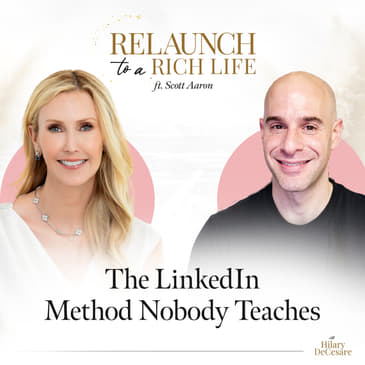
Scott Aaron is a LinkedIn coach, bestselling author, and host of the Networking and Marketing Made Simple podcast. He teaches coaches, consultants, and service based entrepreneurs how to turn their expertise into consistent clients through genuine, organic relationship building on LinkedIn.
In today's episode, Scott joins us to talk about the season of real personal crisis that forced him to rebuild his entire business and life from the ground up, and how you can actually scale your business using LinkedIn.
Scott shares key details about the collapse of the first business he took over, the conflict it caused in his family, and the emotional toll it took on him.
We talk about how Scott rebuilt everything online, matching 15 years of revenue in just six months. Scott reveals how to position yourself as a thought leader instead of a spammer, what to actually post, and how often.
Join us today as we dive into Scott's relaunch story, business mortality versus business rebirth, how to grow real relationships on LinkedIn without being "salesy," profile optimization, content strategy, and the daily habits that scale a business without burning you out.
—
Want to learn how to create better content, build stronger connections, and generate more opportunities on LinkedIn?
Subscribe to Scott’s free LinkedIn Tips and Updates newsletter >> https://www.linkedin.com/newsletters/linkedin-tips-and-updates-6864980141639127040
—
Want to learn Scott’s LinkedIn strategy directly from him?
Join Scott’s free live LinkedIn trainings every Monday and Thursday at 10 AM Eastern >> https://www.facebook.com/share/19fBASpFeZ/
—
Want more practical advice on networking, marketing, and using LinkedIn to grow your business?
Listen to more LinkedIn strategies on Scott's podcast: The Networking and Marketing Made Simple podcast >> https://podcasts.apple.com/us/podcast/networking-and-marketing-made-simple/id1441674842
—
If this episode lit something inside you, that quiet knowing that you’re meant for more, then I want to personally invite you into the most powerful room of the year.
ReLaunch To A Rich Life LIVE is a transformative, neuroscience-backed 3-day experience happening September 17–19, 2026 in Scottsdale, Arizona. It’s designed for women who are done playing small and ready to step into clarity, confidence, and next-level success, not just in business, but in health, wealth, relationships, and life.
This isn’t another event, it’s a quantum upgrade into the life you’re meant to live. Join women who are ready to rewire their identity, elevate their frequency, and claim a Rich Life that feels as good on the inside as it looks on the outside.
Learn more and join us in September: https://www.relaunchtoarichlife.com
—
Visit Scott Aaron’s website: https://scottaaron.net/
Connect with Scott on:
Facebook: https://www.facebook.com/share/19fBASpFeZ/
Instagram: https://www.instagram.com/scottaaronlinkedin?
Linkedin: https://www.linkedin.com/in/scottaaroncoach?
—
Connect with Hilary:
Website: https://therelaunch.com/
Instagram: https://www.instagram.com/hilarydecesare/
FaceBook: https://www.facebook.com/TheReLaunchCo
Interested in being a guest on the ReLaunch Podcast or booking Hilary as a guest? Email us at hello@therelaunch.com
Find Us on Your Favorite Podcast App - https://the-silver-lined-relaunch.captivate.fm/listen
[00:00:00] Don't be a spammer or pitch slapper on LinkedIn. If you are that type of person, stop because it's not working. The way LinkedIn works now is not the way it worked three or four years ago. Scott Aaron rebuilt his business by treating LinkedIn as a place for real relationships, human conversations, and steady organic client growth. He teaches how to turn expertise into consistent clients.
[00:00:22] When people visit your profile, two questions are answered immediately. What does this person do and who do they do it for? And if those questions aren't being answered, you're going to lose people. LinkedIn is the professional platform, but can you post personal? You can post personal if you link it to a business concept. How many times should you post? LinkedIn's algorithm is different from other platforms. The dwell time is tenfold. So you could post something today and you'll get engagement for the next week to two weeks.
[00:00:52] Do you, as the CEO, have to be doing this yourself? LinkedIn does have strict guidelines, so you do need to have... Scott, I said it before. I am so excited to have you on the show today. Well, I am super grateful and honored to be here. Sometimes when I hear my introduction, I'm like, who is that they're talking about?
[00:01:20] I was impressed. I'm like, oh, so good. Well, sometimes you forget about the things that you had to overcome, the things that you've accomplished. And obviously, hearing someone else kind of share your story helps to reiterate how far one has come. So I appreciate everything that you shared. Well, I'm excited to be here. This is going to be a great show. And I want to start with your relaunch moment.
[00:01:46] So take us back to the season when things started to break down. The income, your identity, we're tied to gyms, showing up for other every single day. But what happened that made you realize that that specific model life was no longer going to work for you? Yeah, two things in particular. So the back backstory was how I actually even got into the fitness industry in the first place.
[00:02:14] My father, who will be 74 in December, still is in the fitness industry, still personal trains, still competes in powerlifting with me. So it's something that we still share to this day. But his dream was to always own and operate his own fitness club.
[00:02:34] And he ended up leaving successful businesses behind to have the opportunity to grow his own gym. And this was in downtown Philadelphia. This happened my senior year of high school going into freshman year of college. And unbeknownst to me, this was going to kind of be my calling and obviously the first part of my relaunch.
[00:03:01] So fast forward a few years later, I'm about to go into my sophomore year of college. I'm 19 years old and I find out that my father was going to go to federal prison for two and a half years. And that required me to leave the University of Pittsburgh, transfer to a city school in Philadelphia, Temple University. And as a teenager, take over the family business.
[00:03:30] So that was kind of like a big moment for me. And again, I'm grateful that it happened when it happened because I never had real life experience at that point. I was just a student. So I didn't really have any of the external noise that a lot of professionals have after being in a career for a number of years. I was two years out of high school, but it was one of the greatest learning lessons. Let's talk about that. Two years out of high school. Yeah. Your dad is going to go to federal prison.
[00:03:56] You are, you hadn't really had, as you said, the life experiences. And all of a sudden you are just hit with them. And so how did this affect you? At the time, you know, you're still at that young impressionable age where you want to make your family proud. So I remember when we were, you know, driving my father to drop him off, my mom, myself and my sister.
[00:04:24] You know, he turned, you know, he was driving and he, before I got out to drive home, we embraced before he got taken away. And he goes, just remember, you're the man of the house now. And that kind of like just rewired how I was going to go about things because I needed to be there to support my mom and my sister. And it wasn't about suppressing any feelings or any emotions, but I had to remain strong because they were puddles.
[00:04:51] And I had to do what I had to do to be a shoulder for the both of them and to be able to pick up the pieces and move forward. And it ended up being one of the greatest experiences for me because, well, one, I had to grow up really, really fast. And two, I realized that I had a support system around me. I had my mom. I had my sister. But I had a whole staff at the gym that I had yet to meet that were also a support system to me that embraced me.
[00:05:20] You know, having a 19-year-old come in as the owner, you know, and being the boss for established business professionals. You know, my general manager was 31, had been a general manager for a number of years, my fitness instructors, my personal trainers. Like, this was all new to me. And I wasn't really – I was an athlete, but I wasn't into fitness. I didn't really work out.
[00:05:43] So this was all foreign, but I was so supported and welcomed with open arms that – and I'm also a sponge. So I was always a lifelong learner, and I've always been coachable. So it was a kind of a natural fit for me because I just wanted to learn as much as I could. And I've always been inquisitive, and I've never been afraid to ask for help. And it really just kind of set me up on this path.
[00:06:11] And I think, you know, if my dad was sitting next to me, you know, part of him would say that he was surprised how easily I kind of fell into the role. But also at the same time, I think aspects of this part of our journey did surprise him. And I'll never forget, I still have letters that I wrote to him that he gave back to me. And there was one letter in particular that I still have where it was very early on in my journey.
[00:06:41] And I wrote him and said, I don't know if I can do this. You know, I can't be you. I don't know how to fill your shoes. You know, you're such a big personality. And he wrote me back, and he said, I've never asked you to be anyone other than yourself. Don't be me. Don't try to be me. Be Scott. And always be who you are. And I think that validation where it was just okay for me to be me also gave me the confidence to kind of continue that journey.
[00:07:11] And, you know, looking back now, you know, all of this was my father's dream. But I was kind of brought into that dream, you know, people can say accidentally, but really on purpose, because I wouldn't be I wasn't able to really find my path unless I went through all this.
[00:07:31] And there's also something about what you're saying is that, you know, for so many, it's like we're conditioned into certain jobs into certain lifestyles by our parents and by our upbringing in schools and things like that. And at some point, you had to make a pretty massive decision to kind of separate from your dad. Can you share a little bit more about that?
[00:07:58] Because I think that it's an interesting twist to your story. Yeah. And I will say today, we're still best friends. You know, we hang out all the time. He comes over on Sundays and we work out together. But to your point, there was a culmination of a very tumultuous time in our relationship. We had in 2003, we had sold two of our gyms for a million dollars.
[00:08:23] So we were really living that success of growing a brick and mortar business from the ground up, literally, and selling it and walking away with a really nice family profit. Only to lose everything six years later. And we had rolled everything into the last gym that we owned that we opened in 2004. But because of my father's business past, I was the only one left with credit.
[00:08:52] So everything was really put into my name. And in 2012, my son was born. He'll be 14 soon. And this was kind of like where things started to really shift for me. Because a friend of mine asked me, he goes, if you got sick or injured, how would you earn a living?
[00:09:14] And, you know, for anyone that's listening that owns a brick and mortar business, or maybe you are a service provider, like a personal trainer or a massage therapist, chiropractor, your hands are your business. And my body was my business. If I didn't have my body, I didn't have a business. And that really scared me to death because it wasn't just me that I was looking out for. You know, I was a parent now. I had someone else's future that I was looking out for.
[00:09:39] So that's where the online aspect of what I needed to do really started to churn. And I launched my online coaching practice using LinkedIn. But in between all of that, I started to uncover and unpack a lot of financial disarray with the gym. There was a ton of liability debt that was attached to me.
[00:10:04] For those that don't know, a guarantorship is basically within a lease of a company or a building. The personal guarantor is the one that everything falls on top of if the business fails. So literally, it didn't matter what happened to the gym. My landlords would always be able to recoup that money because I was the guarantor of that lease. Scott, you were how old at that point? We were one year into our second lease.
[00:10:35] I was probably 30, 32, 33-ish. And, you know, when I started to unpack all of this, and mind you, I started working at 19. So I was 15 years into my professional career already when a lot of people, it takes them a lot longer to get to 15 years in their careers.
[00:10:59] So for me, I realized that I needed to take control of my life if I really wanted my life to be a certain way. And that's when, like, kind of things bubbled to the surface where I realized fully I was living my father's dream, not mine. But I learned a lot about myself through those 15 years. I fell in love with people. I loved helping people. I loved being solution-oriented. I just wanted to do it in a different way.
[00:11:28] And I made the difficult decision to ask my father to leave the business. He was not an owner at the time. He was just training there. And I said, if I'm really going to grow, if I'm really going to see if I can take this gym out of the bottom and recoup it in any way, shape, or form, I'm going to have to go this on my own. There wasn't an argument. He said, okay. He packed his gym bag. He left, and he never came back.
[00:11:57] Now, I needed – there was a lot of emotional scarring from all of that. So I really needed – I needed to kind of, like, distance myself for a while. So we probably didn't speak for nearly a year and a half. And you got to understand, I worked every day of my life with him for the past 15 years. So going from seeing that person every day to no contact, yes, it was difficult for me. But it was cathartic in a way because I needed to heal.
[00:12:27] And, you know, not bringing religion into this, but, you know, in Judaism, you don't live with regret. You don't hold grudges. You forgive. And part of what my parents always told me was no matter what the situation, you know, don't hold grudges. Always lead with forgiveness and always move forward. But it took me a year and a half to get to that point.
[00:12:55] Well, and you also had at that point, you had to declare bankruptcy. And you use a phrase, business mortality, to describe realizing that a business can't keep going the way it is. So what did you learn at that point? And what do you refer to when people are out there like, all right, when is it time to say this isn't it?
[00:13:21] Well, I don't think anyone ever thinks about their business mortality in the sense of they don't think about things ever failing. And when I was sitting in my attorney's office after realizing that there was no saving this gym, we were losing $5,000 a month. Thank God my business consulting on the side was doing well because I was able to funnel some of the profits of that into the gym to keep it afloat to make payroll every single month.
[00:13:48] But he said to me, he said, listen, you know, he liked to speak to things in sports terms. He goes, if this was the NBA draft and I was looking at what you have in front of you. And at this time, it was close to a half a million dollars in liability debt. He said, you know, you're probably going to be a number two draft pick. This is a slam dunk as far as personal bankruptcy. I could not file for business bankruptcy because I was a personal guarantor. That would follow me personally.
[00:14:18] He said the only way out of this is if you file for personal bankruptcy. And I said, OK. And he said, this is not your business mortality. He goes, this is your business rebirth. He goes, the way that you have to think about this is that this is a way to get the clean slate that you've always wanted. He goes, you've been carrying around all of your dad's stuff for years and years and years and years. And I'll never forget this.
[00:14:41] But when we submitted all the paperwork and I went downtown in Philadelphia to go in front of the judge and, you know, bring our case. And I'll never forget, I had just come back from a retreat in Costa Rica and I was wearing a chakra bracelet. And I was sitting in his office and he looks at me and he goes, is that a chakra bracelet? And I said, yeah. And he goes, I got one, too. He goes, I think we're going to do pretty well here. So it was really good energy. I mean, it wasn't going to get dismissed.
[00:15:11] It was really good energy either way. But he signed off on it very quickly. And I was walking down the hallway with my attorney and he put his arm around me and he said, and I'll never forget, he goes, now go live your life. And as soon as that permission was given to me, I mean, that's the lightest I had felt in years because I, that was July 31st of 2016. So over 10 years ago.
[00:15:41] 10 years. And he said to me, I'm like, I never had to go back. Like, I never went back. Like, I literally, I signed the papers and I never went back ever again. And it was, it wasn't even a hard decision. I really, I had no other way out. But when I was, when I was brought with the, the options and when this was positioned to me, like, listen, yeah, your credit's going to suck for a little while.
[00:16:10] You don't own a house. You don't own a car. You lease a car. You're in a really good position to do so. And, you know, 10 years later, we own all of our cars. We own our house. I have over 800 credit now. It's such a great story. And I do want to ask about the whole, at some point, LinkedIn shifted from being a place where you had your profile.
[00:16:38] And then now it's this very successful lifeline for your business. Can you share how you first started using LinkedIn and you were doing it intentionally? And one of the things I do want to say is that something very refreshing when we first had our first call together was that you lean into the past.
[00:17:03] You are very willing to talk about your dad's incarceration. You're willing to talk about you having to file bankruptcy. You're willing to go there. And it's something that I think a lot of people would have or could have. And, you know, and I know, hey, I've discussed, you know, when my board member did a Ponzi scheme and ended up in federal prison with one of my companies. There's that moment of like embarrassment. And maybe you don't want to share.
[00:17:32] You don't want to share the story. But it is cathartic when you start to talk about it because then people are like, maybe they haven't had the exact same situation. But they're like, oh, yeah, me too in some strange way. So I'd love for you to share, like, how did it then all this stuff come to a head and you end up on LinkedIn?
[00:17:54] So three years prior to filing for bankruptcy, I had launched the online side of my personal training and nutritional counseling. And a lot of clients that we're working with in person were business professionals in the local Philadelphia area. But I always remember people as they moved out of Philadelphia, the Burbs, other cities. I wish I could work with you. But and I'm like, well, if I was to be able to create a way where we could work together virtually, you know, I could do online nutrition programs. And this, that or the other.
[00:18:24] Would that be something you'd be interested in? And I thought about where I could kind of take this to the market. And I knew all the business professionals were on LinkedIn. So I went on there, changed my profile around, started searching, connecting, you know, messaging organically to business professionals, having conversations. And within six months, my online business revenue was matching my in-person revenue that had taken me 15 years to build up. And that was kind of like the first light bulb moment where I'm like, OK, there's an opportunity here.
[00:18:54] I obviously struck something here. And then the natural thing to do, and I've been in sales my entire life, I started reaching out to some friends that were in the coaching, consulting and speaking space. And I said, listen, you're more better primed for LinkedIn than me. I'm doing wellness. You could be killing it on here. So I showed a few of my friends what they needed to do based on what I had been doing myself. And they all started getting similar results. They were having calls. They were closing sales.
[00:19:23] And one friend in particular reached out to me and he said, listen, he goes, I don't know what you kind of figured out here or what you're doing, but you should be teaching this. He goes, you could have a legitimate business here where you could be teaching other professionals like all of us how to leverage LinkedIn the way that you did. And that was kind of like the other light bulb moment for me when the proof of concept was expanded past myself.
[00:19:49] And I truly believe in that the best businesses are created off of the results that an individual gets first personally and then proves that concept through external resources and validation, which I did. And that's when I'm like, okay. This could work. This could work. I downloaded a brand new app called Zoom onto my MacBook Air at the time. And this is, you know, 13 years ago.
[00:20:14] And I started, you know, doing virtual videos and $49 programs. You've been in the LinkedIn world for 13 years. Yeah. Well, I started like 2009 for my gym, but I started coaching people nearly 14 years ago with what I did. So I'm almost on a decade and a half now. And what's interesting about that is I want to talk about what people right now listening, the it's changed quite a bit.
[00:20:43] I'm sure we can go into a lot of detail, but what do people need to know right now to leverage it in their own businesses? Well, the first thing is don't be a spammer or pitch slapper. So anyone that has spent any time on LinkedIn, that's got any one of those 18 paragraph long drunk log verbal vomit messages that make you want to puke after reading it. Like, don't be one of those people. And I'm sorry if I offended anyone, if you are that type of person, but stop because it's not working. I know it's not.
[00:21:13] The way that LinkedIn really works now is not the way that it worked even three or four years ago, where you would connect with people, you would message, you would try to jump on a call right away. That's not working anymore. What is working is positioning yourself as a thought leader. So it starts with really optimizing your LinkedIn profile. So when people actually visit your profile, two questions are answered immediately.
[00:21:40] You know, what does this person do and who do they do it for? And if those questions aren't being answered within the headline portion or the background banner of your profile, you're going to lose people. Once you grab those people's attention and they start digging in a little bit more to what you do and your featured content section, your about section, your experience section, then people will start diving into your content. And here is the key.
[00:22:05] Right now, LinkedIn is prioritizing thought leadership content that is save worthy and conversational starting. So what I mean by that is if anyone checks out my LinkedIn profile, it's just Scott Aaron on LinkedIn. You'll see that all of the content that I post is educational, information based, thought leadership and just leaving people better.
[00:22:31] And save worthy content is something that someone saves, much like you can save content on other platforms where they want to reread it over and over and over again because it's so valuable and it's so powerful like an infographic or a carousel post that you see on Instagram. You can do those on LinkedIn. LinkedIn. That is what LinkedIn wants people to do. It wants people to spend time reading your content.
[00:22:55] So if you're just going to do inspirational quotes and this, that or the other, you're going to lose the attention of your market. You have to think about what can I do to bridge the gap between myself and the person that I want to work with. And when you give in order to get LinkedIn, we'll start to showcase you more and more. And a lot of people think that, oh, I just need to build this big network and that's how I get the visibility. It's always quality over quantity.
[00:23:24] You know, people look at my profile and they see almost 38,000 followers. Well, that's where I am right now. That's not where I was in 2013. I had like 400 connect. I've built this over the last 13 years. So I believe just like any business, including leveraging LinkedIn, it's a marathon. It's not a sprint. So you have to think about the relationships that you build and the friendships that you make on LinkedIn are the ones that are going to help you grow your business.
[00:23:55] And, you know, my buddy, Andrew Cressidino always says, he goes, if you're not making friends on LinkedIn, you're doing it the wrong way. And that's why one of the big things that I've been focusing on, not just myself, but what I teach is really being that go to person through your content that opens up so many doors of opportunity.
[00:24:37] So, Scott, quick question. How many times should you post in LinkedIn? Like, let's just talk about the basics here of what you're finding and having success around those specific things. Like how many times? Is it once a day? Is it multiple? What do you suggest? Three times a week to get started. So I would say either Monday, Wednesday and Friday or Tuesday, Wednesday, Thursday. Any one of those two patterns.
[00:25:05] LinkedIn's algorithm, which is called 360 Brew, is different from any other algorithm on the other platforms. The dwell time, which is the amount of time that people spend reading or engaging or the lasting of that content, is tenfold greater than any other platform. So you could post something today and you'll get engagement for the next week to two weeks. So it's much different. So you don't, it's about quality over quantity. Less is more on LinkedIn.
[00:25:34] So my wife and I always tell people for the next 90 days, focus on posting three times a week. And if you want to kind of break it down a little bit further and someone's like, okay, I can do that. But what do I post? Like, what are you talking about? Is it personal, professional? We always hear like LinkedIn is the professional platform. But can you post personal? You can post personal if you link it to a business concept. I'll give you an example.
[00:26:03] My wife and I were in Sedona earlier this year and I had just finished a workout and beautiful sunrise, like the Red Rocks. It was just incredible. And I got my phone out and I shot like a quick two minute video. And I talked about, you know, always finding, you know, your path to consistency in keeping to your routine no matter where you are. And I was kind of linking this to my workout that I just came out of.
[00:26:31] But I said, but you can also correlate that to business because there's going to be curveballs. There's going to be times where things don't go necessarily the right way. But you have to find your footing no matter where you are. If you're traveling, if you have a speaking event, if you're on the road, if you have Wi-Fi, you're in business. So it's okay to share personal anecdotes. But if you link it to a business concept, it is completely okay because what that does is it builds credibility. But more importantly, it builds relatability.
[00:26:59] So I believe in sharing the personal side of things that allow people to get to know you where you're looking eye level at people, not looking down upon people. Too many people put themselves on these self pedestals on social media, which I do not believe in. I believe even though my wife and I are very successful, I am no better or worse than anybody else. Because even though I may be on Chapter 10 right now and someone else is on Chapter 2, I'm just eight chapters ahead of them.
[00:27:25] So the fact of the matter is that I'm not looking to make myself look better than anybody else. So are you, well, question because you said you popped out your phone, took a video. Are you seeing more success with videos or photos? So I would say a mixture of both. So if you're going to do a video, make sure it's kind of shortened to the point. The attention spans that people have now on social media are just abysmal.
[00:27:53] So I would focus on maybe 30 to 90 seconds, just a quick tidbit, just to really connect the dots for people. But if you're going to do a post with text, there's two that are working really well right now. A personalized photo and also an infographic image. So like an infographic image that has obviously some do's and do not, so to speak, with some text with it. Those two imagery slash text type posts work really well.
[00:28:23] So what I recommend for people to do is if you're kind of camera shy, so to speak, and you're not ready to dive into a video, I would suggest doing some sort of image text post once a week, a market research poll question once a week, and a longer form type of post like a LinkedIn newsletter, which by far is the most powerful feature on the entire platform that people still are not taking advantage of.
[00:29:17] That would be a great place to start with your content on LinkedIn. And if you had to right now, you know, like just be all in on one piece of advice that everyone who's looking to scale their business from six to seven figures needs to know about LinkedIn, what would that advice be?
[00:29:40] Focus more on the relationships, not so much the desired results, because the relationships that you build on the platform are the things that lead to the results that you're looking for.
[00:29:53] So for me, my number one intention of LinkedIn is to build as many amazing relationships with people on that platform as possible, because if I leave an indelible mark on them in that conversation, as they're networking, as they're connecting with people, and maybe a need comes up that they don't fill, but they remember me in that moment from the conversation that we had,
[00:30:20] you'll start having referrals and business being sent to you all the time. And Hilary, I kid you not, that happens to me every week now. I have someone reaching out to me that I've connected with on LinkedIn that I've built good rapport with that said, I think I have someone for you. Can I do an introduction? And that's the thing. I value relationships over revenue because the relationships are the ones that create the revenue. So if you're that person that wants to scale their business, they want to go from six to seven figures.
[00:30:49] You need to build more quality relationships because the quality relationships lead to the quality revenue that you're looking for. So can you farm this out to somebody else or do you as the CEO have to be doing this yourself? So LinkedIn does have strict guidelines. So you do need to have obviously yourself managing your account. You can have a company page where you can have an admin kind of managing that side.
[00:31:14] But as someone acting as you on your behalf, connecting and messaging, if LinkedIn figures out that you have someone logging into your account for you, they can delete your account. So they do want people actually using the platform as themselves.
[00:31:31] And I think this is the other thing and the other reason why people love working with me is because I have a 20 minute a day method that any CEO, any business owner can apply if they just block the time out for it. The content is more streamlined now because I have prompts and content calendars that I give people that help them create their content. The heaviest lifting is really just the connecting and reaching out to people. But that's something that I love doing.
[00:32:00] I don't want anyone acting as me. Like I'm the one that's building the relationships. I don't want to connect with just anyone. I am so hyper specific about who I send a connection request to. I am even more hyper specific about who I actually message. So I want to be in full control of that. My content, I always have it pre-scheduled through the prompts that we have. But that's really the heaviest lifting. It does. So Scott, where can people find you? LinkedIn is probably a good place to find me.
[00:32:30] It would have been crazy if you didn't say that. So yeah, you can find me on LinkedIn. Just search Scott Aaron. I'll come right up. I do have a free newsletter on LinkedIn. It's called LinkedIn Tips and Updates. I also do two free live trainings every Monday and Thursday on LinkedIn at 10 Eastern. So you can always grab free information there. My website is scotteron.net where there's more information about me. And as Hillary mentioned, we did an interview on my podcast called Networking and Marketing
[00:32:59] Made Simple where I have one LinkedIn specific dedicated episode every single week. So you can check it out there. That's awesome. So Scott's story is proof that you can actually take a platform like LinkedIn, pair it with your service, have high integrity, create a business that not only works for you, but also feels aligned with the life that you really want to be living. So if this conversation spoke to you, I would love for you to stay connected with us.
[00:33:27] Make sure you subscribe to Relaunch to a Rich Life so you never miss an episode. And if this episode gave you insight, encouragement, take a moment to rate and review the show. Your reviews really actually help us more than you would ever know. And if you know someone who is right now really thinking about, you know, what's next, how
[00:33:52] they can leverage LinkedIn, they need to hear Scott's story, go ahead, send it to them and let them understand that your journey is relaunching and their journey is relaunching now. And how we can help each other will help absolutely create that relaunch to a rich life. And not only your business, but in health and relationships. We'll see you again next week.
[00:34:21] Thanks so much for being here today. All right. Your next level is waiting. Thanks for tuning in. This is amazing what we're doing right now. ReLaunch to a Rich Life If today's episode sparks something in you, don't keep it to yourself. Please share it. I'll tell you more later about how that actually helps you have more success yourself.
[00:34:50] Subscribe so you don't miss one episode. Let's create unstoppable momentum together. So until next time, keep relaunching, keep rising and remember, it's go time.