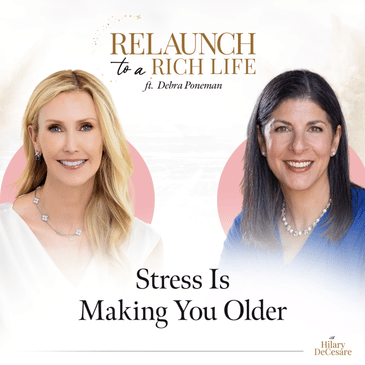
Debra Poneman is a pioneer in the New Thought movement, founder of Yes to Success, bestselling author, and meditation teacher with over 50 years of experience helping people transform their minds, health, and lives.
In today’s episode, Debra joins me to discuss the science of aging, longevity, and the simple lifestyle habits that can help slow down physical and mental decline.
We dive into how stress impacts the brain and body, the connection between meditation and cognitive health, and the daily habits that play a major role in how we age.
Debra shares the research behind meditation and brain function and explains how oxidation accelerates aging. She also reveals the foods, routines, and anti-inflammatory practices she uses to stay energized and healthy at 73.
We explore gut health, sleep, exercise, hormones, blue light exposure, and the factors that influence memory loss, wrinkles, fatigue, and overall health. Debra also reveals techniques for lowering cortisol and the simple changes that can improve your energy, focus, appearance, and long-term wellness.
Join us today as we dive into natural anti-aging strategies, stress reduction, meditation, brain health, longevity, nutrition, daily wellness habits, and much more.
–
To learn the science-backed habits Debra uses to slow and reverse aging, improve brain health, reduce stress, and increase longevity,
Get Debra Poneman Anti-Aging Masterclass >> https://www.debraponeman.com/ageless-masterclass
–
Download Debra Poneman and Ronnie Newman’s free ebook on anti-aging, meditation, stress reduction, exercise, nutrition, and lifelong vitality.
Download the Free eBook: Ancient and Modern Secrets for Lifelong Radiance >> https://www.beinghealthiertoday.com/ancient-modern-ageless-secrets/
—
If this episode lit something inside you, that quiet knowing that you’re meant for more, then I want to personally invite you into the most powerful room of the year.
ReLaunch To A Rich Life LIVE is a transformative, neuroscience-backed 3-day experience happening September 17–19, 2026 in Scottsdale, Arizona. It’s designed for women who are done playing small and ready to step into clarity, confidence, and next-level success, not just in business, but in health, wealth, relationships, and life.
This isn’t another event, it’s a quantum upgrade into the life you’re meant to live. Join women who are ready to rewire their identity, elevate their frequency, and claim a Rich Life that feels as good on the inside as it looks on the outside.
Learn more and join us in September: relaunchtoarichlife.com
—
Visit Debra Poneman's Website: https://yestosuccess.com/
Connect with Debra on:
Facebook: https://www.facebook.com/DebraPoneman.YesToSuccess/
Instagram: https://www.instagram.com/debraponeman/
Linkedin: https://www.linkedin.com/in/debra-poneman
Youtube: https://www.youtube.com/c/YestoSuccess
—
Connect with Hilary:
Website: https://therelaunch.com/
Instagram: https://www.instagram.com/hilarydecesare/
FaceBook: https://www.facebook.com/TheReLaunchCo
Interested in being a guest on the ReLaunch Podcast or booking Hilary as a guest? Email us at hello@therelaunch.com
Find Us on Your Favorite Podcast App - https://the-silver-lined-relaunch.captivate.fm/listen
[00:00:00] There are simple lifestyle choices you can make to slow, stop, and even reverse aging. And these tweaks you make are not a big deal. You just have to know what to do. Debra Poneman is a pioneer in the New Thought Movement, founder of Yes to Success, a best-selling author, and a mind-body wellness expert.
[00:00:23] And she has spent decades helping people create lives of true success from the inside out. The truth is, some aging is inevitable. We produce less collagen as we age, which means you get wrinkles. What's the first thing that we can do to actually slow or stop or even reverse aging? One of the first things we could do to slow, stop, and reverse aging is get your stress levels in check.
[00:00:49] And what are you suggesting these days to keep us looking and feeling better? There's one thing that we do every day, and it's one of the most insidious causes of aging. So Debra, welcome. Thank you. I'm just like you. This morning I woke up and I thought, I get to be with Hilary today!
[00:01:18] I mean, it's crazy exciting. It's energetically off the charts. I know. And when I met you at your relaunch event in Scottsdale, I remember walking in the room, looking at you up on the stage, thinking, you are so beautiful and you are so authentic and you are so... It's not like you knew how to command the crowd.
[00:01:41] It's just that your love just poured out to the crowd that they couldn't do anything except just listen to you and the words of wisdom. And I became a huge fan and I'm still a huge fan. Thank you. Well, it's mutual here. And so we have a lot to cover. I know that you're willing, you know, you're willing to just bring the goods today.
[00:02:03] And again, this is about, you could talk about so many things, but today it's this idea of aging. It's what's happening to us physically, emotionally, spiritually, and you wrap it all around. And what I love is that there's always a tip associated, right? I like to say that I grew up with Curious George and I'm as curious as anything. But don't just tell me like, oh, and then there's something over here that you could be doing.
[00:02:32] Like, tell me what I need to do. Give me my marching orders. And I'm a very good student. So for over 40 years, you've actually been teaching all these summer, summer, you know, seminars around. You've been doing workshops. You've been doing everything on how to create a life of true success. But why, why did you decide to switch gears altogether and start teaching this hot topic of anti-aging?
[00:03:01] I love that question. Thank you for starting out with it because I didn't decide. It decided me. It wasn't, I didn't just wake up one morning and thought, well, I think I'll start teaching a course called Ageless. I went with the flow. I've been happily teaching my Yes to Success seminars, as you pointed out, since 1980 and sharing knowledge and tools to live true success. And I became a teacher of Transcendental Meditation in 1972.
[00:03:32] And I have taught thousands of people how to create that foundation of silence on the inside. So no matter what happens on the outside, you remain unshakable. In fact, last May was my 53rd anniversary of the day I became a TM teacher. But what would happen was that I would be teaching my success seminars or meditation classes around the world, more recently the Zoom world.
[00:03:56] And whenever I would mention my age, which is now 73, about to be 74, people were like, what? Amazing. I think everyone's like, okay, tell me what you know, because that's where we're here. That's what happened when I told them it was, this was actually 100% me. And I would get inundated with emails saying, okay, what are you doing? Like hardly any wrinkles, hardly any gray hairs. It's all really me. And how do you speak from the stage for hours with no notes, as I did at your event?
[00:04:26] And, and I remember names and quotes. And I don't break a sweat when I'm in an exercise class filled with 20 year olds. No aches, no pains, perfect health, no medications for decades. And they're pretty much forever. So instead of continuing answering every email individually, I have the idea to put together a course. And I think that's because there are simple lifestyle choices you can make to slow, stop, and even reverse aging.
[00:04:56] And these tweaks you make are not a big deal. You just have to know what to do. And by the way, the end of my story is as soon as I had the idea, I contacted my dear friend, Ronnie Newman, who I knew in college. We went to WashU together in the early seventies. And I went on to be a full-time meditation teacher. She went on to become a mind-body researcher at Harvard, specializing in slowing and reversing the aging of the brain and body.
[00:05:23] In fact, she was the lead of the team at Harvard who did the research that appeared on the cover of Newsweek. I don't know if you remember, you're probably too young, but it was on the cover of Newsweek in 1991. And it said, have we discovered the fountain of youth? And it was about how meditation slow stops and reverses aging. And that was her team's research.
[00:05:46] So I called her up and I said, honey, let's start a program that we could teach all over the world and just show people how to anti-age. And we started and now thousands of people have learned these scientifically verifiable ways to reverse mental and physical decline. So you've been working on this where you, you're so passionate about it. When we talked about it in Scottsdale, it literally lights you up.
[00:06:15] How long has your focus really been in, in the aging space? Well, I'll tell you something. I, Ronnie and I started teaching the course during COVID. So it's been about five years.
[00:06:29] However, one of the things that is well documented about meditation, which I've been teaching for 53 years, is that meditation itself is one of the most important tools in your toolbox for slowing, stopping and even reversing aging. I mean, here's the thing. The truth is some aging is inevitable. You can't avoid wear and tear on your joints unless you don't move.
[00:06:59] And we all produce less human growth hormone as we age, although I'll tell you how to produce more in a minute. But we produce less collagen as we age, which is the most common protein found in the body. But, um, under stress, collagen strands, which are like rope-like structures under stress, they begin to unravel. So, and that leads to a loss of what they call, here's a good word for you, functional integrity.
[00:07:28] Your collagen and elastin loses its functional integrity, which means you get wrinkles. Okay, so this is interesting though, because you know, you're talking about a lot of, you know, how we slow down aging. You mentioned a lot about how, how do you explain the aging process? And are you saying it's a lot of the chemical reactions that we need to be aware of? I need to know more about like, what is that process?
[00:07:58] Okay. And we're going to get into like, how do we, how do we stop that process? Okay. Well, I'll tell you a few things. First of all, I'll give you a really simple example. Okay. About the fact that it's all choices that we make. Um, you can't, okay. What happens when you take an apple and you cut it in half and you leave it sitting out on your counter? That's brown. It turns brown. It's called oxidation.
[00:08:27] If you don't want it to turn brown, you squirt lemon juice on it, which is an antioxidant. It's so simple. It's a choice you can make. Similarly, you can promote oxidation on your skin by going out in the sun. That's why your skin tans. It turns brown because it's, you're destroying your skin. It's oxidation. Too much sun causes built up oxidation. You get wrinkles, you get discoloration. Smoking oxidizes the skin.
[00:08:56] Excessive alcohol consumption oxidizes the skin. Sugar consumption. They all lead to oxidation and a prolonged state of oxidation. Not only speeds up the skin's aging process, but it contributes to the loss of collagen and elastin, wrinkles, sagging, texture changes, and eventually skin cancer. Okay?
[00:09:19] So, if there are ways that you can increase the oxidation, like for example, eating processed meats, bacon, hot dogs. Hate to break it to you, but hot dogs with their nitrates, it, believe it or not, speeds up the oxidation of the skin. It can break down cell tissue all over the body, not just on the face. However, there are things just like squirting lemon on the apple.
[00:09:48] So, there are things that you can do to slow down oxidation, like eating foods that are antioxidant rich, like broccoli. Write these down, you guys. Spinach. Spinach. Blueberries, especially wild blueberries, dark cherries, strawberries, kale.
[00:10:09] And for maximum antioxidant benefit, don't freak out, but you need to eat 10 servings of fruits and vegetables a day. Now you're like, no way. A serving is just a half a cup, right? So, just, you know, you put your half a cup of lettuce. That's a serving. That's a serving. So, it is. Okay, so hold on, hold on. So, you're telling me, tell me about, you wake up in the morning, what do you eat throughout the day? Because 10 servings sounds like a lot of food in regards to that.
[00:10:37] So, what would your day look like from an eating perspective? Well, truthfully, you want to know, the first thing I do when I get up in the morning is I have a little Ayurvedic detox drink, which is a half of a teaspoon of grated ginger, a half of a teaspoon of organic honey, wild raw honey, and a half of a teaspoon of lemon juice, fresh lemon juice.
[00:11:05] And don't put it in boiling water, because, you know, honey becomes toxic if you heat it over 140 degrees. So, put it into some room temperature water. And, you know, you could put a little bit hot, but not hot, hot. And I drink it. And that's what I do. You do that even before water. You don't drink a glass of water first. You just go straight. Well, you want to know what I really, really do? I want to know what you really do. The worst thing I really, really do.
[00:11:34] I need to know this. Don't hold on. Okay. I'll tell you, because you're you. The first thing I do is I go in the bathroom and I spit. Because you want to get those toxins that have come out on your tongue throughout the night. You want to swallow them. So you spit them out. And the next thing I do after I brush my teeth is it's another Ayurvedic remedy. I scrape my tongue. You can get a tongue scraper on Amazon for a few dollars.
[00:12:02] Make sure you get copper and not stainless steel. Get copper. And you just scrape, scrape, scrape, scrape, rinse, rinse, rinse in hot water. Scrape, scrape, scrape, rinse, rinse, rinse, scrape, scrape, scrape. So you're getting all of those toxins out of your system that have built up on your tongue. You know what your tongue looks like when you wake up in the morning. So that's honestly the first thing that I do.
[00:12:26] Then the second thing that I do is I go downstairs, I make my detox drink and with my ginger and my honey and my lemon, drink that. And then I'm ready to start my day. And I got to go back because there was a question. Why copper and not stainless steel for the tongue? You know, I get asked that question all of the time.
[00:12:52] And the answer is that it's an ancient Ayurvedic recipe. And believe it or not, this is wild. You know, probably if I were an Ayurvedic physician, I would have a better answer. But it actually says in the scriptures and the, you know, Ayur means health. Veda means knowledge. It says copper. So we ain't gonna, we're not gonna argue with what they say 5,000 years ago.
[00:13:19] And you know, I remember when I was growing up, the copper bracelet was a really big deal. Like people wore copper bracelets all the time. You don't, I'm not seeing that as much anymore, but now there might be a reason why people do that. Yeah. And if somebody knows a reason why, I just, every Ayurveda class that I have ever taken, they always say copper. And so I don't argue with the Vedas. And Veda is not alive anymore. He died 5,000 years ago.
[00:13:48] So I don't really know. Are you tea or are you coffee? Oh, me? Well, here's the thing. I have to tell you, you know, of course I drink a lot of tea. However, and I love chai. I make my own chai and it's all yummy. But I am not a person that says no coffee. I, because there's research that supports both for your longevity, for the antioxidant value.
[00:14:18] Some people, and Ayurveda, they are not big on coffee. Ayurveda is not big on coffee. However, here's another little tip. I drink mushroom coffee. Because mushroom coffee has all of the antioxidant benefits. I mean, if you use reishi and chaga and lion's mane and some good organic blend of mushroom coffee, it's good for the brain. It's good for the skin. It's good for longevity.
[00:14:47] And just true confession, because I always tell the truth. I actually like the kind that has a little bit of regular coffee in it. But just that's just me. And but always organic, because, you know, I mean, I could give a whole lecture. I was gonna say I could write a whole book, but I actually did 25 years ago. I don't even know if you know this, that I wrote a book in 2001 called What? No Meat? What to do when your kids become vegetarians.
[00:15:18] And in that, did you know that, that I wrote a book? I did not, but it doesn't surprise me. You're ahead of your time always. And I have a whole chapter on why organic. I have a whole chapter 25 years ago on why we should not be eating genetically modified organisms and recombine in bovine growth hormones. And now more and more people are becoming aware. But yes, that was 2001. So you're talking about all these, you know, 10, you know, types of different foods.
[00:15:48] And do you snack a lot? Are you a snacker? Do you have these with your meals? Do you have two meals, three meals? What's your protocol? Okay, so I'm talking a lot about Ayurveda today, which I do want to get to some other things, but I keep moving. Yeah, definitely. I am going to tell you this. In the science, the ancient science of health, are your health, Veda knowledge. There are three types of body types.
[00:16:15] There's what's called Vata, Pitta, and Kapha. You and I are very Vata. Vatas are usually tall, thin, small bones. If you see somebody with a hand where you could see their veins like this, they are Vata. Because we are thin-skinned. And we do not like to be cold. When I even hear about people, you know, going to North Poland, that Iditarod, is that
[00:16:44] what it's called with the dog slats? I'm like, are you freaking kidding me? I mean, because we don't even like to think about being cold. Honestly, I did. I went to the Iditarod. I went up and I showed my kids because they were doing a whole series of studying around it. And as you said it, I literally got cold. I'm cold right now. I totally get that. And people who are Vata, they talk fast. They move fast. They fast. They think fast. They have cold hands and cold feet.
[00:17:14] That's a Vata. Warm hearts, everyone. Warm hearts, right. Pittas are fiery. Pittas can't stand the heat. Pittas can't digest spicy foods. Pittas usually have like more of a ruddy complexion. They could get angry very easily and they have to eat all the time because pitta means fire. So they have high digestive fires. Vata means air. We could go for a day and think, did I forget to eat?
[00:17:45] Am I right? I am a Vata. So I have to force myself to eat. And the third, I know everybody's like, what? And the third type is Kapha. Kapha are those loyal people. My former husband, who I absolutely adore, we're still best friends. He has that Kapha build, sturdy, loyal, loving. But Kapha's move slowly. It's like, come on, we gotta walk fast.
[00:18:15] We gotta walk fast. And he'd be walking along. I think Vata should only marry Vata's and Kapha should only marry Kapha's. We can walk fast and they could saunter as long as they want. And Kapha's, well, he's Kapha Pitta because he has a lot of, and Pitta's a really, really sharp mind. See, I am talking like a Vata now. This Vata's. But I'm going to take you back now to what's the first thing that we can do to actually slow or stop or even reverse aging.
[00:18:44] Okay, wow. Okay, there's so many lifestyle changes. And by the way, you don't have to be in your 70s like me in order to think that you need to start doing these things. Start wherever you are. I mean, if you start in your 20s or 30s, it's better than starting when you're 60 or 70. I mean, it's better to start at 70 than 75. But the earlier, the better.
[00:19:08] So one of the first things we can do to slow, stop and reverse aging is get your stress levels in check. And I just want to tell you what stress does to the brain. Is that okay? Absolutely. Okay. I think I might have explained this before, but you may, I mean, other times we've been together. You may remember from high school biology that our brain cells called neurons have these finger like protrusions called dendritic spines.
[00:19:36] So the one transmitting the impulse is called an axon and the one receiving it is called the dendrite. And in between these brain cells, there's this infinitesimally small gap called the synapse. And a chemical called the neurotransmitter is discharged from the axon to the space between to the next brain cell. And then the message goes to the next brain cell and the next brain cell and the next brain cell.
[00:20:06] And that's how we think. But when we are under stress, a chemical is admitted called CRH, corticotrophin releasing hormone. And it's released into multiple areas of the brain when we're stressed. And it causes the axon and the dendrites to literally retract. And so the space between our brain cells becomes so large that our cells can't communicate with each other.
[00:20:33] And this damages our ability not only to recall what we've already learned in the past, but also to learn new things like where in the crowded mall parking lot did I park my car? And CRH is at work when somebody tells you a story again that they just told you yesterday, or when you can't remember the name of the movie you saw last night, or the name of the restaurant, or what that person's name is. And you're trying to remember, trying to remember.
[00:20:59] But then when you relax later on, it's like, oh yeah, that person's name was Jane Doe. Am I right? It totally makes sense. I mean, I can't remember the name. And then as soon as I stop worrying about it or stressing about it, it just comes. Or I can't remember where I put my phone and you just stop for a second. You don't think about it. And then I'm like, oh yeah, I left it on the table. Now it sounds like this is not menopause. This is something that actually has a reaction going on. It's corticotrophin releasing hormone.
[00:21:28] And two of the areas of the brain that are most affected by stress are the prefrontal cortex, which is, you know, sits behind the forehead. And it is responsible for what they call the sophisticated human intellect. So it's known for executive function like planning, memory, time management, basic organizing abilities, and even self-control.
[00:21:55] So it helps you not to outburst at the wrong time and helps us with impulsive behavior like staying on a diet and not eating a pint of ice cream. But the prefrontal cortex naturally thins with age. That results in impaired memory. Remember, it's our prefrontal cortex is where our memories are stored and cognitive decline. So how do we protect our brain from the ravages of stress so we don't have cognitive decline?
[00:22:25] Meditation. It is one of the most potent stress management techniques. In fact, meditation does more than just manage stress. It literally helps to grow a bigger brain. It literally thickens the areas that normally thin with age. I just want to cite one study. There's a study published in PubMed by a researcher named Lazar.
[00:22:50] And she said that the average cortical thickness of 40 to 50 year old meditators was equal to the cortical thickness of 20 to 30 year old non-meditators. Got it? Hold on, hold on. That's interesting. Very interesting. How long do we have to meditate during the day? How many times? And is there a better form? Because there's a lot of different meditations out there. A lot of different styles. Is there something that works better?
[00:23:20] Yes. The studies were done and there was a, that was by Lazar. And there was another study done by a woman named Luters. All women. And they, that study provided preliminary data suggesting that meditation will slow, stall or even reverse age related brain deterioration. But those studies were done on transcending types of meditation.
[00:23:48] The type that I happened to teach for 53 years. And basically what it is, it's you get a mantra and a mantra is a sound that has a soothing effect on the nervous system. Allows them, you know, people, oh, I can't settle down the mind. You don't have to settle down the mind. When you get your mantra or sound that has that soothing effect on the nervous system and you learn to use it properly, the mind naturally settles down.
[00:24:17] And you, you reach that state of transcendence, which is beyond space, beyond time, beyond thought. It's infinite silence. And you bring that out into your daily life. So the more you meditate with the transcending type of meditation, not only do you push back any decline in cognitive functioning, but that silence stays with you more and more and more.
[00:24:45] And it impacts our quality of life, not only immediately, but into our 80s and 90s and beyond. If you want to have that crystal clear mind. And the two organizations that teach transcending meditation, obviously transcendental meditation organization, and also the one that I've been teaching through, which is the art of living foundation. It's called Sahaj meditation. Sahaj means effortless. Give us a little example of this.
[00:25:14] Like I'm, I'm, in my mind, I'm going to, um, that kind of, is that what you're talking? Tell us what would this look like if we were working with you? Well, you have to, it's a three day course. I mean, only like two hours a day, but it's a three day course. And then you have it. I took a three day course 55 years ago in October of 1970. And that's all I needed was a couple hours a day for three days by a qualified teacher.
[00:25:42] And I've been doing the technique ever since. All right. Um, but I can't teach it to you now, but all I can tell you is this. Every sound has an effect on the nervous system. Like for example, if I scratch my fingers on one of those old chalkboards. Right. Or you hear the. You just immediately are like. Oh, right. Even just the thought of it. And it has no meaning, but the sound makes you cringe.
[00:26:10] Or if a mother or father is singing a lullaby to a child, the child doesn't know what hush, pretty baby means. But just the sound of that loving voice puts the baby to sleep. So every sound has an effect on your nervous system. These mantras that are thousands and thousands and thousands of years old, passed down from teacher to student, teacher to student through a very long and revered tradition.
[00:26:40] We give the person the sound that is the best sound for their nervous system. We go to a long teacher training, just so you know, the best sound for their nervous system. I can't give one to everybody on the line, although a lot of people on the line are meditators and I have taught them.
[00:26:57] And but it allows the mind to go inward, to settle down, to to achieve that state of infinite silence and to bring that silence out into their daily life. However, if you want me to teach everybody a technique, I can right now. Let's do it. I have to I have to have some takeaway right now because there's a lot of like intrigue.
[00:27:23] We need to we need to kind of take them there because the one of the best comments you said to me, I said, you know, give me like how much time? And you said, well, you know, how much time are you thinking? I'm like, I don't know, like 15 minutes. And you said, you said, well, if you're thinking that 15 minutes is too much time, you need an hour. It was the greatest. It was the greatest comment because I'm like, huh, that's a really interesting thought. OK, but teach us a technique.
[00:27:53] I mean, the things that we waste 15 minutes on, we actually meditate 20 minutes twice a day, but you become so much because it creates brainwave coherence, too. So you become so much more effective in your daily life that, you know, 20 minutes twice a day. You have it now because I'm loving it. Yeah. But and you're just so much more effective. But what I can do is I can teach you a breath technique to show the power of the breath to conquer stress.
[00:28:20] There was a study done at the University of Ottawa by I think it was another woman, Agaral on cortisol, cortisol. And you probably know cortisol is the stress hormone. It's the least popular hormone. And it was significantly reduced by this simple breathing exercise. And and the people who did the breathing exercise, their cortisol stayed low after they finished the practice.
[00:28:49] So I'm going to teach you to everybody. And it is called straw breath. And by the way, it's very good for your dendritic spine spine spines, those cells. So what I'm going to what we're going to do, we're going to do it together is I want you to sit comfortably and just simply breathe in through the nose. Slow, deep breath.
[00:29:17] And when you breathe out, purse your lips and blow out through as if you were blowing through one of those tiny straws like you would get at a coffee shop. Blow out slowly, slowly, slowly through the straw. And when your lungs are empty, breathe in again through your nose and then out through your purse lips through that tiny straw slowly.
[00:29:47] Not like a birthday candle slowly. Did you see me doing it? And now for extra credit, close your eyes and continue with a few more straw breaths and through your nose. Filling up the lungs, but not straining and then out slowly through your mouth. Let's continue.
[00:30:44] One more breath. And now slowly when you're ready, open your eyes. So good. There is like that really, it's almost like you can feel this wave go through your hands. I just have to tell you one quick story.
[00:31:13] Ronnie, who I teach my ageless course with, her mother, who is 90, was rushing to pick up the phone and, you know, God forbid she should miss a call. And she slipped and boom, right on the linoleum, like back of her head. She had a huge hematoma. She called Ronnie. Ronnie went and got her, brought her to the emergency room. And they said, fortunately, there was no brain bleed, but her blood pressure had spiked up over 200.
[00:31:40] And they said to her, they couldn't give her medication because it wouldn't interact with some other medication that she was on. So they said to her, just relax. Now, how could you just relax after that happened to you? And Ronnie said, Mom, I'm going to teach you straw breath. And she taught her mom the straw breath. And when the nurse came in again, just a few minutes later, her blood pressure had dropped 30 points. That's incredible. Incredible. Right.
[00:32:08] And Ronnie does not make up stories because she is a peer reviewed many times over published research scientist. And she keeps me on the straight and narrow. She will not let me even exaggerate. Only tell the truth, which I don't anyway, but that's exactly what happened. So I want to keep going with we were talking about food.
[00:32:34] We were talking about, you know, kind of this idea of it really fuels you. It helps with antioxidants. Is there is there also something that's kind of the inside that you are helping yourself with anything that you're doing to look like how you look on the outside? Yes. And then I still want to make sure we had a few of the other major topics.
[00:33:01] But I got to tell you this, if you could only do one thing for your diet, for better health, for longevity, for your skin, I would say, please stop eating white refined sugar. I mean, it's a drug. I'm not going to say that it's going to be easy. Oh, just stop it tomorrow. But it is one of the worst offenders when it comes to brain and body inflammation, which leads to your body and brain atrophying.
[00:33:28] If you don't want to get dementia, if you don't want to get Alzheimer's, sugar ages your brain too fast. White refined sugar and foods that act the same in your system, like white bread and white pasta, they are causing the inflammation. That's not only does it slow down communication between the brain cells and makes you feel dull and foggy, but there are areas all over the body that also get inflamed when you eat white sugar.
[00:33:57] So sugar and refined carbs. And I am telling you, Hill, when I stopped eating white sugar, my complexion completely changed. I didn't look tired anymore. The dark circles, the, you know, just, I can't even explain it. I would look in the mirror and I'd think, darn, I look good.
[00:34:20] And it was getting rid of white sugar and sugar and refined carbs that act like, you know, that inflame your body. You don't have to worry about that because first of all, your mind can't function optimally. Even our kids, how are they supposed to function optimally? And I know you've got a bunch of them. When you give them, you don't, give them sugar laden cereals or a donut or a Pop-Tart and their brain cells retract too.
[00:34:50] And then you give them drugs because they have ADD and then they're drinking soft drinks and cookies and, you know, whatever else they eat. And then you give them pharmaceuticals. It's a vicious cycle. So I recommend to wean yourself, start using sugar substitutes like organic stevia or monk fruit. Write these down. Organic date sugar, coconut palm sugar.
[00:35:18] Even raw organic unprocessed cane sugar is better than white sugar. It doesn't cause as much inflammation. Honey's also okay, but it has to be raw or of course, organic, unprocessed, not heated above 140 degrees. But don't be fooled by things like sugar in the raw or brown sugar. It's just white sugar with a tad of molasses left in to give it the brown color. They're scamming you. And you can enjoy delicious cakes and pies.
[00:35:46] My kids didn't have white sugar until they, you know, went out into the world when they were like six or seven years old. But I could tell you a funny story about that. When I, one of my daughters, one of her birthdays, we were at a restaurant and they said, oh, you get a Twinkie Sunday. She was like, it was like her sixth birthday. And she's like, oh, what's a Twinkie? And the, the racer, she was like, and then she said, well, you know, the, the cake. And she goes, well, it's a Sunday.
[00:36:11] Anyway, but you could, you can sweeten with applesauce, mashed bananas. Um, but I just want to say one thing, buyer beware. Before you swap refined sugar for artificial sweeteners like aspartame or twin, what's it called? Yellow twin, something twin. I don't use it. Sucralose, Splenda.
[00:36:32] Those are even worse at causing brain inflammation and have been linked to everything from memory loss to infertility, to migraine headaches, even autoimmune disease. Not to mention an increased risk of obesity, because you're going to love this one. I never told you this before. Those sugar substitutes suppress the satiety reaction, that feeling of fullness. So you stop eating. They suppress it.
[00:37:00] The pink and the yellow and the blue packets suppress the satiety reaction. Even the American Diabetes Association, American Heart Association. I've never heard of them. This is amazing. I did not know that. Yeah. That's why, you know, people drink a lot of that Coke, whatever called zero. Oh my God. And then they're hungry. Why? Because it is suppressing the satiety reaction.
[00:37:25] And by the way, if you do buy monk fruit, which is one of my favorite sweeteners, make sure the first ingredient is not erythritol. Erythritol is a sugar alcohol. And anything that ends with the tall, erythritol, maltitol, sorbitol, it's horrible for your gut biome, what they call your second brain. I don't have time to go into the downside of sugar alcohols. But for most people, I'm going to get graphic.
[00:37:52] The obvious part of eating sugar alcohols like erythritol is you get horrible gas. But why? It's because it is, this is a technical term, completely screwing up your gut biome. So nothing that ends with the tall. Okay. I got to keep us moving. Okay. I did not know many of those things. So thank you.
[00:38:15] But I am curious, especially as we age and our bodies physically, what are you recommending people do with the, because there's a lot of different approaches out there for exercise too. What are you saying is the best way to get your body strong? Okay. Well, I'll tell you what science says is the best way to get your body strong. Everyone knows you have to move if you want to keep your body vital.
[00:38:43] But if you're exercising because you want to slow and reverse aging, then there are two particular types of exercise that are better than others. In fact, there is compelling research that's concluded that these are the two exercise modalities that not only slow down cellular aging. Well, first I'll tell you what they are. One is endurance training, also called aerobics.
[00:39:11] Anything that increases your heartbeat and breath, right? Like running or cycling or aerobics classes or speed walking or rowing. And the other is high intensity interval training or HIIT, which is, as you can guess, interval training. Very high intensity bursts of cardio exercise followed by equal or longer periods of rest.
[00:39:36] So think 30 seconds to a minute of sprinting, followed by a minute or two of walking or slow jogging. There was a study published in the European Heart Journal where researchers examined the effects of different types of exercise over a six month period with like, I think there were about 150 participants in the study. And they were told to perform all different modalities.
[00:39:59] At the end of six months, the researchers found that HIIT actually increased telomere length. And if you don't know what a telomere is, telomeres are the nucleotide sequences found at the end of our chromosomes. They're kind of like, you know, a shoelace has a little cap at the end.
[00:40:19] And every time our chromosomes divide, that telomere gets infinitesimally shorter and shorter and shorter and shorter. And that's how aging occurs. High intensity interval training and endurance training were the only modalities found to increase telomere length. Thus producing an anti-aging effect.
[00:40:48] And that doesn't mean you shouldn't do strength or resistance training, you know, for your bone density. But if we're talking about anti-aging high intensity interval training and anything that gets your heart pumping. You know, what's so great is that what you're telling us to do, many of us, we've heard it. But now it's like you have the science behind it. Let's go do it. And another area I have to tell you just recently, I don't know what it was.
[00:41:17] I just woke up one day and decided to start stretching more. I've always been a go out and run just kind of, and I do interval, like I'll kind of go quickly and then I'll, I'll kind of slow down a bit. But my goodness, for those out there that haven't tried to touch their toes lately, it is, it's a doozy when you do it. You're kind of like, oh my God, how'd that happen? How'd it happen so fast? And then you're like, oh, I haven't done this in a while. What do you suggest about that?
[00:41:45] Well, my favorite way to stretch is a dance modality called Nia. You don't have to be a dancer. Believe me, I'm not. I have other talents. Dancing is not one of them. But the reason why I love Nia is because it's a dance modality where you stretch a lot and you do touch your toes and you, you know, and you like this and all, you, you stretch every muscle in your body.
[00:42:11] And you're also moving so you also get that aerobic intensity. I love Nia. So NIA, if you could find a Nia class in your hood, I would recommend that. Of course, I do yoga as well. I used to teach yoga years ago. But, so I think yoga is fantastic for stretching. But I love Nia because you get the heart pumping and you get all the stretch at the same time. Hmm. I will check it out.
[00:42:40] And I'll actually, I'm sure YouTube has plenty of this. We can see if you like it. All of that goodness. I, one thing I want to talk about is, you know, there's a lot of information out there right now. I'm wearing my aura ring. The thing I really monitor with my aura ring is sleep. And I want to know from all of your experience, anti-aging, sleep, what should we do? What shouldn't we do? Okay. Well, you know, lack of restorative sleep has become epidemic.
[00:43:09] In fact, 68% of Americans in similar numbers in other countries report, people report having trouble falling asleep, staying asleep, and waking up feeling rejuvenated. Fortunately, there are many things people could do beginning tonight to restore more rejuvenating sleep. And I'm just going to share one that is a powerful anti-aging boom.
[00:43:38] And this is it. In our sleep, we produce human growth hormone, the anti-aging hormone referred to as HGH. It's involved in brain function, mood, aerobic endurance, speaking of aerobics, immune function. It also, HGH, human growth hormone, also increases skin elasticity, and it stimulates fat burning, and it increases muscle mass and bone density.
[00:44:09] The bad news is that HGH decreases as we get older. The good news is, is that we can increase our production of HGH by a factor of five-fold, depending on our sleep habits. So, here's a quiz for you, Hillary. Is it better to get seven hours of sleep between 10 and 5, or nine hours of sleep between midnight and 9? All right.
[00:44:38] Okay, let's do this. Everybody in the chat. Is it better to put an A if you think it is better to go? What was the parameters tend to? Is it better to get seven hours of sleep between 10 PM and 5 AM, or nine hours of sleep between midnight and 9 AM? All right. I'm calling a friend, and I'm looking at it, and I would say, Yes.
[00:45:08] Hey! Okay, everybody on this call is just way too smart, or they took my ageless course. But, so even though it's two hours longer, going to sleep at midnight misses peak HGH production because HGH is produced while we sleep, and it's tied to circadian rhythms. What that means? Our bodies still function like they did when there was no electricity, and we start producing HGH.
[00:45:37] Our bodies still start producing it when the sun goes down. So, HGH production starts peaking around 10 PM, and at midnight it drops precipitously. So, almost no HGH is produced after 2 o'clock. So, when you sleep makes a huge difference. We produce five times as much HGH between 10 and midnight than during any other time of sleep.
[00:46:06] So, if you're like me, sometimes burning the midnight oil, you will be amazed at the difference being asleep during that window. When I go to bed at 10 o'clock, I am telling you, early to bed, early to rise is really, really true. It makes all the difference in the world. So, if you're into anti-aging, go to bed by 10 o'clock for peak HGH production.
[00:46:34] Well, it's a good thing that my husband, Ian, we go to bed about 9 o'clock because we are early risers. We happen to look down at a sunrise. We do not see the sunset because it's behind us. So, I'm like, well, I want to see the sunrise. So, we get up, we're the 5 a.m. club. And now I'm like, hey, hey, hey, I'm looking good because of it. Okay, I know that there is one more area.
[00:47:00] And you shared this in Scottsdale at Relaunch to a Rich Life. Everybody was just on the edge of their seats. They were all like, tell us more, tell us more. Can we go into a little bit around tech? And what are you suggesting these days to keep us looking and feeling better? Yes. So, for those of you who have never heard this before, you will probably be in shock.
[00:47:24] There's one thing that we do every day and it's one of the most insidious causes of aging. And science is saying it is one of the worst causes of aging of the skin. And I was going to have you guess what it is, but I know that many of you know, no, because I see my friends on the line. But if you don't know, it also causes damage to the eyes. Okay, take a guess. What is it?
[00:47:53] It's exposure to what? Put in the chat. Blue light. Take care, Sarah. No, it's not the sun, Dolores, but that was an excellent guess. Okay, so yes, it is exposure to blue light. So what is blue light? It's the light that's emitted from our computer screen. And this is in addition to the EMFs that we are swimming in,
[00:48:20] electromagnetic frequencies or electromagnetic fields, which is a topic for another day. But the light that comes off the screens of our devices is known to have severe long-term health effects.
[00:48:32] Even the health letter of the Harvard Medical School said in July of 2020, and I could quote it because I've quoted it a thousand times, blue light can not only affect your sleep and your immune system, but can potentially cause disease, including cancer, diabetes, heart disease, and obesity. And you're like, what? The blue light coming off of my computer can cause that?
[00:48:59] Studies also say that continued exposure to blue light over time could lead to damaged retinal cells and eventually to vision problems like age-related macular degeneration and even blindness. And just sidebar, blue light exposure is a particular concern for children because their developing eyes absorb more blue light than adults, putting them at greater risk of long-term damage.
[00:49:24] In fact, some research are saying that macular degeneration and blindness are going to be the biggest health crisis when our kids who spend hours a day in front of computers exposing their eyes to blue light become adults. So, and by the way, also headaches can be linked to blue light suppression of our body's melatonin.
[00:49:48] So you want to turn off your screen at least one hour to 90 minutes before you go to bed. And because, you know, melatonin is a sleep hormone. So you want to get your melatonin too, but I'm not going to talk about that now. Okay. How do you counteract the effects of blue light? Well, first of all, you could wear blue light blocking glasses, which I always do except for when I'm on one of these shows because I want to look pretty.
[00:50:16] But, but the other thing that you could do is you could put a blue light blocking screen over your, your existing screen. It doesn't affect your view. People who have touch, touch screens are saying it affects it a little bit. I have a Mac, so it doesn't affect it.
[00:50:38] But your children who probably are not going to wear blue light blocking glasses, please, please, please, please, please, please put a blue light blocking blocker screen. My favorite company is OcuShield, O-C-U Shield, OcuShield. It's out of England, and it is a medical grade blue light blocking device.
[00:51:02] And even if you do wear blue light blocking glasses, you also want to put the blue light blocking screen because believe it or not, if you don't, you will want to put on sunscreen with an SPF of at least 40.
[00:51:22] Because dermatologists are saying that the blue light that comes out of our computers is now becoming what they call the silent agers of our generation. As a matter of fact, I knew you were going to ask me this because I know it's your favorite subject. So I have a quote here. Dr. Stephanie Williams, it was quoted in an article in Bizarre Magazine.
[00:51:50] We are now seeing increased data on the potential long-term harm of blue light on our skin. Our digital devices are swiftly being labeled the silent agers of our generation. Dr. Murad, the dermatologist behind his own skincare brand, said spending four eight-hour workdays in front of a computer exposes you to the same amount of skin-damaging energy
[00:52:16] is 20 minutes lying in the strong midday sun. I mean, nobody in their right mind would bake their face with no protection in the strong midday sun for 20 minutes like we used to do. We would put aluminum foil on our record albums. Didn't we? Baby oil? Oh, yeah. Baby oil. But now that we know and now that the sun damage because of the destruction of the ozone is much more intense,
[00:52:46] so what you want to do is get blue light blocking screens, and I have both, and blue light blocking classes. I remember telling you two Christmases, Hanukkahs ago, I have 17 godchildren. For the holidays, I got them all blue light blocking screens. They wanted a pony, and they got a blue light blocking. Let me tell you, hey, our stockings are going to be stuffed with all that. Blue light blocking screens.
[00:53:14] And you could also put it on your phone. And another time, we'll also talk about EMF protection. But we don't have time today. Okay, I don't know about you, but I felt like I just got a master class in aging backwards. And I'm here for every single second of it. Debra is the real deal. And I hope you felt that energy coming right through your earbuds today.
[00:53:40] If something she said lit you up, screenshot this episode, share it, tag us, because this is the kind of conversation that deserves to be passed on. You can learn more about Debra and her ageless program at yes2success.com. I'm going to drop the link in the show notes along with everything that we mentioned today, including that copper tongue scraper thing and the mushroom coffee.
[00:54:09] All right, you're welcome. And hey, if this episode reminded you that it's never too late to relaunch into the next best version of you, that's exactly why we're here. I'll see you next time. Keep relaunching. All right, your next level is waiting. Thanks for tuning in. This is amazing what we're doing right now. ReLaunch to a Rich Life.
[00:54:38] If today's episode sparks something in you, don't keep it to yourself. Please share it. I'll tell you more later about how that actually helps you have more success yourself. Subscribe so you don't miss one episode. Let's create unstoppable momentum together. So until next time, keep relaunching, keep rising. And remember, it's go time.