
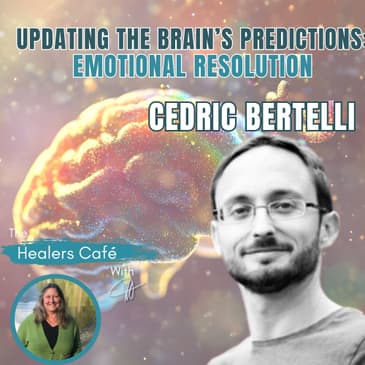
In this episode of The Healers Café, Manon Bolliger, speaks to Cedric Bertelli, founder of the Emotional Health Institute, discusses his methodology, Emotional Resolution (EMRS), which addresses emotional imprints through somatic neuroscience. Inspired by his grandfather's resilience post-WWII, Cedric developed EMRS to help individuals resolve emotional patterns by feeling physical sensations without control. He explains that the brain predicts emotions based on past experiences, often rooted in trauma, and EMRS allows these predictions to play out naturally, updating the brain's response.
For the transcript and full story go to: https://www.drmanonbolliger.com/cedric-bertelli
Highlights from today's episode include:
Emotions are outdated predictions: Debilitating emotions are often outdated predictions from the brain, triggered when current stimuli resemble elements from past traumatic moments. The body then recreates old physical sensations (interoception), even when they're no longer relevant.
Resolution by fully feeling sensations (90 seconds) : If a person can safely stay with the raw physical sensations of an emotion—without trying to regulate, fix, or control them—the interoceptive wave naturally completes within about 30–90 seconds, and the brain updates its prediction, so the same stimulus no longer triggers that reaction.
Stop building stories; stay with the body: Manon emphasizes the importance of not creating or feeding mental stories about what we feel. By witnessing the emotion innocently and staying with the body's sensations rather than the narrative, we allow real resolution instead of reinforcing the pattern.
ABOUT CEDRIC BERTELLI:
Cedric Bertelli is the founder of the Emotional Health Institute and co-developer of Emotional Resolution® & EmRes®, a somatic, neuroscience-based approach for resolving emotional imprints. Before dedicating himself to emotional health, Cedric spent more than a decade in the hospitality industry, including leadership roles with The Ritz-Carlton Hotel Company, where he developed a deep understanding of human behavior and service.
Over the past 15 years, he has trained practitioners across the world, guided thousands of clients, and partnered with researchers at UCLA and UCSF to advance the scientific foundations of EmRes. His work focuses on making emotional healing simple, effective, and accessible so people can live with greater clarity, ease, and resilience.
Core purpose/passion: My core purpose is to help people reconnect with their natural capacity to resolve emotional pain. Not to manage it, not to suppress it, and not to build workarounds around it — but to truly resolve it at the physiological level so they can live with more freedom, presence, and ease.
– Facebook | Instagram | Website | LinkedIn | YouTube |
ABOUT MANON BOLLIGER, RBHT, FCAH:
As a retired Naturopath 1992-2021, I saw an average of 150 patients per week and have helped people ranging from rural farmers in Nova Scotia to stressed out CEOs in Toronto to tri-athletes here in Vancouver.
My resolve to educate, empower and engage people to take charge of their own health is evident in my best-selling books: 'What Patients Don't Say if Doctors Don't Ask: The Mindful Patient-Doctor Relationship' and 'A Healer in Every Household: Simple Solutions for Stress'. and What if Your Body is Smarter than You Think? I am the Founder & CEO of The Bowen College Inc. which teaches BowenFirst™ Therapy and holds transformational workshops to achieve these goals.
So, when I share with you that LISTENing to Your body is a game changer in the healing process, I am speaking from expertise and direct experience".
Mission: A Healer in Every Household!
For more great information to go to her weekly blog: http://bowencollege.com/blog.
For tips on health & healing go to: https://www.drmanonbolliger.com/tips
Follow: Manon Bolliger website | Linktr.ee | Rumble | Gettr | Facebook | Instagram | YouTube | Twitter | LinkedIn |
Follow: Bowen College Inc. | Facebook | Instagram | LinkedIn | YouTube | Twitter | Rumble | Locals
ABOUT THE HEALERS CAFE:
Manon's show is the #1 show for medical practitioners and holistic healers to have heart to heart conversations about their day to day lives.
Subscribe and review on your favourite platform:
iTunes | Google Play | Spotify | Libsyn | iHeartRadio | Gaana | The Healers Cafe | Radio.com | Medioq | Audacy |
Follow The Healers Café on FB: https://www.facebook.com/thehealerscafe
Remember to subscribe if you like our videos. Click the bell if you want to be one of the first people notified of a new release.
* De-Registered, revoked & retired naturopathic physician after 30 years of practice in healthcare. Now resourceful & resolved to share with you all the tools to take care of your health & vitality!
00:00:00
Introduction: Welcome to the Healers Cafe, the #1 show for
00:00:04
medical practitioners and holistic healers to have heart
00:00:09
to heart conversations about their day to day lives while
00:00:14
sharing their expertise for improving your health and wellness.
00:00:20
Manon Bolliger: So welcome to the Healers Cafe, and today I'm
00:00:24
with Cedric Bertelli, and he has created a methodology called em
00:00:31
res, or emotional resolution. And he's the founder of the
00:00:36
Emotional Health Institute, and therefore co founder of this
00:00:42
technique, and it's a somatic neuroscience based approach for
00:00:48
resolving emotional imprints. And I think part of it you you
00:00:54
had a lot of experience understanding human behavior
00:00:59
through your hospitality experience at the Ritz Carlton
00:01:05
and then other trainings, and basically, one way or another,
00:01:11
you got to this, and that's actually my first question to
00:01:17
you, so What, what brought you to this juncture, or this
00:01:22
creation. Yeah, how did it happen for you?
00:01:27
Cedric Bertelli: Hi, Manon, welcome. Thank you very happy to
00:01:30
be here, and thank you for for having me. How I came onto this
00:01:36
field, I will say it's, it's, I guess life bring you there right
00:01:41
one way or another, I think I started getting interested in
00:01:46
this type of work on resolving or releasing anxiety, because I
00:01:50
was suffering myself with a lot of anxiety and self directed
00:01:55
anger, low grade depression, and that's something that I hid most
00:02:01
of my life, you know, up until my late 20s. You know, no one in
00:02:06
my in my previous career, as you said, I was working for for
00:02:10
hotels and restaurant, no one knew that I was dealing with
00:02:13
this anxiety and and depression. And I tried different things on
00:02:18
myself at the time, psychotherapy and other other
00:02:21
modalities, and I've understood maybe why I felt that way, and I
00:02:26
learned to control the way that I was feeling, try to regulate
00:02:30
it, but I never was free of it. It was a constant battles to
00:02:36
speak, right, hiding, controlling, etc. And the reason
00:02:40
why I decided to shift is because I wanted to see if
00:02:43
something else was possible. And one of the the examples for me,
00:02:48
I often talk about it, is my grandfather. My grandfather was
00:02:51
a world war two veteran, and as I I grew up with him around him,
00:02:57
and later on, when I started to question my my own emotional
00:03:02
health. I was wondering how a man who lived so much atrocity,
00:03:08
right, he was in what you call a friend in French, the Maquis,
00:03:11
which were like those men that were not in the military, but
00:03:15
were hiding in the forest, listening to specific messages
00:03:18
on the radio, code and messages and then do actions again. The
00:03:23
Nazis, how can him and men like him were able to tap into so
00:03:29
much resilience when they had absolutely no help, right? They
00:03:32
didn't have psychotherapy, they didn't have none of this, right?
00:03:35
And so that was from when I started to get interested in my
00:03:39
own health. It's like, what, what was he able to do, and what
00:03:43
all the men, not that very, I'm very conscious that it was also
00:03:47
PTSD from World War Two veterans. I'm not, I don't live
00:03:50
in LA, LA LAND. But the way that they were resilient was very
00:03:54
different from the way that I was resilient when I didn't
00:03:56
know, you know, that didn't fight any, any war, and still,
00:03:59
my life was very difficult inside. So anyway, that was the
00:04:06
bridge, right, right. How can this type of people were able to
00:04:12
be resident without any help, and how me? Well, quote,
00:04:15
unquote, normal life with just work and live drama. How is it
00:04:22
that I cannot find this peace within myself? So that's that
00:04:25
was, that was kind of like, I guess, the thought process, you
00:04:29
know,
00:04:29
Manon Bolliger: right, right? So what was the conclusion?
00:04:33
Cedric Bertelli: I think the conclusion for for men like my
00:04:36
grandfather, and it's after the war, they they had to take care
00:04:42
of their family. So after the war, in my grandfather case, for
00:04:46
example, they worked outside. Him, he was working in the
00:04:50
woods. He was a lumberjack, and in the in vineyards, working
00:04:54
outside, moving their body among men who shared a similar
00:04:59
experience. Sense. They never talked about the war after the
00:05:02
war, but they shared a similar experience and with a sense of
00:05:06
purpose. I think those three elements, nature and moving your
00:05:11
body in nature community have an unspoken, unspoken, lived
00:05:18
experience and a strong sense of purpose. There's no other choice
00:05:22
that to make money work and raise my family from absolutely
00:05:27
nothing to to some kind of, some kind of a better status, right?
00:05:34
There's no choice. Was no choice to do anything else, because
00:05:37
other than that, it was just the death of the family, so to
00:05:40
speak, right? So I think, I think that's that was in their
00:05:44
case, for for a lot of them, I think that was the the
00:05:49
alchemical solution. I think when it comes to to my own
00:05:54
experiences, when I started to study the body and how to use
00:05:58
the physical sensations present in emotions, to resolve those
00:06:03
emotions. This is when, when I the more I move my attention and
00:06:09
my research into the physical sensations in the body, what we
00:06:12
call interoception at the time of an emotion, the more I
00:06:16
started to understand the process of how the brain
00:06:21
constrict emotion, and then, of course, studying and reading
00:06:24
neuroscience and collaborating with doctors such as Dr Jacques
00:06:27
femex In France, it became very clear. We know today how the
00:06:31
brain constrict emotion, and from this understanding, it's
00:06:35
actually quite simple to understand how the brain can
00:06:37
undo those debilitating emotional pattern not
00:06:41
cognitively, but through the body.
00:06:44
Manon Bolliger: So in the method that you've put together, what,
00:06:51
what is the the way of, or, I mean, you can perceive the like
00:06:55
the interception, like, what's the body is saying, but the
00:06:59
interpretation of that, how? What is the process? I'm not
00:07:04
trying to get the rights to your just asking, generally, how does
00:07:09
this work? How do, how can people learn to do this?
00:07:14
Absolutely method?
00:07:15
Cedric Bertelli: Yeah, absolutely. I mean to go back a
00:07:19
bit on my grandfather when, when he was crossed by an emotion.
00:07:24
You know, when he felt, I don't know when you had a flashback or
00:07:29
something like this, and you're in the wood. What do you do? You
00:07:31
do absolutely nothing. You know you you you do nothing. You just
00:07:36
feel it. You know, at the end of the day, you feel it within,
00:07:39
within some kind of safety surrounding right? Okay, I can
00:07:43
tell you about the methodology we created is called MRAs. We
00:07:46
created it in its official since 2019 so the base, the foundation
00:07:53
of Mrs. Is quite simple. Actually, we know today how the
00:07:56
brain constrict emotion. And I can tell you in a nutshell, you
00:07:59
probably know. But just in case, you know, some people know we
00:08:03
know that was two things to keep in mind when it comes down to
00:08:05
emotional functioning. Number one is that the brain constantly
00:08:10
predict. And to understand this principle of prediction, I will
00:08:13
refer people to Lisa Feldman Barrett, who wrote, Our emotions
00:08:20
are made, which is like for me, one of the Bible of the
00:08:22
neuroscience of emotion. So two things to remember. Number one,
00:08:26
the brain constantly predict. Predict based on past
00:08:29
references. Number two, we understand that that the origin
00:08:34
of any debilitating emotional pattern is an instant of trauma.
00:08:39
So when talking about prediction, I often take the
00:08:42
same example, which is, we know, we realize that the brain
00:08:45
predict because it does it with everything. For example, food,
00:08:48
right? You if you have a Granny Smith sample, for a first time,
00:08:52
you have a first experience, the crunchiness, the CDT, the juice,
00:08:56
is a first experience. But anytime after that, every time
00:09:01
after that, if you take a similar Apple, before you buy
00:09:05
the apple, you're going to predict exactly what experience
00:09:07
you're going to have, to you're going to you're going to have,
00:09:10
you're going to have, and sometimes you can vary a little
00:09:13
bit, you know, the acidity, etc. But there's always a prediction
00:09:16
before you do the action constantly when you have a cup
00:09:18
of coffee, etc, etc, yeah. Another example of prediction is
00:09:22
if you come from working out, for example, and you, you're
00:09:25
thirsty, you go into your fridge and you, you drink, I don't
00:09:30
know, a bottle of water you're going to know when to stop,
00:09:33
which is, which is quite amazing, because actually take
00:09:36
over 30 minutes for your body to integrate the water. That means
00:09:41
that your brain predict how much water you need in order to
00:09:44
quench your thirst, right? Then again, it's prediction. That's
00:09:48
the first thing prediction. Second thing is at the origin of
00:09:52
the patterns, is a moment of trauma. Now the problem is on
00:09:54
the trauma, the problem or the instant of dissociation
00:09:58
happening during the trauma. Hmm, so maybe let's take a
00:10:02
second to talk about what is a trauma? A trauma is an instant
00:10:05
that hold too much stress, physical or emotional, for us to
00:10:11
integrate at the instant when we live it, when we experience
00:10:15
that's it. It's just too much. And when it's too much, very
00:10:19
often there is an instant of dissociation. You dissociate so
00:10:22
you don't suffer too much during this very stressful experience.
00:10:26
And that's in the dissociation that the emotional pattern is
00:10:29
created. And in a nutshell, when we have this conversation, you
00:10:33
and I, our brain, cognitively, consciously, is gathering about
00:10:38
2000 bits of information per second, process at the speed of
00:10:41
150 miles per hour. That's what we are aware of at the same
00:10:45
time, our subconscious has a potential to gather 400 billion
00:10:48
bits of information per second, versus 2000 and process it at
00:10:52
the speed of 150 miles per hour. These are the numbers from
00:10:57
the pen University from 2012 and those number varies, but it's
00:11:01
always the same type of scale. The subconscious has a much
00:11:05
higher potential and processing much faster when we have a quiet
00:11:10
conversation, like we do now Manon, our cognitive is is used
00:11:14
as a filter, so the prefrontal cortex filter a lot of this
00:11:18
information so we can live in society, so we we can adapt to
00:11:22
what we're supposed to do as humans. But when you, when you
00:11:25
experience a trauma and there's dissociation this, the
00:11:28
subconscious takes over. So imagine a vortex, a huge vortex,
00:11:33
opening up outside and inside of yourself, gathering all the
00:11:37
information available to you during the system of
00:11:39
dissociation without any type of filter. So it's going to gather
00:11:43
the temperature, the taste, the texture, the light, all those
00:11:47
very physical elements, sensorial elements. And your
00:11:51
subconscious is also going to record the physical sensation
00:11:55
that you're feeling at this instant, just like you do when
00:11:57
you have an apple, for example. So imagine this vortex open in
00:12:01
and out, gathering all this information at a very high
00:12:04
speed, at a very high what's the word definition, but in a non
00:12:13
linear way, when the subconscious takes over, nothing
00:12:17
makes sense. There's no logic. It's ton of information gather
00:12:21
without any type of logic. Well later on, and we have those
00:12:26
instant of dissociation again and again and again in our life,
00:12:29
from the time we're in utero to the birth process to later on in
00:12:33
life, it happens 10th and 10th of times without sometimes
00:12:38
noticing it even later on, when the brain finds itself in a
00:12:42
situation where it recognizes one or several elements that
00:12:46
were present during one of those traumatic event, your brain is
00:12:49
going to predict instantly what physical sensations you're about
00:12:52
to feel based on what you felt in your body during a specific
00:12:57
event. Those physical sensations is what we call interoception,
00:13:01
those physical sensation is what let us know that we feel an
00:13:04
emotion. We feel we know that we have anxiety. We feel anxiety.
00:13:08
We're feeling angry or sad or whatever. We know that it's not
00:13:12
in the brain. It's a conceptualization of physical
00:13:15
sensations, physical sensations that are nothing else but an
00:13:19
outdated prediction from your brain, because that's what it
00:13:23
is, a debilitating emotional pattern. Basically, when you
00:13:26
feel an emotion that is not congruent to your current life,
00:13:31
is an outdated prediction from your brain. What does MREs do?
00:13:35
Mrs. Letting this prediction play out until the end in a safe
00:13:40
environment. Because what we find is quite simple. It is that
00:13:44
if a person, when as an emotion start in them, if they can be
00:13:50
with the physical sensations, so letting the interoceptive
00:13:54
prediction play out until the end in a self in environment
00:13:59
without controlling how they feel inside. I mean, no breath,
00:14:02
no twisting, no stretching, no touching, no you feel. That's
00:14:07
the only action necessary, what you feel in your flesh, in a
00:14:10
safe environment, this interoceptive prediction will
00:14:14
never last longer than 90 seconds. It will take two and 90
00:14:19
seconds. Yeah. And the thing is, if you're able to feel the
00:14:23
sensations as they change in your body in a self environment,
00:14:26
without impacting them or without impacting your
00:14:28
surrounding, at the end of this prediction, your brain is
00:14:33
anticipating for you to be healed by some kind of danger,
00:14:35
just like it happened years ago. Well, at the end of this
00:14:39
prediction, nothing happens from that very second your brain
00:14:44
update the prediction whatever stimulus was creating this
00:14:49
emotional reaction after this experience will be an absolute
00:14:53
non event. It will not trigger the emotion anymore, ever,
00:14:59
right?
00:15:00
Manon Bolliger: So by allowing it to play out for up to about
00:15:06
90 I mean, you don't stop it, but your experience has been 90
00:15:09
seconds, which I would concur with that too. That's what I've
00:15:15
noticed as well. But it's like, then you're not. It's like, it's
00:15:21
like it's gone through that part. It, it doesn't need to it,
00:15:26
it re it doesn't have to start at the same base point. Now
00:15:31
we've got a new base point where there was no trauma. Therefore
00:15:36
it updates the cartilage, or whatever you want to say the
00:15:41
prediction,
00:15:42
Cedric Bertelli: yeah, it's exactly, yeah, it's the
00:15:44
prediction is updated your brain recognize a stimulus that it's
00:15:50
one, it's one element in your current life that your brain
00:15:53
recognize from the past, automatically, instantly, is
00:15:56
going to predict what physical sensations you're about to feel
00:15:58
just Well, The thing is, right now, the stimulus is irrelevant
00:16:03
to your life. You might be a smell. It might be, for example,
00:16:06
let's say you, we meet you, and you and me for the first time,
00:16:08
and we don't know anything about each other, but you're going to,
00:16:11
you're going to meet me, and you're going to going to feel
00:16:13
tension in your body. And maybe you're going to feel tension in
00:16:17
your body because, because the way that I look maybe my size,
00:16:21
maybe a smell that you don't even recognize, but it
00:16:24
recognized. Your brain recognize it as somebody was, you know,
00:16:28
abusive to you, maybe. But the fact of the matter is, something
00:16:31
in you is going to recognize something in me, an element, and
00:16:34
that's going to create tension in you. Yeah, it has nothing to
00:16:37
do with me, but it's tension. Your brain is going to
00:16:39
conceptualize it. It's going to say, well, there's something
00:16:41
about civic that I don't like, and it's nothing about me. It's
00:16:45
something about an element about me. And we're going to make up a
00:16:48
story on that, and we're going to this relationship is going to
00:16:51
be already floated because of this tension that you have
00:16:54
around me, that's an emotion as well. So here, what I mean is,
00:16:59
like a lot of stimuli that we have in our current life have
00:17:03
nothing to do with our current existence, right? It is just
00:17:09
it's just vibrating. It's just mirroring something that
00:17:12
happened way way before.
00:17:15
Commercial Break: What would your life be like if you were
00:17:17
pain free, if you were one of the millions who suffer from
00:17:22
chronic pain, the thought of just one day without it may seem
00:17:26
impossible. This is often because conventional medicine
00:17:30
tends to fall short in the treatment of pain, opting to
00:17:34
prescribe pills or recommend surgery rather than getting to
00:17:39
the root cause of the problem. But if you are suffering with
00:17:43
emotional or physical pain, there is hope. Join the founder
00:17:48
and CEO of Bowen College, Manon Bolliger, live online for your
00:17:52
body mind reboot. Learn how to listen to your symptoms and get
00:17:57
to the root cause of your pain, plus be trained in basic Bowen
00:18:01
therapy moves so that you can reboot your body for optimal
00:18:06
health. You don't have to live in pain. You can heal, stop the
00:18:10
pain pill cycle by visiting www.yourbodymindreboot.com, to
00:18:14
learn more and to register you.
00:18:24
Cedric Bertelli: Yeah, and that put us in trouble or hurt us,
00:18:27
right?
00:18:28
Manon Bolliger: I mean, I think that's where being aware of the
00:18:33
stories we create, you know, or make it mean something, because
00:18:38
there's a part of us that tries to justify or come up with a
00:18:44
reasoning or something like this, but to watch it, to be
00:18:48
innocent, to be witness to just the emotion, stay with what the
00:18:53
body is experiencing. You can remove the thoughts. I mean,
00:18:58
just don't like don't hook more thoughts to make a story. You
00:19:03
know, one of the common, and I was wondering if you had some
00:19:10
statement or some experience with this, is the feeling of
00:19:13
overwhelm as an emotion, and it's usually a traumatic
00:19:18
emotion. It has it's not, you know, fear, anger, all of those
00:19:23
that are clear this overwhelm. It's like a It's an all
00:19:29
encompassing, no action to take, kind of thing. And people are
00:19:35
quite bewildered in that state. Is there something different
00:19:39
about that state or or is it just my experiences that it look
00:19:44
it feels different to me than clear emotions
00:19:49
Cedric Bertelli: for me, there is no experience. And maybe in
00:19:52
the in the in the feeling of the person. A lot of time when you
00:19:55
feel anxious or angry, you feel sensations, right? There is
00:19:58
tension in your body. I. Often with the overwhelm. It's the
00:20:02
contrary that happened. It's a lack of sensation, a lack of
00:20:05
exactly but this lack of sensation, if it is more
00:20:07
difficult for somebody to feel by themselves, with a
00:20:10
practitioner, they will be able to be conscious of this lack of
00:20:15
sensations. So in the brain, it is exactly the same thing,
00:20:19
except that instead of being, quote, unquote, flooded by
00:20:23
sensation, it's a complete lack of sensation. So it's confusing,
00:20:26
and you don't move, and you're frozen, and it's you can't take
00:20:29
any action. It's like life leave you for a little bit. It's a bit
00:20:32
of death. It's a little piece of death, in a way. And I think
00:20:36
it's what it is. It's actually a moment of physical death. And
00:20:39
the person may have felt, maybe in utero, at birth, or, yeah, in
00:20:43
some kind of accident,
00:20:44
Manon Bolliger: yeah, like the or, you know, trauma before a
00:20:48
certain age, like a state of disassociation where there's no
00:20:54
actual recall, you know, yeah,
00:20:57
Cedric Bertelli: that's the beauty about this, about Mrs.
00:21:00
Is, like, you don't need to, you need to know where the emotion
00:21:03
comes from. Irrelevant. It is irrelevant. You don't need to
00:21:06
know where the emotion comes from. What matters is how you
00:21:08
feel today. So even if somebody comes to see us with, Well, I I
00:21:14
experienced this or this or that trauma in their life, it's we
00:21:18
don't we don't need to. What are the impact of this trauma in
00:21:24
your life today? Well, my relationships are this way, self
00:21:29
confidence in your life today. What are the impact? Because
00:21:33
trauma cannot be healed. You know, it sounds good. You know
00:21:37
trauma healing is something that is a good motto. It's in it
00:21:42
sounds good on books, but trauma cannot be healed because trauma
00:21:44
happened, no matter what it is. It happened. But what can be
00:21:48
healed are the wounds than this? Trauma created this we can heal,
00:21:53
right?
00:21:54
Manon Bolliger: I mean, that could be a bit of semantics too.
00:21:57
Yeah, absolutely. The wounds are the impact of the trauma, right?
00:22:04
Absolutely. History is history, right? So, yeah, there's
00:22:08
Cedric Bertelli: nothing you can do. There's nothing you can do.
00:22:10
And talking about the talking about the trauma again and
00:22:13
again, in a way, is anchoring the trauma
00:22:16
Manon Bolliger: absolutely, yeah, which was the method that
00:22:19
was used right? A lot of in psychology, it was a belief that
00:22:25
you, you know, hit the pillow, get rid of the anger, it's like,
00:22:29
but you're just reenacting on a continual basis. So, so can you
00:22:36
give? I mean, I can easily come up with any trauma. But can you
00:22:43
give an example how this would would look like if somebody came
00:22:49
to you or to a practitioner using this method, how, what is
00:22:54
a seance like, or a therapy session like? Yes, absolutely.
00:23:01
Cedric Bertelli: First of all, this work can be done on Zoom,
00:23:02
so you don't need to see people in person. Some people receive
00:23:05
clients in person. I don't anymore, since the pandemic, I
00:23:08
didn't see anybody in person anymore, which, in a way, is is
00:23:13
freeing. So it can be done on Zoom or other other platform.
00:23:18
The way that it will it will start, will be I would ask my
00:23:21
client a simple question, if we could resolve anything within
00:23:24
you today, what would that be? If anything could be resolved,
00:23:28
what would that be? Wen thing at the time, because often people
00:23:31
come with an issue, so it's a shame, guilt, anger, but from
00:23:35
this one issue, there are a lot of other emotion that piled upon
00:23:38
it, and maybe some emotion that were before them as well. So
00:23:43
we're going to focus on one problematic, one issue. And the
00:23:47
person will tell me, Well, I, I don't know I, I'm very uneasy in
00:23:52
social setup, and I like to, I like to work on that social
00:23:56
anxiety. Okay, very well. So we will address this, this
00:24:01
problematic in several way. First, we'll use memories, some
00:24:05
memories when the person felt uneasy in public setting,
00:24:10
nothing old, everything recent, within the last few weeks of
00:24:14
your month. And we would quote, unquote, trick the brain, you
00:24:17
know, the for the brain to be confused. Are they at the event
00:24:21
again, or are they here? So what we're trying to do here is to
00:24:25
recreating the interception and the person is feeling in a
00:24:28
social event, and we become very good at that, so the person will
00:24:33
feel the same sensations as they feel in the social event. Now,
00:24:36
instead of being in a social event and having to control
00:24:40
their behaviors and the way that people interact with them, the
00:24:44
safe and sound. So we're going to feel we're going to invite
00:24:47
the the client in feeling the sensations in a specific way, in
00:24:51
a safe environment. And as a practitioner, we're not going to
00:24:53
try to we're not going to help them. We're not going to make
00:24:56
them feel better. Because if you try to make them feel better, if
00:24:58
you tell them that everything is okay. What's, what's the point
00:25:00
you are. You are controlling the emotion. It's not going to work.
00:25:04
We're going to be we work with memory a lot, in our positioning
00:25:08
as a practitioner, to give intense attention without
00:25:13
stepping into the process of the client, right? So that's one way
00:25:17
using memories, recreating interoception and then
00:25:20
resolving, and then we're going to access, for us, the emotions
00:25:27
on three layers, so to speak, to keep things to keep things
00:25:30
simple. Conscious emotion, which are the emotion why people come
00:25:33
to see us most of the time, unconscious emotion, which are
00:25:37
the emotions we don't want to look at, the shame, the guilt,
00:25:40
you know, the emotion that we know are there, but because they
00:25:43
do not fit with the character that we want to display in life,
00:25:47
or the character who we think we are, we don't want to look at
00:25:51
them. And they have a lot of power upon us. Those unconscious
00:25:54
emotion and then that the subconscious emotion, the
00:25:57
subconscious emotions, or emotions that are not reachable
00:26:00
consciously at all, and often they're just tension in the
00:26:05
body, tension that are not strong enough to be
00:26:09
conceptualized by the prefrontal cortex, but that are very much
00:26:13
creating dynamics in our life. And usually that gives symptoms
00:26:17
as well. You know, physical symptoms such as eczema, pain,
00:26:20
etc, often come from subconscious fears, because they
00:26:25
never, they never attended anyway. So to go back to your,
00:26:31
to your, to your answer, I apologize. We going to be using
00:26:35
memories. We're also going to use something that we call
00:26:38
impact question, impact question, or question design to
00:26:42
raise the fear here and there from the clients, fears that
00:26:46
they're not conscious of. So we ask a specific question.
00:26:51
Interception comes, and we resolve it, and then we have
00:26:56
other techniques, so to speak, to encounter and resolve
00:27:02
subconscious fear. So we're going to work on three layers.
00:27:04
And you'll see that during a session, most of the time we
00:27:07
resolve between eight and 12 emotions.
00:27:12
Manon Bolliger: And so let's say I'm just thinking out loud. I'm
00:27:17
conscious right now, for example, of a toothache. Yes,
00:27:22
you know, but I know that pain doesn't come by itself. You
00:27:28
know, of course, I've done all the right things to clean the
00:27:30
area and all that, but you know, pain usually comes if you were
00:27:36
to deal with pain to bring out the emotion that is behind it.
00:27:43
How, what would you do?
00:27:45
Cedric Bertelli: So when, when it comes to working specifically
00:27:49
on, on symptom, it's, it's, we develop a tool mostly Dr Jacques
00:27:54
few makes, who is a gastroenterologist from Lyon,
00:27:58
France, called the amres droning, where we're going to
00:28:03
enter the symptom to meet subconscious fears. So of
00:28:10
course, we're going to start by working. If there is anything
00:28:13
conscious right, how does it make you feel to have this pain
00:28:15
resolve the emotion created by the symptom? Also, do you notice
00:28:19
any pattern in your life, such as in when I leave specific
00:28:23
situation, the pain increase? Well, let's see this is
00:28:26
conscious. What's happening in those type of situation? What
00:28:29
type of emotion do you feel in this type of situation? Let's
00:28:32
resolve them that already, that's for the conscious and the
00:28:35
unconscious. And then we're going to enter the symptom
00:28:38
directly through a methodology that we call the MRes drone. Uh
00:28:41
huh.
00:28:41
Manon Bolliger: MREs journey, fascinating. Yeah, very
00:28:44
interesting work. Yeah, good. And so you've been doing this
00:28:49
now for quite a few years.
00:28:51
Cedric Bertelli: Yes, yes, for since I started this whole
00:28:55
process in 2011 2011 and we, we founded the emotional health
00:29:02
institute in the US in 2019 in France, I believe 2020 and we're
00:29:08
now operating as well in Japan, since 2023 it's growing.
00:29:14
Manon Bolliger: It's, it's wonderful. Well, it seems all
00:29:17
healing. And the bottom line is, it's, to me, it's, it's a simple
00:29:22
process, but you got to know what it is and which one for
00:29:26
which people you know. But yeah, I always find this fascinating,
00:29:31
which is why that's my what I love discussing with people,
00:29:36
Cedric Bertelli: as you say, it doesn't have to be complicated.
00:29:39
You know people, I guess people in our society like to make
00:29:43
things complicated, and I don't know, maybe because there's more
00:29:46
value into it, or we attach more value into it, or because, but
00:29:50
often, you know, at the at the Emotional Health Institute, we
00:29:53
collaborate with veterinarians and ideologies we observe the
00:29:59
other. Animal word, the mammal world, and the emotion, the
00:30:04
relationship to emotion, and what Dr nila, she know, who is
00:30:09
veterinary veterinarian working with us, noticed, and you
00:30:12
probably know that as well. Then there's three species of mammal
00:30:15
that hold on to trauma, humans, of course, pets and some, in
00:30:21
some cases, farm animals. And what is the commonality between
00:30:27
That's That's right, and we control our youngs. We control
00:30:31
our youngs as human beings very quickly. We we either way. We
00:30:34
control the way they feel because we are disturbed
00:30:37
ourselves if we see them in pain or anxious. So we control them,
00:30:41
and we teach them to control themselves. I mean, my, my
00:30:44
youngest daughter is, is still in preschool, and, you know,
00:30:48
that's wonderful. I'm not saying anything, but, but they teach
00:30:51
them to regulate their emotion, try to to to count, to do all
00:30:56
those technique when it's when she comes home and say, No,
00:30:58
don't do any of that. You feel what you're feeling. Don't yet
00:31:02
you just feel. And so she's very confused. She's, what do I do?
00:31:07
Is, you'll do whatever you feel. Is right? But, but we teach
00:31:10
emotional regulation, which is a great thing to our kids very
00:31:13
early on. Emotional regulation is an interference to emotional
00:31:18
resolution, right? It's a coping skill, yeah, coping skill. It's
00:31:22
not a healing that's right, and because we used to do it from
00:31:26
very early on, because our parents told us, our teacher
00:31:29
told us, our emotional arts taught us, our church told us we
00:31:33
there's a part of us that still believe, and this is the truth,
00:31:36
and this thing is actually interfering with the resolution
00:31:40
of the emotion.
00:31:42
Manon Bolliger: Yeah, it's interesting, because, you know,
00:31:45
like animals, often after trauma, they they just shake.
00:31:50
That's right, it's a natural thing. But so do children, if
00:31:55
they haven't been stopped absolutely, you know. And I
00:31:58
think you know, our body knows what to do if we don't get our
00:32:04
minds involved, you know, and stop it, and have all these
00:32:08
theories and you know, but once, once you've done that, you're
00:32:12
past it, right? It's when, when we have an issue, then it's
00:32:16
okay, like, then, I love systems, you know, you have
00:32:19
three, three ways of addressing it, you know, if it's
00:32:23
unconscious, if it's conscious, or, you know, so it's very,
00:32:28
yeah, it's interesting, you know? And yet, just by nature,
00:32:32
we're so made to heal.
00:32:36
Cedric Bertelli: We're not, we're not meant to hold all that
00:32:38
we're not. It's why we get so sick. That's why we that's why
00:32:41
we were constantly sick, you know, because we hold on too
00:32:45
much. We we hold on so many emotions, we deny them, we hide
00:32:49
them, or we control them. But when you control them, they're
00:32:52
still there, and they still come up, and you can control them. I
00:32:54
mean, I, I, when I used to work in hotels, I used to control my
00:32:58
emotion a lot with drinking, you know, I was, you know, working
00:33:01
in restaurants and come home at two o'clock in the morning and
00:33:04
drinking a whole bottle of wine because, because I needed to
00:33:07
come down and sleep, because I had to go back at work at 8am
00:33:09
the next morning. And it was just fine. You know, I was
00:33:12
regulating just fine. No problem. I was just fine. It's,
00:33:15
it's, it's, it's so unhealthy, right? And we do that, we do
00:33:20
that in so many ways. I mean, yeah,
00:33:25
Manon Bolliger: well, our time is up, but it was a very, I
00:33:30
think it was a very good conversation. I learned a lot.
00:33:34
And how do people reach you, or the methodology? How do they get
00:33:39
more on, on that. Maybe you could conclude with
00:33:42
Cedric Bertelli: that absolutely, I think the best way
00:33:44
to learn is to go to emotional health institute.org, it's our
00:33:49
website. Or they can also go to MREs, E, M R, E, s.com, and it
00:33:56
goes to the same to the same website. Okay, very good.
00:33:59
Manon Bolliger: Well, thank you so much. Thank you, Manon, what
00:34:03
I've pulled out from our discussion with Cedric Bertelli
00:34:08
is that healing itself is quite simple, and the closer we allow,
00:34:14
what would the natural body would do the you know,
00:34:19
uneducated, untold. You know, the person who's who's free like
00:34:25
an animal. You know, shake out the stress, shake out the the
00:34:30
trauma, the the better we'd be. I found that it was very
00:34:36
interesting, though, to see the different ways of working with
00:34:41
the unconscious and the conscious mind. But the
00:34:46
predominant, you know, experience is to leave the
00:34:50
emotion like allow the emotion to be and that though we have
00:34:56
predictive, you know, past. Patterns based on the on the
00:35:01
past, that once we allow the emotion to play out, and it
00:35:06
recognizes that in the current reality, that prediction is is
00:35:12
actually not accurate, it is a predictive patterning, then we
00:35:17
can let it go, and we're not going to need to see it again.
00:35:23
Ending: Thank you for joining us at the Healers Cafe. If you
00:35:27
haven't already done so, please like, comment and subscribe with
00:35:32
notifications on as I post a new podcast every Wednesday with
00:35:36
tons of useful information and tips for natural healing that
00:35:41
you won't want to miss you.