
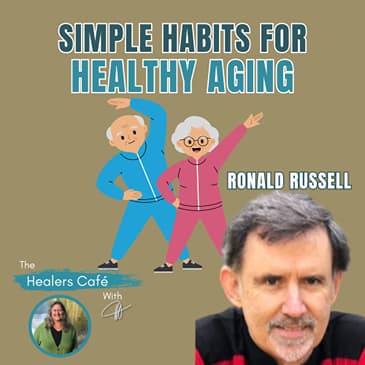
On This Episode of The Healers Cafe, Ronald and Manon discussed how his plant-focused cooking career informed his approach to longevity and an active health span.
For the transcript and full story go to: https://www.drmanonbolliger.com/ronald-russell
Highlights from today's episode include:
-
Ronald: Build healthy habits gradually, choosing nutritious foods you enjoy so the changes can last.
-
Ronald: Make dark leafy greens a daily staple—add them to smoothies, salads, or cooked dishes.
-
Manon: Food choices are individual; she shared that legumes trigger her MS symptoms and emphasized finding what works for your own body.
ABOUT RONALD RUSSELL:
Ron Russell is the author of Longevity Visa and founder of LongevityVisa.com — the passport to a longer, stronger, ageless healthspan. He's a vegan chef who spent five years cooking for Dr. Dean Ornish's UCLA cardiology patients, co-founded the award-winning SunCafe Organic in Hollywood, and has taught over 400 plant-based cooking classes. Today he separates real longevity science from the hype and turns it into habits anyone can actually use.
Core purpose/passion: Helping people improve their Healthspan with easy method to habit stack their way to health and longevity.
Website | Instagram | LinkedIn | YouTube |
ABOUT MANON BOLLIGER, RBHT, FCAH:
As a retired Naturopath 1992-2021, I saw an average of 150 patients per week and have helped people ranging from rural farmers in Nova Scotia to stressed out CEOs in Toronto to tri-athletes here in Vancouver.
My resolve to educate, empower and engage people to take charge of their own health is evident in my best-selling books: 'What Patients Don't Say if Doctors Don't Ask: The Mindful Patient-Doctor Relationship' and 'A Healer in Every Household: Simple Solutions for Stress'. and What if Your Body is Smarter than You Think? I am the Founder & CEO of The Bowen College Inc. which teaches BowenFirst™ Therapy and holds transformational workshops to achieve these goals.
So, when I share with you that LISTENing to Your body is a game changer in the healing process, I am speaking from expertise and direct experience".
Mission: A Healer in Every Household!
For more great information to go to her weekly blog: http://bowencollege.com/blog.
For tips on health & healing go to: https://www.drmanonbolliger.com/tips
Follow: Manon Bolliger website | Linktr.ee | Rumble | Gettr | Facebook | Instagram | YouTube | Twitter | LinkedIn |
Follow: Bowen College Inc. | Facebook | Instagram | LinkedIn | YouTube | Twitter | Rumble | Locals
ABOUT THE HEALERS CAFE:
Manon's show is the #1 show for medical practitioners and holistic healers to have heart to heart conversations about their day to day lives.
Subscribe and review on your favourite platform:
iTunes | Google Play | Spotify | Libsyn | iHeartRadio | Gaana | The Healers Cafe | Radio.com | Medioq | Audacy |
Follow The Healers Café on FB: https://www.facebook.com/thehealerscafe
Remember to subscribe if you like our videos. Click the bell if you want to be one of the first people notified of a new release.
* De-Registered, revoked & retired naturopathic physician after 30 years of practice in healthcare. Now resourceful & resolved to share with you all the tools to take care of your health & vitality!
00:00:05
intro: Welcome to the Healers Cafe: Conversations on Health
00:00:08
and Healing at Manon Bolliger, a retired and deregistered
00:00:12
naturopathic physician with 30 plus years of experience. Here
00:00:18
you will discover engaging and informative conversations
00:00:21
between experienced healers, covering all aspects of healing,
00:00:27
the personal journey, the journey of the practitioner, and
00:00:31
the amazing possibilities for our own body and spirit.
00:00:44
Manon Bolliger: So welcome to the Healers Cafe, and today I
00:00:48
have with me Ron Russell, who's the author of Longevity Visa and
00:00:54
founder of Longevity visa.com. It's actually the passport to a
00:01:00
longer, stronger, ageless health span, and he's a vegan chef who
00:01:06
spent five years cooking for Dean Ornish's UCLA cardiology
00:01:14
patients, and he co-founded the award-winning Sun Cafe Organic
00:01:21
in Hollywood, and has taught over 400 plant-based cooking
00:01:26
classes. So I think with that we'll we'll just welcome you,
00:01:34
and maybe you could share with us what started you on this
00:01:39
journey.
00:01:41
Ronald Russell: Well, thank you so much, Manon. Yeah, it it
00:01:45
started very young, surprisingly. My mother wanted
00:01:50
to be a good mother, so she started reading before I was
00:01:55
born nutrition books. She she didn't know that much, and so
00:02:01
she wanted to kind of you know give me a good start, and I look
00:02:06
back and I don't think of it as super healthy like I try to be
00:02:11
now. But compared to my peers, it sure was. Never had lunch and
00:02:15
meat, never had white bread, never had a Coke until I was 18
00:02:18
years old. So you know she did a lot of good basics, and it's
00:02:23
stuck in my head about nutrition and why not be as healthy as you
00:02:27
can be. And so it's been a lifelong journey of learning
00:02:31
more about it and healthy lifestyle. And then then I
00:02:40
opened the restaurant about 20 years ago, Sun Cafe in in
00:02:45
Hollywood, and we started with only 20 seats, and we ended up
00:02:51
growing to 150 seat restaurant with three patios. And every
00:02:55
celebrity you can name came into my restaurant, and and it was a
00:03:03
healthy, you know, you can be an unhealthy vegan and vegan, and
00:03:08
you can definitely be an unhealthy vegan that eats, you
00:03:11
know, potato chips and cookies all day long. But our restaurant
00:03:15
was very health-minded, and you could go super healthy on our
00:03:21
menu, or you know, moderately healthy, because we had to
00:03:25
appeal to a large group of people. But and through that, I
00:03:29
started getting people asking me about cooking classes, and so I
00:03:34
started doing wellness and cooking classes. It wasn't just
00:03:37
about cooking; it was also about kind of getting people to
00:03:40
understand, you know what was wrong, you know with, you know
00:03:46
why they weren't feeling as good as they should, and so that's
00:03:51
and then from there it grew into longevity and the whole
00:03:57
longevity lifestyle. So that's kind of the quick path I took,
00:04:02
and then wrote the book about a six months ago, a year ago.
00:04:06
Yeah.
00:04:07
Manon Bolliger: Okay. Interesting. So, I mean, it's as
00:04:10
good as you point out. There's quite a range, you know, because
00:04:14
my partner's kids are both vegan, and and and what they
00:04:19
brought home to eat. This is later, as you know, young young
00:04:24
adults when they came to visit. One was all white, you know. It
00:04:28
was rice and pasta, and you know, and oh my gosh, this is so
00:04:35
not nutritious, you know.
00:04:37
Ronald Russell: Right. And then the
00:04:39
Manon Bolliger: other one, you know, had vegetables and and
00:04:44
what was that called? Oh my goodness! Avocados and yeah,
00:04:48
sure. You know, and seeds and things. And I thought, okay,
00:04:52
okay, this is getting you know, this is like how is this
00:04:58
related? But you know. You could really go the wrong way with
00:05:03
vegan if you're not educated, you know.
00:05:06
Ronald Russell: Yeah, sure. Well, with any diet, you can go
00:05:09
wrong. Of course,
00:05:10
Manon Bolliger: of course. And so
00:05:11
Ronald Russell: you know, it's it's not that difficult, but you
00:05:14
know, it takes some thought to it, and and it's pretty obvious
00:05:18
when you think about what the nutritious things are, and kind
00:05:23
of what I've done is create a hierarchy of what the healthiest
00:05:28
things are, in for myself, and then it kind of grew into the
00:05:33
book. But I think of them there being two two parts. There's the
00:05:40
nutrition, and then the unhealthy part that you want to
00:05:44
get rid of. So you want to gradually get the healthy part
00:05:47
going up, and the the bad habits coming down. And I think of it
00:05:52
as stacking your habit. You know, you want to just get into
00:05:58
the groove of what's healthy. Now, I'm a lunatic. I actually
00:06:04
have a spreadsheet with 60 things I'm willing to do every
00:06:07
day of my life on my longevity list. Now, I don't suggest
00:06:11
people start that way, but you know, start with one thing
00:06:15
you're willing to do in the nutrition category. For
00:06:20
instance, like one of the things on my list is blueberries. I try
00:06:23
and eat blueberries every day. Well, you know that's not a
00:06:27
difficult thing to do. I enjoy blueberries, and that's what I
00:06:30
would recommend to people. Find things that you do enjoy eating,
00:06:34
or let's say you're not a big fan of greens, but find a way to
00:06:39
make them tasty for you, or you know, so it's like choosing the
00:06:46
right things and what you're willing to do and enjoy doing. I
00:06:51
think is very important. If you if you hate whatever it is,
00:06:57
avocado, definitely you don't have to have avocado. Don't feel
00:07:01
like you have to force yourself because I don't think that works
00:07:05
long term. So I have substantial number of things I try and eat
00:07:11
every day. There's about 12 things that I try and eat every
00:07:15
day, and then I try and avoid certain things. For instance,
00:07:19
the biggest harms of health, in my opinion, are two main things.
00:07:26
One is soft drinks and sugary drinks. I think those are one of
00:07:34
the most damaging. And it's not just sugar in soft drinks; it's
00:07:38
also the phosphoric acid and other acids that disrupt your
00:07:43
gut health, and your gut health is very important to longevity
00:07:47
and and your health span. So you want to really protect your gut.
00:07:54
And then the other thing is fried food. I would say is at
00:07:58
least very limited in your diet, definitely, you know, you see
00:08:04
people that eat, you know, fried food at every meal. That's just
00:08:09
basically what you're eating. Just so you know, I hate to say
00:08:12
this, but you're eating rancid oil is the problem with fried
00:08:16
food, because to heat it high enough to cook, it turns it
00:08:21
rancid, and rancid oil is full of radicals, which break down
00:08:25
your cell structure. So that's why it's so bad for you. And
00:08:29
then you know, eating, and
00:08:31
Manon Bolliger: also they they use coke, you know, not coconut,
00:08:34
um, canola oil. Yeah,
00:08:36
Ronald Russell: yeah, right. You know, and yeah, unhealthy oils
00:08:38
that are, you know, have all sorts of other problems, but
00:08:42
yeah. So there's those are two things that I think you know you
00:08:45
should try and limit as much as you can, and ideally get rid of
00:08:48
altogether. But and then maybe one other one would be heavily
00:08:54
processed foods, especially processed luncheon meats, for
00:08:58
instance. They've actually come out in studies saying that's
00:09:02
just as bad as smoking, eating luncheon meats. Well, that's
00:09:07
pretty bad because smoking takes about 10 years, a full decade
00:09:11
off your life if you smoke. And same with luncheon meats, you're
00:09:15
probably going to lose about 10 years of your life. And I'm when
00:09:20
I talk about longevity, I'm not talking about just living to 100
00:09:24
and being bedridden for 30 years. I want you to, you know,
00:09:28
have a really active life right to you know the last day. That's
00:09:33
my goal. You know, so
00:09:35
Manon Bolliger: what what would be? I mean, I know they're your
00:09:38
12, but what are just as an example of 12? You can share
00:09:44
yours, or but what are the things you think are really
00:09:48
good?
00:09:49
Ronald Russell: Let me back up and say what I'm trying to
00:09:51
accomplish with diet is to have an anti-inflammatory diet. Most
00:09:58
diseases start. Inflammation. There's inflammation of some
00:10:02
kind. Inflammation of the stomach. Inflammation of you
00:10:06
know like acid reflux is a is inflammation of your throat,
00:10:11
etc. That's where diseases start. So if you can have an
00:10:16
anti-inflammatory diet, then you're going to reduce those
00:10:19
risks. And and when I say cause disease, heart disease, cancer,
00:10:26
diabetes are all linked to inflammation. So so that's what
00:10:31
I'm attempting to do with the diet. So you can easily look up
00:10:35
what the anti-inflammatory foods are. the The most
00:10:38
anti-inflammatory foods are probably dark leafy greens,
00:10:43
things like kale and chard and bok choy and cabbage and all
00:10:49
those things are really healthy for us. Especially the
00:10:52
cruciferous vegetables, which have all sorts of other
00:10:57
properties, such as they have a a compound in them that helps
00:11:04
fight off cancer and other diseases, which most other foods
00:11:08
don't. They're the most nutrient dense foods in the world. So,
00:11:14
and I would also add into the dark leafy green seaweed. So any
00:11:20
of those super dark green ones, and I emphasize dark because the
00:11:24
lettuce is, you know, it's good for you, but it's not as
00:11:28
nutrient dense as the dark greens.
00:11:31
Manon Bolliger: Right.
00:11:32
Ronald Russell: So, my recommendation, if you can, get
00:11:38
a pound at least of leafy greens in your diet a day, and I know
00:11:43
that sounds like a lot, and it is. But here's how I do it real
00:11:47
quickly. I I typically do one smoothie a day. I put in my
00:11:51
vegan protein powder and you know my mushroom powders and my
00:11:56
all these other things that I think are really nutritious for
00:11:59
me. But I also make sure to put in a big handful of whatever
00:12:03
green I happen to have on hand. Then I try and have at least one
00:12:07
salad a day, and then the real tip is I tell people put dark
00:12:14
leafy greens, chop them fine so they're not like big hunks of
00:12:18
them, and put them in everything. And what I mean by
00:12:21
that is, you do a stir fry, you can throw in a handful of kale,
00:12:24
and you'll barely notice. Or you're making enchiladas, you
00:12:28
know, in the mix. You you know, with like I make enchiladas with
00:12:31
bean and my own cheese, and I throw in, you know, chard or
00:12:36
something in there, and I barely notice. Or you're doing a
00:12:40
casserole, or your almost anything you make, you can throw
00:12:44
a handful of greens in, and so that's a a tip I would suggest
00:12:50
for people. And then also just learn how to cook it really
00:12:53
simply. The way I typically cook a green is I always get a kick
00:12:59
out of Southern Creole cuisine. There is no cuisine on earth
00:13:04
that starts with healthier ingredients than Creole cuisine
00:13:09
and ends up with a less healthy meal. You know, because what do
00:13:13
they do? They take kale and collard greens and all these
00:13:17
wonderful healthy things and cook them an hour and a half,
00:13:21
and turn them dark brown. Get rid of all the green, and then
00:13:25
throw in a pound of bacon fat. It's like what the heck? So,
00:13:29
here's how you cook a green. You cook it until it wilts. That
00:13:33
means spinach you cook for 40 seconds. Kale you cook for maybe
00:13:38
a minute and a half before it wilts. As soon as it wilts,
00:13:41
you're
00:13:41
Manon Bolliger: done.
00:13:42
Ronald Russell: And then to make it taste good for me, maybe not
00:13:45
for everybody, but I'll throw in some pressed garlic, and garlic
00:13:52
is also super healthy for you. Also, if you cut it or press it
00:13:57
about 10 minutes before you put it in with the greens, it it
00:14:03
activates all sorts of cancer-fighting compounds, and
00:14:09
so you don't want to cook it too much. So I typically just put it
00:14:13
in after I've turned off the pan, and it warms it, and you
00:14:16
know, makes it not quite so pungent. And then afterwards,
00:14:20
not in my cooking. I usually cook it whatever green dry, and
00:14:25
then afterwards I'll drizzle some olive oil on it because you
00:14:28
don't want to heat olive oil because it has a low burn rate.
00:14:32
So you you and it's super healthy for you. So I think
00:14:37
olive oil is probably the best of the processed oils for you,
00:14:42
and but you know use it as a finishing oil is how I look at
00:14:48
Manon Bolliger: it. And how do you feel about some of the seed
00:14:51
oils like sunflower oil, suss oil? I mean, those were I know
00:14:58
way back when I. Yeah, was raising my kids. You know, I
00:15:02
thought I was doing all the right things. Yeah, sure. Tofu
00:15:07
and drizzling it with after. Yeah, yeah, yeah. So I mean, the
00:15:13
seed oils.
00:15:14
Ronald Russell: There's been a lot of things coming out about
00:15:16
it. I've also recently seen some pushback where they say, you
00:15:22
know, it's not as bad as it's been made out to be. I think, I
00:15:26
think, if you're going to cook with oil, I think the oil to use
00:15:32
is avocado oil. It has a high burn rate. You know, you can
00:15:37
heat it decently high, and I haven't heard any real negatives
00:15:41
about avocado oil, so at the moment that seems to be the one
00:15:45
I would cook with if you're going to cook with oil. But I
00:15:48
try to. Very rarely do I feel I need oil. A much better purchase
00:15:55
to me is a ceramic pan. Nothing will stick to it. It has no
00:16:02
toxic substances like Teflon has been linked to all sorts of
00:16:07
problems health-wise, and also Teflon breaks down very quickly.
00:16:13
Yeah, where where ceramic, I you know I've had no problems with
00:16:18
ceramic pans, and it's basically inert material, and so there
00:16:25
shouldn't be any real toxic substance to it if it's like
00:16:30
decently, you know, manufactured. And then, like I
00:16:34
say, nothing sticks to it, so it's great for cooking and even
00:16:40
browning things you can do with with no oil. So anyway, that's
00:16:45
how I do my most of my cooking.
00:16:48
Manon Bolliger: Yeah, it's interesting because I'm I'm
00:16:50
definitely I'm not a vegan. I'm more I was raised as a you know
00:16:55
organic produce in the garden and then farm farm to table,
00:17:00
right? So you know you know what what the animals have eaten.
00:17:06
Sure, they're raised. You know, so it's not factory
00:17:08
Ronald Russell: farmed and all that. No,
00:17:09
Manon Bolliger: exactly. So because I mean, there's so many
00:17:12
issues with meat. Yeah,
00:17:14
Ronald Russell: not just how the animals are treated, but just
00:17:16
the actual what's the end product is is very questionable.
00:17:20
Manon Bolliger: How they make it, you know? Yeah,
00:17:22
Ronald Russell: there's there's lots of issues, especially with
00:17:24
chicken. I feel they're in such poor condition and so much feces
00:17:31
that it's estimated that roughly half of all chicken that goes to
00:17:34
the market has is cancerous. Not that you're going to get cancer
00:17:39
by eating a cancerous chicken, but what I mean is, it's it's
00:17:43
not the healthiest meat you can eat. So you know, be be be aware
00:17:48
of if you're going to eat meat, you know, be aware. And I would,
00:17:52
if we look at most of the blue zone diets, the areas where
00:17:56
people live the most over age 100, almost all of them are
00:18:01
plant-centered. They're not vegan, but they're
00:18:04
plant-centered. They that's the basic of their diet. And yes,
00:18:08
they have a little meat, but not a huge slab of meat. Or you
00:18:12
know, they'll they'll season with meat, or you know, things
00:18:15
like that. They'll put little.
00:18:17
Manon Bolliger: Manon Bolliger here, and I want to thank you
00:18:20
for taking actionable steps towards engaging your healing
00:18:23
journey and helping others discover their path by watching,
00:18:29
sharing, subscribing, and reviewing these podcasts, every
00:18:35
review and share helps spread the word on these different
00:18:39
perspectives and choices and options for healing. And to
00:18:44
thank you, I'd like to invite you to sign up to my free seven
00:18:47
sequence email tips on health and healing for everyday life.
00:18:52
And you can go to healerscafe.com. Tips. Thanks so
00:18:57
much.
00:19:02
Ronald Russell: Pieces in it, but it's generally not a big
00:19:05
slab of meat. So that seems to be one of the the constants in
00:19:11
those blue zones is plant centered. You know, lots of
00:19:19
fresh vegetables, very big on lentils and beans in all those
00:19:24
cultures, and and the Okinawa, which is one of the first blue
00:19:31
zones that got talked about. A couple things about them: the
00:19:38
their main bean is soybean, and a lot of people seem to have.
00:19:43
There was a lot of kind of negative press about soybeans. I
00:19:45
have a bit of a different take on it. I when I'm questioning is
00:19:52
something healthy or not, my go-to is Dr. Michael Greger. He
00:19:58
he has nutrition facts. Org, and the reason I think he's so good
00:20:03
is all he does is study nutrition. Only he doesn't see
00:20:07
patients. He reads every medical study that comes out every year,
00:20:11
and he analyzes the nutritional elements to it. And I just find
00:20:18
I think he's probably the most knowledgeable there is, and his
00:20:21
take on soy and tofu is that soybeans have a natural hormone
00:20:30
inhibitor, and that's one of the reasons people are concerned
00:20:33
about soy. Is it does have hormones in it, but according to
00:20:38
Dr. Greger, I'm no scientist. He claims, and and he never makes a
00:20:43
statement without citing a medical study. He never says my
00:20:47
opinion is ever. It's always here's the verse where it talks
00:20:53
about it, and so this inhibitor keeps the hormone from getting
00:20:58
into your system. So yes, it has hormones. No, it doesn't affect
00:21:03
your hormones, according to Dr. Greger.
00:21:06
Manon Bolliger: So what do you do with and and this this is a
00:21:10
bigger question too. But people who are sensitive to to beans,
00:21:17
to lentils, to you know, I'm one of them. You know, okay, I love
00:21:22
like Indian food, and I love chafals and all that. But the
00:21:27
second time I have it, first time I can almost get away with
00:21:32
it. Second time, um, it triggers all my MS. Oh goodness! And so I
00:21:37
know I I can't. And one of the things with, you know, I
00:21:43
definitely have mostly vegetables and meat is a. I
00:21:48
wouldn't say it's a decorative taster. I I would definitely
00:21:52
have
00:21:53
Ronald Russell: sure
00:21:53
Manon Bolliger: my protein portion from it yeah equalized
00:21:58
out. But but I think all the what foods not to eat, I all the
00:22:05
junk food and the non foods, which I would also include, like
00:22:09
um, you know, Doctor Bill Gates, you know, all his phony foods
00:22:15
for vegans, right? Like right, right, right.
00:22:18
Ronald Russell: The fake meats and the and yeah, yeah. I mean,
00:22:22
anything overly processed, you can almost be sure that it's not
00:22:27
healthy for you. So anything that is clearly heavily
00:22:31
processed, you can ideally avoid. As far as beans and
00:22:35
lentils go, some a couple things that can help. One is I find
00:22:42
that people more often have a problem with beans than they do
00:22:47
with lentils. So
00:22:48
Manon Bolliger: that's true.
00:22:50
Ronald Russell: Not exclusively, but what I've seen. So you can
00:22:54
usually there's there's you know three or four different kinds of
00:22:57
lentils now. There's you know green and red and yellow and so
00:23:03
on. So often those people can eat those without too much
00:23:07
problem. That's one option. Another is how you cook them.
00:23:12
There's several different ways that that can change how you
00:23:17
digest them. One is cooking them in a pressure cooker. This helps
00:23:22
get rid of the lectins that are are prominent in which can
00:23:29
affect some people in beans and and lentils. So that eliminates
00:23:34
the lectins. So that's one aspect. And then another is if
00:23:39
you cook the beans and let them, you know, cook them a little
00:23:43
bit. Then let them sit in water overnight. Always put a little
00:23:48
salt in so that bacteria doesn't grow. But then drain them after
00:23:55
they've kind of plumped up, and then finish cooking them. Often
00:23:59
that getting rid of the water, and we'll get rid of the gas. I
00:24:04
know that's a problem with some people, and it can make him more
00:24:07
digestible. Another final one I talked to. He's more disciplined
00:24:14
than I. He he sprouts all his beans and lentils, which of
00:24:20
course gives it a lot more nutritional. I mean, they are
00:24:23
already pretty nutritious, but when you sprout them, a whole
00:24:28
different layer of nutrients comes forth.
00:24:32
Manon Bolliger: Right.
00:24:32
Ronald Russell: I am not thrilled with the taste. If you
00:24:35
can do it, great. I think it is probably the healthiest way, but
00:24:40
for me, it's like as a as a chef, I just I don't know. It
00:24:45
doesn't quite do it for me, but I think it's the best practice.
00:24:48
But yeah,
00:24:50
Manon Bolliger: yeah, I've also done and heard about putting
00:24:54
seaweed the night before, like, and then just
00:24:59
Ronald Russell: soaks up. Some of the yeah
00:25:01
Manon Bolliger: right, and then getting rid of all the water and
00:25:04
doing that, you know, yeah. But then you know when you're trying
00:25:07
to get the right amount of protein, so they'll say beans.
00:25:13
So again, sure that we've discussed that part. But then
00:25:17
the the other part is the rice. So you know because that's they
00:25:21
say the combination of the two is one of the ways. What's I
00:25:25
Ronald Russell: think that's I think that's largely been
00:25:27
debunked. Basically, there are certain so so there's many
00:25:33
different amino acids. There's supposedly not I think it's nine
00:25:37
critical ones that you the other ones can be manufactured in your
00:25:40
body, but there's nine that you have to input into your body.
00:25:44
Manon Bolliger: Yeah.
00:25:44
Ronald Russell: So my my feeling is that from everything I've
00:25:50
read recently, it didn't used to be this way. But in the newer
00:25:54
books, they say as long as you get all nine, it doesn't have to
00:25:57
be at the exact same meal. So it used to be thought that you had
00:26:02
to get it all at the same time, or else it didn't work properly
00:26:05
together. I think that's been largely debunked. So I think if
00:26:09
you eat a broad spectrum diet, you're you're going to find your
00:26:13
all your proper amino acids. So I I think that's okay. And also
00:26:20
I'm kind of negative on grains in general. I know it's supposed
00:26:26
to be one of the main food groups, but I think it's best to
00:26:30
avoid most grains. They tend to be too high in carbohydrates.
00:26:37
One of the things that is a predictor of longevity is your
00:26:41
blood sugar spiking over the years, and there's a cumulative
00:26:45
effect of constantly. That's one of the reasons why white sugar
00:26:49
is so bad for you. It just spikes your blood sugar so
00:26:51
quickly, and that is one of the indicators of how long you're
00:26:55
going to live. If if you just keep spiking that blood sugar,
00:26:58
eventually your body starts to break down, and and and
00:27:04
especially white rice and white bread and white pasta. Just
00:27:09
there's too much you know blood sugar issues with it, and it's
00:27:14
just too much empty calories too. There's just not enough
00:27:17
nutrition there to to justify it. You want to be what I well
00:27:23
not what I call it, but Dr. Fuhrman calls it nutritional
00:27:28
density. You want a nice heavy nutritional density to your
00:27:33
foods. I mean, that's supposedly why you're eating is for
00:27:37
nutrition. Right. I know we enjoy it, but you know you you
00:27:42
should also you know get in the habit of thinking like a little
00:27:46
bit as about like how is this helping my body? And I am
00:27:52
definitely a food lover. I'm a chef. I I don't want plain food.
00:27:57
I you know I love food, but I also, you know, want to have a
00:28:02
healthy life, so I kind of try to balance them both. And I've
00:28:06
also found ways to make things both healthy and and tasty. So
00:28:12
that's kind of been my goal with my my cooking.
00:28:15
Manon Bolliger: Yeah. So I was going to add the also with
00:28:18
grains, it's also all the glyco phosphates, right? Oh
00:28:22
Ronald Russell: yeah, sure.
00:28:23
Manon Bolliger: Everywhere, you know, and and there, you know,
00:28:25
it's interesting. I've read this. I I believe I saw a study.
00:28:32
I don't remember it right now. So do your own homework. But um,
00:28:36
but I've also had patients at the time when I was in practice,
00:28:40
go to Italy and be fine.
00:28:44
Ronald Russell: Yes, yes.
00:28:45
Manon Bolliger: Come back home and or to the states and just
00:28:49
could not handle it. Right.
00:28:51
Ronald Russell: Well, part of it is our GMO crops. Wheat is one
00:28:54
of our main wheat and corn are two of our main GMO crops, as
00:28:59
well as soybeans. So, if you are going to eat any of those, you
00:29:02
want to try and stay organic, so that you don't get the GMO. If
00:29:07
it's organic, it means that it's not GMO. So, so, but in Europe,
00:29:13
they have stricter laws just in general for crops, so they don't
00:29:17
allow Roundup to be sprayed just like you know without any
00:29:22
thought to it, and so on. So, so that's why people, you know, can
00:29:26
often, you know, have like spelt wheat in in Europe, and it isn't
00:29:33
the same effect they get with, you know, the issues with wheat
00:29:37
in America. So,
00:29:38
Manon Bolliger: yeah.
00:29:39
Ronald Russell: Anyway, that's one of the. There's multiple
00:29:42
reasons why I stay away from the grains as much as I can. I'm not
00:29:45
100, but and if you are going to eat a grain, the grain I eat is
00:29:52
quinoa. Technically, it's not even a grain; it's a seed.
00:29:55
intro: Right.
00:29:56
Ronald Russell: So, and it's it's more nutrient dense. Have
00:30:00
GMO, you know. There's no. It is. There's only a few crops
00:30:05
that are GMO. I think a lot of people think there's just
00:30:08
endless number of GMO crops. It's only. I think it's eight
00:30:11
now. There's not that many. So, but they can. There's a lot of
00:30:18
question marks with GMO crops. I'm not going to say they're bad
00:30:22
necessarily, but there's question marks. So
00:30:26
Manon Bolliger: yeah, yeah. So it sounds like between a farm to
00:30:31
table person and a vegan person, as long as we remove the the
00:30:38
worst of all things, the most processed of all things, and we
00:30:42
focus on. I mean, I happen to love, you know, Swiss chard, and
00:30:48
I just crave all those things. Oh yeah, it's like oh, when
00:30:51
they're
00:30:52
Ronald Russell: cooked right, they they're amazing.
00:30:54
Manon Bolliger: They're delicious. Yeah, exactly. You
00:30:55
know, so I I actually rejoice in eating that kind of thing, but
00:31:00
then I would say, when we come sort of to the ifs, the yeah,
00:31:06
the breads and all that, I I would say they're equally
00:31:11
suspect, if not worse, than possibly. Yes,
00:31:14
Ronald Russell: I totally agree.
00:31:15
Manon Bolliger: Very clean meat, you know.
00:31:18
Ronald Russell: Yeah, because
00:31:19
Manon Bolliger: clean meat doesn't have all the problems
00:31:22
that when we say or
00:31:24
Ronald Russell: wild caught salmon or I think there's things
00:31:26
that are
00:31:27
Manon Bolliger: yeah
00:31:28
Ronald Russell: relatively proven to be healthy in the in
00:31:31
the in the in the animal plant the the non plant based world is
00:31:38
not what I want to do but I understand why people do it and
00:31:40
if you stick with the healthier ones, I think you'll probably be
00:31:43
fine. And don't over, like I say, overdo it. Just like I'll
00:31:48
give you an example. I had this gentleman come to one of my
00:31:51
cook, well, multiple of my cooking classes, and he was
00:31:54
trying to get healthy. He he was 50 and already like aging very
00:31:58
quickly,
00:31:59
Unknown: and
00:32:00
Ronald Russell: had all sorts of health issues, and I asked him a
00:32:03
few questions and was shocked when he when I asked one of my
00:32:09
questions that often ask people. It's not probably proper, but I
00:32:13
ask how many times a day do you go number two, and he said, "Oh,
00:32:17
I go about once a week." That's how much. Well, first of all, if
00:32:23
your viewers don't know, meat does not have no animal product
00:32:28
has fiber in it. So, if your, you know, 80% of your diet is
00:32:34
meat, the fiber is what pushes it through your system. So, if
00:32:39
you're not eating vegetables and other things with fiber, you
00:32:43
know, there's you're gonna have issues, and I mean one of the
00:32:48
issues with that is once food has stayed in your system over
00:32:53
about 24 hours, it starts to ferment, which causes all sorts
00:32:57
of issues: ammonia gas and and sugar spiking, and on and on,
00:33:03
all the problems that you get when things start fermenting in
00:33:06
your system. So I can't even imagine how uncomfortable he
00:33:10
must have been for years if he only goes once a week. I think
00:33:16
people should go at least twice a day. If you're eating enough
00:33:20
fiber, you will go twice a day, and so I feel like fiber is kind
00:33:25
of the forgotten nutrient out there. So yeah,
00:33:29
Manon Bolliger: actually, we're we're out of time, but I do want
00:33:32
your opinion on fruits because we didn't. Yeah, besides
00:33:36
blueberries, we didn't actually talk about them.
00:33:39
Ronald Russell: Well, I do limit my fruits. I know other people
00:33:43
that are very healthy that eat a ton of fruit. For me, the the
00:33:49
the ones that don't spike your blood sugar are the all the
00:33:53
berries. So it doesn't have to be blueberries, blackberries,
00:33:56
raspberries, strawberries. Just make sure that they're organic.
00:34:01
I feel it's pretty important in the berry category to eat
00:34:05
organic. Not everything is important in the to eat organic,
00:34:09
but I think those are and the greens because you're you're not
00:34:13
peeling anything off. Like if a banana is not you know organic,
00:34:19
it's like you're peeling off the skin, so you're probably going
00:34:21
to be fine. So, but if you're eating the whole thing, I don't
00:34:27
think I want a bunch of Roundup, you know, in my system.
00:34:31
Manon Bolliger: No, no, you can really taste it when, you know,
00:34:34
I've been eating as organic as possible, you know. Yeah. But
00:34:38
occasionally, you, you know, you're somewhere else, and then
00:34:42
you have blueberry, and you look forward to it, and then oh, I
00:34:46
can just it's just disgusting. The
00:34:50
Ronald Russell: letdown, yeah.
00:34:51
Manon Bolliger: It's like oh, what is this? You know, food
00:34:54
that doesn't taste like food, but um,
00:34:57
Ronald Russell: and and I would say as far as any fruit. If it's
00:35:00
fresh fruit or frozen, people, you know, I eat a lot of frozen
00:35:06
blueberries, and from everything I've read, it's just as healthy,
00:35:11
if not more so, than fresh. Part of the reason is they freeze
00:35:15
them as soon as they're off the vine, so they haven't been
00:35:17
sitting in a warehouse for three days or something. So, and and
00:35:22
for me, I often get blueberries that have you you don't see it
00:35:28
at first, but then you notice mold. Well, with frozen, I don't
00:35:32
really have to worry about that, and so it's just a quick hack
00:35:37
for me. And I think I'm getting just as much nutrition from it.
00:35:40
But for all the other fruits, yeah, I think I think all the
00:35:44
fruits are fine in moderation. I I wouldn't go crazy with fruit,
00:35:50
but you know, you want a mango, you want a banana, sure. I don't
00:35:53
think it's it's going to hurt you at all. I think there are
00:35:57
healthiest things you can eat, but but you know you know we
00:36:02
have to enjoy our food too. I think that's important.
00:36:07
Manon Bolliger: Okay, well our time really is up. But thank you
00:36:09
so much for sharing your well wealth of information and
00:36:13
Ronald Russell: thanks
00:36:14
Manon Bolliger: and the inspiration to make it exciting.
00:36:18
Ronald Russell: We try, yeah. And just check out my book and
00:36:21
my website longevityvisa.com. And there's lots of things on
00:36:25
there, including a test you can take to see how long you might
00:36:28
live based on your current habits. Gives you kind of an
00:36:31
outline. Thank you.
00:36:33
Manon Bolliger: Right. Thank you.
00:36:38
intro: Thank you for joining us at the Healers Cafe with Manon
00:36:41
Bolliger, continue your healing journey by visiting
00:36:46
thehealerscafe.com and her website, and discover how to
00:36:51
listen to your body and reboot for optimal health.