
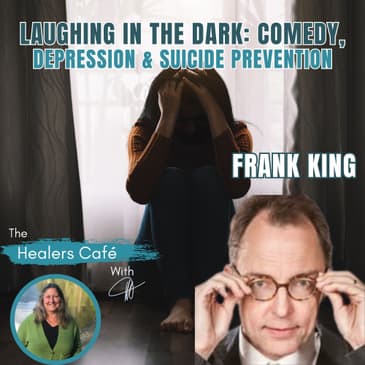
In this episode of The Healers Café, Manon Bolliger, speaks to Frank, who discussed his mental health struggles, including major depressive disorder and chronic suicidal ideation, and how humor helps him cope. Frank emphasized the importance of starting conversations about suicide, noting that one person dies by suicide every 40 seconds globally. He highlighted the need for empathy and intervention to prevent suicides, sharing stories of how his talks have helped individuals. Frank aims to save a life a day through his work.
For the transcript and full story go to: https://www.drmanonbolliger.com/frank-king
Highlights from today's episode include:
For some people, suicide is always an option their brain offers, even for small problems (e.g., car breaks down: "fix it / buy a new one / kill myself"). Naming it ("chronic suicidal ideation") helps people realize they're not freaks and not alone, which can be profoundly relieving and life-changing.
Suicide often results from a cascade of factors, like a car accident with many causes (nighttime, rain, slick road, etc.). A simple intervention—someone asking, "Are you okay?" or showing they care—can interrupt that cascade and literally save a life (e.g., Kevin Hines on the Golden Gate Bridge).
You highlight that in contexts like MAID in Canada, people are often met with serious validation of ending life but not always offered a gap—humor, caring connection, or alternative ways of seeing their situation.
ABOUT FRANK KING:
Frank King, Suicide Prevention Speaker, writer for The Tonight Show for 20 years, speaker and comedian for 39.
His speaking is informed by his lifetime of Depression and Suicidality and coming close enough to ending his life that he can tell you what the barrel of his gun tastes like.
Turning that long dark journey of the soul into 13 TEDx Talks, sharing his lifesaving insights with corporations, and associations.
He's shared the stage with comedians, Jeff Foxworthy, Adam Sandler, Jerry Seinfeld, Dr. Ken Jung, Ellen DeGeneres, Dennis Miller, and Bill Hicks, as well as entertainers, Lou Rawls, The Beach Boys, Randy Travis, and Nancy Wilson.
On top of all of that, he has survived 2 aortic valve replacements, a double bypass, a heart attack, and losing to a puppet on the original Star Search and has lived to joke about it all.
Core purpose/passion: To save a life a day.
– Facebook | Instagram | LinkedIn | mentalhealthcomedian.com | howtomakemoneyspeaking.com | Born to Be Funny YouTube | Mental With Benefits YouTube | A Matter of Laugh or Death YouTube | Suicide, The Secret of My Success YouTube | Dry Bar Comedy Special
ABOUT MANON BOLLIGER, RBHT, FCAH:
As a retired Naturopath 1992-2021, I saw an average of 150 patients per week and have helped people ranging from rural farmers in Nova Scotia to stressed out CEOs in Toronto to tri-athletes here in Vancouver.
My resolve to educate, empower and engage people to take charge of their own health is evident in my best-selling books: 'What Patients Don't Say if Doctors Don't Ask: The Mindful Patient-Doctor Relationship' and 'A Healer in Every Household: Simple Solutions for Stress'. and What if Your Body is Smarter than You Think? I am the Founder & CEO of The Bowen College Inc. which teaches BowenFirst™ Therapy and holds transformational workshops to achieve these goals.
So, when I share with you that LISTENing to Your body is a game changer in the healing process, I am speaking from expertise and direct experience".
Mission: A Healer in Every Household!
For more great information to go to her weekly blog: http://bowencollege.com/blog.
For tips on health & healing go to: https://www.drmanonbolliger.com/tips
Follow: Manon Bolliger website | Linktr.ee | Rumble | Gettr | Facebook | Instagram | YouTube | Twitter | LinkedIn |
Follow: Bowen College Inc. | Facebook | Instagram | LinkedIn | YouTube | Twitter | Rumble | Locals
ABOUT THE HEALERS CAFE:
Manon's show is the #1 show for medical practitioners and holistic healers to have heart to heart conversations about their day to day lives.
Subscribe and review on your favourite platform:
iTunes | Google Play | Spotify | Libsyn | iHeartRadio | Gaana | The Healers Cafe | Radio.com | Medioq | Audacy |
Follow The Healers Café on FB: https://www.facebook.com/thehealerscafe
Remember to subscribe if you like our videos. Click the bell if you want to be one of the first people notified of a new release.
* De-Registered, revoked & retired naturopathic physician after 30 years of practice in healthcare. Now resourceful & resolved to share with you all the tools to take care of your health & vitality!
00:00:00
Introduction: Welcome to the Healers Cafe, the #1 show for
00:00:04
medical practitioners and holistic healers to have heart
00:00:08
to heart conversations about their day to day lives while
00:00:13
sharing their expertise for improving your health and
00:00:17
wellness.
00:00:17
Manon Bolliger: Welcome to the Healers Cafe, and today I have
00:00:25
with me Frank King. He's done several TEDx talks, and just to
00:00:32
know what it's about, it's a suicide he's a suicide
00:00:36
prevention speaker and a comedian for 39 years. Now, you
00:00:44
know, how do those two fit together? I guess we're going to
00:00:47
find out. But I was, I was thinking, Oh, this, this will be
00:00:52
an interesting discussion. So thank you for accepting to have
00:00:57
this discussion, and why don't we just start what happened? Or
00:01:03
how did it start? Or how did you become a comedian? Or why did
00:01:07
you go into suicide prevention? Like, let's start wherever,
00:01:12
whichever part you feel like answering first
00:01:14
Frank King: Yes, therein lies a tail, as my mother would say in
00:01:19
fourth grade. And I feel very fortunate. This happened in
00:01:22
fourth grade. I told my first joke. The kids laughed. The
00:01:27
teacher was hysterical. She had to excuse herself to go to the
00:01:30
teacher's lounge. She was laughing so hard. And at that
00:01:33
moment, at nine years old, I thought, I'm going to be a stand
00:01:36
up comedian. And, wow, yeah, nine, you know, not a doctor,
00:01:41
firefighter, you know, comedian. And then 12th grade. I had taken
00:01:49
drama all three years of high school in the US. At the time,
00:01:52
high school was three years and and never got a speaking role in
00:01:56
any of the school plays. And I thought, well, there's a talent
00:02:01
show in the spring. If I do stand up, I can write, direct,
00:02:06
produce and star in my own show. I did, nobody ever done stand up
00:02:10
at the talent show, and I won. Of course, I beat the accordion
00:02:14
player and the folk dancer, so it wasn't a real tough victory.
00:02:17
But still, I told my mom, I'm going to LA to be a comedian.
00:02:21
She's, she was big on education, and she said, No, son, you're
00:02:25
going to be, you're going to college first. I don't care what
00:02:28
you do when you get done. Hell, you can be a goat herder for all
00:02:30
I care. But you're, you're going to be a goat herder with a
00:02:33
college degree. So I went to UNC Chapel Hill and got two college
00:02:38
degrees and then bolted for the West Coast, and on April Fool's
00:02:41
Day, not by accident, 8419 84 back in the 1900s I did my first
00:02:48
open mic, and halfway through my set, I heard a voice inside my
00:02:51
head say, simply, you're home. So at that moment, I decided I,
00:02:57
for real, was gonna do it for a living. Now I had no idea how
00:03:00
I've threatened to write a keynote since then, called, what
00:03:04
could you do if you didn't know no better? Because I had no idea
00:03:08
how hard it was. 18 months later, December of 84 I said to
00:03:13
my wife of 38 years, with my girlfriend at the time, I'm
00:03:16
going on the road be a comedian. You want to come along for the
00:03:20
ride, figuring she'd go, Oh, hell no. She goes, yeah. So we
00:03:24
gave up the apartment and our jobs, and when I gave up my job,
00:03:30
there's a guy named Bill who saw me and standing by the door as I
00:03:34
walked out, and he knew what I was up to. He knew I was going
00:03:36
to be a stand up comic, and he said, You'll be back. That was
00:03:40
39 years ago. I hope he's not waiting. So we went on the road
00:03:45
2629 nights in a row, non stop, seven years and
00:03:50
Manon Bolliger: change. Oh, my goodness.
00:03:54
Frank King: And worked with people who are famous now, Jim
00:03:57
Carrey, Canadian. There was Mike McDonald, sadly deceased, but
00:04:03
also Canadian, very funny. And Seinfeld, Jeff Foxworthy, Ellen
00:04:09
Rosie, Adam Sandler, Kevin James, Steve Harvey, back just
00:04:13
where they were comics and and then did a little radio back in
00:04:19
my hometown. I got hired to be a DJ morning show in the mid 90s,
00:04:22
they were hiring comics to be sidekicks, and that lasted 18
00:04:27
months, because there are two kinds of people in radio, ones
00:04:30
who've been fired, once you're going to be fired. So and my
00:04:34
boss said, after he fired me, and we're still friends, yeah, I
00:04:37
mean, the show never really jailed. So I don't I don't hold
00:04:40
it against him. He said, Go back on the road. Well, the comedy
00:04:43
boom invested. However, I was a clean act. So I thought, I'll do
00:04:46
corporate comedy. I'll do comedy at conventions, you know, the
00:04:49
rubber chicken circuit. So I did that. Until the last recession.
00:04:54
The world financial collapse in 2008 910, and I. We lost
00:05:00
everything in a chapter seven bankruptcy, and that's when I
00:05:02
learned what the barrel of my gun tasted like. Literally, the
00:05:06
audience should know. Spoiler alert, I did not pull the
00:05:09
trigger, which is the first laugh I get in my keynote. And I
00:05:13
go, it's okay to laugh. That was the point. They call it comic
00:05:15
relief for a reason. And last year, a friend of mine was at a
00:05:19
keynote and he thought he'd be funny. He came up afterwards. He
00:05:21
goes, Hey, man, how come he didn't pull the trigger? I said,
00:05:24
Hey, man, could you try to sound, I don't know, slightly
00:05:27
less disappointed. That's where the funny is in the topic. So
00:05:32
when conferences came back, 2011 ish meeting planner, more than
00:05:37
one meeting planner, speaker's bureau said to me, Frank, look,
00:05:39
we love you, but we can't pay you five grand just to be funny
00:05:43
anymore. You've got to teach the audience something. And I always
00:05:46
wanted to make a living in a difference. I always wanted to
00:05:49
teach. I just said, no, what have I got to teach? So a friend
00:05:52
of mine and listen up if you're an aspiring speaker. Friend of
00:05:57
mine, Judy Carter, wrote a book called The message of you turn
00:06:04
your life into a money making speaking career. She gave me a
00:06:07
copy. She said, Frank, look, you're smart. You read it,
00:06:11
you'll figure it out. And I went into it thinking I got nothing.
00:06:14
And halfway, she takes you by the hand to find your heart.
00:06:17
Story The one you can't help but tell, the one makes the hair on
00:06:20
the back of your neck, stand up. So she I got a cat here. What's
00:06:24
up? Come on, baby, we have six rescue kitty cats. Oh, so they
00:06:29
make you may see more than one before the This is Lily. Wow. So
00:06:36
halfway through the book, I do have something to talk about.
00:06:41
Judy led me right to it. I thought, you know, given my two
00:06:44
mental illnesses, near suicides, is that attempt suicide, loss,
00:06:49
survivor, more nuts in my family than in a squirrel turd, I could
00:06:54
speak on suicide prevention if I got some training I did, got a
00:06:59
couple certifications. And then my second thought was, now, wait
00:07:02
a minute, I've been doing comedy for two and a half decades. Who
00:07:06
in the world's going to take me seriously? So my wife said, do a
00:07:09
TEDx. And I said, What's a TEDx? I now have 13 of them, and I got
00:07:16
an application that week from a TEDx in Vancouver, British
00:07:20
Columbia, oh, my goodness, yes. Collingwood, something is a
00:07:25
neighborhood, yeah? In in Vancouver. Love the light rail,
00:07:30
by the way. Lord, yeah, yeah. Oregon is a lot like Canada,
00:07:36
only, more guns, worse health insurance. The they I
00:07:42
auditioned, and I got it. And then two other events called and
00:07:45
said, Do you have any more mental health topics? So that
00:07:47
was number two, number three, and I became a suicide
00:07:50
prevention speaker. And the the theme of my first TEDx, and the
00:07:57
theme of my speaking career is starting the conversation on
00:08:02
suicide. Because what I discovered when I was putting
00:08:05
the speech together was, even though one person dies by
00:08:08
suicide in the US, every nine minutes worldwide, every 40
00:08:12
seconds, hardly anybody talks about it unless you bring it up
00:08:15
and then, dear Lord, almost everybody has a story. So that's
00:08:18
how I got started as a suicide prevention speaker. And then, as
00:08:24
we say, in the US, I picked that lane to speak meeting planners,
00:08:27
like, like the expert or thought leader, you know, just speak on
00:08:30
one thing and do it really well. And then I thought, well, I'm
00:08:33
going to pick a handful of people who industries that have
00:08:36
a really bad problem, construction being number one.
00:08:39
So I picked the top 10 industries in the US and pretty
00:08:42
much around the world, choose that, and I just market to them.
00:08:47
I just booked one this week for a large electrical contracting
00:08:52
Association. They had seen me at another event in Phoenix for
00:08:57
another large electrical contract in construction, 1000
00:09:02
people last year died by accident. 5000 died by suicide.
00:09:06
Wow. Yeah, you're five times more likely to jump off the
00:09:09
building than fall off. So that's really I mean, that
00:09:12
they're leading the league. Sadly, that's how I and and
00:09:17
oftentimes I get booked. They want the teaching. They want,
00:09:20
the learning objectives. Teach them something they want, the
00:09:23
lived experience, which I've got plenty of, and the fact they can
00:09:26
do it with, you know, some funny personal anecdotes to kind of,
00:09:30
it's, it's tough topic, yeah, makes it more digestible, more
00:09:35
memorable. That's how I got to be the mental health comedian,
00:09:40
right?
00:09:41
Manon Bolliger: Well, I mean, humor is gives a little bit of
00:09:44
that gap, right? You're, you know, when? Mean, you may
00:09:49
actually be funny, but people who are bored, yes, but some
00:09:55
people aren't funny, you know, but if they use humor. It sort
00:10:00
of helps them separate themselves from really, the
00:10:04
actual pain they're in, right? Because you can say things, you
00:10:10
know, it's, it's almost like a distancing possibility, right?
00:10:14
Frank King: Yes, distance is often the key. There's a there's
00:10:17
a rule in Comedy, tragedy plus time equals Comedy,
00:10:23
Manon Bolliger: tragedy plus time. Okay?
00:10:25
Frank King: Comedy, yes. And the longer you do comedy, the
00:10:26
shorter the time. Queen. What's happening in the punch line? I'm
00:10:30
telling you, I had a heart had a heart attack. I've had health
00:10:35
problems all my life. Heart problems. I inherited a
00:10:39
cholesterol level from my mom of a deep fat fryer, and my dad had
00:10:44
a bad heart valve. And I inherited all that, and I had a
00:10:48
heart attack in the woods with the dogs. By myself. I had my
00:10:52
cellphone, but had T Mobile, so I didn't have service, and had
00:10:56
to drive. I'd walk half mile the car, drive two miles home and
00:10:59
take a 25 minute ride to the hospital. Comedian's job is to
00:11:03
make people comfortable. That's nice. That's why I struggle with
00:11:08
sales. Because in sales, you have to make somebody
00:11:11
uncomfortable where they are and then show them how your product
00:11:13
will restore the comfort Exactly. Yeah, I just I make
00:11:17
them feel uncomfortable. I just wait. I'm in the memo. Here's a
00:11:21
tip, by the way, if you arrive at the hospital with with a
00:11:23
heart attack symptoms, no waiting. I've told you. I told
00:11:28
you, look, if you break your nose and you go to the emergency
00:11:31
room, there's a long line. When they ask you what's wrong, you
00:11:34
say this, I broke my nose and I think I'm having a heart attack.
00:11:38
No waiting. So I'm back in my little triage unit with a nurse,
00:11:41
and you could tell she's nervous, because I'm a rather
00:11:44
large heart attack. I wanted to, I wanted to be comfortable. So
00:11:48
she said, Frank, no paperwork, but I have to ask you a personal
00:11:51
question. And I said, through my pain, honey, I'm married, but I
00:11:56
love the way you think she's laughing. She goes, No, no, no,
00:12:01
no, no. Your full name is Frank Marshall King the third. But
00:12:04
what do you like to be called through the pain? I said, Big
00:12:09
Daddy. So to this day, 14 years later, 15 years later, when I go
00:12:14
back to Oregon, heart and vascular and see somebody for
00:12:17
that morning. Hey, Big Daddy. So, but I just wanted to make
00:12:21
her now I'm literally having a heart attack and writing comedy
00:12:24
at the same time. Yeah, yeah. I thought to myself, I'm having a
00:12:28
good show. My second thought was, well, I better. This one
00:12:30
may be my last. Again, writing comedy, having a heart attack.
00:12:38
Manon Bolliger: Well, well, I mean, it's really like a passion
00:12:41
lived in the way you perceive life, right? Yes, it's, it's
00:12:46
everything can be seen with a sense of humor.
00:12:51
Frank King: Yeah, I've, I've people that made Tell me about
00:12:54
yourself, like, Oh, I'm a comedian. And they go, no, no,
00:12:56
not what you do, who you are. Well, redundant every fiber of
00:13:00
my being. I can teach you to write comedy. I can teach you
00:13:02
just to perform it. I cannot teach you to process the
00:13:05
incoming information the way my brain does. It's just unbelief
00:13:09
that my imagination, comedic ability and so forth is simply
00:13:15
the flip side of my depression and thoughts of suicide. Same
00:13:18
brain, same wiring, right? How could it be any, any other way?
00:13:22
Manon Bolliger: Yeah, well, I was going to ask you that,
00:13:24
because it's, it is the flip side, if you look at it, if you
00:13:28
see the world, you know, from a depressive perspective, or Doom,
00:13:35
or suicidal, or this my last day, it is the flip side of that
00:13:41
humor that takes any potential tragedy and just makes it
00:13:46
lighter, right? It really is the same brain. It's it feels like
00:13:51
to me, at least. I mean, I don't know, I don't have that much
00:13:54
experience with suicidal people in my clinic or when I was in
00:13:58
clinic, but I certainly know of many people who that's the way
00:14:05
they went, you know, yes, yeah. And it's, it's interesting, it's
00:14:11
like, but you're living it in a comedy, and because you're
00:14:18
teaching it is that the what drives you forward that you
00:14:25
haven't committed suicide at this stage?
00:14:28
Frank King: Well, yeah, when I speak, I have two mental
00:14:33
illnesses. One is called major depressive disorder, and the
00:14:35
other is chronic suicidal intensity, ideation or
00:14:40
intensity, yeah, and every time I speak, I talk about chronic
00:14:44
suicidal ideation, and I've met therapists of 20 years who when
00:14:50
I say chronic suicidal ideation, they stare at me like a pig
00:14:52
staring at a wristwatch. They have no idea what I'm talking
00:14:56
about, because it's not the DSM five. So. So I tell the story of
00:15:02
my chronic suicidal ideation. I say to the audience, look,
00:15:05
here's what, here's what it's like for me and my tribe.
00:15:09
Suicide is always an option on the menu as a solution for
00:15:12
problems large and small, and when I say small. Couple years
00:15:15
ago, my car broke down, I had three thoughts unbidden. One,
00:15:18
get a fixed. Two, buy a new and three, I could just kill myself.
00:15:21
Commercial Break: What would your life be like if you were
00:15:24
pain free? If you were one of the millions who suffer from
00:15:27
chronic pain, the thought of just one day without it may seem
00:15:32
impossible. This is often because conventional medicine
00:15:35
tends to fall short in the treatment of pain, opting to
00:15:39
prescribe pills or recommend surgery rather than getting to
00:15:42
the root cause of the problem. But if you are suffering with
00:15:46
emotional or physical pain, there is hope. Join the founder
00:15:51
and CEO of Bowen College, Manon Bolliger, live online for your
00:15:56
body mind reboot. Learn how to listen to your symptoms and get
00:16:01
to the root cause of your pain, plus be trained in basic Bowen
00:16:06
therapy moves so that you can reboot your body for optimal
00:16:10
health. You don't have to live in pain. You can heal, stop the
00:16:15
pain pill cycle by visiting www.yourbodymindreboot.com to
00:16:22
learn more and to register.
00:16:32
Frank King: I know it sounds weird, but and then, almost
00:16:35
every time I've spoken, there's been somebody in the audience
00:16:38
who has chronic suicidal ideation. They have no idea it
00:16:41
has a name. They think they're just some kind of freak and all
00:16:44
alone. I've had more more. I've had a number of people come up
00:16:48
with me crying, crying so hard they couldn't speak. I was at a
00:16:51
dental convention. A dentist came. Everybody's leaving the
00:16:53
room except this dentist woman walking toward me, and I can see
00:16:56
she's crying, and she gets to me, she's crying so hard she
00:16:58
can't speak. So I said, you have chronic suicidal ideation. She
00:17:02
nodded, yes. You didn't know it had a name. Nod yes. You thought
00:17:07
you're just a freak. Yes. I said, Well, when you get back
00:17:10
home, do you have a therapist? Nod, yes. Tell them everything
00:17:13
you learned today, and for goodness sakes, tell them you
00:17:15
Googled it. Don't tell them you learned it from a comedian. I
00:17:19
got an email a week later, Frank, I think I was at that
00:17:21
dental conference, in large part simply to meet you. You've
00:17:24
changed my life. And I can't say that about a lot of people, and
00:17:28
that happened over and over and over. And one time I was in
00:17:32
Montana, University of Montana, Billings finished the show,
00:17:37
standing outside, it's winter time, waiting for the young man
00:17:41
to come with his truck take me to the hotel. And So picture
00:17:43
this, it's winter, it's dusk, starting to snow, and there's a
00:17:47
river nearby, dusk, snow river. And I thought to myself, Oh
00:17:52
Lord, I am George Bailey, and it's a wonderful life. I've been
00:17:57
showing these people's lives we like, if I weren't there simply
00:18:00
to tell my story and listen to theirs and it I can't kill
00:18:04
myself. Otherwise, I'd take a lot of those people with me. So
00:18:07
I'm stuck. I can't, I can't, I can't. Friend of mine said, You
00:18:12
can't live with that. I go, No, you missed the point. I can't
00:18:15
die with that, right? Knowing that I could have helped
00:18:17
somebody, it's very therapeutic. My goal is to save a life a day,
00:18:22
right, right? And every now and then I hear back. I did a
00:18:25
military base in the US, Fort Irwin and outside of Barstow,
00:18:29
California, they did a survey anonymous, 30% of the soldiers
00:18:33
said in the last year they thought about suicide. So they
00:18:35
brought me in, and I met base psychologist, did his podcast,
00:18:40
and a couple of months later, I got a phone call from him. He
00:18:44
said, Frank, I had a soldier walk into my office this morning
00:18:47
and flat out say to me, I'm depressed and suicidal, and I'm
00:18:50
here because Frank King said I had to tell somebody. Boom,
00:18:56
yeah, it choked me up just to tell the story. But that's,
00:18:59
that's what's in it. For me, that's the ROI very therapeutic
00:19:04
for me, knowing that you can make kind of difference.
00:19:08
Manon Bolliger: And what do you feel? Because it's bound to be a
00:19:12
different understanding than what psychiatrists or
00:19:17
psychologists might believe to be the case. But what do you
00:19:21
think makes the difference for a person who has either suicidal
00:19:26
ideation, or, you know, feels like on the verge or they're
00:19:32
considering it
00:19:33
Frank King: makes a difference how, in
00:19:35
Manon Bolliger: their in their decision to to stay. What? What
00:19:41
do you think that the switch is? Because it feels like a switch,
00:19:45
almost, yes.
00:19:47
Frank King: Well, when someone decides to in their life,
00:19:51
oftentimes it happens within an hour, sometimes within 10
00:19:54
minutes. Now, if they survive, the chances of them attempting
00:19:58
again are very low. My depression is not situational.
00:20:02
I've been most depressed some of the best times in my life. And
00:20:06
my depression isn't actually connected the two, two
00:20:09
illnesses, not actually connected the depression and the
00:20:12
chronic suicidal because I've had, I've had suicidal ideations
00:20:16
when I wasn't depressed, right? And I met somebody, a woman, she
00:20:20
goes, could I just have, just have the chronic suicidal
00:20:23
aviation I don't think I've got depression. I go, my you may be
00:20:28
right. The it's, it's a sense of hopelessness. My depression is
00:20:36
hopelessness. And I think it's, it's that why bother for young
00:20:42
people? Because they tend to think in the immediate right not
00:20:45
gonna be better than this. And I don't think it is. Then why
00:20:47
bother? And they in their lives, if you can interrupt it's like
00:20:53
I'm a co author on four books on men's mental health, and we use
00:20:57
the automobile as a metaphor. Automobile accidents aren't
00:21:01
generally the result of one thing. It's not just because the
00:21:06
road was slick, it's not because just because it was nighttime.
00:21:10
It's not because it's raining hard and it's cut your
00:21:13
visibility. It's those things in a cascade. If you interrupt that
00:21:17
cascade, if all sudden it clears up and you can see clearly, even
00:21:22
though the road's slick and it's night time, then you may not
00:21:25
have the accident. So I think suicides are oftentimes a
00:21:29
cascade of things, and if you can interrupt that, and anybody
00:21:33
can, you don't have to be a mental health professional.
00:21:35
That's what I tell my audience. Look, the good news is you can
00:21:37
make a difference. You can save a life, and you can do it by
00:21:40
doing something as simple as what we're doing right here. You
00:21:42
doing right here, and that is having a conversation, if you
00:21:45
know how. And before we leave, you will know how. So it's,
00:21:49
it's, yeah, I think if the if you can interrupt that cascade,
00:21:55
whether simply by saying to somebody, are you okay, there's
00:21:59
a, there's a guy named Kevin Hines, one of the few survivors
00:22:04
of jumping off the Golden Gate Bridge. And he bipolar disorder,
00:22:11
I believe, hears voices, and they told him to kill himself.
00:22:14
He's in the Bay Area, San Francisco. Well, how do I kill
00:22:17
myself in the Bay Area? Well, helpfully, Google has the answer
00:22:24
gave Melissa bridges, and so he found the one that was closes
00:22:29
Golden Gate, and he went out and got on a bus, and he said to
00:22:33
himself, if anybody asked me how I'm doing anybody I will tell
00:22:38
him I am suicidal. Please call the police. I'm going to harm
00:22:41
myself. Nobody on the bus ride. So he goes on to the bridge,
00:22:46
walks out. He's looking over the railing. Tap on his shoulder. It
00:22:50
was a woman. She goes, Excuse me. He thinks, thank God. She
00:22:54
goes. We're visiting from Germany. Would you take our
00:22:56
picture? No, being a gentleman, he took their picture, handed
00:23:01
back the phone. As soon as they turned their backs over the
00:23:05
rail, he went. But if somebody, anybody, just simply said to
00:23:09
him, are you okay? It's that easy to interrupt that cascade
00:23:15
and perhaps stop, you know, stop a suicide.
00:23:20
Manon Bolliger: Yeah, it's really putting that gap in, in,
00:23:24
like, almost a train of consciousness, which isn't fully
00:23:28
conscious, but it's like just one moment of another human
00:23:34
being caring or noticing, or, you know, it's a, yeah, no. It's
00:23:40
a very good point. And I think with humor, it's easier to get
00:23:46
through than even very seriously, you know? I mean, if
00:23:52
you're with the guy on the bridge, I guess humor might not
00:23:55
be the right thing, or it could be, depends on the on the
00:23:58
energy, right? But, but it's the caring of, you know, yes,
00:24:04
reaching out
00:24:06
Frank King: and humor, I think, in the right the the during the
00:24:09
recession, I needed a job, a good job with benefits, and I
00:24:13
always wanted to be a police officer, so I applied with 12
00:24:16
departments instead of Washington taking no chances.
00:24:19
And they had several oral boards, but they said to me,
00:24:21
what's the connection between comedians and police? I said,
00:24:25
Well, we are both paid observers. We notice things
00:24:29
other people don't. I mean, they see it, but they don't take
00:24:32
note. Secondly, when you step on stage, you have to read the
00:24:36
crowd. When you're in a squad car and you pull up on an
00:24:40
intersection where people are milling about. Got to read the
00:24:44
crowd. You got to take the temperature, and you got to
00:24:46
figure out, you know, maybe, who's, you know, who's in charge
00:24:49
of all these people and I, and with, with comedy and with the
00:24:53
situation at an intersection, the first thing you say can
00:24:56
either escalate the situation or deescalate the situation.
00:25:00
Comedians can think that fast. They can say something that
00:25:04
would de escalate. I was at a gate at the airport and the
00:25:09
planes delayed mechanical. So everybody around me is grumpy.
00:25:13
You know, they may miss a meeting, miss a wedding, who
00:25:16
knows, but they're grumpy now I'm standing on our television
00:25:20
set above me, CNN is on, and you can hear it all over the gate
00:25:24
area. The guy standing next to me, because I'm waiting for my
00:25:28
opportunity to break the, you know, to break the tension. The
00:25:32
guy next to me goes, how do we get this TV turned to Fox News
00:25:35
in a loud voice so everybody heard so I thought that's the
00:25:38
opening I was waiting for. I said, Well, you kill me first,
00:25:44
the place explodes. Everybody's laughing. They're still happy.
00:25:50
They're not going anywhere. But it broke attention. Just one
00:25:53
sentence, yeah, the entire group of people that were there, and
00:25:56
that's, that's if you can break that, you know, and there's a
00:26:00
new protocol, stop drop and roll, like the protocol for if
00:26:05
you catch fire, you stop
00:26:08
moving right drop.
00:26:10
And the idea is that if you're in that storm, if you're you're,
00:26:15
you're that cafe, you stop and pause. And you want to train
00:26:21
yourself to a, not make any serious decisions at that
00:26:26
moment. B, if you can give yourself a day, 24 hours, and
00:26:31
then you know if you're going to proceed, proceed then. But get,
00:26:35
you know, give yourself some space to, you know, say Not, not
00:26:39
like I said, if somebody decides, oftentimes, it's within
00:26:42
an hour, sometimes 10 minutes. I've had a friend, sadly, who
00:26:48
was a cruise director and the boat docks, one of the pastors,
00:26:54
who was, you know, a big time cruiser, lots of points in
00:26:59
whatever their, you know, their club was complained. Cruise
00:27:03
Lines are famous for this. They fired him unceremoniously. No,
00:27:08
let's see what you think. Let's hear what they think. Let's you
00:27:11
know, just boom, you're fired. And I've known him for 10 years.
00:27:16
I mean, he knew what I did for a living, so I'm sure he had, had
00:27:20
he been lived with depression? I probably wouldn't know it. He
00:27:23
was staying on the 10th floor of a building in Miami, and he went
00:27:27
over the railing, and, you know, 10 stories. And I imagine it was
00:27:32
the only way. There was no other means for him at that moment
00:27:35
than going over there. I think, had he paused? And, you know,
00:27:42
tried to get a good night's sleep and then make that
00:27:45
decision in the morning. That is a funny story. I met a guy who's
00:27:49
living in New York City, and he was going to go jump off a
00:27:52
bridge in New York City. He's really depressed. He was out,
00:27:55
and he's on his way out the door practically, and he hears behind
00:27:59
him Monday Night Football. The Jets are playing. So he goes,
00:28:04
Well, the bridge is going to be there tomorrow. I'm going to go
00:28:07
watch the Jets game, right? That was enough the next day. You
00:28:13
know, the thought had passed and is going to be there tomorrow.
00:28:17
What's the rush? Well, and a minor funny story. I was in the
00:28:21
woods with the dogs post heart attack, and I'm 68 years old at
00:28:26
time. That's last year, and I was thinking about suicide, not
00:28:29
the act, but just the, you know, the topic. And I stopped, and I
00:28:34
went, Wait a minute. I'm 68 years old. Why rush it? How much
00:28:39
time have I got left? Anyway, if I'm 38 okay, we can talk about
00:28:43
it. If I'm starting another 40 years, okay, let's chat about
00:28:46
it. But 68 What's the hurry?
00:28:51
Manon Bolliger: You know, I know when we've our time is almost
00:28:55
up, but I just wanted to say right before we started, you
00:28:58
know, I brought up this maids thing in Canada, right?
00:29:01
Medically assisted aids and or deaths. Actually, that's what it
00:29:06
is and how. You know, currently, there's more and more
00:29:11
legislations making it easier for teenagers without the
00:29:17
consent of their parents, for depressed people, for people who
00:29:22
can't economically figure out how to survive in this, you
00:29:27
know, difficult at these difficult times. And I was
00:29:31
thinking, you know, the whole intention or the what happens in
00:29:39
those times is, it's all taken very seriously, but there's no
00:29:45
gap. There's no like, you know, I'm thinking how easy it is to
00:29:50
just believe your thoughts, if you have the type of empathy
00:29:56
that says, you know, well, you can end it rather. Than the type
00:30:00
of empathy that says you know, like or that brings up a hockey
00:30:05
game or something that you know want to miss, right, like you
00:30:09
know. And I was just thinking it might be an incredible topic for
00:30:13
Canadians, if you ever come you know, or want to do a talk here,
00:30:19
because it has, you know, been it's a very hot topic here,
00:30:24
because a lot of people have ended their lives that just
00:30:29
didn't have another option presented to them. And then
00:30:34
there's people who have been suffering and are old enough,
00:30:39
they're in their 80s, 90s, whatever, and they've
00:30:41
chronically suffered, and they really have had enough of this.
00:30:46
So I think there's, you know, there's, it's not a there's a
00:30:48
lot of gray zone, but it's, it's reaching populations that I
00:30:53
think could really use a totally different solution. Before
00:30:59
considering this, as
00:31:00
Frank King: we talked about in Oregon, you know Right to Die
00:31:02
death with dignity. You have to be you have to have only a
00:31:04
certain amount of time left. A psychiatrist signs off, a
00:31:07
physician signs off. And what they discovered was that, if
00:31:10
given the control the person who is going to end up dying by
00:31:15
suicide, they live longer and better knowing they have the
00:31:20
option and and, you know, chronic suicidal ideation, I
00:31:24
have a friend who has it, and he said to me, Frank, if it weren't
00:31:27
for my chronic suicidal ideation, the fact I'm willing
00:31:29
to kill myself at any moment, I probably would have killed
00:31:32
myself a long time ago, right? Because, yeah, I'm a mortician
00:31:36
friend who says I always try to take suicide off the table. I
00:31:39
go, No, no, don't take it on the table. Just move aside. Don't,
00:31:41
don't cut off their only exit. Yeah, you might end up, you
00:31:45
know, so, yeah,
00:31:47
Manon Bolliger: but I think it's getting to the bottom of what is
00:31:50
the education that is training these people to perform this
00:31:57
work. I think that's what has to be revisited, at least here, you
00:32:01
know, because I agree. Keep it on the side. I think it's if
00:32:07
you, if you anything, you say you can't have, people are going
00:32:11
to want,
00:32:12
Frank King: yeah, absolutely forbidden food. Exactly well.
00:32:16
And in the 20s, let's say, in the US, they went from a model
00:32:20
of psychology psychiatry, where they would try to figure out
00:32:24
what was causing all this, and then they went to a medical
00:32:29
model where it was more of them treat them with psychotropics.
00:32:34
And then when insurance got involved, you have to have a
00:32:36
diagnosis, which comes with a code, otherwise the practitioner
00:32:41
doesn't get paid, and so, for example, with ADD and ADHD, the
00:32:47
symptoms are very similar to children who have suffered
00:32:50
trauma, and they may not have ADD ADHD. They may be suffering
00:32:55
from childhood trauma, so it's but you know, you're not going
00:32:59
to find that out. It's easier just to give them a prescription
00:33:02
for Ritalin than it is to dig deep and figure out what's wrong
00:33:05
with the child Exactly.
00:33:09
Manon Bolliger: Anyway, our time is up, and I just want to leave
00:33:12
you the last words. And yeah, thank you so much for sharing
00:33:16
your wealth of knowledge and inspiration.
00:33:19
Frank King: Well, let's leave it on a funny note. Here's how a
00:33:23
comedian would close out a podcast. You Ready?
00:33:26
Manon Bolliger: Ready?
00:33:26
Frank King: If you enjoyed this podcast, please subscribe, rate
00:33:31
and review and tell your friends if you did enjoy this podcast.
00:33:35
Well, we hope you have no friends.
00:33:41
Manon Bolliger: All right, thank you.
00:33:43
Frank King: You are welcome. Thank you.
00:33:45
Ending: Thank you for joining us at the Healers Cafe. If you
00:33:48
haven't already done so, please like comment and subscribe with
00:33:53
notifications on as I post a new podcast every Wednesday with
00:33:59
tons of useful information and tips for natural healing that
00:34:03
you won't want to miss.