
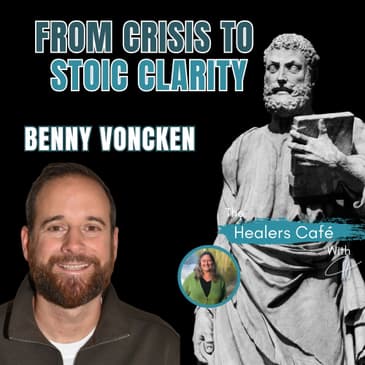
In this episode of The Healers Cafe, Manon speaks with Benny Voncken, a stoic coach and co-founder of VIA Stoica, discusses his journey and philosophy of life based on stoicism. Benny emphasizes the importance of finding one's philosophy of life, the dichotomy of control, and the virtues of wisdom, justice, temperance, and courage.
For the transcript and full story go to: https://www.drmanonbolliger.com/benny-voncken
Highlights from today's episode include:
Stoicism helped him stop seeing himself as a victim during divorce, injury, and burnout, and realize he has agency to change his life.
The true goal of Stoicism is eudaimonia (a good, balanced inner state) through virtue—wisdom, justice, temperance, and courage—not emotional suppression.\
She highlights a loss of courage and social responsibility, noting how people often look away instead of acting, reflecting a weakened moral compass in society.
ABOUT BENNY VONCKEN:My name is Benny Voncken. I'm the co-founder of Via Stoica and the Via Stoica Podcast. We offer Stoic life coaching, corporate training, motivational speaking, and workshops. Our mission is to help people live better lives through the creation and application of a philosophy of Life, mainly based on Stoicism.
I'm from the Netherlands and have lived abroad for over 15 years. After teaching for almost 12 years, I focused on Stoicism and coaching to improve my life and to help as many people discover who they are and find their path and purpose in life.
Core purpose/passion: My mission is not to turn others into Stoics, but to inspire them to explore and develop their own philosophy of life as a guiding compass to start improving and becoming better people.
Website | Facebook | Instagram | LinkedIn | Twitter | YouTube
ABOUT MANON BOLLIGER, RBHT, FCAH:
As a retired Naturopath 1992-2021, I saw an average of 150 patients per week and have helped people ranging from rural farmers in Nova Scotia to stressed out CEOs in Toronto to tri-athletes here in Vancouver.
My resolve to educate, empower and engage people to take charge of their own health is evident in my best-selling books: 'What Patients Don't Say if Doctors Don't Ask: The Mindful Patient-Doctor Relationship' and 'A Healer in Every Household: Simple Solutions for Stress'. and What if Your Body is Smarter than You Think? I am the Founder & CEO of The Bowen College Inc. which teaches BowenFirst™ Therapy and holds transformational workshops to achieve these goals.
So, when I share with you that LISTENing to Your body is a game changer in the healing process, I am speaking from expertise and direct experience".
Mission: A Healer in Every Household!
For more great information to go to her weekly blog: http://bowencollege.com/blog.
For tips on health & healing go to: https://www.drmanonbolliger.com/tips
Follow: Manon Bolliger website | Linktr.ee | Rumble | Gettr | Facebook | Instagram | YouTube | Twitter | LinkedIn |
Follow: Bowen College Inc. | Facebook | Instagram | LinkedIn | YouTube | Twitter | Rumble | Locals
ABOUT THE HEALERS CAFE:
Manon's show is the #1 show for medical practitioners and holistic healers to have heart to heart conversations about their day to day lives.
Subscribe and review on your favourite platform:
iTunes | Google Play | Spotify | Libsyn | iHeartRadio | Gaana | The Healers Cafe | Radio.com | Medioq | Audacy |
Follow The Healers Café on FB: https://www.facebook.com/thehealerscafe
Remember to subscribe if you like our videos. Click the bell if you want to be one of the first people notified of a new release.
* De-Registered, revoked & retired naturopathic physician after 30 years of practice in healthcare. Now resourceful & resolved to share with you all the tools to take care of your health & vitality!
00:00:00
Introduction: Welcome to the Healers Cafe, the #1 show for
00:00:04
medical practitioners and holistic healers to have heart
00:00:08
to heart conversations about their day to day lives while
00:00:13
sharing their expertise for improving your health and
00:00:17
wellness.
00:00:17
Manon Bolliger: Welcome to the Healers Cafe, and today I have
00:00:23
with me Benny von Ken and he calls himself a stoic coach. Now
00:00:30
we're going to find out what exactly that means very shortly.
00:00:34
But he is co founder via Stoica and the via Stoica podcast. He
00:00:42
also offers stoic life coaching, corporate training, motivational
00:00:47
speaking and workshops, and his mission is to help people live
00:00:54
better lives through the creation and application of a
00:00:58
philosophy of life, mainly based on stoicism. So all right, let's
00:01:05
go. Let's tell us more about what this is, and are we basing
00:01:13
ourselves on philosophers or welcome anyways. And let's tell
00:01:20
a little bit more about which what it is you do.
00:01:23
Benny Voncken: Yeah, well, at first, Thank for having me on. I
00:01:25
really appreciate it. And because this is, as I said, as
00:01:28
you mentioned, it's one of my missions to kind of help inspire
00:01:31
people find their philosophy of life. And I use stoicism is my
00:01:36
philosophy of life, at least, I try to live Best I Can according
00:01:41
to the philosophy, but I'm not, as, you know, as we get into
00:01:44
stoic coaching later on. It's not my goal to turn people into
00:01:47
Stoics, but really to help them find their philosophy of life
00:01:50
and how they live and know themselves more throughout that
00:01:54
that vehicle. But for me, that's, that's, you know, stoic
00:01:58
philosophy really spoke to me, and that's why I've really tried
00:02:01
to live my life according to it, but it is difficult. You know,
00:02:04
it is a stern and not always easy philosophy to live by, but
00:02:10
that's life, right? And we just have to focus on the process,
00:02:13
and that's what I help people with as well.
00:02:16
Ending: Okay? And you came across stoic philosophy in one
00:02:22
of your personal turnarounds, correct?
00:02:25
Benny Voncken: Yeah, exactly. Yeah. And this is when I'm when
00:02:28
I meet most people about when, you know, when they go to stuff,
00:02:31
it's not usually when they are on the top of the mountain
00:02:33
screaming like, Oh, I've made it. It's usually when you when
00:02:36
you meet some obstacles. And for me, like, now, looking back at
00:02:40
it, that was actually one of the best moments in my life. At the
00:02:43
moment itself, it's really difficult and tough, but now I
00:02:46
noticed that that's when I really found myself and and as I
00:02:49
was reading more books, and I started, you know, I diagnosed
00:02:52
myself with an existential crisis, so I picked up a book on
00:02:55
on existentialism, and the Stoics game came, you know about
00:02:59
in that book, and that's where I found myself on paper. And the
00:03:03
more I started reading, I started it just connected with
00:03:06
me. And I think that that's like, if you are looking for a
00:03:08
philosophy of life, that's the real big sign is like, Oh, this.
00:03:12
This really resonates. The words they use, the methods, the way
00:03:17
they look at life. And that's what stoicism really did to me.
00:03:21
Ending: Okay, well, why don't we, or maybe I ask you to make
00:03:26
it relevant in the sense of give us a little bit of what you were
00:03:30
going through and how the stoic philosophy related to how it
00:03:36
helped you get through it.
00:03:38
Benny Voncken: Basically, yeah, that's a great moment to start.
00:03:41
And for me, it was, I was working as a teacher in Dubai at
00:03:44
that moment, and teaching in Dubai isn't the easiest place to
00:03:48
teach. So that was like big pressure, and it was just
00:03:51
difficult mentally. But on top of that, I went through a
00:03:54
divorce. My, you know, the marriage fell apart. I had a
00:03:59
pretty severe knee injury. And then after, you know, the
00:04:02
divorce, all of that, I started drinking again pretty heavily,
00:04:06
and that was really the moment when I started to tell myself,
00:04:09
like, this is not how I'm going to live my life. When I woke up
00:04:12
one morning, hung over, feeling really bad, physically, but
00:04:15
especially mentally, kind of depressed, and I looked at the
00:04:18
mirrors like, this is not this is not going to be me. This is,
00:04:21
I've got to make some changes, and I've got to be I saw a set
00:04:24
some rules for myself, not just like to try and live healthy
00:04:27
physically, but, you know, with food, but also mentally. And
00:04:30
that's when I started taking those steps and and one of you
00:04:33
know, as I started looking into philosophy, it really helped me
00:04:36
to com, compartmentalize the things that are happening to me
00:04:40
and how I reacted to it. And one of the major steps was it that I
00:04:45
stopped looking at myself as a victim and saying, like, Okay, I
00:04:48
have agency here. I can actually improve my life from this if I
00:04:53
use it the right way.
00:04:57
Ending: Okay, so that would be one of the 10. Tenants of the
00:05:00
philosophy is that you have agency, yeah?
00:05:05
Benny Voncken: And that's, and that's a really nice thing to
00:05:07
see once you realize that, that you actually can, can do
00:05:10
something in the with the world, right?
00:05:13
Ending: Like, a bit like, it's not happening to me, it's
00:05:16
happening for me, yeah, which we can look at later, usually not
00:05:22
in the moment. It's like, no way. Okay, so, so what other
00:05:29
tenants of stoicism Did you relate to? So that was one of
00:05:35
them. What's another example of
00:05:40
Benny Voncken: what so a big, so a big one is the dichotomy of
00:05:43
control. This is what usually people like, when they start,
00:05:45
like, start to talk about stoic philosophies, like, Okay, what's
00:05:48
about? And it's mainly, mainly to start about what's in your
00:05:52
control and what isn't. And again, that was something really
00:05:55
important, that instead of looking outward and trying to
00:05:58
change what was happening to me, I really had to learn to accept
00:06:01
it. So there's this kind of like radical acceptance. But
00:06:04
Nietzsche coined a new phrase that the Stoics, the modern
00:06:07
Stoics, have used. It's called amarfati, to really learn to
00:06:10
love and embrace your faith. And even someone like Seneca, one of
00:06:15
the most famous stoic writers that at least the texts have
00:06:18
survived from a Roman stoic, he said, you know, you're
00:06:21
unfortunate if you never been unfortunate, because you've
00:06:23
never had the opportunity to show yourself and the rest of
00:06:27
the world what you're capable of. And those kind of things
00:06:30
they showed me, okay, I can, I can do this, but let me focus on
00:06:33
what I need to control. And one of the things, for example, was
00:06:36
dealing with criticism and dealing with how other people
00:06:39
look at me, and realizing that that's just their words, that's
00:06:42
just their opinions, and I can make it affect me if I choose
00:06:46
to, or I can say, let's see what's what? Is there any truth
00:06:49
behind it? Let's see if there's actually something that can help
00:06:52
me. And if not, then I should just learn to let it go. It's
00:06:55
again. You know, it's easier to explain this, but doing it is
00:06:58
difficult. It takes practice, but I've seen throughout the
00:07:01
years, like my anxiety levels and my worries have really
00:07:04
diminished, have really reduced a lot just by practicing it and
00:07:09
just trying to apply it on a
00:07:10
Ending: daily basis. So it's like taking ownership of what is
00:07:14
yours and not what isn't. You know so, and I think, you know,
00:07:19
a lot of people have this issue of not liking what's going on,
00:07:24
right? And then it's like, well, what of what's not going on? Do
00:07:29
you have direct access and control? And if you don't, then
00:07:35
what can you do about your relationship to it? Right? Yeah,
00:07:41
you know, I think, I think that's a, it's a, it's a very
00:07:44
big turning point for a lot of people when they they work. So
00:07:48
for you, it was like, what people think of you, which is a
00:07:51
common one, right? It's like, Are you the tinfoil Hatter? Are
00:07:55
you the oddball? Are you you know, whatever, whatever, like,
00:08:00
you know, but you're gonna, you're gonna make different
00:08:02
decisions because they are coming. They're, they're really
00:08:06
about you and those you control, right?
00:08:11
Benny Voncken: Yeah, and that's one of the key points in stoic
00:08:14
philosophy and some kind of, you know, there's a lot of
00:08:17
misconceptions about it. And the modern view, you have this
00:08:20
broicism, especially in the manosphere, where it just means
00:08:23
like to man up and have that stiff upper lip, right? The
00:08:26
stoics really had like, the goal of this of a stoic life is
00:08:31
called eudaimonia, and I roughly translate it as the good spirit
00:08:35
state. So they really focusing on preserving your character and
00:08:40
your soul in the best possible way. That's really what the
00:08:43
stoics are after, and they do that by, you know, being
00:08:45
virtuous. They say virtue is the only good and to live in
00:08:48
accordance with nature by using your reason and logic. That's
00:08:51
kind of like stoicism, in a nutshell. But oftentimes people
00:08:55
forget about that goal, that it's like, oh, you need to be
00:08:58
emotionless. You need to not have all these things affect
00:09:01
you, but it's really about things happen to you, and how
00:09:04
can you then act in the best morally right way to preserve
00:09:08
your character? And that's really what it's about, to make
00:09:11
sure that when you die, like they say, to give your character
00:09:13
in the best possible way back to the to the logos, to the
00:09:16
universe. So it kind of resembles a little bit to like
00:09:20
Buddhism, but more like in a pragmatic, pragmatic, down to
00:09:24
earth way, at least, that's how I view it.
00:09:27
Ending: Now, that's interesting. I had not seen it that way. And
00:09:30
yes, the bias of stoic has that idea that you're not going to
00:09:35
deal with emotions and you're going to, you know, do the
00:09:38
English thing, put it under the carpet or, you know, and then
00:09:42
stand proudly on top of it without noticing what's
00:09:45
happening, right? And I think we have a huge false stoicism as a
00:09:54
kind of cultural bias, you know, especially in the male culture.
00:10:00
You know, I mean females too, but they tend to eventually
00:10:04
talk,
00:10:07
Benny Voncken: and it's and it's interesting, like in my journey,
00:10:09
I've seen so many more women reach out and talk about it, and
00:10:13
also feel like connected with a philosophy like this, and that
00:10:17
helped me also kind of reshape my view. And it because, at the
00:10:20
beginning, you speak to a lot. It's mainly male dominated, but
00:10:23
more and more women start to identify with with this as well.
00:10:27
And it, it's really refreshing.
00:10:30
Ending: So, so, so there's, I'm just trying to really get a
00:10:36
handle of the third component. Okay, so the third component of
00:10:39
this is when you use the word virtue, it's more like your
00:10:44
value system. It's like how it's not about virtuous it's really
00:10:52
about knowing what you stand for, being clear about your
00:11:01
right and wrong or, or is it God's right and wrong? Like, how
00:11:07
far does it go into your, your inner work and your and your
00:11:12
relationship to some people's relationship to society?
00:11:18
Benny Voncken: Yeah, and first, like the stoics are very pro
00:11:20
social so one of the key things, and what set them apart from
00:11:24
their kind of rivaling philosophical school the
00:11:26
Epicureans, was that they said like, you need to be part of
00:11:29
society, right? That's part of your duty, part of your
00:11:32
responsibility. And when we translate the word virtue as
00:11:36
they used it, it's more excellence, right? So it's also
00:11:38
your idea of being the best version of yourself. So whenever
00:11:42
you need to show up, you need to try to be as good as possible,
00:11:47
right? Obviously, again, that's difficult. But to help, kind of
00:11:50
they, they divided the Four Virtues well Plato actually did
00:11:54
before the Stoics and Socrates, into wisdom, justice, temperance
00:11:58
and courage. To to kind of help you a little bit in that moment,
00:12:02
to break it in little parts and see okay, what is you know, the
00:12:06
wisdom is like knowing what is good and bad. Justice is
00:12:09
understanding what is fair to you, but also to the world
00:12:12
around you, temperance, moderation and then courage is
00:12:16
knowing what is good and bad and then still doing it, even if it
00:12:19
isn't in your your aligned with your desires or aligned with
00:12:24
what you really wanted to do. So that's where it kind of really
00:12:26
helps you in that moment, because again, they're really
00:12:29
focused on the present.
00:12:32
Ending: Well, that's very interesting. What would you say
00:12:35
because you're counseling other people and organizations? What
00:12:39
virtue of the four. Do you feel because one came to me like
00:12:44
that's what's missing. But you know, I haven't been in this
00:12:48
field as you have. What would you say that there is a core
00:12:53
weakness of one of these elements more than others, or
00:12:57
they're all what do you see with people?
00:13:00
Benny Voncken: Well, for myself, mainly, it was like a
00:13:03
temperance, but also knowing what is really good and bad to
00:13:06
do in the moment. And when I speak to moments, I think
00:13:08
nowadays, Temperance is, you know, living in moderation is
00:13:12
very difficult because we're just bombarded with wanting more
00:13:15
and all these, you know, the influences from outside. So it's
00:13:18
very difficult to remain in that kind of balance mode, that's at
00:13:22
least what I see, but then also justice and how to interact with
00:13:26
people, and again, as I said before, like not to have things
00:13:29
really affect you too much from the outside, but trying to learn
00:13:33
and to interact in the right and just way with others. But I
00:13:37
think what? And there's a, there's a there was a French
00:13:40
writer. He's passed away now, but Pierre ado, he wrote about
00:13:44
the three stoic disciplines. And for me, that really captures the
00:13:47
practice of stoic philosophy. And then you can see where
00:13:51
people kind of struggle. So you have the discipline of desire,
00:13:54
the discipline of ascent and the discipline of action. And that,
00:13:59
you know, most people struggle with the desire, but ascent is a
00:14:02
difficult one to basically that that requires you to find the
00:14:07
truth of the impressions that you're getting. And I think that
00:14:11
that's where kind of people miss now, at the moment, to they are
00:14:15
not able to interpret the world in a more objective and unbiased
00:14:19
way, and then know, know how what affects them, and then how
00:14:24
not to act and how to act with the right information, right?
00:14:28
Ending: No, I that's very interesting. Yeah, the one that
00:14:31
occurred to me is courage, because, you know, you see, it's
00:14:37
almost like we see enough violence that, you know you have
00:14:43
somebody in the street getting punched, or, you know, an old
00:14:49
little lady in her bag is stolen. And you know, people
00:14:53
look and then they look away, rather than run and get that
00:14:57
person or grab the child. Aisle that is being taken, or whatever
00:15:02
the story that you see, right, like, there's, there's this kind
00:15:08
of, like, well, what difference can I make? Or, you know, or,
00:15:13
Oh, it's not my job. Or, like, we create all kinds of, you
00:15:17
know, ideas, but if we're truly in society as active beings,
00:15:25
then really it should be our, our, our duty, in that sense, to
00:15:31
to do something right. But I think that also the reason it's
00:15:35
so weak is is the moral compass is unclear. You know, we like
00:15:42
now we're getting, you know, we're hearing about the
00:15:45
unbelievable sloths of, you know what, all our people in
00:15:50
Parliament, and you know, the money laundering, the child
00:15:53
trafficking, the, you know, the forest parties. You know it's
00:15:59
like, what the world is going on and and it's like, I don't know
00:16:05
whether it ends up desensitizing or separating us or, you know, I
00:16:14
mean, they will all be arrested. I can only hope otherwise, we
00:16:19
don't have a moral fiber in our society, right? Which we
00:16:22
haven't, because the corruption is so deep, you know? But it's
00:16:28
interesting, right? Because, yeah, we're not citizens
00:16:33
anymore, like we're not active anymore, in the way that it's
00:16:38
like a show, and now it is a joke, but you know it really,
00:16:44
there's a separation there of your your duty to be your best
00:16:50
person,
00:16:52
Benny Voncken: yeah, and it feels like, you know, we're
00:16:54
intentionally being made, like fearful to live in that way, or,
00:16:58
you know, ashamed of, you know, if you make certain choices and
00:17:01
and that's where, as you said, rightly, like Courage is
00:17:04
lacking, and not just when you know when something like
00:17:06
violence happens, but also in the choices that we make.
00:17:09
Commercial Break: Your life be like if you were pain free, if
00:17:13
you were one of the millions who suffer from chronic pain, the
00:17:16
thought of just one day without it may seem impossible. This is
00:17:21
often because conventional medicine tends to fall short in
00:17:24
the treatment of pain, opting to prescribe pills or recommend
00:17:28
surgery rather than getting to the root cause of the problem.
00:17:32
But if you are suffering with emotional or physical pain,
00:17:35
there is hope. Join the founder and CEO of Bowen college Manon
00:17:41
Bolliger, live online for your body mind reboot, learn how to
00:17:47
listen to your symptoms and get to the root cause of your pain,
00:17:51
plus be trained in basic Bowen therapy moves so that you can
00:17:55
reboot your body for optimal health. You don't have to live
00:17:59
in pain, you can heal. Stop the pain pill cycle by visiting www
00:18:06
dot your body, mind reboot.com, to learn more and to register.
00:18:18
Benny Voncken: Sometimes, if I want to have a promotion. And
00:18:21
you know, because I feel that that's what society requires of
00:18:24
me to accept a promotion at work, well, I might have to
00:18:27
spend far more hours there and lose time with my family or with
00:18:30
my loved ones. The courageous thing would have been like, No,
00:18:33
I'm fine where I am right now, because I have other priorities.
00:18:36
But then you need to know what those priorities are, and and we
00:18:40
can, you know, relate stoicism back to Socrates, and Socrates
00:18:44
said, like, people don't do bad things willingly. They do them
00:18:47
out of ignorance. So if you see someone do something bad, it's
00:18:50
not because they know that this is bad and they want to do it
00:18:53
because everybody does the right thing to themselves, right? They
00:18:56
that's the kind of the oecosis, the self appropriation, where
00:19:00
they say people do only good things to themselves. But the
00:19:03
problem is that most people don't know what the right thing
00:19:05
to do is. So that's where we see that, that unbalance. And then
00:19:10
when we talk about, you know, people going to prison or not at
00:19:12
the end of the day, for a stoic that's, you know, whether they
00:19:15
whether they get a, you know, that kind of punishment, they
00:19:19
have corrupted their soul. That's the worst thing that they
00:19:22
could have done, right? So there's a story from the
00:19:25
Epictetus, who was a slave and became Marcus Aurelius,
00:19:28
inspiration. There's some really lovely discourses, and a little
00:19:32
like handbook that is there, and he tells about like he a lamp
00:19:36
was stolen from him that was outside of the house, and he
00:19:39
said that person chose to value that lamp such highly that he
00:19:43
was able to turn himself into a thief, a thief, right? That he
00:19:46
that he corrupted his character, and the lamp was valuable enough
00:19:50
to do so. So, you know, that's the choices that we need to
00:19:54
make. And I think if we start to look at the the one thing that
00:19:58
we need to preserve, then we. You are able to make different
00:20:01
choices, and that's how we live, and then we can live a peaceful
00:20:05
and calm life, because our conscious and our soul is is at
00:20:10
peace, and that's really what it's and for me personally, that
00:20:13
has shifted, like how I look at the world and how I look at
00:20:16
myself pretty drastically as well.
00:20:19
Ending: Yeah, well, I was thinking, you know, I mean, this
00:20:23
reminds me so much of the in 2020, 2021, you know, when
00:20:29
people so called had the choice. Now in Canada we, you know,
00:20:34
choice wasn't really a thing, because there was a big
00:20:38
confusion that mandate is a law, right? But practice is that for
00:20:46
people who live, which is still at least 85% of the people live
00:20:50
paycheck to paycheck two weeks at a time, it's not a real
00:20:55
choice to choose health over experimentation with health,
00:21:02
right? But that's why you need such a top down. And I don't
00:21:10
mean you need it positively. That's why it was created to
00:21:13
have so much misinformation so that people really didn't know
00:21:20
like it went against another fundamental belief. Well,
00:21:24
authority, like our government, wouldn't lie to us, would they?
00:21:29
Right? And it's like, oh, you know, and oh, they don't make
00:21:33
money, you know, our like our own. Well, I won't give names so
00:21:37
that nothing can happen. But you know, I mean, if you own 40% of
00:21:41
every shot of Pfizer, you have a an advantage to getting that
00:21:46
out, but you see that lack of transparency and that general
00:21:52
belief that people wouldn't do harm and people In Charge
00:21:57
wouldn't be bad, like all of that really went against the
00:22:05
instinctual Well, you know, I'm not in their age group where
00:22:10
this is a problem. I'm not whatever, whatever, right. Or
00:22:13
they're my children are not, for sure, not right, you know? And I
00:22:17
think it's so confusing, because you have health which people do
00:22:22
stand behind, you know, but so do they authority that they see
00:22:29
as benign, which is not, but, you know, it's very it's very
00:22:33
interesting, right? Like, if you had to make one of those stoic
00:22:38
decisions, you'd be in total confusion.
00:22:42
Benny Voncken: Yeah, and this is one of the things that the
00:22:44
Stoics, they talk about, the impressions, right? The desire
00:22:46
of assent that I say that you can, you can ascend to
00:22:49
impression to say, like, Oh, this is really happening. And
00:22:52
then you investigate the best as you're, you know possible. Or
00:22:55
you can reject it, like, this isn't really happening. And
00:22:58
you've investigated it, it's truly not happening. For
00:23:00
example, if someone is angry at you, and you see someone is
00:23:03
looking at angry, it's like, oh, this person is angry. Ask him,
00:23:05
are you angry? He says, Yes, you know. They say, okay, my
00:23:08
impression was right. But they also say that in most cases, we
00:23:11
should withhold, you know, our judgment on these things,
00:23:14
because simply, we don't know. And then it's up to us to try to
00:23:18
make the best possible choice that we that we can make and but
00:23:22
even when we think about a topic like health, you know, and
00:23:26
illness, the Stoics, they say that that's a preferred
00:23:28
indifference, right? They when Zeno, the founder of stoicism,
00:23:32
he studied with the cynics, and they said, virtue is the only
00:23:34
good. Right, whether you're ill, whether you have nothing, virtue
00:23:38
is the only thing you need to live well, to have a good life,
00:23:41
right? To preserve your character, your soul. And Xeno
00:23:44
said like, well, I prefer to be healthy, right? But if I'm sick,
00:23:47
I can still be a good person. If I'm poor or if I have money. And
00:23:51
even Marcus already said, like, you can live well in a in a
00:23:53
palace, because he thought, like, it's more difficult to
00:23:56
live well if you have everything right, because then moderation
00:23:59
goes out of the door, as many examples, like Nero and
00:24:03
Caligula, all those emperors show them. But for them, it's
00:24:06
like you can still live well, then I prefer this. This is like
00:24:09
my preferred state, and we'll work towards being healthy. But
00:24:12
if I, for example, with my knee, happened that I, you know, I was
00:24:15
in bed for six weeks, and I was, if we have, I could ever walk,
00:24:18
you know, some sports I cannot play anymore. And obviously this
00:24:21
is not like a life threatening disease, but it still kind of
00:24:24
had me adjusting my life in a pretty drastic way. But I
00:24:28
reminded like I can still be a good person. You know, this has
00:24:31
happened to me. You know, fate is not always online with what
00:24:34
we want to happen, but I can still make the best choice. So
00:24:37
even when all these external things happen, and that's where
00:24:42
I think we as a society should come together a little bit more,
00:24:45
instead of standing up against each other, because that's often
00:24:48
what I felt, is to make the debate. And because there were
00:24:51
people, you know, and when we talk about the 2020 and 21 there
00:24:55
were people being afraid, and then we make unrational
00:24:58
decisions, and we lose that. Discourse with each other, where
00:25:01
we can all try to learn. Instead of pointing fingers to each
00:25:05
other, we can say, Okay, let's take a step back here. And let's
00:25:07
just because even you know the people in you know, the medics
00:25:10
and the people in government, they had no idea, but they had
00:25:13
to make a decision. So I don't know it is, it is difficult, but
00:25:16
what I think is the, you know, the worst thing there and is
00:25:19
that we lost that connection of trying to find something
00:25:23
togetherness and and the second century stoic philosopher
00:25:26
hierocles, he created the concentric circles of of how
00:25:30
things work, right? It starts with the self, and then you have
00:25:33
your your family, you know close family, your friends, your
00:25:37
acquaintances. But then you go to society, to the world and to
00:25:40
the to the logos, right? The stoics call themselves
00:25:42
cosmopolitans, and they said you need to try to bring those outer
00:25:46
circles in your inner circle. You need to try to see them as
00:25:49
as your you know your peers, your the same. We're all people
00:25:53
are at the end of the day. And that's kind of what I think is
00:25:57
philosophy of stoicism can help us to not act out of those
00:26:00
emotions, right? They call it the passions. But to take a step
00:26:03
back and and just kind of like, okay, you know what? I'm
00:26:06
struggling. You're struggling. Let's try to figure this out
00:26:08
together. Instead of saying, Oh, you're wrong and you don't know
00:26:11
what you're talking about, it's like, okay, you know, I try to
00:26:14
empathize with or show compassion with how you feel in
00:26:17
that situation, but you know, and if you make a different
00:26:20
choice than me, you know that's that's your the end of the day,
00:26:23
that's your choice to make,
00:26:26
Ending: yeah, but it is kind of an ideal. And I'm not saying
00:26:31
this wrong to have an ideal, but, but really, it didn't come
00:26:38
down to that in in this society anyways, like in Canada, if you
00:26:44
shared a different point of view, you were censored, or you
00:26:50
lost your license, or, you know, you weren't allowed to practice,
00:26:54
or you didn't have hospital rights, or, Like, I don't think
00:26:59
there was a fair playing field for that debate, and that's so
00:27:06
important, you know, like, there's so many things in the
00:27:08
discussions that are that are worth discussing, like, that's,
00:27:14
you know, 100% right, but it's like, you don't even Get there,
00:27:19
because the power structures don't even allow that very
00:27:24
simple citizenship. I'll call it right, but it's like, you know,
00:27:31
who tells us we can't speak, but then when everyone who has a
00:27:35
tongue loses it, well, we know now how it works, you know, so I
00:27:41
don't know where the stoicism, how it works in that way, you
00:27:47
know, in that part of I don't know if I'm My question's clear,
00:27:53
yeah, yeah, no, because
00:27:55
Benny Voncken: the stoics are very big on freedom, right? And
00:27:57
I said, like, and a stoic, this is kind of the famous saying
00:28:01
that a stoic can even experience joy while being tortured, right
00:28:06
because they know that they're doing the right thing. So stoics
00:28:10
look at emotions in twofold they see the passions, what they call
00:28:13
the bad emotions. You know, the anger, the sadness, the grief,
00:28:18
even like exuberant pleasure. Because the reason why they call
00:28:22
it bad is because they take you out of a rational state, right?
00:28:25
So you don't want to act out of anger. But they say the good
00:28:29
emotions are Joy. Joy is being felt when you act virtuous,
00:28:33
right, when you do the right thing. So even when the world is
00:28:36
against you and when you are maybe put in a corner, you can
00:28:40
still be free, because no one can control, no one can no one
00:28:44
can control that. So even you might not have the outreach that
00:28:47
you wanted. For example, Socrates is the best example,
00:28:50
right? He got sentenced to death because he was, he was, you
00:28:54
know, apparently corrupting the youth of Athens with the
00:28:57
philosophy. And he had his outs, right? People were able to get
00:29:00
him out of prison, and if he only just relinquished, you
00:29:04
know, the philosophy and trying to have these conversations with
00:29:07
the with the people of Athens, and they would forego a
00:29:10
sentence. But he said, No, I can't do that, because this is
00:29:12
who I am, and if I do so, then I will relinquish who I am, and
00:29:16
that's not what I'm going to do. So I live in a society, and
00:29:19
there are people who are in power and how they get there,
00:29:22
that's, you know, maybe a different debate, but that's
00:29:25
also the rules that they said that I've got to live with, but
00:29:28
I can still have my freedom within right? And that's what
00:29:31
the economy of control comes about. Is like, Okay, this is
00:29:33
happening outside of my control, but I can still control. And
00:29:37
then maybe you can bring it to smaller circles, to the people
00:29:40
that you talk to, or at least live by the virtues that you set
00:29:45
for yourself, or the virtues and the values, I mean, the
00:29:48
priorities, and then you can still live that good life, even
00:29:51
though the rest of the world is trying to make it as difficult
00:29:53
as possible, you can still do the right thing.
00:29:56
Ending: Yeah, for yourself. Yeah, no. I think I That's true
00:30:02
of the people who could you know. And I think it's, it's,
00:30:07
it's very in such a sophisticated propaganda and
00:30:14
with a high level of lack of knowledge like and and not the
00:30:19
ability to truly share knowledge. It's interesting.
00:30:25
This whole debate becomes very important, right? You know,
00:30:30
because so many people are saying, well, I had no choice.
00:30:35
And it's like, well, you did, but the choice would have been
00:30:41
not feeding your family. Now, what kind of choice is that,
00:30:45
right? So it's like, you know, some people say, Well, I had to
00:30:49
to travel. Okay, that's a choice, but, you know, and then
00:30:53
some people travel because that's their job. Others need it
00:30:57
because, you know, again, there's a whole spectrum, right,
00:31:00
you know. And some people see the freedom in traveling, and
00:31:03
that's what mattered more than health. That's, that's then a
00:31:07
decision I wouldn't make, but it's a, it's a, it's a virtue
00:31:12
decision if you believe that, you know. So it's, it's
00:31:16
interesting. It's a, it's a very muddy, we're going to have a
00:31:20
it's going to take a lot of years to sort this out
00:31:23
internally, to find that piece, especially, I think as parents,
00:31:30
you know, I run a few groups that they did it for school
00:31:34
purposes and things like that, you know. And it's like, what is
00:31:38
their responsibility? You know, how do you live with yourself
00:31:45
with this level of trickery, you know, like it's, it's really a
00:31:50
anyway, but it's time for these conversations, that's why, yeah,
00:31:55
really looking forward for our discussion today, so and but
00:31:59
Benny Voncken: this also happens on many other levels, right? If
00:32:01
you have to make a decision about where to work, and if
00:32:04
you're going to work for certain, you know such a
00:32:06
company, or make, you know other decisions in life, that's and,
00:32:10
but, and I think that that's where people forget that they
00:32:13
you know that they are responsible for their own
00:32:15
actions and for what they do and and sometimes, you know, we also
00:32:19
have to be honest, like we're human beings, and we're going to
00:32:21
make mistakes, right? And this is one of the things that stoic
00:32:24
philosophy gets criticized a lot because they have the bar really
00:32:27
high to say, like, you want to be to work towards being the
00:32:30
perfect person, but they really focus on making progress. And
00:32:34
they say, like, Okay, if you made a mistake, you know, learn
00:32:36
from it. Turn it into knowledge. Turn it into something that you
00:32:39
can help you for the next for the next time around, and then
00:32:42
you might make different decisions, because all of that
00:32:45
experience will help you to get to know yourself and you know,
00:32:48
and then it's also time to show compassion to yourself and to
00:32:51
others, right? Because when people make mistakes, it's like,
00:32:54
hey, you know, what have we learned here? Instead of
00:32:56
pointing the finger, we can say, okay, you know, let's come
00:32:58
together and let's try to kind of figure this out, especially
00:33:02
when times are confusing and they are, you know, we don't, we
00:33:05
don't know what's going on, like even in the person next to us,
00:33:09
even if they tell us, there might still be a lot of
00:33:11
different things going on or in our society. But the story is
00:33:14
also clear, like, we live in a society, and if the rules are
00:33:17
there, then we either, you know, learn them and try to work as
00:33:20
best with them or accept them just as the laws of nature. You
00:33:23
know, sometimes nature is the nature can set the hardest
00:33:27
boundaries on our life, and still, we need to try to learn
00:33:30
and live with them.
00:33:32
Ending: Well, Benny, we're at the end of our time. Do you have
00:33:37
a few last words and maybe, how do people get hold of you? It'll
00:33:42
all be put on the website, but just for those who are purely
00:33:46
listening,
00:33:48
Benny Voncken: yeah, no, I would love to encourage people to find
00:33:50
their philosophy of life and to set their values and priorities
00:33:53
and to try to really live that good life from an internal
00:33:57
perspective, with, you know, connection with everybody around
00:34:00
them. And if they do want to learn out more, they can go to
00:34:02
via stoica.com that's, that's the website, and there's pretty
00:34:05
much all the information there. And also the, you know, the
00:34:08
podcast is on YouTube, but via Stoica, that's pretty much all
00:34:12
you need to look for online. And you can, you can find me on all
00:34:16
the socials and and everywhere there. And then you can get in
00:34:19
touch as well. The my emails and everything is out there as well.
00:34:22
Ending: Okay, great. Well, thank you very much for sharing your
00:34:26
your enthusiasm and and purpose, life, purpose. Yeah, thank you
00:34:30
Benny Voncken: very much for having me on. It was a great
00:34:32
conversation. I went by fast.
00:34:34
Ending: Yes, thank you for joining us at the Healers Cafe.
00:34:40
If you haven't already done so, please like comment and
00:34:44
subscribe with notifications on as I post a new podcast every
00:34:49
Wednesday with tons of useful information and tips for natural
00:34:54
healing that you won't want to miss you.