
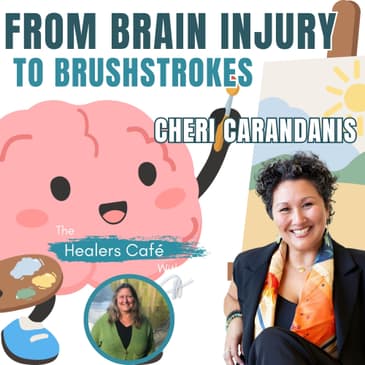
Cheri Carandanis, an abstract painter and former Air Force critical care nurse, shared her journey from pre-med studies to nursing, driven by her desire to balance career and family. She transitioned to the military, specializing in ICU and CCAT teams, and served in Afghanistan post-9/11. After separating from the military, she pursued hospice nursing and earned a master's degree in nursing. In 2019, she suffered two brain injuries, leading to cognitive and vestibular issues, forcing her to retire her nursing license. Through functional neurology and alternative therapies, she recovered significantly, emphasizing the importance of creativity and mindfulness in healing.
For the transcript and full story go to: https://www.drmanonbolliger.com/cheri-carandanis
Highlights from today's episode include:
When I paint, I don't have a brain injury." – Abstract art and flow state became a powerful part of her neurological and emotional healing after two brain injuries.
"If you've seen one healing, you've seen one healing." – Every healing journey is unique, and creativity, intuition, and somatic work can open paths that conventional medicine alone often can't.
"Nothing's really broken; it's just not communicating how it should." – The body often needs a reset, not a label, and approaches like Bowen and other body-centered work help "reboot" the nervous system so healing can happen.
ABOUT CHERI CARANDANIS:
Cheri Carandanis is an abstract painter, mixed media artist, and former Air Force Critical Care nurse who knows a thing or two about surviving what she never saw coming. After a traumatic brain injury ended her 25-year nursing career, she turned to art…not as a hobby, but as a lifeline.
Now based in Portland, Oregon, Cheri creates raw, emotionally layered work that invites connection and contemplation. Her paintings don't try to explain everything—instead, they hold space for what's been broken, unraveled, and rebuilt. Through texture, color, and bold mark-making, she explores themes of healing, resilience, and the beauty that often shows up after the fall.
Her story is one of reinvention, grit, and choosing creativity when everything else falls away.
Core purpose/passion: My core purpose is to create space for truth, the kind that lives in the body, not just the story. I'm passionate about art as a place where people can slow down, feel what they've been avoiding, and come back to themselves without being fixed or explained. I care about honest healing, not performative healing, and about beauty that holds weight, not escape. My work invites presence, courage, and staying with what's real.
Website | Facebook | Instagram | YouTube |
ABOUT MANON BOLLIGER, RBHT, FCAH:
As a retired Naturopath 1992-2021, I saw an average of 150 patients per week and have helped people ranging from rural farmers in Nova Scotia to stressed out CEOs in Toronto to tri-athletes here in Vancouver.
My resolve to educate, empower and engage people to take charge of their own health is evident in my best-selling books: 'What Patients Don't Say if Doctors Don't Ask: The Mindful Patient-Doctor Relationship' and 'A Healer in Every Household: Simple Solutions for Stress'. and What if Your Body is Smarter than You Think? I am the Founder & CEO of The Bowen College Inc. which teaches BowenFirst™ Therapy and holds transformational workshops to achieve these goals.
So, when I share with you that LISTENing to Your body is a game changer in the healing process, I am speaking from expertise and direct experience".
Mission: A Healer in Every Household!
For more great information to go to her weekly blog: http://bowencollege.com/blog.
For tips on health & healing go to: https://www.drmanonbolliger.com/tips
Follow: Manon Bolliger website | Linktr.ee | Rumble | Gettr | Facebook | Instagram | YouTube | Twitter | LinkedIn |
Follow: Bowen College Inc. | Facebook | Instagram | LinkedIn | YouTube | Twitter | Rumble | Locals
ABOUT THE HEALERS CAFE:
Manon's show is the #1 show for medical practitioners and holistic healers to have heart to heart conversations about their day to day lives.
Subscribe and review on your favourite platform:
iTunes | Google Play | Spotify | Libsyn | iHeartRadio | Gaana | The Healers Cafe | Radio.com | Medioq | Audacy |
Follow The Healers Café on FB: https://www.facebook.com/thehealerscafe
Remember to subscribe if you like our videos. Click the bell if you want to be one of the first people notified of a new release.
* De-Registered, revoked & retired naturopathic physician after 30 years of practice in healthcare. Now resourceful & resolved to share with you all the tools to take care of your health & vitality!
00:00:00
Introduction: Welcome to the Healers Cafe, the #1 show for
00:00:04
medical practitioners and holistic healers to have heart
00:00:08
to heart conversations about their day to day lives while
00:00:13
sharing their expertise for improving your health and
00:00:17
wellness.
00:00:17
Manon Bolliger: So welcome to the Healers Cafe. And today I
00:00:23
have with me Cheri Carandanis. And she is an abstract painter,
00:00:30
mixed media artist and a former Air Force critical care nurse.
00:00:36
Yes, of course, there's always a health component. So this is
00:00:41
likely to be a very intriguing share. You know what happened?
00:00:46
How are you? Yeah, like, I don't want to give it away, really, so
00:00:51
I think let's just talk about, you know, your your, your life
00:00:56
and well, first, what, what prompted you to go into nursing
00:01:01
and critical care, maybe that's the first part that we can go
00:01:06
into what happened afterwards.
00:01:07
Cheri Carandanis: First, I'm so excited to be here, so thank you
00:01:11
for having me on I think it'll be a really fun conversation. I
00:01:16
started off pre med actually, and in college, about my
00:01:22
sophomore year, I I don't know, I just had this wake up call,
00:01:25
like, do I want to be a doctor? What does my life want to look
00:01:29
like? And I knew I wanted an occupation or profession where I
00:01:33
could step in and out, because I knew I wanted to be a mother and
00:01:36
a wife someday. And so I I landed in nursing and and I
00:01:43
think I just wanted to have the time and the capacity to connect
00:01:48
with patients. And I know that physicians are just, there's so
00:01:52
much demanded of them that they don't get that time that nurses
00:01:56
do. So I was in nursing and I about a year out from
00:02:03
graduation, I was just working on a trauma floor, and my father
00:02:09
was in the Air Force for 26 years. So I grew up in the air
00:02:12
force, and I swore I would never, never join the military,
00:02:17
but one morning, I woke up and decided that's what I was going
00:02:20
to do, because I just couldn't imagine waking up to the same
00:02:23
job, to the same people. The military was just in my blood.
00:02:27
And so I joined the military, and I was assigned as a new kind
00:02:32
of a baby nurse. I was assigned to a med search floor, and after
00:02:35
working there for a year, I asked if I could be retrained
00:02:38
into some sort of ICU. They sent me to the NICU, and after one
00:02:44
day, I said, No, this is not for me. They're too tiny. I The
00:02:49
babies are just so small. I just, I just knew in my gut that
00:02:53
wasn't for me. And so they put me in the ICU, and I loved it. I
00:02:59
loved it. I learned so much. It was so challenging. I love the
00:03:05
energy of the ICU, and so in the Air Force, I had the
00:03:09
opportunity, they had a fairly new program rolling out called
00:03:13
CCat teams, and that's critical care air transport teams, and
00:03:17
that's where I would be trained to be deployed with a
00:03:22
intensivist physician and a respiratory therapist and then a
00:03:27
critical care nurse, and we would be outfitted to be able to
00:03:30
set up mobile ICUs in any opportune aircraft in wartime
00:03:35
situations. And so I was accepted and was trained to be a
00:03:40
Seacat nurse. And then lo and behold, September 11 happens.
00:03:44
And we decide, you know, not we decide, but the Air Force
00:03:48
decides to go make this program go live. And so we were
00:03:53
deployed, and I spent time in Afghanistan, and it was the
00:03:58
honor of my life. It was, it was intense, but I feel like I was
00:04:05
well trained and as prepared as I could be in a situation like
00:04:09
that, and had the honor of caring for our troops and
00:04:13
getting them home the best we could. So I did that, and after
00:04:18
I got deployed and came back in about 2003 i i My husband and I
00:04:24
thought we wanted to have children, and I just watched so
00:04:27
many of my friends get deployed with children, and it was so
00:04:31
painful to watch. And so I did separate from the military,
00:04:34
because I did want to start a family with my husband. So I did
00:04:38
separate and did some ICU nursing as a civilian, but then
00:04:43
fell into hospice nursing. It was not something I planned. It
00:04:47
was not something I really thought about doing ever, but I
00:04:51
went to an interview and the nurse manager thought I'd be a
00:04:54
really good hospice nurse. I said, I'll give it a try. And I
00:05:00
did, and I loved it. It was so great. And then, using my GI
00:05:05
Bill, I was able to get my my master's degree in nursing, and
00:05:09
I became a nurse manager for the hospice. And so being able to
00:05:12
take care of the nurses was even a greater honor. And I love
00:05:18
that. I love that role. And then, well, I did that for a
00:05:21
while, and then in 2019 the rug got pulled out from under me. I
00:05:26
suffered two separate brain injuries. They were six months
00:05:29
apart. And you know, as a nurse, I thought I understood brain
00:05:35
injury. I thought there was lots of help for people with brain
00:05:39
injury. I quickly learned that need I have no idea. I had no
00:05:45
idea what brain injury felt like, and there wasn't a lot of
00:05:49
help for people with brain injury. I was told, you know, in
00:05:54
my mind, I say Western medicine, but just kind of mainstream
00:05:58
medicine that my insurance would cover, kind of told me, take an
00:06:03
antidepressant, right? This is your new normal. And it was at
00:06:09
the point, at the I that I was at was not good. I cognitively,
00:06:14
I was having a lot of issues. Vestibularly, I was wrecked,
00:06:19
constant tinnitus that was driving me insane, and I had
00:06:25
speech problems, and they just there was no help that they
00:06:31
could offer. And so I was I fell into a deep depression because I
00:06:36
knew, first of all, after a couple of years, that I could
00:06:40
not go back into nursing safely, cognitively, I knew I didn't
00:06:45
have that capacity anymore, and so I had to retire my nursing
00:06:48
license, which heartbreaking.
00:06:51
Manon Bolliger: Wow,
00:06:51
Cheri Carandanis: it was my identity,
00:06:52
Manon Bolliger: and how did this happen to you, or how
00:06:56
Cheri Carandanis: the first injury was a result of a fall.
00:07:00
And so I I was healthy. I was fine, and we were vacationing in
00:07:06
Arizona, and they think that maybe I got dehydrated, which I
00:07:11
don't know, because I was very careful about hydrating myself
00:07:14
and making sure, but maybe I was dehydrated, but I I passed out
00:07:20
and hit the back of my head. And so that was the first one. And I
00:07:25
went through all the, you know, concussion specialists and
00:07:29
physical therapy and speech therapy and, you know,
00:07:32
occupational therapy. And after, I don't know, about four months,
00:07:37
I thought, I'm not getting better. I feel like I should be
00:07:40
getting better because I'm doing all their I'm being a very
00:07:43
compliant patient. I'm listening to everything they're saying,
00:07:47
and I'm not feeling like I'm getting better. And then at the
00:07:50
six month mark, as my my father was taking me to an appointment,
00:07:55
actually, for vision therapy. We got in a car accident, and so
00:08:00
then that was my second and that just really, really rocked me.
00:08:07
And so I had from that one, I had mobility issues with my left
00:08:11
leg, I had speech issues, and then whatever I was suffering
00:08:16
cognitively, just an amplified Yes, yes. Yes. And so I went
00:08:24
back to the neurologist, went back to, you know, physical
00:08:26
therapy, and the neurologist just, you know, kind of
00:08:32
dismissed. I felt very dismissed. And as a and as
00:08:36
someone who advocates for people and advocates for patients, I
00:08:39
was really like, I'm going to advocate for myself, because
00:08:42
this isn't okay. You can't just tell me this is my new normal
00:08:45
and take an antidepressant like that doesn't sound right to me.
00:08:49
And so I started researching, there has to be help. There has
00:08:52
to be more. And so I did find functional neurology, and I
00:08:57
found nature. My naturopath was huge in helping me.
00:09:02
Unfortunately, all of those things are not covered by
00:09:06
insurance, and they're
00:09:07
Manon Bolliger: not now, but they, I think they will be. I
00:09:10
pray
00:09:11
Cheri Carandanis: every day. I pray because people should have
00:09:15
access to this kind of care. So then that opened my whole world
00:09:19
up into alternative therapies, and in that all of those
00:09:24
modalities teach me to get in touch with myself. As a nurse i
00:09:30
i was in touch with everyone
00:09:32
Manon Bolliger: else, Exactly, yep. And so it
00:09:34
Cheri Carandanis: really guided me inward. And so it kind of was
00:09:39
like all the planets started to align for me, like I was getting
00:09:43
the help I needed, I was getting the support I needed. Thank God
00:09:47
that we are privileged enough to be able to afford some of those
00:09:52
modalities. But really, I just did my homework and took the
00:09:55
homework with me, because we couldn't afford to keep going
00:09:58
forever and. To the treatments, but I did, you know, we paid for
00:10:02
what we could. I took it home, and I did the homework, and I
00:10:07
think that's what gave me some hope that, you know, maybe this
00:10:12
isn't my new normal, maybe I can get better, right? It was a long
00:10:17
road, and I learned quickly that the brain has a lot of
00:10:20
neuroplasticity, and it is able to heal. It takes its time doing
00:10:26
it slow healing process. But I was even able to go to Dr Daniel
00:10:32
Amen, the Amen clinic. Oh, yeah. And that was fascinating. I
00:10:36
learned so much more about my brain than just what happened
00:10:40
with the brain injury. And so with their help, I was able to
00:10:43
get on a good diet, and some, you know, the right supplements,
00:10:47
and not taking everything under the sun, but just really
00:10:50
targeting what's going to help me. And so with this little team
00:10:54
in place, especially my functional neurologist, I
00:10:57
started to get better. And so now I'm about seven years out,
00:11:03
and I'd say I'm like 80 90% there. I have good days, I have
00:11:09
bad days, but gratefully, there are way more good days than bad
00:11:13
days now. And so I don't I don't even mind if I'm left with what
00:11:18
I'm left with, as far as my symptoms. Yeah, I feel like I'm
00:11:23
doing so much better than I used to, yeah, and without hope, I
00:11:27
had
00:11:28
Manon Bolliger: no and so the the art, because, I mean, art is
00:11:34
known to be one of the therapeutic modalities that
00:11:38
helps. But what was your did you just come across it? Did you
00:11:43
know about it? Did you
00:11:46
Cheri Carandanis: I knew nothing about healing. I knew nothing
00:11:51
about art in general. I always say my kids never even got a
00:11:55
scrapbook page for me because I just I didn't do crafts or
00:11:59
anything like that. But I was in with my psychologist and one of
00:12:06
my functional neurologists, and they both kind of said the same
00:12:08
thing, which told me this is a message I need to listen to.
00:12:12
They say, you know, most of your injuries on the left side of
00:12:15
your brain, so we need to go into the right side and fire
00:12:19
that up. We need to get the healthy side really fired up so
00:12:22
we can start making some connections there. And I said,
00:12:25
awesome, I'm okay. What do I do? Make sense, right? And, yeah,
00:12:29
they're like, creativity, presence, mindfulness. I just
00:12:35
started laughing. I said, No, I don't do any of those things. I
00:12:40
don't know how to do any of those things. I'm not sure. And
00:12:44
so my psychologist said Sheri, just start with an adult
00:12:47
coloring book. Like, just get one of those mandala beautiful
00:12:50
coloring books, sit down and just start there, see what
00:12:53
happens. And so I did, and I colored for about 10 minutes,
00:12:58
and hated every second. I ripped it up, I threw it away, and I
00:13:04
thought, I'm in big trouble. I'm in big trouble because I can't
00:13:08
do these simple things that could be helping me. And as God
00:13:13
would have it, I was watching YouTube because that was
00:13:15
something I could do. Was watch YouTube. I saw an artist come
00:13:19
across my feed, and she wasn't just an artist, she was an
00:13:22
abstract artist, and she was painting on large canvases. And
00:13:26
as I don't know what intrigued me, but I understood that she
00:13:31
wasn't painting landscapes or people. She was painting her
00:13:36
feelings. I understood that immediately, that she was
00:13:39
painting her feelings. So I was intrigued by that, and so I
00:13:43
thought, I'm going to try that. And so my dad had just bought a
00:13:46
big screen TV, and I went down to his house, and I cut out one
00:13:46
of the sides of the cardboard and decided that'll be my
00:13:48
canvas, because I don't want to spend any money on this, because
00:13:55
I'll probably hate it again. And then I got my kids paints out
00:13:59
from school, their tempura pains from school, and I just started
00:14:04
smearing paint, literally with my hands, onto this canvas. And
00:14:11
something just sparked, just like, Wait, this feels good.
00:14:17
This feels good. I'm just going to keep doing this. And so I
00:14:20
have a amazingly supportive husband, and he could see that
00:14:25
something was happening, and he said, let's, let's follow this.
00:14:28
Let, let's really press into this. And so he got me paints.
00:14:32
We got canvases, and the more I painted, I realized that when I
00:14:38
paint, I don't have a brain injury, like I forget that I
00:14:43
have these awful things that I have to deal with every day,
00:14:47
right? I was able to get into what I learned was flow state,
00:14:51
which I didn't know anything about flow state, and you go
00:14:55
into this state where you don't have to use the bathroom, you
00:14:58
don't have to drink water, you you. Just get lost in the
00:15:02
creativity. And then I learned I don't paint things. I paint
00:15:07
intuitively. Sorry I had it on silent. And so then that put me
00:15:14
into touch with my intuition, and that was a new lesson for
00:15:18
me. So I learned that to get to know my intuition, I have to
00:15:27
spend time with it. So then that led me into meditation, and that
00:15:32
just opened up everything as far as healing, because I felt like
00:15:37
that was the foundation I was trying to heal from up here,
00:15:41
right? Trying to heal from my knowledge, I had to move down
00:15:47
into my soul and heal from there. This would catch up
00:15:51
eventually, but when I learned, but it's I love, the way I say,
00:15:58
God just aligned everything for me, and just one step at a time
00:16:03
I learned. It wasn't all a big download. It was just one thing
00:16:07
at a time leading to the next thing for me to learn. And one
00:16:10
of my favorite things quotes that I like, and I think it was,
00:16:14
it was a it was a Buddhist quote, and it says that when the
00:16:18
student is ready, the teachers appear, right? That is so true,
00:16:23
whether it's podcasts or books or, you know, whatever it is, it
00:16:28
comes into your life when you're ready. And yeah, I was certainly
00:16:32
ready to figure out how to heal and not in the way that I was
00:16:38
trained. You know, as a nurse in western medicine, I was trained
00:16:41
to heal a certain way. Well, it wasn't working. That wasn't
00:16:44
working. So realizing that my body wants to heal and it knows
00:16:50
how to heal, yeah, like, I want to figure it out. That's
00:16:57
incredible.
00:16:58
Commercial Break: What would your life be like if you are
00:17:00
pain free, if you are one of the millions who suffer from chronic
00:17:05
pain, the thought of just one day without it may seem
00:17:08
impossible. This is often because conventional medicine
00:17:12
tends to fall short in the treatment of pain, opting to
00:17:16
prescribe pills or recommend surgery rather than getting to
00:17:19
the root cause of the problem. But if you are suffering with
00:17:22
emotional or physical pain, there is hope. Join the founder
00:17:28
and CEO of Bowen College, Manon Bolliger, live online for your
00:17:33
body mind reboot. Learn how to listen to your symptoms and get
00:17:38
to the root cause of your pain, plus be trained in basic Bowen
00:17:42
therapy moves so that you can reboot your body for optimal
00:17:47
health. You don't have to live in pain. You can heal, stop the
00:17:52
pain pill cycle by visiting www.yourbodymindreboot.com, to
00:17:58
learn more and to register.
00:18:09
Manon Bolliger: But that's the mind shift, right? That is the
00:18:12
difference. If you're going to generalize, I mean, there's an
00:18:16
end again. It's not the people who do it right, because they
00:18:20
come from vast difference beliefs and knowledge base, you
00:18:24
know, but it really is that idea that you know one, you're you're
00:18:30
you're the facilitator, and you're the one doing the action
00:18:34
to help the other person. And you're, in a sense, the the
00:18:39
powerhouse, and they're the receiver to this other idea that
00:18:44
it's actually the patient, the client, the person doing the
00:18:49
healing. And you're, you're receiving the information step
00:18:53
by step. You know, as as much as you can take it, you know, in
00:18:58
the right rate, the right speed, and you're gonna like, it can be
00:19:02
a lot like, that was a lot, yeah. And you could never decide
00:19:08
it, yeah. You can never decide it as from the same mind that
00:19:13
was injured. It really comes from having to see the world in
00:19:18
a different way, right, and then follow the lead, right? So it's
00:19:22
yeah, no
00:19:23
Cheri Carandanis: changed my entire that mindset shift
00:19:25
changed my entire life, not just how my body healed, but how I
00:19:29
see myself, how I see the world, how I see other people. There's
00:19:34
so much compassion, there's so much just i think i i, we all
00:19:41
feel this need to be heard and understood when, if we could
00:19:46
just take the time to hear and understand ourselves. Yes, then
00:19:52
there's not that need that, you know, that frustration and so
00:19:56
spending time with myself and learning the. About me. And then
00:20:01
that just opened up all kinds of like there was trauma that I
00:20:05
never dealt with, you know, that I just buried down and that. And
00:20:09
you know, Body Keeps the Score that will affect my health. So
00:20:14
then I thought, nope, I want to do it all. I want to go on every
00:20:17
level and discover how to bring health to this body and to
00:20:23
maximize what it's created to do, which is live, live.
00:20:28
Manon Bolliger: Yeah, exactly. So now that you know what you
00:20:32
know, do you see any part of the art journey that might have made
00:20:44
sense, not necessarily for you, because at that point you were
00:20:48
the giver, but for the people, because you've had different
00:20:52
medical exposures. You know, do you see that, that that path,
00:20:58
art and or meditation, could have helped other people at the
00:21:06
time, like, if you knew what you knew now, kind of thing,
00:21:10
Cheri Carandanis: absolutely, absolutely, and that's why part
00:21:13
of my my purpose now is to let People know how powerful
00:21:19
creativity and mindfulness really is like I have been asked
00:21:24
to speak to women's groups, and especially perimenopausal that
00:21:28
type, because I'm learning that perimenopause and menopause can
00:21:31
often feel like a brain injury in many ways, and so teaching
00:21:39
women that don't Want to be professional artists, don't want
00:21:42
to make it their thing, but taking time to just create
00:21:47
something, a meal, a garden, a flower arrangement, anything,
00:21:53
anything that lights them up. It just brings that energy, that
00:21:58
frequency like it. Makes your body primed to heal.
00:22:04
Manon Bolliger: And so it's like the, it's the feminine, right?
00:22:06
It really, it's bringing that back into balance in the world
00:22:12
that we have allowed,
00:22:15
Cheri Carandanis: yeah, and I was, you know, I lived in that,
00:22:19
especially in the military, and being a nurse, you're always,
00:22:23
you know, like, there's that masculine you know, like, do it
00:22:27
and you know. And then this healing journey has been very
00:22:33
much in that, that frequency of the feminine, of nurturing and
00:22:38
calming down, but not in a not, not in a way that's like, soft
00:22:43
and it's, it's very powerful. It's a very powerful presence,
00:22:48
like, I've got this, I've got this. I don't need all the
00:22:55
inputs that I believed about myself throughout my life
00:22:58
because all of that went away with brain injury. You know, all
00:23:01
of my accolades, all of my smart she is, and how multi she can
00:23:06
multitask, that all went away. So I couldn't tout that part of
00:23:12
myself, which I think I did a lot, and now it's just stripped
00:23:17
down, bare naked me, and it's awesome. It's beautiful. It's so
00:23:22
freeing, and not really looking for, you know, anyone's
00:23:27
acceptance, you know, or any of that. It's just being me, and
00:23:33
being me opens me up to so many more people, because it's that
00:23:38
authentic connection that we Right exactly. Yeah.
00:23:42
Manon Bolliger: So are these pieces of your art behind you?
00:23:45
Sure?
00:23:45
Cheri Carandanis: Yes, this one. This is a newer piece. It's
00:23:50
called I'm not just a number, because it came out of
00:23:54
frustration. A couple weeks ago, I got a call from my insurance
00:23:57
company saying they would no longer cover something for me
00:24:00
that was helping me with my brain injury. And I was so
00:24:02
upset, and I appealed it, and I I wrote my own prior auths and
00:24:07
and they said no. And so I was so upset, not just for myself,
00:24:11
but for everyone that is trying to get help and trying, and they
00:24:16
pay into these insurance companies, you know, they they
00:24:18
hope that when something bad happens, these insurance
00:24:21
companies are going to help them. And I them, and they
00:24:23
don't. And so there was this frustration, I mean, not just
00:24:27
for me, but for everyone, and for the fact that in our
00:24:31
country, it feels like healthcare is a privilege and
00:24:36
it's a human right, like everyone should have the right
00:24:38
to have a healthy life and to have access to health. And so
00:24:43
that painting, I didn't realize it, but after a few days of
00:24:47
looking at it, I noticed there were a lot of bars in it, and I
00:24:50
was like the bars. And then I realized, you know what? It's
00:24:55
like, a barcode, like just a barcode to them. I'm not, you
00:24:59
know? A person with a story and relationships and this whole
00:25:03
life, I'm just a barcode, and I did not meet their required
00:25:07
boxes that needed to be checked. And so they said no. And it's
00:25:13
Manon Bolliger: interesting, because the boxes are are very
00:25:15
simple, right? It's like it's a profit driven system that really
00:25:22
supports pharmaceuticals, not innovation, not cure, you know,
00:25:28
as I mean, I'm
00:25:29
Cheri Carandanis: in prevention at this point, not
00:25:31
Manon Bolliger: even prevention, no, no, or what they call
00:25:34
prevention. Prevention is poison. But anyway, it's very
00:25:40
scary, you know, but in that system, you're not going to
00:25:45
really get the support anyways. It doesn't makes it's not built
00:25:50
for that. So just like every other institution, it has to be
00:25:55
completely rethought, revamped and opened up to, you know, what
00:26:00
is the purpose and what is it driven by? You know? And I think
00:26:05
that's the real, you know question. I mean, I, I was a
00:26:09
naturopath, because I, I did lose my license for speaking,
00:26:15
because I do live in Canada. So, you know, it's complicated here.
00:26:23
I mean, it is complicated in many places, but some places
00:26:27
made more of a show of it, you know, anyway. But yeah, it's, I
00:26:34
would say it's, you know, most people who go into naturopathy
00:26:38
because you have to pay for it yourself, right? So you don't
00:26:41
get grants. You don't get funding from, you know, a whole
00:26:45
bunch of other research optics where they want you you know
00:26:50
your knowledge because they know they're going to get a piece
00:26:53
because, and also, you can't, what's the word? You know, if
00:26:58
you have natural foods, you can't really get a patent on it,
00:27:03
right, unless you profitable, unless you make it artificial,
00:27:07
which is against the idea of what we do. So it's like a
00:27:11
misnomer that just, you know, I'm surprised we exist at all.
00:27:17
It's true in the system, you know, and, and it's, it's
00:27:22
becoming so clear that we don't belong in the system, you know,
00:27:27
but we shouldn't. It's not like, Oh, we're not good enough. No,
00:27:31
no, we are quite good for the system, exactly, well. And it's
00:27:36
also like, it's a bit like your experience of, you know, you
00:27:40
develop another part of you, and you realize that you're enough.
00:27:46
You know you are full. This is the authentic you know, being
00:27:51
that you know you you really were when you started this,
00:27:55
until it got all, you know, mucked up with the energies of
00:28:00
this other world, you know, as now we're trying to be
00:28:03
amalgamated all in one. It's like, yeah, it's troublesome
00:28:10
Cheri Carandanis: way that that magic, oh, who we are as
00:28:14
individuals and as human beings. And I want to stay in the magic.
00:28:19
And, you know, it's so it's so ironic that we fight so hard to
00:28:24
be in the system like I thought it was my right, and we paid
00:28:28
into this, and I want to be in that system and pay for my blah,
00:28:32
whatever. Yeah, and no, I don't. I don't. I don't want to be in
00:28:37
that system. And, you know, we, I have a I have a very deep
00:28:42
faith, and I just asked God whatever treatments I need to
00:28:46
get to the place I need to be able to put love out into the
00:28:49
world again and to serve others again in whatever way that
00:28:53
looks. I never thought it would be. As a artist, it was not on
00:28:58
my radar. But thank God, I'm not in charge. I'm not in control.
00:29:04
My Spirit wanted that. I didn't know it did, but he was hungry
00:29:09
for that. It was so hungry. And now that I'm in this space, I
00:29:15
would do it all over again. I would do it all over again. My
00:29:18
husband, when I said that to him, I said, you know, I'd have
00:29:20
brain injury again to be in this place. Wow, was like the hell we
00:29:25
went through, hell we went through. For you to say, That's
00:29:29
a miracle, yeah, miracle. And I said, it really is. I'm glad it
00:29:36
happened. I'm glad it wasn't worse, because it could have
00:29:40
certainly been worse, but it's taught me so much. It's taught
00:29:46
through so many ways, not just healing, but meeting the right
00:29:50
people and learning about the soul and me and my intuition and
00:29:56
the world and our connection to each other, that we're all
00:29:59
connected. I. Never thought about that. No, yeah, but now I
00:30:03
can't. I'm obsessed.
00:30:08
Manon Bolliger: Yeah, I think it's a great message, really, to
00:30:12
to wrap up her session, but it's like people who receive a
00:30:17
diagnosis, even if they don't know what it is, because
00:30:19
sometimes whatever, but you know that you can't function. It's
00:30:24
like, just, just wait a minute, you know, see, and then look,
00:30:29
look outside of what box you're in, whatever box you're in, and
00:30:34
see, because I, I think it's always in hindsight, we get
00:30:37
these like, oh my goodness, I would do it again, you know, and
00:30:41
it's
00:30:41
Cheri Carandanis: like, but never in the moment. My side is
00:30:47
definitely 2020, yeah. And I really do believe our bodies
00:30:51
have the answers. We just have to listen and learn how to
00:30:57
listen. And I think that's the first step, is getting in touch
00:31:00
with ourselves and and learning how to listen to our intuition,
00:31:04
because it has the answers and wants to guide us.
00:31:07
Manon Bolliger: Actually, I have one more question for you that,
00:31:11
did you do any physical therapy? Okay, yeah, which types or that
00:31:21
had the impact on you
00:31:23
Cheri Carandanis: that helped me? Yeah, it was all through the
00:31:27
functional neurologist, okay, and so it was a lot of I always
00:31:32
felt like I was going to space camp when I went into functional
00:31:36
neurology, to say the most bizarre things, like putting me
00:31:41
in a big cage that flipped me around. It was like the gyrostim
00:31:45
is called the gyros. They put me in the hyperbaric chamber. They
00:31:49
did VR glasses, so kind of retraining that vestibular
00:31:53
system. It all felt like it was making it worse. Like I would
00:31:58
always tell the doctor, I think it worse by that, he goes, No,
00:32:02
we're resetting, we're retraining. We're only going to
00:32:04
do baby steps, and that's what. Because when I went to the other
00:32:08
physical therapy, regular physical therapy, after going
00:32:11
for about a year and a half, he's like, Cherie, there's
00:32:14
nothing else I can offer. Like, I feel like we've offered
00:32:17
everything, and you're not getting better with your
00:32:20
vestibular system. So it was functional neurology that really
00:32:24
helped me first. I mean, within eight weeks, my speech came
00:32:28
back, and that was through electrical stimulation on my big
00:32:31
toe and my tongue and just these bizarre things. This is not
00:32:38
gonna I'm not sure what, but I was desperate, and I was willing
00:32:43
to try anything. And lo and behold, they know what they're
00:32:46
doing.
00:32:48
Manon Bolliger: Well, no, because I ask, also because I
00:32:52
have a college called Bowen College, and we do Bowen
00:32:56
therapy, and it is a reset to the nervous system, and I've
00:33:02
actually had quite a lot of success, and so my students,
00:33:06
obviously, you know, with brain injury. So I was curious
00:33:13
whether, you know, it's touch, or it's that touch, because it's
00:33:19
very little touch. It's, it's an unusual technique. It's mostly
00:33:23
hands off, but you kind of reset the body by doing certain moves
00:33:30
in certain places.
00:33:32
Cheri Carandanis: And it's like an energetic modality, like
00:33:35
you're
00:33:36
Manon Bolliger: you know, the massage therapists who have
00:33:38
learned it hate to use the word energy, because they like to
00:33:42
think it's all physical, but the Cairo's are okay. Or osteopaths,
00:33:48
they see it more as it could be energy, but it follow meridian
00:33:53
lines, some of the cases, not all cases, it really works with
00:33:59
a fascia, and it helps, sort of detox and drain, but it really
00:34:04
resets the neurology. So I was curious if,
00:34:08
Cheri Carandanis: God bless you for putting that out in the
00:34:10
world, that's what we need. Like, I went to craniosacral
00:34:14
like that. I didn't think was going to help, but it does. It
00:34:18
does help? Yeah. Well, therapy helps.
00:34:22
Manon Bolliger: Yeah, it does. Yeah, that's it, yeah, and I'm
00:34:26
just mentioning it in case, you know, people are in the
00:34:30
situation you're in. They haven't heard about it. It's
00:34:32
just yeah, good to know about that.
00:34:35
Cheri Carandanis: Yeah, it makes sense. A reset electrical right?
00:34:40
When our computers freak out, we reset them,
00:34:44
Manon Bolliger: actually, that is why I call, I call one of my
00:34:47
programs reboot, because I used to call my son all the time. I
00:34:52
don't know what to do. I can't get like and he goes, Mom, you
00:34:56
know, just shut it down and reboot and and. And after 50
00:35:01
times slow learner, you know, just like, I'd rather call him
00:35:05
an angst than Yes, take a breath and go, Okay, you know what? I'm
00:35:09
just gonna reboot.
00:35:13
Cheri Carandanis: Not it works.
00:35:16
Manon Bolliger: And then the body, I had no problem
00:35:18
understanding that concept. So it's like, name the program that
00:35:22
right? Because it's just reboot, and that's it, you know. And
00:35:25
then it's, it's like, nothing's really broken. It's just not
00:35:28
communicating how it should, or how it did, you know, that's
00:35:32
right, yeah, which is what I find fascinating, that they
00:35:36
decided, or whoever it was, that you have to work the right side
00:35:40
of your brain to activate and make new synapses with the left
00:35:45
right, makes perfect sense,
00:35:49
Cheri Carandanis: it does. But then how,
00:35:53
Manon Bolliger: oh, yeah, that part we do not for me,
00:35:57
Cheri Carandanis: it was a paintbrush.
00:36:00
Manon Bolliger: But that's exactly it, right? It's, it's a
00:36:02
different, it'll be different for everyone, right?
00:36:06
Cheri Carandanis: Yeah, that's the beauty of medicine, right?
00:36:09
Or, or healing, I shouldn't even exactly, is that if you've seen
00:36:13
one healing, you've seen one healing, exactly,
00:36:17
Manon Bolliger: yeah, okay, well, I'm gonna need to end it
00:36:21
here, but thank you so much for sharing your experience and
00:36:25
Cheri Carandanis: your conversation. Thank you for
00:36:27
having me the
00:36:28
Manon Bolliger: comment I wanted to reiterate from my
00:36:31
conversation with Cheri Carandanis is the importance of
00:36:36
body work, right, of somatic work. And you know her journey
00:36:41
starting with a prescription of antidepressants. It's so far out
00:36:46
of touch, no pun intended to what is really needed for a body
00:36:52
to heal. But when you have brain injury, there are people who
00:36:57
still believe that it's just in the head and the body and the
00:37:02
whole nervous system is not impacted, and that couldn't be
00:37:07
further from the truth. So if you are new to this, definitely
00:37:12
in this case, go to BowenCollege.com and find out
00:37:17
what we offer. There are classes that are available just to the
00:37:22
public that you can use, you know, for yourself and family.
00:37:27
It's done on another person, so you can't do it to yourself, but
00:37:33
the basis of it can help the basic program reboot can really
00:37:38
help you a lot as well. Of course, if you become a
00:37:42
practitioner and you work with a TMJ and and the coccyx, you're
00:37:48
going to have a lot more impact in the cases that don't respond
00:37:53
as quickly to reboot.
00:37:55
Ending: Thank you for joining us at the Healers Cafe. If you
00:37:59
haven't already done so, please like comment and subscribe with
00:38:03
notifications on as I post a new podcast every Wednesday with
00:38:08
tons of useful information and tips for natural healing that
00:38:12
you won't want to miss you.