
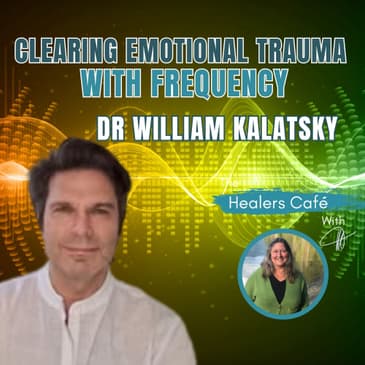
In this episode of The Healers Café, Manon Bolliger speaks to Dr. William Kalatsky, a former chiropractor, who developed a method to clear emotional trauma using frequency.
For the transcript and full story go to: https://www.drmanonbolliger.com/william-kalatsky
Highlights from today's episode include:
Dr. William explains that emotions have distinct frequencies, and by matching the resonance of an emotion (like grief, anger, jealousy, rage), it can be disentangled and cleared from the body.
Dr William describes working with the field of consciousness to clear intense emotional charge (including PTSD and extreme grief) often within a single session, with changes felt immediately.
Manon describes how Bowen therapy works not just physically, but also as a frequency-based, consciousness-involved process.
ABOUT DR WILLIAM KALATSKY:
Dr. William Kalatsky is a pioneer in the field of consciousness and emotional healing. With decades of experience in chiropractic care, meditation, and energy work, he developed Field of Consciousness Healing, a method that helps people release trauma, dissolve limiting patterns, and step into new levels of clarity and freedom.
At the heart of his work is a simple yet profound truth: emotions are frequencies stored in the body and field of consciousness. When unresolved, they continue to shape our thoughts, relationships, and health. Dr. William's method guides people to identify these patterns, clear the frequency of trauma, and install new emotional codes of peace, gratitude, and empowerment.
He is the author of The Intuition Method, which offers practical tools to strengthen intuition, rewire subconscious patterns, and manifest aligned outcomes. His sessions and workshops have helped clients from all walks of life—professionals, entrepreneurs, and trauma survivors—experience rapid transformation. Many report that painful stories can be remembered without emotional charge after just one session.
Dr. William's work bridges science and spirituality. Collaborations with institutions such as the University of Miami explore how brainwaves, HRV, and biometrics validate what thousands have experienced firsthand: when the field of consciousness is cleared, the mind and body reorganize into health, resilience, and creativity.
Whether speaking on stage, leading group healings, or working one-on-one, Dr. William brings clarity, compassion, and a deep commitment to human potential. His mission is to show that freedom from trauma is possible—not in years of struggle, but often in moments of breakthrough.
Core purpose/passion: My purpose is to help people free themselves from trauma by clearing the specific frequencies that keep old pain alive. This work is always evolving. Years ago, I was clearing the frequencies of migraine headaches in hospitals in England. That led me to discover that unresolved emotions were behind the pain. Each realization has taken me deeper, and I don't know where the next evolution will lead. What I do know is that when people release trauma and move into peace, joy, or love, it shifts not only their life but the frequency of the entire planet.
– Facebook | YouTube | Instagram | LinkedIn | Website
ABOUT MANON BOLLIGER:
As a recently De-Registered board-certified naturopathic physician & in practice since 1992, I've seen an average of 150 patients per week and have helped people ranging from rural farmers in Nova Scotia to stressed out CEOs in Toronto to tri-athletes here in Vancouver.
My resolve to educate, empower and engage people to take charge of their own health is evident in my best-selling books: 'What Patients Don't Say if Doctors Don't Ask: The Mindful Patient-Doctor Relationship' and 'A Healer in Every Household: Simple Solutions for Stress'. I also teach BowenFirst™ Therapy through Bowen College and hold transformational workshops to achieve these goals.
So, when I share with you that LISTENING to Your body is a game changer in the healing process, I am speaking from expertise and direct experience".
Mission: A Healer in Every Household!
For more great information to go to her weekly blog: http://bowencollege.com/blog.
For tips on health & healing go to: https://www.drmanonbolliger.com/tips
Follow: Manon Bolliger - | Linktr.ee | Rumble | Gettr | Facebook | Instagram | YouTube | Twitter | LinkedIn |
Follow: Bowen College Inc. | Facebook | Instagram | LinkedIn | YouTube | Twitter | Rumble | Locals
ABOUT THE HEALERS CAFE:
Manon's show is the #1 show for medical practitioners and holistic healers to have heart to heart conversations about their day to day lives.
Subscribe and review on your favourite platform:
iTunes | Google Play | Spotify | Libsyn | iHeartRadio | Gaana | The Healers Cafe | Radio.com | Medioq | Audacy |
Follow The Healers Café on FB: https://www.facebook.com/thehealerscafe
Remember to subscribe if you like our videos. Click the bell if you want to be one of the first people notified of a new release.
* De-Registered, revoked & retired naturopathic physician after 30 years of practice in healthcare. Now resourceful & resolved to share with you all the tools to take care of your health & vitality!
00:00:00
Introduction: Welcome to the Healers Cafe, the number one
00:00:03
show for medical practitioners and holistic healers to have
00:00:08
heart to heart conversations about their day to day lives
00:00:12
while sharing their expertise for improving your health and
00:00:17
wellness.
00:00:17
Manon Bolliger: So welcome to the Healers Cafe, and today I'm
00:00:24
with Dr William Kalatsky. And he was originally a chiropractor,
00:00:30
and then he developed a method to clear emotional trauma in
00:00:34
minutes, using frequency, one of my favorite subjects. So now
00:00:39
he's being researched in collaboration with the
00:00:42
University of Miami, and I don't think we're going to say a lot
00:00:46
more, other than start the conversation and well, first
00:00:50
question really is, how did you get into this? Caf? Okay, I can
00:00:56
understand, you know, but why don't you give us a little bit
00:00:59
your history, and then what got?
00:01:00
Dr William Kalatsky: Sure? Well, well, chiropractic goes back to
00:01:04
when I was a kid, because my interest wasn't actually
00:01:06
chiropractic. It was that my brother and I were diagnosed
00:01:09
with Crohn's Colitis, and we met a chiropractor who had said, who
00:01:14
had done this kind of interesting work using energy
00:01:17
frequency. And he said, Give me a few months, and if you're not
00:01:20
better, then do the surgery as recommended, but if it's not an
00:01:24
emergency, don't do it first. So we took a few months, and we
00:01:27
both got better. And at the age of 12, you're kind of amazed
00:01:30
when you're really told this is the fact you're stuck and
00:01:34
somebody helps you. You think it's magic. So he said, you
00:01:37
know, if you go to chiropractic school, I will teach you. So
00:01:41
that's how it started. And I just had such an interest in
00:01:45
consciousness my whole life, since childhood. You know,
00:01:48
reading books on science fiction people with awareness and
00:01:51
abilities and over time, working on 1000s of people over the
00:01:56
years, paying attention to patterns allows you to notice
00:02:00
new things. So a number of years ago, I discovered the
00:02:04
frequencies to clear migraine headaches and other kinds of
00:02:08
headaches, and I was put into the hospital system in the UK
00:02:14
for as a referral for women with migraines that were pregnant
00:02:18
that maybe the meds didn't help. So I was, I was that frequency.
00:02:22
Work led me to discover the frequency of all the emotions,
00:02:27
and in noticing that, it suddenly allowed me to realize,
00:02:30
Oh, if somebody has grief or anger or resentment or jealousy
00:02:34
or rage, by connecting to that frequency, it can be dissolved,
00:02:37
it can be disentangled from the body. So, so that was the basis
00:02:42
of this work, and now it's become, I mean, I start teaching
00:02:46
in November, it's become very, very popular amongst those
00:02:50
negatives, yeah,
00:02:52
Manon Bolliger: yeah, wow, very cool. But so, I mean frequency,
00:02:56
I relate to that word, but I know that there's a million
00:03:01
other frequency systems, right? Others. What is it like
00:03:08
anything? Is it based on anything?
00:03:11
Dr William Kalatsky: It's it would be like this. When you
00:03:13
walk into a room and you a couple was in a fight, and you
00:03:17
sort of sense it in the air, right? A lot of people do that,
00:03:20
and your nervous system is attuned to that on some kind of
00:03:23
level. So I've developed the skill set, the ability to finely
00:03:28
tune that to where I can really find not just that emotion, but
00:03:31
track it. And it's akin to it, you know, if you ever put your
00:03:37
finger, your hand, in a fish tank to try to get some debris
00:03:40
out of the tank. If you move your hand fast, it's the water,
00:03:43
and the debris goes right around your hand. So you start to move
00:03:46
very slowly, and as you match the speed of the water, you can
00:03:50
close your hand on the debris and take it out. So what I'm
00:03:54
actually doing is matching the frequency, the resonance of the
00:03:58
emotion. And once you do that, you can connect to it, and once
00:04:02
you connect to it, you can disentangle it from the body. So
00:04:05
the big discovery is really the body doesn't keep the score. The
00:04:08
body's being programmed by a frequency that makes the body
00:04:12
feel a certain way, right?
00:04:15
Manon Bolliger: So do you, I mean, I don't know. Do you know
00:04:19
Bo in therapy? By any chance,
00:04:21
Dr William Kalatsky: I don't, okay, so I know it's your
00:04:24
college.
00:04:25
Manon Bolliger: Yeah, it is my college. But just to give you
00:04:27
three words on it, so we can have a conversation, sure of
00:04:31
sort of similarities and not but so bone therapy is a physical
00:04:35
therapy, and it, in my mind, it works through frequency, and I
00:04:43
have attuned myself after 30 plus years of practice, but to
00:04:47
actually feel where, where things are, feeling blocked. And
00:04:54
I teach my patients to also say, Okay, where do you feel? What?
00:05:00
So pain, it's, it's obvious, right? Because we can, but if,
00:05:05
if I, if they have an emotion that comes up, we use the
00:05:08
Chinese medical system determine that, but also just go there,
00:05:13
and then from that, you can do a move that I don't know, I don't
00:05:18
know how to explain that, but you connect to it and and you
00:05:23
can move it, because you've got the person's consciousness and
00:05:30
the experience of relaxation through the parasympathetic. And
00:05:33
then there's something that happens. It's not very
00:05:36
scientific explanation. I'm working on it. But what Tell me,
00:05:42
what's how is it different? How do you work with people?
00:05:47
Dr William Kalatsky: Well, I do most my private sessions. I do
00:05:50
90% or more over zoom so it can be done anywhere in the world.
00:05:54
And, yeah, and so the negative emotion, whatever it is, whether
00:06:00
it's grief some, you know, I just announced today, you know,
00:06:04
that I'm very honored just, I just got invited to start
00:06:07
working with military veterans with PTSD. Yeah, I've worked
00:06:11
with a number already, but, you know, they have very the more
00:06:13
extreme the trauma, the bigger the change, right? Because
00:06:16
there's more energy stored. So I do most of my work over zoom,
00:06:20
and then I do large groups in person, and I'll do those around
00:06:23
the country. I'll do them in South America. And what I love
00:06:26
about the large groups is everybody gets to see tangible
00:06:30
results, especially when I bring one person up to the front. So
00:06:33
the work is done by feeling on my part, tracking the emotions,
00:06:37
asking some questions. First, I clear some of the static in the
00:06:40
mind. So that way I have access and and that also sounds like,
00:06:44
what does that mean? Well, it means me as an antenna and you
00:06:47
as an antenna. We're always transmitting and receiving
00:06:50
information, right, right? We're receiving when we're in our Wi
00:06:53
Fi, you know area, when you're a router, we are receiving
00:06:56
radiation, right? When we're when someone is sad or happy, we
00:07:00
feel it like an empath we're receiving. So we're always doing
00:07:03
something. And so what I'll do is connect to their frequency,
00:07:08
and really mostly just untying it or detangling it, because the
00:07:14
system knows what to do. Once you remove the obstruction, it
00:07:17
knows how to rewind itself, re wrap itself the way it's
00:07:21
supposed to be. And so, so that's what I'll do. So I'll
00:07:25
connect to it. I'll ask the person to feel the feeling. Once
00:07:27
they can feel the anger, the grief, the sadness, whatever it
00:07:30
is, I can then feel the density change around their body, around
00:07:33
their system, and then I can connect to it, clear it. And
00:07:36
then finally, I take them through a guided meditation
00:07:39
while I'm expanding their field, to install the frequencies they
00:07:42
want in their life, happiness, joy, whatever it is. So that
00:07:46
way, because when there's so much empty space, you feel so
00:07:48
clean inside, we have to put something there, otherwise
00:07:50
you're going to put on the TV news and get depressed.
00:07:55
Manon Bolliger: Yeah, that would be counterproductive, right?
00:07:59
Yes, yeah. Okay, very interesting, and it happens
00:08:03
again very quickly, within moments once
00:08:06
Dr William Kalatsky: it's about the difference starts
00:08:08
immediately. But to clear something like I just worked
00:08:11
with a family this two Sundays ago. Woman was there. She came
00:08:16
in from Jacksonville for pretty far from Miami, because her
00:08:21
husband committed suicide, and she and she got there, because a
00:08:24
month earlier, her sister came, who was the husband's sister.
00:08:28
And so when you see, sometimes they'll allow me to record, and
00:08:32
I, you know, I think it's a great idea to do with extreme
00:08:35
situations, because the changes are so beautiful. I mean,
00:08:39
there's tears in the room, because you're watching somebody
00:08:41
suddenly smile again and feel this space inside of themselves.
00:08:45
And so it happens so fast that it's surprising, and that's one
00:08:50
of the reasons University of Miami is doing research with me,
00:08:53
because we all want the data. We all want to see what's happening
00:08:58
and some some products around it, basically also to make it a
00:09:03
consumer type of thing that people can use in doctor's
00:09:06
offices to quickly calm their anxiety and things like that.
00:09:13
Manon Bolliger: So with PTSD, what I mean, I know it ranges
00:09:20
and all of that. But how, how is it something you must repeat, or
00:09:25
you go through different layers of emotion, or how do you work
00:09:30
with that?
00:09:30
Dr William Kalatsky: Well, so, you know, depending on the
00:09:32
situation, it's very sensitive, right? I mean, it's, it's like
00:09:35
having a a bruise that just happened on your face that you
00:09:39
could touch it so gently, and it's going to still hurt, as if
00:09:43
it's horrible. And so we work with the field and just clear,
00:09:46
you know, first clear the outer layer, here's the the immediate
00:09:51
tension, or like electrical charge, and we clear that. And
00:09:55
then I'll have somebody take a breath, close their eyes, see
00:09:59
how they feel. They. Then if they say, Oh, wow, yeah, it
00:10:02
feels lighter. I don't feel it as much. I'll say, okay, good,
00:10:04
let's turn it up. Try to think a bit more. I'll even, depending
00:10:07
on the situation, talk through it in a way that makes it feel
00:10:10
scarier or worse, temporarily, because I want it to come up.
00:10:13
The more the feeling comes up, the more we can clear it. And
00:10:17
then we'll just cycle through and then often, the person will
00:10:19
say, if it's if it's a strong case of PTSD, for something
00:10:22
that's, you know, one of those unimaginable situations, it's
00:10:27
something where the change is fast, but there's a gentleness,
00:10:34
because I don't, you know, it has to be much more incremental.
00:10:37
So instead of maybe 15 or 20 minutes, it might take 25
00:10:44
because I'm going to move a little slower, right? But if
00:10:44
it's just something like grief, you know, that's something we
00:10:45
can go right in on, yeah.
00:10:47
Manon Bolliger: And also, I think, I mean, my feeling is
00:10:51
that the body won't let you go deeper than it's able to handle,
00:10:56
you know, there's a natural kind of
00:10:59
Dr William Kalatsky: It's Yeah, you know, it comes from a state
00:11:03
of resonance. So sometimes I explain it like this, like if I
00:11:06
come up behind you and I grab your shoulders and I begin to
00:11:09
shake them, you know, when I'm just shaking them, and I keep
00:11:12
following behind you all day, shaking your shoulders, I'm
00:11:15
putting a vibration in your system. And you start to get
00:11:17
annoyed, but you forget I'm doing it. And then someone comes
00:11:19
up to you and you're in a horrible mood, and they say, Do
00:11:22
you know William is shaking your shoulders? And they move me
00:11:25
away, and then you're suddenly not shaking. You say, Oh my God,
00:11:27
I feel so relaxed. Had no idea that was happening. And that's
00:11:31
trauma, yeah, it's vibrating us at a frequency that needs to be
00:11:36
curbed. Or it's like a guitar. If you put your finger on the
00:11:40
string, the tune will change. And if you never take your
00:11:42
finger off the string, it's always going to sound
00:11:44
differently until we're able to take the finger off.
00:11:50
Manon Bolliger: Yeah. So, so you. So it's an intuitive method
00:11:56
in in the in the end, it's not like you you use ripe or any
00:12:00
other sort of frequency that has sort of a disease in mind, or,
00:12:06
you know, right? Yes, resonance, it's not like that. And emotion,
00:12:11
I mean, they have, you know, there's all kinds of stuff
00:12:14
there. But you're, you're working directly with the client
00:12:19
or patient and and then you're getting in there and moving
00:12:25
things when the time is right to get in. Yeah. Okay. It really
00:12:33
has nothing to do with chiropractors.
00:12:35
Dr William Kalatsky: It doesn't No, no, no. But if not for
00:12:37
having my hands on so many people for so many years, I
00:12:39
would have never noticed the patterns.
00:12:42
Manon Bolliger: Correct, correct, yeah. And have that
00:12:45
comfort of, you know, dealing with a body and, you know, yeah,
00:12:50
because I do teach people that don't have training because just
00:12:56
so they do it for their families, yeah. And there's a
00:12:58
different level than if you've been in practice, doing
00:13:01
whatever, you definitely know that's quite spectacular. That's
00:13:07
very exciting.
00:13:08
Dr William Kalatsky: It's exciting and it's fun. I don't
00:13:10
even when I talk about clearing emotions for people, I'm really
00:13:14
talking about clearing the cause of the emotions. Because as
00:13:16
humans, we feel emotions make us human, right? We know we're a
00:13:20
human because we feel things. It's one of the ways we're
00:13:23
driven to do things, or afraid to do things. And we don't
00:13:26
realize there's a little lever, a little code, that's actually
00:13:29
vibrating us to act a certain way, just like if you're ever on
00:13:33
top of a high diving board and you're terrified you can't jump,
00:13:35
your body's frozen in fear. That's really a frequency that's
00:13:40
freezing your body. And if we were to clear that fear,
00:13:43
suddenly, however we did it, you'd be able to jump. So it
00:13:48
forces us to do things. It locks us occasionally. I've worked
00:13:50
with people that were not well health wise overall, and they
00:13:54
were very scared. And one person had to get these supplements and
00:13:58
pills and things and but she asked me to clear the fear. So
00:14:01
we cleared the fear. And two days later, I checked in, and I
00:14:07
said, How are you doing? Did you get your supplements, things
00:14:11
like that? And she said, No, no, I think I'm fine. And I said,
00:14:11
Okay. Well, here's the thing, if you're not going to be fearful
00:14:14
and use that as the driver to get what you need right now, you
00:14:18
need to organize yourself and do the things your doctor tells you
00:14:22
to do, because fear is going to drive you to do things, and we
00:14:26
have to make sure it's not needed. If you know there's a
00:14:29
fire behind you and you decide you're not in fear, you might
00:14:32
not move right, right? We don't want it to overwhelm either. No.
00:14:37
Manon Bolliger: Well, with a case, let's say of pain. Well, I
00:14:42
actually, I can talk about my partner, because other people
00:14:45
have heard about it in my pocket. Yes, it's not when I not
00:14:49
when I started these podcasts five plus years ago, but he's he
00:14:53
developed a situation that became worse and worse, and of
00:14:57
course, we have done everything under the sun. Yes, you know
00:15:01
energy work, we've done homeopathy, we've done Bowen,
00:15:04
we've done it doesn't matter, you know, I know it doesn't
00:15:07
always fit. And you you know, it's maybe not the right time,
00:15:10
and blah, blah, blah. But anyway, so I'll so people who
00:15:14
are following me might know the case, and it'd be interesting
00:15:17
your opinion on this. So his nervous system is is like
00:15:23
totally in panic mode, because his pain is 1112, out of 10, and
00:15:32
he has periods where the pain goes down to six, and what the
00:15:36
condition, you know, was diagnosed is post her panic or
00:15:41
not, her Pedic shingles, neural, okay, got it in the inner ear.
00:15:48
Okay, it's excessively painful. And so, you know, if I were
00:15:53
accidentally to touch his head, he would go into total pain,
00:15:59
total panic, total. I mean, panic, pain, panic, you know,
00:16:02
it's like this, it's right, and then he would come, you know,
00:16:07
down to a resonant level of discomfort. So, and we did try
00:16:14
some drugs, you know, conventional ones, because after
00:16:18
a while, it's like, but they didn't do anything, and we
00:16:21
didn't. He didn't last long because he had so many side
00:16:24
effects. So we okay, we're we're moving, and that's actually why
00:16:27
Mexico looking at doing a now, oxygen therapy, you know. But
00:16:38
my, my heart, always thinks that things are that's like 3d but if
00:16:45
you work at 5d it doesn't make, I mean, you know, sure, do a
00:16:49
Myers cocktail, it'll do a few things like, you know, natural
00:16:52
things. But still, the root is it's somewhere else. And, you
00:16:58
know, we know how it started. You know, during we live in
00:17:03
Canada and in British Columbia, which is probably one of the
00:17:07
most corrupted aspects of government in Canada, and we
00:17:13
were mandated before to do things, yes, I figured, and, and
00:17:20
we escaped that. So, you know? Okay, yes, I know, like we're
00:17:25
not in the genocide plan here. So, but the thing is, this is a
00:17:30
very common side effect.
00:17:31
Commercial Break: What would your life be like if you were
00:17:34
pain free? If you were one of the millions who suffer from
00:17:37
chronic pain? The thought of just one day without it may seem
00:17:42
impossible. This is often because conventional medicine
00:17:45
tends to fall short in the treatment of pain, opting to
00:17:49
prescribe pills or recommend surgery rather than getting to
00:17:52
the root cause of the problem. But if you are suffering with
00:17:56
emotional or physical pain, there is hope. Join the founder
00:18:01
and CEO of Bowen College, Manon Bolliger, live online for your
00:18:06
body mind reboot. Learn how to listen to your symptoms and get
00:18:11
to the root cause of your pain, plus be trained in basic Bowen
00:18:16
therapy moves so that you can reboot your body for optimal
00:18:20
health. You don't have to live in pain. You can heal. Stop the
00:18:26
pain pill cycle by visiting www.yourbodymindreboot.com. To
00:18:32
learn more and to register.
00:18:42
Manon Bolliger: Okay? This outside of heart disease and
00:18:45
whatever the new 279 side effects that they finally
00:18:50
admitted to anyway. But okay, I digress. I've been banned
00:18:55
anyways from too many places. I don't care anymore. Wow, the
00:19:00
truth is coming out. Yes, it is, yeah, but it so we were having
00:19:06
dinner, and the suppression of not being able to actually talk
00:19:14
to anyone, because what happens is, if you can't talk about
00:19:18
what's happening, and everyone thinks you're a tinfoil pattern,
00:19:23
right? And it's like, and we're not that social, so small talk
00:19:29
is, you know, and where can you go? Small talk, you know, how's
00:19:32
the weather? Oh, they're at it again, Chris. It's like, it gets
00:19:39
really limiting, right? If you're going to be truthful, and
00:19:41
yeah, say in integrity, right? So anyway, so the suppression of
00:19:46
that like we didn't want to rock the boat. It was a big family
00:19:51
dinner, and we decided we'll try and be as non provocative as
00:19:57
possible, because, you know, we're. Close to family, and they
00:20:01
were, you know, they didn't treat us like leopards that
00:20:06
can't come in and can't hug babies like none of that stuff.
00:20:10
So we were, like, grateful that we could have normal life, but
00:20:14
that impacted him so deeply that it's shortly after that, that
00:20:21
the neuralgia took place, and so that's the core, and we've tried
00:20:28
different things, you know, it's, it's an anger, it's, you
00:20:32
know, it's feeling paralyzed, you know, not sure, whatever,
00:20:41
anyway. And you know, it's not like, he doesn't admit the
00:20:44
cause, like, we know what it is. We haven't been able to get to
00:20:47
it,
00:20:48
Dr William Kalatsky: yeah, yeah. Well, I can, you know, I can
00:20:51
offer your partner a session, and we can record it if you want
00:20:56
to. And, oh,
00:20:57
Manon Bolliger: yeah, we'd love to.
00:20:59
Dr William Kalatsky: Because what happens is, you know,
00:21:01
there's the physical body, there's the emotional body,
00:21:04
there's a mental body, and then there's the field, right? And so
00:21:07
my work's called field of consciousness, field of
00:21:09
consciousness.com and so I'm working with the field to
00:21:11
connect to the frequency that connects to the emotions, from
00:21:14
the emotions, I access the body, right? So it's like everything
00:21:18
is a lever each area is levering The next area. And from an
00:21:23
emotional perspective, once we get to the emotions, when we
00:21:27
start to clear those, you know, imagine somebody is very angry.
00:21:31
They're tight, right? Their body looks intense. That's a lot of
00:21:35
electrical activity in the muscles, in the whole system.
00:21:38
And when, when I work with somebody, and we clear the the
00:21:41
emotional body, the emotional tension. Suddenly I'll say, Get
00:21:45
up and take a little walk. And they'll get up and walk around
00:21:47
and go, Oh my god, this is amazing. You know, you said
00:21:50
everything just lets go, because you're letting go of all that
00:21:52
electrical activity that you've been holding for too long. And
00:21:57
so I'm sure it will help with the let's call it the
00:22:03
hypersensitivity, which is exactly where it's at. Yeah,
00:22:07
yeah. And there still may be things underlying it, but that's
00:22:10
a different story. But in terms of the frequency of the
00:22:12
emotions, when you clear that there's so much more peace, and
00:22:15
obviously the body functions way better under peace,
00:22:18
Manon Bolliger: of course, because that's you know what's
00:22:19
happening is, you know, from everything I know, you know you
00:22:23
have to be in parasympathetic to heal. Well, he can barely get
00:22:27
out of this state, yeah, right. It's not actively angry anymore,
00:22:32
but that will trigger, right? Yeah, so. And then I know that
00:22:36
trauma adds itself to previous traumas.
00:22:42
Dr William Kalatsky: Sure, exactly. That's right, yeah, you
00:22:45
know.
00:22:45
Manon Bolliger: Then, of course, we went deep, deep into
00:22:48
childhood stuff. We went, Oh my God, you know, yeah, and with
00:22:53
different people too, like, you know, like, I've been very
00:22:57
honest about, this is a search,
00:22:59
Dr William Kalatsky: yeah, you know, I've talked and said to
00:23:03
people things like, when you have your initial trauma, the
00:23:08
next trauma is not clearing that first trauma, because if you
00:23:13
have to keep living your life as if in that constriction, you
00:23:16
don't get to live your fullest life, right? And that in itself,
00:23:19
is traumatic. And if we're living under a filter that is
00:23:22
highly traumatic, meaning something happened to us a long
00:23:25
time ago. And for instance, when I worked with somebody who had a
00:23:28
fear of dogs, they were bit by a dog as a child. They're afraid
00:23:31
of dogs. Every time they see a dog, stress response they leave
00:23:34
their house. What if there's a dog? Suddenly, we clear this
00:23:37
fear of dogs, and they're going out going, oh my god, I love
00:23:41
dogs. Oh, my God, this is crazy. I've been so afraid of dogs,
00:23:44
they're not getting the cortisol response anymore. They're able
00:23:46
to go out without fear. I mean, imagine the overall level of
00:23:49
change in their life. Yeah, totally. And so trauma number
00:23:53
two is always a reflection of trauma number one because you're
00:23:57
living constriction. You can't ever fully express yourself with
00:24:00
that filter over your whole being.
00:24:03
Manon Bolliger: No, exactly. And it's very interesting that the
00:24:06
the the shingles chose the location of the air because as a
00:24:13
child, he was set on fire on his ear, right? Wow, wow. This is so
00:24:20
I mean, it's not always that. It was so kind
00:24:24
Dr William Kalatsky: super interesting. Yeah.
00:24:27
Manon Bolliger: Anyway, it's been okay. So I was also using
00:24:30
this as an example how you would work with people. But I would
00:24:33
love to do that, happy to record it. And he's done several
00:24:36
recordings. I'm sure it's a year and 10 months of this level of
00:24:42
pain. So sorry, we're done.
00:24:46
Dr William Kalatsky: Sure, yeah, well, let's do that. Yeah,
00:24:49
Manon Bolliger: I would love to do I mean, I and him, else
00:24:52
people, yeah,
00:24:54
Dr William Kalatsky: of course, yeah. Let's do it. Okay.
00:24:59
Manon Bolliger: So now. Me ask you. So when you do group
00:25:03
sessions, because when I teach, I teach, obviously, in in
00:25:09
groups, but healing is way more augmented I find in a group
00:25:17
setting. I don't know what do you mean by that. So in other
00:25:21
words, when I used I got my license removed as well. So
00:25:29
that's what happens in Canada, you know. But I'm retired at
00:25:35
this stage. Anyhow, when I did one on lots happens when I found
00:25:43
that when I when I'm teaching, and we're in groups, and I teach
00:25:47
through the pains of others, in other words, I I use everyone as
00:25:51
an again example to get through the whole teaching, and that's
00:25:56
how I train my other teachers. What we found is that the the
00:26:01
healing is that much more intensified, as in, faster,
00:26:07
clearer, like what might take two sessions takes one. You know
00:26:11
that, right? Yeah, got it. Does that make sense in your because
00:26:16
yours is fast, so if it's fast, you don't really, you're not.
00:26:19
You're never really doing a whole bunch of sessions.
00:26:22
Dr William Kalatsky: Well, yeah, with my work, a session is about
00:26:26
an hour. The longest part of the work is the installation,
00:26:29
meaning the guided meditation, where we install the emotions to
00:26:32
replace the ones that are gone. Sometimes somebody will come in
00:26:35
with uncertainty about how they feel, so they're like, Well, I
00:26:37
have this and I have this. The more things you have. I mean,
00:26:40
really, we can do about two solid emotions per session. If
00:26:44
we do five or six, we sort of, you know, it's, you know, a lot
00:26:48
of times it'll jump around, because somebody who's new will
00:26:52
say, I think it's this, but no, it's changed to this. And that
00:26:55
happens because when you clear one, the next one shows itself.
00:26:57
Oh, it's not really anger, it's really frustration. Oh, it's not
00:27:00
really frustration. Oh, it's not really frustrations,
00:27:02
disappointments, not disappointment. It's sadness.
00:27:04
But really it's just because that's what's up after we clear
00:27:07
the top one. So I'll always get a one to 10 base number. Like,
00:27:10
how bad is this anger? 10 out of 10? Because I know what happens
00:27:13
next. They say, I don't think it's anger. I think it's
00:27:16
sadness. I'm like, Well, you said it was 10 out of 10 a
00:27:18
minute ago. So you know, I learned that we have to get that
00:27:21
written down. And so it is fast most people, maybe they pop in
00:27:29
for tune ups, if it's just for one thing, if it's, you know, I
00:27:33
work with people that are in business as well those, those
00:27:36
are typically ongoing, because there's always something new.
00:27:40
It's like, okay, deals aren't closing, or I'm feeling down
00:27:42
about something that happened. We can clear that the
00:27:44
installation takes the longest because we're not used to
00:27:47
training ourselves to hold positive states. We can hold
00:27:51
anger. I can be angry at somebody for 10 years and
00:27:53
remember it like it was yesterday, but it's much, much
00:27:57
harder to hold on to happiness for 10 years. Happiness,
00:28:00
happiness is something that we say is fleeting, because
00:28:03
happiness is a much lighter density. It's it is very
00:28:06
gossamer. It's very ethereal, and so it doesn't stay that
00:28:10
long. So we have to keep generating more happiness, which
00:28:13
is beautiful. I think it's an evolution of a species like we
00:28:16
have to find a way to be happy. Otherwise, if happiness could
00:28:19
stay with us, as long as anger or sadness, we could sit on the
00:28:22
couch doing nothing, feeling happy, and nothing would happen.
00:28:27
Manon Bolliger: I will say, I think that is my life. Okay,
00:28:30
good.
00:28:31
Dr William Kalatsky: But imagine you're not creating as much
00:28:33
because you have what you want, right? Yeah, in the sense that
00:28:36
if you're totally satisfied exactly.
00:28:39
Manon Bolliger: And the thing is, if you look at life with and
00:28:43
it sounds so cliche, but like with gratitude, just just happy
00:28:47
that, oh, my goodness, these two birds landed on this branch and
00:28:50
this and then I make that mean something good, of course,
00:28:54
because my mind goes, it's like, oh, that means I'm having a
00:28:58
lucky day, or, you know, Whatever, yes, for sure, and
00:29:01
then it's like it just stays. And I am yeah for myself this, I
00:29:06
think that is my predominant state. I write
00:29:11
Dr William Kalatsky: when you're when you're there for someone
00:29:13
like you, when you have that gratitude and happiness, you
00:29:16
share it, right? You have a podcast, you're sure, so you
00:29:18
want to give that to others. And that's a natural state of things
00:29:21
too. When you have gratitude, you want others to feel that
00:29:24
too. We want to empathically transfer it in some way. That's
00:29:27
evolution. Yeah, correct, yeah. But you're going to always find
00:29:30
a new thing, like you're not thinking about the birds on
00:29:33
this, on the branch yesterday, the way you would think, if
00:29:35
you're not going to remember it today, the way you remembered it
00:29:38
yesterday, the impact it had
00:29:40
Manon Bolliger: no right, because, because every moment as
00:29:43
you're right, present, right, right, really grateful for our
00:29:47
discussion, because I find it really, it's really, it's
00:29:51
exciting, and I feel like this is where we're going, right,
00:29:55
we're going to to frequency, we're going to, I. I've always
00:30:00
said healing is actually easy. You just have to be aligned to
00:30:07
it properly, you know. It's not like a complicated ordeal, blah,
00:30:11
blah, blah. But of course, I have a life lesson that, you
00:30:14
know, my partner, there's nothing easy about it, you know?
00:30:19
And it's like, okay, now I've got to understand, you know,
00:30:22
right? And any is the same positive attitude. It's like,
00:30:25
okay, it's happening for a reason. Yeah, it's just not
00:30:29
obvious yet, right? We'll figure it out. Yes, okay, but we're
00:30:34
done, yeah,
00:30:37
Dr William Kalatsky: there, there was one woman who came to
00:30:40
a group session that I did, and she had very bad low back pain.
00:30:46
And so I'll ask, who's got, you know, the 10 out of 10 trauma?
00:30:49
And she raised her hand and said, Well, I do, but I'm really
00:30:53
here for low back pain, but I think it might be emotional,
00:30:57
because I've tried everything else. And so she came up and
00:31:02
energetically connected to the system, cleared the low back
00:31:05
pain, and then what came up after that was it was
00:31:14
loneliness. And so we cleared that tone. And right after the
00:31:19
loneliness, then came grief, and she started crying. And I don't
00:31:23
ask, I said, you know, do you want to share it? If you and she
00:31:26
said, Yeah. And she said, my fiance died one year ago. It's
00:31:30
the anniversary. I can't get over it. And so I said, Well,
00:31:33
let's clear it. And we did. And if you look on my Instagram,
00:31:36
you'll see this picture of a woman in the front of the room
00:31:38
with this huge smile on her face, and next thing I know,
00:31:42
she's sailing in the Caribbean. And I was like, wow, this is,
00:31:46
you know, extraordinary. What happens? Because freedom is
00:31:48
waiting on the other side, if we can let this stuff go
00:31:52
Manon Bolliger: exactly, yeah, yeah. And it's really also a
00:31:56
mindset towards what life is about, right? Yeah. Like, it's
00:32:01
like, been there, done that. I don't mean it in the negative
00:32:04
way, but it's like, okay, what? What else you know, and, and
00:32:08
then how, how easily do you just flow with what's happening, you
00:32:13
know, whether it's Katie loving what is which? You know, first I
00:32:18
used to roll my eyes when I heard that, like, 20 years ago,
00:32:21
I went, Oh, seriously, you've got no idea. But now it's like,
00:32:25
seriously. That is the only way.
00:32:28
Dr William Kalatsky: Ah, it's funny. It's a different two
00:32:30
different seriously. One is seriously, and then what is
00:32:33
seriously?
00:32:34
Manon Bolliger: Yeah, anyways, um, really more our time is
00:32:37
already up. Oh, okay, did we? I mean, we covered plenty to get
00:32:43
people a sense of what you do. Sure, can you, and I'd love to
00:32:48
continue this discussion part two. But where can people get
00:32:53
hold of you, or how does that work? Because if you do it
00:32:56
online,
00:32:58
Dr William Kalatsky: obviously, well, I have a website called
00:33:01
field of consciousness.com and you can find me there. Email is
00:33:06
William at intuition method.com. Intuition method is a book I
00:33:10
wrote about how to access intuition on a conscious level.
00:33:12
Has all kinds of nice exercises in it to understand how the mind
00:33:17
works and process things. And then I travel. You know, people
00:33:21
contact me and say, Hey, will you do a group session in my
00:33:23
city, in my state, in my country? And if there's, you
00:33:25
know, they get enough people together. I'm there.
00:33:28
Manon Bolliger: Wow, I'm missing. Okay, okay, well, thank
00:33:30
you so much for sharing your knowledge and your passion with
00:33:33
us.
00:33:34
Dr William Kalatsky: Yeah, my pleasure. Thank you so much for
00:33:36
having me. I appreciate it.
00:33:38
Ending: Thank you for joining us at the Healers Cafe, if you
00:33:42
haven't already done so, please like comment and subscribe with
00:33:46
notifications on as I post a new podcast every Wednesday with
00:33:51
tons of useful information and tips for natural healing that
00:33:55
you won't want to miss you.