
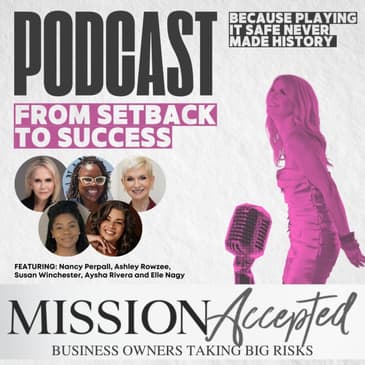
Repeated firings, unhealthy workplaces, systemic bias, perfectionism, alcoholism and childhood trauma. These are things today’s guests experienced and pushed past to create unmitigated success for themselves. Instead of letting negative events define their future, they took the feedback and adjusted their trajectory. Listen as successful entrepreneurs Nancy Perpall, Susan Winchester, Ashley Rowzee, Aysha Rivera and Elle Nagy discuss how they flipped the script on their setbacks and created more powerful results than they could have imagined before. Be sure to take notes as these women share stories of transformation and what they’ve learned about how to truly create the future you want.
Websites:
https://enlightenedcommunicationinstitute.com
Nancy Perpall - nancyperpall.com
Susan Winchester - susanwinchester.com/
Ashley Rowzee - floridamanresidential.com/
Aysha Rivera - www.whole-fit-method.com/
Elle Nagy - ellenagy.com
[00:00:02] Deborah, with her 30 years of being an entrepreneur and creating over seven companies, knows exactly what it means to accept the mission. When you make that decision, when you accept the mission to become a solopreneur, to take yourself and your talents to market, then you embrace a life of not only unlimited possibilities, but also the unknown. It's an elixir of fear and bravery that only someone who's taken the leap really understands.
[00:00:28] On our show, Deb digs deep with her guests to highlight what you, the listener, wants to know. The stories, the whys and the hows to navigate the journey to success. Get ready to hear from some of the most incredible mission takers from Generation Z to boomers. So sit up, perk up and get ready to be blown away. Now here is your host, Deborah Drummond.
[00:01:12] Oh my goodness. Welcome back to another incredible show. Mission accepted on you today. What are you guys doing out there? What mission did you take on today? I want to hear about it and you know I do. And the one thing that I want to just pour love onto you is that you are constantly telling us the shows that you're watching, the lessons that you're learning. And I tell you, don't just tell us.
[00:01:38] The speakers and the guests that are on mission accepted, they want to hear what you're doing. They want to hear how they're making an impact. So make sure you reach out to them. And I know that you are. So thank you so very much. I get to say that you are the best podcast audience. And maybe not just with me, but with me, you're absolutely fantastic. So thanks for coming back again this weekend. Appreciate your enthusiasm. Now we always kind of tell you how you're going to feel at the end of the show today.
[00:02:06] And at the end of the show, you're not going to only feel hopeful. You're going to feel like you have fortitude. You are going to be so you're going to feel so capable of handling everything that's going on in your life or may go on. Because I tell you, now look, we have all the women today. I don't know how that happened. But lucky you. We have a group of incredible women that are going to be sharing with you. Kind of how they've done a turnaround moment. You know, we have these moments in our businesses.
[00:02:35] And I know that a lot of you out there are doing business. You're entrepreneurs. You're authors. You're doing things beyond maybe what you thought you were ever going to do. And sometimes things, shall we just say it, get a little funky. They can get a little funky. Things can just go a little sideways. And, you know, people will say to us, well, you never know what's going to happen. Or, you know, isn't there a movie out there called Silver Linings? So there's all these ways that people tell you that things can turn around.
[00:03:03] But isn't it nice when someone's gone before you? And they can actually tell you a story how they turned something around. So I'm going to introduce you to these incredible women. They're going to tell you a little bit of something about themselves. And then we're going to kind of get into it a little bit. We're going to hear how they had their turnaround moment. So, you know what? This is where we can kind of just wave, ladies. I'm going to introduce you. This is, so as I call your name, Ashley, just give us a little wave. So people that are viewing and not just listening.
[00:03:33] And then we've got Aisha. Oh, my gosh. Give us a little wave or, you know, another little sign. And then Elle, please just give us a little thank you. And Nancy, let us know. Awesome. And then, of course, Susan. All right. So we're going to start back with Ashley. Ashley, if you can just give us a little bit of, you know, tell us your name and what you do. And we'll take you from there. I'll kick this show off. Hey, everyone. My name is Ashley Rousey. I'm the owner and CFO of Florida Man Residential.
[00:04:03] You're going to apply and repair experts. And what I have brought to the table is bringing corporate concepts to the trade. I am elevating the conversation. And it's more than just bubbling and a trap. We're changing the conversation. We're having women in the trades. We're having women of color in the trades. And so I'm super excited about the changing climate. And I'm just here to talk about all the things that I've been through and how I can help everyone. Thank you so much. Thank you so much. Welcome to Vision Accepted.
[00:04:32] And Aisha. I'm Aisha Rivera. I'm the creator of the Whole Fit Method. I take the approach of reducing stress as we build muscle. More importantly, growing bone density. And this is important because there's a lot of early loss to preventable disease that actually is related to muscle and bone loss.
[00:04:55] And so for the woman who's showing up and she's being dependent on by everybody else, when she works with me, she can finally keep up with the pace that life demands. And her body no longer has to pay the price. So I take care of those women, so they can take care of everyone else. Awesome. Thank you so much. And Al, hello. Hello, everybody. My name is Al Nage. I'm a Rich Life Advisor, author, and the creator of Women Reimagined.
[00:05:25] So I work with ambitious women who have mastered the art of achievement, and they are craving a life that's more at ease, flow, hell of a lot more fun. And where things that really matter start growing naturally instead of having to be forced. So the work that I do is deep identity recalibration to the next version of who she came here to be so that she can create life on her own terms. Oh, my goodness.
[00:05:55] This is going to be quite a show. Nancy, thank you. Oh, Nancy, we just need you to unmute there. No worries. Hi, I'm Nancy Papal, and I began my professional career as a critical care nurse working in the emergency room and intensive care. For reasons I'll explain later, I became a divorce attorney, and for over 30 years, I helped my clients take their marriages apart.
[00:06:25] Now my mission, as the author of The Malnourished Marriage, Five Essential Emotional Nutrients for a Healthy Relationship, I'm trying to help people keep their marriage together. And I use a food metaphor to explain why so many couples really hunger to have the love that they had for each other again.
[00:06:46] And then they thirst for connection so that they can quench the pain of marital loneliness. And that's my mission. Beautiful, beautiful. Thank you so much. And Susan, please share with us. Hi, everybody. I'm Susan Winchester, and I spent nearly 37 years in the corporate world, 16 and a half of those years as the chief HR officer for a Fortune 500 and a Fortune 150.
[00:07:16] And I'm very happy about my career. I had a wonderful career as the chief HR officer, and now I'm loving my part-time practice, executive coaching. I'm an international bestseller. The book is called Healing at Work, A Guide to Using Career Conflicts to Overcome Your Past and Build the Future You Deserve.
[00:07:36] And so I get the privilege now of working with people, helping them to understand how much our unconscious beliefs and experiences from our childhood are actually affecting us every single day in the workplace. And I am basically guiding people to understand how to understand those past experiences and have a totally different experience at work. My mission is to change how people experience work so it's not stressful and it actually becomes joyful.
[00:08:04] And that's what I'm on a mission to do. What an amazing room. This is going to be a fantastic conversation today. All right. So, Ashley, I'm going to go back and talk to you. And ladies, the same question for all of you. I mean, look at, you know, we've had a couple of days back-to-back on the planet. We might have had a heartbreak or two that may not have been from a well-nourished marriage, but it may have been from life, right?
[00:08:33] There's been things that we've had to recover, turn over, learn more about ourselves. I'm sure, Susan, that you've talked to a lot of people that have had to learn more about themselves. There is things that happen in this beautiful world of entrepreneurship that may have seemed unfavorable or at the very least uncomfortable. So if you could share with us maybe your experience with that and how and what you did to turn that around.
[00:09:02] So, Ashley, we'll go back to sharing with you. Okay. Something that's so unfavorable for me was getting fired and then getting fired again and again. And I think what that taught me was that, hey, maybe you're trying to do something you were never meant to be or do. So I've always been an entrepreneur. I've always had a side hustle and I always did that with my job.
[00:09:27] And so as a result, I kept getting fired and I was a real follower. I was doing all the right things. But I also felt like I was outshining everyone or doing too much or, you know, just doing too much. And I just felt like I don't want to put bars on my success. And the firing was kind of like a wake up call to say, hey, maybe you should just become your own boss instead of keep trying to fit yourself into a mold that you were never meant to be in.
[00:09:57] Wow. That's a that's a complete turnaround. Yeah. That's a complete turnaround. All right. You too can start your own business. That's amazing. All right. Aisha, and what about for yourself? Well, almost similarly, but after 16 years in human resources, the company I worked for lost their contract. So I wound up losing that job. But during COVID, I had to move four different times. And so during those moves, as you know, that can be very stressful.
[00:10:27] One of those moves, though, I was with a friend who's a medical student and I watched her eat Uncrustables and sugary coffee drinks every day. And I was very confused by that because, as I mentioned earlier, I've had family loss to preventable disease and I didn't understand how she could be in medical school and doing this. So as I was trying to teach her about whole choices, I decided to put my own knowledge to use and decide to pursue some education in nutrition coaching and personal training.
[00:10:56] And I but I kept holding on to those administrative positions, maybe like Ashley. I just kept going back to what I thought I knew for stability because I was also a caregiver and being a caregiver. Many people will know, even if it's raising your children, it's it's rewarding, but difficult, you know. So at that time, I started to realize the importance of stress, managing stress through these times.
[00:11:21] So I pursued more education, but it was a medical assisting, realizing then that definitely health care, not that it's bad, but many times it's treating symptoms instead of long term health. So I realized then it was important to invest in again in some education to become a strength and longevity coach to really help people on the preventative side. So that's how I started the whole fit method.
[00:11:47] And it's been wonderful ever since I've had clients just this week reporting 22 percent muscle math growth. So I'm very proud and happy for them and happy to be a part of helping women be successful in their taking care of themselves as they take care of others. Wow. So those are two very interesting turnarounds. Similar, similar where there was a bit of a wake up call and something wasn't working.
[00:12:13] And I can't I think that's, you know, I think it's really interesting that you were watching your girlfriend or your roommate and that that was a turnaround for you. Like, I don't know how someone who knows so much about something, but I think that's so common. Right. I think it's so common, not just because someone does it for a living. Sometimes they just do the completely opposite. And I think that was what that's a mirror. Right. Like what are what an incredible mirror for you. L, what about yourself? Has there been something that's been unfavorable?
[00:12:43] That's happened in your business that created a turnaround? Yes. So this one for me was really interesting to think about because my greatest failure was building a successful business. Well, I woke up to the realization that I had created a multiple six figure business in the way that I was taught to build it through hustle and grind and doing everything in a very driven way.
[00:13:11] And realizing that it hadn't changed my internal experience of myself or my life. You know, I was successful, but I wasn't happy. I wasn't feeling fulfilled and I didn't have a rich experience of my life. And so my solution to this was to actually do the thing that everybody thought was crazy. I walked away from it all. I closed down all my social media.
[00:13:40] I stepped away from my business. I left my marriage and I even changed my name. Not because I was running away from a life, but I knew that I did not want to create the same life moving forward from the identity that had carried me for more than 40 years. So for me, the greatest wake up call was if you were looking backwards, did I want that experience moving forwards?
[00:14:09] And the pivot for me was the identity of who I am. And that created the business that I have today. Wow. Powerful. I'm having some powerful moments with you ladies here today. Nancy. Well, when I was a nurse, I collaborated on a textbook, Advanced Concepts in Clinical Nursing, which was published in 1974.
[00:14:36] And many of the hospitals in Philadelphia, because the collaborators were from University of Pennsylvania, adopted all of the protocols that we had for better patient outcomes. And many other hospitals throughout the United States also adopted them. It was a very successful book, very well recognized.
[00:14:59] But the hospital that I was working at in Allentown, Pennsylvania, in the emergency room, did not adopt those protocols. So I went to the administrator and I asked, why aren't you adopting the protocols that all of these other hospitals, Pellett, Penn, Temple, Honneman, they're all adopting them. Why aren't you adopting them? And she said, Nancy, you're a nurse. We only adopt protocols that come from doctors. This was 1974.
[00:15:29] So I was very distraught and walked down to the emergency room to resume my shift. And the resident said to me, what is wrong with you? And I told him what happened. And he said, go to law school. They listened to lawyers. So I did. And then after I graduated from law school, I was hired to do defense malpractice because of my medical background.
[00:15:53] And the first day on my job, there were 75 divorce files on my desk. So I went to the managing partner and explained that I really was not interested in divorce work. I was going through a divorce and I was tired to do defense malpractice.
[00:16:11] And the managing partner reached over his large mahogany desk and put his finger an inch from my nose and said, you're not going to make it here until you unless you do what we've assigned you to do. So what I did was what they assigned me to do. Six years later, they lost the contract to represent physicians in the medical malpractice cases.
[00:16:37] And I left the firm, started my own practice with 125 divorce files that I had worked while I was doing litigation in defense malpractice. Six years after that, I was appointed by the Supreme Court of Pennsylvania as chair for the Domestic Relations Rules Committee, a very coveted position. So there you are. There you are. Listen to these incredible turnaround moments. All right.
[00:17:06] Susan, turnaround moment. Okay. My turnaround moment took me a long time. So I mentioned I was in the corporate world for 36 years. And what took me a long time to figure out was that 30 of those 36 years, my success was fueled by my underlying limiting belief that I wasn't good enough. And that transformed into being an overachiever, perfectionist, workaholic, and actually eventually alcoholic.
[00:17:36] And what my experience was, it was very much related to my own past, my own dysfunctional family. And what I realized doing a lot of research is that nearly two-thirds of us grew up in childhoods where there was some significant trauma. And mine was related to a dad who was unpredictably raging and very scary. And so I believe that it was everybody else's job to determine my worth and value.
[00:18:02] And my job was to be as perfect and people-pleasing as possible to earn that validation. And I will tell you that this was a dysfunctional, suffering experience. I always felt like I was spiraling into a pit of painful emotions.
[00:18:17] And my turnaround came, and it took time, but came from the writing of the book that I did with Martha Finney, which is starting to connect our experiences at work, how we think about ourselves, how we think about others, especially people in authority, and how connected that is to our childhood past.
[00:18:35] And as we started to understand this dynamic, sitting in the seat that I was sitting in as a leader in HR, I could see so many people that I was working with struggling with some of the same things, beating ourselves up, working too much, and then using unhealthy self-soothing habits to self-regulate. And as I became more and more aware of how unconscious I was, we can't change what we can't see.
[00:19:01] And as I started to really understand this dynamic, it really changed my whole experience of the workplace, particularly difficult people in the workplace, particularly conflict in the workplace, that those were trigger moments for a lot of us. And what I was able to do with the turnaround was to realize that we have agency, we have the capability to evolve and understand our unconscious beliefs and our old patterns.
[00:19:26] Mine were people facing imperfectionism, other people become bullies, some people hide, and some people are constantly leaving companies. And so that was the turnaround. It was a long journey. It took me, I think, 17 years to write the book. So I was a slow learner on this journey, but it was a major turnaround to start to realize that I was coming from victim, villain, and martyr, and judging and blaming a lot of people that I was working with, especially a lot of bosses.
[00:19:54] And that actually the opportunity and the turnaround was realizing that I can become a leader of myself and managing my own interstate and then teaching executives and leaders all over the world how to do the same thing. That was my turnaround. Wow. Wow. Well, hashtag borrow bravery from you ladies. Like, you know what I mean? I don't think if someone's like sitting out there and going, there is something that I need to turn around in life because many times it's only hitting one aspect of us.
[00:20:24] And sometimes it sounds like there are situations where it was hitting all of you. But here's some hashtag borrow bravery. Absolutely. So I'm going to ask two questions in this last question. And we're going to go around in the same format that we've done before. One, is there anything that you had experienced before this moment where you had your turnaround that you were able to borrow from?
[00:20:49] Like, you know, sometimes we've had a situation and you were able to borrow from that.
[00:21:24] Why was I fired? So it was just things like consistency, following through the certain structure. And I didn't realize I had undiagnosed ADHD. So I was I had all the superpowers that I could do anything.
[00:21:41] But I've been able to draw from all those things that I struggled with as an employee because they're looking me in the face as a self-employed individual where I see like, have you checked your voicemail today? Did you follow up on that? Though you followed up, did you follow up to the follow up? And so I would definitely say to anyone here, I would just say fail forward.
[00:22:06] So as I know that I'm not perfect and I know that I'm finding this balance of being unmedicated and also trying to find the balance in this world where I'm a little bit different, a little bit quirkier. I'm leaning into my differences and acknowledging what I do well and creating systems. And if I need to delegate something to my assistant, I delegate it to my assistant instead of struggling through. So my takeaway is fall forward.
[00:22:34] So if you know that you're setting yourself up for failure, don't do that. Change it. And also, you now know how not to do it. And at least you're one percent better every single day. I love that. I love you delegating things. Right. And the decision not to struggle like it really is a choice. Right. It's a decision not to struggle. It's a decision to hire someone.
[00:23:00] But it is another piece for a strong minded entrepreneur to give jobs for them to do. Right. Let them go through their learning curve in terms of hiring people to take over things that we felt we had nailed down. I absolutely love that. Aisha. Aisha. Well, okay. You asked that question a little different than I was expecting. But I like the way you asked it.
[00:23:25] So I'll just say that endlessly giving to others feels admirable. But it is the opposite of what you're going to actually achieve. So it's very important to find not just balance, but the idea or understanding that managing your stress is essential, not just for your emotions, but for your actual bone and muscle mass. You break down physically.
[00:23:53] And you will be unable to give to others the way you want to. So giving to yourself the time that it takes to de-stress and then build a body that will be able to manage life's demands is extremely important. So what I learned, I learned that from watching family members try to endlessly take care of others and eventually had their own downfall. And that was very sad.
[00:24:18] So I'm looking to help others to do their best to continue on in that. And the one thing, again, it would just be finding a way to get to bed early and finding a way to de-stress regularly, even if it's five minutes every couple of hours to take a walk outside. Very important for your long-term health. Fantastic. I love this. I love this.
[00:24:45] And Elle, so with your turnaround, was there anything that you had experienced in your life before that helped you prepare for that turnaround? And that one thing that is securing your success now that you can share with the audience? Absolutely. So I have a core belief that life always prepares us for the moment. So as I started looking back over my life, my first identity demise was at 18. You know, I started dancing at the age of five. And at 18, I smashed both my knees.
[00:25:14] And for the first time, I had to sit myself down and go, oh, my goodness, if I am no longer a dancer, then who am I? And this was a theme in my life. You know, I became a kickboxer and then had a cycling accident, had to reinvent my identity, went into endurance sports, became an Ironman, always had to reinvent my identity. So the business one wasn't my first identity demise, but it was the biggest one for me.
[00:25:42] But so life had prepared me for that. And I truly believe life always prepares us for the big moments. I think the one thing that I would leave the audience with is that achievement is a great slave, but a terrible identity. You know, my work today is in the understanding that I am the artist and the art of my life.
[00:26:05] So I am very intentional in the experience that I am creating for myself, in my business, in my partnerships, in my health, in my body, all of these things. Because life is just about the experience. It's actually not about what we achieve. If we are constantly seeking worth through the next achievement, we never get there.
[00:26:30] But when we start focusing on the presence of what is it that I want to experience in my business, who do I want to experience myself as? That's when we get to the winning formula. Wow. Thank you so much, my friend. And Nancy, yourself. We're going to get you to come off mute. No worries, son. I get it. We appreciate you.
[00:26:57] Well, when I was a nurse in both the intensive care unit and an emergency room, a patient's condition can decline very rapidly. And you have to be prepared to pivot from the treatment plan that they're on to a different treatment plan. And time is of the essence. And you have to keep your wits about you.
[00:27:20] And you have to control yourself so that everyone else in the team is also gets that vibe. And you can work together for the betterment of the patient. And I learned as a nurse that when life pushes you back, you have to push forward.
[00:27:42] And I saw that in so many patients who came through both the emergency room and intensive care, that they got pushed back, but they fought and they pushed forward. And I think that when you overcome obstacles, whether it's health or business, emotional, genetic, you have to push forward.
[00:28:08] And that's what, excuse me, someone said, you know, fail forward. And my position, my tidbit for the audience would be failure is not permanent unless you give it the power to be. And you were in control of that.
[00:28:30] And I think particularly women have the power to reinvent and reinvent and reinvent. Because historically, through the ages, that's what we've always done. And so I just think if you don't give the power to difficulty or disappointment, you can move forward. Oh, I like that. Oh, this is fantastic.
[00:29:00] I'm going to watch this over and over again myself. Thank you so much, right? I love that. I'm hearing so much about choice. I'm hearing so much about decisions. I'm hearing so much about hope and bravery and knowingness. I mean, when I listen to you ladies talk, I just hear this self-assured and knowingness. Love it. Susan. All right. So a big component of my turnaround involved getting sober.
[00:29:28] And I'm really grateful that God woke me up and basically said, you need to stop or you're going to hurt yourself or someone else. And doing a look at myself and then realizing that a lot of high-achieving perfectionist workaholics often turn to self-soothing habits, unhealthy self-soothing habits to manage their nervous systems. Because most of us never learned how to do that. And I think there's a huge opportunity for sharing with others.
[00:29:57] I'm very open on stage when I talk to people that I'm not ashamed of my drinking. It was all I knew how to do to manage my nerves and my anxiety. And there's always an opportunity to step off that path and to find healthier strategies, somatic practices, therapy, et cetera. There are so many other things that can help us regulate our nervous systems that I never knew when I was in my early days in my corporate life.
[00:30:25] And the other thing I'd share as far as a tidbit for people in the workplace, whether you're an entrepreneur or working in a big company, is that it's normal for us to crash into one another at work where we have an experience where we become upset or triggered by somebody, something they've said or done or something we've said or done that upset them. I call those moments bumper car moments where we're literally crashing into one another.
[00:30:50] And I would challenge the audience to think about their own bumper car moments and to start getting curious about what's the limiting belief that's getting activated here? What is my resulting pattern? And start becoming more aware and conscious of how those are influencing your experiences at work. Because when we take back control, like I said before, we can't change what we can't see.
[00:31:11] But the bumper car moment exercise is a great one to begin paying attention to what's upsetting you at work and then taking action to do something differently. Wow. This is a complete turnaround show. This is fantastic. If there's ever any show, and we haven't had one, that there's ever been like a tech issue, like I'm coming in on my phone, people, for those that are viewers, I was like, if there was ever a show that it should happen on, it's the turnaround show. I don't like that you're listening.
[00:31:40] And I love the reflection of self. And I love the inquiry to the audience to do the same. Right? That's really, I think, one of the most powerful things around is perspective. Is perspective to your situation. How grand is it? Doesn't mean it's not grand. It doesn't mean that you make it smaller than it is or bigger than it's not. It's just how has it affected you? And what someone else could have breezed through could have been the thing that was the catalyst for you.
[00:32:10] Like Nancy, that person putting their finger in your face and saying, that's how it's done here. And what ended up happening and where you ended up being is so individual. Right? It's so individual. I just feel a lot of love and a lot of power and a lot of wisdom in this episode today. Right? So I inspire to ask the audience to dig a little deeper and get to know these women. It's incredible.
[00:32:38] And I'm also going to inspire you to come on and be as transparent as these women have. I think that there's a lot of power. There's a lot of power in the allowance to be vulnerable. I love, Susan, your bravery on stage because it stops the this only happens to me. It stops the inner isolation that entrepreneurs experience enough.
[00:33:04] Most of us are going to work in our own offices, which is not far from the fridge. Let's face it. Right? There's a lot. Right? Post days are different or you're at a cafe at best. Um, and I think it's really important for, uh, entrepreneurs or people that are doing this solo journey to not feel solo. And I believe that one of the activations for that is people being transparent. Um, and that certainly was the case today on a powerful group.
[00:33:33] So I'm very grateful for you sharing. I want to talk to the audience. If you feel like you have a story to share, we want to hear from you. If you have a book that people need to know about, we want to hear from you. Yeah. You didn't write that book as an, as a diary to yourself and not to be read, not to be read by others. So we want to hear from you. We want to have you on the show and we encourage you to share with us. What is it for you? That was your turnaround moment.
[00:34:00] It could be something really personal that happened in your personal life that activated something in your business life. Because we know that those two things live pretty close. They live pretty close. You know, they say where you go, we follow. So where you go in business to follow, where you go in personal, they tend to cross over. Ladies, thank you so much for your sharing. Thank you so much for what you do. I love the variety of this incredible group that showed up today. And thank you for taking the mission. We talk a lot here about the middle.
[00:34:30] You know, it's one thing to decide to be entrepreneurs. It's one thing to put your forward, you know, put yourself out there and move forward. It's another thing to go through the middle and then the evolution of who we are becoming. Who we are becoming. Even those of us that have been around for a little while. There is an ongoing who we are becoming. So I appreciate that. I appreciate you. I appreciate the audience. And with that, I'm going to end, as I always do, telling everybody to be well. And you show you'd love that.
[00:34:59] We tell everybody to be well. And honestly, stay groovy. So bye for now. Thank you, ladies. Peace.