
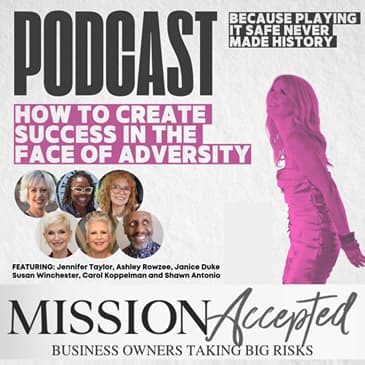
Today’s guests embody the words “Go big even if…” They’ve experienced major setbacks—traumatic brain injury, false murder conviction, death of a parent and caregiving for another, a near-death experience—the kind of experiences that would make some people pack up and quit. But, like you, they are wired differently than most people. Listen as they share how they recovered, developed the courage to keep going and came out stronger on the other side. Each story has real, practical wisdom you can use as a guide when things get hard. Instead of sob stories, these are tales of conviction, persistence, love and redemption that will inspire you as you tackle your own challenges.
Websites:
Jennifer Taylor: https://resiliencebrilliance.co
Shawn Antonio: https://shawnantonio.com/
Ashley Rowzee: https://floridamanresidential.com
Susan Winchester: https://susanwinchester.com
Carol Koppelman: https://cpksolutions.com
Janice Duke: https://janicedukecoaching.com
[00:00:03] Deborah, with her 30 years of being an entrepreneur and creating over seven companies, knows exactly what it means to accept the mission. When you make that decision, when you accept the mission to become a solopreneur, to take yourself and your talents to market, then you embrace a life of not only unlimited possibilities, but also the unknown. It's an elixir of fear and bravery that only someone who's taken the leap really understands.
[00:00:28] On our show, Deb digs deep with her guests to highlight what you, the listener, wants to know. The stories, the whys and the hows to navigate the journey to success. Get ready to hear from some of the most incredible mission takers from Generation Z to boomers. So sit up, perk up and get ready to be blown away. Now here is your host, Deborah Drummond.
[00:01:14] Welcome back to yet another incredible episode of Mission Accepted Media. And thank you, thank you, thank you, thank you, thank you. Look, there's podcast hosts on here, but I'm going to say this anyways. You guys have been rocking it. I see that you every show because it somehow inspires you to keep telling me what you want to hear. And it's moved us from 5% in the top podcast to 3% in these last couple of weeks. So yay you, yay you.
[00:01:40] And today, today you are in for, you know, this is one of our most powerful shows that we do all month. And it is a group podcast. And you have, you have caliber of correction on here today. You are going to feel like you have a solution to every problem. All right. This is talking about the messy middle of taking on that mission and what that looks like and how we get through it with smiles on our face. Whether we feel like it or not. All right.
[00:02:10] So we're going to do a great podcast for you. And I want to introduce you to these incredible people. Now look, as we go around the room, I'd like to your first question, lovely people. Lovely people is tell us who you are, what your business is. And can you share a defining moment that your business faced like a major setback? Or how did you overcome from something like that? Like, was there a moment that I, if I say to you, was there a major, ah, you know, that you had to come up against?
[00:02:40] Can you just, you know, shed some light on what that was? Because really what we want to do for you today, when we say there's a solution to every problem is we want you to see that you're out there and you're making change. You might be in the messy middle of your business right now. You might be at the beginning of your business right now, or you might be on a complete high. And you've also overcome some things. And we just want to let you know that there is that solution to every problem. And you're going to hear from some experts that are in the game. They're moving forward. They're changing. They're change makers. They're trailblazers. They're all of it.
[00:03:10] And somehow we got them all to show up today for you. So get your pen and paper ready unless you're driving. You just keep going. And we're going to start off with the beautiful Jennifer. Jennifer, please tell us who you are, your business and a moment like that. Absolutely. Thank you for having me here, Deb. Great to be with all of you people. My name is Jenna Taylor. I'm an author, speaker, resilient strategist, and a transformational guide. And my business is Resilience Brilliance. I was a marketer before. And life changed things for me.
[00:03:40] And I just kept having to overcome one adversity moment after another. And it takes me back to 2017 when I had a traumatic brain injury that left me unable to walk, talk, or form new short-term memories. And as a single person, sole business owner, it was devastating on all levels. And I gave myself a full year to physically recover from my injuries.
[00:04:09] Decided that after a full year, I would decide, well, what could I do? Could I still do what I do? Or do I need to adapt? And it didn't matter how much money I spent. Because if in a year, I was bankrupt, I was living on Social Security, it didn't matter. So I've come a long way. And within 10 months, I was hired by IBM Watson Health to write copy. And the one thing I haven't told you is, I had this condition where I couldn't come up with words.
[00:04:38] And as a copywriter and a marketer, you really need your words because it's a career killer without those. And I decided I was going to go transparent and let people know that I had this brain injury. And as soon as I made that decision, the flow of work came to me. Wild. Fantastic. Thank you so much for sharing. And Ashley, yourself. Well, my name is Ashley Rousey and I'm the owner of Florida Man Residential.
[00:05:08] We're a family owned appliance repair business. And my moment actually just happened. I actually just got out of a month long stay at the hospital. I had a dermal cyst that ruptured and I lost my appendix. And I definitely had this moment as somebody who operates a business with her husband, where I wasn't there. The person that kept the business running wasn't there to help run it.
[00:05:37] And I wasn't there to support my spouse who I was, you know, filling in the gaps of his strengths, my weaknesses, where we were batting off of each other. So it's been quite a journey coming back. Wow. Wow. So glad you're back, girl. So glad you're back. All right. Susan, please tell us about you, your business and a defining moment. Sure. I'm Susan Winchester.
[00:06:02] And my business is all about teaching people how to use workplace conflict as a catalyst for emotional healing. And my setback was when I first stood up my business back in 2021. It was very much a model of digital business, webinars, courses, et cetera. And I had a big infrastructure, a lot of people working for me, and I realized I didn't like it.
[00:06:31] And it was a big thing to switch operating models. It took me about four years to figure out what I needed to do differently. And I was very blessed to get this visualization when I was in a meditation one time that basically said, you want to do the work you love with the people you respect and admire. And I completely changed the business model to being one that's primarily executive coaching and work related to healing at work. And but it was hard to let go of that. Wow.
[00:07:01] Heartful. Thank you so much for sharing. And Carol. Hi, I'm Carol Koppelman, CBK Solutions. I'm an author, editor and a podcaster. And I believe a couple of years ago, my mother, my father passed. My mother, I became a part time caregiver. And my husband was also in the hospital a couple of times during that year. And that was a tough year.
[00:07:24] But the resilience I learned from that was I had to make quick decisions and I don't have to analyze anything too much. So that was actually the skills I learned during that time have helped me increase my business. Wow. Thank you for sharing. Incredible. Incredible. And Shauna, yourself, tell us a little about you, your business and a moment in time that you remember that was a short backer. Yeah. Yeah. Big talk. Hi everyone. I'm Shauna Antonio from Shauna Antonio Life Coaching.
[00:07:53] I am an international life coach. I speak five languages. I transform people's lives all over the world. I'm also a keynote speaker and author. I wrote two books called Be the Beast You Are and Having Amazing Relationships both on Amazon. They change people's lives the minute you touch the book. A big setback. And I'm based in Hollywood, California. Love it here. A big setback. I was falsely accused of a crime I didn't commit in 2017. And I was thrown in jail for four months.
[00:08:17] I spent $250,000 to clear my name and unfortunately had to take a plea deal. So I went to jail for four months. So it was really tough. I had to reinvent myself in there and find out what kind of grit and resilience is the word I keep hearing you guys say. That I had to build to get through that moment. I had to stop my coaching business for those four months and tell all my clients I was going to jail. When I came out, I had to reinvent who I was, clean up and mess up. And I started doing survival podcasts and appearances based on surviving trauma and tragedy.
[00:08:47] So that thing gave me the edge and the nice guy thing I had before that whole moment. That guy died. The guy you see now is a guy that's unstoppable because of that moment. That's me. Wow. Wow. Thank you for sharing. Right? Powerful. Powerful. And Janice, for yourself. Well, I'm Janice from Janice Duke Coaching.
[00:09:06] And what I'm doing is I'm supporting single fathers, single parent fathers who may have custody, may not have custody, may just not know how they can handle it, may have been told they can't handle it. Or maybe they're just struggling because they've got a childhood wound as well. And they don't want to bring that into their parenting. And this came about because I had a really great relationship with my dad.
[00:09:33] And we did so much together that I just sync up with men and I understand how they talk. And my setback came when the money that I was using for my business was kind of gone perch and the business funding was temporarily shut down. But then I was also diagnosed with breast cancer. And so I go in for surgery next week. And it's not going to be too serious. I'm not taking it seriously. I mean, somewhat seriously.
[00:10:03] But I really want to take my business seriously. You can be resilient. You've got to have a good mindset. And that's what I want to bring forth to the dads that are coming for coaching. Wow. Fantastic. So interesting, right? I mean, the thing when we meet people and we, you know, whether it's a networking group or a cafe or a social circle or what have you, we never really know what people are going through. But what we do now, listeners and viewers, is that all of us go through something.
[00:10:32] And someone else's setback can be someone else's momentum. We know that when we share how we do and how we get through things, that's where the powerful learning comes from, right? Because when you listen to people that are going through things, whether it's relatable in relationship to the exact thing or not. And that's what we're going to do next. So I would love to find out, Jennifer, we're going to start with you.
[00:10:57] Like, what mindset did you have to take on to help you navigate like the uncertainty or the possible rejection or the fear of losing business or with your situation? I mean, that was one monumental. But even just in general in our business, we hate to say it, listeners, we probably have more than one. So, Jennifer, if you could share. Oh, we can't hear you, honey. So we can't hear you. Yeah.
[00:11:25] As I said earlier, it was that decision for me to go public with my brain injury was frightening. And I had to have the courage to own it, face it, because I'm congruent. I'm a very transparent person and I needed to be congruent. I couldn't go out there and be a hypocrite. And so for me, I had to separate my worth from the outcome. I had to gamble.
[00:11:53] I had to take a chance on myself that doing the right thing and staying congruent with my belief system and my integrity was going to reward me. And that's what it did. So that was the mindset. Mindset was a value based mindset. Right. Yeah. Awesome. And Ashley, for yourself, how did you get around the hat? Yeah, I just had this mantra in my mind of being one percent better every day. I took that with me in the hospital.
[00:12:23] I mean, we had to be honest with our clients and say, hey, you know, part of our team is in the hospital. We are shutting down the business for a very temporary time. And it was literally me coming out of having a tube down my throat to being able to walk the hall to be even able to like communicate on my phone because I was literally one percent better every day, even while in the hospital trying to talk to customers, trying to market, trying to keep my business alive.
[00:12:53] And yeah, so one percent better every day. That was how I was able to keep going. That's a powerful mantra. It's a powerful mantra. And Susan, I know in your work, you talk to many people that have all sorts of things that have their own issues around. I'm fearful by talking. I mean, that's what your whole work. But for you, what was the mindset that you had to take? You said it was a four year process. So what were you thinking?
[00:13:19] Well, the mindset for me, and it's been consistent not only with my my current business, but also when I worked in the corporate world for 36 years. And that is recognizing that moments are going to happen at work and we are going to get triggered. Something's going to upset us. Maybe a client like I had one client during this time period when I was trying to decide my operating model. I spent months with and then he just disappeared. And so the normal response for me would be to blame myself.
[00:13:49] I've done something wrong. Did I did I, you know, did I screw up? What happened? And so the mindset is really recognizing when we're demonstrating limiting beliefs about ourselves and our patterns, people pleasing, perfectionism, whatever is playing out that we have an opportunity to actually take those moments and understand that it's we have an opportunity for learning. So the mindset is recognizing I can release that emotion.
[00:14:17] Research shows that we can do that quickly. Very cool. Very cool. Thank you for sharing. And Carol, for you, what was the mindset? Well, I went the whole gamut as we often do, but I gave myself grace. I had to learn and get out of the perfectionistic streak and give other people grace and just not be too attached to it. The outcome. Mm hmm. That's a powerful mindset. Not being too attached to the outcome.
[00:14:47] I smell a little faith in there. I have a little faith in me. All right. Not me, but you know. Okay. You got a song today. Sean, for yourself, what was your mindset? You had a big one, you know? Yeah. I mean, yeah, mine was really simple. I just stating that this is just a moment in time. This doesn't define me. I just happened to be a statistic in the system of American like sent the system that was broken. I got to be an example. And because I was so I am so loud.
[00:15:17] I am such a big personality. I'm so proud of the impact that I going through that publicly, by the way, went viral. Um, everyone really came back to me with great feedback, like how strong I was, how resilient I was, how powerful. So I was in tears a lot. Tears of gratitude. So I just stated that I matter. I make a difference. I belong here. Right. And I have to get through this. It's just a lesson. This is going to be one of those tough lessons. And I kept that really public and just showed up for myself and others. That simple. Wow. I'm loving this. I'm loving this.
[00:15:46] Thank you so much. And Janice for you mindset. My mindset was remembering why I was doing this in the first place, why I took the IFS training, why I took the coach training. It was because I realized that this was a niche that wasn't getting help anywhere else. And if if I wasn't going to help them, where were they going to go?
[00:16:07] And looking back on some of the messages that I'd received from some of the men, looking at the problems that they had and thinking, I know what to do because I've got the training. So I know what to do, but they don't know what to do. I need to stay in the game and I need to see it as a long game. So, so that I'm still there. I love that. Okay. If you are out there, see it as the long game. Um, so I, I love Sean, we talked about gratitude.
[00:16:36] And when I ask you this question, you're probably going to have some sense of gratitude or I'm hoping what you think about is maybe someone's base comes to mind or, or something that you relied upon for me. You know, I could probably give a thanks to every band from, you know, one era to another, but, um, who or what?
[00:16:55] So Jennifer, when you go back to you and who are what became your biggest, biggest source of support, whether it was a person, was there was a thing that you did during tough seasons or tough times, whether it's the top experience that you just talked about or any season. Cause we go through seasons, right? We go through seasons. Sometimes we, you know, we harvest and then, you know, so. For you, where are you relying upon a source of support?
[00:17:21] Well, when I couldn't take care of myself, my tribe, I was alone. I didn't have any family support. Um, my tribe became everything to me. There was a meal train. People drove me everywhere to my appointments. In fact, one, one friend just said, I'm going to be your professional driver. She also was the one who helped me when I thought I might be able to drive again when I passed the, the, the, the speed test. But I wasn't ready to drive. Um, so she was there.
[00:17:50] I, I had people doing chores at my house. I couldn't, I mean, I couldn't do anything for myself for like, for, I think it was 14, 15, 16 weeks. So that's a long time for an independent person to have to rely a hundred percent on other people. Um, and aside from that tribe, it was my caretakers, like my professional neurologist, my physical therapist, my cognitive therapist. And I was there, my belief and them telling me that I was going to get well.
[00:18:19] I put everything into that. And then I did my part and my job, my full-time job was to get well and to become the best version of this new person that, that you see today. Wow. Thank you so much. Thank you so much. And Ashley.
[00:18:36] You know, I'm just going to have to give this to my husband, um, the mister to my missus, Andrew, because just recently, like I said, I was in that 30 day hospital stay and he helped, you know, put a GoFundMe together, um, which actually raised over $15,000. I just was blown away by the community and support that I had. And, um, he had to make medical decisions for me and impact our future.
[00:19:02] I mean, he, we had to basically, um, take away one of my, um, ovaries, which, you know, you kind of need that for your family planning. And so we've had to have conversations. So my husband was very supportive in this tough time when they say in sickness and in health, indeed, it's my spouse and business partner. And so I'm just very thankful because it could have gone a different way, um, under the pressure and the pressure was great.
[00:19:30] Um, especially because our business and personal life is greatly intertwined. And I know a lot of people are in similar situations as, as we are. Yeah, absolutely. And business partnerships and investors that are in business and all the things that can be affected when there's an upheaval like that. All right, Susan, and for over for you. Thank you, Ashley. Yep. My support has been a coach. I invested in a coach a number of years ago when I was still working in the corporate world. And this woman is amazing.
[00:20:00] You know, as a coach, I've learned a ton from her relative to how to support others. But one moment that really stands out for me was her recognition that I was addicted to anxiety. And we had some of the best conversations around understanding how I love that adrenaline, the cortisol, the rush that was going through me. And through some amazing work she's done with me, we've worked together for six years, I was able to call my nervous system and come back into a place of clarity.
[00:20:28] And I don't know what I would have done without her. And I work with her still. I just did a two day VIP day session with her. All about releasing grief. So, yes, I think it's important to have a coach. I'm with you there, sister. With you there, sister. This is not an alone journey. Absolutely not. Even I always say to people when sometimes people think of coaches, they think out six years and it may be that it may be that. But it also could be six days. It also could be six weeks.
[00:20:56] And sometimes you bring someone in just for expertise in one area. And then there's those people. Yeah. Coaches, counselors, experts, experts, all of it. This is not a solo. This is not a solo party. Carol. I had certainly friends and family, but unexpected acquaintances became very good friends and really supportive during that time.
[00:21:20] And also a lot of my people that I interact with online who are in networking groups unbelievably became friends and support during this period of time. So that was I felt very supported and very, very blessed. Thank you. It's interesting, isn't it?
[00:21:42] Like I know that when we do a big event, I always go on to Chris, you know, I have a large, some large communities and I always just do like this big shout out to like our Facebook family or Instagram family or whatever. And it's very interesting. The support and you see it like you see it when someone announces something that they need something and you just see it. People really do get to know you or the part of you that you share there. And it can make a difference.
[00:22:06] I always say, like, try not just a thumbs up, you know, maybe do the other emoji or send a few words or what have you. But it does make a difference for people's spirits for sure. All right, Sean. How about for you? Some of your. Yeah. Yeah. My gratitude is to Ashley's husband as well. So. No, but I'm I'm my grantee to my wife, Alicia. She's my business partner and my twin soul. We travel many lifetimes together.
[00:22:31] She took me to Egypt in 2011, woke up my soul, taught me what it was to be human, like spend two weeks in Egypt, redesigning myself. And when I did get false accused of my crime of murder, a gentleman unfortunately hit me and he died and I was dead sober and I'm black in America. Yeah. Right. So my wife in 24 hours, she posted on Facebook. She raised thirty six. Sorry. Thirty eight thousand dollars in 24 hours. That's who she was for me.
[00:22:59] She divorced me, which is a story I had in my head. Like, I'm in jail. I'm going to get divorced. My wife will leave me. She stood by me like a rock. So Alicia is my everything. 14 years married. We do our vows every year. Next year is 15. It's great stuff. Alicia Antonio, ladies and gentlemen. She's awesome. All right. There you go. And thank you so much for sharing. Janice. Well, mine is definitely my two sons. I have two great sons, 30 and 38, 39.
[00:23:26] We lose track as they grow, but definitely great support from them. Oh, probably a month before I got diagnosed, I met an absolutely wonderful man of after 17 years of looking for him. I finally found him. And so his support is absolutely tremendous. And the support of the work that I did, the support that I work that I did with the IFS.
[00:23:51] So the inner support that I have from healing the trauma that had got me stuck. And so that's been a huge support. Wow. Thank you very much. Okay. So what I'm going to do is I'm going to kind of clean slate and I'm going to take having this conversation from us to them. Right. Let's talk to the audience. Let's talk to the people that are going to reach out and have a further conversation with you.
[00:24:15] Let's put ourselves in their spot where they're having a season of either turbulence or disturbance. You know, sometimes you're just coming up against something that you don't know how to get over because you don't have the skills. Like, you know, it's not the end. You know, it's not, oh my gosh, do I stay or do I go? But you're coming up against something and you almost don't know what it is, but you just know that you feel stuck or you feel uncomfortable or it's not moving.
[00:24:42] All those things that we'd say that makes this that, you know, kind of gets in someone's head and goes, should I? Should I keep going? What's going on? Or maybe they are really in a season of turbulence where they're having big feelings and they're like, man, did I take the wrong road or should I completely shift over here or should I go back to working for so and so or should I do part time?
[00:25:08] Let's talk a little bit about talk to the audience with the skills that you all have in your brain to the world is what advice would you give to an entrepreneur that's in a season of that's in a season of. So, Jennifer, I'm going to go to you.
[00:25:25] Yeah, I would tell them don't make any permanent decisions if you're coming from a place of depletion, because if we're if we're not solid and we're not on solid ground, we're going to make decisions that could mushroom and make more consequences for us that we have to resolve. But resilience isn't about pushing through. It's about learning how to rebuild in a way that is sustainable.
[00:25:49] And so when you're exhausted or overwhelmed or feeling like everything is impossible, it might just need you need to look back at your start, your nervous system. What can you do to calm your nervous system? Sometimes I like to say, put your hand on your heart. And if you feel comfortable, put another hand over your heart and just breathe. You can do this. And by doing this, just touching your heart, you can calm that central nervous system.
[00:26:17] And, you know, also a difficult season doesn't always mean it's time to quit. Sometimes you just need to look at it like, is it an invitation to lead differently? So take take those moments to really reflect and see if it's something that you need to change or if it's something you just need to pay attention to and work on your capacity. It might not be you need to quit something.
[00:26:44] You might need to start adding things into your life that restore you. Thank you. Thank you. Great words of advice. And Ashley, for you? Well, as somebody who literally almost died, I literally am not holding back. Like, I'm looking at new opportunities.
[00:27:06] Like, as someone who had a lot of limiting beliefs, I'm paying the sponsorships that I was, you know, too quick to say, oh, no, I can't afford it. I'm getting rid of the books that I'm like, I'm not going to read those books. And these are the books that I need to read as a leader. Or I resigned from board positions and walked away from volunteer opportunities, like just holding on to things just because, you know, of a status or, oh, I'm a business owner. I have to look like this in my community.
[00:27:35] You know, now it's not FOMO. It's now it's like, OK, what is it that I really need to be doing right now? What is my purpose? Clearing away the distractions, leaping in with both feet and taking those chances and just living life like it literally is your last. And that I've been so clear, you know, because I have so much clarity and I've made so many changes in such a short amount of time.
[00:28:01] So living like today is your last day is literally will help you make the decisions you need to make in this season. Fantastic. Powerful on Susan. Yes. So when we're upset, when we're carrying emotional pain, we carry it in our bodies. And I love the heart analysis because that's exactly right. And the best way to process that, it's important to process it, is to use sound, movement or breath. Yeah.
[00:28:28] When we jump up and down, when we yell, when we hit our fists on a table or not a table, but a soft couch or something, we will start to release that. And one quick data point, there's a doctor, Dr. Jill Bolt Taylor, who studied how long does an emotion stay in the body physiologically? And her research showed it was only 90 seconds. And so after 90 seconds, if we're continuing to feel upset, we are unconsciously choosing that state. And so choose a different state because you can change that.
[00:29:00] All right. I feel the power train. I feel the power train. All right, Carol, over to you. I can echo what was said before. I'm a big proponent of somatic healing because managing your nervous system and remembering that you are not alone. Support will come from unexpected places. Very cool. Thank you so much. And Sean. Yeah, self-doubt.
[00:29:27] Deal with your self-doubt in any old narratives or old luggage that you're carrying that's not yours. Unsubscribe has been my mantra for the past couple of years with people. Unsubscribe to all the stories you told yourself, all the failures you had before, all the successes that you used to define yourself like you're a winner in certain categories. Like releasing all that stuff so to shove down the negative bias brain, really, really committing to a higher vision of yourself and get rid of anybody toxic around you or chaotic or distracting.
[00:29:54] And if it's you, look at yourself in the mirror and look at what you're getting out of being that person. You get to stay small. You get to be that person that lives in a victimized conversation. What do you want to be? And then step into that and actually really get rid of anything that's limiting, limiting mindsets. It's all garbage. Thorn garbage. Garbage. That's awesome. Thank you so much. And Janice.
[00:30:20] I would say there is so much wisdom in what everybody else has just said. There's a tremendous amount of wisdom and people would do well to listen to all of that. My little bit that I would add is very little, but trust the process. If you've done the early work and your niche or your business is solid, your idea is solid, just stay empowered. Stay resilient. Stay positive.
[00:30:48] Do the things that everybody has said and just trust the process. All things take time and delegate what you must, but really be the face of your business. Be honest with yourself. Be honest with others as others have done here and things will trust the process. Awesome. Look, I'm going to do a little homework for our listeners and viewers today. I want you to, when you can, and if it's right now, you're probably going to finish this sentence,
[00:31:18] you just heard a whole lot of power. That was a serious power train. So I want you to finish this sentence for yourself, for those that are listening. Go big, even if. And you fill in that blank. And as you're filling in that blank, we are going to do it just like this. I want you to tell me a song or a band or an album that makes you feel like you need to go big, even if. So Jennifer, what is it? Don't think too hard. I know. I knew you were going to.
[00:31:48] I'm not a big music person. And so I didn't know you were going to ask me a song about that. What would that feel? So I was like, thinking ahead, my song is Slow Down. It doesn't. It's not like go big, but. I don't know. It's the song. Yeah. If it's the song that you like that makes that it's juicy to you, then it's juicy to you. Okay. What's your juicy song, Ashley? Or band? Proud Mary. Proud Mary. I'm just. I can't let her on. You leave a good job. Just start my basement.
[00:32:19] All right. Susan, what gets you? Boop, boop, boop. Yep. Thunderstruck. ACDC. Oh, my gosh. I love it. Concert. All right, Carol. Who's juicing it? Who's juicing it? This girl is on fire. Oh, my gosh. Absolutely. Absolutely. And these are these are songs that you can listen to out there when you need to fill that and go big, even if. And Sean. Yeah. Mine is Kiss. Rock and roll all night. I want to rock and roll.
[00:32:49] Stronger. Oh, my. Everything. That's it. That's me. All right. Janice, wrap us up. Okay. BTO taking care of business. Oh, my goodness. Oh, my goodness. They just thing here. Yeah. Okay. So see how it just changed? How you guys are feeling? That's definitely how it's what it's doing for our audience and our listeners. I want to thank you for being here and sharing. Like, what a wealth. When I said powertrain, I meant powertrain. And for you out there listening and watching, you know what I'm going to say to you.
[00:33:18] And if this is the first time that you've tapped into Mission Accepted, we expect and would be grateful if you come back and listen to another group of incredible people doing incredible things. And until then, I want you to be well. I want you to stay groovy. And we will see you soon. And that's for all of you as well. So thank you for being on Mission Accepted Podcast. And we will see you again next week. Bye for now.