
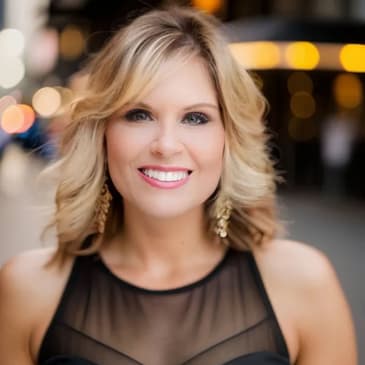
Ready to shift from hustle to calm confidence in your business? Today’s guest, Sovereign Leadership Mentor Jen Du Plessis, tells you how. Jen explains that success requires more than business mechanics and IQ; leaders must elevate their EQ so they can make intentional decisions rather than reacting in the “battlefield” of business. This applies even if the only person you’re leading is you! Lady Jen has lived what she teaches and, in this conversation with Deb, she shares the pivotal moment she changed her approach from proving her worth to embodying her purpose. If you’re looking to go big in life and business, hit play and prepare to be inspired.
Website: ladyjenduplessis.com
Music mentioned in this episode: “Time and Tide” by Basia
Debra, with her 30 years of being an entrepreneur and creating over seven companies, knows exactly what it means to accept the mission. When you make that decision, when you accept the mission to become a solopreneur, to take yourself and your talents to market, then you embrace a life of not only unlimited possibilities but also the unknown. It's an elixir of fear and bravery that only someone who's taken the leap really understands. On our show, Deb digs deep with her guests to highlight what you, the listener, wants to know: the stories, the whys, and the hows to navigate the journey to success. Get ready to hear from some of the most incredible mission takers, from Generation Z to Boomers, so sit up, perk up, and get ready to be blown away. Now, here is your host, Debra Drummond.
Unknown:Welcome back, my wonderful, wonderful friends and listeners and viewers. We are so excited for you to be here today. Welcome back to Mission Accepted. Thank you, thank you, thank you, thank you. You know we've been making these big announcements. Oh my gosh, we are making our way up to 400 episodes. What were we thinking? As a thank you listed notes, we are in the top 5% of listing notes, which tells us that you like what we're doing and you're sharing what we're doing. And I know that anyways because you send me private messages, but keep it going. Keep it going. And today we're going to talk about something that we haven't talked about before. What is that possible out of 400 episodes? I don't know. Have you were have you heard the word sovereign leadership? I know you've heard about scalability, and we're going to be talking about scaling. And we have the sovereign leadership mentor. And let me tell you, Lady Jan Duplessis, right? Yes, we were talking about it. So you know when I do that, we were talking with that pre-show, but I wanted to pronounce her name properly because it's so important. This wonderful lady, we met, we met. I want to say, you know what? When I when I meet someone like you, Jan, it's like I would say we met in the abyss. It was like yes, both doing the things and kind of similar things with kind of similar people, and then we landed together and we've been talking. And I have to tell you, you are one of the best for staying in touch and keeping the relationship movement. Like I thank you, absolutely love that. There's people that know we're like it doesn't. You know, we're like, hey, do you want to talk in a couple of weeks? And it's not about hey, let's close the deal in a couple of weeks. We don't know what's unfolding, but when you know that there's things to do, when you know that there's things unfolding, you know that you want to play with each other in the same pond, and you may not necessarily know what yet. I love the
Unknown:continuum. I love the continuum. You're you're an ace at that. I have to
Unknown:Jen Du Plessis: say thank you. Yeah, thank you.
Unknown:So look at mission accepted. So many of us are on this mission. Sometimes we're in the messy middle. Sometimes we're in the beginning, and we can even be at the beginning after we've been in business for five years, 10 years, 15 years because we decided that we want to take it to that next step. You absolutely love, and you are an expert in relationship to leadership, and one of the things that I love is that what I see you do is a lot of self leadership. If you don't mind, let's start a little bit. Let's start. Let's start there a little bit for our audience because this audience is full of incredible entrepreneurs, and I think we hear the word leadership. We think about people.
Unknown:Jen Du Plessis: Yeah, yeah, she says that all the time.
Unknown:So that's a bunch of stuff. Let's have a conversation about that leadership place.
Unknown:Jen Du Plessis: Yeah, and thank you for saying that because you know some people will say she's a leadership coach, a mentor, and I'm like, no, I'm not really any other. Yes, it's all included, but I don't think it falls into the commodity of what so many people are doing, yeah. Sovereign leadership, you know, was my own journey. I was doing the thing because we have to do the thing and do all do do do everything, and it was I had a really great success, but it wasn't enough, and I was filled with excuses because I was in hustle, and I said, "There's got to be a better way. But but I hadn't been introduced to personal development because I came from the corporate world, and we don't do that. That's like be strong, be tough, put your big girl panties on, right? And so I really didn't have a lot of that. And I thought, well, you know, I'm doing the thing. How come it's not getting where I want to go? And and there was a shift, and I just realized, you know, I need to have the mindset behind it. It's not just the mechanics. And if I wanted to create momentum, I needed both. That required me to elevate my EQ because I had the IQ. We all have IQ. We all. Expertise and IQ, but if we don't bring in the EQ and develop that, that's not a natural tendency. It's it's an awareness. If I don't bring in that EQ, then I couldn't get to where I really wanted to go. And so I started working on personal development and realizing, wow, I was actually experiencing EQ as an executive leader, and you know, in my industry, but I didn't know what it was called because we didn't get trained. But once I tapped into it, then the sky was the limit. It was like, oh my gosh, now I'm going to move forward. So sovereign leadership is much akin to it because we wield this sword every day. You know, we fight battles every day. We're fighting somebody, something ourselves, the system, AI-we're fighting battles every day, and whether we win or lose, we have to wake up the next day and fight another
Unknown:battle. And so, what I help people do is through that discernment is step into the role of the the scepter. Now, this isn't either or; it's and, right? That we step back and we have that courage to discern. So many decisions are made by yes, no. We're swinging at the hip, right? We're shooting from the hip, and when we can step back and take and get off the field, right? Get off the battlefield and step back, then our decisions are better and our business moves forward better because we're now acutely aware of our thinking rather than just doing.
Unknown:Wow!
Unknown:When you first started to realize that you needed some personal development, or you needed to label it as personal development, or you needed to merge your personal development with your business development, your EQ and your IQ. What did that feel like? Because as people that have been in leadership, there tends to be. I mean, I love you talk about the sword. There also tends to be some armor. Like, when did it feel safe, and how does it feel safe, and how do you define that for yourself to be able to go? Oh, I need to play in a different sandbox, and how do I take that into the world that I have built?
Unknown:Jen Du Plessis: Yeah. Oh, that's a loaded question, but it's very good because there's like many parts to it. Yeah, I mean, it was interesting because I had in a specific event that changed things for me, and that's when I said, "Enough is enough. There's got to be a better way, and stepped into that that growth for myself internally, right? I'd already grown in the titles, but internally I was growing, and I was asked to speak at a women's conference, and it was funny because they said, "Hey, listen, there's going to be a podium, and I was, I don't do podiums, not no podiums for me, and when I got there, the podium was still there, and I started getting a little like angry, you know how we're like this isn't set up the way I want it, kind of thing. But then I realized the topic I was talking about is that it was the first time that I was going to share my childhood story, and I had a lot of this self doubt. Right, I'm somewhat of an imposter syndrome, but it was more: what will they think? Will they still like me? Will they still respect me? Will they still work with me? I mean, what are they going to find out when they see that I came from this and was so scared? And the podium became my armor, right? As I poked holes because I did not take it off, right? I poked holes in that armor. It became my second shield. And when I got off stage, everybody was coming to me crying. That's my story. I never knew this about you. Oh my gosh, you're so wonderful, and I was like, well, wasn't I wonderful before? And you know, questioning all that, but I realized that as I poked these holes, my light was shining through, and and I thought, well, what if I could do more of that? What if I could do more of that? So yeah, that's that's where it's kind of layered in then, and I, I've always had that armor. My dad was an alcoholic, and my mom was a verbal abuser, and so I carried that armor to protect myself. But I thought I was working in abundance, like I'm fine.
Unknown:Don't worry about me. I'm strong. But I really wasn't. I was working in scarcity, and so that was really the tipping point for me to realize and start coming up with this. Wow! I've been wearing armor. Maybe I should carry a scepter and a sword, both, and know when to use them.
Unknown:Right. It's such a pivotal moment. It's such a pivotal moment. I was talking to a woman earlier. I'm going to go do. I'm going to go speak for International Women's Day, and they were like, "What do you want to talk about? And I go, "I think we just need to talk about what it's like to be a woman. And you know, we're talking about standing up, speaking up, and showing up. And I said, "You know, so many of us stand up, speak up, and show up out there. And yeah, I think we all can admit that there's a piece of that. I mean, we're helping others, and then there's this show up inside, and I go. Ironically, you would think standing up, showing up, and speaking up on the inside would allow you to go outside and do it. But many of us help others before we think about boundaries for ourselves. Yeah, so many of. So I think it's really. Interesting. The process I've gone through some of it. Where do you share it? When do you share it? What will they think of me? Right. What I think for leadership is, will they still work with me?
Unknown:Jen Du Plessis: Right. Right. That was a big thing for me. You know, I think that as women, you know, my story is very specific because I I was proving my nickname was Jenny. He ain't got a penny in my family, and so when I understood what it really meant, I was like, "I'm not going to be that. And so I spent my entire life proving whether it was childhood, college, everything, right? And then I took it into work until that day. I said, "This has got to give. And so I shifted from proving to purpose, right? And now I have a purpose, and from achievement, because that was the thing. Like I'm proving that I can make all this money and have all these things. But I went from achievement to stewardship, and then success became sovereign leadership. And that's, you know, I I don't you know I don't mentor and advise people to work harder or even smarter. I talk to them about working higher because what I find is that businesses will not transform unless the leader transforms too, and that seems to be what holds people back.
Unknown:Dawn's listening to us right now, and they're really resonating to that, and they're like working higher. Is that you know? Is that about posture? Is it about loving yourself? Is it about being less attached? Is it about having more faith? What
Unknown:Jen Du Plessis: is it? It's all. It's all of that. For me personally, working higher for me was not getting in the hustle. It was not being in the field all the time for me. It was taking, slowing down to speed up instead of speeding up to slow down. Right? I had to take a step back, and that was where he hired because I don't want to work harder, and I don't want to work smarter because it wasn't getting me where I needed to go. I didn't need to be smarter. We all have that IQ, right? I didn't need to be smarter. I needed to do something different, and so I started going. I'm going to work higher. I'm going to. I'm going to hold myself to a higher standard. I'm going to, you know, in all ways, my practice exemplary business, not just business, exemplary expansion, not simply expansion, and exemplary leadership and stewardship of myself and my practice. So that's what it is for me. But I think it's different for everybody. It's it's you know 95% of people wake up every day and unconsciously do stuff all day, doing only 5% wake up and and trigger a con a conscious effort to do the activities throughout the day. That's what stewardship is for me. Every day when I wake up, I make sure that I get back of the line, and I know that I am I am in charge of this practice. I'm in charge of myself. I'm in charge of my reputation. I'm in charge of the way that I help and support my clients that I mentor, and if I'm just going to go through the day and just whimsically, oh, I got a call. Oh, I have a this. Oh, I have a that. Then we'll never move the needle on our business, and we'll never be happy. And I'm looking for you know a not a quality of life, but a life of quality.
Unknown:That's interesting. Well, I shouldn't say
Unknown:Jen Du Plessis: not only a quality of life for maybe not, but but
Unknown:I love your way. I was talking about it this morning. There was a group of us that you know Monday at nine a.m. We're having a jobability meeting, and I talked about you know I talked about how I had this incredible day that was seriously all flow. I mean, it was like you know, if you could put all flow for the last three months into a day, that was the day. Even to the point where I went to go get a gift from my favorite store because my friends were having a wedding anniversary, and I walk in and I hear the clerk. He's telling a woman who's from Japan, he's like, my favorite word in the whole Japanese dictionary is not Sukashi. Now, how often do you? That's my son's company's name. Oh wow, wow! I mean, it was that kind of flow day where I was yeah,
Unknown:Jen Du Plessis: where everything was on top. Yeah,
Unknown:yeah, home deciding where you know what I was like. God winks everywhere. Yeah, the day that I want, like these are the days that I want to have more of. Right, these are the days that you want it. I don't have more of, and and it felt beautiful.
Unknown:Jen Du Plessis: Well, and we can do that every day. We just have to consciously be aware of it, and that's part of the leadership that I'm talking about. It's not just whimsical decisions and go run and run, you know, run an AI. Somebody go fix an AI. Somebody, we have to look at everything that we're charging others to do or delegating others to do, that we're we're assessing what they're doing. That's leadership. It's not management. Is tell people what to do and don't check it. Okay, what does it do? Leadership is different. Yes. Not yes.
Unknown:Go do it and not. That's really
Unknown:Jen Du Plessis: I've never yeah because they do is like why didn't you do it? You'll get an email like hey is that report done? Well, I said it was due last week, and the only reason the manager's checking is because they've been reminded that it's not done, and so now like oh yeah that's right I better do my task checking, and so that's what a lot of managers do and a lot of entrepreneurs stay in that management role even if they're delegate, sometimes they don't even delegate. But if they delegate, they stay in that management role. We want to level this up. So one of the mottos in my practice is to stop working in and on your business, and so that you can begin living above and beyond your business. So my goal is to get people above and beyond, so they can exit personally, or they can exit selling, or they can exit and start a new business. They can exit and sleep in. Doesn't matter. They don't need to be there every day.
Unknown:Things sleep in is like water to an entrepreneur. If someone was going to start, whether that they're they're like I'm loving this. Oh my gosh! Best 17 minutes I've heard all day, all week, all month. Where you know, where's the hose that people need to start drinking from? Like, what is it that like I know that they can work with you and talk with you and have a conversation with someone's out there right now? Like, I love how this woman's thinking. I'd love to adapt that way of thinking.
Unknown:Thinking.
Unknown:Jen Du Plessis: Yeah, it's you know whenever I'm asked this question, people are a lot. Look, what's the next step? My challenge is this: we all have an expertise that we brought into our entrepreneur world, and it doesn't always align with what everyone else's is. So, if as a it'd be a horrible, it would be a misdiagnosis if I said, "Yeah, you should work more on sales. You should work more on your funnels. You should work more on your speaking. I'd be crazy to say that because you may have come in with great speaking, but not as good business acronym. I come in with good business acumen, but maybe not good social media. So it's hard to say what the next step is for any one person, other than I would just the overall word that I would use today is reflection. It's time to just you know go through your day. That's fine if you're hustling through your day, but if you're seeking harmony and you want to make money, then that's the shift. It's the shift from hustle to harm money, and it's through reflection and discernment of was that a good decision? Did I make it too fast? Did I not have counsel behind it? Did I just want to get it done and now it's out there? It's good enough. Did I tell that person what to do, but I didn't explain it and then blamed it on them? Right? There's, there's. It's hard for me to do that because there are everybody has a different unique DNA that they bring in, and I'm I pride myself on finding the real issue. You know, someone just said to me today. I was talking to. She said, "I just don't trust my team. They've worked with her for 20 years. 20 years. I don't trust my team. I said, "Well, trust is not the problem. There's a deeper problem, and I found that in 20 years she had no systems that allowed for everybody to do everything. She was-I don't think it was ego, but sometimes it's ego. I don't want to let it go to grow, so I'm just going to make sure they can all come to me and ask questions that make me feel like I need it,
Unknown:right? But they don't need you. Your clients need the experience, and if you can build the experience, they don't need you there every day. That's why when I go to Paris, I walk into, you know, Starbucks and go, "Hey, where's the CEO? He should be here because I want his experience. Right? It's not possible. Yeah,
Unknown:yeah, no. Well said. And I think, and I think within that answer, people discover their answers, right? Within that answer that you just gave, the reflection will know a little bit other intuitively or painfully, right? Where the gap might be sitting, where the gap.
Unknown:Jen Du Plessis: Yeah, and I never want to give someone a supplement. I want to give them a pain pill, so it's determining what their pain is. Everyone, the the overall pain is: I'm too involved in my business. I'm making bad decisions. I'm not the leader I want to be. I don't have the team that I want to have. I want a personal life. That's the pain. Now, what's the solution? And that's different for everyone.
Unknown:Got a couple of questions where we get to know you a little bit. Thank you so much for sharing that part in the in the you know your story in the beginning about getting vulnerable and sharing in the podium. Had the exact same experience right away. And actually, when I got to the podium, I was like, "This isn't bad. But I need this all day. No, this all day because I, I didn't know I'd be out there. I didn't know be what I was supposed to be saying out there because they didn't tell me till I got backstage. Like, by the way, oh
Unknown:Jen Du Plessis: yeah, yeah,
Unknown:okay, that was that was really great. But when
Unknown:Jen Du Plessis: in doubt, bring the podium out.
Unknown:Well, it's great because then it also would take you don't have to hold the micro. So I love that. Yeah,
Unknown:Jen Du Plessis: yeah.
Unknown:As well, you've been in business for 40 years. Yeah. Okay. So you know, I think that's important to state. And obviously, there's been you know much growth in every area of your business. Has there been Something that, I mean, there's been many. I get it. 40 years. I mean, four months. There's been many. But has there been some fundamentals that have really like brought it home to you? We we all have our magical moments and what makes it different for us. But from your from who Jen was 20 years ago to who Jen is now,
Unknown:Jen Du Plessis: experience and
Unknown:aspirations me have changed. Oh yeah, yeah. So has there been something that's just made you feel like this has been magical?
Unknown:Jen Du Plessis: Yeah, and and I think that you know again, it's going to go back to the you know the moment I said enough is enough, and I'm not going to prove anymore, and I'm going to start living my life. And I had to find a way, you know, to be able to to live my life. And and through that process, I was already a manager too. I was in sales, but I was already a some kind of manager, regional or something. But it changed the way that I that I managed people, and I I started looking at it as yes, there's a management aspect and there's a leadership aspect of it, but it started changing the way I did that because you know when we're all climbing the corporate ladder when we're young, we just want the title, and I realized nothing nothing is about the title, absolutely nothing, and it's the way that it's the way that we lead and encourage other people, and I've tried to do that throughout my entire career. I try to-I don't ever hire someone for a job. I hire them for the vision that my company has because I want them to grow with me. I want my vision to be so large that it includes all the goals and aspirations that others have. So I never want to bring someone and say you're going to be my virtual assistant till the end of Earth. You know, I'm looking for ways to graduate and grow people, and I see that in my employees. And I have four companies, so I have across several different businesses, and I see them and I see them grow, and that brings me so much joy because I know that I again I'm going to use the word stewardship, right? Is that I'm a steward of their whole entire life. I mean, what their dreams and aspirations, whether they own a home or not own a home, whether they can have a boat or not have a boat, whether they have good credit or not good credit, whether they would consider having a child, right, and having that additional piece, so I'm very aware of my role, and I think that that's what's important for others. That would be a foundational
Unknown:piece for me is stewardship. Just can you leave that word? It's it's very broad, but it encapsulates quite a bit. There's so much in what you shared with us today. I know that we could talk longer and longer and longer and dig into it. We talked at the very beginning, and I'm going to wrap up with this: is that we're going to talk about scaling, and I think everything that you have just shared is very fundamental in being able to scale. Absolutely, people get it's a sexy word that's out there. You know, yeah, yeah. There was the generation of I don't remember everything was 10x and 10x and 20x and 5x, and then it's moved over to scaling and scaling and scaling. And now, you know, there's another
Unknown:you know in AI is kind of you know taking over the turns of the of the world right now as we are in marketing. But scaling is so appealing to people because I think underneath it feels like it's going to bring relief.
Unknown:Jen Du Plessis: Yeah, yeah. I think well, and I use scaling is different than growth. Growth is revenue. Scale is revenue, and and it's everything, and and the team, and yourself, and your reputation, and your credibility, and your clarity, and your efficiencies and your community-it's all of that. That's what scaling is. It encompasses so much more than just the growth. And most of the time, with my clients, it becomes a byproduct. The revenue growth becomes a byproduct by millions of dollars for my clients because everyone's on the same page and working together as a cohesive organization, and it was just waiting for that leader to step up to make it happen. Cool. Any last words before we, yeah, up yet another powerful session of mission accepted. I love this. I love that we got right into it. I love that it was defining. That's who you are. I love it when we have conversations. We're right into it, and it's super and it's super defining. Thank you. Well, I'm known as the Velvet Hammer. Someone coined that phrase so that she's the Velvet Hammer. I'm like, well, okay, yeah. I always leave with this quote because. This was instrumental in helping me make that shift from hustle into harmony and to start growing. But this-it's actually a part of a poem. But it's we flatter those we scarcely know, we please the fleeting guests, but we deal many a thoughtless blow to those we love the best. So I would encourage you to not deal thoughtless blows to yourself and to your business. Be as good to you as you are to that business, and both will flourish.
Unknown:That, my friend, be as good to you as you are to your business, because don't we pour into our business and we pour into the dreams, and we put in the time, and we put in the hours, and we put in the okay. I'll learn that if I have to. And there's so much that we do for the sake of our business.
Unknown:Jen Du Plessis: And then whatever's left, we get. And there's not much these days. We have all these efficiencies that make us even more busy.
Unknown:Good. We're gonna let people sit on that. Thank you so much for being part of Mission Exchange today. Yeah, thank you. No, absolutely, an audience. You know, you know, you know, you know. I'm going to end off with this exact question to Jen that she doesn't know is coming. Oh boy, completely different topic. And then I have a message for you. So, Jen, you're on your way to a desert island. You and you, just you and you. You've got this beautiful suitcase. You've got room for putting in one piece of vinyl. Of course, we have a beautiful record player waiting for you. Right. It's called nine tie. It's just you're going to the island and you're gone for a while. I don't know if you're coming back. You're going to love it so much. What is the album or the song or the singer that you would want to listen to? That I could not imagine not listening to you for the rest of your life.
Unknown:Jen Du Plessis: Yeah, that's simple. That's Basha, and the song is Time and Tide.
Unknown:All right, I got it. It's going to be in the show notes. People can listen to that. Thank you so much, and audience. As always, I want you to be well and stay groovy, and we will see you next week. Thank you for everything. Bye. Bye.