
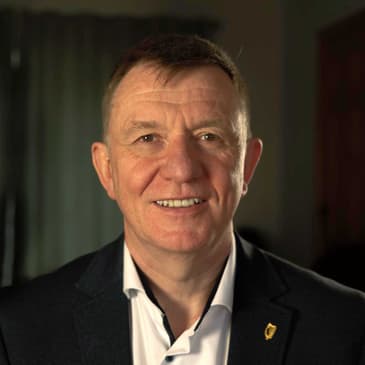
Today’s guest LOVES sales and he wants you to love sales too. Most people think sales is hard because they don’t know the key that makes selling your product or service easier. Sales Coach Joe Dalton lets you in on that secret and so much more in this episode! He started his sales career at 13 and loved it from the start. The wisdom he shares from 30 years in sales will give you a fresh perspective on sales that makes it feel like something you actually want to do! After listening to this episode with Joe, you will 100% be in love with doing sales.
Website: https://breakthroughbrands.net/
[00:00:02] Deborah, with her 30 years of being an entrepreneur and creating over seven companies, knows exactly what it means to accept the mission. When you make that decision, when you accept the mission to become a solopreneur, to take yourself and your talents to market, then you embrace a life of not only unlimited possibilities, but also the unknown. It's an elixir of fear and bravery that only someone who's taken the leap really understands.
[00:00:28] On our show, Deb digs deep with her guests to highlight what you, the listener, wants to know. The stories, the whys and the hows to navigate the journey to success. Get ready to hear from some of the most incredible mission takers from Generation Z to Boomers. So sit up, perk up and get ready to be blown away. Now here is your host, Deborah Drummond.
[00:01:14] Welcome back to another incredible, phenomenal, world renowned, the Mission Accepted podcast. Look, thank you so much for the comments. Thank you so much for reaching out to our speakers. We appreciate it. They appreciate it. We're here to help you stay on your mission because we know the easiest part is saying that you're going to do something. And then we talk to people that teach us why, how, what?
[00:01:43] I'm still doing what? What's going on? So we have Mr. Joe Dalton all the way over from the some people say the Isle of Green. Some people say Ireland and some people say where I go and have my favorite cold beer. But Joe is going to join us today and we're going to have a great time. And you know why we're going to have a great time? Because first of all, he's a great guy. But second is because he's all about breakthroughs. He's all about breakthroughs. He has a vast client base.
[00:02:12] We love talking about sales and leadership, right? And so we are so grateful that you had time today to pop on all the way over to Vancouver, Canada. Let's not have a conversation. So, look, Joe has an incredible book called Sales Prep and he does all of the things. And so I'd love to welcome you to the show. Welcome you to Mission Accepted. And Joe, maybe just, you know, I know you. Maybe just let our audience know you a little bit and then we'll get right to it.
[00:02:42] We'll have some fun today. Have some breakthroughs. People will get your pen and paper ready unless you're driving. You just keep listening. Just keep listening. I'm excited. Thank you for the invitation. And I look forward to speaking to yourself and answering your questions and hopefully sharing some wisdom and knowledge with your wonderful audience as well. Well, thank you, my friend. So sales and leadership, broad topic.
[00:03:11] Breakthrough brands. What does that mean? Tell us. Yes. Well, breakthrough brands was crafted. God, maybe about a decade ago. And it originally started off when I had on a radio show and it was to talk to business people who wanted to have a breakthrough. And from there, it has just evolved.
[00:03:39] And now it's about helping business owners and founders develop a system and a strategy that actually moves them up. The moves the needle so they can actually take what they're doing, start making money from it with ease and enjoying what they do. So that's where breakthrough brands really evolved. And now it's a podcast. It's a business. It started off with just an idea in my head.
[00:04:08] Sales craft is the book, which is a methodology, which I have used over the decades to simplify sales, to make people have better conversations and to close more deals. Now, Deb, I'll say one thing. Sales, when a lot of people hear sales, they go, oh, I hate sales. I don't like selling, whatever it is.
[00:04:33] I would like them, your audience, to discard all that today because sales is a skill. It's a skill that is part of communication. And that communication can be used.
[00:04:49] And when you get the skill right, better conversations with your partner, better conversations with your family, better conversations with your work employees or your partners at work and better conversation with your friends and your community. So sales isn't about selling. It's about having a better conversation. So let's go.
[00:05:15] Let's have that conversation because we know that there's a lot of people here today that are listening that, you know, for the most part are in their business and for the most part they're doing okay. But for the most part, wouldn't we all like to yield a little more? So what is it that you would say to somebody that is, you know, doing their business? They're not they're not in a desperate state, but they're not at the highest peak that they would want to go. Whether it's sales or this. Well, let's stick to sales because we just had that conversation.
[00:05:45] What are what is something that you could say to someone? Ask yourself if you're doing this and and it's a good thing or not a good thing. What is it when people are looking to tweak? I think that's a hard place to be. You're like, I want to yield more. I'm doing okay. But I but there's something not happening. I'm not closing as quick as I want. I'm not like, you know, what are some of the things people can look at from their sales perspective? Yeah. Okay, perfect. And a great question.
[00:06:14] So can I start off with telling you a story? Well, let me get my teddy and my blankie. Once upon a time, children, everyone got around. There's an old man talking. Quick, get around. I started off in sales. I sold a baked potato when I was 13. And at that stage, I realized I like sales and I fell in love with it.
[00:06:44] Most people fall into sales because they feel they're not good or something else. For me, I realized if I speak to people, I get money. That's what I felt at 13. When I was about 17 or 18, I got my first sales job. And that was knocking on doors, cold calling. And I enjoyed it. And I could sell. And I thought I was a good salesperson because I always had this entrepreneurial mindset.
[00:07:14] And what was happening was I was selling, but I didn't know what good sales looked like. And I couldn't compare what I was doing with what professional sales was. And when I was trained to be, I went and someone taught me how to sell, gave me the skill set. And I knew that, I knew that. I know what. And I was in the middle of the years. And I realized I was a lot. I was in the middle of the years.
[00:07:44] Because it was moving from selling to professional selling. And I have crafted that over the decades. And the reason I'm saying this story, that a lot of your audience probably can sell. And a lot of the companies that I work with, they can sell.
[00:08:04] But the difference is when you start to add maturity and a methodology and a framework to how you sell, the game changes. And I did a talk there with one of the big enterprise boards. And I'm also brought into a government initiative to help budding entrepreneurs. And I talked to them about sales.
[00:08:31] And the one question that I get from everyone is, how do I close a deal? And I say, you don't. And it's not what you do at the end. The biggest part of the whole sales process is the point where we may call it discovery, fact finding, detective work, blueprinting.
[00:08:58] It's this part in the sale where you've just built a rapport. And then you need to go and ask irrelevant questions. And there's a list of types of questions. And I can let you know them and offer insights. And it's this moment of the sales process that's where deals are won and lost before you even get into your product, before you even get into closing.
[00:09:28] And we call this the research or discovery part. And I'm going to make a discussion. You're going to correct me if I'm wrong and give me gold stars if I'm right. But this happens when you see the beginning of the sale. So when someone is we're having a meeting, we've met somewhere, a networking event, someone's put us together. And there's in that beginning, you're asking questions before you get into what it is that you have to offer. All right.
[00:09:57] So I'm going to ask, share one question so people can start to kind of have an idea. I will. There's different questions that you need to ask. Right. So we know that people, we talk about needs. Yes. Wants. OK. There's also questions should be asked about time. There should be questions asked about authority.
[00:10:23] And there should be questions asked about capital. Because if you get the art of asking questions and listening, when you get to the end of the sale, you will have eliminated all the objections. And I want to remove the word objection because that's very heavy and confrontational. I want to replace it with the word concerns.
[00:10:51] So you don't have any concerns at the very end because you have answered these concerns up front. And what you are trying to achieve in that discovery part is the DBM. And the DBM starts for dominant buying motive.
[00:11:13] And the dominant buying motive is the reason why emotionally and logically why the person wants to or needs your service or your product. Very good. Thank you so much. I am sure there's people that are listening right now that are nodding their head.
[00:11:36] Because instead of waiting to the end of the sale when you've given your information and shared and then things arise, right? Well, you know, I have surgery next week or we're renovating or I don't have money for that or I don't have time for that. Or what I was hoping for with this is that you would be able to curate that through your conversation. Yeah. And it's preparation. I would say to people, it's prepare.
[00:12:04] So, you know, do the research before you meet your prospect or your buyer. And one of the things as well is that some people go in and they ask surface level questions and then they have the idea, if I just show you my product, you will fall in love with it and you will buy it. That's what they have.
[00:12:27] But what you have to do, because when you are demonstrating your service or telling them about your product, you really are only using about 15% of the whole product knowledge because you're only connecting it with what the people want or need.
[00:13:14] I'll give you an example. Because they've lost interest. So you have to keep on point of what you're talking about. So asking those questions. And it's not just asking questions for the sake of it. You want to get into your buyer's world. You want to know all about their world. And this is a place that the longer you are there, the better the results you're going to have at the end.
[00:13:44] If you're with someone and five minutes are gone, no. But if you're with someone and it's about an hour and you're building that, you know you have a better chance of closing. And simple questions like, you know, if people are talking about money, it can be simple as, what would it cost you not to have this? Or what would it cost you if you don't go this way? Or time is, you know, what have you done in the past?
[00:14:09] You know, what sort of time frame are you looking to hope to get something this year? How much time have you allocated towards it? Authority can be as, is it just yourself that makes the decision? Or, you know, when you're making a decision like this, is there anyone else involved? So it's not about just asking questions. It's having a conversation. And the conversation has to be natural.
[00:14:36] Because what you're doing is you are finding out the person's emotions. You're asking the questions logically because people buy emotionally. They ask questions logically, but they make those decisions on the logical questions that they asked as well. Well, I was in a long way of answering your question. No, but this show is about the long way.
[00:15:06] You know what I mean? This show is about people that are on a mission and they're looking to start, they're looking to middle, and they're looking to complete for themselves. And you and I both know, I was just talking, I was just training in a class on training accountability. Accountability. And it's, you know, we're talking about, it's when you take time out of your world to learn that. I mean, there's an old adage about if you're going to chop a tree, spend 95% of your time sharpening the axe.
[00:15:34] And so as we're in this group, I'm like, you got to realize there's a lot of people right now having coffee in a chopper croissant. And you're here, cranking down, learning about accountability. And yeah, right? Learning about accountability. Absolutely. And I'm like, this is the sharpening of the axe. And I don't think it takes too long before you step into entrepreneurship, right? When the angels lift and the unicorn wings start to spread, that you go, oh, I need some skills. Or like you said, you were good at sales.
[00:16:03] I mean, my gosh, you enjoyed door to door. I mean, I think there's some people that just fell over when they heard that, right? They're like, no wonder he teaches sales. But you too came to a place where I think a lot of people come to. And it's like, I need to sharpen my axe. I know I can do better at this. Or I want to at least attempt to learn what that looks like. So, I'm still learning. I've been in sales for, you know, three decades.
[00:16:34] And I am still learning. And I think any person who wants to be an entrepreneur or is, you learn. We stand on the shoulders of joints. And the one piece of advice I'll give people, listen. Take advice from people that have walked. Because I have learned so much from so many people.
[00:17:00] And it's, you know, there can be ego. There can be, as they go in business, first they'll start dealing with people that they may not like. But as their entrepreneurial muscle gets a lot stronger, they then can choose who they want to work with. And those people that they worked with in the beginning wasn't a disaster. It was a lesson. Because you know who you want to work with and who you don't want to work with.
[00:17:30] And the greatest gift that anybody in entrepreneurship or the world can have is clarity. Because when you are clear on what you do and who you serve, as you said, those wings of the angels open up and something changes in the ether when you are aligned with everything. And it's magical.
[00:17:59] So, what I hear in there, and maybe because it ties into what we talk a lot about here, is that taking risks. Like, taking risks. Like, even when you think you know, like you said, if your ego's got you here, taking risks. Like we say, you know, our tagline is playing it safe never made history. So, outside of the time where you kind of had this experience as a salesperson going, I think I need to get some more skills. Just from a general entrepreneurial,
[00:18:28] I mean, you mentioned that you've been doing this for a few decades. So, I'm going to assume that there's been some things that you've had to overcome, work through. What was something that you really, like, you had to risk? It was a risk. You felt like you were making a move or I don't know if it was buying a program or opening up a new division or changing your brand. Like, what is something that you really kind of had to take a deep breath on to continue having success in your business?
[00:18:56] I have to accept a failure. I got involved in a business and I had partners and we understood what the product and the service was, but we were too early for market. We even got it on Good Morning America. Yeah. Yeah. Yeah. So, it was on Good Morning, Sunday Morning America. Sorry. Sunday Morning America. And we got it on that.
[00:19:27] It was, you know, we got funding, everything, but the market wasn't ready for it. And I had invested an awful lot of money and I basically nearly bankrupt me. But it was a decision that I made that went, we can't do this anymore. And I had to take that courage
[00:19:55] and cut, cut, cut it, close it down, shut it down. And I focused on what I'm good at. And that business, now if we had got more money and funding, it would have been, because everybody now goes with DNA testing for athletic ability and nutrition. Take it out, we were doing this way before anyone. Ah.
[00:20:21] But the lessons I learned there were priceless. And I learned so much in that part of the business that now with my coaching and mentoring, I make sure that no other company or other people fall into that trap. Well, one can relate to your pioneering pain. I call it pioneering pain. I like that actually. Yeah.
[00:20:50] I, you know, I always say hashtag, my next book is hashtag God pick on somebody else. Because, you know, having to be a pioneer or break round, you know, it takes a little bit of extra, three ton, you know, to go through. When I hear you share about that, we talk also a lot about top performance and how you get yourself in your best place to do your best work. What do you do from a mindset standpoint?
[00:21:20] Joe, I mean, that in itself would have been a whole stretch, you know. But what do you do to stay in game? That time made me realize that everything external doesn't matter. And the only thing we have to focus on is internal. And I have a TEDx talk on it called Becoming Consciously Aware. Oh.
[00:21:49] And so the TEDx, six minutes on it, it's been walking up a mountain. And it's what happened and what I now practice today. You know, people may say to me, oh, I forgot something in the post and it's a scary letter from government or whoever. And I say to them, all that is, is just words on a page. You are being triggered by something external that has no power over you internally.
[00:22:17] So for myself, everything external is just, it's just part of the process. And I don't allow it to affect me internally. And I'm, like, hold with peace and trust and gratitude and humility internally. And they're like a force field that all the external stuff, like people say to me, if I ever walk into it, as you said, you know,
[00:22:47] a bar or a pub and I need to remember certain things. Oh, Joe, we've lost you a little bit. Your, your audio just kind of bleeped out a little bit there. Nope, we're not back. We heard about going into a pub. So I think that we'd all like to kind of go into a pub. I mean, you are in Ireland. Is there a way you can bring back some volume? Nope. It's just kind of bleeped out a little bit. So
[00:23:17] I'm going to state the conversation and go ahead and just keep talking to us if you like. No, we can't hear you. Maybe take your earbuds out. Just go direct to Mike. See if that works. Let's see. Will I log out and log in? No, this is, so we, we, we shoot, we shoot our shows raw. So let's see. We almost heard you a little bit there. It kind of just
[00:23:46] buzzed out a little bit. This is the best part of being live and going live. Can we hear you now? It's a little fuzzy. It's a little fuzzy. We're going to let Joe, we're going to let Joe figure that out as he was talking about walking up the mountain and just the mindset, the mindset. You can imagine when you heard his story, where, what would, what would, what that process would be like for you. I'm sure it was very much
[00:24:16] an internal journey. The wonderful things about entrepreneurship that they don't tell you doesn't come with a manual. And I think it's from not just listening to shows like this, it's reading good book, it's having people in your court when you have those things that go on. People that know who you are, not just what you do, can get you through times like that. Just really being able to, to, to pull people to remind you the strength that you have inside. So let's see if Joe
[00:24:45] can join us now. No, we can't hear you. My friend, Joe. There are more don't know. No, is there, is there any way that you can? Testing, testing. Here we go. Joe's back. There we go. I got to stand on the soapbox a little bit and tell people to, one of the things that I was sharing if you were listening to me was about when you come up against times like that is really, who's in your court? You know what I mean?
[00:25:14] I always say to people, there's your, there's your success circle and there's your support circle, right? And there's people that in my support circle that don't have a whole lot about entrepreneurship. You know, they don't have a whole lot in terms of resource or know a lot about it, but they know who I am inside. And when stuff gets really tough and you start to quaver with, oh my gosh, am I good enough? What am I doing? What was I thinking? That's it. That's like what you said, an inside job. And I go out
[00:25:44] to the people that know who I am. They've been friends for a long time. We've had heartwarming conversation. We've had, you know, tough got life conversations. And they remind me who I am and what I'm capable of. And then I go into that success circle and go, okay, I need advice. I need help. What am I going to do? So, anyways, I'm going to take it back to you. You were, you were sharing with us a little bit there. I'm going to talk about your mindset and what you do for yourself.
[00:26:14] Yeah, the mindset, as I say, can you hear me? Yeah, we got signal here again. Yeah, I'm watching the dials. The mindset is, if I was saying that if I went into a bar and people realise that I was sad or something was wrong, they know there was a real problem in the world because I have trained myself to actually just enjoy life. And even when the bad stuff happens
[00:26:43] and everything happens to us or something, not bad, something will always be presented in front of us to turn the ship slightly, I'd look at it as a gift and I go, okay, this is happening. It's okay. We will deal with it. And there's one thing that I would love to share with your audience. Don't be worrying about something. And sometimes if you force it, you make it worse. But if you just allow
[00:27:13] the process to happen, it will actually work out better than actually if you were trying to force it to fix it yourself. Yes. Worrying can be mentally tapping out. I know we're coming close to the end of the show. I'd love to ask you, business, not business, life, anything, what is something that you still on that have that less do list? What's something that calls you? I think
[00:27:42] there's a lot of power when you say it to the world, to the universe, what have you. What, Joe, is still on that list that you want to do a big checkmark? It's not that big, really. I want to spend, go to Australia and New Zealand. And the next step in my life is to buy the next property on about three acres of land, which in Ireland is a lot compared to the States,
[00:28:11] and have a little farm and grow my veg. because I think business is like growing veg. It takes time, nurturing. Some seasons you have good seasons and some seasons are bad seasons. But if you keep attending to them, the vegetables, the garden grows. And one last thing just for your, for the audience, play the long game, not the short.
[00:28:41] play the long game. That reminds me of a really good song by Supertrout. You know, it's a long way home. It's a long way home. I'm listening to, I'm a little bit addicted to music. Okay, my last question for you, Joe. What couldn't you live without? My family. My family. There's probably many, but what's one? My wife and my children. Awesome. Awesome.
[00:29:10] Thank you so much for spending some time today. I'm going to talk to the audience for a minute here. Thank you once again for supporting and showing your love on the Mission Accepted show. If there was something that you heard that you, that changed something in you today, probably someone else as well. So please share the show. This is how we change. This is how we inform. This is how we inspire. And this is how we all stay collectively together. Because for us at Mission Accepted, it's important for you
[00:29:39] that you stay on your path, your mission, and you've taken enough bravery to step in and do it. There's so many places and so many resources to help you stay there and grow. So we so appreciate you. Look, if you want to be here, if you want to be sitting here sharing your passion, your book, your story, please contact us. We're not difficult to find. You found us here. You're going to find us there. Just go to debdrummond.com. You just go to half a dozen pages on that website and there is a contact page and you can go through
[00:30:09] and you can say that you'd like to be on the podcast. You'd like to be in our next publication. You'd like to be in our stages. So if you have a mission, we want to hear about it. You know where we are. Joe, thank you so much for spending some time with us today. I know that it's not going to be the last time. We'd love to hear more and I can't wait. And of course, you know, Joanne has a brother in Australia. If you don't know, that's an inside scoop. So, you know. Well, I have, I have, my daughter is over there at the mall.
[00:30:38] And my wife is wanting to, to go over with, with our two smaller children to go over and visit. So yeah, we'll, I'll reach out to Joanne and see where they are. My daughter, I'll hook up with them and have a party. Absolutely. Let's go have a party in Australia. Thank you so much for being with us today. And as always, my dear audience and friends, until we meet again, you stay well and be groovy. Bye for now. Bye.