
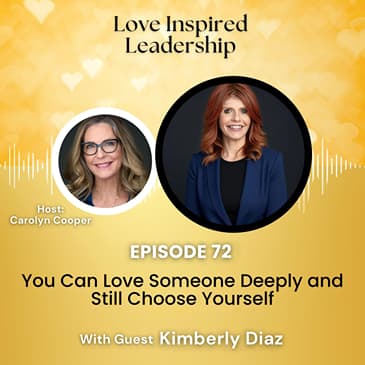
Can you deeply love and care for someone without losing yourself in the process?
After nearly three decades in nursing and a lifetime shaped by caregiving, Kimberly Diaz, RN, has learned that compassion does not have to mean self-sacrifice. In this honest conversation with Carolyn Cooper, Kimberly explores caregiving, dementia, boundaries, grief, resilience, and the courage to choose yourself while still deeply caring for others.
What You’ll Hear:
- How nearly three decades of nursing and caregiving shaped Kimberly’s understanding of love, responsibility, and compassion
- Why being a loving caregiver does not mean sacrificing or losing yourself
- How Kimberly learned that love can include healthy boundaries, even within complicated family relationships
- What families should understand about dementia, aging, and caregiving before a crisis happens
- Why caring for the whole person must also include caring for the person providing the care
- How to recognize when resilience means continuing to fight and when courage may mean letting go
Resources Mentioned
- ✨ FREE 21-Day Sacred Insights Journey: Receive daily inspiration, soulful reflections, and journaling prompts from Carolyn Cooper to strengthen self-trust, embrace your authentic power, and lead with love and purpose. Start Your Free 21-Day Journey: https://www.theinspiredconnection.ca/21days
- 🌿 AIM High Sanctuary: Discover a supportive community of heart-centered women committed to living and leading with truth, alignment, and purpose. Explore the AIM High Sanctuary: https://aim-high-sanctuary.circle.so/commit30days
Featured Guest: Kimberly Diaz
Kimberly Diaz, RN, is a nationally recognized dementia care expert, Certified Dementia Practitioner, educator, author, and founder of Care Matters, LLC and Caring Minds Dementia Consulting & Training.
With nearly three decades of nursing experience spanning emergency and trauma care, hospice, home health, and dementia care, Kimberly brings both clinical expertise and a deeply human approach to supporting families through some of life's most difficult transitions.
She is the author of Where Do We Go From Here? The Complete Dementia Care Guide for Family Caregivers and a Certified Elite Brain Health Clinician through Amen University.
Kimberly is passionate about changing the way we think about dementia, brain health, caregiving, and aging while ensuring the needs of care partners are never lost in the process.
Her mission is simple: guiding families through the journey so they know where to go from here.
Follow Kimberly Diaz:
- Website: https://kimberlydiazrn.com/
- Aging Parents Toolkit: https://agingparentstoolkit.com/
Meet the Host: Carolyn Cooper
Carolyn Cooper is the woman high‑capacity women in business call when life looks impressive but their soul knows something is off. She works with soul‑centered, love‑inspired leaders who are done performing success and ready for results that feel true and aligned. As host of the Love Inspired Leadership Podcast, creator of the AIM High Method, and founder of the AIM High Sanctuary, she offers a potent, grace‑filled space where women tell the truth, regulate their energy, and clean up their boundaries. In this Sanctuary, they connect with deeply aligned partners, watch their businesses soar, and experience deeper joy, clarity, tangible growth, and sustainable prosperity, all from their authentic identity.
Connect with the Host:
- Website: https://aim-high-sanctuary.circle.so/commit30days
- Instagram: https://www.instagram.com/inspiredconnectioninc/
- Facebook: https://www.facebook.com/InspiredBusinessDevelopment
- LinkedIn: https://www.linkedin.com/in/inspiredbusinessdevelopment/
🎁 Carolyn's Gifts
✨ FREE 21-Day Sacred Insights Journey: Lead, Live & Love Unapologetically
Ready to reconnect with your authentic power and lead with greater clarity, courage, and purpose?
Join Carolyn Cooper for 21 days of daily inspiration, soulful reflections, and powerful journaling prompts, delivered straight to your inbox.
Discover simple practices to strengthen self-trust, embrace your truth, and create meaningful change in your life, relationships, and leadership.
💌 Start Your FREE 21-Day Sacred Insights Journey:
https://www.theinspiredconnection.ca/21days
🌿 AIM High Sanctuary: Your Space to Rise, Connect & Grow
Ready to experience greater clarity, confidence, and momentum in your life and leadership?
Explore Carolyn's AIM High Sanctuary 30-Day Activation Gift and connect with a community of heart-centered professional women committed to living and leading with truth, alignment, and purpose.
Through live coaching, meaningful conversations, and supportive accountability, you'll have opportunities to strengthen self-trust, gain fresh perspectives, and take intentional steps toward what matters most.
✨ Explore the AIM High Sanctuary:
https://aim-high-sanctuary.circle.so/commit30days
Love Inspired Leadership is proud to be part of the High Vibe Podcast Network.
Explore Carolyn's Gift in the Vault:
https://highvibepodcastnetwork.com/gifts
Share the Love
✨ If this episode lit something up in you… tag us on Instagram @HighVibeLeaders and let us know your biggest takeaway!
🦋 Don’t forget to rate & review — it helps us reach more conscious rebels like you.
Listen & Subscribe
🎧 Spotify
[00:00:02] What if you let love, not fear, lead your life and your leadership? I'm Carolyn Cooper, and I've learned that true leadership isn't about perfection. It's about daring to be vulnerable, holding your vision in the darkness, and trusting your soul to guide you home.
[00:00:28] Welcome to the Love Inspired Leadership Podcast, a sacred space where every moment invites you to aim higher with love and purpose. Here, we don't just talk about leadership, we redefine it. Let's dive in.
[00:00:51] Welcome back to the Love Inspired Leadership Podcast. I am really excited today about my guest, and I love how the universe sets things up.
[00:01:12] I mean, my intention is to bring people to you, to support you, to guide you, to direct you in really what matters most. And I'm just thrilled because this woman, I immediately connected with her. I respect her. I honor her position and how she's serving the world. She just created this incredible book that I want to share with you.
[00:01:38] But the reason I do this podcast, I just got truth bumps all over, is to bring these kind of conversations to the masses to understand what true love inspired leadership is.
[00:01:53] So, and it's a space where we just have these really genuine, radically honest conversations that lead from our heart with courage, with conviction, and the more potent possibility is available to all of us. So, welcome. Thank you for being here. And let me introduce you to this incredible woman.
[00:02:18] Oh, before I do, this episode, the theme is called Caring Without Losing Yourself. Love, boundaries, resilience, and the courage to let go to lead, which is one of my key phrases. And I just, oh, this is going to be so great. Anyway, I rather- No pressure. Woman. Yeah, right. Exactly. No pressure.
[00:02:47] Not at all. We're just going to have fun. So, I'm honored to introduce you to and welcome Kimberly Diaz. She is an RN, a nationally recognized dementia care expert. She's certified as a dementia practitioner, educator, and she's also an author,
[00:03:10] and the founder of Care Matters and the founder of Care Matters and Caring Minds Dementia Consulting and Training. So, she has spent nearly three decades caring for people through some of the most vulnerable situations in life and moments. And she's really worked across emergency trauma care, home health and dementia care.
[00:03:40] So, what I'm really excited is Kimberly is bringing this understanding of caregiving. And it's deeply personal to her. So, her journey has included caring for others, even from a really young age, loss, complicated family relationships, health challenges, entrepreneurship,
[00:04:04] and the seasons when she had to learn that loving someone does not require losing oneself. So, I'm just, I relate to so much of what Kimberly stands for.
[00:04:22] And, you know, today, we're really going beyond the polished version of caregiving to talk deep truth about love, about boundaries, about grief, about resilience, about aging, and what it actually means to keep choosing your own life while deeply caring and loving another.
[00:04:49] So, Kimberly, you know, I don't know a lot about dementia. And I don't think my audience does either. And recently, when we met, I shared with you that I have connected with some experts in dementia here locally where I live. And so, I feel like the universe is setting this up, this interview, as well as just bringing great information to people.
[00:05:18] So, where we're going to start is when caring becomes a part of who you are. And it's been that way for me, too. And I did lose myself, I will tell you. So, I'm looking forward to learning from you. But for Kimberly, you, caregiving entered your life long before it became your profession.
[00:05:42] So, what did caring for others teach you early in life about love and about responsibility? Oh, so, going back, it started with my grandfather. Watching, he was a veteran. So, he spent a lot of time at Heinz VA Hospital. So, so did I. My parents were very young when they had me. So, I spent a lot of time with my grandparents.
[00:06:11] And he was at the hospital. So, that meant my grandma and I were at the hospital. But back then, kids weren't allowed in their rooms. And I was literally four to probably seven during this time. And so, I got to be out in the community areas where the veterans would talk to one another. Where I'd see nurses running around taking care of everybody. And my eyes were just big and my heart was open.
[00:06:39] And for whatever reason, I knew that's what I was going to do. I remember telling my mom that. I remember as I was going through my own trials and tribulations growing up, I had kids too early. Made some decisions probably shouldn't have made. But nursing was all, that's all I ever knew I wanted to do. There was no plan B for me.
[00:07:09] So, ultimately, but not until my late 20s, I became that nurse. But really watching my grandmother who worked the night shift, 11 p.m. to 7.30 a.m. at a factory for 40 years before she retired. And during the day, she took care of my grandfather. She took care of me. She took care of everybody. But who didn't get taken care of? Her. She didn't.
[00:07:39] Nobody ever asked her, how are you doing? It was always give more, give more. The family would visit from Florida, come unannounced. So, there's a big meal to be made. And there's beds to be made. Because now we're having company. My grandfather was Southern. So, it was just, that's just how it was. And so, but she's the one that really, she's my inspiration.
[00:08:08] My book is dedicated to Millie, which is my grandmother. What was her name? Millie, Mildred. Beautiful. Yeah. Yeah. So, Millie. We become so inspired by our younger years, don't we? And people make such a meaningful impact into the character of who we are and the purpose and the passion. You know, there's so many elements of that story that I absolutely cherish and love.
[00:08:36] And I love that you knew, even at a young age, that you wanted to be a nurse. My dad was a doctor and my mom was a nurse. Okay. And I signed up for nursing. And I volunteered at the hospital just to see what it was like. And I decided not to. Yeah. And isn't that interesting? My path, my purpose, I knew it wasn't. You knew it was.
[00:09:01] So I just find this wonderful how we can intercept and come back together, both living a purpose-driven life to contribute to people's lives. So how do you think that shaped you in regards to sort of love and caregiving and the importance of not losing yourself?
[00:09:24] So what, in witnessing your grandmother give every ounce of who she was to everybody else, what did that teach you within yourself? You know, at the time, it was just, she was Wonder Woman, right? She was able to do it all. She was able to manage it all.
[00:09:47] Now, in the last several decades, I realize I became that caregiver also because I never really felt cared for myself. So how I felt validated was by caring for others and by taking care of others because that's what I saw. And that's, in a way, what I was taught.
[00:10:10] And then, you know, fast forward, after my grandfather died, my grandmother got older, and then my mother became the caregiver to my grandmother. And I was already a nurse at the time. And I remember trying to warn her that she was giving so much of herself that she would not know who she was once grandma passed. And she didn't listen.
[00:10:40] And it literally took her three years after my grandma's passing to get out of what she called this funk. She just lost her purpose. She lost her identity. And I see this over and over and over again. Can we just pause here for a minute? Sure. When I was preparing for this podcast, I got teary-eyed on this part right here because I have lived up looking after a family member.
[00:11:09] And I lost myself. I thought that, and I didn't know who I was, even though I'd accomplished amazing things for decades before that. And this is just feels so humble at this moment. And I want the audience to just pause here for a moment and be present with us and look in the mirror. And, you know, I just, I want you to realize that where we're going with this conversation is for you.
[00:11:38] To keep you connected to who you are. And to love yourself, too. See, I gave everything. I was like your grandmother. And I figured I was superwoman. I would tell you straight goods. Well, just give it to me. I can do it. Hey, listen, I'm the strong one. I can achieve, but I didn't realize the cost, the sacrifice, and the price I paid.
[00:12:07] And it took me years to recover from that, too, to be honest. But what I love is, and I know you talk about this in your book, too. You know, there was a point in time. Oh, I just got truth bumps again. I love those. I don't call them goose bumps. I call them truth bumps.
[00:12:23] It's that there was a point in time that you realize that, you know, and recognize that being a loving person and sacrificing yourself is not the same thing. So I would love to go there right now. Could we? Sure. Sure. So what does that look like?
[00:12:52] Well, you know, you had what I tell you, you have to love yourself first. You cannot love others entirely if you don't love yourself. And that was such a hard thing for me. I could say really probably I'm 57 in the last, since I turned 50, and I've really been through some tough stuff with my kids. Because finally, I love myself.
[00:13:23] And I realize that that has to come first. No matter what. That helps to fill my cup. That means that I'm taking care of myself. I get up at 430 in the morning by choice. But it's to exercise. It's to journal. It's to get in the sauna. It's to take care of Kimberly first before she goes out and serves the world. And that truly, and I meditate.
[00:13:53] I mean, that truly is what lights me up, fills me up before, you know, 7 a.m. starts and let's get going. And that's my choice to get up that early. My husband just loves when the alarm clock goes off at that time. But he also respects that. That's what I've got to do for me. And it makes me a more loving wife, partner, and a successful businesswoman.
[00:14:20] And that I'm able to help others to see that. And it's, it's, I want to let the audience know. It can start slow and small, which is what I did. All I did was do one thing. You can choose right now. Just one thing. And I also get up at 5. So occasionally at 430 and 5 for sure.
[00:14:46] Because I got to fit in these things before I get on Zoom or serve my community and my clients. And I love them all. But here's the thing. Is you can start with one step. And that's all I started with. Yes, me too. And I was a rookie. I did not know how to honor and love myself. I'll be honest. I was so addicted to serving. I was a just so into giving.
[00:15:16] I didn't realize at the time when I started this journey, the profound impact on my life. And I know you're the same. And I want the audience to really hear this. It's one step to honor you. So I started with a one page journal. That's all I started. Then it turned into a whole process on Course in Miracles.
[00:15:41] And then a whole other journey of doing recordings every morning that I put into the AIM High Sanctuary, my community that I guide of high capacity professional women. So they get to see what I journal every day, what I record. And then I do my exercise too. I went to the gym for an hour and a half this morning. Beautiful music. And I am strong. And I feel better.
[00:16:10] I just had my birthday, 68th birthday. I feel stronger, more beautiful, more grounded because I made the decision to carve out time to honor myself. And I want to let the audience go, you may not think it's going to make a difference because I really didn't in the beginning either. But we're here to tell you the truth. And you'll notice little differences.
[00:16:39] Wow, my energy is really consistent. Aren't they? Wow. Just really grounded. I can be present more. I can hear me. And so this is an invitation from both of us, Kimberly and myself, to take this on to just one small step. And we're going to invite you at the end of this podcast too.
[00:17:02] So your definition of being a good caregiver has changed over the years. Oh, yeah. And can you give us a understanding of that transitional process? Because you were like your grandmother and like your mother and gave until the battery was on, you know, five or 10%.
[00:17:34] And we know when we're drained too. We're just denying it or hiding it or not wanting to face it. But for you, how did that transition change over the years? I mean, as a nurse, as a daughter, as a mother? Well, during nursing school, I developed a neurological disorder, which we didn't know what it was for 20 years.
[00:18:01] So it showed up in me as an illness because I wasn't caring for myself. And how many women do we know with autoimmune disease and, you know, all sorts of things that are going on from not taking care of ourselves? So we can try to trick ourselves as much as we want, but our bodies know. And our bodies, unfortunately, are going to fail us if we don't listen. Yes.
[00:18:29] And it's speaking to us consistently daily. Yes. I look at my sleep score. I look at my VO2 max. I just put into AI all my numbers. And I'm actually at a 45 to 55-year-old. I'm so, I shared it with the community. I was so excited. But this is years in dedication of really honoring myself. Of putting you first. Your body speaks to you.
[00:18:56] And our job as women is to be curious, be open, and listen. Yes. Because our body is trying to direct us to love ourselves. And when we don't listen is when things really start to go downhill. I got Meniere's disease from the caregiving. So I got that vertigo. And now I don't have it anymore at all. Never have.
[00:19:26] Thank goodness. That's awful. I've had vertigo a couple of times. It's awful. Yeah. No, this was interesting. And so, but I also know that that inspired me to be more dedicated, more disciplined, and more consistent in honoring and loving myself. So I just love the conversation so much. Oh, my goodness. Okay.
[00:19:51] So let me say that we often celebrate the person who gives everything to everyone else. We think that's the way to do it. We're telling you, no, it is not. It's rarely that we ask what happens when there's nothing left to the person who's doing the giving. And I mean, there's so many elements to this.
[00:20:21] But what I love is, you know, this concept of boundaries. Now, the interesting thing, I have themes each month inside the AIM High Sanctuary. Our theme this month is clean boundaries, which I love.
[00:20:41] When I discovered that the profound respect and self-trust of what boundaries actually do with love and thoughtfulness and kindness. I mean, my life completely changed. So this is going to be fun. So, you know, you said something. I think so many people need permission to hear.
[00:21:08] So I want the audience, every woman who's listening right now, to put on your listening ears. You can deeply love someone and still choose you. Yeah. Yeah. And no is a complete sentence. It is. Truly. It is. Yeah. And this whole, I mean, I have themes each month inside the Sanctuary. I have my own personal transformation with each theme.
[00:21:36] And so does every single person inside the Sanctuary. Yeah. When we actually understand that we can make choices and decisions that honor and guide what matters most to us, our life is transformed. All of a sudden, we have this extra time and energy. And we feel good. And we're happy. And you start attracting what you want.
[00:22:07] You don't even have to look for it. It just comes to you. It does. But here's the other piece on giving that I really want to talk about today because I'm so excited about this piece that I've learned. And the other piece of it is that when I take this position on, that is when I have the opportunity to receive love more too.
[00:22:30] And then I have this abundant foundation overflowing that is simple and easy to contribute. It doesn't drain me. It refuels me. Yeah.
[00:22:45] So what I'm interested in for yourself, you know, what did you have to experience before you truly understand this dynamics of clean boundaries and the significant impact and difference in your life that that made?
[00:23:06] When I started showing up as the genuine me, I could feel the energy shift in my patients in a room that I would walk into. In fact, you know, when I worked in the ER and the ICU, they'd always give me the difficult patients. There's one patient in 30 years that he and I decided he needed to have another nurse. That's it.
[00:23:35] And I have seen hundreds of people. But when you come in grounded and a calm energy, that's what you get back. It changes the room. I mean, it's just remarkable. And with dementia, especially if you come in chaotic and frustrated and your day is going to hell. I mean, it's just because that's what they're they mirror what you do. So you come in composed. You come in calm.
[00:24:04] You come in confident. And you're going to have an entirely different experience than if you don't. And how much better is that going to feel for you? You're going to feel like you are able to make a connection that day. You are able to act lovingly towards your person. And, you know, when you're taking care of a family member, you're taking care of decades of relationship. So no one's saying this is easy.
[00:24:34] Sometimes it just plain sucks and it's hard and it's difficult. But you can still choose how you show up, no matter what the history is, no matter what the wounds are. You can show up with grace and your outcome will just be different. I'm telling you, I've done it for a long time. And then I didn't do it. And there's a huge difference.
[00:25:01] And the difference is not just within ourselves. Oh, no. It changes the energy in the room. That is the people that are witnessing this heart-centered, grounded, loving energy, regardless of what's happening outside of ourselves.
[00:25:20] We have this beautiful opportunity to show up and be completely present and accept and love whatever is happening. With releasing any backstory or judgment or criticism. It's just to be 100% present with an open heart and open mind.
[00:25:48] Because our energy impacts other people. And I want the world to know this so much. It's part of, I think, my living legacy too, Kimberly. I think that's why I immediately connected so deeply on a soul level with you. Because imagine the world this way. I just want the audience to just pause right now. Can you imagine? Yeah.
[00:26:17] Yeah. I mean, I can. Yeah. I can. No, I always say, the reason I started this podcast, love inspired leadership. Love is the answer. Always. It is the solution. Always. Always. And that has an influence far beyond a ripple effect that you're even aware.
[00:26:46] And so thank you so much for that beautiful story. I loved it. Now, how did I know this question? This is a good one. Oh, great. So how do you distinguish between setting a healthy, clean boundary and simply walking away when something becomes difficult?
[00:27:15] So for me, I can feel it. My body's going to let me know. I mean, I don't get it right every time. Nobody does. And that's okay. You've got to give yourself grace. Sometimes you have to apologize. Sometimes you've got to step out, take a couple of deep breaths, go for a quick walk,
[00:27:39] go scream in a pillow, do what you got to do and come back and try again. But you have to give yourself grace. We're not going to nail it every single time. And a healthy boundary is one that makes you feel good. It lights you up. It makes you feel like it's, you're going to know that it's the right thing. If you're fighting with it. Yeah. If you're fighting with it and, you know, it's like trying to put a, you know, square peg into
[00:28:09] a round hole, you're going to know this just isn't working. It's very obvious. You mentioned the body because in the last four or five years for me, I'm really listening to my body in moments, in energy, in relationship or tasks and how my body responds in the moment. Because there is clues, there's signals.
[00:28:40] And the other part of this, I think that's so beautiful about setting clean boundaries, is the boundary is connected to honoring and loving yourself. Yeah. And when the boundary is set, it's about respect. And that's respect for you and them.
[00:29:07] And my experience is once it's clean and set, if someone chooses to step over it, then you get to make another choice. Yep. So it's not about anger and guilt and blame and resentment. None of that. I call that below the line thinking. I have a framework in my community.
[00:29:31] So it's being decided that you deserve to be treated with respect and you deserve to speak and treat other people with respect. So I have found in my own life that when I've clearly stated the boundary with love and its honor,
[00:29:54] the relationship takes a much deeper, more intimate, connected, profound love in it. But when they decide to keep stepping over, that's when I let it go. That, you know, I'm going to let this go. This relationship. Thank you. I'm moving forward and, you know. Yeah.
[00:30:21] Because you can't control what other people do, but you can always control how you respond. And that response needs to be what's good for you. Agreed. And I'm giving, this is what I had to do, but I'm telling the audience, see, the reason I'm doing this podcast is because I want to eliminate pain and suffering for other women. I mean, that's my truth. Yes.
[00:30:44] And so I want to bring you all these incredible pieces, tools, strategies of wisdom so you can navigate through these places now. Wow. So tell us about, I love this part too. You know, you've used this beautiful image, segments in here so perfectly. I'm not trying to control how someone else behaves or is.
[00:31:13] It's called, you know, you said it, rows their boat. What did you mean by that? So, so rowing their boat. So you can't. So when I think about that, I think about, you know, someone's going to row their boat in the direction that they, you're rowing together, right?
[00:31:38] And then if they start rowing differently, you're going in circles, right? So you've got a decision to make at that time. Are you going to stay on? Are you going to get off? Again, that goes back to how you respond. You know, that's something you always have control of no matter what. There's no victim mentality.
[00:32:06] There's no, you know, there's none of that. You are in control of how you respond. The end. And part of my above the line framework, I am in control of what I think, what I say, and what I do. Nothing else. Nothing.
[00:32:28] So, you know, the beautiful part of grace here too is I, I create intentionally a space for grace in those moments and drop from my head, which is analytical into your heart. Yeah. Yeah. So that's beautiful too. Okay. So perhaps one of the most courageous expressions of love that we can do for ourselves is recognize
[00:32:57] where our responsibility ends and another person's begins. And we, we can care deeply without carrying everything. So I just go back to this, um, honoring oneself. Okay. Let's go into the dementia, the aging, the caring for the whole person.
[00:33:23] And so, um, tell me what is, you know, something that you really truly desire that you wish that families understood about dementia, um, before they find themselves making decisions in the middle of a crisis. Yeah. Um, I, I want that.
[00:33:47] So I hear a lot of times that he's doing this or she's doing this like they're doing it intentionally. And what the, I want them to understand. And I know it, it's hard to understand, but they're not, they've, they've been like this their whole life. That's why they're doing this. You know, it's not a manipulation.
[00:34:08] It is literally a brain disease and they are losing bits and part, parts of them every single day. And they are not able to change their reactions or what they're doing. So therefore you are the one that has to make the adjustments and make the changes. And a big thing I like to talk about, and I'm don't even like that they call it behaviors,
[00:34:37] but you hear about that a lot. And that's truly communication. It's the way that they're trying to communicate with you with what they have left. So you need to get curious. You need to try to figure out, you know, put on your Sherlock Holmes hat. I have been able to figure out some bad things that have happened to people because of the way they've reacted in certain situations.
[00:35:06] But then once you start talking to the family and you, you get some answers, well then now we know where to go from there. But truly getting curious with your loved one instead of getting upset with them or thinking that they're just being belligerent or really sitting with them. And you know what? You don't have to say anything. You don't have to say anything. Just sit with them. Just being present.
[00:35:36] If there's somebody that is comfortable with you putting your hand on them or, you know, something like that, fine. Maybe it's just sitting next to them. Turning on some music, you know, that they like. I mean, I've seen that turn a mood around really quickly. There was a woman that I had in hospice. She barely talked anymore. But I would come every visit that I would see her when I was a hospice nurse.
[00:36:02] Her husband left me some CDs and we'd go in her room and I'd put on one of those CDs, the Bee Gees. She loved them. She would just ah and light up and sing. And it was my favorite visit of every single week. Just literally watch her come alive to that music because she still remembered it.
[00:36:26] This is so beautiful, potent and such radical honesty into the truth of what our responsibility is as a caregiver. Yeah. If or when we are loving and guiding and supporting someone with dementia is to have that space for grace in the moment and release any personalization.
[00:36:55] It's to be, have that state of wonder and curiosity. It's fun. It can be fun. Yes. And to realize that they're doing the best job that they know how. And, and, uh, I, I, I, you know, and so are you, but we're all on this personal growth journey together.
[00:37:19] Honestly, in, in life, in our relationships, whatever issues and challenges that we're facing, it's a matter of just being open and curious. Yes. To see how we can be creative here. How we can have a new purpose to serve. Because every one of us has something like dementia in our lives.
[00:37:45] So I just love this because this is going to conframe that, that space for grace and acceptance of what is. This is truly above the line thinking, living and leading in my books, but it's, it's being a love inspired leader and leaders are in a position that, you know, they don't have all the answers. Those are the best leaders that bring in people into that reality. Creativity.
[00:38:14] Yes. Yes. Yes. And so often in dementia, now everybody's journey is different, but I hear from families all the time. This is not the same person that I grew up with. This is not the same mother that I knew.
[00:38:31] And oftentimes, you know, it could be good or, or it could be bad, but then I try to talk to them about let's, let's spend some time learning who this new person is and develop a, developing a relationship with this person who they are today. Right. You know, and that can take some of the pressure off too, because you're not, maybe not dealing with that demanding mother you always had. Right.
[00:39:01] And, and she's, she's changed. Yes. You know, what an incredible, beautiful opportunity. If it was me that I can learn about myself. Yes. Journey and have self-compassion and compassion for her. I mean, my mom suffered from mental health issues. She had two nervous breakdowns. She struggled with mental health issues her whole life. She had schizophrenia, like just really big.
[00:39:31] Sorry. Yeah. Oh yeah. But you know, who she was inspired me to be who I am. Yeah. And I loved her exactly who she is. It took me a humbling journey of self-discovery, but that's why I'm so passionate about this love inspired leadership, because we have an opportunity to look in the mirror.
[00:40:01] And, and shift and alter our way of showing up. It's like circling back to where we were before. And what greater gift than that? It is endless. It is abundant. You know, and the truth in life really is when do we ever really stay the same as we were 20, 30, 40 years ago? We do not. And that's the truth. Yeah, we do not. Thank goodness. Yeah.
[00:40:31] Well, yeah, yeah. I mean, it's true. I am super happy about that. Me too. So, what are some of the early signs that a caregiver may be disappearing inside their caregiving role and sinking into this loss within themselves?
[00:40:55] I wish, well, no, you can't, you can't ever go back, but I, if I look back, I can see when I was, and I really isolated myself looking after this family member. Like I, yeah. Isolation is huge. I often see drinking more than, that's appropriate.
[00:41:22] Prescription drugs, non-prescription drugs, just trying to find that way out, that release. I've seen caregivers that, you know, I go to visit mom and they've got, you know, their hair's not done. And just not taking care of themselves, not making themselves a priority. Yes, yes, yes. Those, those are all signs.
[00:41:46] So, what I want to just mention right now for the audience too, if you notice a caregiver where, you know, they, they, they did their hair, they put on some makeup or they went into the gym or they did yoga or Pilates and really, but you see them deteriorating. You know, support and guide and love them too. And remind them, you know, what the truth is. This is not a journey that's meant to do alone. It's just not.
[00:42:14] You need a village and that's, that's, that's no joke. Nope. It is the truth. And it, and it's outside of your family. Oh, sometimes your family isn't it at all. Yep. No, it isn't. So, okay. So, um, let's just look at resilience, reinvention, and knowing when to let go. So what is resilience come to mean to you?
[00:42:45] Resilience to me is showing up regardless. Resilience to me is showing up as your best self, taking care of yourself first, but still showing up day after day and being a person of your word.
[00:43:03] And also, if you can't show up as a person, you want to be being able to ask for help, being able to say, I can't do this today. Somebody needs to help me. You know, being able to ask for what you need. And not feeling ashamed about it. Not feeling guilty about it.
[00:43:28] And sometimes it's, you know, maybe you're the daughter because 70% of caregivers are the daughter. And you've got that brother that lives in another state that, you know, he's too busy. He can't help. Well, then great. Can you send some money so that we can get some respite care in here? Because I need some time off. You know, I need to get my hair done. I need to have coffee with a friend. I need a break. There's lots of different ways that people can help. Yeah, absolutely.
[00:43:58] It's so true. And that's so beautiful. And it's just taking one step into honoring oneself. It's just taking that one step. And it's what I, my experience of women, the reason my mother suffered so much is she was not willing to ask for support.
[00:44:17] Well, I have in my life, this is one of my passion pieces, is when we need help, we need to ask for it immediately. Yes.
[00:44:30] And also, and also have relationships set up outside of your family with people that know who you are, your weaknesses, your limitations, your gifts, your talents, your expertise, and they love you. So you can show up and say, this is what's happening. And I need some help. I can't do this today. Yeah, exactly.
[00:45:00] But here's the other piece that I think it is to give yourself permission. And I do this occasionally, to just be gentle with yourself, to cancel, you know, the Zoom meetings you have today, because your energy is lacking because of a situation that happened. And so, and, you know, I give myself permission. I would never do that before. And now I do. Those people don't mind.
[00:45:30] Yep. Okay. We'll meet next week or in two days. So it's just giving yourself permission and the space for grace to choose you. Yep. Yep. Yep. And resilience is a learned skill. And it's deciding. It takes practice. Lots of it. Yes. And it's deciding what you truly want and desire and asking for it.
[00:45:59] And then the other piece that I've been working on so much in the last few years is the receiving piece. Because when it's right in front of you and it's there, it's like, oh, oh, my goodness. Okay. I'm going to say, yes, yes, yes. Yes. So I've been really learning and integrating the receiving because it's made sense. It's such an impact on my life. And I want to invite the audience to. Someone offers to help. Say yes. Yes. Say yes. Yep.
[00:46:29] You know, it's not. Oh, no, no, no, no. No. If they want to. They're putting it out there. Say yes. And then just. You know. Accept it. Yes. Yep. Okay. And don't assume that people know what you need either. Like you said, you have got to ask for it. And if the neighbor keeps coming over, what can I do? What can I do? Give them something to do because they really do want to help. You know what I'd love is a casserole.
[00:46:59] You know what I'd love? Someone to mow my lawn. You know what I'd love is to have someone walk my dog twice a week. Well, I'll get my daughter to, you know. So, yeah. Just listen and receive the support that's around you. Because there's a lot of really great people in this world, honestly, that are kind, that are generous. And they. And you're going to make them feel good. So you're giving them that gift also.
[00:47:30] Okay. How good is this? I told you it was going to be great. I told you. So what, here's the last question for you before we close. What is something life taught you the hard way that you now consider one of your greatest gifts? Honestly, we talked about this a little bit offline. I'm estranged from two of my daughters. And that was one of the hardest things I ever went through.
[00:48:00] But it made me reflect even more. And that's why I wrote the book. That's why I'm a better clinician today. That's why I'm a better leader today. Things happen for a reason. And it's unfortunate. But it is what it is. But I'm not going to sit there in a ball and die because of their choices. Again, all I can choose is how I'm going to respond.
[00:48:30] And what it did is it made me a better person, a stronger person, a more resilient person. And I love myself more than I ever did before. That is it right there. Bingo, bango, bongo. Thank you for that. Yeah. And, you know, when we go through hard things, when we go through traumatic things that we have to accept,
[00:48:58] I think it's the most important thing is to go within to win. So to be curious, like you said, to be open-minded and see where love takes you. What would love want me to do right now? What would love want to say? And I just want to honor you in that courage. It's very courageous to choose love over fear.
[00:49:25] It's very bold and brave to choose curiosity over criticism. Yeah. So I just, I really acknowledge you. I do with all my heart. And I think you're absolutely amazing human being. So it's the truth. So as we come to a close here, the last part is that I want to just ask you is about your book. Yes.
[00:49:54] And how people can get a hold of you to take this conversation further. I'm just going to highly recommend that the audience does that. But for anybody that wants to have a conversation about anything we went to, Kimberly is there for you. So, and you have a gift as well. So book. Sure. Next step, gift. Okay. So the book, where do we go from here?
[00:50:22] The Complete Dementia Care Guide for Family Caregivers. Because being a family caregiver is very different than being a professional caregiver. This is on Amazon. It's 11 chapters. No, 12 chapters. It goes from dementia 101 all the way through the end of life. It is not heavy clinical. It is an easy read.
[00:50:47] And it's a resource guide that I want you to keep handy so that when things come up, you're like, oh, wait a minute. There was that chapter on that. There's nutrition. There's behavior. It's navigating the healthcare system. It's about 15 years of me hearing the same questions over and over again from families. And it's that roadmap that they don't get when they leave the doctor's office.
[00:51:14] I've had clients call me from the doctor's office parking lot where they've been sitting for two hours crying after a diagnosis because they don't even know what to do next. So this, my hope is this can be part of your roadmap. To get a hold of me, my website is KimberlyDiazRN.com. And then I do have a gift, which is AgingParentsToolkit.com.
[00:51:42] That's a way to get a hold of me. And that also, we didn't talk about a lot of the wounds that come up. But that helps you understand that it's kind of a personality test with what type of a caregiver you are, what wounds might be coming up for you, and then gives you individualized resources and things to do based on how you respond for the next five days. It just gives you emails. And then that's a good way to reach out to me.
[00:52:12] I live here in Colorado, but I consult with people everywhere. So we could do Zoom. We can do, you know, meet, you know, anything like that to connect. I would love to connect with you. And this is my passion, and this is what I'm doing. This is my purpose in the world. I feel it. This is your living legacy. And I love meeting people who live their legacy. I am too.
[00:52:39] And so I want to just remind the audience, connect with Kimberly and connect with me too. I mean, you know, I've got this incredible gift for you to come into the Aim High Sanctuary and meet other incredible women like Kimberly on the same path of purpose, passion, and making a difference in the world. True high capacity women.
[00:53:02] And my gift to you is a 30-day activation gift to come in, experience the meetings, the buddy pods. I'm having an incredible networking circle event coming up October the 15th that I welcome you to. It's complimentary. But just, you know, activate and come into the sanctuary and realize what it is to honor yourself, to love yourself,
[00:53:29] and become a love-inspired leader, whatever role and responsibility and the way that you serve the world. We are meant to serve from our highest self. Yes. And that's what it's about. So, Kimberly, thank you. Thank you. Thank you. I hope you'll come back again on the podcast. I'll be there the 15th for sure. Yes, I know that too. Thank you.
[00:54:21] Take good care and God bless. Thank you. Thank you. For years, you've been the woman who holds it all together. The team, the clients, the launch, the household. But lately, the cost is your nervous system, your sleep, your joy. You're leading on adrenaline, overthinking every decision, breaking quiet promises to yourself just to keep everything afloat. The Aim High Sanctuary is where that ends.
[00:54:49] This is where you remember who you are and structure your life around that truth and lead for regulated energy, clean boundaries, and honest power. Book in a clarity call with me through the link below or by scanning the QR code and join us in the Aim High Sanctuary. Thank you for joining me on the Love Inspired Leadership Podcast.
[00:55:15] Remember, love isn't just a feeling. It's the most magnetic, prosperous force in the universe. When you lead with love, you unlock abundance, fulfillment, and a living legacy that truly matters.
[00:55:39] If today's episode stirred something in your soul, share it with someone who's ready to aim higher. Receive our transformational Aim High Business Breakthrough Checklist that is your opportunity to be all you can be in 30 days. Keep holding your vision, anchor in your truth, and take intentional inspired action.
[00:56:09] Because love is all there is. And it's the greatest prosperity you'll ever know. Until next time, I'm Carolyn Cooper. Keep letting love lead your life forward.