
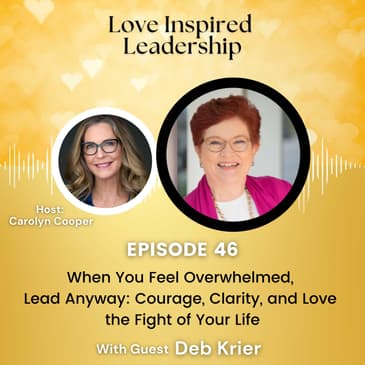
What happens when a life-changing diagnosis collides with leadership, identity, and responsibility? Deb Krier shares a powerful, human conversation about taking your control back, building your “tribe,” and choosing love-led leadership even in the middle of uncertainty.
What You’ll Hear:
- Deb’s turning point: an “annual checkup” that quickly escalated from stage zero to stage four
- Control vs surrender - accepting reality while still advocating for yourself
- Self-advocacy in action: asking questions, setting standards, and making informed choices
- “You are not your diagnosis” - reclaiming identity beyond labels
- Leading through crisis: choosing your team, communicating with integrity, and protecting your business
- The power of support: building your “tribe” so you don’t navigate challenges alone
Resources Mentioned
- Carolyn’s 21-Day Sacred Insight Journey: https://www.theinspiredconnection.ca/21days**
- Deb Krier Resources: https://tryingnottodie.live/resources/
Featured Guest: Deb Krier
Deb Krier is a strategic cancer advisor for business leaders and a purposeful entrepreneur known for her grounded, heart-forward resilience. Through Trying Not to Die.live, she supports high-performing professionals navigating cancer while still carrying the weight of leadership, responsibility, and identity. Deb’s work helps leaders take control back, advocate for themselves, and keep living with courage, clarity, and love - even when life interrupts everything.
Follow Deb Krier:
Website: https://tryingnottodie.live/
LinkedIn: https://www.linkedin.com/in/deborahkrier/
Facebook: https://www.facebook.com/groups/1465660477225232
Podcast: https://podcasts.apple.com/us/podcast/the-business-power-hour-with-deb-krier/id642539481
Meet the Host: Carolyn Cooper
Carolyn Cooper is the visionary guide behind the AIM High System and Love Inspired Leadership Podcast. With four decades of expertise, she empowers leaders and visionaries to boldly unleash their authentic power. Her work ignites transformation, guiding others to let love lead, honour their truth, and create legacies with energy, purpose, and unapologetic courage. Choose love. Embrace the power of possibility.
Connect with the Host:
Website: https://www.theinspiredconnection.ca/
Instagram: https://www.instagram.com/inspiredconnectioninc/
Facebook: https://www.facebook.com/InspiredBusinessDevelopment
LinkedIn: https://www.linkedin.com/in/inspiredbusinessdevelopment/
Ready to step into your next level of purpose, potential and prosperity? Unlock “Above the Line Living: 21 Days to Ignite Your Purpose, Presence, and Power with Love”-your daily journey to unapologetic self-leadership and authentic joy. Receive Carolyn’s sacred insights, meditation reflections, and empowering prompts right to your inbox. Choose love. Claim your courage. Transform your living legacy-one inspired day at a time.
✨ Begin your journey now: https://www.theinspiredconnection.ca/21days
Love Inspired Leadership is proud to be on the High Vibe Podcast Network. Check out Carolyn’s Gift in the Vault https://highvibepodcastnetwork.com/gifts
Share the Love
✨ If this episode lit something up in you… tag us on Instagram @HighVibeLeaders and let us know your biggest takeaway!
🦋 Don’t forget to rate & review — it helps us reach more conscious rebels like you.
Listen & Subscribe
🎧 Spotify
[00:00:02] What if you let love, not fear, lead your life and your leadership? I'm Carolyn Cooper and I've learned that true leadership isn't about perfection. It's about daring to be vulnerable, holding your vision in the darkness, and trusting your soul to guide you home.
[00:00:28] Welcome to the Love Inspired Leadership Podcast, a sacred space where every moment invites you to aim higher with love and purpose. Here, we don't just talk about leadership, we redefine it. Let's dive in.
[00:00:51] I'm so glad that you're here at the Love Inspired Leadership Podcast. And if you're here for the first time, I absolutely am so honored to host this podcast and interview extraordinary human beings who have chosen love over fear, over doubt, over hardship, over trauma,
[00:01:20] and have circled back to what love is, what love does, and what love represents. Because to me, every single human being on the planet has an opportunity to be a love-inspired leader. And that's in your own personal life, that is in your professional life, in every single role and responsibility that you hold that matters.
[00:01:45] So, I just want to graciously thank you for taking the time to be here to meet my incredible guest today. And today's theme is really about leading when life interrupts us. You know, it's leading from that place of courage, clarity, and love, even in the midst of crisis.
[00:02:08] Because that, to me, is the most important, potent decision in being decided to choose love over fear. So, my name is Carolyn. I am so thrilled to introduce you to Deb. How do you say your last name? Is it Career? Career. Okay. Wonderful. And she is truly a strategic cancer advisor for business leaders.
[00:02:37] She's a purposeful, passionate entrepreneur, and really an authentic, powerful voice for resilience in the most human moments in leadership.
[00:02:52] So, through her trying not to die dot live, Deb supports high-performing professionals navigating cancer while still carrying this incredible weight of being a leader and taking responsibility and to understand their identity. Oh, my goodness. I love it. I love it, Deb.
[00:03:16] And her journey reminds us that even when life gets interrupted by anything and everything that we had originally prepared, planned, and tried to control, it's love, clarity, and courage that can truly lead us forward and, I believe, back home to who we are.
[00:03:43] So, in the audience, if you've ever wondered how to keep showing up when life feels completely overwhelming, hard, and impossible, this conversation is to meet you honestly, exactly where you're at.
[00:04:02] And our intention here today is to bring you our heart-centered wisdom in the mature years that we have lived, both Deb and I, to really impact your life. So, where we're going to start is, Deb, I want to start in the concept of transformation and new beginnings.
[00:04:26] So, the way I look at this, it's like the intersection of identity meets reality. So, you know, you've spent decades helping organizations tell their stories. So, can you take us back to the moment when your story was dramatically changed in a way that you never anticipated or expected?
[00:04:54] Well, first of all, thank you so much. This is, I am just truly honored to be on your podcast. I did listen to some of your other interviews, and they're phenomenal. Just absolutely incredible. And so, it truly is my honor to be here. You know, you mentioned that I helped people tell stories. Well, I'm a marketing person, right? And a communications person. Have been most of my career helping people tell their stories. Some of which I worked for the American Cancer Society, right?
[00:05:24] And I also worked for an oncologist. So, I know just enough to be dangerous about all of this. But it was about 10 and a half years ago. I went in for my annual checkup. I had my mammogram. And they called and said, you've got to come back. And, you know, like I said, I had enough experience to go, uh-oh, it wasn't that I didn't smile pretty. Um, and so, I went back. And what they said was I had, um, uh, tiny little specks.
[00:05:52] Not a lump, not a bump, anything like that. In fact, the computer saw it. And I did a little research. Now, folks, watch Dr. Google. This is not really what we want to get, right? But I did enough research to know what was going on. And it's something that happens in all mature women as our bodies change and the hormones change. We get these little, little speckledy specks. But mine had started to gather, um, which is very rare. But I'm a very special person.
[00:06:20] Um, and so, my initial diagnosis was stage zero. You know? And we didn't think too much about it. Wasn't anything. I mean, I was annoyed. But, you know, it wasn't. It was, hey, we're just going to watch this. Then things progressed. Um, and we ended up taking, um, actually going into surgery and, uh, removing lymph nodes. Um, and, uh, and eight of 12 lymph nodes were positive for cancer.
[00:06:45] So I went from stage zero to stage three in a 10 second spurt, right? As it took her to tell me, I thought, oh, this is much worse. Um, and then eventually the diagnosis is that it's stage four. Um, and, but, you know, I, I, I distinctly remember, even though this is 10 and a half years ago, looking at my doctor and saying, I'm sorry, I don't have time for this. She, of course, looked at me like, silly girl. Um, but, you know, you mentioned the word control.
[00:07:16] And, and I think that is one of the biggest things with any type of serious diagnosis. The first thing we think is we're not in charge. We're losing control. And, and that's, I think, worse than actually thinking, you know, here's what's going on. It's how can I, you know, get back under control? And one of the things that I tell people is you have to pick what's going to work for you. You know, now I chose the traditional route, right?
[00:07:45] I was going to do chemo. I was going to do surgery. And then I was going to do radiation. And fate said, you're going to have lots of complications. Um, but yeah, it was, you know, and, and, but if, if somebody says, you know, that's not for me. Okay. You know, that's, that is, you know, and the nice thing is we now have so many options that we can choose from, um, both from, uh, you know, the, the traditional, uh, the Eastern,
[00:08:14] you know, all sorts of different things. I know that you do hypnotherapy. I went to a therapist, um, during part of this, a hypnotherapist because she helped me with my pain level. And you, because I was a big and taken all those icky drugs. Yeah. And, and what she did was absolutely incredible. And so it's, how are we going to get our lives? And then, ooh, our business is back under control. Oh my goodness.
[00:08:42] So your story has, has sparked so many incredible ideas of where I want to go next. I just want to really pause here for a moment. And I want the audience to resonate with me and they will agree with what I'm going to say. Your spirit is absolutely beautiful, Deb. Your inspiration, your enthusiasm for life is contagious.
[00:09:12] It is so refreshing to witness someone that has had a life changing diagnosis to have a state of perspective that you do. And I just really want to acknowledge that. I want to encapsulate that. And anybody who's listening here, if you have just been diagnosed or if you've been through the journey,
[00:09:40] this, this, this podcast is for you. Or if you have someone that you know has been on the path and the journey or just diagnosed, please share this with them. Because it's, here's the idea about control is that what I find fascinating about life is to have the most control is actually to make the decision to surrender and accept what is.
[00:10:09] Would you agree with that, Deb? Yeah. Yeah. You know, and, and we go through a myriad of emotions, feelings, you know, a big one during this process is grief, right? Our lives, even if it's a fairly simple, basic diagnosis, our lives have changed. You know, you're always thinking, when is it coming back? You know, they call the, you know, like a lot of people will say they have scansiety, right? You know, the once a year, whenever that they get their scans until they get the results.
[00:10:39] You know, they got little heart palpitations and all of those things. And anger is a huge thing. There's also guilt, right? What, what did I do? You know, and what did I do to desert this? Why, why is, why is this happening to me? Yes. Yes. Right.
[00:10:59] You know, and, and I only asked that once and, and was, you know, and, and, and I was going in for, well, I, like I said, I had multiple complications. Um, I did, I, my first chemo just about killed me. Um, I ended up with septic shock, which 75-ish percent of the times is fatal. And my doctors were arguing over how fast I was going to die that day.
[00:11:24] Um, and I mean, you talk about lack of control, but I remember thinking, excuse me, I get to vote here. Um, you know, and, and, but. Hold on, hold on, hold on. We got, we got to get that. We, we, we got to grab it. Okay. I want to grab that. Hold on a second here. I have a say in this. This is my light. You're having a conversation whether I'm living or dying. Wait a second here. Right. I get to have the say here. Right. Yeah.
[00:11:54] And they were out in the hall and my husband says it was a little different, but he said that was kind of the gist of the conversation. Um, you know, and, and so, yeah, I had multiple, multiple, I was in the hospital for a little over seven weeks in and out of ICU, in and out of surgery. The septic shock has done far more to my body than the cancer probably ever will. Um, you know, and, and, but, you know, as much as I could now, I was a very, very sick little kid. Right.
[00:12:29] And I had a staff laugh. Um, you, cause they have really hard jobs, right? You know, I had one and, and, oh, I, I absolutely loved her. She was still the, probably the lowest person on the totem pole as far as the, you know, the medical people were concerned. And she, every day requested, because they all changed, you know, they all moved around every day. She said, I have to have her, I have to have her. And when I left, yeah, when I, when they finally discharged me, she came back.
[00:12:59] And she wasn't working that day and she came back to tell me goodbye. Um, you know, and it was just. Okay. So let's, let's grab that what you just did. Okay. So let, let's extract that. Let, let, let's take a focus on that. So, so you brought humor to people who served you in a very vulnerable position you were in.
[00:13:23] And you set your mind on the focus of creating joy and humor for that staff in the hospital. Right. Now, I also know that there were times where I was a cranky little person. I mean, you know, you know, there was a lot of pain, um, you know, all sorts of things. And, uh, you know, and, and so there were times where I was not a happy camper, but I also did what I could to make sure that I was the,
[00:13:53] was in charge. Right now. My, my mom, um, I am an only child. And at that point she lived in Kansas. She has since passed away, but she came out and, and she and my husband were obviously the primary caregivers. Um, my aunt, um, her sister, uh, is a retired nurse practitioner, but then she was still practicing. And so she came out a couple of times and then I had friends, you know, I was never in that hospital room alone. Um, you know, and, and that comes back to that word love, right? Um, you know, and, and I mean, that was what,
[00:14:23] it was so incredible. Of course the staff loved it because it meant they didn't have to check on me all the time and, and all sorts of things. But, you know, it was, how could, you know, how could I make things easier for them? You know, and, and, and just things like, you know, they, they'd say, you know, you can ask for X. I'm like, why? I don't need it. Um, but, but yeah, you know, I did things, uh, like I said, control. Right.
[00:14:51] Um, at one point I had, I think 10 different doctors, you know, that, that came in every morning and I was kind of in and out of consciousness and, and all sorts of things. And they'd come in and they'd, and then they'd leave. And when I was more conscious, I distinctly remember it and telling them, wait, I need you to stand at the foot of my bed. I had, I had this giant window. When you live in the hospital, you get the best room. Um, and you want to, and they would go look out the window. And I said, no, no, I need you to stand at the foot of the bed so I can see you.
[00:15:21] They all did. Nobody questioned it. Right. And, and I said, and before you go any further and every time you come in here, I need to know your name and your specialty because that's going to make a difference as to what I'm asking you. And I had one who said, well, I have a name tag on now. He's six feet away from me and, and, um, and I didn't have my glasses on, but I told him, I said, show me your name tag. Well, it was under his lapel. So he apologized.
[00:15:49] And then I remember my infectious disease specialist came back and I thought, oh, I'm dying. I'm dying. He's come back. And he pulled up a chair and he sat down and he said, you know, you told me something that probably is the best advice I've ever gotten. He said, my ego thought you knew who I was and why I was there. And it never occurred to me. You didn't. And so he'll, uh, and, and I was really firm on that.
[00:16:17] I wouldn't, I, you know, once I, once I could, I know I'm not going to answer your questions. I'm also not going to take the drug. I'm not going to, you know, there were times where they would appear with a drug and I would say, was that for? And they would say, oh, I don't know. So-and-so prescribed it. I said, well, if you can't tell me what it's for, I'm not taking it. And, you know, and other doctors would come in and say, why do you have all these pills lined up? I don't know. Nobody could tell me what I was, what they were for.
[00:16:41] Um, you know, and, and so it's, sometimes it's the little things that help us. Well, it's always the little things, isn't it? Oh yeah. But it's also, you know, just to unpack that story is that you're taking control back. Mm-hmm. Yeah. Even little. Even small, small things that you feel that you are taking control of this journey that we're going on. And, and this is whether you have cancer or anything else. Right.
[00:17:11] Life. I mean, you know, and what, what I think is wonderful is you brought in a point that I think is really, really important here. And I have been through personal, extremely traumatic situations myself. It wasn't cancer. Thank you, God.
[00:17:30] And, and it's this concept of ego with that doctor and how you supported him to realize within himself that that broke the connection with his patients. Right. Right. So that forever changed. Right. Yeah.
[00:17:54] Because you stepped up to be navigating, being decided to take control of this journey that you are on. So I think that is a profound thing. Yeah. You know, there were a couple of times in the hospital and then I had to go to a care facility afterwards. Because when you've been in the hospital that long, you have to learn how to walk again and do things like that.
[00:18:19] And I, there were several times where I complained, like major complain. And I told them, I said, you need to understand. Doesn't affect me as much as I'm saying. However, I'm not the only one that this is probably affecting. You have a lot of older patients here. You have a lot of people who will not speak up. And I said, so I'm going to tell you this is what is going on.
[00:18:49] You know, and I actually had a nurse hurt me on purpose and not as part of, hey, we have to push harder for physical therapy. No, she physically hurt me. I mean, like I could have had her arrested. And they asked me, they said, do you want us to do that? I mean, they, they knew how serious it was. And, and I said, no, you just make sure she never works with patients again. I have no idea if that, you know, if they did or not. But I said, you need to understand.
[00:19:16] I was able to say, get your hands off of me. 90% of your other patients cannot do that. Well, then you're, you made a stand. I'm just going to state what you did. You took a stand really at a voice for the people who could not have a voice for themselves. And you knew it was an injustice.
[00:19:42] And you had the courage and the confidence to really be an advocate for all the other older, mature, not as resilient other folks that maybe were going through the Senate. Because when you go through cancer, I'm supporting someone right now, intimately, that's been through prostate cancer.
[00:20:06] And I'm his emotional resource in the last year and a half, almost two years now, through radiation and everything. And it's hell. So I, I know that because I'm witnessing it right now. I know that when you go through cancer, you make the decision that you are going to take control back. Great. Everything changes. I, I'm, I'm witnessing it right now.
[00:20:35] We had a conversation yesterday and you're going to understand this. He just made a decision to not have the hormone therapy. He's going to see the oncologist today in 30 minutes to, to let him know. And I cried. I cried on FaceTime because I'm so happy. Because there is a period of time you can either navigate through the cancer, the whole way through being your own advocate, taking control. Or you can sit back and not.
[00:21:05] So I think the power is in taking your own control and being decided. Right. That you're a part of this process. Yeah. I fired doctors during this process. And, you know, and it wasn't that they were incompetent. Most of the time they just didn't understand me.
[00:21:28] You know, and, and, and I was having this discussion last week with someone and they said, you might not like them, you know, but you have to trust them. And I said, and you have to, especially when it's something long term like this, right? You know, if it's your primary care that you see once a year, you know, I'm not always sure I remember what they look like. Right.
[00:21:48] But, but yeah, if it's, you know, and, and, and I said, you know, for, for somebody who's going to be taking care of you for a long time, you have the right to say who they are. I said, because they work for you. And I said, and if it's not working out, you get a different person. And her response broke my heart. She said, you mean I can do that? And she's all younger. Yes. And you know what?
[00:22:13] So this is giving every listener right now a message to take those people that you love, cherish your door, that are going through this horrific journey of cancer. You can tell them that they can give themselves permission to choose. Right. Is it awkward? Yeah. I mean, you know, it's like firing an employee, right? We don't like doing that, even if they've been incompetent.
[00:22:43] But, yeah, it's, and, and I love my team. I mean, you know, I've, I've, I'm down to just, I think, four doctors now. But, like, last week I had treatment. I am actually still in active treatment. I go in every 21 days. Like I said, I chose the traditional approach. Yes. Which has turned out to be something very, very different from what anybody expected. But I, my treatment day last week, as we're recording this, was also my birthday. Oh.
[00:23:11] And, and of course they knew that because you go in and you have to tell them on a birthday 900 times. And so I stopped and I bought three dozen donuts. So a dozen was for the front desk. A dozen was for the, the people who draw the blood and then the treatment room. Right. And I told them all, I said, you all have kept me alive for 10 years. You deserve this. Oh, you know, and, and, and, you know, they, they all just looked at me because now I've been going there 10 and a half years.
[00:23:41] I've never seen that. Um, when I finished with radiation, I took them cupcakes. Now that was, that actually, you know, I see people do that more when it's their last whatever. Um, and so, but yeah, show them because like I said, they got really hard jobs with people. Oh, they do. And they're doing bad things and, and, you know, and, and all sorts of stuff. And so just showing the person and tell the other people, Hey, this person works for you. You need to know she does a really good job. Yes.
[00:24:10] So, so it, uh, I mean, that's porn love all over it. Let's be real here right now. And it's showing your gratitude, which is grateful is right behind you. I love that. And it's also expressing the level of appreciation you have for the care that they have provided for you because their job is hard. And there's a lot of people that are in a lot of fear and exceedingly emotional going on that path and they need love too.
[00:24:40] And also here's the thing that I want to bring in right now, which I love, is that whatever we give is truly the only thing that we get to receive. So it's a circle of love. So whatever I contribute and give is this glorious opportunity to receive the same. Right. Yeah. You know, I had a scan several weeks ago. I have scans fairly often, blood work, all that good stuff. Right. And this was somebody I hadn't had.
[00:25:10] And as we were walking out, we walked past this door that said manager. And I stopped. I said, are you her manager? And you could see she got this. Oh, and yeah, she's like, you know, and, and I told him, I said, you need to know she did a really, really good job. Yeah. Yeah. Yeah. And, and he said, nobody ever says that. I said, that's why I made so important.
[00:25:37] Because being a, people want to be appreciated more than anything else. So audience, listen up. I mean, I have been to the cancer clinic. I have seen the extraordinary, dedicated human beings that serve my friend. And, and for all the men out there right now, listen to me, please get your PSA. Yes. Taken every single year. One year it was four. And the next year it was 10.7. Right.
[00:26:07] So you don't know. And he had no idea, no symptoms, no nothing. So he also has had two friends that he really encouraged them to go get the test. And they both had it. Right. So he's saying. And two of his friend's life. Yeah. With, with cancer, the biggest thing that is going to help determine your survival is how early it is caught. Yes. Yes.
[00:26:32] And, you know, and it's that way with, with a lot of, of various illnesses, both cancer, especially, you know, and of course the tricky thing is sometimes there are no symptoms like with prostate cancer, you know, things like that. And so you don't know. And so that's why simple blood tests, mammograms, all those various things. Are they annoying? Yes. Do we like having them done? No, I don't care because the alternative is, you know, not good.
[00:27:02] No, no, no. It isn't good. So tell me what was behind the resistance becoming known as the cancer girl. Like what ultimately shifted your perspective of that? Well, it was suggested to me by my absolutely fabulous business coach who knows my whole story. And we were on a Zoom and we were talking business. Right. Right. And then she shook her finger at me. And I thought, what did I do?
[00:27:32] And she said, you know, you didn't go through everything you went through without using it to help others. I said, yeah, but I don't want to be cancer girl. You know, I'm, I'm, yes, I'm still intrigued, but I still have to deal with this. But that's not what I want to be known for. And she just kind of looked at me and I was like, oh, and I mean, oh, she didn't, she didn't push any harder. And I thought about it. I thought. They already call me in when it's a new patient, when they've got students.
[00:28:01] Oh, they always like to bring me in when they're students that they're, they're working with. Right. And because I'm, I'm the, you know, I'm, I'm going to, in a good way, tell them, you know, things that they need to be hearing from the patient. But one of which is you ever call somebody by their diagnosis and you deserve to get smacked. I had somebody do that. This is the, I've had three diagnosis. First is stage four metastatic triple positive breast cancer. That's a mouthful, right?
[00:28:29] Then I had basal cell carcinoma. That sounds horrible. Man, that's your garden variety skin cancer, right? And I'm a redheaded freckly kid. But then I, it's been almost three years ago, I was diagnosed with thyroid cancer. And one time when I was in for a checkup, they said, hey, the thyroid cancer is in room four. And I went out and I said, excuse me, I understand HIPAA, which here in the United States is a privacy thing, right? And I said, so you can't yell out my name.
[00:28:58] Now they can't say your first name, you know, it's, it's, you know, because that's not really identifying you. But, but I said, please do not ever reduce somebody to just their diagnosis because we're far more than that. Okay. You know, and that's also taking control back. Yeah. Yeah. I'm, you know, I am not the thyroid cancer patient in room four. But, you know, I thought about what Kathleen called well, my business coach had told me. And I, and I thought, you know, she's right. How can I help others? You know, and that was when we started trying not to die dot live.
[00:29:29] Because we get so caught up in trying to not die that we forget that we have to live. And sometimes it's five hours, right? Sometimes it's, yeah, all 40 years. But who knows? But how are you going to live during that time frame? Yes. And choose to lead with love. Yes. Choose to lead with curiosity and wonder. And donuts. And donuts. And trust.
[00:29:57] And caring about others too and giving back, even when it's challenging for yourself. Right. Right. Because, you know, I mean, I love your story. I love who you are. And, you know, it's, this is the essence of love inspired leadership. And it doesn't always begin where we think it's going to begin or land where we think it's going to land as an outcome.
[00:30:26] Life is here to teach us. Life is here for us to make that clear and final decision that everything that happens to us in our life is for us. As teaching us the lessons, the gifts, and the opportunity to serve from your highest self. And that is what you're doing. And thank God for your coach. Because that changed the trajectory of how you're showing up in the world. Correct?
[00:30:55] Yes. Yes. You know, and I still have my business. I have my marketing firm that pays the bills. But, but yeah, it's, you know, there's, there are things, you know, how can we help? And sometimes it's simple, right? Simple, basic things. You know, in the infusion room, I usually I'm not the only one there. I mean, it's a big place. There's 30 chairs that are in there. I get up. Now, I am a very mobile person, right? It's not like I'm attached to an IV or anything like that.
[00:31:24] And I'm always going and getting myself something to drink and cookies or whatever. Anybody I go past, do you need some? Can I get you something? You know, and, and yeah, that's what the staff does. And of course, they figured out a long time ago, I can help. Oh, I hated COVID because I couldn't do that, right? I could not touch somebody, you know, the guy.
[00:31:44] And, but, but yeah, you know, if I can, if I, you know, if the staff doesn't have to worry about getting Fred over there, his thing of water, then their time is better used helping. Now that is helping. I get that. But, you know, can I help them help others? Well, and it's, it's also stepping outside of yourself to serve.
[00:32:07] And anytime that I have gone through really hard things, it's when I've made the decision to be kind, thoughtful, giving to another soul that I feel better myself. So you received in your giving to me there, right?
[00:32:24] So how did you navigate, here's the big question for me, how did you navigate your business, which was running, going through stage four cancer diagnosis? So what, what helped you continue to be this love inspired leader for your business too, while navigating this treatment, uncertainty? So how did you do it?
[00:32:53] Obviously it's a personal choice for everybody. And, and it is hard to decide who to tell and how much to tell. Because, you know, the first thing that they might say is, well, we don't, you know, no, we don't want to work with you anymore. You know, for whatever reason. Now they might be saying you need to focus on yourself, right? Or maybe it's, you can't do our job. You can't do it. You know, and, and so I was extremely fortunate. My clients were wonderful.
[00:33:22] And, you know, and, and I had to tell them, hey, there are going to be times where I'm dropped off the face of the earth. And, you know, and, and I said, you know, and, and it's funny, I use Facebook to communicate a lot. And my clients are my Facebook friends. So they know. Now, I know for many people, that is not what they want to do. They want to maintain their privacy. That's perfectly fine. But you want to control. There's that word again, the narrative.
[00:33:51] Because if you don't tell people at least something, they make it up. You know, if I just started missing deadlines and not telling why, then, first of all, I would deserve to be fired. But more importantly, they're going to say, oh, you know, it's because without ever knowing why. But, but yeah, I, I was very fortunate. In fact, it was so funny.
[00:34:15] Two of my clients or one of my clients actually was where I got my first round of COVID vaccinations way back then. They, you know, they were still very hard to get here at just even your regular doctor. And for cancer patients, you would have thought we could have got them. No, there's a senior living community. And they, and, and so that's where I went and got my, my COVID shots. But yeah, my clients, you know, they're, and, and, and I've been very fortunate in that.
[00:34:43] You know, and, and I tell people, whether it's clients, whether it's customers, staff, whoever, if they don't say, what can we do to help you through this? Then you might not want to be working with them. Yes, yes, yes, yes, yes, yes, yes. Because let's come back to love again. What is love? Love is patient. Love is kind. Love is thoughtful. Love is accepting.
[00:35:08] And because I know this for a fact that you provide such an incredible service and they appreciate you. So they will stay with you through this process and transition. Because they know your character. They know your integrity. So I just think that's beautiful.
[00:35:28] So do you have any systems or mindset shifts that you believe that every leader could put into place before a crisis? Right. Like this hits. Well, many of them are simple, basic business things, right? Do you have a business continuity plan?
[00:35:53] And even if it is just you all by yourself, does somebody know who your clients are? Where's your bank account? I mean, all of those things, because we could get hit by a bus tomorrow. Or, heaven forbid, you want to go on vacation, right? But, you know, have you thought about things like, you know, if a key member of your business is all of a sudden unable to perform their duties? Are those tasks written down?
[00:36:22] You know, are there things that absolutely positively must be done? Well, somebody needs to know how to do them. And, of course, the trick is for all of this is in our head. We are, you know, but, hello, write it down, you know, and you're not broadcasting it to the world. But the people who need to know need to know, you know, that information. Delegate. Yeah. Which is really hard. Oh, I am a type A person. Yeah. And delegating is really hard for me.
[00:36:51] And, you know, but the other thing is we work with, and I, you know, I have a very large volunteer group that I also manage in a totally different format. And I know that I have incredible volunteers. You also can have incredible employees, right? Give them the opportunity to shine by empowering them.
[00:37:20] You know, and I think that's one of the biggest things is let them make the decisions. You know, I do have a business podcast, and it's so funny because I had a guest on one time who told me, and he has thousands of employees, is a big company. And he said he knew he was truly a success when he went on vacation for two weeks and nobody called or emailed him. Oof, how ice. She will be magnificent.
[00:37:48] And that is how many times are we like, oh, but that means they don't need us. They don't love us. No, it means you've got the right people. Yeah. And it means that you trust them. It means that you have empowered them to make their own decisions. And it also means that you believe in them and that you get to be the owner of this business. Right. That is the free player. For other things.
[00:38:14] You know, I've recently come to the philosophy and I've told several people this when they said, well, we don't know. What if there's not them? I'm like, will somebody die? No? Okay. Then it can be fixed. I mean, absolutely. It's the truth. Because there's always a solution. Right. And it's always available immediately. And now here's the funny thing. And this is hard. This is really hard for me to learn. Somebody else's solution might actually be better than my solution.
[00:38:42] Well, this has been the humbling journey I've been on my business. I did a love it and let go list. So I spent two months writing down everything that I'm in flow, that I have joy, that I love doing this podcast. I cherish, love, and adore having these conversations. You can tell. And then my let go list was admin, Canva, great. You know, all of that. So I hired someone for Pornet, oh, almost five years ago now. I call her my virtual assistant angel.
[00:39:11] She does everything for me. She does everything I don't want to do. But I had the list ready when she showed up. But I made a decision that I was willing to let go to lead. And that's one of my phrases that pays. So the audience, you can write down, let go to lead. And that's in your life. That's in your business.
[00:39:31] And when you make that final clear decision to let things go is when you get more space for grace, more space for joy, more space for fun, more space for freedom. Right? Yeah. Because, you know, there's a fine line. And I just want to bring this in as we wrap here is that, you know, there's a fine line between being in control of everything. We've talked about control a lot in this interview.
[00:40:01] Fine line between control and letting go. Now, I think we all as human beings need to be our greatest advocate. Mm-hmm. Take a stand for what matters most within our life, within our integrity, with what's right. But also, there's so much that we can release and let go.
[00:40:26] So what's your final word and, you know, perspective on control and letting go and that fine line? Yeah, I think the big thing is to recognize you are in charge. And, you know, and sometimes that is I'm in charge to say it's your responsibility or I'm choosing this treatment or whatever it is. But you are in charge.
[00:40:52] I think that's sometimes hard for women, you know, and it's really hard when there's that person in that white coat who's gone to school for a bazillion years. No, you are in charge. You might still go with what they're suggesting, but it's your decision. Yes, yes, yes, yes, yes, yes, yes, yes. And I love this interview.
[00:41:15] Deb, I think you are one of these bright lights in the world that have brought your pain to purpose, that you have brought your purpose to a passion, that you have brought hope for people, that you are bringing these messages of truth to people. And, you know, I think about this incredible journey that you've been on over the last 10 years.
[00:41:44] And it's been a gift from God, I think, and a grace for you to just really learn to love yourself, to love the people in your life, and to really level up this love-inspired leadership. And light you shine. And it's okay to gently let go of people, right? Sometimes maybe not gently. But, yeah, you know, there's so much ick in the world.
[00:42:13] And, you know, no, we don't need all of that. You know, as we're talking, the Olympics were last week. I love the Olympics. Sorry about the hockey. But to see the love that they had, you know, and all of those things, I mean, that was, and the teamwork. You know, I want to leave this with folks. I have a tribe. You know, I tell people I'm a warrior.
[00:42:42] I'm a cancer warrior. I'm in the fight of my life. And I know some people don't like those words because they're aggressive. Find what works for you. But you have to have your tribe. And they're the people that are going to support you. And they come, they go. You get the right people. You give the others the grace to go and do something else. But no warrior ever, ever, ever stands alone. Never. Never. And you're never meant to do this alone. Not in life. Not whether you have cancer.
[00:43:10] Not whether you're running a business. Whatever hard shit. You're never meant to do it alone. And there's someone that you're thinking of right now that could be part of you. Call it your tribe. I call it my dream team. I have people that I call in when I am off the path. But I call it thinking above the line. Is when I'm off the path and thinking below the line in fear, doubt, resentment, anger, regret, whatever. The past, worrying about the future.
[00:43:38] I call in one of my dream team. And I call in a lifeline. And they tell me the truth. I get back on track within minutes. And it is a blessing. It is a lesson. And it is a gift. So I'm highly recommending the entire audience to build your tribe. Build your dream team. Because that's where miracles, that's where magic, that's where love lives and is.
[00:44:06] That is the truth. And why AIM High Method is all about love. It's about truth, alignment, and radiance. We're all here to shine our beautiful loving light on the world. Because we all have a story too. And it's about telling that story with conviction, with purpose and passion.
[00:44:34] And Deb, you got that nailed, girl. Love it. So I want to thank you for your story. Thank you. Thank you for your wisdom, your humanity, your kindness, your generosity of spirit. Wherever you go, it is beautiful. And we can all be inspired by that. So tell us about how people can connect with you and your work. Yep. It's very easy. Go to tryingnottodie.live.
[00:45:03] That is the website URL. Yourcancercoach.live is also where, if you are an executive on this journey, where you can do that. You can Google me. There's, I think, three Deb careers in the whole world, right? I told you I was special. And I think I'm the only one with this red hair. So find me. Reach out. You know, and whatever I can do to help, just let me know. Oh, beautiful. And for the audience, please do.
[00:45:32] I mean, Deb has answers. She's lived it. Those are the people that you want to talk to because she'll tell you the truth and she'll love you up to, guaranteed, because that's who she is. That is her character. That is her integrity. That is her mission in life. That is her living legacy. So I also want to let the audience know, once again, that you can receive my 21 days above the line living.
[00:45:58] It's a sacred journey listening to a three-minute audio recording that I do in my pajamas in the morning after I do my journal. I give you reflections. I give you journal opportunities that you can look at. And here's my final question. How might love lead your next decision, even in uncertainty? So, Deb, thank you. Blessings to you, my dear. Blessings to you.
[00:46:27] And thank you for being on the Love Inspired Leadership Podcast. And to the audience, hey, I'm so happy that you're here. Please share this with many, many people because my intention is to bring this deep love to the world. And I appreciate your help. Until next time, I look forward to seeing you and hearing you on the Love Inspired Leadership Podcast. Take good care.
[00:46:58] For years, you've been the woman who holds it all together. The team, the clients, the launch, the household. But lately, the cost is your nervous system, your sleep, your joy. You're leading on adrenaline, overthinking every decision, breaking quiet promises to yourself just to keep everything afloat. The Aim High Sanctuary is where that ends. This is where you remember who you are and structure your life around that truth
[00:47:26] and lead from regulated energy, clean boundaries, and honest power. Book in a clarity call with me through the link below or by scanning the QR code. And join us in the Aim High Sanctuary. Thank you for joining me on the Love Inspired Leadership Podcast. Remember, love isn't just a feeling.
[00:47:54] It's the most magnetic, prosperous force in the universe. When you lead with love, you unlock abundance, fulfillment, and a living legacy that truly matters. If today's episode stirred something in your soul, share it with someone who's ready to aim higher.
[00:48:22] Receive our transformational Aim High Business Breakthrough Checklist. That is your opportunity to be all you can be in 30 days. Keep holding your vision, anchoring your truth, and take intentional inspired action. Because love is all there is. And it's the greatest prosperity you'll ever know.
[00:48:51] Until next time, I'm Carolyn Cooper. Keep letting love lead your life forward.