
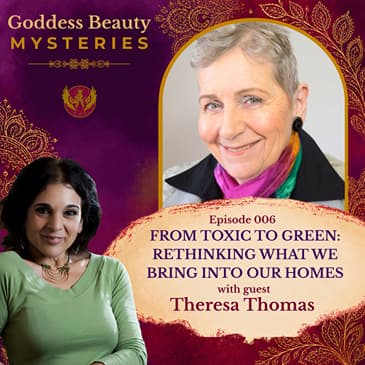
How can we become more aware of the fragrances and everyday products we bring into our homes? Christine welcomes environmental health advocate Theresa Thomas for a conversation about chemical sensitivities, conscious parenting, and the relationship between our personal spaces and the living world. Theresa shares the personal health experience that led her into environmental advocacy and introduces her book, From Toxic to Green, along with her Sleep Smart System.
From scented bedding and bedroom routines to an unexpected discovery during a family stay at a vacation rental, their conversation brings awareness to choices that can easily become invisible through habit. Christine and Theresa reflect on questioning familiar products, making room for personal sensitivities, and approaching change with greater curiosity. Their shared care for the Earth also opens a conversation about beauty and choice, including Christine’s work with henna and herbal hair color. At its heart, this is an invitation to pay closer attention to the environments we create for ourselves and the generations who follow.
Mysteries to Uncover:
- The personal experience behind Theresa’s commitment to environmental health.
- Where parents might begin when everyday product choices feel overwhelming.
- The bedroom habits and surroundings Theresa invites people to reconsider.
- What an unexpected vacation rental discovery revealed about fragrance awareness.
- How herbal hair color can offer another way to express personal beauty.
About the Guest:
Theresa Thomas is an author, speaker, and environmental health advocate whose experience with Multiple Chemical Sensitivities inspired her work supporting families. Through From Toxic to Green, workshops, and coaching programs, she helps parents become more aware of everyday chemical exposures and make informed choices for their homes. Theresa also leads ancestral ceremonies and enjoys gardening, traveling, and spending time with family.
Free Gift: https://fromtoxictogreen.com/free-gift/
About Me:
I’m Christine Shahin, a natural hair colorist, eco-beauty pioneer, educator, and author of Natural Hair Coloring: How to Use Henna and Other Pure Herbal Pigments for Chemical-Free Beauty. For more than two decades, I’ve helped people embrace their natural beauty through henna and other pure, plant-based pigments.
My work blends practical education with a deep respect for traditional beauty practices, helping people transition away from conventional chemical dyes while reconnecting with healthier, more sustainable approaches to hair color and self-care.
Connect:
Website: https://christineshahin.com
With heartfelt thanks to Tarek Haddad for the beautiful music that helps bring the spirit of Goddess Beauty Mysteries to life.
Thanks for listening!
Thanks so much for listening to our podcast! If you enjoyed this episode and think that others could benefit from listening, please share it using the social media buttons on this page.
Do you have some feedback or questions about this episode? Leave a comment in the section below!
Subscribe to the podcast
If you would like to get automatic updates of new podcast episodes, you can follow the podcast on Apple Podcasts or your favorite podcast app.
Leave us an Apple Podcasts review
Ratings and reviews from our listeners are extremely valuable to us and greatly appreciated. They help our podcast rank higher on Apple Podcasts, which exposes our show to more awesome listeners like you. If you are enjoying the show, please leave us a review on Apple Podcasts.
***************
We are proud to have Goddess Beauty Mysteries on the High Vibe Podcast Network.
Love this show? Check out the other shows on the High Vibe Podcast Network.
Share the Love
✨ If this episode lit something up in you… tag us on Instagram @HighVibeLeaders and let us know your biggest takeaway!
🦋 Don’t forget to rate & review — it helps us reach more conscious rebels like you.
Welcome to Goddess Beauty Mysteries, the podcast exploring henna, ancestral wisdom, and plant-based beauty traditions. I'm your host, Christine Shahin, author and founder of Goddess Beauty. Together, we are bringing ancestral wisdom into the present to create a more beautiful and sustainable future. Thank you for joining me to remember the Goddess Beauty Mysteries.
Christine Shahin:Greetings, every beauty! I'm so excited to introduce you to Teresa Thomas, and I'm going to have Teresa introduce herself because she's just an amazing environmental activist who has captured my heart because we are eco activist sisters. Teresa, take it away and tell us who you are and all the things that you contribute to make our world a better place.
Theresa Thomas:Well, thank you so much, Christine. I'm so honored to be here, and I love the work that you're doing as well. Well, I started out as a normal woman, you know, mother, married, job, all those things, and then one day I got, I'd have long-term, low-level exposure to synthetic chemicals, and one day, my whole world just went orange, and I had to hang up on a mortgage broker and run out of the room, run out of the building, and it ended up that these low levels of chemicals had really gotten into my deep tissues, and I wasn't able to go outside without a mask on for 10 years. So
Theresa Thomas:through that journey, I became an advocate for environmental health and wellness, and also I did a lot of studying of different modalities, and then landed in a course miracles and did some very deep personal work, and then I ended up with an African spiritual teacher, so also doing earth-based rituals for healing, and yeah, of course. I think, as you know, Mother Earth is so powerful, and and that energy of Mother Earth will help us cleanse our bodies and and release so much.
Christine Shahin:Yeah, what a beautiful experience, and thank you for sharing that. And so we see that your book is from Toxic to Green, and it focuses on a parenting guide. Could you tell us a little bit more about that?
Theresa Thomas:Well, basically, my big thing is that our children's bodies are so tiny, and their organs are tiny, so it's hard for them to process all that overnight. So my number one thing is to stop having scented sheets, pajamas. If you can get the prescription to get or make them yourself, fire retardant freely pajamas, and as much as a way of synthetic as possible during those sleeping hours, then the body can cleanse and purify and wake up the next day ready to go, not be having all kinds of runny noses, rashes, earaches, irritability, and all those things that happen.
Christine Shahin:Yeah, it is true. They get exposed so much sooner than our past generations,
Theresa Thomas:yes,
Christine Shahin:because the chemicals are much more pervasive today than they were when our grandparents and our parents and then ourselves. So, yeah, I think it's just a very wise practice. And thank you for a guide because sometimes it's just so overwhelming. You're a new parent, and you want to do the best, but you don't know where to begin. And and that's a great thing to have somebody like you with the knowledge that you have to be able to be the guide for
Theresa Thomas:us. Thank you. And the other thing is, of course, we're inundated with ads about how terrible germs are and how we have to protect ourselves from all these things.
Christine Shahin:Right.
Theresa Thomas:And really, it's only you know vinegar and water will do the trick most of the time. It's not like we're working in labs that are full of dangerous. What do you call them? Germs or viruses.
Christine Shahin:Right. Right.
Theresa Thomas:We're just living in the normal environment. It's not that scary, and we don't need to, you know, spray the railings and the counters with this stuff that kills everything.
Christine Shahin:Right. Yes, I remember learning about those antiseptic soaps, and then realizing that the EPA literally said that just a regular soap and some water was plenty to take care of the exposures. You know, if you're outside and you're playing and stuff like that. Yes,
Theresa Thomas:exactly. Yeah. So, and even. On our food, I don't know. I hope people don't do that, but they're they're spraying it on their counters, and then they're cutting their food on the counter or putting the food on the counter. So you're getting these other toxins into the food as well, besides what they're all sprayed with. And you know, usually we recommend people wash their vegetables and fruits with a non-toxic soap before they start eating it. That's an interesting. I know I've been doing like the soaking them in the vinegar and water
Christine Shahin:or the salt and water. But tell us some more about a non-toxic soap that would you would just use like a regular handmade soap.
Theresa Thomas:Yes, a veg wash. Yes, just a vegetable-based soap would work on that. It's
Christine Shahin:great, and you mentioned food, so I know too that oftentimes what we don't make the connection to is that when our food is not organic and we're consuming it, of course, our mouth is actually our first digestive, and then these pesticides literally can wreak havoc on our immune system in our mouth, and that's why so many people have oral issues, and they don't make that connection to the fact that it might be their food, and also around food, I'm wondering: were there particular things that you did with food to detox yourself from all those low-level exposures that built up and
Christine Shahin:kind of had their way with you.
Theresa Thomas:Well, I basically did the food elimination diet, so eliminating everything because I was reacting to foods as well. I was reacting to everything, so I did. And then, if you're doing that radically, you would just go back to rice only, and start adding other foods. And the other thing is, someone was saying it's a seven day period now, but at least four days between each food family.
Christine Shahin:I see. So if
Theresa Thomas:you're thinking you might be sensitive to dairy, then you would cut out yogurt, cheese, milk, butter, all those wonderful dairy things, and and you don't necessarily think, oh yeah, yogurt is milk, right? And butter is milk, so you cut out all of those things for four or maybe seven days, and then you have a big glass of milk and see what happens. Wow! And I read about that happening. So then the the child just projectile vomited the milk because it was something they were reacting to. Now the other thing you can do is just make sure you only have that food group every
Theresa Thomas:five days or so, and then your body gets a chance to cleanse out that food group. That's beautiful,
Christine Shahin:wonderful wisdom, wonderful wisdom, and I really appreciate all the work that you do, but also for sharing with us today on Goddess Beauty Mysteries, and very grateful for this book. I'm going to be really promoting this. I love it,
Theresa Thomas:and
Christine Shahin:I look forward to doing more with you to keep raising this awareness on how we can grow our green kids, and yes, and our green grandkids.
Theresa Thomas:Exactly, exactly. So the sleep smart system is the other thing I'm I'm working with, and plus I'm working with women who've come to some crisis like mine, whether it was health or divorce or career. You know what's happened to disrupt our life, and I'll be working with them to bring the environment into their living space, but also do some of the rituals for cleansing and release and stuff. But the big thing is the sleep smart system, and that tells us what to get out of the bedroom. So I talked about the sheets and
Christine Shahin:oh right, and
Theresa Thomas:and then the other thing is your electronics. Like everybody wants to have their phone right by the bed, and oh, I have my two little alarm clocks that are windups upstairs because I add them to the repair shop. But you know, a windup clock or an old fashioned plug-in radio alarm. These do not have the same kind of electromagnetic fields around them that our phones do, and you know to be able to even if you can in your own household just shut down all of the Wi-Fi while you're sleeping, so that you know turn off the main switch so that there's no active radio waves going on
Theresa Thomas:all the time, that gives our brain a little bit of a chance to rest as well.
Christine Shahin:Yeah, beautiful. I know those are some of the things that I practice and shut up all the systems, and then I do not have my phone in my room. And literally, I when I wake up the. First thing I do is go outside, and connect with yeah. And then after maybe a couple of hours, I will turn on that device.
Theresa Thomas:Yes, yes.
Christine Shahin:It's hard in the beginning, but after a while, it really kind of settles in.
Theresa Thomas:Nothing is that urgent, right? Right. Yeah. So, yeah, and and then there's things like your mattress and your pillows and the floor coverings and of course what you're cleaning your room with. Right. No. Again, and you know a lot of people have plugins and things like this. Well, those are not really good for us while we're sleeping. So,
Unknown:yeah,
Theresa Thomas:you know, take them out. You'll be able to smell them for months afterwards. Anyway, once the stuff is in your wall,
Christine Shahin:it's true. And recently, my a few of my children and myself were visiting family, and we rented a B and B, and it was kind of shocking. We're sitting in the living room having a conversation, and all of a sudden there was like this puff of scent, and then we tracked it down to like it looked like a vase, and it was literally putting out these sort of like plug-in aromas, and then when we noticed that, we went through the whole house and found that they had these things under the beds and under sinks, and you know it was amazing. So we collected them all and we put them
Christine Shahin:outside. And then when we went to leave. It was a lovely place. We really loved it, you know. And then when we went to leave, we just replaced them, put them back where they were. But it really taught us to be much more investigative when we're staying in a in a place, you know. And I can almost like
Theresa Thomas:looking for sorry, almost like looking for hidden cameras, right?
Christine Shahin:Yeah, yeah, yeah. Hidden toxins or something. Yeah, was very eye opening for sure, and I think that I can understand why they would want to do something like that. But at the same time, I was maybe hopeful that we could convert them to something that was less toxic. So, you know, having those conversations with these places and being like, we do have some chemical sensitivities in our family, and you know, it would be nice to know that you have these devices or whatever they are. Yeah, but I'm really happy, and it's called the Sleep
Theresa Thomas:Smart System. Sleep, and I have a little gift of that. If that's okay with you, we didn't talk about it. Yes, please. Yes, yes, I can send that link along for you, and then beautiful. Your listeners could get that. Love it, and the other thing when I got sick, there was a big hospital injury in Halifax, Nova Scotia. So about 800 hospital employees that went off sick because of some synthetic chemical, and ventilation for the building was in intaking idling trucks and various other things. So we had a lot of people in Halifax very concerned about the environment, and all over
Theresa Thomas:Nova Scotia we had this "No Sense Is Good Sense" campaign. Oh, nice! So then the cosmetics, fragrance, and toiletry industry came to Halifax and asked to meet with all of us, and we're in this meeting. And you know, these guys are well. Anyway, they you know, we said we're concerned about the sense. Well, it's just those little old ladies; they just put on too much. And of course, a lot of these women were nurses, middle-aged nurses, and you know that did not go over very well, so then he says, "Well, well, how do these posters get printed? And Rhona Cathcart, who was the head of the
Theresa Thomas:nurses' union at that time, she sits up. Well, we print them ourselves, and we put them up everywhere we go because, of course, that was preventing them from going back to work or thinking properly at work, and so I'm at the end of the table with these gentlemen, and he comes back and sits down by his colleague and says, "We'll have to start advertising to the children, and that's what happened in the late '90s, and it still just gives me a chill. So then I thought, well, if this happens, then these young people are going to be getting overloaded, and you know, in 20 years or 10 years or 15
Theresa Thomas:years, we're going to have more sensitivities. Yeah. So you know, that's when it's sort of amped up another level. I'm sure they shared that. With all of the industry people around the world, right? And
Christine Shahin:yeah, it's concerning, isn't it? Because you would think that they could easily find substitutes, but they definitely are invested in what they're using as a profit.
Theresa Thomas:Yes.
Unknown:Yeah.
Christine Shahin:And so, there's no incentive for them to consider otherwise. Though you would wonder what if they think that they're immune themselves or their children are immune, and how they would somehow get away with that kind of. I think it's probably going
Theresa Thomas:to be like the smoking. And remember that gentleman who actually ended up getting lung cancer, walking away from the smoking industry. You know, they will have to have some people in their family who get really chemically sensitive before they figure it out.
Christine Shahin:Yeah, a sad reality seems to be how it works.
Theresa Thomas:Yes, but
Christine Shahin:Teresa, what a lovely meeting! I'm so you know happy to have found you, and I will share with you. When I was little, I wished my parents had named me Teresa. I don't know. I would tell people my name is Teresa. So when I found you, and I was like, "Oh, she's got the name I always wanted.
Theresa Thomas:That's so sweet. Yeah, huge. Well, I'm looking forward to what's your book called? It's
Christine Shahin:natural hair coloring. How to use henna and other pure herbal pigments For chemical-free beauty,
Theresa Thomas:okay. Yes, what an option says, Hannah.
Christine Shahin:Yes, it's just an option for people that yeah aren't ready to. I'm a little
Theresa Thomas:terrified because oh, your hair is gorgeous.
Christine Shahin:Yeah. Well, your hair is gorgeous. You don't have to do a thing, but this is for others who may be younger that don't aren't really quite ready to embrace that part, and yeah, I'm I'm doing it myself, but at some point I know I'll be letting it go.
Theresa Thomas:Uh huh.
Christine Shahin:Yeah.
Theresa Thomas:Well, your hair looks beautiful.
Christine Shahin:Thank you. Yes,
Christine Shahin:as does yours. Thank you so much, Teresa. I'm looking forward to more with you.
Theresa Thomas:Thank you. So great to meet you, Christine.