
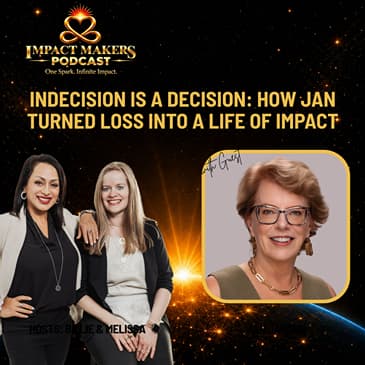
🎙️✨ What if the decision you keep avoiding is actually the decision keeping you stuck?
In this inspiring episode of the Impact Makers Podcast, Jan shares a powerful truth: indecision IS a decision. 🔥
After the loss of her husband, Jan found herself living alone on 20 acres and realizing that the life she had built no longer matched what she needed. Rather than remaining on Victim Island 🏝️, she made a bold decision to move toward connection, community, and a new chapter in Solution City. 🌆✨
Her story is a beautiful reminder that we don't always need to know exactly how everything will unfold before we move.
💡 Clarity follows decision.
When we decide, we act. When we act, we receive feedback. And that feedback reveals the next step. 👣
Today, Jan is turning those lessons into impact by teaching others how to stop overthinking, make empowered decisions, and move forward with greater confidence. Through her books — including Life’s Too Short for Maybe and Devil with a Briefcase — and her upcoming series exploring grief, she is transforming her lived experiences into practical tools that help others navigate their own crossroads. 📚❤️
🎧 Tune in to hear Jan’s incredible story and discover why the decision you make today could become the first step toward an entirely different tomorrow. ✨
Sometimes getting from Victim Island to Solution City begins with one simple, powerful act:
🔥 DECIDE.
Take The Next Step:
Check Out The Impact Maker Alliance and take our Blueprint Quiz:
Introduction video about Girls Matter: https://drive.google.com/file/d/1R3-xqzJLZW14om1PhFClcU_oRSZ8zgip/view
About the Guest:
Jan Janzen is an author, entrepreneur and Decision Strategist who has spent more than four decades challenging conventional thinking and making bold decisions.
An entrepreneur since the age of 19, Jan has built businesses, lived and travelled internationally for nine years, and navigated extraordinary change, loss and reinvention.
Her latest book, Life’s Too Short for Maybe: Stop Overthinking. Start Deciding., explores a simple truth: our lives are shaped by our decisions, yet no one teaches us how to make them.
Today, Jan writes about decisions, life, grief, freedom and the lessons gathered from a life fully lived. She lives on Vancouver Island, where she writes, photographs, gardens and enjoys the community she calls home.
Contact:
Meet the Hosts: Billie & Melissa
Billie Aadmi and Melissa Deally are the dynamic co-founders of Amplify Impact Academy, a global hub for personal transformation, leadership development, and high-frequency living. Together, they empower people to release unconscious limitations, align with their soul’s truth, and amplify their impact in the world.
Billie’s journey spans from saving lives to healing souls — a single mom, seasoned Police Officer since 2005, real estate investor, international speaker, and best-selling author. As the visionary CEO of Go Mindspire Inc., Billie blends her background in Education, Human Kinetics and Metaphysical Science with deep transformational work, helping clients elevate their mindset for lifelong success.
Melissa is an award-winning Integrative Mind-Body Health Practitioner, international speaker, and five-time best-selling author. As host of the globally ranked “Don’t Wait For Your Wake-Up Call!” podcast, she inspires thousands to take charge of their health and life. She also leads Girls Matter, her non-profit dedicated to keeping girls in school in Uganda and Kenya.
Both Billie and Melissa are highly skilled Master Trainers of Hypnotherapy, Trainers of NLP, Time Line Therapy®, NLP Results Coaching and Magnified Healing®. They passionately teach advanced mindset, healing, and personal transformation modalities, equipping clients and students with tools to create lasting breakthroughs. Through their trainings, retreats, and mentorship programs, they deliver powerful experiences that create ripple effects of transformation — helping people everywhere live happy, healthy, wealthy, and free.
Connect with the Hosts:
Website: https://amplifyimpactacademy.com
Socials:
Facebook: amplifyimpactacademy
Instagram: amplifyimpactacademy
LinkedIn: amplifyimpactacademy
Youtube: amplifyimpactacademy
Melissa:
Facebook: https://www.facebook.com/melissa.deally
LinkedIn: https://www.linkedin.com/in/melissadeally/
Instagram: https://www.instagram.com/guidedhealthjourney/
Youtube: https://www.youtube.com/c/MelissaDeally
Billie:
Facebook: https://www.facebook.com/billie.aad
LinkedIn: https://www.linkedin.com/in/billie-aadmi-54063521/
Instagram: https://www.instagram.com/billie.irei/
TikTok: @gomindspire
Take The Next Step:
Apply to be a demo subject on our show:
https://app.amplifyimpactacademy.com/widget/form/wq0e6mbQTEpRoghU8Hlo
The Light Circle Membership:
https://amplifyimpactacademy.com/thelightcircle-aligned-core
CLEAR THE SCREEN™: https://amplifyimpactacademy.com/clearthescreen
Quantum Life Mastery School: https://amplifyimpactacademy.com/90-day-q3
Introduction video about Girls Matter:
https://drive.google.com/file/d/1R3-xqzJLZW14om1PhFClcU_oRSZ8zgip/view
Join our FREE Workshop: Meet Your Unconscious Mind Workshop. Discover a path to peace in just 2 hours by learning the tools that will quiet the noise in your head: https://amplifyimpactacademy.com/um
Amplify Impact Academy is proud to be on the High Vibe Podcast Network. Check out Billie & Melissa’s Gift in the Vault https://highvibepodcastnetwork.com/gifts
Share the Love
✨ If this episode lit something up in you… tag us on Instagram @HighVibeLeaders and let us know your biggest takeaway!
🦋 Don’t forget to rate & review — it helps us reach more conscious rebels like you.
Listen & Subscribe
🎧 Spotify
Welcome back to another episode of the Impact Makers podcast. I am Meli,
Billie:and I am Billy Adme, and this is where one spark can create infinite impact. Today we have a very special guest, Jan Jansen. Welcome to the show, Jan.
Jan Janzen:Oh, thrilled to be here.
Melissa Deally:We are very excited to have you on the show, and I just want to introduce you to the audience a little bit. Jan Jansen is actually a returning guest to this show, as you know. The show has changed over from Clear the Screen and been rebranded to the Impact Makers podcast, and Jan was on episode 10 of our Clear the Screen show. And Jan is an author, entrepreneur, and decision strategist who has spent more than four decades challenging conventional thinking and making bold decisions. As an entrepreneur since the age of 19, Jan has built businesses, lived, and traveled internationally for nine years and navigated extraordinary change, loss, and reinvention. Her latest book, *Life's Too Short for Maybe: Stop Overthinking, Start Deciding* explores a simple truth: our lives are shaped by our decisions, yet no one teaches us how to make them. Today, Jan writes about decisions, life, grief, freedom, and the lessons gathered from a life fully lived. She lives on Vancouver Island, where she writes, photographs, gardens, and enjoys the community she calls home. So welcome, welcome, welcome to the show. You've packed so much into your lifespan, and it's you know, as all lives, it's had its ups and its downs and its twists and its curves and its bends. And in this episode, I really would like to focus on, you know, where life's taken you over the last three years. You have become a widow in that time, and you know worked your way through that. You've moved house. You've had issues with properties that you've owned, and you've worked all the way through that, and literally brought yourself from being in that place of what we call Victim Island over to now where you're living, thriving, loving your new community in Solution City, and I would love for you to share that journey with the audience here today,
Jan Janzen:Melissa. I think if I shared that journey with you, we would be here probably the rest of the world note version. It was it was a lot. I it's hard to believe that this October it will be four years since Greg, my husband, passed away. It feels unbelievable that so much has happened, and I think I'd start with the fact that after traveling the world for nine years, we decided that we wanted quiet peace. Didn't want to talk to anybody. I didn't want to hear anybody. I didn't want to see anybody. All we wanted was to be on our own and to be pretty quiet because the world is a noisy place. And for anyone who's traveled, you really appreciate that. Especially some countries are noisier than others, and I think we were in a lot of those countries, Melissa, because it was just noisy. So we ended up buying 20 acres in the middle of British Columbia, and everybody had 20 acres. So everybody was like-minded. Nobody wanted to see anybody, and it's funny because after we loved it, absolutely totally loved it. And I was there for nine years. I have never lived in a house for my entire life for half that time. So to have lived there for nine years, it was a big deal, and then Greg passed away in October of 2022, and all of a sudden, this sanctuary that was so peaceful and so quiet and so beautiful and exactly what I needed didn't fit anymore. It was so out of sync with what I needed because I needed people, I needed community, I needed a totally different scenario, so I decided to sell the house one morning. It was listed that afternoon, and I started packing. Though there wasn't a whole lot of decision making, it was like it was obvious, and I did it. So I put the house on the market, and as I go down my very long driveway, so that no one could see your house or anything else or you, I go walk down the long high the long driveway to go see my for sale sign, and the woman a woman comes by in her car and she said, "You're moving, and I said, "Yes, who
Jan Janzen:are you? And she said, "I'm your neighbor across the street, and in nine years, I had never seen her. I had no idea what she looked like, I had no idea who she was, and I had obviously never spoken to her before. That was my what I call in my book "Life's To Short for Maybe" my one thing. We had wanted we had wanted privacy and isolation, and without a doubt, we got it. So then, fast forward to now, I am on the welcome committee. Where I live, I walk down the street with having three to four conversations. It was funny. I'm traveling, you know, a long distance, nine hours of ferry, the whole bit with two cats that are feral rescue cats in my the back of my truck that have never been in a vehicle except to be rescued to my house, and they are-they're doing well. It's they've got themselves wedged in between boxes and stuff in this crate, and I'm just frantic to get them out of here. I pull into my driveway at my new house, and I get out, and there's a man standing there, and he says, "Hi, I'm Rudy. I'm your new neighbor. I'm thinking, "Oh my goodness, this isn't really happening. So I went from literally not seeing a neighbor for nine years to not being in my new community for more than two seconds without my neighbor being there. And I said, "It's so nice to meet you, Rudy. I need to get my cats out. Can you we talk later? That was that was my welcome to to a very very special place. I love that, and just what a difference from where you were to where you are now, and even just the way that you know you put the house on the market and it sold, and you found your new place. All of that happened with such ease and grace that it was very much divinely guided because things don't just happen like that, unless there's, you know, some divine guidance helping bring you over to this place of Solution City, and now you can't even walk down
Melissa Deally:the street without knowing people because you're on the welcome committee and you're getting to know not just your neighbors, the entire community.
Jan Janzen:And what was interesting, Melissa? There's a there's a side note, and I I talk about it in my book. Life's too short for me because it was so bizarre. Is I had this offer on the house, and because I lived rural and had 20 acres, you got to meet the buyers, which as you know that doesn't normally happen. So I had built a relationship with the buyers, and we're walking through the property, and I found out that they need did want to sell their house. The sale offer was conditional on the sale of their house, but that they had a trust fund, and that they could access that trust fund if they needed to, because they weren't going to lose my house. So I said to my I said to my realtor, "Is it possible? And I don't know if this is even legal, but can I pay them to take that condition off of my house sale? She said, "I don't know. I've never done that before. I've never even heard of it. And I said, "Well, can you find out if it's legal? Because I really get I can't go look for a house with this condition on my on on the sale of this one. So she came back to me. She said yes, and I paid them. I get to the house that I find, and I put in an offer right away. The next morning, someone else puts in an offer. The difference: they had a condition of sale, I didn't, and I bought the house.
Billie:Nice.
Jan Janzen:That gives me goosebumps just telling you that story.
Billie:Yeah,
Jan Janzen:because most people would have said, "Oh, I'm not going to do that. Like they wouldn't. They would have just dismissed it and not even considered it. A lot of people would have, but me, no, I went through something here, and because of that, I bought the house that I absolutely totally love.
Billie:So, Jim, I love that you know you do a lot of work around decision making, right? And it comes down to you made a decision that this is what you wanted, and nothing was going to get in your way, and that's what we call full congruency, right? There's no part of you that is battling, saying, "Well, should I do it? Should I not do it? I don't know if I should go. If I like, this is how the universe works, and this is what we teach as well in our school. Is that you know? I love what you're you know your little sign there in the back that indecision is a decision, and that you know we're always making choices whether to move forward or to stay stuck or to move backwards. So talk more about you know, because you're a decision master in my my eyes. So talk more about how that has helped you, and now how you use that in your book, and you know how you work with people in in helping them understand that decisions are extremely important, and why it's so important to be congruent in your decisions and not have that internal battle when you're when you're wanting to get things in your life.
Jan Janzen:I think Billie, that it's a very strange thing that our entire life is made up of decisions. I mean, you can't open your eyes in the morning without making a decision that you're going to open your eyes, that you're going to get out of bed. What are you going to wear? What are you going for breakfast? What are you going to do? We make hundreds of decisions every single day, and very few people talk about decision making. There's not a lot of workshops out there. There's not even really a lot of books out there on decision making. And I'm thinking this is a fundamental part of our life, and no one talks about. Isn't that kind of bizarre?
Billie:Yeah, I mean, we teach decision making protocol. Which who knew there was even a protocol for making decisions without emotions around it?
Jan Janzen:So right away, I realized there was a need for this because yes, I am very very good at making decisions, and I've been making decisions my entire life. I mean, radical decisions, and so what I often will will start with is people are afraid of making decisions because we have been taught that if you make a wrong decision, and I put that in quotes, like what is a wrong decision or a bad decision, you always people will feel bad about it. They'll feel like, oh my goodness, I'm a wrong, I'm a failure, and so they they've developed this phobia, this fear of making decisions, because they might be wrong, and what they don't get is that they're already making a decision and not making a decision. So, and that really is the most serious way to mess up your life is to not make any decisions. Because let me tell you, people will find a way to make those decisions for you.
Billie:Right,
Jan Janzen:so that's a big thing, and then people really aren't clear on what I call your one thing. Like, if you don't understand what's important to you in this season of your life, and as my story that I just told you illustrated, that what's important to you, your one thing is going to change, and so you have to really be in touch with who you are in this moment. Doesn't matter what you how you were last year. It's like what is important to you now. And when you're on your deathbed and having watched someone on their deathbed, it's not pretty. It's not fun. It isn't glamorous or or in any way a nice thing to have to go through. It's horrible, and to watch someone die, I think is one of the biggest wake-up calls. To really think about what am I doing and what decisions am I making, and am I living the life that I really want to live? Because I know that at one point in time, I'm going to be laying there thinking, "Did I live the life I wanted to?
Billie:So, Jen, how did you become so good at decision making? Is that something that you worked on, or is it just something that naturally you were really good at?
Jan Janzen:Well, I think growing up with a very dominant father was probably helpful, but because I was raised in a high control religion where a lot of decisions were made, and I was told this is what you have to do. So, for example, I was six years old. I go to school, and I'm in my first assembly, and there's 1000 kids in the auditorium, and I have been told that I must sit for the national anthem. I cannot stand for the national anthem. So, at six years old, I am making a decision that's pretty, pretty. The looking at going, so stand. The teacher knows I will not be standing. This is embarrassing. It's been disconcerting for a six-year-old to be doing this, and yet I had to do it, and I was told I had to do it, and I did it. So that decision was made for me. But I went along with that decision, and I did it. I fulfilled a very challenging decision. At eight years old, my parents said, "Do you want to go with your best friend and her mum to Toronto from Vancouver to Toronto? You're going to take the train out. You'll be there for six weeks, and then you'll come back, and we will call you maybe a couple of times in those six weeks. There was no internet, no Zooms, no anything. And I said, okay, and I did. I was away from my parents for six weeks at the age of eight. And someone once asked me on a on a an interview, "Well, what did you learn? I go, "That I really didn't need parents. I mean, I was spy, 19 five, and I came home, and no wonder at 17 I said to my my principal, "I want to leave. I want to graduate early. I don't want to be here till June. And we weren't on semesters, and he said, "I said, can I do it? And he said, "Well, yeah, we can figure out how to get you enough credits. I said, "Good. I was the only kid out of 1000s of students that graduated at the end of February, and by May I was on a bus by myself moving myself to Montreal. So those are the decisions. And my dad said, "This is pretty amazing. He said to me, "If you leave,
Jan Janzen:you're not coming home, and they sold the house, and they moved into an Airstream trailer, and I never moved home again. Obviously, because there was no home to move to.
Billie:Wow!
Jan Janzen:So when you talk about making decisions, I've been making them for a very long time and big decisions. I mean, this isn't like, do you want a Raggedy Ann or do you want a Raggedy Andy? I mean, this is not. Or do you want a Barbie? Or these are those weren't the kind of decisions I was making. I was making very big decisions.
Billie:Was it that moment when you were six years old that you remember deciding that I am no longer going to let someone make decisions for me? Do you recall that at all?
Jan Janzen:No, because. I did. I went along with it for a very long time. So people made the decision, you know, made a lot of the decisions for me because of just the high control situation that I was in. However, I still was pretty independent and obviously had a mind of my own because I took off to Toronto for six weeks at eight, so that was fine. And then I left. I went to England at 16, and and then I went. I moved out the house at 17. So I think it was a combination, Billy, of a very strong nature family who were never wishy washy. It was very black and white, and then just the situation in which I I grew up in. So I became very good at making decisions, and I took responsibility for those decisions. And my parents were very adamant that I was always responsible for my decisions. They never covered for me. They never made excuses for me. I was responsible, and I was a gift. I think that was a huge gift. Yeah,
Billie:that that is a true gift because I know you know responsibility and accountability go hand in hand, and you know when you are, we're talking about Victim Island. It's a decision to be there, yet most people will not take the responsibility or the accountability that they're there, and they'll stay there still pointing the fingers at other people, but you know keeps them stuck there. And so, what's your advice to help people get off Victim Island and over here to Solution City with the power of decision making?
Jan Janzen:When you understand that you're making a decision to be there, so you're already making a decision. So get over the fact that you're not making a decision because you are. And I think most people don't really acknowledge that, and they can find all kinds of reasons why, and make all kinds of excuses. But at the end of the day, you've made a decision. You've made a decision to stay stuck because indecision is a decision.
Billie:Right.
Jan Janzen:So stop thinking you're not making a decision, and own up to the fact that you are, because that just makes life so much easier. Because once you understand I am making a decision, that means if I'm making the decision this way, I can also make the decision that way. But if you don't think you're making a decision, then it's very hard to make a different decision because you don't even know you've made a decision or you're making a decision. And once you understand that you are, well, then if I've made that decision, well, then I could make a different decision. Yeah, I love it. I mean, it's really that simple.
Melissa Deally:I love that, Jen, and just you know the background that you had with your very strong father, and there was a lot of decisions made for you, and yet you broke out of that, and now you live your life entirely on your terms, making decisions each and every day, and having the awareness, which is always what we talk about in our trainings. Is first you have to have awareness, as you just said, awareness of the fact that indecision is a decision, or that I can make a decision in each and every moment of my day, and as you go through your day, as you go through your life, I'm just wondering: was has there ever been a point where you just kind of had that aha moment of the power of decision making? I know that you said you had a little bit of an aha that decision making isn't talked about. However, for you, was there ever a moment where you're like, "Oh my goodness, choosing to make a decision, being aware of my decision, is what puts me in the power seat of my own life. Did you ever notice that specifically?
Jan Janzen:I didn't really get it because, to me, it just came so naturally. It really did, and so when I think back, did I wake up one morning and go, "Oh my goodness, I'm I'm now calling myself a decision strategist" It was other people really saying to me, "You're very good at making decisions, or "Wow, how do you make these decisions, these big decisions, so quickly? And then I'm sitting back and thinking, "Oh, is this different? Like, is this unusual? And so, and people that would say, "Well, yeah, you, I, I, I can't believe how you do this. And I'm thinking, "Well, how do I do it? And I really had to stop and think how I did it, and then that's how. That's why I think writing a book about it made a lot of sense because I had to really go back and think. Okay, why do I do the things I do, and how do I do it, and how do I do it with such ease and grace, and this attitude that I can't lose? I live a no lose life. I can't lose because even if I make a poorer decision, I've something has good has come out of it because I learned that that decision didn't work, and I've learned something from it, which means I can make a better decision next time. But if you don't make any decisions, you don't learn anything, and then everything nothing gets better because there's nothing to learn from because you're not making any decisions or taking any risks. Whereas I jumped off the cliff and assumed there was a parachute, and so far there always has been.
Melissa Deally:And you're always moving forward, as opposed to staying in this limbo place of not making a decision for whatever reason. Some people don't make decisions for FOMO. Some people don't make decisions because they feel it's safer here than ooh over there, where I don't know what that is.
Jan Janzen:And just one more thing here that I think is important, Melissa, is people assume that clarity comes before a decision, that they're going to get clarity without making a decision, and they've got that absolutely totally backwards. You do not get clarity until you make a decision. Now you don't have to make the bing bing decision, but make a little decision, and then make another little decision, and then make another decision, and then all of a sudden you have more clarity, and then you can make the bigger decision. But if you don't make any decision at whatever size, you're not going to get any clarity because you're keeping yourself in the dark.
Melissa Deally:True, because each of those little decision is telling you whether you're on the right path and keep going in that direction, or no, this isn't the right path. This doesn't feel good, so I'm going to go over here instead. What I was about to say is, I love how you didn't have any aha moment, and you had to have people tell you, "Oh my goodness, you're so good at making decisions, Jen, and you had no idea. And that is so often true of something that is our innate gift, right? It comes so easily to us; we just do it without thinking about it, and then somebody else looks at you doing it, going well, you're amazing at that, and that would be so impossible for me. They have their own innate gift that is different, and so for you, this truly is a gift which comes back to you know your story that as a young child you were making these big decisions with such ease, and so now, how are you helping others get to a place where they can make decisions more easily?
Jan Janzen:That's why I decided to write the book because, really, it was my my coach Forbes Riley, and she's interviewing me. This is last year, and she said to me, "You're really good at making decisions, and out of my mouth, I said no. I'm brilliant at making them, and I'm hearing this at the same time that she is. And she goes, "Yeah, you are, and she says, "And I suck at making decisions. Now, this is a woman that has sold, you know, 1.2 billion dollars on shopping channels and everything else. I mean, her book is just taken off pitch secrets and and I love her to bits, but she was so honest when she just announced. I mean, knowing this is on YouTube, I'm not telling stories out of school. This is on the video that we did together. I suck at making decisions, and I'm thinking, wow, like if you suck at making decisions, I bet you there's a lot of other people that suck at making decisions, and that's really what inspired me. Because she said, "I've never met anyone like you. And there's, I mean, she's worked with stars and celebrities and everything. She said, "I never met anyone like you. And I'm thinking, "Wow, am I that weird? Because I know how to make decisions, and then I realized that it was a gift, and that I was a gift that I had taken for granted, which is why I decided to write "Life's Too Short" for maybe stop overthinking and start deciding, because it's a fundamental principle of if you want to decide, you're not going to get what you want guaranteed.
Billie:So, Jen, what would you say to that person that is just scared of making decisions.
Jan Janzen:Decide to stop being scared. Decide to stop being scared and make a little decision. Can you make a little decision? Because you know, if you're going to parrot, if you're going to learn how to parachute, you don't get up, just put on a parachute, and go jump out of a plane. You don't, and I get that. If you're going to learn to drive, you take some lessons. So, find out how to make decisions better. Is why I teach it because it's not taught. But make a little decision, and then you build that muscle, and then you make another decision, and then you make another decision, and you gain confidence, and you find out that even if it isn't the decision that you hoped it would turn out the way you did, then the question is, what did I get from it? What did I learn? What can I take out of it? How does this now impact how I'm going to think differently about the next decision? Because if you don't make any decisions, you have no you have no information for which to make a decision, and really, people don't understand. You are making decisions all.
Jan Janzen:You're just not being aware of them, and you're not acknowledging that most of the time they worked out, or you would be dead by now. They always worked out, you know. Pretty much, they work out because otherwise, you would have been run over by a car, or something awful would have happened to you because you would have done something stupid. So the decisions that you're making, without even realizing you're making decisions, are already working out for you. So relax and just go make a decision that maybe feels a wee bit.
Melissa Deally:Comfortable, and then find out the life. Do you do okay? You'll find out pretty fast how that happens. Love that, and your just candidness of it. That you know it can be that simple. And so often we do. We get caught up in all of our emotions and the what ifs, and then we get ourselves stuck, as Billy and I well know, because we also teach this. I want to ask you though, Jan. Tell us a decision that you made that after making it, it didn't go the way that you thought it would go. However, you had really powerful learnings from it that you are really grateful for the decision that went the way that it went, which wasn't the way you expected it to go? Do you have a situation like that that you can share?
Jan Janzen:You know, it's funny, Melissa, because I'll think about I'll think about it sometimes during the day. I'll think, well, that didn't quite work out the way it did, but then I think of something positive, and then I just think of the positive. So right now, it's funny that there is not one thing that is coming into my head as a decision that I would have made differently because I saw the positive in it and how it impacted the deck's decisions that I made, and so I felt grateful for that decision that didn't really work out the way I expected. Because I trust that it's not I'm I'm being guided, and I I believe that some people don't, and that's fine. But I do believe that I'm being guided because I my attitude is: I'm the one down here. Excuse me, I'm the one down here, and I need help. So help, because I'm willing to do the work. So I expect help, and I don't think a lot of people have that kind of radical relationship with whoever or whatever's on the other side. I think they feel very often very inferior. And am I good enough? And hey, I was raised with that for 38 years, so I get it. I don't have that attitude anymore. I have the attitude that I'm down here. I obviously volunteered to come here at some point in time, and I've done a good job of my life. I'm proud of it. That had an impact on a lot of people, and so I expect to be supported, and it's not really negotiable in my world. It's just I'm doing the good, good stuff. So you know, help me out. Thank you very much. Amen.
Billie:Again, I love the the congruency and how you speak, Jen. Like you're so just you know embodied and authentic in who you are, and that's really you know the work that we teach and we do is learning how to find who you are. Because until you know who you are, then can you go out there and help others? And that's exactly what you're doing now. Is you know you've been through this journey of really understanding who you are, and now really just owning that, which a lot of people still aren't because we have all these masks that we put on. So, what does making an impact mean to you in in terms of now the work that you do in the world?
Jan Janzen:Well, as you know, I've been involved with Girls Matter for a number of years, which is something that's been very, very important. And even though I'm no longer on the board, I still will obviously continue to support Girls Matter. You're in the back of my books and things like that, so I can't really get away from you because you're that one there. You're that out there permanently, so that's super cool. And I think that the more that I can really help people become more decisive and really show them that it isn't as this big bad scary thing that's we need to hide in the closet. Like, just make a decision, and the more that you gain confidence making a decision, the the more your life will change. And once that confidence starts to come, you will look back and think, "Whoa! Like, this is so different. I feel so different. I am so different. And when people start to notice that you're different, that's also encouraging and inspiring for you to continue to make those decisions, and with when you start to make decisions, it empowers you to think beyond your own world. Because when you're not making bigger decisions, or you're making decisions with this fear and trepidation that something horrible is going to happen, it's very hard to see outside of your world, and when you do have that change of perspective, you start to see ways that you can help and make a difference. So, by showing people how easy it is to learn how to make decisions, then they become more powerful, which means that they can then go out and help others. Hello, very
Melissa Deally:beautiful. So, Jen, if there's someone listening to this podcast that is going, "Oh my goodness, I suck at making decisions, like Forbes Riley said, and I need help, and I can think of a person that I know that is the worst at making decisions, and I perhaps need to send this podcast to her once it's published. What? How can people get hold of you so that they can reach out for support? Because, as you say, we make decisions all day, every day. If we can be more empowered in making those decisions, it literally changes how their life is and how they show up in their life. So, how can people get hold of you?
Jan Janzen:JanJanzen.com is my website. I also suggest that you go to Amazon and pick up the book "Life's Too Short for Maybe. Stop overthinking, start deciding. It's $10. Like really seriously, if it if it doesn't change your life, I'll send you back the $10. Okay, because I really believe that from the information and the feedback I've been getting from the book, people going, "Whoa! Because it's like a bathroom reader. You can pick it up anywhere and just read it. You can pick any chapter and you can read it. And so I love this one. No one is coming. There's a belief that many people have that someone will show up to fix their life. And at the end of it, I say, "No one is going to live your life for you. No one is going to make the decisions that shape your future. No one is going to step in and take responsibility for what happens next. That part belongs to you. So if we can just things like that, like it's straightforward, and yet I think there's a lot of fun in it. People who who are reading it even right now are just going, "I'm loving it. Like I I just love it, and that makes me feel good because if they can read it and apply it, and then we can see progress. And I'm going to be doing something. I'm gonna, I'm gonna test it out. This is a something I'm, I'm gonna play with, and it's called Jan Unscripted. We're on the third Friday of every month that we'll just get on Zoom and it's free for all. Like you just throw whatever you want at me, and I will will have a conversation about it. So that's another way that people will be able to reach out. So when you get the book, there is a QR code at the back so that they can just look at that. And then there's a whole thing on Girls Matter. There you go.
Billie:Thank you.
Melissa Deally:thank you so much for sharing about Girls Matter and getting that message out, and for all of your dedication to Girls Matter over the years. It's so appreciated. And while we're here talking about your books, I can see two others behind you, and would love to just invite you to share a little bit about both of those books as well. Because once somebody's read one of your books; they probably want to read more.
Jan Janzen:Dibble with a briefcase is already out. It is called Devil with a briefcase. Stop winging it. Start winning, because people wing their businesses. And so, what I did is I took the lessons that I learned being in a high control organization for 38 years. They're hugely successful. Probably the most successful volunteer global organization. So my chapters are not called chapters; they're called decisions. So there's 101 decisions, and if you just again, you can just open the book anywhere, and you will find a decision that is supported by a tremendous success. And I'm doing that now in the morning. I get up and go, "Okay, what do I need to focus on today? And I'll open it up, and it'll get you know. It's about visibility. I'm thinking, "Yep, okay, that just reminds me of what I need to do in order to succeed. So that's that's out already. The books on grief. There's a beautiful book. It's written. It's called "Coping with Grief and Loss: What Grief Really Feels Like and What No One Tells You. And I've also created a journal for those who like to journal, which has again been beautifully illustrated. My VA right now out of Venezuela is just gifted with graphics, unbelievable. And then I have done a healing companion, which if it was a business, it would be called a you know workbook, but that doesn't really sound cool for grief. So it's called a healing companion, where there's some prompts because not everybody knows how to journal or likes to journal or feels compelled to journal, but they can by ask a question, then they can they can answer that question, and I think getting that grief out and on paper is really valuable, so those will be out early 2027, and I'm excited about those books as well because grief affects how you make decisions, which no one told me. That would have been nice to know that my brain wasn't working really well, and that I was maybe going to make some poorer decisions, which I did. And I thought that I didn't
Jan Janzen:realize that it was because of grief. And so here I was beating myself up and thinking, "What is wrong with me? Like I'm making some really stupid decisions. And then I finally learned by going to a grief retreat that you helped say you need to go. That was awesome because I learned then what was going on in my head with my brain. And unfortunately, we live in a culture that doesn't talk about that, Melissa. And it's sad that everybody is grieving. Everybody is grieving. We've lost pets. We've lost parents. We've lost loved ones. We've lost homes. We've lost you know things have fallen off of cliffs. I mean, really, we we're we're in a mess, and people are grieving, and no one really talks about it from a practical point of view, and how it affects your body, and how what you can do to really gain that equilibrium. So, writing the book really brought me back to okay, now that I know what's. I can deal with it, and I have.
Melissa Deally:So again, bringing the awareness. So I love how these three books are just bringing together those different aspects of your life, from your entrepreneurial aspect of you to your, you know, gift of being such a powerful decision maker to that journey through grief and loss, and then coming into awareness of how that impacts your decisions, it's just woven together so beautifully. And these books are now available, or will be soon, to the public to be able to buy them and learn from you. So, thank you so much for your time coming on the show for your contribution to humanity through your books, through Girls Matter, through all that you do, and congratulations because I love where you're at. I love what you're offering, and I'm so proud of you.
Jan Janzen:Thank you,
Billie:thank you, Jen, for making an impact and being one of the impact makers in the world, and you know, just helping shine a light on a simple thing like decision making.
Melissa Deally:Thank you, Billie, and to our audience. Thank you for tuning in and listening to the Impact Makers podcast. If any part of this episode resonated with you or with someone you know needs to hear this. Please share it with them.