
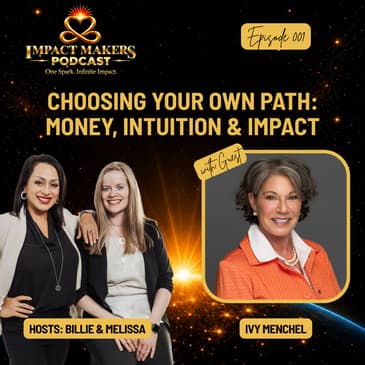
🎙️✨ What is your relationship with money really telling you?
In this powerful launch episode of the Impact Makers Podcast, we sit down with Ivy Menchel, a financial professional who followed her intuition, challenged the expectations placed upon her, and built an incredible 30-year career helping others create greater financial independence. 💰🌎
Ivy shares how she found the courage to choose her own path and why true financial transformation often begins long before we look at the numbers — it starts with the beliefs we hold about money. 🧠✨
From thoughts like “money is scary” or “I’m terrible with money” to the stories we inherited growing up, Ivy reveals how our relationship with money can influence the choices we make and the future we create.
🔥 In this episode, discover:
✨ How Ivy followed her intuition despite family expectations
💰 Why your relationship with money matters
🧠 How limiting beliefs can influence financial independence
🌱 The importance of understanding your money story
🎁 Ivy’s Defining Your Wealth workbook to help you explore your own financial mindset
This conversation is about more than money. It’s about choosing your own path, transforming the stories that hold you back, and using what you’ve learned to create an impact for others.
🎧 Tune in, get inspired, and share this episode with someone who’s ready to create a new relationship with money and possibility. 🌎✨
Gift: Free E-book “Defining Your Wealth” Workbook: https://www.bespokelegacywealth.com/
Take The Next Step:
Check Out The Impact Maker Alliance and take our Blueprint Quiz:
Introduction video about Girls Matter: https://drive.google.com/file/d/1R3-xqzJLZW14om1PhFClcU_oRSZ8zgip/view
About the Guest:
Ivy H. Menchel is a CERTIFIED FINANCIAL PLANNER™ (CFP®) who leads a values-based wealth advisory practice dedicated to helping clients make clear, confident, and meaningful financial decisions. With more than 30 years of experience in financial services, she also holds designations as a CERTIFIED BUSINESS EXIT CONSULTANT (CBEC®) and CERTIFIED DIVORCE FINANCIAL ANALYST™ (CDFA®), reflecting her deep expertise across the financial planning spectrum.
Ivy’s work centers on guiding individuals, families, and business owners through life’s major transitions — from selling a business or navigating a divorce to managing the financial impact of retirement or loss. She begins every relationship by deeply understanding each client’s goals and values, then crafts thoughtful, creative strategies tailored to their unique circumstances.
A strong believer in collaboration, Ivy often works alongside attorneys, accountants, and other advisors to deliver coordinated, comprehensive solutions. She is especially passionate about helping owners of privately held businesses explore their exit options and design transition plans that balance financial success with personal fulfillment — whether the next chapter involves family succession, employee ownership, or an outside sale. Widely regarded as a thought leader in her field, Ivy shares her insights through teaching, speaking, and writing. She is the author of the workbook Defining Your Wealth, which helps individuals articulate what financial well-being truly means to them.
Email: Ivym@bespokelwp.com
Meet the Hosts: Billie & Melissa
Billie Aadmi and Melissa Deally are the dynamic co-founders of Amplify Impact Academy, a global hub for personal transformation, leadership development, and high-frequency living. Together, they empower people to release unconscious limitations, align with their soul’s truth, and amplify their impact in the world.
Billie’s journey spans from saving lives to healing souls — a single mom, seasoned Police Officer since 2005, real estate investor, international speaker, and best-selling author. As the visionary CEO of Go Mindspire Inc., Billie blends her background in Education, Human Kinetics and Metaphysical Science with deep transformational work, helping clients elevate their mindset for lifelong success.
Melissa is an award-winning Integrative Mind-Body Health Practitioner, international speaker, and five-time best-selling author. As host of the globally ranked “Don’t Wait For Your Wake-Up Call!” podcast, she inspires thousands to take charge of their health and life. She also leads Girls Matter, her non-profit dedicated to keeping girls in school in Uganda and Kenya.
Both Billie and Melissa are highly skilled Master Trainers of Hypnotherapy, Trainers of NLP, Time Line Therapy®, NLP Results Coaching and Magnified Healing®. They passionately teach advanced mindset, healing, and personal transformation modalities, equipping clients and students with tools to create lasting breakthroughs. Through their trainings, retreats, and mentorship programs, they deliver powerful experiences that create ripple effects of transformation — helping people everywhere live happy, healthy, wealthy, and free.
Connect with the Hosts:
Website: https://amplifyimpactacademy.com
Socials:
Facebook: amplifyimpactacademy
Instagram: amplifyimpactacademy
LinkedIn: amplifyimpactacademyYoutube: amplifyimpactacademy
Melissa:
Facebook: https://www.facebook.com/melissa.deally
LinkedIn: https://www.linkedin.com/in/melissadeally/
Instagram: https://www.instagram.com/guidedhealthjourney/
Youtube: https://www.youtube.com/c/MelissaDeally
Billie:
Facebook: https://www.facebook.com/billie.aad
LinkedIn: https://www.linkedin.com/in/billie-aadmi-54063521/
Instagram: https://www.instagram.com/billie.irei/
TikTok: @gomindspire
Take The Next Step:
Apply to be a demo subject on our show:
https://app.amplifyimpactacademy.com/widget/form/wq0e6mbQTEpRoghU8Hlo
The Light Circle Membership:
https://amplifyimpactacademy.com/thelightcircle-aligned-core
CLEAR THE SCREEN™: https://amplifyimpactacademy.com/clearthescreen
Quantum Life Mastery School: https://amplifyimpactacademy.com/90-day-q3
Introduction video about Girls Matter:
https://drive.google.com/file/d/1R3-xqzJLZW14om1PhFClcU_oRSZ8zgip/view
Join our FREE Workshop: Meet Your Unconscious Mind Workshop. Discover a path to peace in just 2 hours by learning the tools that will quiet the noise in your head: https://amplifyimpactacademy.com/um
Amplify Impact Academy is proud to be on the High Vibe Podcast Network. Check out Billie & Melissa’s Gift in the Vault https://highvibepodcastnetwork.com/gifts
Share the Love
✨ If this episode lit something up in you… tag us on Instagram @HighVibeLeaders and let us know your biggest takeaway!
🦋 Don’t forget to rate & review — it helps us reach more conscious rebels like you.
Listen & Subscribe
🎧 Spotify
Welcome to the Impact Makers podcast. I am Melissa Deally.
Billie:and I am Billy Aadmi, and this is where one spark can create infinite impact. We are so excited to have our guest Ivy Menchel today. Welcome to the show, Ivy. Thank you, thank you, Billy. Thank you, Melissa.
Melissa Deally:And I would like to introduce Ivy to all of you. Ivy is a certified financial planner who leads a values-based wealth advisory practice dedicated to helping clients make clear, confident, and meaningful financial decisions. With more than 30 years of experience in financial services, she also holds designations as a certified business exit consultant and certified divorce financial analyst, reflecting her deep expertise across the entire financial planning spectrum. So, Ivy, that's a lot that you have accomplished. There was a lot of acronyms I didn't read out there as I was reading your bio, and of course, there's a lot more to your bio as well, which will be in the show notes for listeners to go ahead and read on their own. However, you obviously weren't always a financial analyst. I'd love to just go back and ask you what led you into this line of career.
Ivy Menchel:Oh wow! How much time do we have? Let's see. So the semi-short version is that my undergraduate degree is in psychology, and I always wanted to help people, but for several reasons, after I graduated college, I took a little time off and I started to work. And I was, I was making money, which was a lot more fun than actually going back to school to get my degree in psychology. And I grew very quickly in the industry that I was in, which was kind of like I would scratch my head because all of my education was really social sciences and not business. But then, if you look at my background, I grew up in a family of business owners, so of course, I absorbed all of that. Anyway, I was working and I was making a lot of money, but I really wasn't enjoying what I was doing, so I literally did a T chart. What do I like to do? What don't I like to do? What am I good at? What am I not good at? And it boiled down to that I do something that helped people and utilized my business sense. So I was either going to go back to school and get a dual degree in law and either psychology or sociology, or become a financial planner. So we know the punchline. I became a financial planner, and then of course you know developed a couple of other specialties. But that's really for the most part how I how I got started.
Melissa Deally:I love that you use the good old T chart. You know, I think it's so simple, and sometimes it's the simplest things that can help us make decisions, as opposed to getting bogged down in all of the, you know, what ifs, etc. etc. that make the decision making process so difficult. And just knowing you as I know you, I'd love you to take that story back even to your younger years, to your childhood. Because here you are doing this T chart. Do I go back to school? You've already, you know, been at school and got a degree. Do I do more degrees? Just share with me, you know, the mindset that you grew up in, in terms of you going to school and getting an education, versus how you have shifted that now throughout your life to the person you are today, and how you help people today.
Ivy Menchel:So I grew up in a male centric family that, like the and more so from my father's side of the family than my mother's side of the family, but like the boys got a lot more attention. The boy, you know, everything really focused on the boys much more so than the girls. And actually, so I mean, my parents sent me to college. They didn't, and I mean, I know times are different now, but like, they weren't even involved in like my application or anything like that. And I think that they were really sending me to college just to like meet a husband, like to get married. But I knew, I knew in my teenage years, like I at some point had to break, like had to break out of that, like, um, out of that mindset, and I knew that I wanted to be a professional, and I, you know, and it wasn't so easy because that wasn't really. How I was brought up, you know. My mother, she worked occasionally, but she didn't have a career, so you know, she for the most part she was around for us when we were growing up, and I just not that I wouldn't want to be around for kids, but you know, I just knew that I needed a career. I knew that I needed something different, but it was actually hard because it wasn't as if I was actually being supported for that. And I remember it was Thanksgiving. We were driving home from Thanksgiving, and my grandparents were in the car with us, and I was a junior, and my brother was a freshman. So, right, I'm closer to graduating college. And my grandparents turn around and ask my brother, "What is he going to do? And he starts talking, and he's not sure, and he's throwing a couple of things around. And of course, you know, they said, "Well, you should be a doctor, you know, because everybody wants to, like, you know have their child grow up to be a doctor. Now here I'm getting a degree in psychology, so I say, "Well, I'll be the doctor of the family. And my grandmother takes my hand and pats it and says, "Okay, honey, and then goes back to my
Ivy Menchel:brother.
Billie:I feel you on that, Ivy, because I sounds like we grew up in kind of a similar, you know, household. However, it was a lot more, you know, forward. We were I wasn't needed to make insinuations. It was pretty much go to school, get a job, because nobody wants to marry someone that is not uneducated and doesn't know how to, you know, participate in, you know, the family. And so it was. I totally feel you on that because I actually did grow up with two brothers as well. So there was a lot of you know. I was not encouraged. They were encouraged to you know do the business and entrepreneurship, or I was like, no, no, just go to school and get a degree and get a job, get something safe. You know, I went to school to be a teacher, and you know that kind of thing. And yet here, you know, I so I feel you that we weren't encouraged to be entrepreneurs, and when you don't have the support system, it's that much harder, right? We know an entrepreneurship is hard as on on its own, but we don't feel like, especially the people around us that are usually as our family members, we don't have that support. It makes it that much more. So I want to ask you, Ivy, is how did you break through? Because I know for me personally, always had that little voice too that you you kind of spoke to, you know, and we know that's your intuition and your higher self. Like always, like
Ivy Menchel:you're made from born. You don't do something, you know. You're that like shine your oh, and I was the only person that had that Billy. I didn't. We all have that.
Billie:Me too. We all have it. The problem is most of us don't hear it. That's a problem, right? And that's what we want to hear. And some of us hear it and we just ignore it. I did it for many years. So, what was was there kind of like a pinpoint where you're like, no, like I'm not going to do that, and I'm just going to follow my intuition and follow that I'm I'm made to do bigger things. Like, can you talk more about that journey?
Ivy Menchel:You know, I can't say if it was just one thing. I actually even did work with my father for a little while too, and it became so apparent to me like I was his girl, I was his little girl, like that was it. I would never be an adult or a professional in his mind, and in his mind. And the interesting thing. So here, what I've been in financial services for over 30 years, which of course I can't believe because I still think I'm 25. So the math doesn't work. But and my and my brother is a very successful business owner, but my father still talks to my brother about financial stuff and not me. And even when I tell him something or suggest something, he doesn't even. Yep, he doesn't even listen
Billie:over the head.
Melissa Deally:Right. So fascinating how the people that know us best put us in a box. It doesn't matter how much grow and change that they can allow us out of that box, right? And I'm assuming your brother is not a financial planner. He's a successful business person. However, that's not his forte, and your father still has you in that box.
Ivy Menchel:Yeah, I would say I'm not even 100% sure my father really knows what I do. You know what I mean? Like, I mean, he knows I'm a financial planner, but I'm not sure that he really absorbs that and accepts that. You know, it's yeah.
Billie:My we teach about the unconscious mind, and my dad doesn't even believe we have an unconscious mind. So, I mean, that's really
Ivy Menchel:oh, my father wouldn't either. My father wouldn't either if I asked him,
Billie:right?
Ivy Menchel:Right. You know, I I'm going to now ask him, Billy, and I'm going to get back to you.
Melissa Deally:It's like who's running your body at night while you're asleep? You're not waking yourself up every 30 seconds to remind yourself to breathe. So
Ivy Menchel:exactly right. It's a whole different yeah. It's a whole different ball game. Yeah.
Billie:Okay, so I love that. So you you kind of it almost like you started just following the breadcrumbs, and it just kept going in that direction. And and I love that that you you just started, you know, you never ignored it, right? You just kept going. It
Ivy Menchel:was so important to me. It was so important to me. I knew that I I knew that I needed a career and that I needed to be independent. The interesting thing, and actually, Melissa, I don't know if I ever told you this. So when my mother passed away and we went through the house, I had taken an aptitude test when I was 20, and you know, obviously, I forgot about it, right? When we were going through our house, I still had some stuff in the house and tucked away where the results of the aptitude test, and it's-I mean, I am doing exactly what I'm supposed to be doing. It said that I should do something that helps people, that's mathematically based and that is tied to the business to the legal world, and I have two practices. I have two businesses. That's I do that in both. Like that's exactly what I do in both businesses. So it was so reassuring and so comforting because I always tell people I love what I do, and I feel so fortunate to be doing it, and knowing that, like I am doing what I'm supposed to be doing. Yeah,
Melissa Deally:it's be very fulfilling, very empowering to find that.
Ivy Menchel:Yeah, it was
Melissa Deally:in years later, right? So you got it at the time, and maybe didn't do much with it, and
Ivy Menchel:yet probably didn't even read it, and
Melissa Deally:yet, yeah, and yet you followed that you know little voice, that intuition directing you here, and you know even doing the T chart comparison, that's where you ended up because you were listening to yourself, and your intuition will never guide you astray. And I want to commend you because you never sat on Victim Island. You know, oh woe is me. You know, maybe the thought came to your mind, like your grandmother. You know, just patted you on the hand, and you, you know, you felt diminished. And however, it didn't stop you. It didn't hold you back. You still rose up and went. This is really important to me. I'm going to follow this, and that's exactly what you've done. And you're over here in Solution City, in a career that you love, having been very, very successful through the years, and now helping others, which is so wonderful, and you know you could have made different choices, right? You could have listened to your parents or done what they said, and you broke out of that mold. And to know that from that teenage age is so wonderful that you recognized it and followed it. Was there ever a moment where, through this journey, where you just knew, and perhaps it was when you found that those results, even before finding those results, was there ever a moment where you just knew I've absolutely landed where I'm supposed to be?
Ivy Menchel:That's a good question. I mean, certainly when I found the results, but even when I found the results, I do. I am going to give you a lot of credit because I feel so much more Conviction about what I'm doing since we've been doing our work too, which has really helped me a lot. And not to like sound cocky, but I really do feel that I'm good at what I do. I think that just confirmed. I think that confirmed it for me. You know, that was sort of yeah, it confirmed it for me. I guess I don't know. I don't. Yeah, I don't know if I spent a lot of time before that thinking, "Oh, am I doing what I'm supposed to be doing? I knew that I liked it, but I think that confirmed it for me.
Billie:I love that you put it that way. That you know, people are like, "Well, how do I know what my soul's purpose is? I'm like, "Well, do you wake up enjoying your work, or do you wake up feeling like you're like, you know, like it's sucking the soul out of you? Right. Me, like you know, as I was a police officer, it worked for a little while, and then until it did it, and then I did feel like it was sucking my soul because I knew that was just the stepping stone for me to keep going. It's what we tell people. Like, if you wake up in the morning and you're happy and you enjoy what you're doing and you're good at it, that means you're on the right path. Until it's not, and then it might be you know five years, 10 years, 20 years. Who knows? I was a cop for 20 years that now I'm doing this, and never in a million years thought this is what I would be teaching because I didn't even know. Higher self meant, let alone you know teaching about it, and so it still it's just it kind of it feels like the theme is just like follow your path, right? Is it making you happy, right? Our natural state should be happy when things are we're coming up. You know, we teach this in our school when you're coming up against resistance. That's just messaging. That's just the universe talking to you, saying like, "Okay, maybe while we pivot a little bit, like this is not really working. It needs to make you uncomfortable for you to move. However, if you're in it and you're loving it and you're making money, because everyone should be making money, right? We always also see this that we teach you should be happy, healthy, wealthy, right? If one of those things is not working, that means you're not paying attention to something in your life, right? Because pay means pay attention, and so if you're you're loving what you do, that's great. And if you're good at it, it's because that is part of your soul's purpose, and because we are given all the resources that we need to fulfill our
Billie:mission. So where I want to can I chunk this up a little bit, Ivy? Chunking up meaning just go a little bit higher. Bigger picture. Where do you see yourself? Like, what's the bigger mission of why you want to help people with their their finances? Like, what kind of drives you in that? Because there are a lot of people struggling financially. Obviously, don't teach this in school. Like, I know, Rich Dad Poor Dad was one of the first books I read, then I always joke that my brothers got rich dad. I got a poor dad, right? Can you know? And now I'm you know following the rich dad.
Ivy Menchel:Billy, I might have to quote you on some of these and borrow them. One of those ones. So
Billie:I met. I actually met Robert Kiyosaki in January this year, and I says that too. I was like, "You want to hear something funny? My brothers got rich dad, and I got poor dad. It just happened, and yeah, I still followed it, right? And now I'm being-I always-I was going to write another book called, you know, Rich Mom, Bitch Mom, like rich mom that actually teaches their kids to to be beautiful and and loving, kind, compassionate, and be happy, healthy, wealthy, as opposed to the bitch mom that's just bitching all the time about life and everything, right? So, anyways, I digress. You know what is why is it what is what is it about it that fuels you to to make this kind of impact? Because that's what this podcast is about: is how are you making that impact, and why does that fuel your soul to help people with their finance? You know,
Ivy Menchel:money's funny, right? Like people have so many different relationships with money, it means different things to different people, you know. And certainly, some of it has to do with your background and your family life. But I look even, you know, I compare my brother to me. Like we look at money completely differently. So some of it is based on your experiences and everything, and like I want everybody to have a good relationship with money. Understand that it's one of many aspects of your life. Yes, money really touches almost every part of our lives. You know, whether it's going to the grocery store and picking up groceries, or vacation-you know, like whatever you do, money in some shape or form, money usually is involved. But I want people to have a good relationship with money. I want people, like I always say, my mission is for every single person that I meet and work with, like for them to be financially independent, that could that's defined differently, you know what your definition, you know both of your definitions of financial independence would be completely different than my definition, but or your next door neighbors or even you know what even your significant others, you know, so because I always wanted to help people, and to your point, I always wanted people to be happy. So, if you have a good relationship with money, and it's you know it, you can tackle that. Not I hate when like because sometimes you know I I do webinars or workshops, right? And I'll I'll pass out every attendee gets a card, or if I'm on a webinar, you know, write it down. Money is dot dot dot, and it's so interesting because there's always a portion of the room that they, you know, money's scary. Money, like they have such negative, such a negative relationship with money, and like I want everybody to have a good relationship with money.
Billie:I love that you call it relationship because you know the opposite of a good relationship is a toxic relationship, and we've all experienced toxic relationships-not just personally, but yeah, financially, emotionally, spiritually, in every way. And I love that because we say the same thing that you know, like money is just you know the way that we explain it. We're like, let money be a symbol of your service in the world, right? Money is not the be all end all, but yes, like you know, our motto is get big to give big. We want to make a lot of money so that we can do a lot of things. We have our nonprofit Girls Matter. We're launching our One Match Foundation. Like the more money we have, the more good we can do in the world. The more impact we can create in the world. And yet, we see exactly. We do the exact same exercise that you do in our trainings. Like money means something different, and sometimes money is evil. Money, like said, is scary, or you know, money is scarce, or whatever it is. Right, cancel, cancel, cancel. We can shift that right through their limiting beliefs. That's why we love timeline therapy because it helps get rid of those limiting beliefs of why is money scary? You know what about it is scary, and there's some kind of decision that was made usually in their earlier years of life, that whether their parents were fighting about money or whether they, you know, their parents kept saying, "Oh, money doesn't grow on trees, or you know, whatever you heard growing up,
Ivy Menchel:right? Every household grew up, money doesn't grow on trees, you know. And
Billie:people don't understand that there's programs, right? Like there's poverty programs and there's wealth programs. Those that grew up in poverty have a lot of poverty programs because they heard that those sayings. Whereas you know, in the wealth, where not necessarily wealthy and like oh, super rich, you know, silver spoon children, but also like that they never, you know, you could the parents could have not had any money, and they still could have never had any poverty programs because the parents never talked about it, right? We're not knocking parents. Parents are doing the best they can with the resources they have. But I love how you change that kind of. It's all about shifting the reframing. Like, okay, like let's have a good relationship because the more you focus on the good, right? It's this whole law of attraction. It's like, what are you focusing on? That's where we always teach people. Like, are you focusing on the fact that you don't have any money? Are you focusing on the fact of how you can make money and what you can do with money and all those things? So, how do you? Maybe we can talk a little bit about how do you change people's mindset around that. Like, do you have different tools and things that you use with people?
Ivy Menchel:You know, one of my mentors once said to me, "I'm an unconscious competent. Okay, so it's going to be hard for me to put it into words. But I mean, this was so important to me that several years ago, and we could talk about it afterwards. But I actually created a workbook to help people, you know, take them through their life's journey with money, but you know, when I first start working with people, I spend a decent amount of time. Like, what are their goals? What are their values? And how does that tie into their money relationship? And how are they like? Are they really living up to their values and portraying? I'm having like a senior moment here for the word that I'm looking for, but like, are they really embracing what their money values are and living up to them? And I can't say, oh, this is how I tweak it, but I try to go much deeper, you know, just like you guys do. Like I try to go deeper so that we could get to what the root of their discomfort is, you know, or their lack of security. I mean, I can't tell you how many times I hear from people, you know, I'm terrible with money, or I don't know what to do, or it's so complicated, you know. And then I joke and I say, if I could do it, you could do it, you know. So I think it's really just trying to chisel away at those programs, those stories, you know, those scripts that they have in their head, and try to take it away. You know, look, it doesn't go away overnight, but it, you know, work at it. It becomes part of the like my relationship with the clients too. You know,
Billie:yeah. I mean, we we say that a lot of it has to be the awareness piece, right? If someone is constantly saying, "I'm terrible with money. Guess what? You're manifesting your belief system, and that's what's going to happen. However, you change it, and you know, and a lot of the tools that we use changes it at a neurological level, right? Not using willpower, right? Don't have the awareness that you're even saying this all the time,
Ivy Menchel:right?
Billie:How are you going to shift it, right? Catch yourself, right? Why? Why is where is this coming from? And yeah, that's why we love our tools because it's so fast. Doesn't need to touch. Why I love your tools. Yeah, no, they're great.
Melissa Deally:So love that you're getting to the root for people, and as Billy said, bringing to awareness to them the underlying limiting beliefs that they have because this is likely the first time that anybody's ever brought it to their awareness, and then once they have awareness around it, now they can choose to shift their focus and change their thoughts and change their story, etc. You mentioned the workbook that you created that's part of this process, and I know you very generously have offered that as a gift to people. So, if you would like to just talk about how people can get hold of you if they are, you know, needing your financial support and services, and then how can they get hold of that free gift as well?
Ivy Menchel:Okay, so I do have a website that everybody can go to, which is Bespoke Legacy Wealth. Com, I don't need to spell it out because you'll put it in right or
Billie:yeah.
Ivy Menchel:And actually, on the home page, you can click. There's a place to fill out if you want the workbook, and I'll also provide a QR code for that as well. I am based in New York, so people can also call me too. You know these days, although people don't call people.
Melissa Deally:We can put your email in if you would like.
Ivy Menchel:Okay, and put it in the chat or just
Melissa Deally:put it in the show notes if you would like.
Ivy Menchel:Okay, so it's ivm at bespoke lwp.com.
Billie:Beautiful. So, Ivy, I want to just end with one question: What does being an impact maker mean to you?
Ivy Menchel:Making a difference in everybody's life that I need, and hopefully to go even like larger than that. You know, as I said, like people, you know, people being financially independent, and I feel like if I help people, it's sort of like that ripple effect. Like if I help people and they can get out of their way, then maybe they can show other people how to get out of their way. You know, their own way, then it kind of sounds cheesy, but the world could be like one big happy place.
Billie:Yeah, I mean that's our mission, right? We want everybody's got a light to shine, and you can shine a little bit of lightness into someone's finances, and then they can help someone else shine some light into their finances. And then yeah, I love like the ripple effect concept there-that's exactly what our mission is here too. So thank you, Ivy. We love that you're out there doing the work, and thank you for spreading the word and you know making an impact in the world.
Ivy Menchel:And thank you, thanks to the both of you. And if it wasn't for you guys, I might still be stuck in Victim Island. I'm happy to be in Solution City.
Billie:So much more fun on this side, isn't it?
Ivy Menchel:Yes, definitely.
Melissa Deally:That's beautiful, and I just want to wrap with one question too, and that is: Do you have any last words of wisdom that you would like to share with the audience today?
Ivy Menchel:Oh, that's a good question. Financial independence doesn't just happen; it's planned, and you know people should should plan their financial future.
Melissa Deally:Beautiful, it's that old adage: people don't plan to fail; they fail to
Ivy Menchel:fail to plan. Right?
Melissa Deally:Absolutely applies with your finances. So, thank you so much, Ivy, for coming on the show, sharing your story.
Ivy Menchel:Oh, thank you.
Melissa Deally:On you know choosing to follow your intuition and find your way very early on into your your soul's purpose on this planet, and helping 1000s of others along the way, and thank you to our listeners of the Impact Makers podcast. Please continue to come back and listen to shows full of hope and inspiration of others who are making great impact in this world.
Ivy Menchel:Thank you, ladies. This has been so much fun, and you're doing such good work. So thank you.
Billie:Thank you so much. Yeah, if anybody enjoyed this, and you know somebody that could benefit from Ivy's message or our message at Impact Makers podcast, please share with others.