
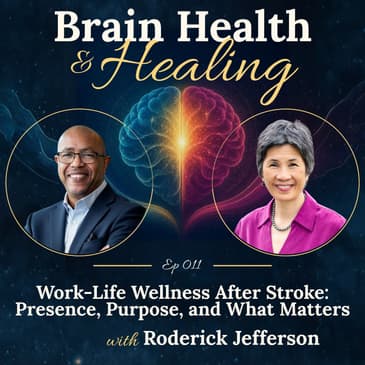
How can a stroke change the way you think about success, presence, and what matters most in your life?
Sandra Lee speaks with keynote speaker Roderick Jefferson about the experience that interrupted a demanding corporate career and invited him to reconsider what he had been working so hard to achieve. Roderick shares his personal experience of stroke, losing abilities he had once taken for granted, and gradually relearning aspects of speech and everyday movement.
Along the way, he reflects on the people who stayed beside him, the small things he began to notice differently, and the question that now shapes how he thinks about success: at what cost?
Their conversation moves beyond what happened medically to explore presence, family, purpose, self-care, and Roderick’s idea of replacing work-life balance with “work-life wellness.” His story also offers a reminder that adversity can sometimes invite us to notice priorities, relationships, and everyday moments in a new way.
As you listen, consider where your own pursuit of success may be inviting you to become more present with what already matters.
What You Are Invited to Discover:
- The hidden tension between achieving outward success and being truly present for the people who matter most
- A different way to consider “work-life balance” through Roderick’s idea of work-life wellness
- The role that repetition, relationships, and encouragement played in Roderick’s personal experience of relearning
- What may become visible when ordinary abilities and everyday moments can no longer be taken for granted
- An invitation to reconsider one powerful question about ambition and achievement: at what cost?
Free Gift: Chapter 1 from Roderick’s book - Stroke of Success
http://miracleinspirations.com/wp-content/uploads/2026/08/Stroke-of-Success-Chapter-1.pdf
About the Guest:
Roderick Jefferson is an internationally recognized business and transformational speaker. He has shared his dynamic and energetic voice in a variety of events, including keynotes, guest lectures, webinars, podcasts, and domain expertise panels, with companies such as the ATD Conference, B2BMX Conference, Cisco, Collibra, LinkedIn, MindTickle, Revasum, Oracle, Sales Assembly Conference, Sales 3.0 Conference, Sales Enablement PRO Conference, Salesforce (Dreamforce), SAP, Seismic, Showpad, SiriusDecisions, Uber, Zoom and others.
Roderick is also an acknowledged thought leader in the sales enablement space and the author of the Amazon bestselling book Sales Enablement 3.0: The Blueprint to Sales Enablement Excellence, Sales 3.0 Companion Workbook and Stroke of Success.
He has held various executive leadership, sales, sales enablement, operations, and customer experience roles at AT&T, Marketo, Oracle, Salesforce, and others.
When he’s not speaking or working on enablement projects and programs, he can be found perfecting the art of barbecuing or playing bocce in the backyard with his family.
Stroke of Success Book: https://www.roderickjefferson.com/stroke-of-success Sales 3.0 Book Link: https://roderickjefferson.com/book
Sales 3.0 Companion Workbook: https://roderickjefferson.com/companion-workbook-sales enablement-3-0
Keynote Speaker Highlight Reel: https://bit.ly/3zRVNJa
Social Media Channels: https://linktr.ee/roderickjefferson
YouTube: https://www.youtube.com/@roderickjeffersonassociates
Free eBooks:
- Onboarding & Everboarding - https://roderickjefferson.com/onboarding-and-everboarding
- Harnessing Collective Intelligence - https://roderickjefferson.com/harnessing-collective-intelligence-in-sales
Podcast Playlist (Spotify): http://bit.ly/4mHhSOv
Resources:
Share your Story with Sandra. Schedule a 10 minute call to share about your head injury, and how it has impacted your life - https://shinewithsandra.com/brainstory
Join Sandra Live on Facebook for Better Brain Briefs every Thursday at 8:00 a.m. Pacific, where you can ask questions and catch the replay for a limited time: https://www.facebook.com/SandraLeeInspiration/
Download your Free Audio Gift, Imagine What’s Possible, at https://shinewithsandra.com
Join the Brain Health & Healing Private Facebook Group - https://www.facebook.com/groups/brainhealthhealing
About the Host:
Sandra Lee has spent almost 40 years helping people feel and function better by addressing what standard treatment often misses: the unresolved trauma and emotional patterns stored in the body. She is the creator of The Spectrum of Anger™ and The Witnessed Body™, which integrates Intuitive Sound Healing and Combat Brain Training to support brain injury recovery, brain health, and dementia. Her work is grounded in the belief that symptoms are messages, not malfunctions, and that when those messages are finally received and released, the body can do what it already knows how to do.
Website -https://miracleinspirations.com
LinkedIn - https://www.linkedin.com/in/sandra-lee-701662250/
YouTube - https://www.youtube.com/@sandralee1miracleinspirations
Thanks for listening!
Thanks so much for listening to our podcast! If you enjoyed this episode and think that others could benefit from listening, please share it using the social media buttons on this page.
Do you have some feedback or questions about this episode? Leave a comment in the section below!
Subscribe to the podcast
If you would like to get automatic updates of new podcast episodes, you can follow the podcast on Apple Podcasts or your favorite podcast app.
Leave us an Apple Podcasts review
Ratings and reviews from our listeners are extremely valuable to us and greatly appreciated. They help our podcast rank higher on Apple Podcasts, which exposes our show to more awesome listeners like you. If you are enjoying the show, please leave us a review on Apple Podcasts.
Original theme music by Bradford Tilden.
Disclaimer: Everything you hear on this show is for educational and informational purposes only. It's not medical advice, and it doesn't diagnose or treat any condition. Please consult your medical practitioner before making health decisions.
Welcome to Brain Health and Healing. I'm Sandra
Sandra Lee:Lee. This show is for people living with head injuries and
Sandra Lee:the families and supporters who love them. If you are ready to
Sandra Lee:reclaim your life, identity, and dreams for the future, you are
Sandra Lee:in the right place. Welcome to Brain Health and Healing:
Sandra Lee:Receiving Adversity's Gifts. This guest today is the person
Sandra Lee:who inspired me to have the podcast be structured the way it
Sandra Lee:is, not just recovering from brain injury because he
Sandra Lee:certainly did that in a very powerful way, but the part about
Sandra Lee:receiving adversity's gifts, taking these things that happen
Sandra Lee:to us and turning them into part of the message, part of the
Sandra Lee:teaching, part of the contribution we make to others
Sandra Lee:in the world, and so my dear friend Roderick Jefferson is the
Sandra Lee:person who inspired that particular aspect of this
Sandra Lee:podcast. So he is a keynote speaker of note and has such a
Sandra Lee:powerful story to share about what happened that pulled him
Sandra Lee:from that into this journey of recovery that has then fueled
Sandra Lee:the work that he does now? So, Roderick, welcome to Brain
Sandra Lee:Health and Healing. Share a little bit more about your
Sandra Lee:journey with us,
Roderick Jefferson:Sandra. First of all, thank you so much.
Roderick Jefferson:I am truly honored and humbled and grateful to be a part of
Roderick Jefferson:your show, and to know that even in the smallest of amounts, I
Roderick Jefferson:was a part of the genesis of it beginning is completely humbling
Roderick Jefferson:to me. And especially knowing you're the way that I do, it
Roderick Jefferson:really means a lot coming from you. So thank you, and thanks
Roderick Jefferson:for the opportunity to kind of share my story, my best
Roderick Jefferson:practices. Mine started about 30 years ago, and I was starting
Roderick Jefferson:out in corporate America. I was dialing for dollars, as we used
Roderick Jefferson:to say, right? I started out in sales and did really well, and
Roderick Jefferson:got promoted to sales leader and got promoted from there up to
Roderick Jefferson:sales trainer, and from there it just took off. I've been blessed
Roderick Jefferson:to be a part of some of the best companies on the planet: Siebel,
Roderick Jefferson:Oracle, AT&T, eBay, etc. Now let's fast forward. I'm out
Roderick Jefferson:there, and I've now reached what I thought was the pinnacle. I
Roderick Jefferson:was a senior vice president. I had come up the ladder. I had
Roderick Jefferson:paid my dues. I'm now flying around in corporate helicopters,
Roderick Jefferson:corporate jets, enjoying times with folks like President Obama
Roderick Jefferson:and Queen of England. I have arrived, is what I thought, and
Roderick Jefferson:I had, but I also realized that. Let me step two steps back. When
Roderick Jefferson:I was the senior director, I felt like I was the most
Roderick Jefferson:empathetic and happiest that I'd ever been, and then I became an
Roderick Jefferson:executive, a true executive. Now it was long hours, long days. It
Roderick Jefferson:was emails at 10 o'clock. It was working on the weekends. It was
Roderick Jefferson:being in rooms with my family, but not really being present. It
Roderick Jefferson:meant, you know, in 18 months I was in London, Paris, Geneva,
Roderick Jefferson:Sao Paulo, Rio, Toronto, etc. And I remember I had been on the
Roderick Jefferson:road for about two weeks, and I came home, and I was talking to
Roderick Jefferson:my wife, and I said, "Babe, I have been in hotels for the last
Roderick Jefferson:two weeks. I just want a greasy taco, and my son comes over, and
Roderick Jefferson:he looked at me. He said, "Dad, no, Thursday shake and bake
Roderick Jefferson:night, and that was the moment that it realized that I had lost
Roderick Jefferson:and forgotten my why, which was always to provide and protect.
Roderick Jefferson:Now, what some may have heard was, "Okay, so it's shaking, big
Roderick Jefferson:night, big deal. What I heard was, "They have an entire life
Roderick Jefferson:without me that they've created an entire routine that I had
Roderick Jefferson:nothing to do with. I was a guy that was providing great salary,
Roderick Jefferson:lived in the right neighborhood, drove the right cars. Wife was a
Roderick Jefferson:stay-at-home mom. The kids went to school in the right
Roderick Jefferson:districts. All those things, but I was an absentee piece of my
Roderick Jefferson:own family, and I felt like I wasn't even a part of the
Roderick Jefferson:family. I was just a guy that was, you know. Direct deposit
Roderick Jefferson:every two weeks. That came home and got his dry cleaning and
Roderick Jefferson:flew out again. So fast forward again. I am down in LA getting
Roderick Jefferson:ready for a sales kickoff event. I'm out with my dinner, out to
Roderick Jefferson:dinner with my team. We're having a great time, but I felt
Roderick Jefferson:really tired and and and off. I was a high level athlete, not
Roderick Jefferson:the kind of tired where you've done double days or you've been
Roderick Jefferson:in the gym and now you're just worn out. This was a level of
Roderick Jefferson:tired I had never felt, but because I was so used to being
Roderick Jefferson:on that hamster wheel, I just kind of went, "Oh, it's no big
Roderick Jefferson:deal. I'm gonna go back to my room. I'm gonna get some sleep.
Roderick Jefferson:I'll probably check in on my presentation before tomorrow,
Roderick Jefferson:but it didn't feel like any day I'd ever felt. I was walking
Roderick Jefferson:back, and and my room was not very far from where we were
Roderick Jefferson:having dinner. I'm walking back, and I felt like I was stepping
Roderick Jefferson:in quicksand. I had to remind myself: lift your left leg, lift
Roderick Jefferson:your right leg, lift your left leg, and I knew something was
Roderick Jefferson:wrong, but I couldn't put my finger on it. So I went to
Roderick Jefferson:sleep, just like you know, every normal night.
Roderick Jefferson:The next morning, so my wife and I always connect over the phone
Roderick Jefferson:of you know what's happening at home, what's my day look like,
Roderick Jefferson:what's my agenda? What's going on with the kids? Kind of thing.
Roderick Jefferson:But today, what I heard sounded like what you hear right now.
Roderick Jefferson:What she heard sounded like gibberish, and I've been with
Roderick Jefferson:her for 30 plus years, so I could hear fear in her voice.
Roderick Jefferson:And I said, "What's wrong? She said, "I need you to say your
Roderick Jefferson:ABCs. I'm like, "Babe, I'm not going to say my ABCs. I think I
Roderick Jefferson:know that by now. She said, "Say your ABCs. I said, "Fine, ABL
Roderick Jefferson:XTQI. And now at this point, my mind is slowing down. She says,
Roderick Jefferson:"Count to 10: 1-220-775-9614, three. And she said, "Go on
Roderick Jefferson:FaceTime. I need to see your face. I said, "For what? She
Roderick Jefferson:said, "Because I think you've had a stroke, and I need to see
Roderick Jefferson:if your face is drooping. And at that time, now I got really
Roderick Jefferson:scared because, like with most people, you hear stroke. Oof,
Roderick Jefferson:that's the worst of worst. So fast forward, turns out I had
Roderick Jefferson:had a stroke while I was asleep. According to American Stroke
Roderick Jefferson:Society, 98% of sleep stroke victims never wake up. That's
Roderick Jefferson:miracle number one. I was awake. My team, my wife called one of
Roderick Jefferson:the directors on my team. He got me, rushed me off to the
Roderick Jefferson:emergency room. I'm in there. They're doing a whole bunch of
Roderick Jefferson:different tests. I'm completely out of it. They thought that I
Roderick Jefferson:was high and I was in there trying to get meds. Other than
Roderick Jefferson:the fact that I stuttered so bad I couldn't speak, but that's a
Roderick Jefferson:whole other story. 90 minutes later, they released me from the
Roderick Jefferson:hospital. I've been to the hospital where it's taken longer
Roderick Jefferson:than that to get to the triage nurse. More or less, something
Roderick Jefferson:as serious is what I was dealing with. But on top of that, that
Roderick Jefferson:was the day I was scheduled to fly back home. I go to the
Roderick Jefferson:airport. I fly home. I land in Oakland. I was in Los Angeles. I
Roderick Jefferson:land in Oakland. She rushes me off to the emergency room. They
Roderick Jefferson:push me in right away. First thing that the cardiologist and
Roderick Jefferson:the neurologist said to my wife, who normally, as we know,
Roderick Jefferson:doctors with their God complex, this was the opposite. She said
Roderick Jefferson:there was fear in their eyes, and the first thing they said to
Roderick Jefferson:her is, "Your husband is an absolute miracle, because
Roderick Jefferson:medically there's no reason he should be alive. He's gone
Roderick Jefferson:through a massive stroke, altitude, cabin pressure, and
Roderick Jefferson:then the drive here. Fast forward. I've been there now for
Roderick Jefferson:about 12 days. Suddenly, I'm and I'm getting worse now. At this
Roderick Jefferson:point, I'm for those that in in your audience that are skiers, I
Roderick Jefferson:went snow blind, so it wasn't dark; it was bright all the
Roderick Jefferson:time. So now I have no concept of days and nights. So my sleep
Roderick Jefferson:pattern's completely messed up. I can't swallow because the
Roderick Jefferson:muscles in my throat are atrophied because I'm not
Roderick Jefferson:talking because I can't speak now, and my entire left side is
Roderick Jefferson:paralyzed. Fast forward, and to mention, this was all five years
Roderick Jefferson:ago. So what was going on? You're right, COVID. So now
Roderick Jefferson:that's the last place that I want to be is in. Hospital with
Roderick Jefferson:a bunch of really really sick people, and I was in the IC with
Roderick Jefferson:the sick of the sickest. I know it was bad because I actually
Roderick Jefferson:lost two roommates. How did I tell? The voices on the other
Roderick Jefferson:side started to change, but those people didn't go home.
Roderick Jefferson:They never went home. You fill in the blank from there. So one
Roderick Jefferson:night, my wife is there, and she's leaving, and she's holding
Roderick Jefferson:my hand, squeezing it, and I could tell something's wrong.
Roderick Jefferson:She said, "I don't want to go home because I don't think I'll
Roderick Jefferson:ever see you alive again. Because at that point, they were
Roderick Jefferson:giving me a 2% chance to live. She went home that night, and
Roderick Jefferson:little did she know how prophetic she was. I'm laying in
Roderick Jefferson:the room, lights are flashing, machines are going crazy, and I
Roderick Jefferson:hear code blue. Code blue. It's my room. In comes the nurses and
Roderick Jefferson:doctors, and at that point, I went beep, and I'm flatlined.
Roderick Jefferson:I'm legally dead.
Roderick Jefferson:I feel my soul fly up out of my body, and I'm up in the corner
Roderick Jefferson:of the room. For those people that have this fascination with
Roderick Jefferson:near-death experiences, I did not see a white light, but I saw
Roderick Jefferson:the most vibrant blues and oranges and purples and yellows
Roderick Jefferson:that I've ever seen, and I wish I could say that was the only
Roderick Jefferson:thing I saw at that moment. But the next thing made me smile.
Roderick Jefferson:I'm floating up in the corner of the room. I'm looking down.
Roderick Jefferson:They're working on my body, pulling out fluids. They're
Roderick Jefferson:doing chest compression, and I look to my left, and it's my
Roderick Jefferson:mama. My mama died in 1999. I knew it wasn't a mirage. I know
Roderick Jefferson:my mom, and the first thing she said, I said, "Okay, mama, I've
Roderick Jefferson:done everything I can. Good and faithful servant. Let's go home,
Roderick Jefferson:she said. "No, baby, got two things to tell you. First and
Roderick Jefferson:foremost, if you would have listened to me, you wouldn't be
Roderick Jefferson:in this situation. You'd have to know my mom to understand. Even
Roderick Jefferson:at 55, it was not beyond her to chastise me because I'm still
Roderick Jefferson:her little boy in her mind. And the other thing she said is,
Roderick Jefferson:"They're going to figure out what's going on, and you're
Roderick Jefferson:going to be okay. But you're never going to have what you
Roderick Jefferson:consider to be normal again. And finally, she said, "My job, and
Roderick Jefferson:I have a whole new life on on on my existence and why I'm still
Roderick Jefferson:here. And I'll give you a teaser. You got to read the read
Roderick Jefferson:the book to understand the rest of it. She said, "Get to know
Roderick Jefferson:the invisible people. I said, "Invisible people? You mean like
Roderick Jefferson:go? She said, "No, like the people that check you in in the
Roderick Jefferson:hotel, the waiters and waitresses, the people in
Roderick Jefferson:everyday life in the grocery store that just looks like they
Roderick Jefferson:could use a smile. So it's my job to walk away to walk around
Roderick Jefferson:with an extra smile in my pocket every day, and hand out at least
Roderick Jefferson:one every single day.
Sandra Lee:Every time I hear that story, I love that part.
Sandra Lee:So, talk to us about what recovery was like.
Roderick Jefferson:Rough because losing
Sandra Lee:losing the ability to speak and how you got it all
Sandra Lee:back.
Roderick Jefferson:Yeah, I didn't just lose my ability to
Roderick Jefferson:speak. First of all, I realized that God has a sense of humor
Roderick Jefferson:because I'm a professional keynote speaker. I get paid to
Roderick Jefferson:talk. My stroke was in the middle of my speech center. I
Roderick Jefferson:was also-I wouldn't say I was fluid, but I was certainly
Roderick Jefferson:conversational in Spanish. No longer, it's gone. So now I've
Roderick Jefferson:got to figure out how to put all of these natural movements. I'll
Roderick Jefferson:say whether it was how to walk, how to tie my shoe, how to do a
Roderick Jefferson:button, how to use a regular spoon. The interesting thing for
Roderick Jefferson:me is, although I had aphasia, which was stuttering really,
Roderick Jefferson:really bad, and my singing is even worse. I'll tell you that
Roderick Jefferson:first. If I sang, I didn't have a stutter, so that let me know
Roderick Jefferson:that it's in there. It's just locked in. The way that my
Roderick Jefferson:neurologist explains it, I love his analogy of rerouting the
Roderick Jefferson:brain. He said, "Imagine you've got a bunch of tabs open on the
Roderick Jefferson:internet, and one of them is playing music, but you can't
Roderick Jefferson:figure out which tab it is. So you got to go." Through all
Roderick Jefferson:these different tabs, and that's what I was doing with speech
Roderick Jefferson:therapy, occupational therapy, physical therapy. I had a
Roderick Jefferson:love-hate relationship with the alphabet. Yes, the the the the
Roderick Jefferson:regular alphabet, because I had to say them over and over all
Roderick Jefferson:day. Then I progressed from there to word games. You know,
Roderick Jefferson:flip the cards over. One is a turtle. One is an elephant.
Roderick Jefferson:You've got to remember what these are. As much as I hated
Roderick Jefferson:it, it certainly helped me because now what I'm doing is
Roderick Jefferson:I'm re-setting and find a new recircuit and a new path inside
Roderick Jefferson:of my brain. And the more that I started, it's like any other
Roderick Jefferson:muscle-you don't use it, you lose it. It atrophies, and with
Roderick Jefferson:the brain, it's different. It's not the go to the gym, and we've
Roderick Jefferson:all heard no pain, no gain. No, no, you don't do that with your
Roderick Jefferson:brain. What I realized was I tired a lot easier. I became a
Roderick Jefferson:lot more frustrating to be around and to be frustrated.
Roderick Jefferson:Also, because the speech center sits next to the emotional
Roderick Jefferson:center and my brain was swelling, it overlapped. I would
Roderick Jefferson:say I had a stroke and I would just break out into tears for
Roderick Jefferson:absolutely no reason at all. So I went back to being that four
Roderick Jefferson:year four year old kid again, and I kept asking the same
Roderick Jefferson:question over and over. But why? But why? But why? Not but why to
Roderick Jefferson:God of why I had it, but why can't I find what I know is
Roderick Jefferson:still in my brain? And again, my neurologist in, and I absolutely
Roderick Jefferson:love him. His answer was this: It's still in there. You just
Roderick Jefferson:have to take a different path to get there. Says, remember when
Roderick Jefferson:you were a kid and you would walk home from school and you
Roderick Jefferson:knew that path, and you probably dredged a ditch back and forth
Roderick Jefferson:between your your house and your school. Now I had to go all the
Roderick Jefferson:way around the block, a different angle, down the
Roderick Jefferson:street, round the corner, to get back to what was easier. But I
Roderick Jefferson:also realized a couple of things. One, I had an amazing
Roderick Jefferson:support group around me in my family, in my friends. They
Roderick Jefferson:would get me out. They would walk with me. They would talk to
Roderick Jefferson:me. Friends like Tim Carlson, and I say this every time. Thank
Roderick Jefferson:you, Tim. I'm alive today because of you. Thank you for
Roderick Jefferson:rushing me to the emergency. To John Barrows, who called me
Roderick Jefferson:without fail every single day for a year, even when I couldn't
Roderick Jefferson:talk and all I could do was grunt? He talked to me.
Roderick Jefferson:He held both sides of the conversation until I started to
Roderick Jefferson:talk to him, Keith Wolerich, for checking on me every single day,
Roderick Jefferson:and Tager Hartswatner for not only checking on me, but sending
Roderick Jefferson:meals out to help out my family as well, so my wife could just
Roderick Jefferson:focus on taking care of me and getting me back. The other thing
Roderick Jefferson:I noticed and learned, Sandra, was just how far my bathroom is
Roderick Jefferson:from the couch when I couldn't walk. But it's in the into the
Roderick Jefferson:refrigerator, it's all the small things that matter, and we we
Roderick Jefferson:take them for granted. I take no breath that I take throughout a
Roderick Jefferson:day for granted anymore.
Sandra Lee:As a keynote speaker, you listened to
Sandra Lee:yourself, your recordings.
Roderick Jefferson:That I did talk about. I had that
Roderick Jefferson:advantage, right? Because I had so many things on YouTube and
Roderick Jefferson:out there in the ethos. I used to listen to me talk over and
Roderick Jefferson:over and over because what I was doing was resetting my brain,
Roderick Jefferson:but I was also figuring out my pace, my speech pattern, my
Roderick Jefferson:intonation, and I would listen to the same things over and over
Roderick Jefferson:and over. My wife's like, "You probably have 60 of these. Can
Roderick Jefferson:you listen to something different than these two? And I
Roderick Jefferson:did. I spread it out. Before you know it, I started to get the
Roderick Jefferson:vibrato, to get the bass back to my voice, I started to get the
Roderick Jefferson:intonation. I started to get my own speech pattern back again,
Roderick Jefferson:and I remember the time I went in to see my speech therapist,
Roderick Jefferson:and she had only heard me stutter now for months, and I
Roderick Jefferson:walked in, and she said, "How are you feeling today? And I
Roderick Jefferson:would normally just nod, and I said, "I actually feel pretty
Roderick Jefferson:good. I thought she was gonna fall off of her chair. She
Roderick Jefferson:literally burst into tears because I think a part of it was
Roderick Jefferson:first a lot of prayers, a lot of hard work, but at the same time,
Roderick Jefferson:I'm an old athlete. I refuse. To let this win, and I was not
Roderick Jefferson:going to lose to it, and I had too many people counting on me
Roderick Jefferson:to get back. I never once Sandra asked God why me. I always asked
Roderick Jefferson:two things, and two things only. One, please allow me to wake up
Roderick Jefferson:tomorrow, because it wasn't guaranteed. We all say tomorrow
Roderick Jefferson:is not promised. I'm a guy that didn't have it tomorrow, and the
Roderick Jefferson:other thing I would ask over and over is, is this a lesson for
Roderick Jefferson:me, or is this a testimony for others to figure out how to go
Roderick Jefferson:through what may be the worst part of your life and keep
Roderick Jefferson:fighting?
Sandra Lee:Ah, what a powerful story about what it takes to to
Sandra Lee:get it back, to build it again, and there are a lot of practical
Sandra Lee:tips within that. I like to leave the audience with
Sandra Lee:practical things that they can apply to their life. So you kind
Sandra Lee:of went into some there at the end. What do you want the
Sandra Lee:audience to take away to remember, so that they can have
Sandra Lee:it make a difference in their life?
Roderick Jefferson:I've got three things. First and
Roderick Jefferson:foremost, I want you to start focusing on no longer thinking
Roderick Jefferson:about work-life balance, it's a fallacy. I want you to focus on
Roderick Jefferson:work-life wellness every single day. What does that actually
Roderick Jefferson:mean? What I do now is I actually put blocks into my
Roderick Jefferson:calendar so that I can get a brain reset. I go outside. I get
Roderick Jefferson:fresh air. I move around. I don't sit in this office all
Roderick Jefferson:day. The other thing is, every single morning, I've got a
Roderick Jefferson:whiteboard right here in front of me. After I do my morning
Roderick Jefferson:routine, my my stretch, my prayer, etc. I come and I write
Roderick Jefferson:four things on my whiteboard every single day. Three things
Roderick Jefferson:professionally that I'm going to do today before I walk away from
Roderick Jefferson:my laptop, and one thing just for me. Some days it's go sit
Roderick Jefferson:out in the backyard and enjoy nature and listen to the birds
Roderick Jefferson:and watch the hummingbirds fly around. Some days it's you know
Roderick Jefferson:what I'm gonna take the dog for a long walk because I just want
Roderick Jefferson:some fresh air. Some days it's barbecue and bask of robins, but
Roderick Jefferson:it's just for me. The other thing is, never ever ever forget
Roderick Jefferson:your why. Look, I'm still a plus plus ish, probably more ADD HD
Roderick Jefferson:now these days. But what I am focused on right now is being
Roderick Jefferson:present. You can be in the same room with people and still not
Roderick Jefferson:be present. There's nothing wrong with being successful.
Roderick Jefferson:Strive for it, push for it. But as you're doing it, I wish
Roderick Jefferson:someone would have told me and asked me this one question I'm
Roderick Jefferson:about to ask you and your audience: At what cost? What are
Roderick Jefferson:you willing to give up? For some, that push for success has
Roderick Jefferson:cost them their family, their relationships, significant
Roderick Jefferson:others. In my case, it cost me my life. So there has to be
Roderick Jefferson:balance in all things. Let's go the old adage of too much of
Roderick Jefferson:anything is a bad thing. Look, I love apple pie. I don't want it
Roderick Jefferson:every day, and the same goes in life. Life is about balance, and
Roderick Jefferson:it's about work, life, wellness. Ah, thank
Sandra Lee:you for that. So this is like in the beginning,
Sandra Lee:you had everything,
Roderick Jefferson:had
Sandra Lee:all the success that you wanted-that so many people
Sandra Lee:are going for that-that big business success, the position,
Sandra Lee:you know, being well known-and then it was all gone. And part
Sandra Lee:of what you now realize is what was more important is being with
Sandra Lee:the people, being with yourself, and having that quality of life.
Roderick Jefferson:What I realized, what was really
Roderick Jefferson:important, and things that money couldn't buy: faith, family,
Roderick Jefferson:friends, and fun. That's my four Fs.
Sandra Lee:I love that. So, you and the audience, write that
Sandra Lee:down. These are gems, right? These are the practical things
Sandra Lee:that make life matter that you take away from this talk today.
Sandra Lee:So, you took the things that you learned through this whole
Sandra Lee:experience, and then you turned that into part of the
Sandra Lee:contribution. You make to the world
Roderick Jefferson:that I did. I actually wrote a book, and I'm
Roderick Jefferson:blessed to say that my book is now become a bestseller. Xander,
Roderick Jefferson:yay!
Roderick Jefferson:And the book is called Stroke of Success. And so, I want to do
Roderick Jefferson:something just for your audience and for your listeners. I'm
Roderick Jefferson:going to share a free chapter that kind of leads up to the
Roderick Jefferson:story that I'm telling now. And by the way, that's one of
Roderick Jefferson:multiple stories in the book, right? But this is one of the
Roderick Jefferson:stories that leads up to how I wound up having the stroke that
Roderick Jefferson:day-not just a stroke, but the stroke that day. And I say not
Roderick Jefferson:just a because this was actually my second stroke. I didn't even
Roderick Jefferson:realize I had a first one. According to American Stroke
Roderick Jefferson:Society, one out of every four people over the age of 25 will
Roderick Jefferson:incur some form of a stroke. It may have felt like you were
Roderick Jefferson:tired. It may have felt like you were a little dizzy or off
Roderick Jefferson:balance. Don't negate those things. Go and get yourself
Roderick Jefferson:checked. Because had I and I was the the quintessential
Roderick Jefferson:executive, hard headed, thought I knew it all. Had I not
Roderick Jefferson:actually gone to the doctor that to the emergency that room?
Roderick Jefferson:Excuse me, emergency room that day. I would have never been
Roderick Jefferson:here. People think that self care is selfish. Yes, it is, and
Roderick Jefferson:it should be. Synonymous. Focus on self care and be selfish
Roderick Jefferson:about it.
Sandra Lee:Thank you for that powerful message. So there will
Sandra Lee:be a link in the show notes for how to get that chapter, and
Sandra Lee:then tell people how they can connect with you.
Roderick Jefferson:Absolutely. So if you are trying to connect
Roderick Jefferson:with me, I always say that if you can't find me on social
Roderick Jefferson:media, you're not really looking, right? And I'll give
Roderick Jefferson:you all of my links. But all you have to remember is my name,
Roderick Jefferson:Roderick Jefferson. If you want to go get the book,
Roderick Jefferson:it@roderickjefferson.com's. My YouTube is Roderick Jefferson.
Roderick Jefferson:My Instagram is Roderick Jefferson. My LinkedIn is
Roderick Jefferson:Roderick Jefferson. Remember, I had a stroke. I gotta have
Roderick Jefferson:something that I can remember and make it easy and simple for
Roderick Jefferson:myself.
Sandra Lee:So, think about the future that you imagine, like
Sandra Lee:the the ideal future for the world. What will you see
Sandra Lee:yourself doing in that future?
Roderick Jefferson:I see myself doing what I'm starting to do
Roderick Jefferson:right now, which is getting the word out about this situation,
Roderick Jefferson:helping people to find that work life wellness, enjoying time
Roderick Jefferson:with my amazing family and my cute little two and a half year
Roderick Jefferson:old granddaughter, and I'm still gonna be out there, handing out
Roderick Jefferson:a smile to somebody every day.
Sandra Lee:I love that last message. I'm going to have that
Sandra Lee:be the last thing you that people leave with. Thank you so
Sandra Lee:much, Roderick, for being here for our brain health and
Sandra Lee:healing. It has been an honor and a pleasure being with you.
Sandra Lee:Thank you, audience, for being here with us for this story, and
Sandra Lee:look forward to seeing you again next time.
Roderick Jefferson:Thank you.
Sandra Lee:Oh, I love that conversation with Roderick. To
Sandra Lee:be able to get through all of that to rebuild everything that
Sandra Lee:he had, because it was gone, and to start over, and giving that
Sandra Lee:that model of what happens when you lose these fundamental
Sandra Lee:functions and how you have to relearn them again, like one
Sandra Lee:synapse, one nerve connection at a time. So have him tell that
Sandra Lee:story, and to give him lots of practical strategies for us to
Sandra Lee:do every day to remember what really matters: the
Sandra Lee:relationships and the quality time to just be yourself, to
Sandra Lee:spend that time. So write those gems down, and remember to put
Sandra Lee:them into your life. If you want to go to the Brain Health and
Sandra Lee:Healing Facebook group, then say what you got out of this
Sandra Lee:episode. If you or someone you know has experienced a head
Sandra Lee:injury yourself, accidents, strokes, falls, or focus issues
Sandra Lee:or memory clarity issues, and you want to talk? Tell me your
Sandra Lee:story. I invite you to a 10-minute free share your story
Sandra Lee:call. This isn't a sales call. It's an opportunity. To just
Sandra Lee:like share your experience with me, I know a common experience
Sandra Lee:that people have when they have brain injuries is they don't
Sandra Lee:feel like people see them, they don't feel like people
Sandra Lee:understand them. So you get to have that experience of being
Sandra Lee:heard. And if you decide you want to talk with me about
Sandra Lee:working together, then we can schedule a time after that. So
Sandra Lee:go to sharewithsandra.com forward slash brain story. There
Sandra Lee:is a link in the show notes, and if you want to understand about
Sandra Lee:the messages that the body is trying to give you through your
Sandra Lee:symptoms, then get the Imagine What's Possible audio gift. Go
Sandra Lee:to sharewithsandra.com forward slash imagine. Your brain heals
Sandra Lee:itself every day of your life. Imagine what's possible.